
North America 5G Device Market Size and Share
Market Overview
| Study Period | 2020 - 2031 |
|---|---|
| Forecast Data Period | 2026 - 2031 |
| Base Year Market Size (2025) | 0.82 Billion units |
| Market Volume (2026) | 0.97 Billion units |
| Market Volume (2031) | 1.78 Billion units |
| Growth Rate (2026 - 2031) | 12.91 % |
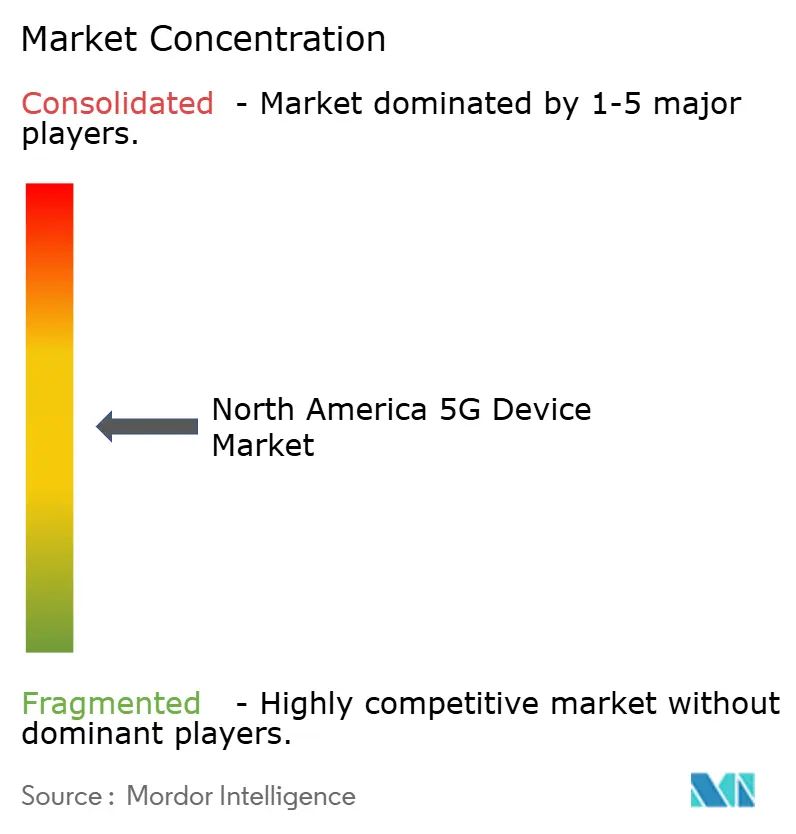
| Market Concentration | Medium |
Major Players *Disclaimer: Major Players sorted in no particular order Image © Mordor Intelligence. Reuse requires attribution under CC BY 4.0. | |
North America 5G Device Market Analysis by Mordor Intelligence
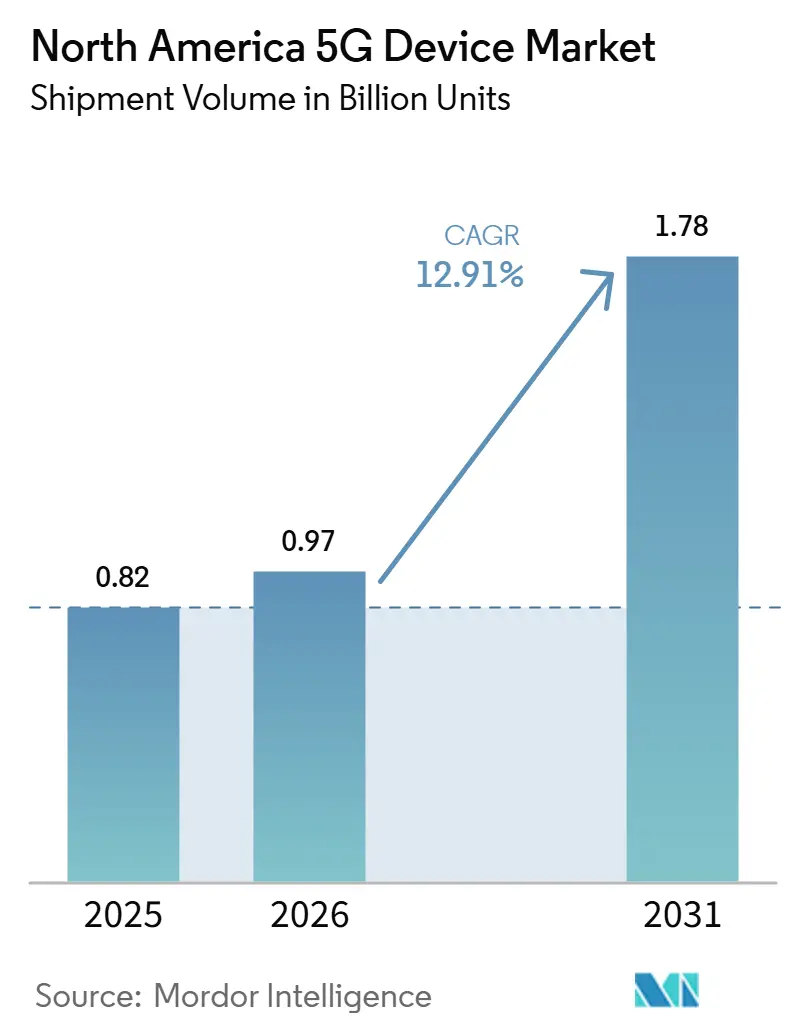
The North America 5G Device Market size in terms of shipment volume is expected to increase from 0.82 billion units in 2025 to 0.97 billion units in 2026 and reach 1.78 billion units by 2031, growing at a CAGR of 12.91% over 2026-2031. The North America 5G device market is moving beyond its first smartphone-led adoption phase as fixed wireless access, private networks, connected vehicles, and connected wearables add new sources of demand. Carrier subsidies lower the upfront cost of premium handsets and encourage consumers to replace older devices earlier. Fixed wireless access creates a recurring need for updated customer-premises equipment, while private networks add demand for rugged routers, gateways, and cellular modules. Regulatory requirements for C-V2X equipment and industrial spectrum programs give automotive and industrial procurement a clearer timetable. Device pricing, uneven coverage outside cities, and certification requirements still limit adoption in price-sensitive and rural settings.
Key Report Takeaways
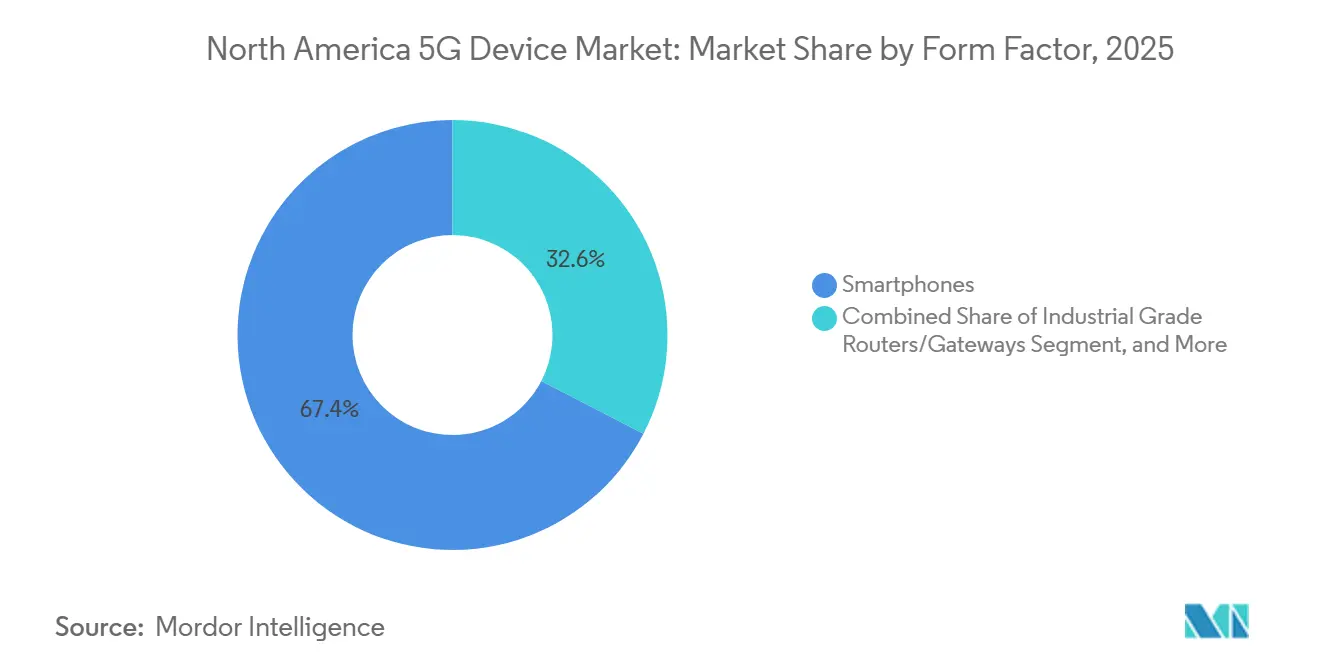
- By form factor, smartphones held 67.40% of the North America 5G device volume share in 2025, while wearables and XR devices are projected to expand at a 14.35% CAGR through 2031.
- By spectrum support, sub-6 GHz devices held 61.85% of the North America 5G device volume share in 2025, while hybrid (sub-6 GHz and mmWave) devices are projected to expand at a 14.80% CAGR through 2031.
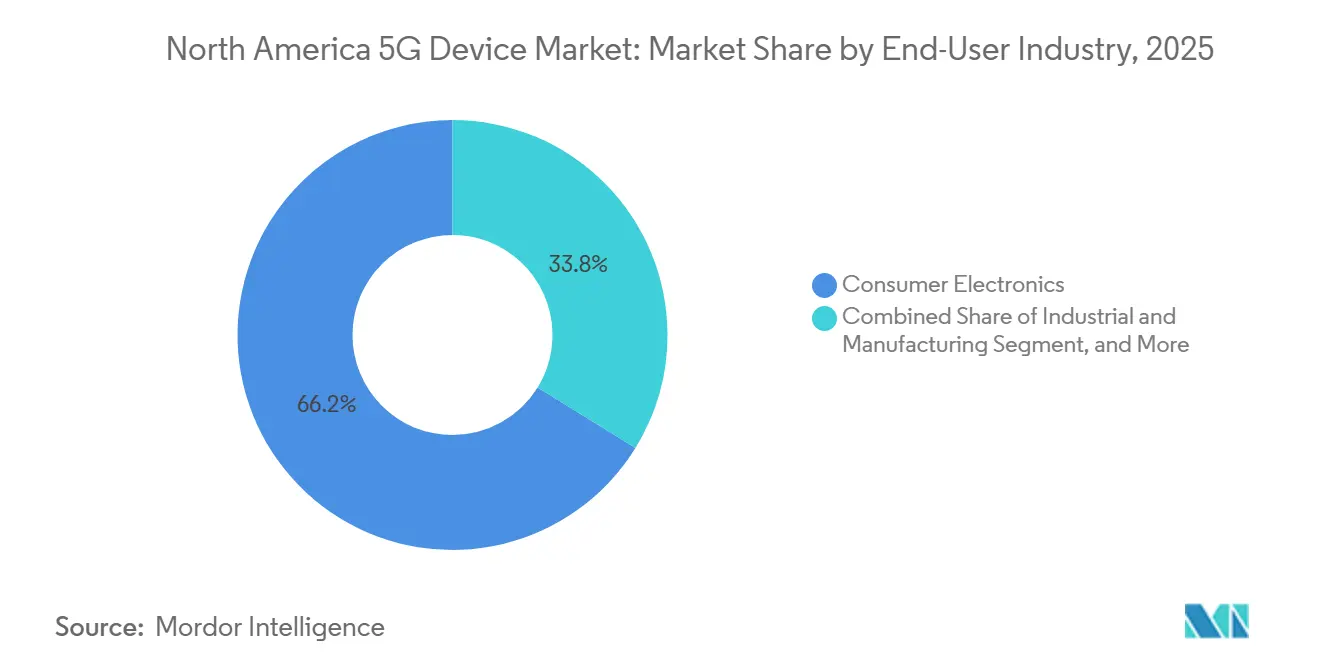
- By end-user industry, consumer electronics held 66.20% of the North America 5G device volume share in 2025, while the automotive and transportation segment is projected to expand at a 14.60% CAGR through 2031.
- By application, enhanced mobile broadband (eMBB) accounted for 57.30% of the North America 5G device volume share in 2025, while vehicle-to-everything (V2X) is projected to expand at a 15.25% CAGR through 2031.
- By country, the United States held 83.60% of the North America 5G device volume share in 2025, while Mexico is projected to expand at a 14.20% CAGR through 2031.
Note: Market size and forecast figures in this report are generated using Mordor Intelligence’s proprietary estimation framework, updated with the latest available data and insights as of January 2026.
Market Trends and Insights
Drivers Impact Analysis of North America 5G Device Market*
| Driver | (~) % Impact on CAGR Forecast | Geographic Relevance | Impact Timeline |
|---|---|---|---|
| Carrier Bundling of 5G Smartphones and Premium Plans | +3.2% | United States and Canada | Short term (≤ 2 years) |
| Enterprise Fixed Wireless Access Device Replacement Cycles | +2.5% | United States and Canada | Short term (≤ 2 years) |
| Private 5G Network Rollouts in Manufacturing and Logistics | +2.1% | United States, with early adoption in Canada | Medium term (2-4 years) |
| IoT-Enabled Device Convergence Across Consumer and Industrial Use Cases | +1.8% | Global, with North America leading commercial deployment | Medium term (2-4 years) |
| RedCap and Low-Power 5G Device Adoption | +1.1% | United States, with spillover to Canada | Medium term (2-4 years) |
| mmWave Coverage Expansion in Dense Urban Hotspots | +0.8% | Major United States metropolitan areas | Long term (≥ 4 years) |
| Source: Mordor Intelligence | |||
Carrier Bundling of 5G Smartphones and Premium Plans
Competition among the three national U.S. carriers has made device subsidies a central lever for 5G upgrades in the North America 5G device market. T-Mobile introduced Galaxy S26 offers tied to its Experience Beyond plan in February 2026, and Verizon offered Galaxy Z Fold8 and iPhone 17 Pro bundles through its Simplicity Plan in July 2026. These offers made flagship devices available with no effective upfront payment for eligible new-line customers. They also tied customers to 36-month billing commitments on plans priced from USD 80 to USD 100 per line each month. The resulting service revenue supports network densification and continued device incentives, which shortens replacement cycles beyond normal handset aging. Verizon also combined smartphones, watches, and tablets in add-a-line promotions, bringing more wearables and tablets into carrier-led purchases.
Enterprise Fixed Wireless Access Device Replacement Cycles
Enterprise fixed wireless access is changing customer-premises equipment replacement from an occasional purchase into a planned infrastructure cycle in the North America 5G device market. Ericsson reported in April 2026 that all surveyed North American service providers offered fixed wireless access and that 89% used 5G as the delivery layer.[1]Ericsson, “Fixed Wireless Access Outlook,” Ericsson Mobility Report, ericsson.com The report cited 35 million global customer-premises equipment shipments in 2025, 26% higher than the prior year, and stated that 57% of shipments were 5G-capable. Managed WAN contracts and software-defined networking agreements commonly tie gateways to 3-5-year refresh cycles, which is shorter than the 7-10-year life often associated with traditional enterprise routers. Ericsson announced the Cradlepoint X20 5G Router in February 2025 and made it available from April 2025 with network slicing and multi-operator prioritization features. PTCRB and GCF certification requirements can add 3-6 months to the path to commercial readiness, favoring established suppliers that already hold multi-operator approvals.
Private 5G Network Rollouts in Manufacturing and Logistics
Private 5G programs are progressing from individual trials to multi-site industrial infrastructure programs in the North America 5G device market. Cargill expanded its NTT DATA private 5G footprint from 20 U.S. test sites to 50 live global deployments within 6 months after its first site went live in March 2025.[2]NTT DATA and Cargill, “Cargill Modernizes Manufacturing Operations with NTT DATA’s Private 5G Network,” Business Wire, businesswire.com The expansion supports demand for rugged routers, gateways, and certified industrial modules across production and processing locations. Cargill reported a 70% reduction in cabling and setup costs against comparable Wi-Fi infrastructure, and 1 private 5G access point covered an area comparable to 9 Wi-Fi access points. That deployment model can increase the number of cellular devices used at a site as operations add robotics, automation, and digital workflows. Mexico’s planned industrial spectrum tender identified automotive smart factories, connected vehicles, and quality-control systems as intended applications, supporting procurement in major automotive corridors. The North America 5G device market, therefore, gains demand from projects where connectivity is part of production infrastructure rather than a discretionary information-technology upgrade.
IoT-Enabled Device Convergence Across Consumer and Industrial Use Cases
Consumer wearables and industrial IoT endpoints increasingly use similar 5G module architectures in the North America 5G device market. Cellular smartwatches, continuous glucose monitors, and safety wearables use modem platforms that also support industrial sensors, cameras, and asset trackers. This common architecture gives chipset and module suppliers a larger addressable production base while reducing the need for distinct connectivity designs. T-Mobile introduced 5G RedCap features for wearables during its 2025 network expansion, recognizing the need for lower-power service tiers beyond smartphones. Ericsson, T-Mobile, and Qualcomm began extended-reality trials on T-Mobile’s San Diego 5G standalone commercial network in March 2025, including distributed spatial computing and low-latency on-device AI capabilities. Qualcomm and Samsung expanded Snapdragon support across intelligent eyewear and smartwatches in July 2026, giving 5G connectivity a broader role in wearable form factors.[3]Qualcomm, “Qualcomm and Samsung Expand Collaboration With Snapdragon Powering the New Galaxy Lineup Across Smartphones, Watches, and Intelligent Eyewear,” Qualcomm, qualcomm.com
Restraints Impact Analysis of North America 5G Device Market*
| Restraint | (~) % Impact on CAGR Forecast | Geographic Relevance | Impact Timeline |
|---|---|---|---|
| High Device ASPs Versus 4G Alternatives | -2.1% | United States prepaid market, Mexico, and rural Canada | Short term (≤ 2 years) |
| Carrier Spectrum and Coverage Gaps Outside Major Urban Corridors | -1.7% | Rural United States, Canada, and Mexico outside major metropolitan areas | Short term (≤ 2 years) |
| Fragmented Certification and Interoperability Requirements | -0.9% | North America, including PTCRB and GCF compliance across the United States and Canada | Medium term (2-4 years) |
| Slower Enterprise Refresh Cycles for Routers and Modules | -0.7% | United States and Canada enterprise and industrial segments | Medium term (2-4 years) |
| Source: Mordor Intelligence | |||
High Device ASPs Versus 4G Alternatives
Average selling prices for 5G-capable devices remain above those for comparable 4G products across most form factors in the North America 5G device market. Carrier subsidies can cover the upfront cost for premium postpaid customers, but prepaid subscribers often pay the full price difference. This issue is especially relevant in Mexico and in budget-focused U.S. customer groups. Higher import-related costs in 2025 added price pressure to mid-range smartphones, limiting unit demand where 5G features did not justify a higher purchase price. In modules and IoT equipment, enterprise buyers may delay replacement when 4G LTE products meet operational needs at a 30-40% lower unit cost. The restraint is expected to ease as lower-power 5G chipsets move closer to LTE Cat-1 pricing, but cost remains a material near-term barrier to device replacement.
Carrier Spectrum and Coverage Gaps Outside Major Urban Corridors
5G coverage produces a two-speed device environment across the North America 5G device market. Dense cities have competing mid-band and mmWave networks, while exurban, rural, and border areas often rely on limited 5G coverage or LTE. Telcel reported 5G coverage for 60% of Mexico’s population across 125 cities at the end of 2025, showing the gap between major urban areas and other parts of the country. AT&T, T-Mobile, and Verizon announced in 2026 plans for a joint venture to address wireless dead zones, including in rural areas. The initiative may broaden the addressable base over time, but it does not remove the immediate coverage constraint on device purchases in underserved corridors.
*Our forecasts treat driver/restraint impacts as directional, not additive. The impact forecasts reflect baseline growth, mix effects, and variable interactions.
North America 5G Device Market Segment Analysis
By Form Factor:
Smartphones Anchor Volume While Wearables and XR Devices Lead GrowthSmartphones held 67.40% of the North America 5G device market share in 2025 and remained the main consumer volume base. Apple’s premium iPhone 17 range supported postpaid upgrade activity during 2025 through carrier promotions. Samsung’s Galaxy A-series supported prepaid-tier demand, while the Galaxy S26 Ultra renewed interest in premium Android devices after its early 2026 launch. Motorola recorded unit-shipment growth among the top 5 vendors through carrier shelf placement in the sub-USD 400 range, where Apple and Samsung have limited direct competition. Smartphones will remain central to the North America 5G device market because carrier subsidies continue to bring premium models into routine replacement decisions.
Wearables and XR devices are projected to grow at a 14.35% CAGR through 2031, the fastest rate among form factors. Early 2026 FDA guidance reduced regulatory barriers for lower-risk health-tracking wearables, while enterprise use includes augmented-reality training, field service, and remote diagnostics. Qualcomm and Samsung expanded the Snapdragon platform into intelligent eyewear and smartwatches in July 2026, embedding 5G across product categories beyond handsets. Customer-premises equipment, industrial routers and gateways, modules, laptops and tablets, and hotspots form the middle of the volume stack. These categories benefit from parallel demand from fixed wireless access, private networks, and enterprise mobile broadband.



By Spectrum Support:
Hybrid Devices Define the Premium Frontier While Sub-6 GHz Anchors CoverageHybrid Sub-6 GHz and mmWave devices are projected to grow at a 14.80% CAGR from 2026 to 2031. The growth shows that premium smartphone, enterprise router, and fixed wireless access gateway buyers increasingly expect both broad-area coverage and high-throughput capability. The performance advantage of mmWave in dense urban locations supports a premium for hybrid modems in these deployments.
Sub-6 GHz devices accounted for 61.85% of volume in 2025 and will remain the foundation of coverage during the forecast period. Mid-band 5G supports the widest usable coverage across the United States, Canada, and Mexico. Apple’s reported approach for iPhone 18 Pro variants, using Qualcomm modems in the United States for mmWave compatibility, shows the importance of mmWave in the North American premium tier. T-Mobile, Nokia, and Qualcomm demonstrated 4.3 Gbps downlink speeds using 6-carrier aggregation with a Samsung Galaxy S25 and Snapdragon X80, and a secondary test with a Snapdragon X85 device reached 6.3 Gbps. Standalone mmWave devices will remain specialized because signals are usually usable within 900 meters of a transmission site. Network density constraints outside large metropolitan areas also limit their contribution to volume.
By End-User Industry:
Consumer Electronics Leads While Automotive and Transportation Scales on a Defined TimetableConsumer electronics accounted for 66.20% of industry-level device volume in 2025, driven by smartphone replacements, connected home customer-premises equipment, and health and wellness wearables. Industrial and manufacturing demand is also expanding as private 5G sites require factory routers, endpoint modules, and safety monitoring equipment. Private network deployments have reported lower downtime and have moved procurement discussions beyond pilot budgets. Healthcare, energy, and utilities are adding diagnostic wearables, remote patient-monitoring devices, point-of-care tablets, connected sensors, and smart-grid endpoints using 5G modules. These varied requirements keep consumer electronics dominant while extending device demand into operational settings.
The automotive and transportation industry is projected to grow at a 14.60% CAGR from 2026 to 2031. The FCC’s 5.9 GHz Second Report and Order required the transition from DSRC to C-V2X, and DSRC roadside-unit operations will sunset on December 14, 2026. This deadline requires fleet operators, state transportation departments, and automotive manufacturers to replace legacy on-board units and roadside equipment. Atlanta became the first U.S. Day One Deployment District for C-V2X in September 2025, providing a permanent city deployment reference. General Motors committed USD 1 billion for Mexican manufacturing in 2026 and 2027, while Verizon expanded its Frontline Network Slice to compatible devices for first responders nationwide.
By Application:
eMBB Commands Volume While V2X Leads GrowthVehicle-to-everything (V2X) is projected to grow at a 15.25% CAGR from 2026 to 2031 and is the fastest-growing application in the North America 5G device market. Regulatory requirements create a defined need for C-V2X hardware, rather than relying solely on voluntary adoption. Verizon Business launched its Edge Transportation Exchange platform in June 2025 with Volkswagen Group of America, the Arizona Commerce Authority, Delaware DOT, and Rutgers University CAIT among its first commercial users. Aptiv and Wind River presented a mobile-network V2X proof of concept in March 2026 that enabled vehicles from different manufacturers to share sensor data via standardized APIs, reducing the need for separate hardware validation for each manufacturer relationship.
Enhanced mobile broadband accounted for 57.30% of application-level device volume in 2025. Video streaming, gaming, and cloud synchronization remain the primary reasons most device owners use 5G connectivity. Fixed wireless access is the second-largest and fastest-maturing application outside V2X, with T-Mobile ending 2025 with 8.5 million fixed wireless access connections and AT&T adding 292,000 net connections in the first quarter of 2026. Massive machine-type communications is expanding as 5G RedCap and eRedCap modules replace LTE Cat-1 connectivity in IoT deployments. Ultra-reliable, low-latency communications remain specialized for remote surgery, autonomous industrial robotics, and critical public-safety applications because certification, device populations, and reliability specifications limit the use of general-purpose hardware.
Geography Analysis
United States 5G Device Market
The United States held 83.60% of regional device volume in 2025. Three-carrier competition and device subsidies made 5G smartphones accessible across a wide range of income groups. AT&T completed nationwide 5G standalone deployment in 2025 and expanded its mid-band footprint using 3.45 GHz spectrum. Enterprise demand also comes from factory private networks and public infrastructure programs that support industrial digitalization. The FCC's DSRC roadside operations deadline establishes a defined demand period for C-V2X devices before the end of 2026.
Canada 5G Device Market
A more consolidated carrier structure and later mmWave spectrum timing constrain Canadian demand for mmWave-focused devices in the near term. Bell’s 5G Plus Advanced network operated in the Greater Toronto and Hamilton Area and expanded toward the Niagara region in 2026. This expansion supports higher-throughput Sub-6 GHz devices in the country’s most populous corridors. Canadian wholesale smartphone value is expected to move toward the upper end of the CAD 12 billion (USD 8.8 billion) to CAD 14 billion (USD 10.3 billion) range in 2026. Enterprise IoT and private 5G remain in early industrial deployment, with automotive and aerospace supply-chain links to the United States supporting demand for compatible industrial modules.
Mexico 5G Device Market
Mexico is projected to grow at a 14.20% CAGR through 2031, the fastest rate among the three country markets. Its lower adoption base and Telcel’s 5G coverage of 60% of the population across 125 cities at the end of 2025 leave room for consumer and industrial device adoption as coverage expands. Automotive smart factories, connected vehicles, and advanced quality-control systems are central to industrial use, while General Motors committed USD 1 billion to Mexican manufacturing in 2026 and 2027, and LG Innotek committed MXN 3.5 billion (approximately USD 190 million) to a Querétaro electronics plant. Mexico City, Monterrey, and Guadalajara were priority 5G acceleration locations ahead of the 2026 FIFA World Cup, supporting network densification and related device investment.
Competitive Landscape
The North America 5G device market is moderately concentrated in smartphones and fragmented in industrial and enterprise equipment. Apple and Samsung lead smartphone shipments through carrier-channel reach and ecosystem loyalty, while no company has a meaningful cross-segment position. Ericsson’s Cradlepoint business combines device hardware, software, and connectivity management through NetCloud. The X20 5G Router and R2400 vehicle router integrate 5G standalone support, dual-SIM failover, Wi-Fi 7, and edge AI in managed offerings. This strategy competes with carrier-branded customer-premises equipment and third-party enterprise routers, while Qualcomm completed its acquisition of V2X specialist Autotalks in 2025 to secure intellectual property before C-V2X ecosystems consolidate around silicon reference designs.
The strongest opening for smaller suppliers lies in rugged tablets, connected safety wearables, precision-agriculture modules, and Mexico’s developing enterprise ecosystem. Fibocom and Telit Cinterion compete for enterprise business with RedCap and eRedCap platforms that require multi-operator certification. Their ability to qualify products during a 3-6-month certification window can give them an advantage over larger competitors that move more slowly. Qualcomm’s Snapdragon 8 Elite Gen 5 powered Samsung’s Galaxy Z Fold8 Ultra in July 2026 and combined advanced radio capabilities with on-device AI processing. This move differentiates premium devices through local AI performance and connectivity, reinforcing Qualcomm’s role across the premium smartphone ecosystem.
Verizon established its 6G Innovation Forum in June 2026 with Ericsson, Nokia, Samsung, Meta, and Qualcomm to address future use cases, devices, and network architectures. Existing 5G partnerships can make it harder for new suppliers to displace established technical relationships. The North America 5G device market remains open to specialists because enterprise buyers require different device types and carrier certifications. Competition remains strongest within individual device categories, where carrier relationships, certification readiness, and software management capabilities are important.
North America 5G Device Industry Leaders
Apple Inc.
Samsung Electronics Co., Ltd.
Qualcomm Incorporated
Cisco Systems, Inc.
Nokia Corporation
- *Disclaimer: Major Players sorted in no particular order
North America 5G Device Market Companies Covered in this Report
- Apple Inc.
- Samsung Electronics Co., Ltd.
- Qualcomm Incorporated
- Cisco Systems, Inc.
- Nokia Corporation
- Telefonaktiebolaget LM Ericsson
- T-Mobile US, Inc.
- Verizon Communications Inc.
- AT&T Inc.
- Motorola Mobility LLC
- Netgear, Inc.
- Cradlepoint, Inc.
- Sierra Wireless, Inc.
- Digi International Inc.
- Quectel Wireless Solutions Inc.
- Intel Corporation
- MediaTek Inc.
- Fibocom Wireless Inc.
- Telit Cinterion (Telit IoT Solutions Holding Ltd.)
- Inseego Corp.

Recent Industry Developments in North America 5G Device Market
- July 2026: Qualcomm and Samsung expanded their Snapdragon ecosystem collaboration at Samsung Unpacked, with Snapdragon 8 Elite Gen 5 powering the Galaxy Z Fold8 Ultra, Galaxy Z Fold8, and Galaxy Z Flip8, Snapdragon Wear Elite powering the Galaxy Watch9 and Watch Ultra2, and Snapdragon AR1 Gen 1 enabling Samsung’s new intelligent eyewear alongside Android XR. This extension of Snapdragon silicon into wearable and augmented-reality form factors marked a material expansion of 5G-connected device categories beyond smartphones.
- July 2026: Samsung and Verizon announced pre-order availability for the Galaxy Z Fold8 and Z Fold8 Ultra beginning July 22, 2026. Verizon offered the Galaxy Z Fold8, 256 GB, from USD 60 per month for 48 months on its Simplicity Plan, plus bundled promotions with the Galaxy Watch9 and Galaxy Tab S10 FE. The offer extended carrier multi-device bundling into foldable and wearable 5G form factors.
- April 2026: Verizon expanded its Frontline Network Slice nationwide to compatible laptops, tablets, and smartphones. The service provided dedicated 5G Ultra Wideband network resources for first responders supporting mission-critical applications, drone feeds, and mobile command centers. Verizon reported USD 138.2 billion in 2025 revenue, underscoring the carrier's scale, supporting the rollout.


North America 5G Device Market Report Scope
The North America 5G device market volume is measured by the annual shipment of 5G devices (in units), including smartphones, customer-premises equipment, routers, gateways, modules, laptops, tablets, hotspots, and wearables, across sub-6 GHz, mmWave, and hybrid spectrum configurations for applications such as enhanced mobile broadband (eMBB), ultra-reliable low-latency communications (URLLC), massive machine-type communications (mMTC), fixed wireless access (FWA), and vehicle-to-everything (V2X).
The North America 5G device market report is segmented by form factor (smartphones, customer-premises equipment (indoor/outdoor), industrial grade routers/gateways, modules, laptops/tablets, hotspots, and wearables and XR devices), spectrum support (sub-6 GHz, mmWave, and hybrid (sub-6 GHz and mmWave)), end user industry (consumer electronics, industrial and manufacturing, automotive and transportation, healthcare, energy and utilities, and enterprise/commercial), application (enhanced mobile broadband (eMBB), ultra-reliable low-latency comms (URLLC), massive machine-type comms (mMTC), fixed wireless access, and vehicle-to-everything (V2X)), and country (United States, Canada, and Mexico). The market forecasts are provided in terms of volume (units).
| Smartphones |
| Customer-Premises Equipment (Indoor/Outdoor) |
| Industrial Grade Routers/Gateways |
| Modules |
| Laptops/Tablets |
| Hotspots |
| Wearables and XR Devices |
| Sub-6 GHz |
| mmWave |
| Hybrid (Sub-6 GHz and mmWave) |
| Consumer Electronics |
| Industrial and Manufacturing |
| Automotive and Transportation |
| Healthcare |
| Energy and Utilities |
| Enterprise/Commercial |
| Enhanced Mobile Broadband (eMBB) |
| Ultra-Reliable Low-Latency Comms (URLLC) |
| Massive Machine-Type Comms (mMTC) |
| Fixed Wireless Access |
| Vehicle-to-Everything (V2X) |
| United States |
| Canada |
| Mexico |
| By Form Factor | Smartphones |
| Customer-Premises Equipment (Indoor/Outdoor) | |
| Industrial Grade Routers/Gateways | |
| Modules | |
| Laptops/Tablets | |
| Hotspots | |
| Wearables and XR Devices | |
| By Spectrum Support | Sub-6 GHz |
| mmWave | |
| Hybrid (Sub-6 GHz and mmWave) | |
| By End User Industry | Consumer Electronics |
| Industrial and Manufacturing | |
| Automotive and Transportation | |
| Healthcare | |
| Energy and Utilities | |
| Enterprise/Commercial | |
| By Application | Enhanced Mobile Broadband (eMBB) |
| Ultra-Reliable Low-Latency Comms (URLLC) | |
| Massive Machine-Type Comms (mMTC) | |
| Fixed Wireless Access | |
| Vehicle-to-Everything (V2X) | |
| By Country | United States |
| Canada | |
| Mexico |


Key Questions Answered in the Report
What is the North America 5G device market size?
The North America 5G device market recorded 0.82 billion units in 2025, is projected at 0.97 billion units in 2026, and is forecast to reach 1.78 billion units by 2031 at a 12.91% CAGR.
Which device category leads 5G adoption in North America?
Smartphones led with 67.40% of volume in 2025, supported by carrier promotions and established consumer replacement cycles.
Which 5G device category is expected to grow fastest?
Wearables and XR devices are projected to grow at a 14.35% CAGR through 2031 as health, enterprise XR, and connected-device use cases expand.
Why is fixed wireless access important for device demand?
Fixed wireless access requires customer-premises equipment, and managed service agreements can create regular 3-5-year refresh cycles for gateways.
How is C-V2X affecting connected-vehicle equipment demand?
The December 14, 2026 DSRC sunset requires operators and manufacturers to transition relevant roadside and on-board equipment to C-V2X technology.
Which country is expected to grow fastest through 2031?
Mexico is projected to grow at a 14.20% CAGR through 2031, supported by broader urban coverage and industrial demand from automotive corridors.
Page last updated on:





