
Nootkatone Market Size and Share
Market Overview
| Study Period | 2022 - 2032 |
|---|---|
| Market Size (2027) | USD 21.27 Million |
| Market Size (2032) | USD 23.85 Million |
| Growth Rate (2027 - 2032) | 12.11 % |
| Fastest Growing Market | Asia-Pacific |
| Largest Market | North America |
| Market Concentration | Medium |
Major Players *Disclaimer: Major Players sorted in no particular order Image © Mordor Intelligence. Reuse requires attribution under CC BY 4.0. | |
Nootkatone Market Analysis by Mordor Intelligence
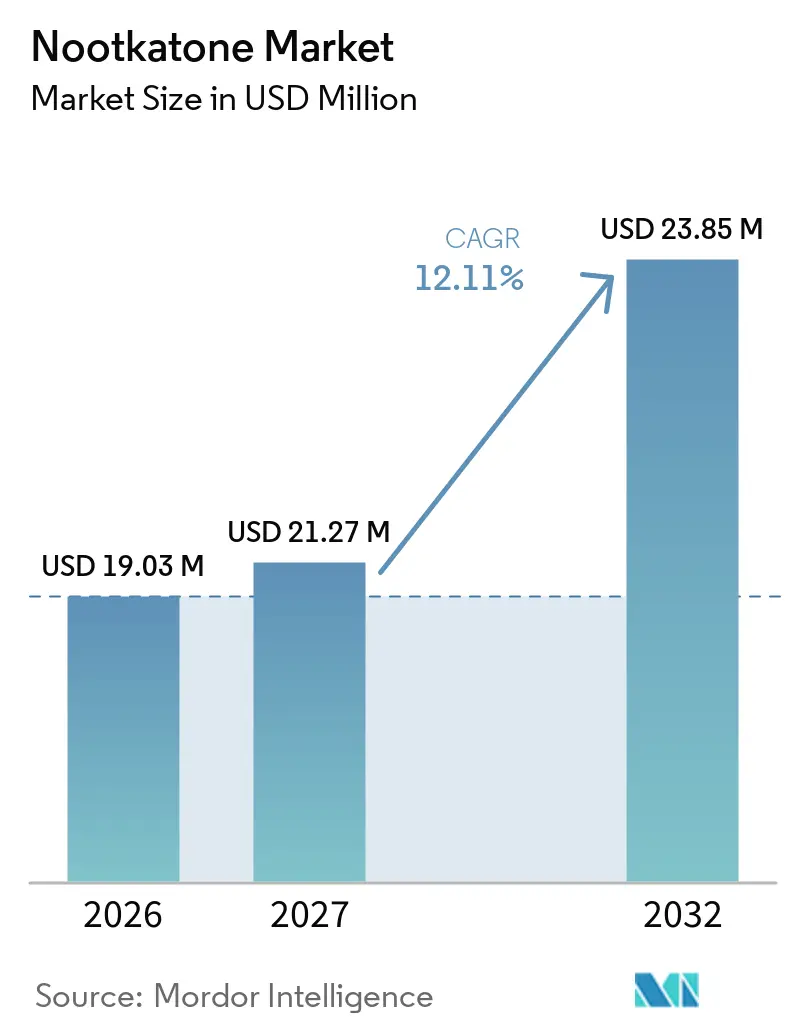
The Nootkatone Market size was valued at USD 19.03 million in 2026 and is estimated to grow from USD 21.27 million in 2027 to reach USD 23.85 million by 2032, at a CAGR of 12.11% during the forecast period (2027-2032). The nootkatone market is moving beyond its established role as a grapefruit flavor and fragrance ingredient because registered pest-control uses are creating another source of demand. Food and personal care formulators continue to value natural positioning, while the United States Environmental Protection Agency (EPA) registration supports product development in repellents. Precision fermentation gives producers a steadier supply base than citrus extraction and reduces exposure to crop cycles. The decline in Florida grapefruit production also strengthens the case for non-extractive supply, while pyrethroid resistance supports interest in products with a different insect-control mechanism. Competition in the nootkatone market is strongest among suppliers that can combine fermentation capacity, product purity, regulatory documentation, and application support.
Key Report Takeaways
- By form, liquids held 65.78% of the nootkatone market share in 2026, while crystals are forecast to advance at a 12.87% CAGR through 2032.
- By source, natural held 71.13% of the nootkatone market share in 2026, while synthetic is forecast to advance at a 12.71% CAGR through 2032.
- By application, flavors and fragrances held 44.56% of the nootkatone market share in 2026, while insect repellent and insecticide are forecast to advance at a 13.43% CAGR through 2032.
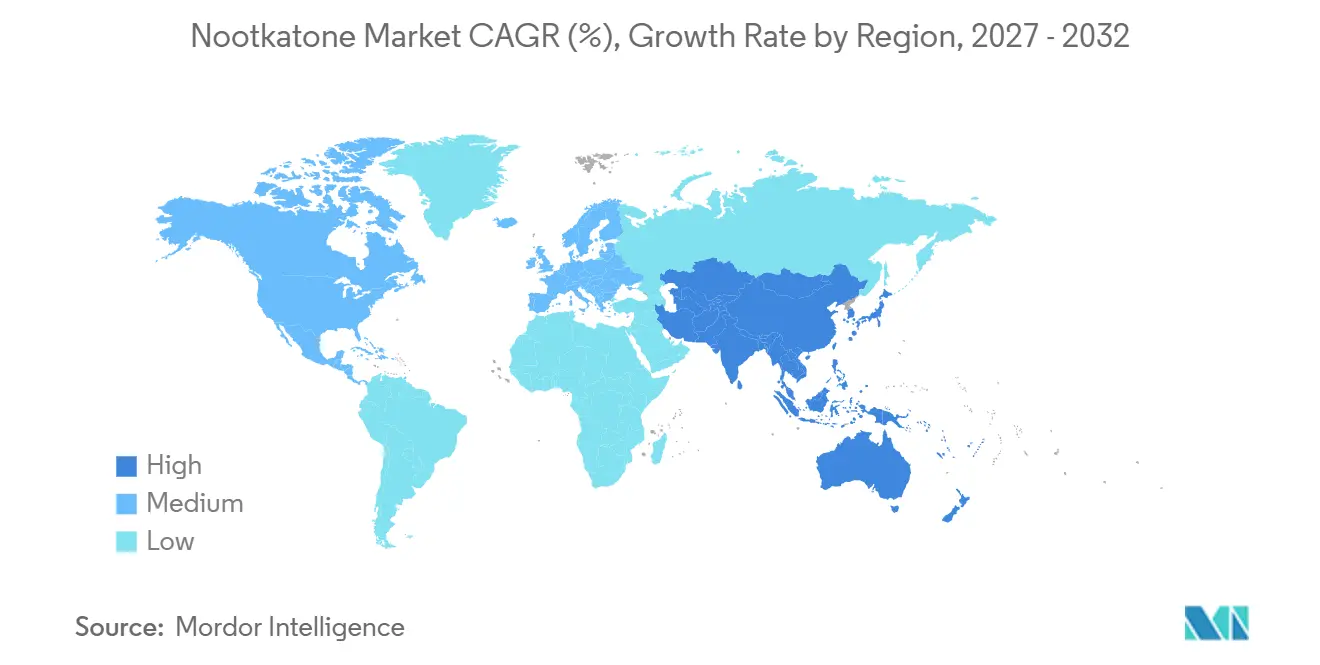
- By geography, North America held 40.45% of the nootkatone market share in 2026, while Asia-Pacific is forecast to advance at a 12.32% CAGR through 2032.
Note: Market numbers in this report are based on Mordor Intelligence's proprietary estimation framework, which combines nine months of actuals with Q4 projections for base year 2026.
Global Nootkatone Market Trends and Insights
Drivers Impact Analysis*
| Driver | (~) % Impact on CAGR Forecast | Geographic Relevance | Impact Timeline |
|---|---|---|---|
| Clean-Label and Bio-Based Ingredient Substitution | +2.9% | Global; highest intensity in North America & EU | Medium term (2-4 years) |
| EPA Registration Expanding Repellent Addressability | +2.6% | North America core, spillover to APAC & LATAM via WHO frameworks | Short term (≤2 years) |
| Precision Fermentation Stabilizing Year-Round Supply | +2.1% | Global | Medium term (2-4 years) |
| Resistance-Management Demand for a Distinct Arthropod Mode of Action | +1.4% | Global; high urgency in tropical APAC and Sub-Saharan Africa | Long term (≥4 years) |
| Citrus-Crop Volatility Increasing the Value of Non-Extractive Supply | +1.0% | North America & Europe predominantly | Short term (≤2 years) |
| Source: Mordor Intelligence | |||
Clean-Label and Bio-Based Ingredient Substitution
Demand for ingredients from natural sources is raising the importance of nootkatone in the nootkatone market for food, fragrance, and personal care formulations. Regulation (EC) No. 1334/2008 sets conditions for using the term natural for flavoring substances in the European Union. Fermentation-derived material can meet this standard when it is made through qualifying biological processes. Lallemand Inc. launched Natural Nootkatone in 85% liquid and 98% crystalline formats in December 2025, with natural certification for the European Union and the United States. The availability of both forms reduces the labeling work needed for products sold across several regions. Compliance with Flavor and Extract Manufacturers Association Generally Recognized as Safe designation No. 3166 and International Fragrance Association requirements also supports use in beverage, dairy, savory, and fragrance products.
EPA Registration Expanding Repellent Addressability
The Environmental Protection Agency registered nootkatone as a biopesticide in 2020 under the Federal Insecticide, Fungicide, and Rodenticide Act[1]. The registration allows companies to develop eligible repellent and insecticide products, subject to product-level review. Research in Current Biology found that nootkatone combines chemosensory repellency with positive allosteric modulation of the insect gamma-aminobutyric acid-gated chloride channel. The study reported a 4.8-fold leftward shift in the gamma-aminobutyric acid concentration-response curve at 100 μM. Field evaluation of 10% NootkaSHIELD formulations reported 78.5% to 80.8% knockdown and residual control against nymphal Ixodes scapularis and Amblyomma americanum ticks. The nootkatone market could favor suppliers with reviewed active ingredients if requirements for competing botanical repellents become more demanding.
Precision Fermentation Stabilizing Year-Round Supply
Precision fermentation is changing how the nootkatone market is supplied because production can be planned without waiting for a citrus harvest. A 2025 study reported a maximum nootkatone titer of 6.5 g/L in a 5 L fed-batch Saccharomyces cerevisiae bioreactor. The process used engineered pathway genes and reduced valencene accumulation to 29.3 mg/L. Higher yields can help producers align supply with fermentation capacity rather than seasonal fruit availability. Lallemand Inc. offers products with Kosher and Halal certification, which supports access for nootkatone market buyers in the Middle East and Southeast Asia. Givaudan’s BioNootkatone uses a non-genetically modified sugar feedstock through Manus Bio’s BioAssemblyLine platform.
Resistance-Management Demand for a Distinct Arthropod Mode of Action
A 2025 review documented pyrethroid resistance across Aedes aegypti populations and described target-site mutations, cytochrome P450 detoxification, and behavioral avoidance as important mechanisms. Nootkatone has a mode of action distinct from organophosphates, neonicotinoids, and pyrethroids. This distinction gives the nootkatone market a role in rotation programs where resistance management is important. A 2025 field study reported 93.7% mean repellency against Amblyomma sculptum nymphs at 5% nootkatone concentration. The same study found that nootkatone with eugenol maintained more than 85% repellency after 2 hours under field conditions. Livestock and veterinary uses remain less developed, although a 2025 review identified botanically derived compounds as priorities for acaricide-resistance work.
Restraints Impact Analysis*
| Restraint | (~) % Impact on CAGR Forecast | Geographic Relevance | Impact Timeline |
|---|---|---|---|
| High Cost of High-Purity Nootkatone | -2.2% | Global; disproportionate in price-sensitive APAC & LATAM | Medium term (2-4 years) |
| Product-by-Product Pesticide Registration Burden | -1.4% | North America, EU (BPR framework) | Long term (≥4 years) |
| Limited Field-Performance Data Across Climate and Formulation Conditions | -0.9% | Tropical APAC, Sub-Saharan Africa, LATAM | Long term (≥4 years) |
| Source: Mordor Intelligence | |||
High Cost of High-Purity Nootkatone
High-purity nootkatone can be difficult to use in price-sensitive household insecticides and entry-level personal care products. Fermentation requires bioreactor assets, purification, and quality certification, which add cost at smaller volumes than bulk synthetic fragrance chemicals. A 2025 field study identified cost as a practical barrier to commercial nootkatone repellent formulations, despite favorable efficacy evidence. Some formulators may choose lower-purity valencene-enriched material for selected fragrance uses, which could weaken the premium positioning of high-purity products. Givaudan announced a CHF 55 million investment in its Campus 52 natural ingredients center in Grasse in February 2026.
Product-by-Product Pesticide Registration Burden
Commercial end-use products containing nootkatone require individual review under the Federal Insecticide, Fungicide, and Rodenticide Act. Applications must address efficacy, safety, and product characterization. In the European Union, the Biocidal Products Regulation requires separate product authorization for repellents under product type 19 and insecticides under product type 18[2]. These requirements can delay new products and reduce the immediate demand signal to fermentation suppliers. Larger companies can spread documentation costs over several product lines, whereas smaller regional formulators may face higher costs per product. The nootkatone market may therefore develop faster among multinational suppliers with established regulatory teams.
*Our forecasts treat driver/restraint impacts as directional, not additive. The impact forecasts reflect baseline growth, mix effects, and variable interactions.
Segment Analysis
By Form: Liquids Lead, While Crystals Accelerate
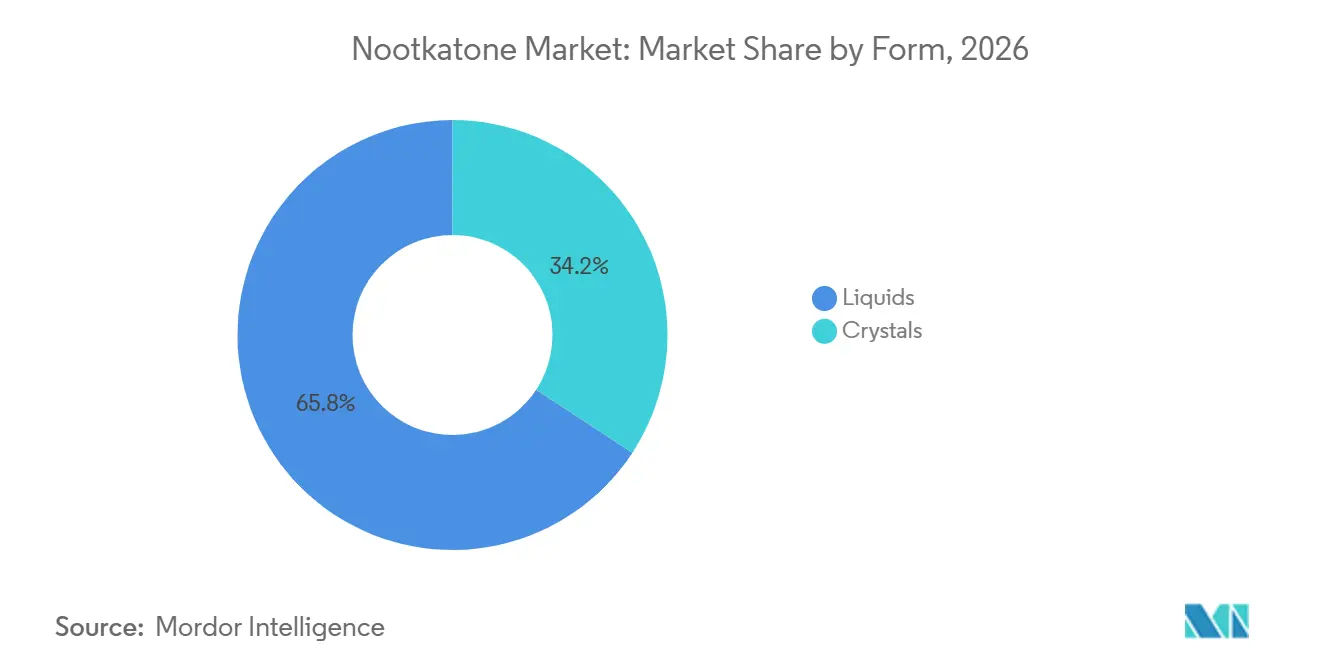
Liquids held 65.78% of the market share in 2026 because they fit conventional liquid flavor and fragrance compounding operations. Liquid material also has a cost advantage in bulk beverage applications, where use levels of 0.3-2.0 ppm are standard. Its compatibility with carrier solvents and its phase behavior support blending by fragrance houses. These practical properties make liquids important for large-volume beverage and fragrance programs. The format is also readily integrated into existing handling systems, reducing charges for buyers.
Crystals are projected to advance at a 12.87% CAGR through 2032 within the nootkatone market size. Demand is linked to purity requirements of at least 98% in fine fragrance, pharmaceutical-grade repellent products, and cosmetic ingredient submissions under Regulation (EC) No. 1223/2009. Lallemand Inc. launched 98% crystalline Natural Nootkatone in late 2025 with European Union and United States natural certification. The launch reduces the former trade-off between purity and natural labeling. As clean-label cosmetic brands broaden their active ingredient portfolios, crystals are set to grow faster than liquids.
By Source: Synthetic Gaining Ground on Registration and Purity Credentials
The natural segment held 71.13% of the market share in 2026. Its position reflects labeling benefits in flavor and fragrance uses under the European Union and United States frameworks. Fermentation has expanded the availability of material classified as natural beyond the limits of citrus extraction. This larger supply base supports the established position of natural material. The segment also benefits from a price premium in applications where ingredient origin is visible to consumers.
The synthetic segment is projected to advance at a 12.71% CAGR through 2032. Growth is associated with insecticide formulation and vector-control research, where a natural label is not required. Research groups and vector-control programs need confirmed-identity reference standards for registration dossiers and dose-response testing. A 2025 patent application described oxidoreductase variants that increased fermentation yield 9.6-fold compared with wild type. The development gives the nootkatone market a continued scope to narrow performance differences between biological and synthetic production routes.
By Application: Insect Repellent Disrupting a Flavors-Dominated Market
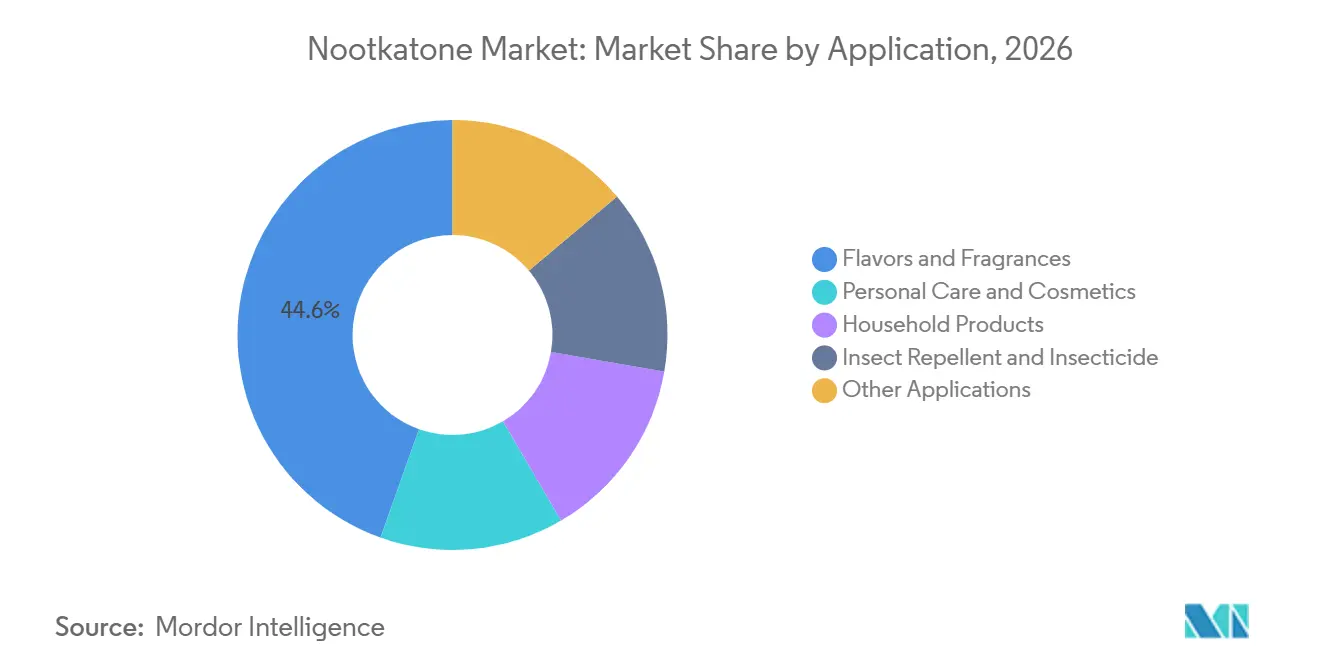
Flavors and fragrances held 44.56% of the market share in 2026. Nootkatone provides a recognizable grapefruit note in beverages, perfumery, and personal care products. Personal care and cosmetics also use it as a functional fragrance ingredient in moisturizers, hair care, and skin products. Household products use its biocidal properties in surface sprays and diffuser systems. Pharmaceutical research and crop-protection uses remain at an early stage, with published literature examining their antiplatelet and anti-inflammatory activities.
Insect repellent and insecticide are projected to advance at a 13.43% CAGR through 2032 in the nootkatone market. Environmental Protection Agency registration and field evidence support this pace of development. Formulators can use nootkatone in multi-benefit personal care products because it combines protection with a grapefruit scent. This differentiates it from diethyltoluamide, whose odor can limit consumer appeal. The application gives producers another route to build demand beyond flavor and fragrance customers.

Geography Analysis
North America held 40.45% of the market share in 2026. The United States is a major source of demand for natural-certified flavor ingredients and is the main jurisdiction with an active nootkatone biopesticide registration under the Federal Insecticide, Fungicide, and Rodenticide Act. Beverage, craft spirit, and soft-drink makers support flavor-grade consumption through their use of grapefruit notes. The Centers for Disease Control and Prevention (CDC) licenses nootkatone technology to Lallemand Inc. for the NootkaSHIELD platform. Canada and Mexico add flavor-grade demand, including demand related to Mexico’s processed food and beverage exports.
Europe contributes meaningful demand in the nootkatone market size through its preference for bio-based active ingredients and flavorings. Regulation (EC) No. 1334/2008 and the Biocidal Products Regulation support the relevance of fermentation-derived material in food and pest-control applications. Germany, France, and the United Kingdom are important demand centers, and French luxury fragrance houses create a premium channel for high-purity material. The European Green Deal’s interest in biological alternatives strengthens the positioning of bio-based active ingredients over the forecast period.
Asia-Pacific is projected to advance at a 12.32% CAGR through 2032. China’s food and beverage sector is adopting more natural flavor ingredients, while India and the Association of Southeast Asian Nations markets are increasing demand for natural repellents. China’s GB 2760 standard, revised for February 2025 implementation, governs food additive use and supports the use of nootkatone as a flavoring in beverages. India has an essential oil and terpene processing base that can support valencene oxidation routes. South America has demand potential because of Aedes aegypti-borne dengue and Zika, while Brazil’s approval pathway may delay near-term product launches, and Middle East and Africa demand is emerging, where Kosher and Halal certification supports entry into Gulf Cooperation Council markets.
Competitive Landscape
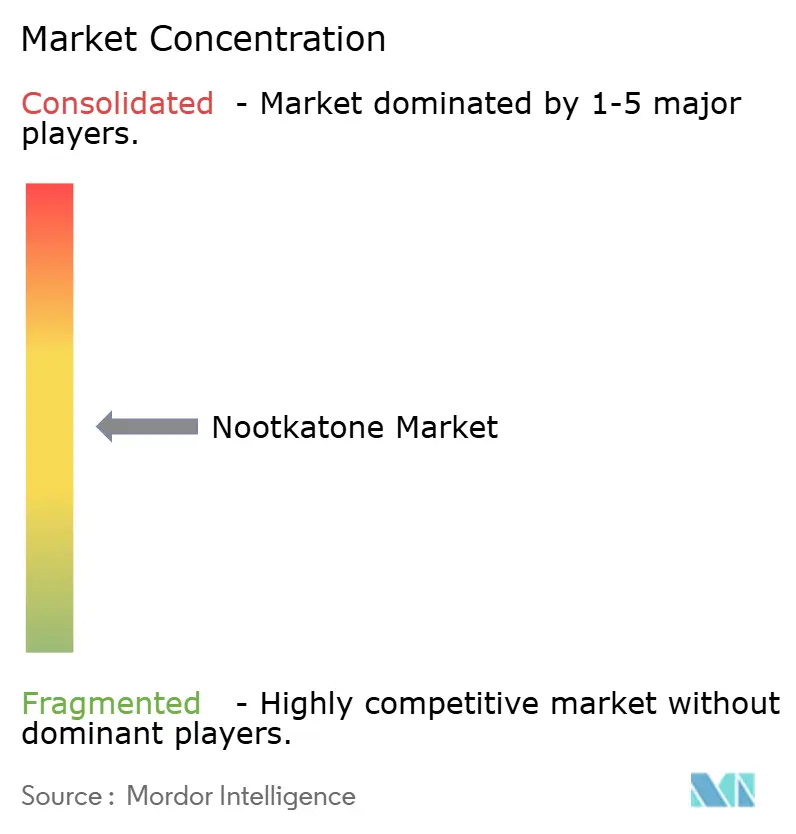
The nootkatone market is moderately concentrated, with the top five players including Symrise, Isobionics, International Flavors & Fragrances Inc., Givaudan, and Lallemand Inc. A 2025 patent application covering oxidoreductase variants reported a 9.6-fold increase in biosynthesis yield compared with wild type. This intellectual property can protect production improvements and raise entry barriers, while Isobionics offers Nootkatone 98 as a high-purity grapefruit-odor ingredient.
Givaudan announced its CHF 55 million (approximately USD 71.5 million) Campus 52 investment in Grasse in February 2026. The facility will bring together agronomy, extraction innovation, production operations, and perfumer collaboration. Givaudan also inaugurated its White Biotechnology Innovation Centre in Toulouse in 2025 to support fermentation and biocatalysis development. Lallemand Inc.’s December 2025 launch of liquid and crystalline natural nootkatone provided a commercial option across different purity requirements. These actions show that capacity, format choice, and product-development support are key competitive tools in the nootkatone market.
Vigon International, LLC and Penta Fine Ingredients, Inc. connect producers with regional formulators that do not purchase directly at scale. MANE SA, Robertet SA, and MOELLHAUSEN S.P.A. use nootkatone in formulation portfolios and can provide customized citrus ingredient combinations. Chinese fine chemical manufacturers are adding synthetic-route supply in Asia-Pacific, increasing price pressure on synthetic grades, while natural-certified fermentation remains the more defensible premium position for Western producers. Registration under the Registration, Evaluation, Authorisation and Restriction of Chemicals (REACH) framework can favor incumbents with established dossier-management capabilities.
Nootkatone Industry Leaders
-
Symrise
-
Isobionics
-
International Flavors & Fragrances Inc.
-
Givaudan
-
Lallemand Inc.
- *Disclaimer: Major Players sorted in no particular order
Recent Industry Developments
- February 2026: Givaudan announced a CHF 55 million (approximately USD 71.5 million) investment in Campus 52, a new natural-ingredients center in Grasse, France. The facility will integrate agronomy, extraction innovation, production operations, and perfumer collaboration, supporting the nootkatone market through expanded capabilities for developing and producing natural fragrance ingredients.
- December 2025: Lallemand Inc. commercially launched Natural Nootkatone in 85% liquid and 98% crystalline formats, both certified as natural in the European Union and the United States. The launch supports the nootkatone market by expanding the supply of fermentation-derived nootkatone for natural flavor and fragrance applications.
Global Nootkatone Market Report Scope
Nootkatone is a naturally occurring sesquiterpenoid compound known for its distinctive grapefruit-like aroma and potential insect-repellent properties. It can be obtained from natural sources or produced synthetically for use in fragrance, flavor, personal care, and pest-control formulations.
The Nootkatone Market is segmented by form, source, application, and geography. By form, the market is segmented into liquids and crystals. By source, the market is segmented into natural and synthetic. By application, the market is segmented into flavors and fragrances, personal care and cosmetics, household products, insect repellent and insecticide, and other applications. The report also covers the market size and forecasts for nootkatone across 15 countries. For each segment, the market sizing and forecasts have been done on the basis of value (USD).
| Liquids |
| Crystals |
| Natural |
| Synthetic |
| Flavors and Fragrances |
| Personal Care and Cosmetics |
| Household Products |
| Insect Repellent and Insecticide |
| Other Applications |
| Asia-Pacific | China |
| India | |
| Japan | |
| South Korea | |
| ASEAN Countries | |
| Rest of Asia-Pacific | |
| North America | United States |
| Canada | |
| Mexico | |
| Europe | Germany |
| United Kingdom | |
| France | |
| Italy | |
| NORDIC Countries | |
| Rest of Europe | |
| South America | Brazil |
| Argentina | |
| Rest of South America | |
| Middle East and Africa | Saudi Arabia |
| South Africa | |
| Rest of Middle East and Africa |
| By Form | Liquids | |
| Crystals | ||
| By Source | Natural | |
| Synthetic | ||
| By Application | Flavors and Fragrances | |
| Personal Care and Cosmetics | ||
| Household Products | ||
| Insect Repellent and Insecticide | ||
| Other Applications | ||
| By Geography | Asia-Pacific | China |
| India | ||
| Japan | ||
| South Korea | ||
| ASEAN Countries | ||
| Rest of Asia-Pacific | ||
| North America | United States | |
| Canada | ||
| Mexico | ||
| Europe | Germany | |
| United Kingdom | ||
| France | ||
| Italy | ||
| NORDIC Countries | ||
| Rest of Europe | ||
| South America | Brazil | |
| Argentina | ||
| Rest of South America | ||
| Middle East and Africa | Saudi Arabia | |
| South Africa | ||
| Rest of Middle East and Africa | ||
Key Questions Answered in the Report
What is the size of the nootkatone market?
The nootkatone market size was valued at USD 19.03 million in 2026 and is estimated to grow from USD 21.27 million in 2027 to reach USD 23.85 million by 2032, at a CAGR of 12.11% during the forecast period (2027-2032).
What is driving demand for nootkatone?
Natural ingredient demand, precision fermentation, and Environmental Protection Agency biopesticide registration are expanding use in flavor, fragrance, and repellents.
Which nootkatone application is projected to advance fastest through 2032?
Insect repellent and insecticide are projected to advance at a 13.43% CAGR through 2032.
Which form held the largest share in 2026?
Liquids held a 65.78% share in 2026 because they worked with established flavor and fragrance compounding systems.