
NLP In Finance Market Size and Share
Market Overview
| Study Period | 2021 - 2032 |
|---|---|
| Market Size (2027) | USD 13.10 Billion |
| Market Size (2032) | USD 39.30 Billion |
| Growth Rate (2027 - 2032) | 24.50 % |
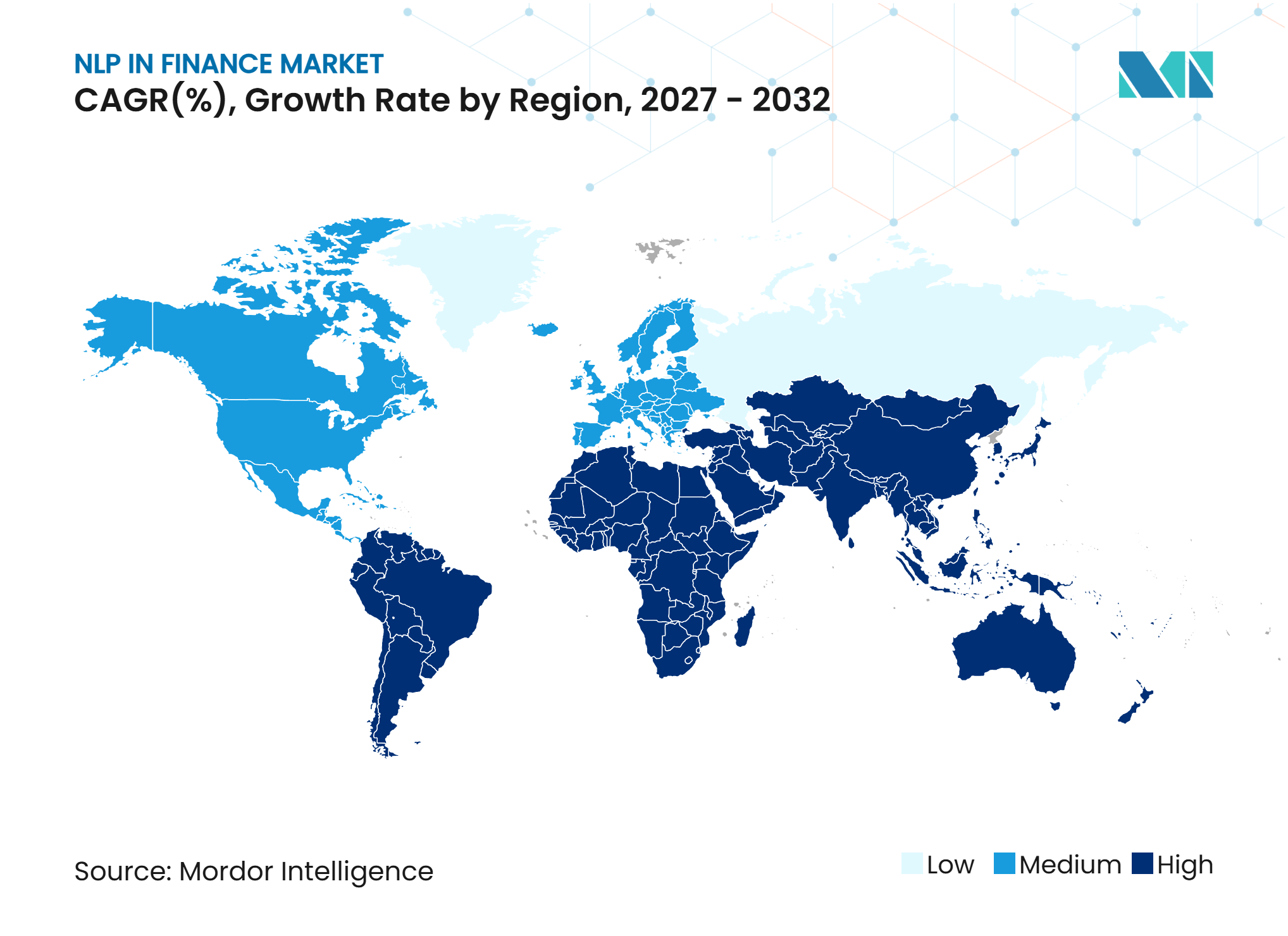
| Fastest Growing Market | Asia-Pacific |
| Largest Market | North America |
| Market Concentration | Low |
Major Players *Disclaimer: Major Players sorted in no particular order Image © Mordor Intelligence. Reuse requires attribution under CC BY 4.0. | |
NLP In Finance Market Analysis by Mordor Intelligence
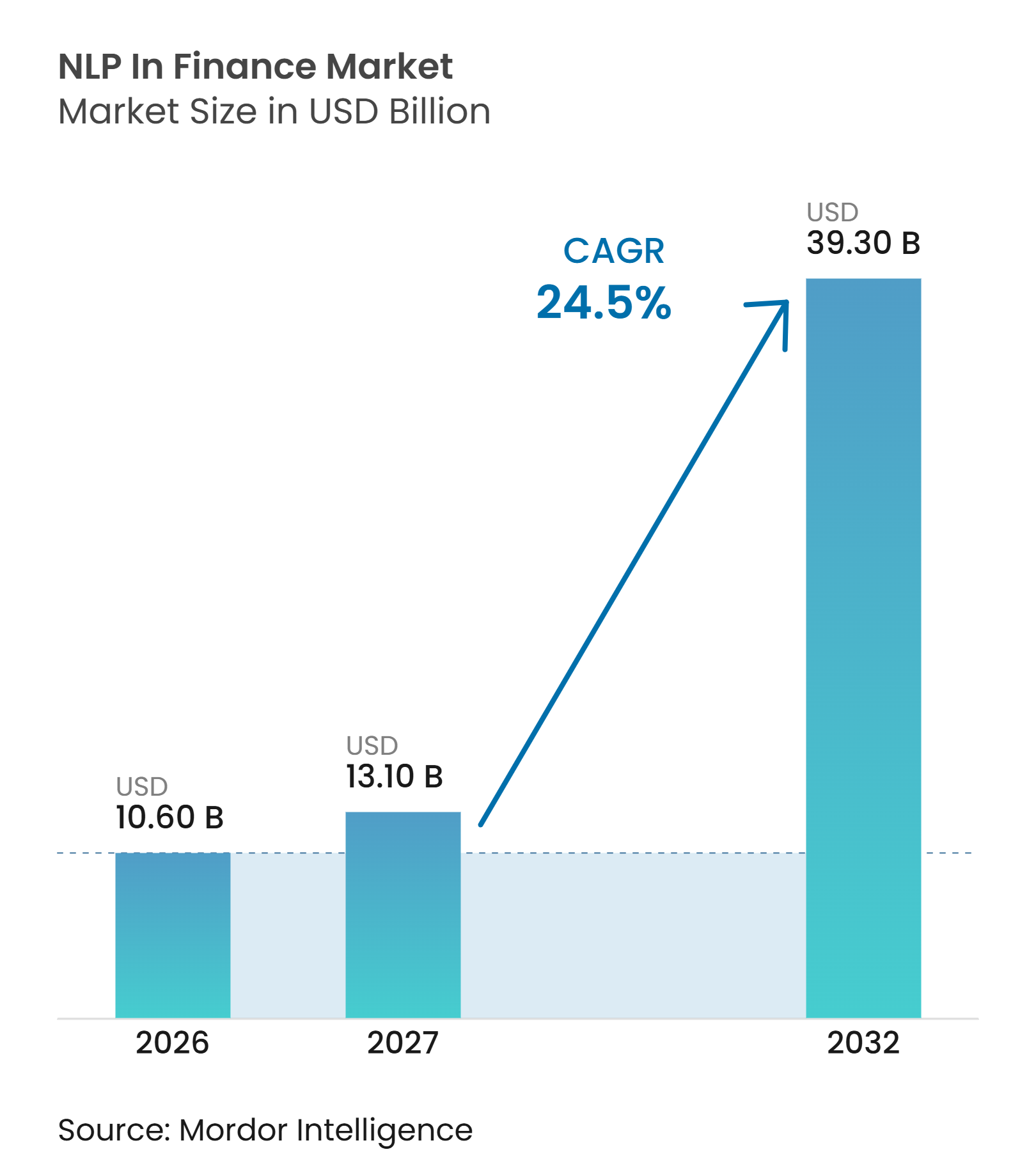
The NLP In Finance Market size was valued at USD 10.60 billion in 2026 and is estimated to grow from USD 13.10 billion in 2027 to reach USD 39.30 billion by 2032, at a CAGR of 24.5% during the forecast period (2027-2032).
Financial institutions are moving beyond isolated language-processing tools toward platforms that support risk, compliance, customer service, and investment work. The Cambridge Centre for Alternative Finance found that 81% of financial services firms had adopted artificial intelligence at some level in 2026, while generative artificial intelligence adoption reached 71%. The growing use of language models makes governance, reliable outputs, and secure access to institutional information central requirements for NLP in the finance market. Infrastructure providers and specialized financial software companies are expanding partnerships because financial institutions need models, data access, workflow controls, and audit trails to work together. The market opportunity is therefore strongest where language tools can reduce manual review without weakening regulatory controls or customer trust.
Key Report Takeaways
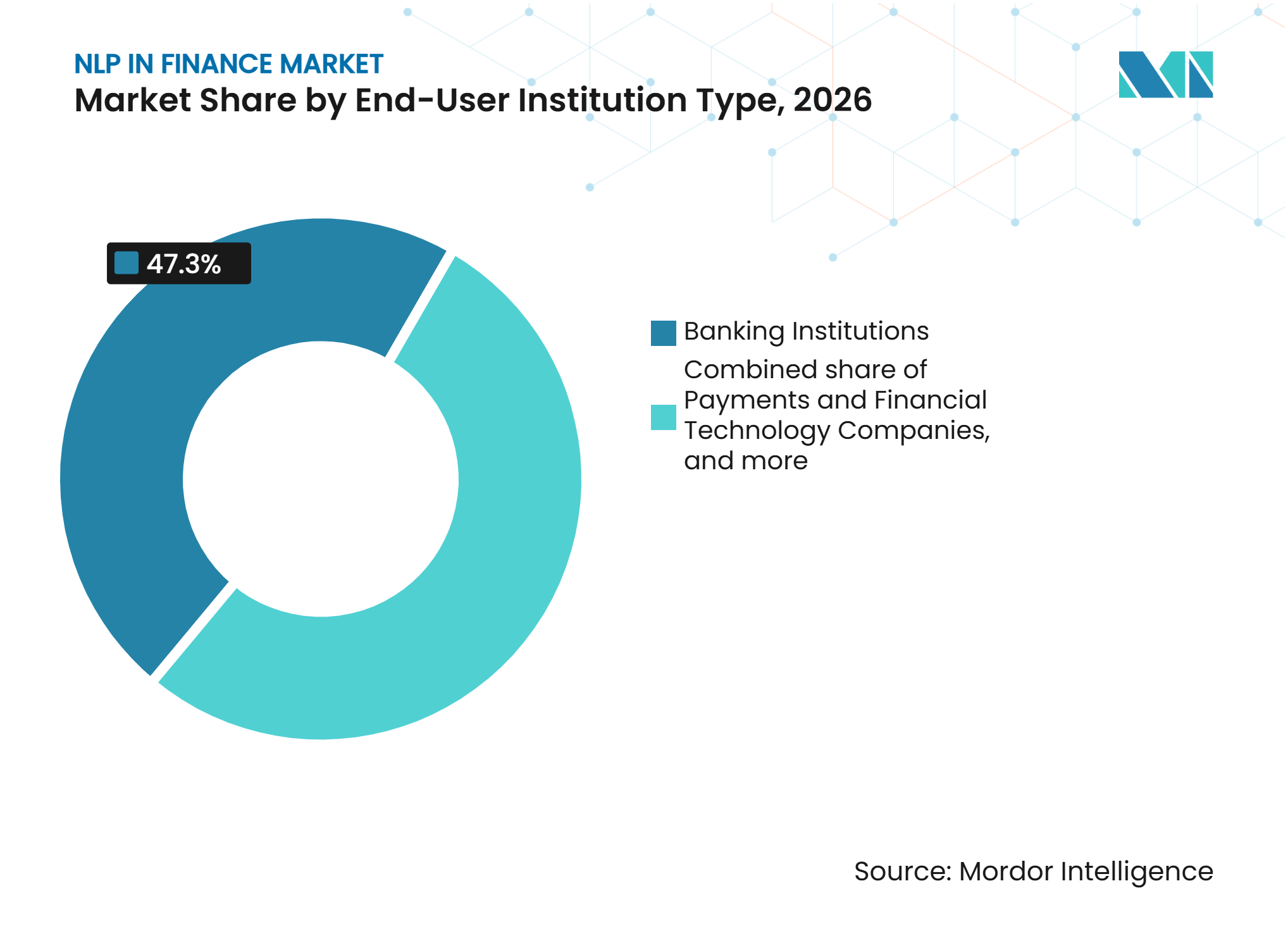
- By end-user institution type, banking institutions held a 47.3% share of the NLP in Finance market in 2026, while payments and financial technology companies are projected to grow at a 29.5% CAGR through 2032.
- By application, risk management, financial crime, and regulatory compliance & surveillance captured a 29.6% share of the NLP in Finance market in 2026, while ESG, sustainable finance, and non-financial disclosure intelligence are projected to grow at a 27.9% CAGR through 2032.
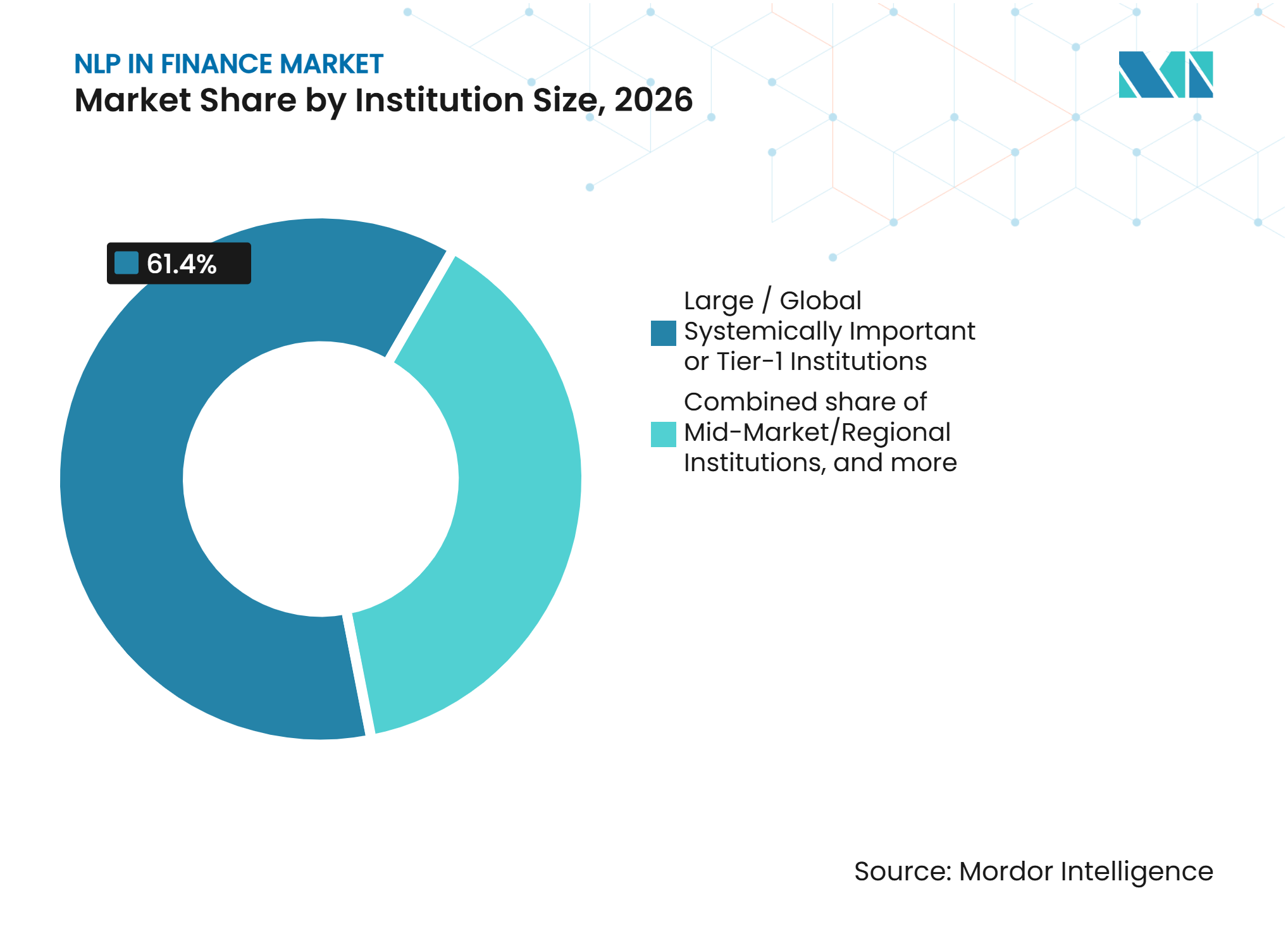
- By institution size, large, global systemically important, or Tier-1 institutions captured a 61.4% share of the NLP in Finance market in 2026, while mid-market and regional institutions are projected to grow at a 27.3% CAGR through 2032.
- By function, risk, compliance, and financial crime held a 27.5% share of the NLP in Finance market in 2026, while customer experience and retail or commercial banking operations are projected to grow at a 26.4% CAGR through 2032.
- By geography, North America held a 41.7% share of the NLP in Finance market in 2026, while Asia-Pacific is projected to grow at a 28.2% CAGR through 2032.
Note: Market numbers in this report are based on Mordor Intelligence's proprietary estimation framework, which combines nine months of actuals with Q4 projections for base year 2026.
Market Trends and Insights
Drivers Impact Analysis of NLP In Finance Market*
| Driver | % Impact on CAGR Forecast | Geographic Relevance | Impact Timeline |
|---|---|---|---|
| Growing volume of unstructured financial data and demand for automated text analytics | +5.8% | Global | Medium term (2–4 years) |
| Rising adoption of NLP-based conversational banking and customer service automation | +4.2% | Global | Short term (≤ 2 years) |
| Increasing demand for NLP-driven financial research and investment intelligence | +3.6% | North America & EU | Medium term (2–4 years) |
| Growing adoption of NLP for regulatory compliance, KYC and financial crime monitoring | +4.1% | Global | Short to medium term (≤ 4 years) |
| Advancements in finance-specific LLMs and retrieval-augmented generation | +3.2% | Global | Medium to long term (2–5 years) |
| Increasing demand for multilingual NLP in cross-border financial operations | +1.4% | Asia-Pacific, MEA, South America | Long term (≥ 4 years) |
| Source: Mordor Intelligence | |||
Growing Unstructured Financial Data and Demand for Automated Text Analytics
Financial institutions process large volumes of information in filings, earnings transcripts, research, contracts, identity documents, and regulatory notices. LSEG notes that natural language processing can help financial firms organize and analyze unstructured content that conventional data systems cannot easily interpret. The NLP in finance market benefits when institutions connect document ingestion, search, extraction, and review processes instead of treating them as separate tools. AIMA reported in 2025 that 51% of senior alternative-investment executives identified data-quality issues and the growth of unstructured documents as a major operating challenge[1]. Institutions with well-organized internal repositories can make language tools more useful because analysts can locate relevant content and check the supporting record. The resulting advantage depends on data controls and domain-specific tuning, since financial documents vary widely in structure, terminology, and materiality.
Rising Adoption of NLP-Based Conversational Banking and Customer Service Automation
Conversational tools are becoming part of routine banking services when they can perform useful tasks within defined controls. The ACL Anthology documented Ryt Bank’s regulator-approved approach in which conversational artificial intelligence serves as the main banking interface for core transactions. The case shows that approval processes, monitoring, and escalation paths remain as important as language capability in customer-facing banking. Commerzbank’s Ava assistant manages more than 30,000 customer conversations each month and resolves 75% autonomously, according to a Microsoft customer case study[2]. Bank DBS Indonesia reported that its Guided Conversation platform reduced manual service requests by 80% and increased customer satisfaction by 18% in 2025. These results support continued spending in the NLP in finance market, where customer questions can be answered accurately, logged clearly, and transferred to staff when needed.
Increasing Demand for NLP-Driven Financial Research and Investment Intelligence
Investment teams face a growing volume of filings, transcripts, research notes, and sustainability disclosures that must be reviewed quickly. The CFA Institute described natural language processing as a method that can help investment professionals extract information from text-based sources and support research workflows. Schroders stated that its AI tools could reduce an analyst's initial company-assessment time by approximately half. This use case is more dependable when a system retrieves information from controlled document collections and shows the evidence used in its response. AlphaSense introduced SuperAnalyst in June 2026 to monitor filings, earnings, and expert transcripts continuously and produce source-linked research outputs[3]. The NLP in the financial market therefore has room to grow where research teams need speed but cannot accept unsupported outputs in investment decisions.
Growing Adoption of NLP for Regulatory Compliance, Know Your Customer, and Financial Crime Monitoring
Compliance and financial crime operations must review alerts, policies, customer documents, and changing regulations at scale. HGS reported in January 2026 that its AMLens platform reduced case-analysis time by 75%, lowered false positives by 60%, and increased investigator throughput from 8 to 24 cases per day[4]. The NLP in the finance industry gains support from this type of measurable workflow improvement because compliance work cannot be deferred when regulatory requirements change. Financial institutions must also align automation with standards and supervisory expectations from bodies such as the Financial Action Task Force, the Financial Crimes Enforcement Network, and the European Union’s Anti-Money Laundering Authority. Clear audit trails matter because investigators and regulators need to understand why an alert was prioritized, or a document was classified in a certain way. As a result, products that combine language processing with review queues, evidence links, and policy controls are more likely to be adopted in high-consequence workflows.
Restraints Impact Analysis of NLP In Finance Market*
| Restraint | % Impact on CAGR Forecast | Geographic Relevance | Impact Timeline |
|---|---|---|---|
| Stringent financial data privacy, confidentiality and data residency requirements | -1.2% | Europe, North America, and Asia-Pacific | Medium term (2–4 years) |
| Model hallucination, limited explainability and reliability of financial NLP outputs | -0.8% | Global | Short to medium term (≤ 4 years) |
| Fragmented financial data and complex integration with legacy systems | -0.7% | Global | Medium term (2–4 years) |
| High costs and shortage of specialized financial NLP expertise | -0.5% | EMDEs and smaller community/specialist institutions globally | Long term (≥ 4 years) |
| Source: Mordor Intelligence | |||
Stringent Financial Data Privacy, Confidentiality and Data Residency Requirements
Data governance limits the way many financial institutions can deploy language models across business lines and national borders. The European Banking Authority stated in November 2025 that the European Union AI Act and the General Data Protection Regulation may both apply where artificial intelligence systems process personal data, creating parallel compliance considerations. The NLP in the finance market must accommodate data residency rules in jurisdictions such as India, China, and Brazil, where cross-border handling of sensitive information may be limited. These requirements increase the value of private deployments, access controls, and methods that limit exposure of personal or confidential information. The European Banking Authority also identified the need for governance and risk management as artificial intelligence use expands across banking and payments. Institutions may adopt more gradually when they need to complete privacy reviews, test model behavior, and establish responsibility for third-party technology providers.
Model Hallucination, Limited Explainability and Reliability of Financial NLP Outputs
Incorrect or unsupported outputs can create material risk in credit, customer advice, financial crime, and regulatory reporting. The Hong Kong Monetary Authority identified hallucination as a primary challenge in banking artificial intelligence adoption because plausible but incorrect output can undermine credibility in financial settings. The Bank for International Settlements also highlighted reasoning errors and excessive confidence in artificial intelligence outputs as governance concerns for central banks in 2026. These risks slow use in decisions where an institution must explain the evidence, methodology, and human review behind an outcome. Reliable deployment requires testing against financial use cases, documented controls, and escalation to qualified staff when confidence is low. The NLP in the finance market will depend on vendors proving that their systems can deliver traceable results rather than only fluent responses.
*Our forecasts treat driver/restraint impacts as directional, not additive. The impact forecasts reflect baseline growth, mix effects, and variable interactions.
NLP In Finance Market Segment Analysis
By End-User Institution Type:
Banking Institutions Lead, While Financial Technology Companies Expand QuicklyBanking institutions accounted for 47.3% of the NLP in finance market share in 2026 because they operate language-intensive workflows across retail, corporate, and investment banking. These workflows include customer onboarding, know your customer document review, suspicious-activity reporting, earnings analysis, and internal policy search. The European Banking Authority reported in 2025 that artificial intelligence use was becoming more common across the European Union banking and payments sector, with natural language processing among the techniques used by institutions. Their scale creates a need for consistent permission controls because confidential customer and market information is used across many teams. Banking institutions will remain a central source of demand in the NLP in finance market as they move selected language functions into controlled production environments.
Payments and financial technology companies are forecast to grow at 29.5% CAGR through 2032, the highest rate within this segmentation. Digital-first providers can introduce conversational payment flows, fraud-review tools, and natural language onboarding without carrying the same legacy system burden as established banks. The Cambridge Centre for Alternative Finance reported that fintech firms led incumbent financial institutions in advanced artificial intelligence adoption, at 47% compared with 30%. Capital markets and securities institutions use language tools in trading research and information retrieval, while financial information and analytics providers apply them to search and data delivery. Insurance companies use them for claims narratives and policy documents, while asset management and investment firms use them for transcript review and portfolio commentary.


By Application:
Compliance and Risk Form the Core, While ESG Disclosure Work ExpandsRisk management, financial crime, and regulatory compliance & surveillance commanded 29.6% of the NLP in finance market share in 2026. The application includes anti-money laundering alert triage, sanctions screening, regulatory text interpretation, and document review. This spending is resilient because compliance requirements are not discretionary and the underlying work involves large amounts of text. HGS demonstrated the potential for efficiency gains in this setting, reporting a 60% reduction in false positives through its AMLens deployment. The NLP in the financial market will continue to favor systems that make investigators more effective without removing necessary oversight.
ESG, sustainable finance, and non-financial disclosure intelligence is forecast to grow at 27.9% CAGR through 2032. The European Sustainability Reporting Standards and the European Union Taxonomy Regulation create detailed disclosure requirements for covered institutions and companies. Research published through the ACL Anthology in 2025 showed how a disclosure-content dataset can support mapping of sustainability reporting content to Global Reporting Initiative and European Sustainability Reporting Standards requirements. Customer engagement, service automation, and onboarding or know your customer also remain important because firms can connect service improvements to cost and customer experience outcomes. Document intelligence and operational workflow automation, together with investment research, market intelligence, and portfolio insights, address separate productivity needs and broaden the use of NLP in the financial market.
By Institution Size:
Tier-1 Institutions Hold the Largest Position, While Regional Firms Gain AccessLarge, Global Systemically Important, or Tier-1 Institutions held 61.4% of the NLP in the finance market size in 2026. Their position reflects large technology budgets, broad data estates, and the operational scale needed to deploy a common language platform across many functions. BNP Paribas has described an internal language-model service that provides its entities with standardized model access hosted within the bank’s own data centers. This type of internal platform allows large institutions to combine model selection, identity management, logging, and governance. Private or controlled cloud deployment is particularly relevant where data confidentiality prevents unrestricted use of external model endpoints.
Mid-Market and Regional Institutions are projected to grow at 27.3% CAGR through 2032. Cloud-native software, smaller domain-focused language models, and managed deployments can lower the cost of adopting useful capabilities. The NLP in finance market can reach this group through packaged tools for document classification, service support, policy search, and financial crime operations. Small, Community, and Specialist Institutions remain earlier in their adoption path because they may have limited artificial intelligence teams and governance capacity. Providers that reduce integration work and offer straightforward controls can widen the NLP in the finance market without requiring these institutions to build large internal technology programs.

By Function:
Risk and Compliance Lead, While Customer Operations Grow FasterRisk, Compliance, and Financial Crime held a 27.5% share in 2026. Regulatory pressure and the substantial volume of policies, alerts, identity records, and case notes make this function well suited to language processing. NICE Actimize introduced Xceed AI Agents in April 2025 for alert triage, backlog categorization, and high-risk case summarization in fraud and anti-money laundering workflows. Such tools are most useful when they preserve investigator accountability and identify the evidence behind each recommendation. The function will remain a leading area for NLP in the finance market because operational efficiency and regulatory scrutiny both support investment.
Customer Experience and Retail or Commercial Banking Operations is forecast to grow at 26.4% CAGR through 2032. Salesforce introduced Agentforce for Financial Services in May 2025 with role-based agent templates for service requests and digital loan origination. The development reflects demand for reusable workflows that can shorten configuration time while applying specific permissions and policies. Investment, Markets, and Asset Management teams use language tools for earnings intelligence, sector research, and early-warning monitoring. NLP in the finance market can expand into operations, shared services, back-office processing, and finance or treasury functions, although each use case requires different review and access controls.
Geography Analysis
North America: Deep Institutional Use and Broad Workflow Deployment
North America held a 41.7% share of the NLP in the finance market in 2026. JPMorganChase deployed its LLM Suite to more than 200,000 employees, while its broader AI applications generated an estimated USD 1 billion to USD 1.5 billion in value across operations, fraud prevention, and credit decisions. UBS deployed Azure OpenAI-powered assistants to approximately 30,000 employees and developed a legal AI assistant to search 26 million multilingual documents. Regulatory requirements around model risk, data protection, and recordkeeping further support demand for controlled NLP applications across financial institutions.
Asia-Pacific: Digital Banking Infrastructure Supports Faster Growth
Asia-Pacific is forecast to grow at a 28.2% CAGR through 2032. The OECD's December 2025 assessment of 19 Asian jurisdictions identified banking as a leading sector for AI adoption across financial services. Singapore's Monetary Authority of Singapore supports financial-sector AI adoption through PathFin.ai. In South Korea, KakaoBank launched an Azure OpenAI-powered conversational search service in May 2025. In Japan, Japan Digital Design developed a 70-billion-parameter financial translation language model in November 2025 for planned use by Mitsubishi UFJ Bank. Multilingual NLP capabilities remain important across Southeast Asia, where the CroFinBen benchmark identified performance differences across Indonesian, Malay, Thai, Filipino, and Vietnamese financial-language tasks.
Europe, South America, and the Middle East and Africa: Regulation, Localization, and New Financial Platforms
Europe's adoption is shaped by the EU AI Act and GDPR. The European Banking Authority's November 2025 assessment highlighted compliance requirements for AI applications in banking, particularly high-risk creditworthiness assessments. In the United Kingdom, Aveni developed FinLLM with input from Lloyds Banking Group and Nationwide to address financial-services-specific requirements. In Brazil, Banco Bradesco developed its Bridge multi-agent platform for customer service and internal workflows, while Itaú Unibanco introduced its ia.i conversational AI service in July 2026. In Egypt, First Abu Dhabi Bank Misr implemented IBM watsonx in October 2026, including AI agents for enterprise knowledge access and financial analysis.
Competitive Landscape
Market Concentration
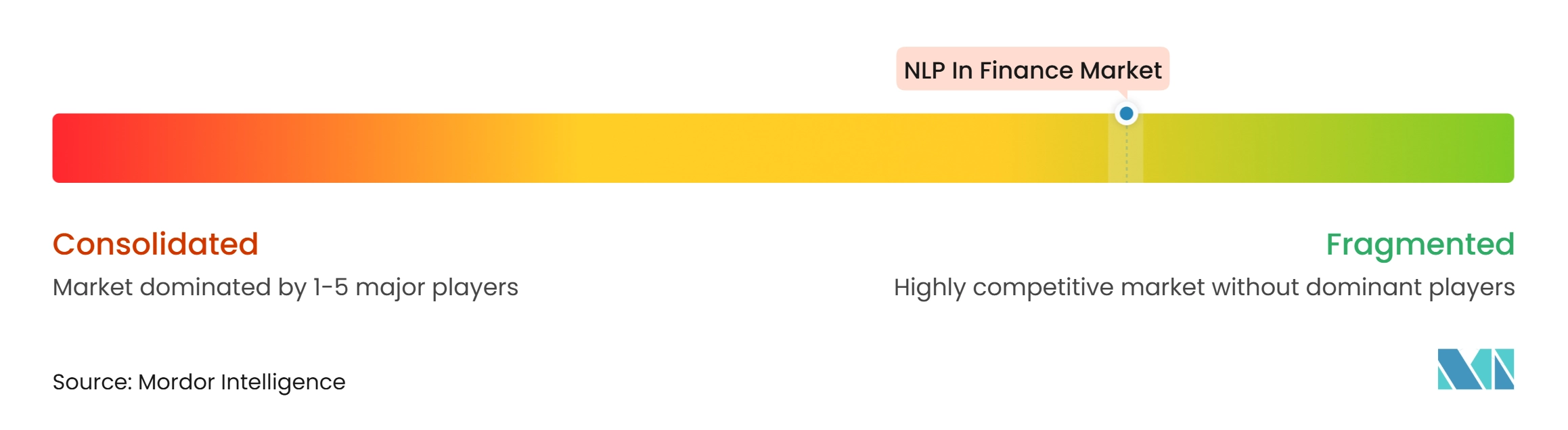
The NLP in finance market is fragmented, with competition distributed across cloud infrastructure providers, financial data companies, and specialized AI software vendors. Microsoft, Google, Amazon Web Services, and NVIDIA provide cloud, AI models, and computing infrastructure, while Bloomberg, Moody’s, AlphaSense, Kasisto, and NICE Actimize compete through financial data, research, banking workflows, and compliance applications. Providers differentiate through domain expertise, integration capabilities, data access, and governance features. Strategic partnerships and platform integrations are therefore important for expanding market reach and strengthening product offerings.
Microsoft and Moody’s expanded their strategic partnership in April 2026, integrating Moody’s credit ratings, research, and risk intelligence into Microsoft 365 Copilot, Researcher, and Excel. Separately, Moody’s partnered with Anthropic in April 2026 to make its credit analysis and compliance workflows available within Claude through a Model Context Protocol integration. In September 2026, Oracle introduced Nexus Case Flow and Nexus Reach, adding agentic AI capabilities for financial crime investigations, evidence gathering, and case analysis to its compliance portfolio. Bloomberg launched Enterprise MCP on September 29, 2026, enabling enterprise AI applications to retrieve licensed Bloomberg data across more than 100 million securities through a standardized interface.
Specialized vendors are also advancing agent-based products for banking, fraud detection, and compliance workflows. Kasisto launched KAIgentic in August 2025, a banking-focused agentic AI platform featuring compliance architecture, audit logging, hallucination detection, and confidence scoring. Backbase launched its AI-native Banking OS in April 2026, introducing Sentinel, an authority layer that checks customer, employee, and AI-agent actions against bank-defined policies. In October 2026, Backbase launched Conversational Banking, enabling AI agents to execute permitted banking tasks through voice and text interactions. Competition increasingly depends on financial accuracy, implementation capabilities, data security, and governance controls alongside underlying model performance.
NLP In Finance Industry Leaders
-
Microsoft Corporation
-
Google LLC
-
Amazon Web Services, Inc.
-
Oracle Corporation
-
International Business Machines Corporation (IBM)
- *Disclaimer: Major Players sorted in no particular order
NLP In Finance Market Companies Covered in this Report
- Microsoft Corporation
- International Business Machines Corporation (IBM)
- Google LLC
- Amazon Web Services, Inc.
- Oracle Corporation
- SAS Institute Inc.
- NVIDIA Corporation
- OpenAI
- Salesforce, Inc.
- SAP SE
- S&P Global Inc.
- Bloomberg L.P.
- AlphaSense Inc.
- Moody's Corporation
- NICE Ltd.
- Expert.ai S.p.A.
- Kasisto, Inc.
- Uniphore
- Xceptor Limited
- Backbase B.V.
Recent Industry Developments in NLP In Finance Market
- October 2026: Bloomberg introduced BQuant Assistant, a conversational AI coding assistant integrated into BQuant Desktop and BQuant Enterprise. It enables financial professionals to generate Python code, query Bloomberg datasets, debug code, and develop financial applications using natural-language prompts.
- October 2026: First Abu Dhabi Bank Misr (FABMISR) adopted IBM’s watsonx portfolio to deploy an on-premises enterprise AI platform. Its production-ready applications include a retrieval-augmented generation (RAG) agent for enterprise knowledge access and a Financial Analyst AI agent for financial analysis and decision support.
- September 2026: OpenAI launched ChatGPT for Financial Services, combining GPT-6 Astra with built-in financial data from Daloopa, PitchBook, LSEG News, and Crunchbase. The platform supports financial research, valuation and financial modelling, multi-source analysis, and preparation of client materials, with Morgan Stanley and Evercore serving as design partners,
- September 2026: Bloomberg launched Enterprise MCP, an AI access layer connecting clients’ AI agents to licensed Bloomberg data across more than 100 million securities and over 50,000 fields. The standardized Model Context Protocol interface includes financial data metadata and workflow-specific tools to support research, portfolio, risk, and operational workflows,
Global NLP In Finance Market Report Scope
Segmentation Overview
| Banking Institutions |
| Insurance Companies |
| Asset Management and Investment Firms |
| Capital Markets and Securities Institutions |
| Payments and Financial Technology Companies |
| Financial Information and Analytics Providers |
| Risk Management, Financial Crime, and Regulatory Compliance & Surveillance |
| Customer Engagement, Service Automation, and Onboarding / KYC |
| Investment Research, Market Intelligence, and Portfolio Insights |
| Document Intelligence and Operational Workflow Automation |
| ESG, Sustainable Finance, and Non-Financial Disclosure Intelligence |
| Large / Global Systemically Important or Tier-1 Institutions |
| Mid-Market / Regional Institutions |
| Small / Community / Specialist Institutions |
| Risk, Compliance, and Financial Crime |
| Customer Experience and Retail / Commercial Banking Operations |
| Investment, Markets, and Asset Management |
| Operations, Shared Services, and Back-Office Processing |
| Finance, Treasury, and Corporate Functions |
| North America | United States |
| Canada | |
| Mexico | |
| South America | Brazil |
| Argentina | |
| Rest of South America | |
| Europe | United Kingdom |
| Germany | |
| France | |
| Italy | |
| Spain | |
| Rest of Europe | |
| Asia-Pacific | China |
| Japan | |
| India | |
| South Korea | |
| Australia | |
| Indonesia | |
| Thailand | |
| Malaysia | |
| Singapore | |
| Vietnam | |
| Rest of Asia-Pacific | |
| Middle East and Africa | Saudi Arabia |
| United Arab Emirates | |
| Turkey | |
| South Africa | |
| Egypt | |
| Rest of Middle East and Africa |
| By End-User Institution Type | Banking Institutions | |
| Insurance Companies | ||
| Asset Management and Investment Firms | ||
| Capital Markets and Securities Institutions | ||
| Payments and Financial Technology Companies | ||
| Financial Information and Analytics Providers | ||
| By Application | Risk Management, Financial Crime, and Regulatory Compliance & Surveillance | |
| Customer Engagement, Service Automation, and Onboarding / KYC | ||
| Investment Research, Market Intelligence, and Portfolio Insights | ||
| Document Intelligence and Operational Workflow Automation | ||
| ESG, Sustainable Finance, and Non-Financial Disclosure Intelligence | ||
| By Institution Size | Large / Global Systemically Important or Tier-1 Institutions | |
| Mid-Market / Regional Institutions | ||
| Small / Community / Specialist Institutions | ||
| By Function | Risk, Compliance, and Financial Crime | |
| Customer Experience and Retail / Commercial Banking Operations | ||
| Investment, Markets, and Asset Management | ||
| Operations, Shared Services, and Back-Office Processing | ||
| Finance, Treasury, and Corporate Functions | ||
| By Geography | North America | United States |
| Canada | ||
| Mexico | ||
| South America | Brazil | |
| Argentina | ||
| Rest of South America | ||
| Europe | United Kingdom | |
| Germany | ||
| France | ||
| Italy | ||
| Spain | ||
| Rest of Europe | ||
| Asia-Pacific | China | |
| Japan | ||
| India | ||
| South Korea | ||
| Australia | ||
| Indonesia | ||
| Thailand | ||
| Malaysia | ||
| Singapore | ||
| Vietnam | ||
| Rest of Asia-Pacific | ||
| Middle East and Africa | Saudi Arabia | |
| United Arab Emirates | ||
| Turkey | ||
| South Africa | ||
| Egypt | ||
| Rest of Middle East and Africa | ||
Key Questions Answered in the Report
What is the projected value of NLP in finance by 2032?
The NLP in finance market is projected to reach USD 39.3 billion by 2032, growing at a 24.5% CAGR from 2027 to 2032.
Which financial institution type has the largest NLP spending share?
Banking Institutions held 47.3% share in 2026, supported by use across onboarding, compliance, service, research, and internal operations.
Which application is growing fastest in financial NLP?
ESG, Sustainable Finance, and Non-Financial Disclosure Intelligence is projected to grow at 27.9% CAGR through 2032.
Why do banks use natural language processing for compliance?
Banks use it to review alerts, policies, identity records, and regulatory documents more efficiently while retaining evidence and human oversight.
Which region is growing fastest for financial NLP?
Asia-Pacific is projected to grow at 28.2% CAGR through 2032, supported by digital banking infrastructure, regulatory sandboxes, and multilingual needs.
What limits deployment of language models in financial services?
Privacy and data-residency rules, output reliability, explainability, and the need for robust governance can slow deployment in regulated workflows.