
Nickel Cobalt Aluminum (NCA) Oxide Market Size and Share
Market Overview
| Study Period | 2021 - 2031 |
|---|---|
| Market Size (2026) | USD 3.49 Billion |
| Market Size (2031) | USD 6.30 Billion |
| Growth Rate (2026 - 2031) | 12.56 % |
| Fastest Growing Market | Asia-Pacific |
| Largest Market | Asia-Pacific |
| Market Concentration | High |
Major Players *Disclaimer: Major Players sorted in no particular order Image © Mordor Intelligence. Reuse requires attribution under CC BY 4.0. | |
Nickel Cobalt Aluminum (NCA) Oxide Market Analysis by Mordor Intelligence
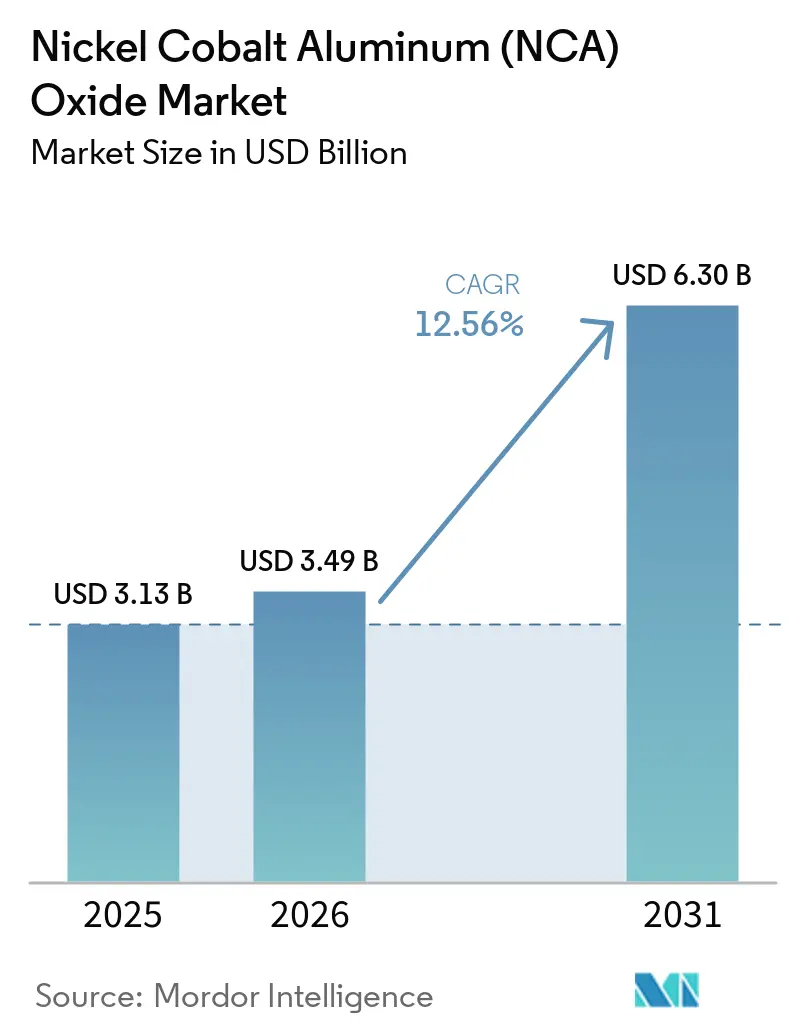
The Nickel Cobalt Aluminum (NCA) Oxide Market size was valued at USD 3.13 billion in 2025 and is estimated to grow from USD 3.49 billion in 2026 to reach USD 6.30 billion by 2031, at a CAGR of 12.56% during the forecast period (2026-2031). The Nickel Cobalt Aluminum (NCA) Oxide market primarily serves applications requiring high energy density, particularly premium electric vehicles with demanding range and weight requirements. It remains most relevant where higher material costs are accepted in exchange for range, power delivery, and compact pack design. NCA cathode materials deliver a specific capacity of 200-220 mAh/g and an energy density of 270-300 Wh/kg, enabling premium electric vehicles to travel more than 500 km on a single charge while maintaining comparable pack weight. Global electric vehicle battery deployment reached 1.2 TWh in 2025, with lithium iron phosphate batteries accounting for more than 55% of deployed capacity, leaving high-nickel chemistries in a smaller premium tier. The NCA Oxide market, therefore, depends on vehicle manufacturers that prioritize range, power output, and compact battery packs over the lower cost of lithium iron phosphate alternatives. Supply chain regionalization is directing capacity investment toward South Korea, Japan, Europe, and North America, where manufacturers seek a qualified non-Chinese cathode supply. Nickel-containing chemistries accounted for nearly 80% of electric vehicle batteries deployed outside China in 2025, with NCA, Nickel Manganese Cobalt 811 (NMC811), and NMC721 accounting for nearly 80% of cobalt-containing deployment in those markets.
Key Report Takeaways
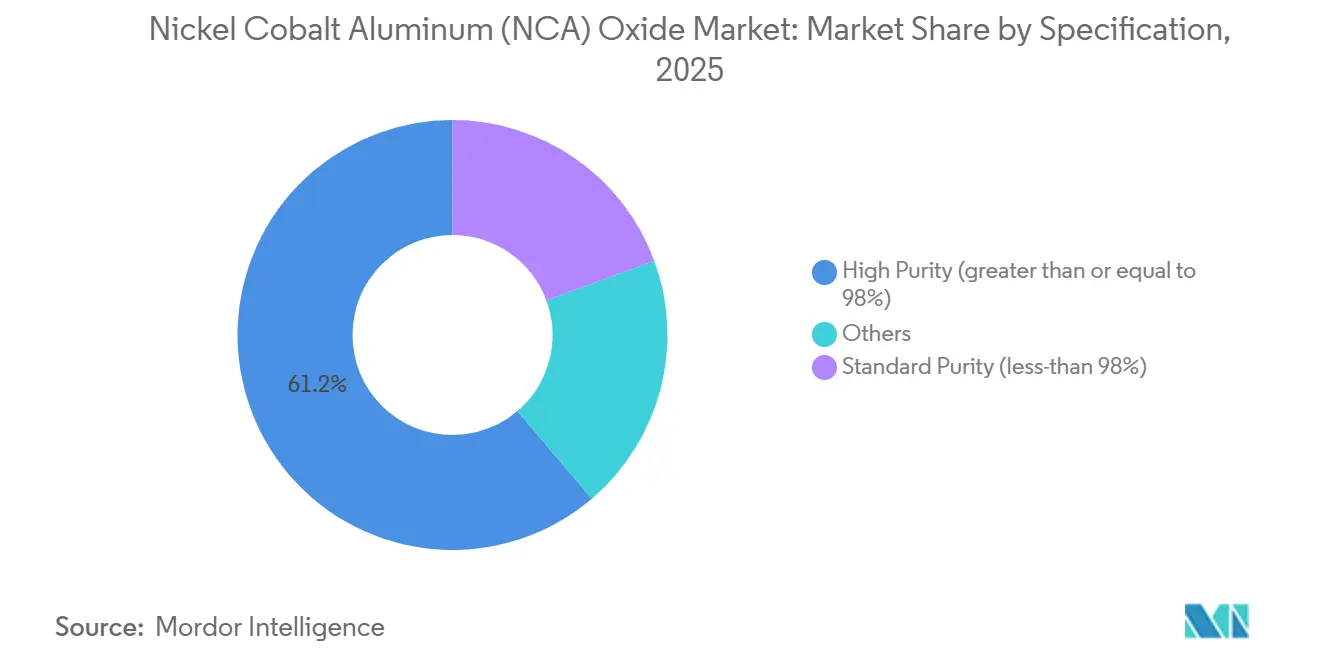
- By specification, high-purity NCA held 61.23% of the Nickel Cobalt Aluminum Oxide market share in 2025 and is projected to expand at a 13.52% CAGR through 2031.
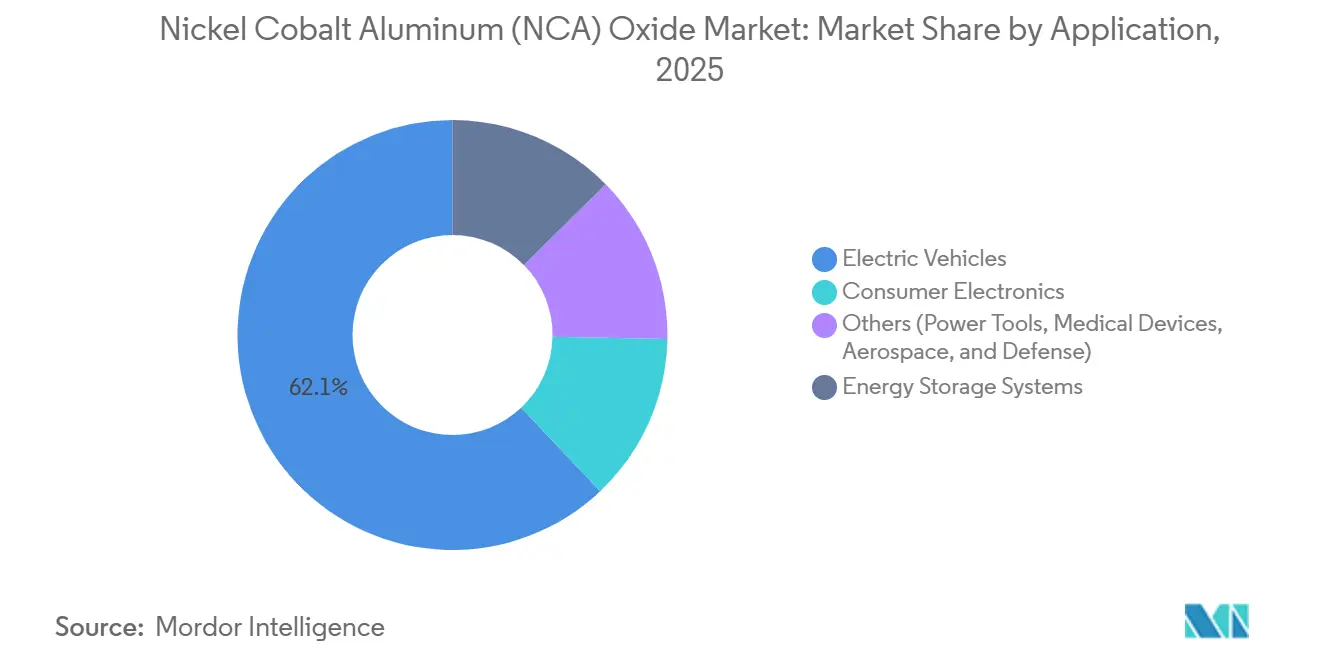
- By application, electric vehicles held 62.06% of the Nickel Cobalt Aluminum Oxide market share in 2025, while energy storage systems were projected to expand at a CAGR of 14.03% through 2031.
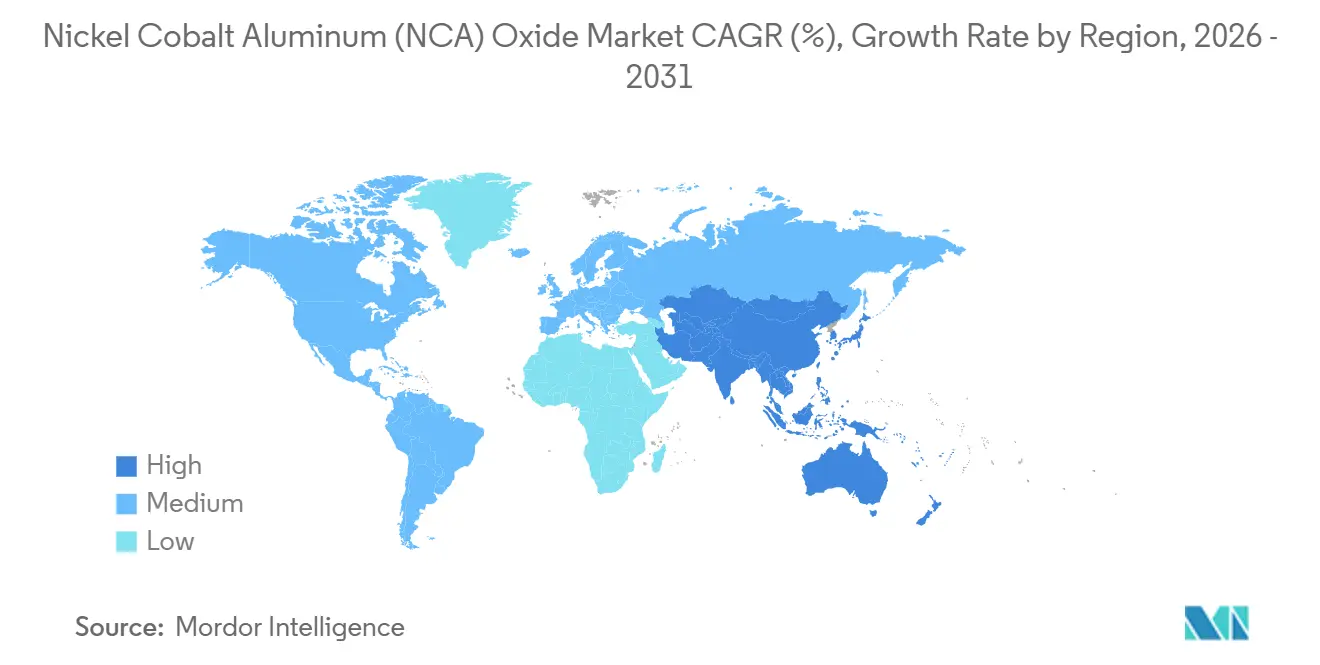
- By geography, Asia-Pacific held 45.62% of the Nickel Cobalt Aluminum Oxide market share in 2025 and was projected to expand at the highest regional CAGR of 13.13% through 2031.
Note: Market size and forecast figures in this report are generated using Mordor Intelligence’s proprietary estimation framework, updated with the latest available data and insights as of January 2026.
Market Trends and Insights
Drivers Impact Analysis of Nickel Cobalt Aluminum (NCA) Oxide Market*
| Drivers | (~) % Impact on CAGR Forecast | Geographic Relevance | Impact Timeline |
|---|---|---|---|
| Premium EV Range Requirements | +4.2% | Global, with concentrated demand in North America, the EU, and Japan | Short term (≤ 2 years) |
| Electrification of High-Performance Vehicles | +3.1% | North America and the EU, with the luxury and sport segments | Medium term (2-4 years) |
| High-Nickel Energy Density Advantage | +2.8% | Global | Long term (≥ 4 years) |
| Regionalization of Battery Supply Chains | +3.5% | North America and the EU, with spillover to Asia-Pacific non-China suppliers | Medium term (2-4 years) |
| Closed-Loop Nickel and Cobalt Recovery | +1.6% | Asia-Pacific and EU, with early gains in Japan, South Korea, and Germany | Long term (≥ 4 years) |
| NCA Qualification for High-Power Cylindrical Cells | +2.4% | Global, with OEM qualification concentrated in the EU and North America | Medium term (2-4 years) |
| Source: Mordor Intelligence | |||
Premium EV Range Requirements Sustain NCA's Position in the Powertrain Hierarchy
Range concerns remain a barrier to wider electric vehicle adoption, and automakers serving premium buyers continue to prioritize energy density as it can extend range without a proportionate increase in battery pack weight. High-nickel NCA cathodes have demonstrated 20-30% higher energy density than standard nickel-cobalt-manganese chemistries, supporting longer driving range in suitable applications. The Nickel Cobalt Aluminum Oxide market is tied to vehicle programs where range performance is a core part of the offering, including vehicles priced above USD 50,000. NCA accounted for 15% of cobalt-containing battery chemistry deployed in electric vehicles globally in 2025, with its role more concentrated in premium applications outside China[1]. Lower-cost vehicles can often use lower-energy-density chemistries and larger or differently designed battery packs, making NCA unsuitable for every electric vehicle program. Premium manufacturers face tighter packaging and performance constraints, leaving a narrower yet more technically demanding demand base for producers capable of delivering consistent high-nickel cathode quality.
Electrification of High-Performance Vehicles Expands the NCA Addressable Market
Electrification is extending into high-power sports cars, performance sport utility vehicles, and other applications where high specific energy and sustained discharge capability are important. These applications require battery designs that support performance while limiting vehicle weight. BMW's use of 46 mm cylindrical cells for its next-generation electric vehicles reflects this shift toward large-format cylindrical architectures. The Nickel Cobalt Aluminum Oxide market can benefit when manufacturers select cathodes that meet these requirements and when lower-cost chemistries offer limited alternatives. The opportunity also extends to aerospace-related uses, drones, and electric vertical takeoff and landing platforms, where weight directly affects operating capability. Beijing Easpring stated that cathode materials for solid-state batteries with energy density targets exceeding 400 Wh/kg had been used commercially in drones and eVTOL platforms. These specialized applications create high-value demand but require extensive material validation and safety testing, which limits the number of qualified suppliers.
Regionalization of Battery Supply Chains Redirects Capital Toward Non-China NCA Production
Foreign entity of concern provisions in the United States and critical-material rules in Europe are changing how premium electric vehicle supply chains are organized, requiring manufacturers to identify and qualify non-Chinese cathode suppliers earlier in product planning. This increases the value of production plants that can provide traceable materials and meet regional sourcing requirements across cathode production, precursor sourcing, and refining. The Nickel Cobalt Aluminum Oxide market benefits when high-nickel capacity is developed near North American and European customers, as regional supply can reduce compliance-related disruptions. POSCO Future M shipped supply-chain-independent Nickel Cobalt Manganese Aluminum (NCMA) cathode materials to Ultium Cells in the United States using domestically refined precursors from its Gwangyang facility. EcoPro BM began shipping high-nickel cathode from its Debrecen facility in Hungary to European automotive original equipment manufacturers in June 2026, at a plant with an annual capacity of 54,000 tons. These developments indicate that production location, regional policy alignment, and reduced reliance on a single country are becoming part of the supplier qualification process.
High-Nickel Energy Density Advantage Compounds Through Ongoing Cathode Innovation
Nickel content in commercial high-nickel NCA cathodes now exceeds 90% in some formulations and approaches 95% in next-generation products, supporting the energy density gains needed for premium electric vehicle battery packs. EcoPro BM and Samsung SDI have developed NCA cathodes with up to 95% nickel content for higher-energy-density battery designs. The Nickel Cobalt Aluminum Oxide market benefits when producers can convert higher nickel content into reliable automotive cathode performance, as energy density alone does not determine suitability. Cell makers also require stable quality, cycle life, and safe operating behavior. POSCO Future M completed pilot development of ultra-high-nickel single-crystal cathode materials for premium electric vehicles and planned mass-production technology development through 2026. Single-crystal architecture aims to address intergranular cracking during repeated charge and discharge cycles without sacrificing high-capacity benefits, reinforcing the value of qualified process control and durable high-nickel formulations.
Restraints Impact Analysis of Nickel Cobalt Aluminum (NCA) Oxide Market*
| Restraints | (~) % Impact on CAGR Forecast | Geographic Relevance | Impact Timeline |
|---|---|---|---|
| Lithium Iron Phosphate (LFP) Cost and Availability Advantage | -2.8% | Global, concentrated in Asia-Pacific and emerging markets | Short term (≤ 2 years) |
| Nickel and Cobalt Price Volatility | -1.4% | Global | Medium term (2-4 years) |
| High-Nickel Thermal-Runaway Exposure | -0.9% | Global, particularly the EU and North America, with strict safety standards | Medium term (2-4 years) |
| Qualification and Process-Control Burden | -0.7% | North America and the EU, as new capacity regions | Medium term (2-4 years) |
| Source: Mordor Intelligence | |||
LFP's Cost and Scale Advantages Limit NCA's Addressable Market
Lithium iron phosphate battery packs were more than 40% cheaper per kWh than nickel-manganese-cobalt alternatives in 2025, and lithium iron phosphate accounted for more than 55% of global electric vehicle battery deployment. This price advantage and established Chinese production scale have supported the adoption of lithium iron phosphate in mass-market electric vehicle segments. The nickel cobalt aluminum oxide market cannot readily match that cost position, as it relies on nickel and cobalt inputs and more demanding production controls. Ternary cathodes, including NCA and nickel-cobalt-manganese (NCM), grew 12% in 2025, while lithium iron cathodes grew 58%, and lithium iron phosphate exceeded 70% of total cathode demand by the end of 2025. NCA consequently remains concentrated in premium applications where compact pack size, high specific energy, and range performance carry clear commercial value. This creates a meaningful but selective opportunity compared to the broader electric vehicle battery market, requiring producers to maintain their performance and qualification advantages rather than compete on cost alone.
Nickel and Cobalt Price Volatility Introduces Margin Risk and Qualification Disruption
NCA cathode economics are sensitive to nickel and cobalt prices, which followed different trajectories in 2025. Cobalt prices doubled during 2025 after export restrictions and quotas in the Democratic Republic of the Congo tightened supply. The nickel-cobalt-aluminum oxide market faces margin pressure when cobalt costs rise, even if nickel prices remain stable, particularly for cathode grades with higher cobalt content. This can make multi-year supply agreements harder to price and expose cathode precursor producers with limited capacity to absorb sudden increases in input costs. The resulting pressure can lead to contract renegotiation, revised material pricing, and supply continuity concerns for cell makers using a specified NCA grade, while any change in cathode grade or supplier may require new validation. Recycling could reduce this exposure by creating additional supply streams for nickel and cobalt. In June 2026, DOWA ECO-SYSTEM developed an integrated recovery process and began sampling recovered nickel and cobalt sulfates with cathode material producers[2].
*Our forecasts treat driver/restraint impacts as directional, not additive. The impact forecasts reflect baseline growth, mix effects, and variable interactions.
Nickel Cobalt Aluminum (NCA) Oxide Market Segment Analysis
By Specification:
High-Purity Grades Entrench as the Commercial StandardHigh-purity NCA with a nickel content of at least 98% accounted for 61.23% of the Nickel Cobalt Aluminum Oxide market in 2025 and is projected to expand at a 13.52% CAGR through 2031, representing the fastest growth rate within the specification segment. Higher-purity formulations deliver the incremental range gains sought in premium electric vehicles, as increasing nickel content raises specific capacity. The Nickel Cobalt Aluminum Oxide industry relies on this relationship between performance, pack weight, and vehicle range. High-purity cathodes can command a qualification premium because automotive customers require proven material performance and stable manufacturing quality.
This qualification requirement creates a barrier to entry and supports pricing discipline among established suppliers. POSCO Future M's pilot work on ultra-high-nickel single-crystal cathodes in 2025 illustrates how the at-least-98% category is evolving toward even higher-nickel formulations. Standard-purity NCA below 98% and other grades meet the remaining demand, including cost-sensitive consumer electronics and commodity power tools, where the full performance range of high-purity NCA is not always necessary. The Nickel Cobalt Aluminum Oxide market remains divided between high-value automotive grades and lower-demand applications, with IEC 62133 and IATF 16949 standards governing automotive qualifications.

By Application:
EV Demand Leads While Energy Storage Systems Grow FastestElectric vehicles accounted for 62.06% of the Nickel Cobalt Aluminum Oxide market in 2025, making them the largest application segment. Premium electric vehicles require high energy density to maximize range per kilogram of battery pack weight, and NCA's 270-300 Wh/kg energy density supports this requirement. The Nickel Cobalt Aluminum Oxide industry is therefore closely linked to premium vehicle platforms rather than the broader electric vehicle population. EcoPro's cumulative NCA sales exceeded 300,000 tons in the first half of 2025, which the company attributed to cathode material for nearly 3 million electric vehicles. Its development work with Samsung SDI also targeted 95% nickel NCA for a subsequent product generation.
Energy storage systems are projected to see the fastest application growth, at a 14.03% CAGR through 2031, driven by grid storage for renewable power integration and rising electricity demand from data centers. Redwood Materials launched Redwood Energy to repurpose collected electric vehicle batteries for AI data centers and large industrial sites. Consumer electronics remain a modest but stable demand base, as their use cycles often favor lithium cobalt oxide and Nickel Manganese Cobalt (NMC) chemistries at current prices. The Nickel Cobalt Aluminum Oxide market also serves power tools, medical devices, aerospace, and defense applications, where high specific energy is valued over lower material cost.
Geography Analysis
APAC Nickel Cobalt Aluminum (NCA) Oxide Market
Asia-Pacific held 45.62% of global NCA demand in 2025 and is forecast to expand at a 13.13% CAGR through 2031. The region was both the largest and fastest-growing regional market, with China remaining a major location for cathode precursor production and finished NCA output. South Korean producers, including EcoPro, POSCO Future M, LG Chem, and L&F, supply premium-grade cathode materials to global original equipment manufacturers from domestic facilities. Japan remains important to the NCA market through its material producers and technology base. Sumitomo Metal Mining has been shifting from NCA toward Nickel Manganese Cobalt Oxide (NMC) for mid-market products, reflecting differing chemistry preferences across battery applications.
India and ASEAN Nickel Cobalt Aluminum (NCA) Oxide Market
India, ASEAN countries, and other Asia-Pacific markets offer medium-term demand potential as domestic electric vehicle manufacturing expands. These countries do not yet match the scale of China, South Korea, or Japan in cathode production, but their roles may grow as regional vehicle assembly and battery supply chains develop. The NCA market in Asia-Pacific also benefits from concentrated battery manufacturing expertise and specialized supplier networks. This supports material development, production scaling, and customer qualification, while exposing regional producers to shifting Chinese demand and competition from lithium iron phosphate. The balance between premium high-nickel demand and lower-cost battery chemistry demand will continue to guide regional investment.
The Americas, EMEA and APAC Nickel Cobalt Aluminum (NCA) Oxide Market
North America and Europe attract high investment per unit of planned output as suppliers work to meet U.S. and European sourcing requirements. LG Chem's Tennessee cathode plant is scheduled to begin operations in 2026 with an annual capacity of 60,000 tons, while EcoPro BM began shipments from its 54,000-ton-per-year Debrecen plant to European automotive original equipment manufacturers in June 2026. South America is strategically relevant as a raw material source through POSCO's lithium brine assets in Argentina and nickel procurement from the Philippines. The Middle-East and Africa remain early-stage consumption regions, with battery material activity present in Morocco. The NCA market has limited current demand in these regions, where electric vehicle adoption remains focused on niche industrial and commercial uses.
Competitive Landscape
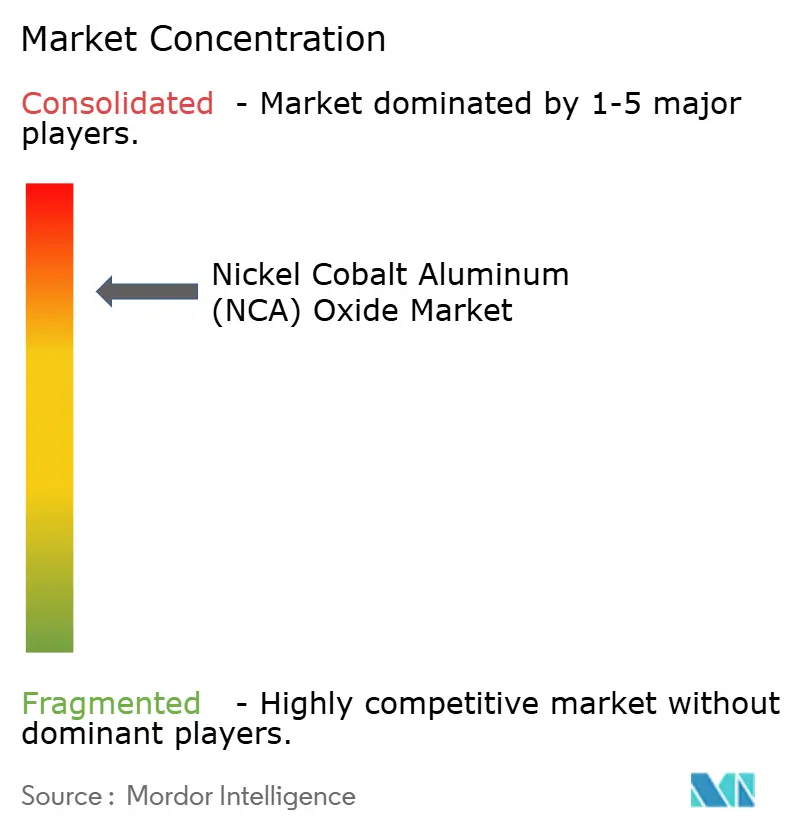
The Nickel Cobalt Aluminum Oxide market is consolidated in premium cathodes, with Korean and Japanese producers competing for qualification as non-Chinese original equipment manufacturers. Chinese producers, including Ningbo Ronbay, Ningbo Shanshan, CNGR Advanced Material, and Beijing Easpring, remain influential in global ternary cathode output due to their scale and cost advantages. Korean manufacturers have emphasized vertical integration from raw material processing through precursor and finished cathode production. POSCO Future M has developed a chain from nickel sulfate to domestically produced precursors at Gwangyang and finished high-nickel cathodes. This configuration supports customer requirements for supply chain independence and compliance with foreign entity of concern requirements, and favors suppliers with established integrated operations and long-standing customer relationships.
Competitive opportunity is concentrated in ultra-high-nickel single-crystal NCA above 95% nickel and in closed-loop recycling of certified nickel and cobalt inputs, where specialized process capability limits qualified supply. Umicore's revised roadmap targeted a total of 195 GWh of cathode manufacturing capacity globally by the end of 2026, reflecting a shift from expansion toward asset utilization in a difficult margin environment. The market also requires improved recovery of critical materials as demand for recycled inputs expands. Research on recycling nickel-rich cathodes has emphasized retaining both structural and functional value through circular material systems.
Technology and ownership structures are also reshaping the competitive landscape. LG Chem developed a direct-metal-to-cathode synthesis process in 2025 that bypasses the conventional precursor step, reducing supply chain complexity and production cost. Ningbo Ronbay restructured its Jae Se unit in South Korea to make cathode output available to North American original equipment manufacturers while addressing foreign entity of concern considerations. These developments indicate that access to North American customers depends on both material capability and ownership structure, while leaving room for specialists in advanced high-nickel products or verified recycled material inputs.
Nickel Cobalt Aluminum (NCA) Oxide Industry Leaders
-
Sumitomo Metal Mining Co., Ltd.
-
ECOPRO
-
BASF
-
Ningbo Ronbay New Energy Technology Co., Ltd.
-
L&F Co., Ltd.
- *Disclaimer: Major Players sorted in no particular order
Nickel Cobalt Aluminum (NCA) Oxide Market Companies Covered in this Report
- BASF
- Beijing Easpring Material Technology Co., Ltd.
- Changyuan Lico Co., Ltd.
- CNGR Advanced Material Co., Ltd.
- ECOPRO
- GEM Co., Ltd.
- L&F Co., Ltd.
- LG Chem
- Nihon Kagaku Sangyo Co., Ltd.
- Ningbo Ronbay New Energy Technology Co., Ltd.
- Ningbo Shanshan Co., Ltd.
- POSCO FUTURE M
- Redwood Materials, Inc.
- Sumitomo Metal Mining Co., Ltd.
- Tesla, Inc.
- Umicore
Recent Industry Developments in Nickel Cobalt Aluminum (NCA) Oxide Market
- June 2026: EcoPro held a shipment ceremony at its Debrecen, Hungary, facility, marking the first high-nickel NCA deliveries to European automotive OEMs from a plant with a 54,000-ton annual capacity. The facility is being developed as an EU Critical Raw Materials Act (CRMA)-compliant production base, supported by EcoPro's Indonesian nickel smelter investment.
- June 2026: DOWA ECO-SYSTEM, Japan, announced the establishment of a recycling process for recovering lithium, nickel, and cobalt from lithium-ion batteries, with nickel and cobalt sulfates being sampled by cathode material producers. This supports the EU Battery Regulation's 2030 recovery targets and positions Japan-origin recycled materials as a future input for NCA producers.
Global Nickel Cobalt Aluminum (NCA) Oxide Market Report Scope
Nickel Cobalt Aluminum (NCA) Oxide is a mixed metal oxide compound used as the active cathode material in high-performance lithium-ion batteries. It provides high energy density and a long battery range.
The nickel cobalt aluminum (NCA) oxide market is segmented by specification, application, and geography. By specification, the market is segmented into high purity (greater than or equal to 98%), standard purity (less-than 98%), and other specifications. By application, the market is segmented into electric vehicles, energy storage systems, consumer electronics, and others (power tools, medical devices, aerospace, and defense). The report also covers market size and forecasts for nickel cobalt aluminum (NCA) oxide across 15 countries in major regions. The market sizes and forecasts are provided in terms of value (USD).
Segmentation Overview
| High Purity (greater than or equal to 98%) |
| Standard Purity (less-than 98%) |
| Others |
| Electric Vehicles |
| Energy Storage Systems |
| Consumer Electronics |
| Others (Power Tools, Medical Devices, Aerospace, and Defense) |
| Asia-Pacific | China |
| India | |
| Japan | |
| South Korea | |
| ASEAN Countries | |
| Rest of Asia-Pacific | |
| North America | United States |
| Canada | |
| Mexico | |
| Europe | Germany |
| United Kingdom | |
| France | |
| Italy | |
| NORDIC Countries | |
| Rest of Europe | |
| South America | Brazil |
| Argentina | |
| Rest of South America | |
| Middle-East and Africa | Saudi Arabia |
| South Africa | |
| Rest of Middle-East and Africa |
| By Specification | High Purity (greater than or equal to 98%) | |
| Standard Purity (less-than 98%) | ||
| Others | ||
| By Application | Electric Vehicles | |
| Energy Storage Systems | ||
| Consumer Electronics | ||
| Others (Power Tools, Medical Devices, Aerospace, and Defense) | ||
| By Geography | Asia-Pacific | China |
| India | ||
| Japan | ||
| South Korea | ||
| ASEAN Countries | ||
| Rest of Asia-Pacific | ||
| North America | United States | |
| Canada | ||
| Mexico | ||
| Europe | Germany | |
| United Kingdom | ||
| France | ||
| Italy | ||
| NORDIC Countries | ||
| Rest of Europe | ||
| South America | Brazil | |
| Argentina | ||
| Rest of South America | ||
| Middle-East and Africa | Saudi Arabia | |
| South Africa | ||
| Rest of Middle-East and Africa | ||
Key Questions Answered in the Report
What is current market size of Nickel Cobalt Aluminum (NCA) Oxide Market?
The Nickel Cobalt Aluminum (NCA) Oxide Market size was valued at USD 3.13 billion in 2025 and is estimated to grow from USD 3.49 billion in 2026 to reach USD 6.30 billion by 2031, at a CAGR of 12.56% during the forecast period (2026-2031).
Which NCA specification leads demand?
High-purity NCA with nickel content of at least 98% led with a 61.23% share in 2025 and is forecast to grow at a 13.52% CAGR through 2031.
What is the leading application for NCA cathodes?
Electric vehicles were the leading application, accounting for 62.06% of demand in 2025, while energy storage systems recorded the highest forecast CAGR at 14.03%. Stationary storage demand is linked to the integration of renewable power and rising electricity needs from data centers.
Which region leads to demand for NCA cathodes?
Asia-Pacific led with a 45.62% share in 2025 and is forecast to record a 13.13% CAGR through 2031.