
New Zealand Kiwi Market Size and Share
New Zealand Kiwi Market Analysis by Mordor Intelligence
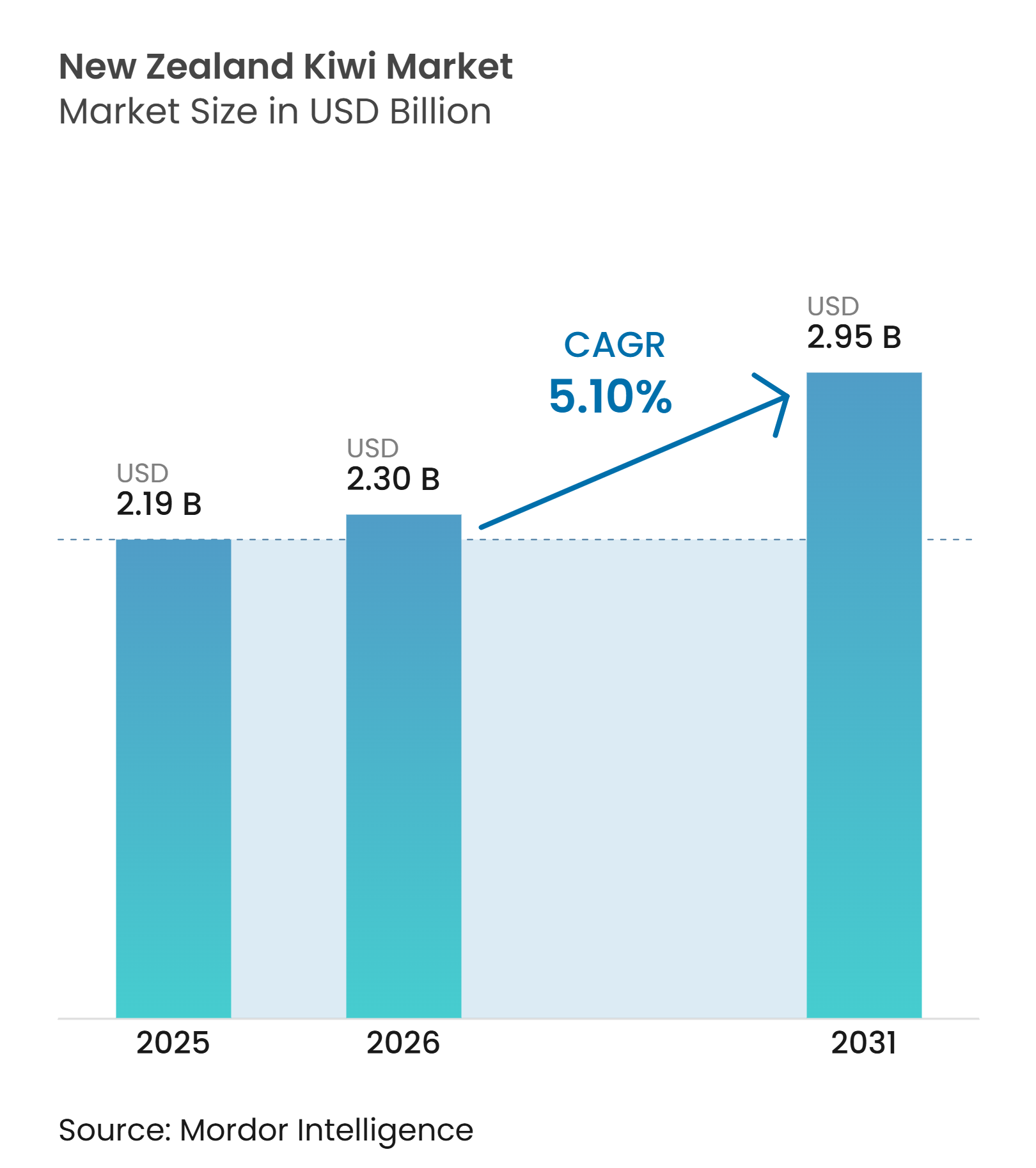
The New Zealand Kiwi Market size stood at USD 2.19 billion in 2025 and is projected to grow from USD 2.30 billion in 2026 to USD 2.95 billion by 2031, at a CAGR of 5.10% during 2026–2031. The New Zealand kiwi market continues to be shaped by premium pricing rather than by simple output growth, which keeps export earnings resilient even when supply conditions vary across seasons. The single-desk structure of Zespri Group Limited gives the New Zealand kiwi market a rare combination of pricing discipline, concentrated brand control, and high operational dependence on one marketer. The removal of European Union tariffs, the rise in premium gold and red varieties, and maturing orchards are all strengthening the growth path of the New Zealand kiwi market. At the same time, weather exposure, labor costs, freight pressure, and infrastructure limits are forcing growers and post-harvest operators to invest earlier and more heavily in automation, offshore supply, and logistics resilience.
Key Report Takeaways
- The European Union remained a key destination for New Zealand kiwifruit exports, with export value increasing approximately 42% in 2025, following the entry into force of the New Zealand–European Union Free Trade Agreement (FTA).
Note: Market size and forecast figures in this report are generated using Mordor Intelligence’s proprietary estimation framework, updated with the latest available data and insights as of January 2026.
Market Trends and Insights
Drivers Impact Analysis of New Zealand Kiwi Market*
| Driver | (~) % Impact on CAGR Forecast | Geographic Relevance | Impact Timeline |
|---|---|---|---|
| Rising global demand for premium health-focused fruit | +1.2% | Global, especially China, United States, and European Union | Medium term (2-4 years) |
| Zespri-led brand premium and 12-month supply strategy | +1.0% | Global | Long term (≥ 4 years) |
| Orchard maturation and gold variety yield expansion | +0.9% | New Zealand, especially Bay of Plenty, Northland, and East Coast | Short term (≤ 2 years) |
| Trade access gains in Europe and Asia | +0.8% | European Union, Japan, India, and Comprehensive and Progressive Agreement for Trans-Pacific Partnership markets | Medium term (2-4 years) |
| Growth in licensed offshore supply to protect shelf space | +0.6% | European Union, Japan, and South Korea | Long term (≥ 4 years) |
| New variety commercialization and product portfolio depth | +0.4% | Global | Medium term (2-4 years) |
| Source: Mordor Intelligence | |||
Rising Global Demand for Premium Health-Focused Fruit
Demand for fruit with a clear health position continues to support the New Zealand kiwi market across retail channels. Gold kiwifruit household penetration increased by 3.2% globally in 2024, indicating that category adoption is still expanding even after strong gains in developed markets. Taiwan reached 74.9% household penetration, while Singapore and Belgium both reached 49.7%, which suggests the fruit already has a stable consumer base in several higher-value markets[1]. China at 16.7% and the United States at 8.4% still leave substantial room for further uptake, leaving the New Zealand kiwi market with substantial expansion headroom in two priority destinations. Kiwifruit still accounts for less than 1% of the global fresh fruit market, so small gains in household penetration can translate into meaningful export upside for the New Zealand kiwi market. In mature destinations, high household penetration indicates an established consumer base, while lower-penetration markets provide greater scope for further category adoption.
Zespri-Led Brand Premium and 12-Month Supply Strategy
Zespri Group Limited remains central to the New Zealand kiwifruit market because it manages supply, marketing, and brand positioning more like a branded consumer-product company than a commodity exporter. The 2024 Producer Vote approved up to 420 additional offshore hectares of SunGold (yellow-fleshed kiwifruit variety) per year over 6 years across Italy, France, Japan, South Korea, and Greece, which supports a year-round shelf presence[2]. That matters because the New Zealand kiwi market earns a premium when retailers do not need to switch shelf space back to unbranded alternatives during the domestic off-season. This supply model gives the New Zealand kiwi market stronger control over retail continuity, pricing discipline, and product positioning than most fresh produce categories.
Orchard Maturation and Gold Variety Yield Expansion
The New Zealand kiwi market is also benefiting from the natural yield progression of orchards planted during the last expansion cycle. SunGold orchards (yellow-fleshed kiwifruit variety) generally enter stronger commercial production after 4 or more years, and many blocks planted between 2018 and 2022 are now entering that phase. Total planted area increased from 14,512 hectares in 2023/24 to a forecast 15,425 hectares in 2025/26, while production rose from 593,070 metric tons to 800,000 metric tons over the same period[3]. The increase in production, therefore, reflects both continued expansion of planted area and the increasing contribution of maturing orchards entering stronger commercial production stages, providing an additional supply-growth pathway beyond new acreage expansion. Yield improvements associated with changes in dormancy-breaking chemical use are also enhancing orchard productivity, which could further strengthen the New Zealand kiwifruit supply base in the coming seasons.
Trade Access Gains in Europe and Asia
Trade policy changes have become a direct driver of growth for the New Zealand kiwi market. The New Zealand–European Union Free Trade Agreement (FTA) entered into force on 1 May 2024, eliminating EU tariffs on New Zealand kiwifruit exports. According to the New Zealand Ministry of Foreign Affairs and Trade (MFAT), following implementation, New Zealand and India substantively concluded FTA negotiations in December 2025, securing preferential quota access for New Zealand kiwifruit, securing duty-free quota access for kiwifruit and a 50% reduction in India's prevailing 33% tariff on qualifying out-of-quota shipments, effectively reducing the tariff to 16.5%. Preferential access under the Comprehensive and Progressive Agreement for Trans-Pacific Partnership also supports the New Zealand kiwi market in Japan, South Korea, Canada, and Peru, although phytosanitary compliance remains important at each destination.
Restraints Impact Analysis of New Zealand Kiwi Market*
| Restraint | (~) % Impact on CAGR Forecast | Geographic Relevance | Impact Timeline |
|---|---|---|---|
| Climate volatility and harvest disruption risk | -1.2% | New Zealand, especially Bay of Plenty and Hawke's Bay | Short term (≤ 2 years) |
| Single-desk export structure and regulatory dependence | -0.8% | New Zealand | Long term (≥ 4 years) |
| Labour availability and seasonal workforce constraints | -0.6% | New Zealand | Medium term (2-4 years) |
| High freight, packing, and cold-chain cost pressure | -0.5% | Global supply chain | Medium term (2-4 years) |
| Source: Mordor Intelligence | |||
Climate Volatility and Harvest Disruption Risk
Climate exposure remains one of the most significant physical risks facing the New Zealand kiwifruit market, as production is concentrated in a limited number of regions, particularly the Bay of Plenty. The industry remains vulnerable to warmer winters, insufficient chill accumulation, severe wind, hail, flooding, and cyclonic events, which can affect dormancy, flowering, fruit development, and marketable yields. Severe weather can also damage vines, shelterbelts, and orchard infrastructure, with recovery potentially extending across 2–3 growing seasons, increasing replanting, maintenance, and labor costs beyond the initial loss year. Rising temperatures and changing rainfall patterns may further increase variability in flowering and harvest timing, while extreme rainfall can raise waterlogging, disease, and orchard-access risks. These conditions increase yield and cost volatility, making climate-resilient orchard management, infrastructure protection, and geographic diversification increasingly important for maintaining reliable export supply and premium fruit quality.
Single-Desk Export Structure and Regulatory Dependence
The New Zealand kiwi market operates under a concentrated regulatory structure, as the Kiwifruit Export Regulations 1999 grant Zespri Group Limited exclusive export rights outside Australia. Kiwifruit New Zealand oversees compliance with rules on non-discrimination, prior notice, non-diversification, and information disclosure under the same system. This framework creates discipline and supports premium capture, but it also leaves growers dependent on one export route for most overseas sales. The requirement for grower approval on major strategic initiatives can affect the speed at which Zespri responds to changing market opportunities, particularly when expansion requires approval. The 2022 rejection of Zespri's offshore expansion proposal and the subsequent approval of a revised proposal in 2024 demonstrate how the producer-approval process can extend the timeline for strategic expansion and delay the deployment of capital into new production regions. For the market, this can slow supply diversification and reduce flexibility in responding to rising overseas demand or changing production conditions. Any future change to the single-desk system would also entail significant transition costs, as overseas distribution and customer relationships have been built under a centralized model for decades.
*Our forecasts treat driver/restraint impacts as directional, not additive. The impact forecasts reflect baseline growth, mix effects, and variable interactions.
Geography Analysis
The Bay of Plenty remains the dominant kiwifruit-producing region in New Zealand, supported by its favorable climate, established orchard base, packhouse infrastructure, and proximity to the Port of Tauranga. Northland, Waikato, Hawke's Bay, Nelson, and other regions provide additional production capacity, contributing to geographic diversification within the domestic supply base. This concentration in the Bay of Plenty gives the region a central role in New Zealand's export-oriented kiwifruit industry, while expansion into other growing regions provides opportunities to increase production capacity and reduce reliance on a single geographic production base. The regional production structure also supports efficient aggregation, packing, and export logistics, strengthening New Zealand's ability to supply international markets at scale.
China presents both a demand opportunity and a competitive challenge for the New Zealand kiwifruit market, as it is simultaneously the world's largest producer and a major export destination. Strong Chinese consumer demand for premium imported fruit supports higher price realization for New Zealand exporters, even as domestic Chinese production creates competition. India represents the fastest-growing external market, as the December 2025 agreement established a new quota-based entry path from a previously high tariff base, opening access to a large and growing consumer base that was largely inaccessible before. This creates a significant opportunity for volume growth for New Zealand kiwifruit exporters. New Zealand kiwifruit currently reaches 55 international markets, providing a broad geographic base that reduces dependence on any single market and supports further premium expansion across diverse regions.
Imports remain a limited component of the New Zealand kiwifruit market because the industry is primarily export-oriented and uses offshore-licensed Zespri production to maintain year-round supply. Non-New Zealand-grown Zespri volumes reached 32.3 million trays in 2025/26, supporting continuity of retailer programs outside the New Zealand harvest season, with Italy remaining the largest offshore production base. This offshore model extends Zespri's geographic reach while reducing seasonal supply gaps in key international markets. At the same time, per-tray returns showed mixed movements, with the Zespri SunGold Kiwifruit variety increasing from NZD 11.81 per tray in 2024 to NZD 11.90 in 2025, while the Zespri RubyRed Kiwifruit variety declined from NZD 17.00 to NZD 16.01. Both varieties, however, exceeded Zespri's February 2025 forecasts, indicating stronger-than-projected final returns. The combination of offshore production and premium branded varieties therefore enables geographic expansion while supporting supply continuity and value capture, rather than relying solely on higher shipment volumes.
Competitive Landscape
The New Zealand kiwi market has an unusual competitive structure: export marketing is centralized, orchard ownership is dispersed, and post-harvest competition remains active. Zespri Group Limited sits at the center of the New Zealand kiwi market through exclusive single-desk export rights outside Australia, leaving little direct competition for overseas market access. Competition is therefore strongest among post-harvest operators competing for grower supply, processing capacity, and service quality. EastPack Limited, Apata Group Limited, and Trevelyan's Pack and Cool Ltd remain relevant operators, but scale is increasingly important in the New Zealand kiwi market.
Strategic moves in the New Zealand kiwi market show a clear pattern of building control over varieties, logistics, and processing efficiency. Zespri Group Limited expanded RubyRed into 16 markets in 2026, which shows that branded variety rollout remains a priority growth lever. Zespri Group Limited also commercialized Red80 in late 2025 to extend the premium red-fruit selling window, thereby strengthening the company’s portfolio depth. Seeka Limited completed 3 Reemoon optical sorting installations in 2025, showing how large operators are responding to labor pressures and quality demands through automation. Zespri Group Limited and Fresh Carriers Co., Ltd. also completed a low-emissions-fuel charter voyage in March 2025, which points to future competition around lower-carbon shipping performance.
The main competitive opening is not in replacing the export model, but in serving it more efficiently and profitably. Smaller operators such as Cooper Coolpac Limited, Kainui Pack and Cool Ltd, and Birchwood Packhouse Limited still hold regional roles, yet the New Zealand kiwi market is asking for more capital spending than many niche operators can absorb. The strongest advantage now comes from multi-site packing, automation, cool-store discipline, and the ability to support premium varieties with tighter quality control. That means competition in the New Zealand kiwi market is moving away from simple throughput and toward reliability, technical capability, and alignment with Zespri Group Limited’s branded standards. As premium varieties, offshore supply, and sustainability targets expand, firms that cannot invest at scale are likely to remain relevant only in narrower regional positions.
Recent Industry Developments in New Zealand Kiwi Market
- April 2026: New Zealand concluded the NZ-India Free Trade Agreement, which provides a tariff-free quota of approximately 15,000 MT per year for kiwifruit exports. This replaces the pre-Free Trade Agreement (FTA) tariff of 33%, with above-quota volumes subject to a reduced rate of 16.5%. Once implemented, this agreement is projected to benefit the New Zealand kiwifruit market by improving access to one of the world's largest consumer markets, potentially driving higher export volumes and supporting grower returns.
- December 2025: Zespri Group Limited's board approved the commercialization of Red80, a kiwifruit cultivar with a later harvest window and longer storage life than Red19. 100 hectares of Red80 license were made available to growers in 2026, with commercial volumes anticipated in 2028.
- November 2025: The Kiwifruit Breeding Centre advanced 5 new green cultivars into first-stage commercial trials, with potential commercialization within 1–2 years, alongside a new gold cultivar targeted within five years. A dedicated 30-hectare trial orchard in Kerikeri is simultaneously testing rootstocks adapted to climate stress and reduced winter chill conditions.
New Zealand Kiwi Market Report Scope
A kiwi is a small, nutrient-dense fruit featuring a fuzzy, brown skin and vibrant green or golden flesh. The New Zealand Kiwi Market Report covers Production Analysis (Volume), Consumption Analysis (Value and Volume), Import Analysis (Value and Volume), Export Analysis (Value and Volume), Wholesale Price Trend Analysis, List of Key Players, and More. The Market Forecasts are Provided in Terms of Value (USD) and Volume (Metric Tons).
Segmentation Overview
| Production Analysis (Area Harvested, Yield, and Production Volume) |
| Consumption Analysis (Consumption Value and Volume) |
| Import Market Analysis (Import Value, Volume, and Key Supplying Markets) |
| Export Market Analysis (Export Value, Volume, and Key Destination Markets) |
| Wholesale Price Trend Analysis and Forecast |
| Regulatory Framework |
| List of Key Players |
| Logistics and Infrastructure |
| Seasonality Analysis |
| New Zealand | Production Analysis (Area Harvested, Yield, and Production Volume) |
| Consumption Analysis (Consumption Value and Volume) | |
| Import Market Analysis (Import Value, Volume, and Key Supplying Markets) | |
| Export Market Analysis (Export Value, Volume, and Key Destination Markets) | |
| Wholesale Price Trend Analysis and Forecast | |
| Regulatory Framework | |
| List of Key Players | |
| Logistics and Infrastructure | |
| Seasonality Analysis |
Key Questions Answered in the Report
What is the current value of the New Zealand kiwi market?
The New Zealand kiwi market estimated at USD 2.30 billion in 2026 and is projected to reach USD 2.95 billion by 2031, growing at a 5.10% CAGR.
What is driving growth in New Zealand kiwifruit exports?
Growth is being supported by premium fruit demand, tariff removal in the European Union and stronger branded shelf presence through year-round supply programs.
Which export destination is the most important for New Zealand kiwifruit?
The European Union was the largest export destination in 2024/25 with 32% of shipment volumes, ahead of China at 27% and Japan at 14%.
Why are gold and red kiwifruit becoming more important?
Premium varieties generate stronger returns, with RubyRed at NZD 16.01 (USD 9.4) per tray and SunGold at NZD 11.90 (USD 7.0), which is encouraging orchard conversion and portfolio expansion.