
Network Digital Twin Platforms Market Size and Share
Market Overview
| Study Period | 2020 - 2031 |
|---|---|
| Market Size (2026) | USD 1.44 Billion |
| Market Size (2031) | USD 3.37 Billion |
| Growth Rate (2026 - 2031) | 18.54 % |
| Fastest Growing Market | Asia-Pacific |
| Largest Market | North America |
| Market Concentration | Medium |
Major Players *Disclaimer: Major Players sorted in no particular order Image © Mordor Intelligence. Reuse requires attribution under CC BY 4.0. | |
Network Digital Twin Platforms Market Analysis by Mordor Intelligence
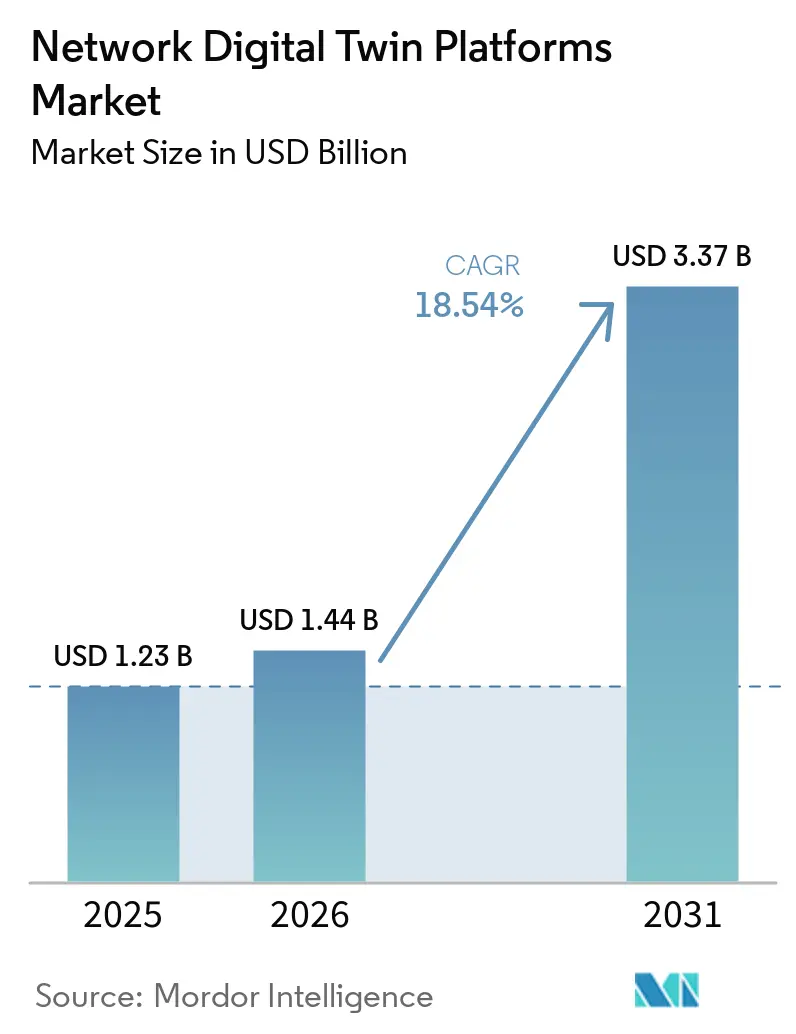
The Network digital twin platforms market size was valued at USD 1.23 billion in 2025 and is estimated to grow from USD 1.44 billion in 2026 to reach USD 3.37 billion by 2031, at a CAGR of 18.54% during the forecast period (2026-2031). The Network digital twin platforms market is supported by the greater operating complexity of standalone 5G and Open RAN deployments. These environments integrate components from several vendors, making testing changes on live networks more difficult. Operators are using virtual replicas to assess radio coverage, core capacity, and configuration changes before deployment. The move toward closed-loop automation also makes continuous synchronization more important than periodic planning exercises. Suppliers that combine simulation, data management, and application interfaces are well positioned to address a broader set of operational needs.
Key Report Takeaways
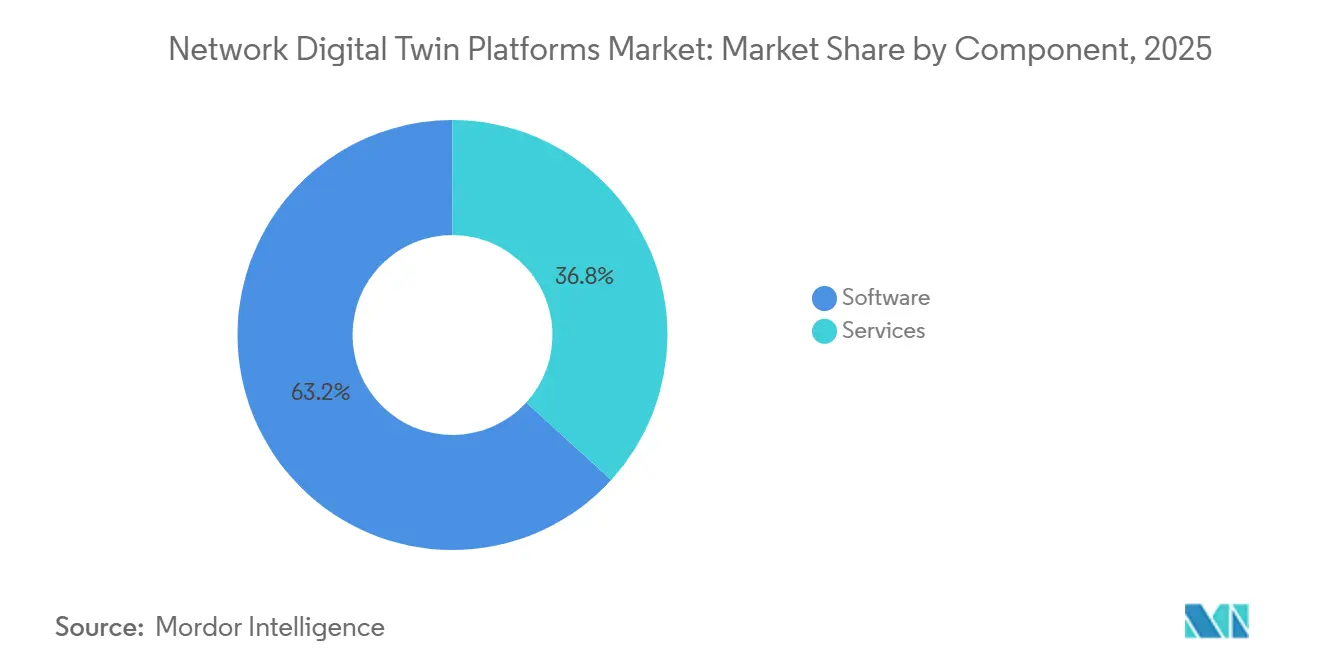
- By component, software held 63.22% of the network digital twin platforms market share in 2025 and is projected to grow at a 20.12% CAGR through 2031.
- By deployment mode, cloud-based deployment held 56.77% of 2025 revenue, while hybrid deployment is forecast to grow at a 19.87% CAGR through 2031.
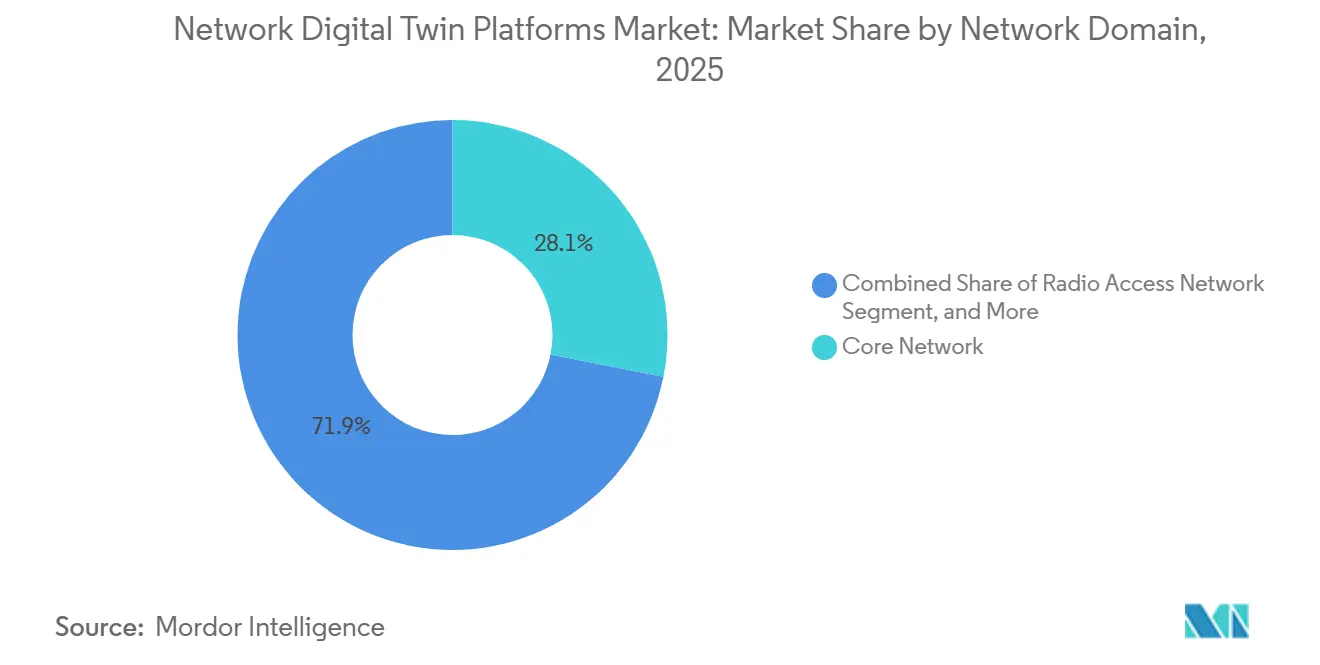
- By network domain, the core network held 28.11% of 2025 revenue, while edge and multi-access edge computing are forecast to grow at a 20.16% CAGR through 2031 in the network digital twin platforms market.
- By application, network performance monitoring and assurance held 31.12% of 2025 revenue, while capacity planning and traffic optimization is forecast to grow at a 19.67% CAGR through 2031.
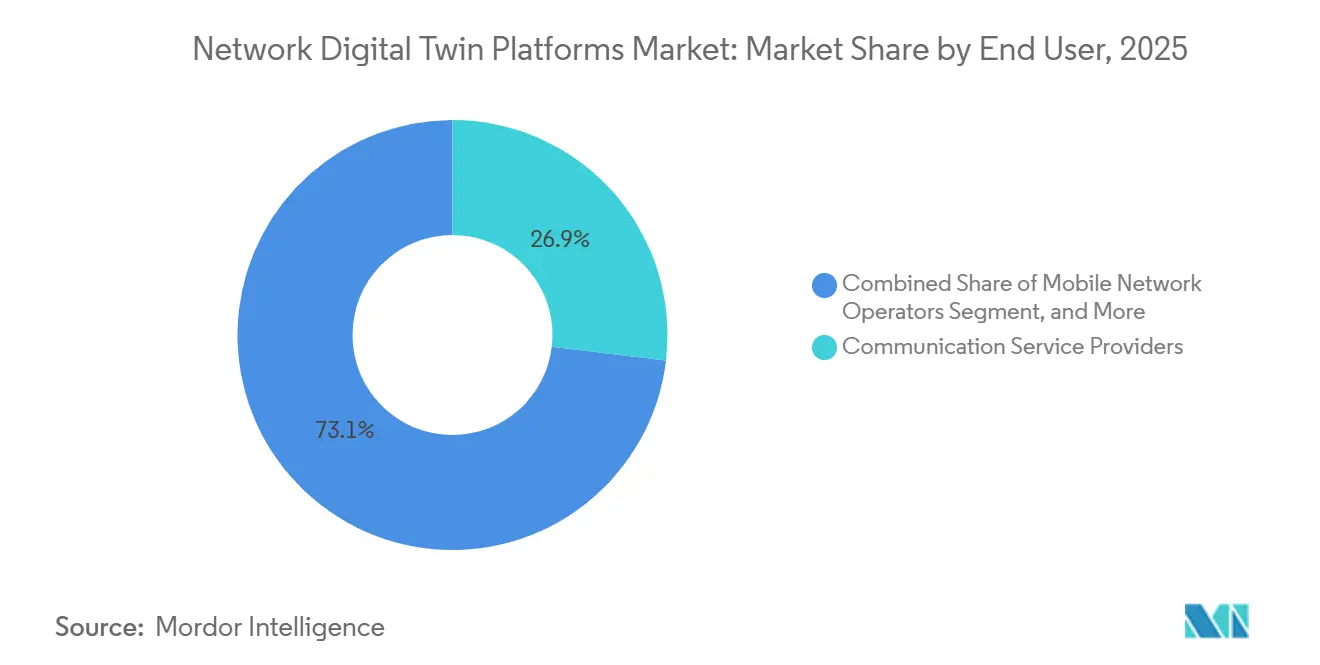
- By end user, communication service providers held 26.89% of 2025 revenue, while network equipment manufacturers are forecast to grow at a 20.17% CAGR through 2031.
- By geography, North America held 27.87% of 2025 revenue, while Asia-Pacific is forecast to grow at a 20.11% CAGR through 2031 in the network digital twin platforms market.
Note: Market size and forecast figures in this report are generated using Mordor Intelligence’s proprietary estimation framework, updated with the latest available data and insights as of January 2026.
Market Trends and Insights
Drivers Impact Analysis of Network Digital Twin Platforms Market*
| DRIVER | (~) % IMPACT ON CAGR FORECAST | GEOGRAPHIC RELEVANCE | IMPACT TIMELINE |
|---|---|---|---|
| 5G And Open RAN Network Complexity | +4.2% | Global, acute in North America, Asia-Pacific, and Europe | Short term (≤ 2 years) |
| Closed-Loop Automation and Agentic AI Validation | +3.8% | Global, led by North America and the Asia-Pacific | Medium term (2-4 years) |
| Network Energy Optimization and Carbon-Reduction Mandates | +2.9% | Europe, Asia-Pacific, and North America | Medium term (2-4 years) |
| Cloud-Native, Edge, And Multi-Cloud Infrastructure Growth | +2.6% | Global, accelerated in North America and the Asia-Pacific | Short term (≤ 2 years) |
| AI-Native 6G And High-Fidelity RAN Research | +2.1% | Asia-Pacific and North America, with spillover to Europe | Long term (≥ 4 years) |
| Digital Twin-Based Fiber and Fixed Access Modernization | +1.4% | Europe, North America, and the Asia-Pacific | Medium term (2-4 years) |
| Source: Mordor Intelligence | |||
5G and Open RAN Network Complexity
Disaggregated 5G and Open RAN architectures have changed radio access management from a single-vendor engineering discipline into a multi-vendor software coordination task that conventional labs cannot reproduce at scale. The O-RAN Alliance identifies high-fidelity digital twins as an environment for training and validating xApps and rApps without interrupting live operations, while requiring synchronized physical measurements, node models, and O1 telemetry that can trigger resynchronization when a model drifts.[1] Nokia launched its RAN Digital Twin on NVIDIA’s Aerial Omniverse Digital Twin platform in February 2026, using radio propagation simulation to assess beamforming, antenna placement, and handover performance in demanding mobility scenarios.[2] The O-RAN Alliance also supports a research platform at Northeastern University that automates data collection, training, and testing for xApps and rApps. The Network digital twin platforms market benefits when operators require site-specific evidence before committing capital to network changes.
Closed-Loop Automation and Agentic AI Validation
The move from rule-based automation to autonomous software agents raises the need for a safe environment to test proposed changes before they reach production systems. ETSI describes digital twins as a virtual sandbox for experimentation with self-healing and self-optimizing networks, and its work addresses interfaces that enable twin outputs to support closed-loop automation. NVIDIA states that its autonomous telecom work combines operational support systems, business support systems, telemetry, and digital twins when ranking remediation options.[3] This model places greater importance on dependable data connectors and clearly governed ontology management, because a poorly synchronized replica cannot safely guide automated activity. It also gives suppliers a recurring role in calibration, model maintenance, and integration rather than a limited role in a planning project. The Network digital twin platforms market can gain as operators treat the twin as an operations layer rather than a design-only tool.
Network Energy Optimization and Carbon-Reduction Mandates
Energy use is a material operational issue for telecom providers, especially in radio access networks that require many distributed sites and often experience substantial traffic fluctuations. Digital twins can test cell shutdown, beam deactivation, and other energy-saving policies before operators apply them, reducing the risk that a lower-energy setting will create an unexpected coverage gap. Nokia’s MantaRay Energy offering uses a digital twin to validate AI-optimized policies before deployment. Network energy-saving features in 5G Advanced also require operators to understand how decisions will perform under different load, coverage, and configuration conditions. The operational telemetry generated through these activities can support both energy management and future AI model development. The Network digital twin platforms market is driven by the need for verifiable energy decisions, improved network utilization, and support for sustainability reporting.
Cloud-Native, Edge, and Multi-Cloud Infrastructure Growth
Cloud-native functions and multi-access edge sites have expanded the set of conditions that operators must model, as service paths can span on-premises infrastructure, cloud regions, and edge clusters managed by separate organizations. ETSI’s work on NFV Release 6 describes the growing role of cloud-native virtualization and AI-driven orchestration in these environments. Cisco introduced Cloud Control in June 2026 as an agentic operations platform that includes digital twin simulation across networking, security, compute, and observability.[4] Private 5G offerings also need to test service-level objectives across edge and cloud resources before providers make commitments to enterprise customers. Suppliers that support Kubernetes-orchestrated RAN and containerized 5G core functions can address needs that older hardware-centered tools do not cover. These conditions reinforce demand for cloud and hybrid solutions across the Network digital twin platforms market.
Restraints Impact Analysis of Network Digital Twin Platforms Market*
| RESTRAINT | (~) % IMPACT ON CAGR FORECAST | GEOGRAPHIC RELEVANCE | IMPACT TIMELINE |
|---|---|---|---|
| High-Fidelity RF And GPU Infrastructure Cost | -1.8% | Global, acute for Tier 2 and Tier 3 operators in South America, the Middle East and Arica | Short term (≤ 2 years) |
| Multi-Vendor Data, Schema, And Ontology Fragmentation | -1.5% | Europe, North America, and multi-vendor Asia-Pacific markets | Medium term (2-4 years) |
| Cybersecurity Exposure from Twin-To-Live Network Connectivity | -1.2% | Europe, North America, and the Asia-Pacific | Medium term (2-4 years) |
| Scarcity of Telecom-Domain AI and Digital Twin Talent | -1.0% | South America, the Middle East and Arica, and Tier 2 Asia-Pacific markets | Long term (≥ 4 years) |
| Source: Mordor Intelligence | |||
High-Fidelity RF and GPU Infrastructure Cost
High-fidelity radio-frequency simulation requires specialized compute resources, calibrated real-world data, and sustained processing capacity, which can be difficult for Tier 2 and Tier 3 operators with limited information technology budgets. VIAVI states that city-scale RAN simulations need GPU acceleration and O-RAN-compliant software built for AI application validation. Cloud-hosted compute can reduce upfront capital spending, but it can introduce data-sovereignty concerns where network telemetry is regulated or treated as sensitive operational information. ETSI has also established cybersecurity requirements for AI systems used in network operations. Operators must balance fidelity, security controls, and operating costs rather than evaluate compute capacity in isolation. This constraint can slow adoption in price-sensitive parts of the Network digital twin platforms market.
Multi-Vendor Data, Schema, and Ontology Fragmentation
Mixed-vendor radio estates often use incompatible telemetry schemas, performance indicators, and ontology models, producing several isolated virtual replicas rather than a unified operational model. The FIDAL Horizon Europe project proposed a vendor-agnostic 5G data-space architecture and found gaps in the scope and interoperability of existing approaches. NIST identifies the heterogeneity of standards as a foundational trust challenge for digital twin systems, particularly when multiple federated instances require secure, reliable interaction. Fragmented data can reduce anomaly-detection quality, limit confidence in predictive maintenance, and delay returns from advanced AI applications. TM Forum’s Open Digital Architecture provides a partial path toward better vendor-interface consistency. Integration work remains a material barrier for the Network digital twin platforms market when operators seek a cross-domain view.
*Our forecasts treat driver/restraint impacts as directional, not additive. The impact forecasts reflect baseline growth, mix effects, and variable interactions.
Network Digital Twin Platforms Market Segment Analysis
By Component:
Software Anchors Platform Revenue While Services Bridge AdoptionSoftware is projected to account for 63.2% of the network digital twin platforms market in 2025 and is projected to grow at a 20.12% CAGR through 2031, reflecting a shift toward subscription-based and cloud-delivered solutions rather than hardware-centric purchasing. The category includes platform cores, simulation and emulation engines, analytics modules, data and topology management layers, and orchestration and assurance tools. The platform layer aggregates telemetry across vendor domains, hosts AI inference, and provides application interfaces for third-party automation tools. Control of this layer can influence switching economics across the broader technology stack, as it connects the data, models, and operational applications operators use. Software, therefore, remains the central control point within the platform environment.
Services include advisory, systems integration, implementation, migration, and managed support, bridging the gap between software procurement and operational deployment. Operators with limited digital twin expertise often require external support to develop model fidelity, translate data schemas, and connect operational support systems to new platforms. Multi-vendor network estates make systems integration particularly important, as customized middleware may be required to reconcile different equipment and performance data structures. TM Forum’s Open Digital Architecture provides a common framework that can increase demand for such integration services. Managed services can also transform calibration, model retraining, synchronization monitoring, and service-level accountability into recurring engagements rather than one-time implementation projects. This approach gives operators continued access to specialized resources after initial deployment.
By Deployment Mode:
Cloud Leads, Hybrid Momentum Redefines the ModelCloud-based deployment is projected to account for 56.77% of network digital twin platform revenue in 2025, driven by operators’ preference for elastic computing resources that scale with processing requirements. Detailed RAN simulation and energy optimization require substantial computing capacity, although these requirements do not remain constant throughout the day. Cloud deployment allows operators to scale workloads without maintaining an equivalent dedicated on-premises computing estate. It also enables faster deployment of analytics, data management, and application updates across distributed operations. These advantages support the current leadership of cloud-based delivery, particularly among operators seeking to expand simulation capacity, update analytics capabilities, and extend platforms across dispersed network sites without replacing local infrastructure.
Hybrid deployment is forecast to grow at a 19.87% CAGR through 2031, as it combines cloud-based AI and simulation capabilities with local processing of latency-sensitive or regulated data. Tech Mahindra and Microsoft are expected to collaborate in June 2026 to combine Azure services, Azure Digital Twins, and AI frameworks for complex multi-vendor telecommunications environments. On-premises systems will remain relevant for operators managing classified configurations, data localization requirements, or export control obligations. ETSI guidance on the explainability and transparency of AI processing may encourage operators to retain sensitive training data locally while using cloud capacity for other workloads. Hybrid deployment can therefore address data control requirements while preserving access to scalable computing resources, which is important when local regulations, commercial contracts, or internal security policies restrict the movement of network telemetry.
By Network Domain:
Core Network Commands Share as Edge Computing SurgesThe core network is projected to account for 28.11% of the network digital twin platforms market revenue in 2025, reflecting sustained investment in digital replicas of 5G standalone core functions. Operators use these twins to model session management, user-plane functions, authentication, policy control, and network slicing. Errors in these functions can affect a broad range of subscribers, services, and dependent applications. The core network also represents a relatively mature domain for twin deployment because its cloud-native microservices share development patterns with the container-based simulation frameworks used to build digital models. This technical alignment can reduce integration complexity compared with hardware-centric radio environments while enabling operators to test the service and policy functions that connect core operations with the wider network.
Edge and multi-access edge computing are forecast to expand at a 20.16% CAGR through 2031, as operators model latency-sensitive deployments before committing to industrial automation, autonomous communications, and private 5G service-level objectives. RAN twins also benefit from active standards development and research, with the O-RAN Alliance identifying them as an enabler of AI model validation and next-generation network development. Transport and backhaul twins are becoming increasingly relevant as network providers model optical paths, end-to-end latency, and automated service provisioning. NTT describes the use of optical network digital twin control loops to support on-demand services. Fixed broadband and fiber access represent smaller application areas but can use unified active and passive network views to reduce truck rolls, improve fault isolation, validate inventory records, and help field teams identify likely issues before visiting outside-plant locations.

By Application:
Performance Monitoring Defines Use Cases, Capacity Planning Scales FastestNetwork performance monitoring and assurance is projected to account for 31.12% of the network digital twin platforms market in 2025, making it the leading application, as it provides a lower-risk entry point for operators. Teams can validate configurations, observe service behavior, and compare proposed changes against expected network conditions before expanding automation. China Mobile Henan’s 2025 proof of concept is expected to demonstrate configuration validation that is up to 20 times faster than traditional laboratory methods, along with a 94% improvement in operational efficiency for the stated use case. These outcomes explain why monitoring and assurance often establish the operational foundation for more autonomous use cases. Operators can first build confidence in data quality and model behavior before allowing the platform to support a broader range of actions.
Capacity planning and traffic optimization are forecast to grow at a 19.67% CAGR through 2031, as AI-based traffic forecasting requires continuously calibrated models to assess congestion, service-level exposure, and infrastructure decisions. Predictive maintenance and fault management are also gaining importance as operators seek to identify failures earlier across transport and radio domains. AWS and NTT DOCOMO describe a proof of concept that combines a network digital twin graph with agentic AI to isolate transport and RAN failures within 15 seconds. Security testing and compliance validation can use a digital replica to simulate attacks and test responses without placing production infrastructure at risk. Network design and planning remain the entry point for operators beginning their digital twin adoption journey, while the network digital twin platforms industry is expanding as applications evolve from individual tools into connected workflows for planning, assurance, fault management, security testing, and capacity decisions.
By End User:
CSPs Drive Volume While Equipment Manufacturers Pivot to PlatformsCommunication service providers (CSPs) are projected to account for 26.89% of the network digital twin platforms market revenue in 2025, reflecting the scale and operational exposure of their network estates. CSPs manage the radio, core, transport, and service layers, which must operate together when implementing configuration or capacity changes. Failures across large networks can create service-related costs that significantly exceed platform licensing expenses. Consequently, CSPs have a strong incentive to validate changes before production deployment. Their demand also supports the broader use of digital twins beyond network design and into assurance and automation, as the same model can be updated as network conditions change and used by multiple operational teams.
Network equipment manufacturers are projected to grow at a 20.17% CAGR through 2031 as they embed validation environments into research, product delivery, and differentiation strategies. KDDI, KDDI Research, NVIDIA, Keysight Technologies, and Samsung Research America are expected to begin a high-fidelity 6G RAN digital twin collaboration in June 2026. Mobile network operators are preparing for 5G upgrades and 6G research cycles, while internet service providers can apply digital twins to fiber planning and outside-plant fault management. Tower companies can use these platforms for site-capacity planning, antenna placement, and multi-tenant lease planning. Enterprise users of private 5G networks represent a longer-term opportunity because they require direct visibility into service-level compliance rather than relying solely on carrier reporting, particularly when network performance affects industrial processes, site operations, or defined quality commitments.
Geography Analysis
North America Network Digital Twin Platforms Market
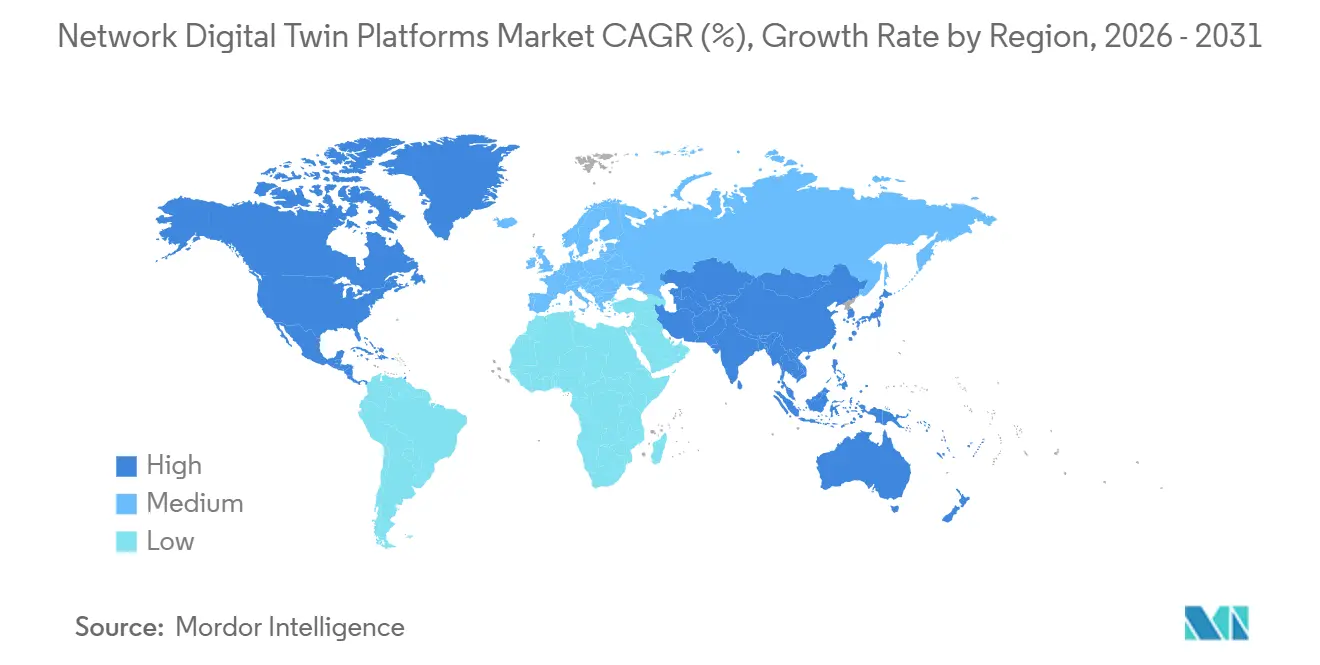
North America is expected to account for 27.87% of the Network Digital Twin Platforms Market in 2025. The region brings together tier-1 operators, cloud providers, and standalone 5G deployments, supporting sustained demand for real-time simulation and operational testing. The United States is the primary national contributor, with adoption across financial services firms, government agencies, and large enterprises. Canada uses these platforms for rural connectivity planning, where virtual models can reduce field survey requirements. Mexico applies similar capabilities to 5G spectrum and multiband radio planning.
Europe and South America Network Digital Twin Platforms Market
Europe represents the second-largest geographic cluster in the Network Digital Twin Platforms Market. Germany, the United Kingdom, and France support market activity through established operator bases and policy focus on network energy efficiency. ETSI documented a Deutsche Telekom and Huawei proof of concept that used twin feedback loops for intent-driven RAN energy optimization. ETSI's work on zero-touch service management also establishes integration expectations for twin-to-live interfaces. Italy and smaller European countries remain in the early stages of adoption, with fiber access modernization and transport planning serving as the primary use cases. Brazil and Argentina are piloting entry-level 5G capacity planning solutions that require less complex simulation environments, creating a foundation for broader adoption across South America.
APAC and MEA Network Digital Twin Platforms Market
Asia-Pacific is forecast to grow at a CAGR of 20.11% through 2031, the highest regional growth rate in the Network Digital Twin Platforms Market. China's city-scale programs, South Korea's advanced 5G deployments, and Japan's structured 6G research are driving regional momentum. KDDI's planned June 2026 collaboration will combine radio propagation simulation, user equipment emulation, and GPU computing, with a prototype milestone scheduled for March 2028. KDDI India has promoted digital twins for rural broadband planning, while Saudi Arabia and the United Arab Emirates use these platforms to support smart city initiatives and 5G expansion. Africa remains the smallest regional market, as infrastructure costs limit adoption primarily to planning applications. However, broader availability of cloud computing could increase uptake later in the forecast period.
Competitive Landscape
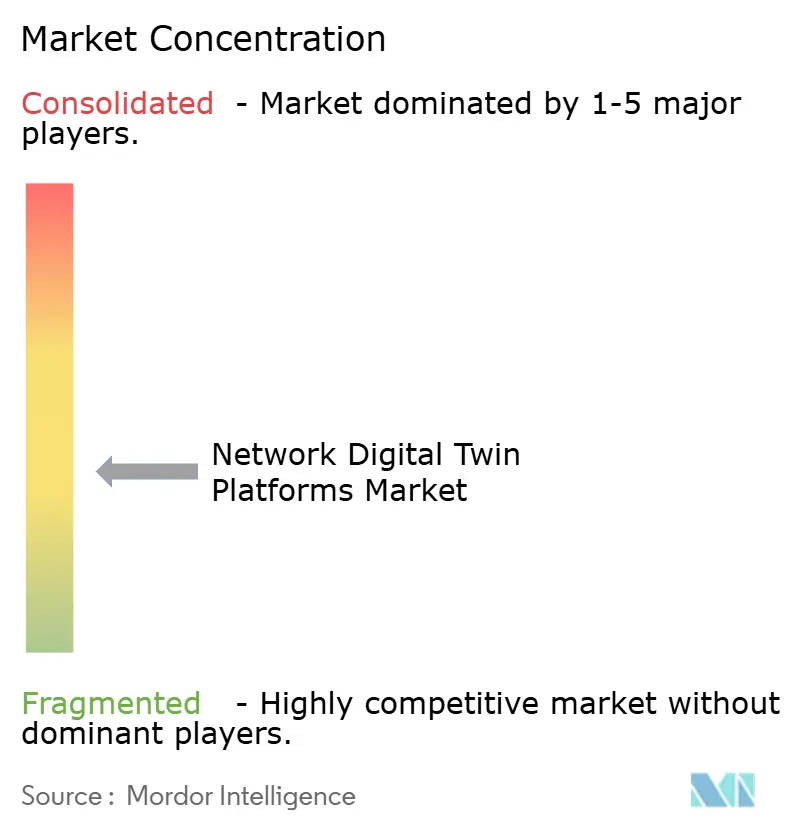
The Network Digital Twin Platforms Market has a tiered competitive structure comprising integrated telecommunications suppliers, cloud providers, and specialized platform vendors. Nokia, Ericsson, Huawei, and Cisco combine equipment, software, and long-standing relationships with operators. Amazon Web Services and Microsoft position digital twin capabilities within broader cloud and AI agreements. Forward Networks, VIAVI Solutions, and Keysight Technologies compete through mathematical precision, vendor neutrality, and support for industry standards. This competitive mix provides buyers with integrated and specialized platform options, requiring suppliers to compete on operational fit rather than a single technical feature.
Nokia is expected to extend its radio and fixed-access portfolio with a RAN Digital Twin in February 2026 and an FTTH Digital Twin in October 2025. Cisco is expected to introduce Cloud Control with simulation capabilities within a governed agent loop in June 2026. KDDI's 6G RAN Digital Twin collaboration demonstrates how equipment, testing, and computing suppliers are collaborating to develop validation infrastructure. Competition increasingly centers on agent validation, standards support, and energy analytics, particularly as operators seek to connect multiple network domains.
Operators often use separate tools for RAN, core, transport, and edge functions, creating integration requirements and sustaining the role of systems integrators and middleware suppliers. This fragmentation also supports demand for open-standard platform layers that can connect isolated twins. The Network Digital Twin Platforms Market offers opportunities across mid-market operators, private 5G deployments, and multivendor integration. ETSI requirements for AI cybersecurity provide an additional point of differentiation in regulated procurements. Suppliers that maintain synchronized and secure models can strengthen their market position as operators expand automation.
Network Digital Twin Platforms Industry Leaders
-
Nokia Corporation
-
Telefonaktiebolaget LM Ericsson
-
Cisco Systems, Inc.
-
Huawei Technologies Co., Ltd.
-
Microsoft Corporation
- *Disclaimer: Major Players sorted in no particular order
Network Digital Twin Platforms Market Companies Covered in this Report
- Nokia Corporation
- Telefonaktiebolaget LM Ericsson
- Huawei Technologies Co., Ltd.
- Microsoft Corporation
- VIAVI Solutions Inc.
- Cisco Systems, Inc.
- Juniper Networks, Inc.
- NEC Corporation
- Samsung Electronics Co., Ltd.
- Amazon Web Services, Inc.
- International Business Machines Corporation
- Keysight Technologies, Inc.
- Spirent Communications plc
- Ansys, Inc.
- Forward Networks, Inc.
- Mavenir Systems, Inc.
- Oracle Corporation
- Siemens AG
- Netcracker Technology Corporation
- Cohere Technologies, Inc.
Recent Industry Developments in Network Digital Twin Platforms Market
- August 2026: Infoblox completed its acquisition of Kentik, a leading network intelligence and observability platform, integrating real-time network-flow, routing, path, and performance intelligence with Infoblox's authoritative DNS and asset-visibility capabilities to create a trusted data foundation for AI-driven network operations and AgenticOps. The combined platform underpins digital twin-adjacent use cases, including continuous topology discovery, multi-cloud path visibility, and preemptive security posture management across hybrid environments.
- June 2026: KDDI Corporation and KDDI Research launched a high-fidelity 6G RAN Digital Twin collaboration with NVIDIA, Keysight Technologies, and Samsung Research America. The platform combines high-fidelity radio-propagation simulation, user-equipment emulation, and GPU-accelerated computing to enable safe AI-native RAN algorithm training and "what-if" network optimization, with a prototype milestone set for March 2028 and commercial-network validation targeted for FY2030.
- June 2026: Tech Mahindra and Microsoft announced a collaboration to deploy an AI-driven 5G Network Digital Twin integrating Microsoft Azure, Microsoft Fabric, Azure Digital Twins, Microsoft Foundry, and agentic AI frameworks. The platform targets medium and large CSPs managing complex multi-vendor networks, supporting autonomous decision-making, closed-loop orchestration, and enterprise-facing 5G SLA slice management.
- June 2026: Cisco Systems unveiled Cloud Control at Cisco Live US, an agentic network operations platform that integrates Digital Twin simulation into a governed agent loop spanning networking, security, compute, and observability. Powered by Cisco's Deep Network Model grounded in 40 years of operational data, Cloud Control entered controlled US availability on June 2, 2026, with connectivity to more than 50 third-party platforms via open Model Context Protocol.
Global Network Digital Twin Platforms Market Report Scope
The Network Digital Twin Platforms Market is Segmented by Component (Software [Network Digital Twin Platform Software, Simulation and Emulation Software, Analytics, AI, and Optimization Software, Data, Inventory, and Topology Software, and Orchestration and Assurance Software] and Services[Consulting and Advisory Services, Systems Integration Services, Implementation and Migration Services, and Managed Operations and Support Services]), Deployment Mode (Cloud-Based, On-Premise, and Hybrid), Network Domain (RAN, Core, Transport and Backhaul, Edge and Multi-Access Edge Computing, Fixed Broadband and Fiber Access, and Other Network Domain), Application (Network Design and Planning, Network Performance Monitoring and Assurance, Predictive Maintenance and Fault Management, Capacity Planning and Traffic Optimization, Security Testing and Compliance Validation, and Other Applications), End User (Communication Service Providers, Mobile Network Operators, Internet Service Providers, Tower Companies, Network Equipment Manufacturers, and Other End Users), and Geography (North America, South America, Europe, Asia-Pacific, Middle East andAfrica). The Market Forecasts are Provided in Terms of Value (USD).
Segmentation Overview
| Software | Network Digital Twin Platform Software |
| Simulation and Emulation Software | |
| Analytics, AI, and Optimization Software | |
| Data, Inventory, and Topology Software | |
| Orchestration and Assurance Software | |
| Services | Consulting and Advisory Services |
| Systems Integration Services | |
| Implementation and Migration Services | |
| Managed Operations and Support Services |
| Cloud-Based |
| On-Premise |
| Hybrid |
| Radio Access Network |
| Core Network |
| Transport and Backhaul |
| Edge and Multi-Access Edge Computing |
| Fixed Broadband and Fiber Access |
| Other Network Domain |
| Network Design and Planning |
| Network Performance Monitoring and Assurance |
| Predictive Maintenance and Fault Management |
| Capacity Planning and Traffic Optimization |
| Security Testing and Compliance Validation |
| Other Applications |
| Communication Service Providers |
| Mobile Network Operators |
| Internet Service Providers |
| Tower Companies |
| Network Equipment Manufacturers |
| Other End Users |
| North America | United States |
| Canada | |
| Mexico | |
| South America | Brazil |
| Argentina | |
| Rest of South America | |
| Europe | Germany |
| United Kingdom | |
| France | |
| Italy | |
| Rest of Europe | |
| Asia-Pacific | China |
| Japan | |
| South Korea | |
| India | |
| Rest of Asia-Pacific | |
| Middle East | Saudi Arabia |
| United Arab Emirates | |
| Rest of Middle East | |
| Africa | South Africa |
| Nigeria | |
| Rest of Africa |
| By Component | Software | Network Digital Twin Platform Software |
| Simulation and Emulation Software | ||
| Analytics, AI, and Optimization Software | ||
| Data, Inventory, and Topology Software | ||
| Orchestration and Assurance Software | ||
| Services | Consulting and Advisory Services | |
| Systems Integration Services | ||
| Implementation and Migration Services | ||
| Managed Operations and Support Services | ||
| By Deployment Mode | Cloud-Based | |
| On-Premise | ||
| Hybrid | ||
| By Network Domain | Radio Access Network | |
| Core Network | ||
| Transport and Backhaul | ||
| Edge and Multi-Access Edge Computing | ||
| Fixed Broadband and Fiber Access | ||
| Other Network Domain | ||
| By Application | Network Design and Planning | |
| Network Performance Monitoring and Assurance | ||
| Predictive Maintenance and Fault Management | ||
| Capacity Planning and Traffic Optimization | ||
| Security Testing and Compliance Validation | ||
| Other Applications | ||
| By End User | Communication Service Providers | |
| Mobile Network Operators | ||
| Internet Service Providers | ||
| Tower Companies | ||
| Network Equipment Manufacturers | ||
| Other End Users | ||
| By Geography | North America | United States |
| Canada | ||
| Mexico | ||
| South America | Brazil | |
| Argentina | ||
| Rest of South America | ||
| Europe | Germany | |
| United Kingdom | ||
| France | ||
| Italy | ||
| Rest of Europe | ||
| Asia-Pacific | China | |
| Japan | ||
| South Korea | ||
| India | ||
| Rest of Asia-Pacific | ||
| Middle East | Saudi Arabia | |
| United Arab Emirates | ||
| Rest of Middle East | ||
| Africa | South Africa | |
| Nigeria | ||
| Rest of Africa | ||
Key Questions Answered in the Report
How large is the Network digital twin platforms market?
It is estimated at USD 1.44 billion in 2026 and is forecast to reach USD 3.37 billion by 2031 at an 18.54% CAGR.
What is driving the adoption of network digital twin platforms?
5G and Open RAN complexity, closed-loop automation, energy optimization, and cloud-native edge infrastructure are increasing adoption across the Network digital twin platforms market. These forces make it more important to test a change before it affects a live service.
Which component led revenue in 2025?
Software led with 63.22% of 2025 revenue, as it includes the platform, analytics, orchestration, and AI layers. This central role supports its leading position in the Network digital twin platforms market.
Which deployment model is growing fastest?
Hybrid deployment is forecast to grow at a 19.87% CAGR through 2031 as operators combine cloud scalability with local data controls. It addresses an important deployment choice for the Network digital twin platforms market.
Which network domain has the highest forecast growth?
Edge and multi-access edge computing are forecast to expand at a 20.16% CAGR through 2031.