
Network API Monetization Market Size and Share
Market Overview
| Study Period | 2020 - 2031 |
|---|---|
| Market Size (2026) | USD 3.58 Billion |
| Market Size (2031) | USD 14.15 Billion |
| Growth Rate (2026 - 2031) | 31.64 % |
| Fastest Growing Market | Asia-Pacific |
| Largest Market | North America |
| Market Concentration | Medium |
Major Players *Disclaimer: Major Players sorted in no particular order Image © Mordor Intelligence. Reuse requires attribution under CC BY 4.0. | |
Network API Monetization Market Analysis by Mordor Intelligence
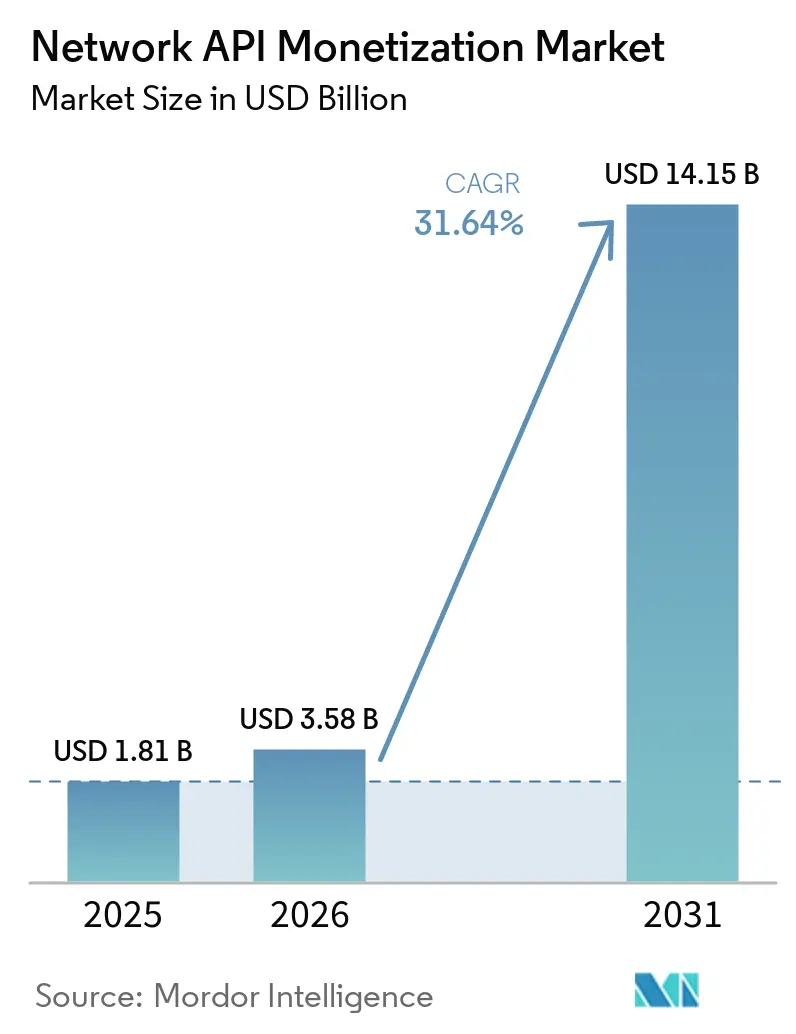
The Network API Monetization Market size is projected to expand from USD 1.81 billion in 2025 to USD 3.58 billion in 2026, and to USD 14.15 billion by 2031, registering a CAGR of 31.64% between 2026 and 2031. Growth rests on operators exposing network capabilities as programmable services rather than relying only on connectivity revenue. Standalone 5G makes this shift more practical because it supports controlled access to session, bandwidth, and network-slice functions. Common API standards are also reducing the need for enterprises to work with separate operator interfaces. Fraud prevention has created the first repeatable commercial use case, while automotive, industrial, and AI-enabled workflows are broadening demand. The Network API Monetization Market is therefore moving from early demonstrations toward distribution, developer adoption, and repeatable usage-based revenue models.
Key Report Takeaways
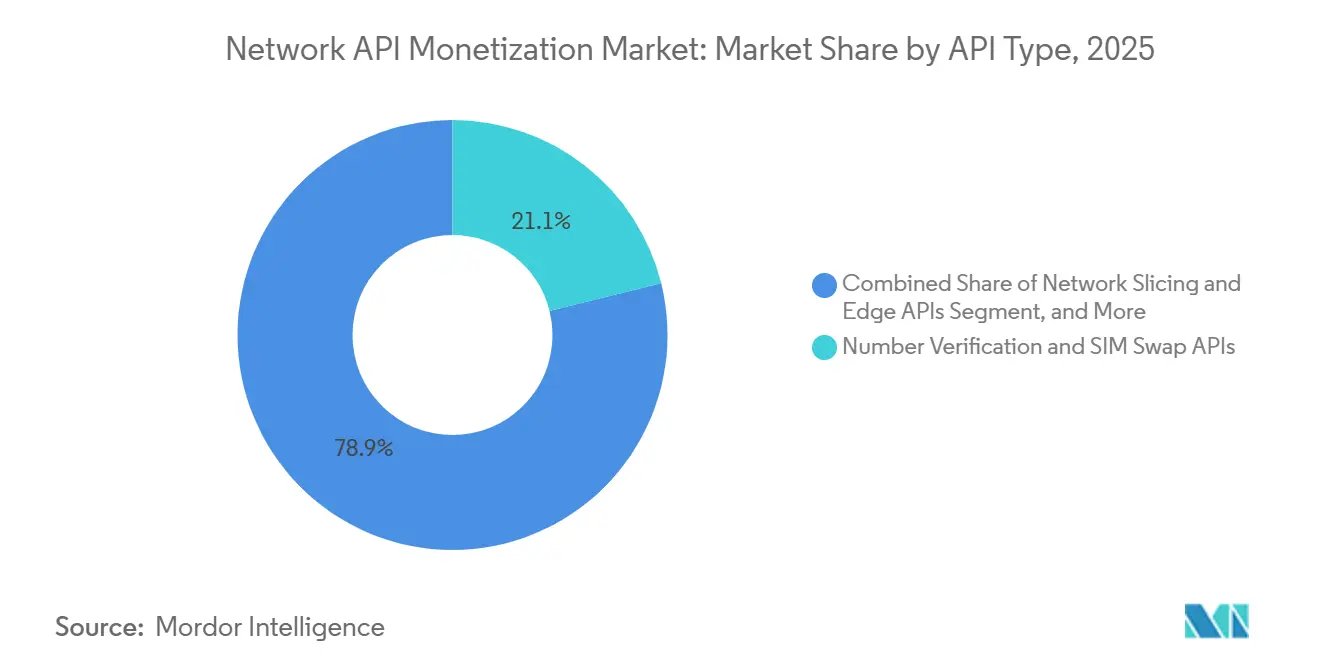
- By API type, Number Verification and SIM Swap APIs held 21.14% of the Network API Monetization Market market share in 2025, while Network Slicing and Edge Enablement APIs are projected to expand at a 33.41% CAGR through 2031.
- By component, the API Monetization Platform held a 31.24% revenue share in 2025, while the Developer Portal and API Marketplace components are projected to expand at a 33.14% CAGR through 2031.
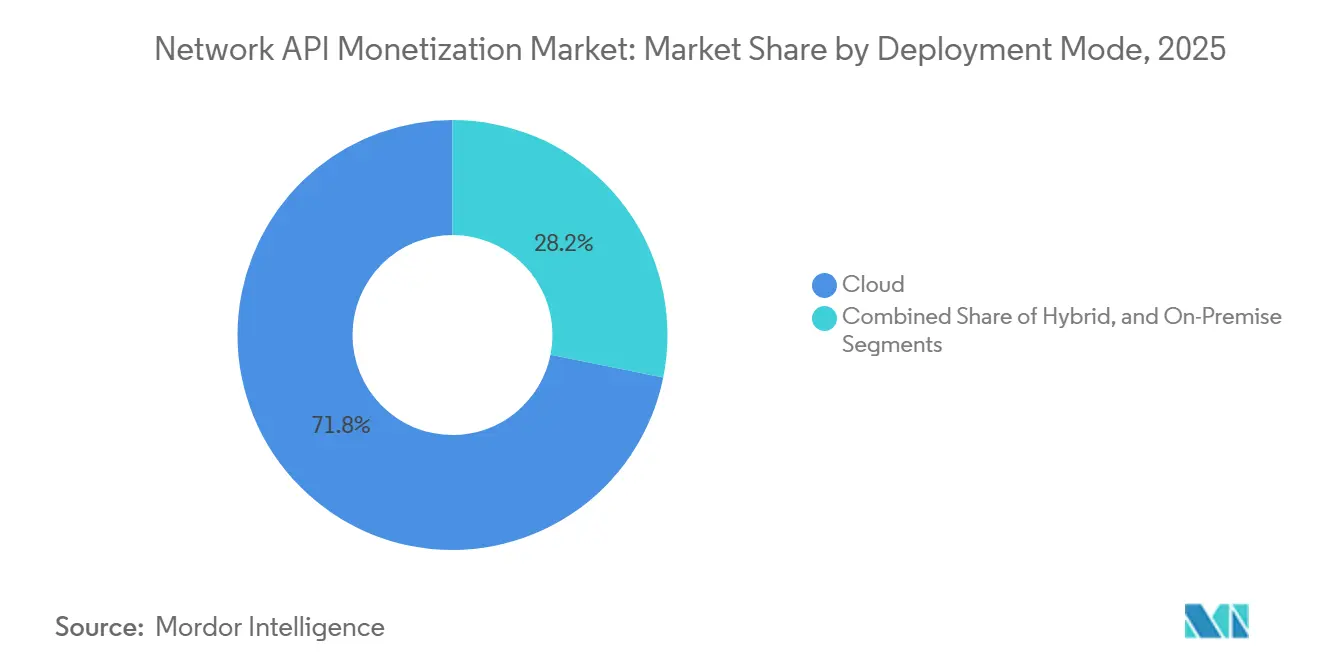
- By deployment mode, cloud deployment accounted for 71.83% of Network API Monetization Market revenue in 2025, while hybrid deployment is projected to expand at a 32.47% CAGR through 2031.
- By end-user industry, Financial Services and Fraud Prevention held 36.82% revenue share in 2025, while Automotive and Connected Mobility are projected to expand at a 33.36% CAGR through 2031.
- By geography, North America held a 34.12% revenue share in the Network API Monetization Market in 2025, while Asia-Pacific is projected to expand at a 33.28% CAGR through 2031.
Note: Market size and forecast figures in this report are generated using Mordor Intelligence’s proprietary estimation framework, updated with the latest available data and insights as of January 2026.
Market Trends and Insights
Drivers Impact Analysis of Network API Monetization Market*
| Driver | (~) % Impact on CAGR Forecast | Geographic Relevance | Impact Timeline |
|---|---|---|---|
| Expansion of 5G Standalone Network Exposure | +9.5% | Global | Medium term (2-4 years) |
| Enterprise Demand for Real-Time Fraud and Identity APIs | +7.2% | Global, with North America and Europe as core markets | Short term (≤ 2 years) |
| Hyperscaler and Operator Distribution Partnerships | +5.8% | Global, with North America and Asia-Pacific as core markets | Medium term (2-4 years) |
| API-First Digital Business Models and Partner Ecosystems | +4.1% | Global, with North America and Europe | Medium term (2-4 years) |
| AI Agents and Event Data Creating New Billable API Consumption | +3.2% | North America and Europe | Long term (≥ 4 years) |
| CAMARA and GSMA Open Gateway Standardization Enabling Carrier-Agnostic Access | +2.8% | Global | Medium term (2-4 years) |
| Source: Mordor Intelligence | |||
Expansion of 5G Standalone Network Exposure Unlocks Programmable Monetization
Standalone 5G provides the technical foundation for the Network API Monetization Market, as the Network Exposure Function offers external applications a standardized path to core network functions. It allows developers to request session management, bandwidth prioritization, and slice control in real time. This approach enables a guaranteed quality of service without requiring direct access to proprietary operator systems. Ericsson identified fraud detection, quality-on-demand for enterprise venues, and fixed wireless access monetization as commercially ready API groups at its 2026 Core Network Summit. Operators that complete standalone rollouts in enterprise-dense areas can address early demand for quality-of-service and network-slicing APIs before coverage improves elsewhere. In January 2026, only 22% of operators that had launched 5G had deployed converged or fully standalone networks, leaving material room for later rollout-led adoption.
Enterprise Demand for Real-Time Fraud and Identity APIs Drives Near-Term Revenue
Financial services provide the most mature demand pattern for the Network API Monetization Market because instant payments leave little time to evaluate fraud. Banks and fintech firms can use carrier signals such as SIM status, number tenure, and device associations to strengthen authentication and reduce reliance on SMS one-time passwords. GSMA Intelligence ranked banking and financial services first across the sectors assessed in its 2025 Open Gateway Demand Index.[1] As Number Verification and SIM Swap become standard services, operators can seek differentiation through KYC Match, subscriber behavior signals, and device tenure data. Enterprises are more likely to adopt these services when providers link them to lower fraud losses, easier onboarding, and compliance needs rather than presenting a technical API catalog. This framing is important because it connects API spending to operational outcomes that procurement and risk teams can evaluate.
Hyperscaler and Operator Distribution Partnerships Reshape the Monetization Value Chain
Cloud marketplaces put the Network API Monetization Market in front of developers who already purchase software through AWS, Google Cloud, and Microsoft Azure. Nokia placed Quality of Service on Demand, Number Verification, and Device Location Verification APIs on Google Cloud Marketplace in July 2025.[2] Vonage also made its network API portfolio available through AWS Marketplace in December 2025, connecting carrier capabilities to Amazon's developer ecosystem. This distribution model places network services within enterprise software budgets and supports consumption-based purchasing. It can expand operator reach, although operators need to protect their pricing power as cloud channels become more important. Microsoft also worked with Aduna in June 2025 to distribute aggregated network APIs as Azure services, confirming that the model had moved beyond an early trial.
API-First Digital Business Models and Partner Ecosystems Expand the Addressable Market
API-first operating models are expanding the Network API Monetization Market because enterprises increasingly embed external capabilities within products, partner platforms, and automated workflows. The GSMA reported that more than 60 channel partners were commercializing network APIs for fintech, automotive, manufacturing, and media by March 2026.[3] Developer portals matter because they provide sandbox access, software development kits, and usage tools that make network services easier to discover and test. Kong acquired OpenMeter in September 2025 and launched Konnect Metering and Billing in October 2025, reflecting the need to join API management with metering and billing. An IoT platform that adds SIM-status or location checks can also turn its enterprise clients into downstream users of network APIs. This expands consumption without requiring the operator to establish a separate direct commercial relationship with every eventual enterprise user.
Restraints Impact Analysis of Network API Monetization Market*
| Restraint | (~) % Impact on CAGR Forecast | Geographic Relevance | Impact Timeline |
|---|---|---|---|
| Fragmented Operator Rollouts and Inconsistent API Versions | -2.3% | Global, especially Asia-Pacific and Europe | Medium term (2-4 years) |
| Unclear Developer Willingness to Pay for Network Capabilities | -1.7% | Global, especially North America and Europe | Short term (≤ 2 years) |
| API Security, Consent, and Data-Protection Liability | -1.2% | Europe and North America | Medium term (2-4 years) |
| Legacy OSS and BSS Integration Complexity | -0.9% | Global, especially emerging markets | Long term (≥ 4 years) |
| Source: Mordor Intelligence | |||
Fragmented Operator Rollouts and Inconsistent API Versions Slow Multi-Operator Deployments
Fragmented rollout practices remain a commercial obstacle for the Network API Monetization Market because a common CAMARA specification can still yield different latency, consent, and implementation outcomes across carriers. Cross-border applications must account for these differences, thereby raising integration costs and delaying developer investment. GSMA technical guidance requires support for both CAMARA Service APIs and TM Forum Operate APIs across onboarding, reporting, and consent processes. Enea noted that standardized northbound interfaces still require carrier-specific southbound integration with proprietary network infrastructure. The result is a delay in multi-operator deployments, particularly where commercial launch schedules and technical readiness differ across European and Asia-Pacific operators. It does not limit the overall opportunity, but it can postpone the scale needed for cross-border enterprise applications.
Unclear Developer Willingness to Pay Suppresses Commercial Uptake Beyond Early Adopters
Developers' willingness to pay can constrain the Network API Monetization Market because buyers value lower fraud, improved conversion, and lower operating costs over an API request alone. Per-query operator pricing may not match the commercial value that an enterprise receives from those outcomes. The GSMA described the gap between enterprise awareness and operator revenue as persistently wide in 2026, citing commercial model design, pricing, and channel structure as key barriers. CPaaS providers may capture part of the value created for developers, leaving operators with wholesale-style pricing for unique network data. Outcome-based and subscription pricing can help operators convert latent demand into recurring revenue through 2028. These models would better align the operator offer with fraud reduction, onboarding conversion, and compliance outcomes that developers and enterprises value.
*Our forecasts treat driver/restraint impacts as directional, not additive. The impact forecasts reflect baseline growth, mix effects, and variable interactions.
Network API Monetization Market Segment Analysis
By API Type:
Fraud Prevention APIs Lead Revenue While Edge APIs Gain MomentumNumber Verification and SIM Swap APIs held 21.14% of the Network API Monetization Market share in 2025, making them the largest API category. Their position reflects enterprise demand for carrier-grade authentication that reduces friction from one-time passwords in banking, insurance, and e-commerce onboarding. Subscriber-level SIM data provides fraud signals that third parties cannot reproduce with the same authority or at the same scale. The GSMA Unscammed program is pursuing multi-operator fraud-prevention API deployments in the United States, Canada, the United Kingdom, and Australia. These deployments show that fraud prevention is progressing from isolated trials toward coordinated implementation across the Network API Monetization Market.
Network Slicing and Edge Enablement APIs are projected to expand at a 33.41% CAGR through 2031, the fastest growth rate among API types. Automotive, industrial IoT, and gaming applications require assured latency and bandwidth that best-effort connectivity cannot deliver. Quality-on-demand APIs are gaining use in media streaming and enterprise video collaboration, where selected sessions require priority. Device Location and Geofencing APIs are finding early use in logistics, fleet management, and emergency services. Carrier Billing, Payment, Device Status, and Connectivity APIs remain earlier in their commercial development, with activity concentrated in Asia-Pacific markets that have stronger enterprise billing integration, while the AECC set out requirements for CAMARA-standardized quality-on-demand and network-slicing APIs for connected vehicles at MWC25.[4]

By Component:
Monetization Platforms Lead While Developer Portals Grow FastestAPI Monetization Platform accounted for 31.24% of the Network API Monetization Market size in 2025, making it the largest component. Operators have focused the initial procurement on core billing, access control, and partner onboarding functions that support multiple CAMARA API categories. This spending pattern shows that foundational commercial infrastructure has taken priority over higher-layer developer experience and analytics tools. Ericsson invested in LotusFlare in December 2025 and formed a strategic partnership around DNO Cloud capabilities for consent management and digital commerce. The move reflected the need to connect monetization platforms with consent, access, and developer workflows.
Developer Portal and API Marketplace components are projected to expand at a 33.14% CAGR from 2026 to 2031. Their growth follows a shift in competition toward API discovery, onboarding, sandbox quality, and distribution across the Network API Monetization Market. Better self-service access and software development kits can increase API use compared with basic documentation portals. Metering, analytics, and observability are also becoming important because usage-based pricing requires visibility into consumption, latency, and error rates. WSO2 acquired Moesif in November 2025 and integrated its analytics and monetization capabilities into the API manager lifecycle. Billing, revenue assurance, security, identity, consent management, and managed services remain important supporting components for operators with different internal capabilities, particularly where in-house API program management resources are limited.
By Deployment Mode:
Cloud Leads While Hybrid Use ExpandsCloud deployment accounted for 71.83% of the market share in 2025. Authentication and fraud workloads can rise sharply during payment windows and promotional events, making elastic infrastructure a practical fit. Alignment with AWS, Azure, and Google Cloud can also simplify adoption for developers already using those environments. TM Forum's Open Digital Architecture guidance supports the shift toward cloud-native systems that can provide real-time metering and dynamic pricing. The cloud model has therefore become the default for many new operator API program launches.
Hybrid deployment is projected to expand at a 32.47% CAGR from 2026 to 2031, faster than the other deployment options. Financial services, health care, and government users may store sensitive data on-premises while using cloud-based portals and channels for API exposure. On-premises deployment will retain a role among operators subject to strict data-localization requirements. Large industrial deployments often combine on-premises edge processing with cloud-based analytics. This creates a need for monetization systems that meter usage and enforce entitlements across both environments, enabling the Network API Monetization Market to support hybrid architectures without requiring a full replacement of established enterprise infrastructure.
By End-User Industry:
Financial Services Leads While Automotive AcceleratesFinancial Services and Fraud Prevention accounted for 36.82% of the Network API Monetization Market size in 2025. Banks, fintech firms, and digital wallet providers use Number Verification, SIM Swap, and KYC Match services for onboarding and transaction approval. These applications can reduce fraud losses and one-time-password infrastructure costs, which creates a direct procurement case. Orange stated in July 2026 that the adoption of KYC Match by a major banking client contributed to a nearly 50% reduction in identity fraud. This clear value proposition has shortened buying cycles relative to many other API use cases.
Automotive and Connected Mobility is projected to expand at a 33.36% CAGR from 2026 to 2031. Software-defined vehicles need network-aware connectivity for over-the-air update scheduling, advanced driver assistance, and fleet management. Nokia's Network as Code platform exposes APIs for Quality on Demand, Device Reachability, and Network-Aware Route Optimization to automotive developers. Enterprise IoT and smart manufacturing also use SIM status and location data for asset tracking and process control. Gaming and real-time media streaming can use quality-on-demand services to reduce latency-related disruption, although complex per-session billing has limited traction. Health care, emergency services, retail, e-commerce, aviation, travel, government, and smart cities remain earlier-stage areas with defined use cases but limited commercial deployment, despite clear potential for location, identity, and connectivity services.
Geography Analysis
North America Network API Monetization Market
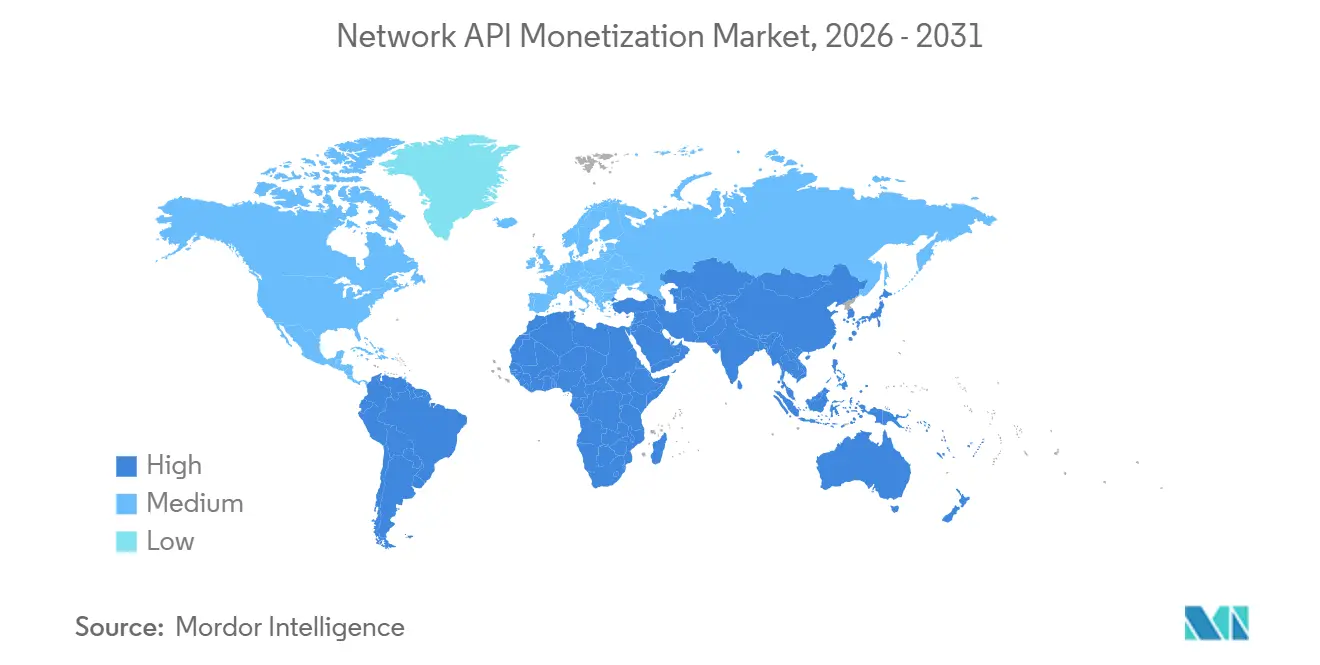
North America held 34.12% of the Network API Monetization Market share in 2025. United States and Canadian carriers introduced Number Verification and SIM Swap services early through CPaaS distribution partners. Established enterprise software procurement processes also support API adoption among financial services and retail customers. Aduna was finalized in July 2025 with Ericsson and 12 operators, including AT&T, T-Mobile, and Verizon, to provide an aggregated distribution layer for developers. In Canada, Enstream brings Bell Canada, Rogers, and TELUS together around a shared CAMARA API model, while Mexico remains earlier in development, with standalone 5G coverage expanding and demand centered on financial inclusion and payment authentication.
Europe Network API Monetization Market
Europe generated meaningful revenue in 2025, supported by the United Kingdom's four-operator CAMARA API collaboration. Vodafone, Virgin Media O2, BT/EE, and Three committed to SIM Swap, Number Verification, Age Verify, and Tenure APIs through a shared Open Gateway approach. Germany also supports regional growth through Deutsche Telekom T Wholesale distribution agreements with Aduna, Nokia, Infobip, and Glide Identity. France, Spain, Italy, and other markets are in active commercial stages, while Telefónica is progressing toward joint GSMA and TM Forum conformance certification. GDPR requires explicit consent for APIs that expose subscriber information, and the AZOP fined a telecommunications operator EUR 4,500,000 (USD 4,900,000) for personal data processing violations in November 2025, underscoring the importance of consent management in Europe.
APAC, MEA and South America Network API Monetization Market
Asia-Pacific is projected to expand at a 33.28% CAGR from 2026 to 2031, the highest regional rate in the Network API Monetization Market. China had more than 3.4 million 5G base stations in 2025, providing broad infrastructure for network API activity, while China Unicom and China Telecom launched GSMA-certified Open Gateway deployments, and China Unicom reported reach across 70% of the country's connected-vehicle market. Nokia partnered with Bharti Airtel in 2025 to provide pan-India network APIs through its Network as Code portal. Japan, South Korea, Australia, the Middle East, and Africa are also seeing activity develop, with Qatar operators committing to broaden their API portfolios in 2026, while South America is an emerging opportunity led by Brazil's Pix infrastructure and fintech fraud-prevention needs, and supported by API pilot activity in Argentina and Chile.
Competitive Landscape
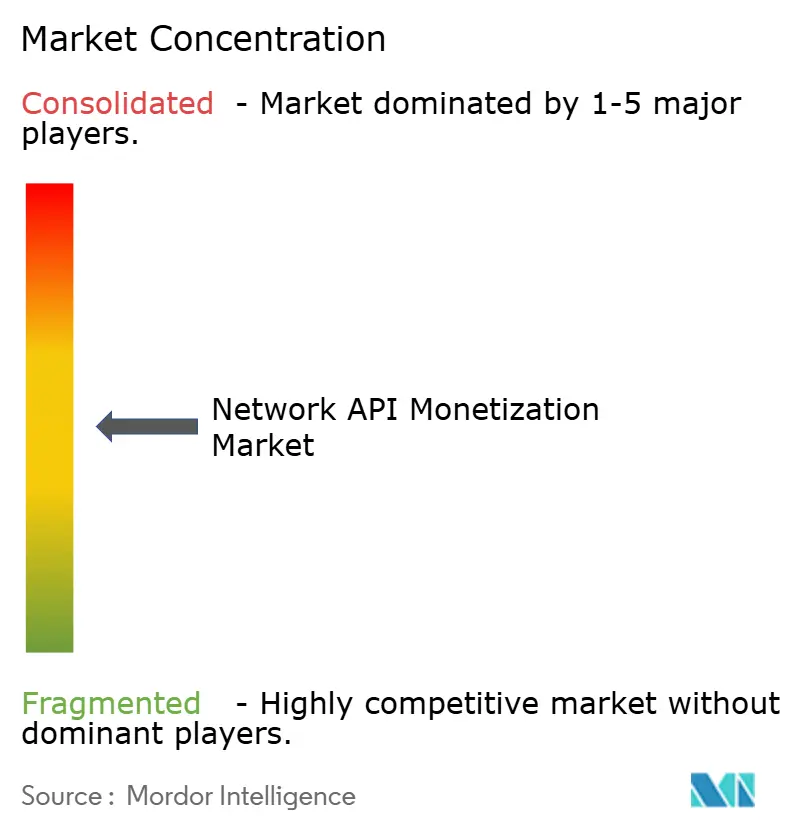
The Network API Monetization Market is moderately fragmented across telecom-native vendors and API management or billing specialists. Nokia, Ericsson, Amdocs, MATRIXX Software, Netcracker, and Mavenir compete through network integration, BSS and OSS interoperability, and end-to-end operator monetization capabilities. Kong, WSO2, MuleSoft, Tyk Technologies, Gravitee, Zuplo, Amberflo, and Lago compete through modular tooling, usage pricing, metering, and developer experience. The GSMA and TM Forum certification program became generally available in November 2025 and verifies conformance with the CAMARA Service APIs and the TM Forum Operate APIs, helping to reduce integration risk for enterprise buyers. Certification can provide an advantage by signaling interoperability across the operator and developer ecosystems.
Distribution partnerships have become a central competitive strategy in the Network API Monetization Market, where cloud channels increasingly influence enterprise access. Nokia listed network APIs on Google Cloud Marketplace in July 2025, allowing developers to obtain those capabilities through a familiar procurement channel. Vonage expanded its AWS Marketplace offering in December 2025, bringing network APIs, communications APIs, and contact center products into the same channel. Aduna also collaborated with Microsoft in June 2025 to make aggregated network APIs available through Azure. These arrangements can simplify enterprise purchase decisions, but they also make distribution partners more influential in pricing and customer access.
Agentic workflows are opening a further area of competition in the Network API Monetization Market, as providers prepare for automated API discovery and consumption. Nokia and Telefónica demonstrated agentic API consumption based on Model Context Protocol and Agent-to-Agent protocols at MWC26 in March 2026. These workflows can allow AI agents to discover, combine, and use network capabilities for multi-step tasks, and existing metering and revenue-assurance systems may need adjustment as automated consumption increases. Smaller billing providers focused on precise event metering are competing by offering lower integration requirements and flexible pricing options, while Comviva Technologies and Netcracker retain an advantage among operators that prefer deep integration with existing BSS systems.
Network API Monetization Industry Leaders
-
Telefonaktiebolaget LM Ericsson
-
Nokia Corporation
-
Amdocs Limited
-
Infobip d.o.o.
-
Cisco Systems, Inc.
- *Disclaimer: Major Players sorted in no particular order
Network API Monetization Market Companies Covered in this Report
- Kong Inc.
- WSO2, Inc.
- Axway Software SA
- Boomi, LP
- Gravitee, Inc.
- Tyk Technologies Ltd
- MuleSoft, LLC
- LotusFlare, Inc.
- Sinch AB
- Zuplo, Inc.
- Moesif, Inc.
- Apiable, Inc.
- Cerillion plc
- Amberflo, Inc.
- Lago, Inc.
- RapidAPI, Inc.
- Nokia Corporation
- Telefonaktiebolaget LM Ericsson
- Amdocs Limited
- MATRIXX Software, Inc.
- Mavenir Systems, Inc.
- Comviva Technologies Limited
- Netcracker Technology Corporation
- Vonage Holdings Corp.
Recent Industry Developments in Network API Monetization Market
- June 2026: Kong Inc. launched Kong Ascent, an AI-assisted migration offering designed to help enterprises move from MuleSoft environments to Kong Konnect, the unified API and AI platform. The offering targets enterprises seeking consolidated governance of APIs, AI agent events, and MCP traffic, positioning Kong to capture a larger share of enterprise API monetization budgets previously held by incumbent integration platforms.
- March 2026: Nokia expanded its Network as Code ecosystem at MWC26 by deepening its partnership with Google Cloud to bring agentic AI capabilities into the platform. The collaboration makes networks programmable by enterprise AI agents via MCP using Google Cloud's Agent Developer Kit and Gemini models, targeting enterprise device management, fleet management, and security monitoring workflows.
- March 2026: Telefónica and Nokia announced a collaboration to test A2A and MCP protocols for network API discovery, consumption, and monetization, with the goal of enabling AI agents to coordinate complex multi-step workflows that include network capability requests without human developer intervention. The initiative is designed to define the commercial architecture for an agentic monetization ecosystem across Telefónica's global operator footprint.
- March 2026: GSMA Open Gateway reported that 86 operator groups representing more than 300 networks and 80% of global mobile connections had aligned around a common CAMARA API framework, with more than 300 commercial instances of 20 different APIs launched across 65 markets, up from 8 CAMARA APIs in 2023.
Global Network API Monetization Market Report Scope
The network API monetization market refers to the ecosystem of platforms and services that enable telecommunications service providers to securely expose their core network capabilities to third-party developers and enterprises. This includes technologies such as API gateways, developer portals, billing and revenue assurance tools, and advanced analytics deployed to manage and charge for APIs, including quality-on-demand, SIM swap detection, device location, and network slicing. By transforming raw network infrastructure into programmable, standardized assets, these solutions enable telecom operators to create new B2B revenue streams while enabling enterprises across sectors such as finance, automotive, and IoT to build highly secure, context-aware, low-latency applications.
The Network API Monetization Market Report is Segmented by API Type (Quality on Demand APIs, Number Verification and SIM Swap APIs, Device Location and Geofencing APIs, Network Slicing and Edge Enablement APIs, Carrier Billing and Payment APIs, Device Status and Connectivity APIs, and Other API Types), Component (API Monetization Platform, API Gateway and Network Exposure Function, Developer Portal and API Marketplace, Metering, Analytics, and Observability, Billing, Invoicing, and Revenue Assurance, Security, Identity, and Consent Management, and Professional and Managed Services), Deployment Mode (Cloud, On-Premise, and Hybrid), End-User Industry (Financial Services and Fraud Prevention, Automotive and Connected Mobility, Enterprise IoT and Smart Manufacturing, Gaming and Real-Time Media Streaming, Healthcare and Emergency Services, Retail and E-commerce, Aviation and Travel, and Government and Smart Cities), and Geography (North America, South America, Europe, Asia-Pacific, Middle East, and Africa). The Market Forecasts are Provided in Terms of Value (USD).
Segmentation Overview
| Quality on Demand APIs |
| Number Verification and SIM Swap APIs |
| Device Location and Geofencing APIs |
| Network Slicing and Edge Enablement APIs |
| Carrier Billing and Payment APIs |
| Device Status and Connectivity APIs |
| Other API Types |
| API Monetization Platform |
| API Gateway and Network Exposure Function |
| Developer Portal and API Marketplace |
| Metering, Analytics, and Observability |
| Billing, Invoicing, and Revenue Assurance |
| Security, Identity, and Consent Management |
| Professional and Managed Services |
| Cloud |
| On-Premise |
| Hybrid |
| Financial Services and Fraud Prevention |
| Automotive and Connected Mobility |
| Enterprise IoT and Smart Manufacturing |
| Gaming and Real-Time Media Streaming |
| Healthcare and Emergency Services |
| Retail and E-commerce |
| Aviation and Travel |
| Government and Smart Cities |
| North America | United States |
| Canada | |
| Mexico | |
| South America | Brazil |
| Argentina | |
| Chile | |
| Rest of South America | |
| Europe | Germany |
| United Kingdom | |
| France | |
| Italy | |
| Spain | |
| Rest of Europe | |
| Asia-Pacific | China |
| Japan | |
| India | |
| South Korea | |
| Australia | |
| Rest of Asia-Pacific | |
| Middle East | United Arab Emirates |
| Saudi Arabia | |
| Qatar | |
| Rest of Middle East | |
| Africa | South Africa |
| Egypt | |
| Nigeria | |
| Rest of Africa |
| By API Type | Quality on Demand APIs | |
| Number Verification and SIM Swap APIs | ||
| Device Location and Geofencing APIs | ||
| Network Slicing and Edge Enablement APIs | ||
| Carrier Billing and Payment APIs | ||
| Device Status and Connectivity APIs | ||
| Other API Types | ||
| By Component | API Monetization Platform | |
| API Gateway and Network Exposure Function | ||
| Developer Portal and API Marketplace | ||
| Metering, Analytics, and Observability | ||
| Billing, Invoicing, and Revenue Assurance | ||
| Security, Identity, and Consent Management | ||
| Professional and Managed Services | ||
| By Deployment Mode | Cloud | |
| On-Premise | ||
| Hybrid | ||
| By End-User Industry | Financial Services and Fraud Prevention | |
| Automotive and Connected Mobility | ||
| Enterprise IoT and Smart Manufacturing | ||
| Gaming and Real-Time Media Streaming | ||
| Healthcare and Emergency Services | ||
| Retail and E-commerce | ||
| Aviation and Travel | ||
| Government and Smart Cities | ||
| By Geography | North America | United States |
| Canada | ||
| Mexico | ||
| South America | Brazil | |
| Argentina | ||
| Chile | ||
| Rest of South America | ||
| Europe | Germany | |
| United Kingdom | ||
| France | ||
| Italy | ||
| Spain | ||
| Rest of Europe | ||
| Asia-Pacific | China | |
| Japan | ||
| India | ||
| South Korea | ||
| Australia | ||
| Rest of Asia-Pacific | ||
| Middle East | United Arab Emirates | |
| Saudi Arabia | ||
| Qatar | ||
| Rest of Middle East | ||
| Africa | South Africa | |
| Egypt | ||
| Nigeria | ||
| Rest of Africa | ||
Key Questions Answered in the Report
What is the Network API Monetization Market size?
The Network API Monetization Market is projected to expand from USD 1.81 billion in 2025 and USD 3.58 billion in 2026 to USD 14.15 billion by 2031, at a 31.64% CAGR.
What is driving adoption of network APIs?
Standalone 5G exposure functions, fraud-prevention demand, common CAMARA standards, and cloud marketplace distribution are supporting adoption. These factors help operators turn network controls and subscriber intelligence into services that enterprise applications can consume.
Which API type generated the most revenue in 2025?
Number Verification and SIM Swap APIs led with a 21.14% revenue share, supported by banking, fintech, insurance, and e-commerce authentication use cases. They reduce dependence on one-time passwords by using carrier-grade signals within onboarding and payment-approval workflows.
Which end-user sector is growing fastest?
Automotive and Connected Mobility is projected to expand at a 33.36% CAGR through 2031 as vehicles need managed connectivity for updates, assistance systems, and fleets. Quality on Demand, Device Reachability, and network-aware routing support these software-defined vehicle applications.
Why is cloud deployment widely used for network API monetization?
Cloud deployment held 71.83% of revenue in 2025 because it can scale for high and variable authentication and fraud query volumes. It also aligns API platforms with the public-cloud environments that many enterprise developers already use.
Which region is expected to grow fastest through 2031?
Asia-Pacific is projected to expand at a 33.28% CAGR, supported by Chinas 5G scale, India's developer ecosystem, and growing operator activity across the region. China Unicom, China Telecom, and Bharti Airtel have advanced related Open Gateway and Network as Code activity.