
Network API Exposure Platforms Market Size and Share
Market Overview
| Study Period | 2020 - 2031 |
|---|---|
| Market Size (2026) | USD 1.15 Billion |
| Market Size (2031) | USD 2.54 Billion |
| Growth Rate (2026 - 2031) | 17.17 % |
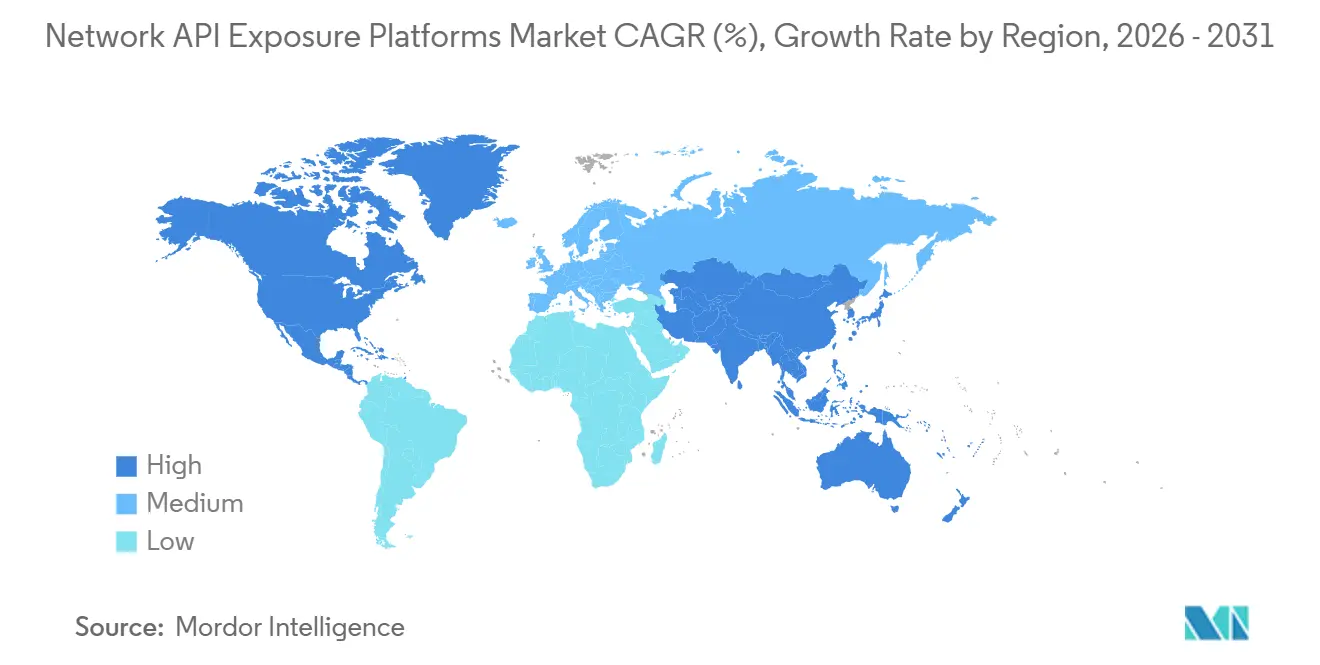
| Fastest Growing Market | Asia-Pacific |
| Largest Market | North America |
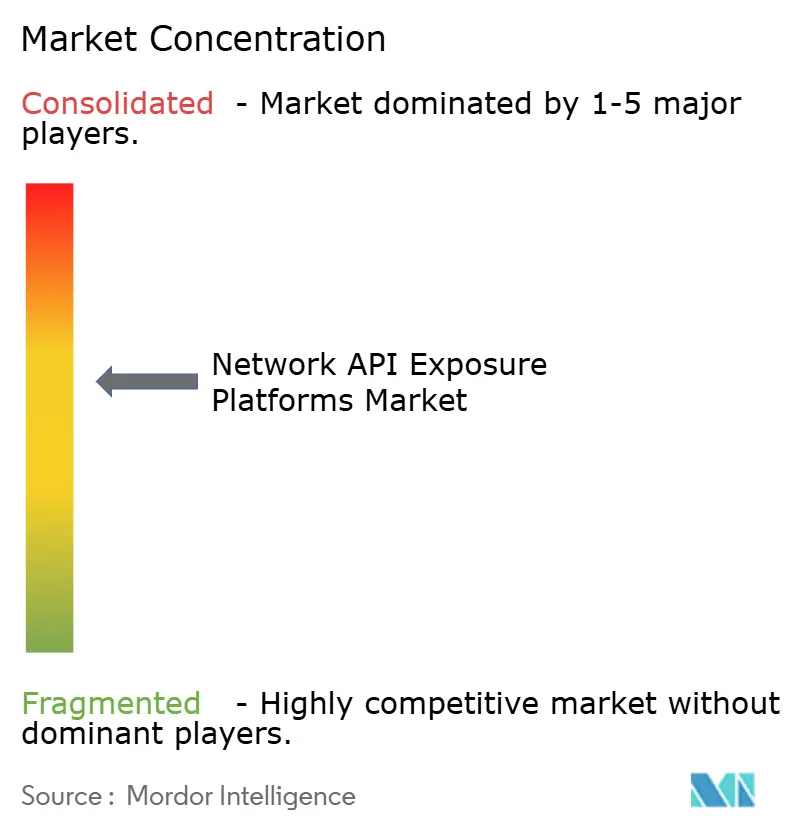
| Market Concentration | Medium |
Major Players *Disclaimer: Major Players sorted in no particular order Image © Mordor Intelligence. Reuse requires attribution under CC BY 4.0. | |
Network API Exposure Platforms Market Analysis by Mordor Intelligence
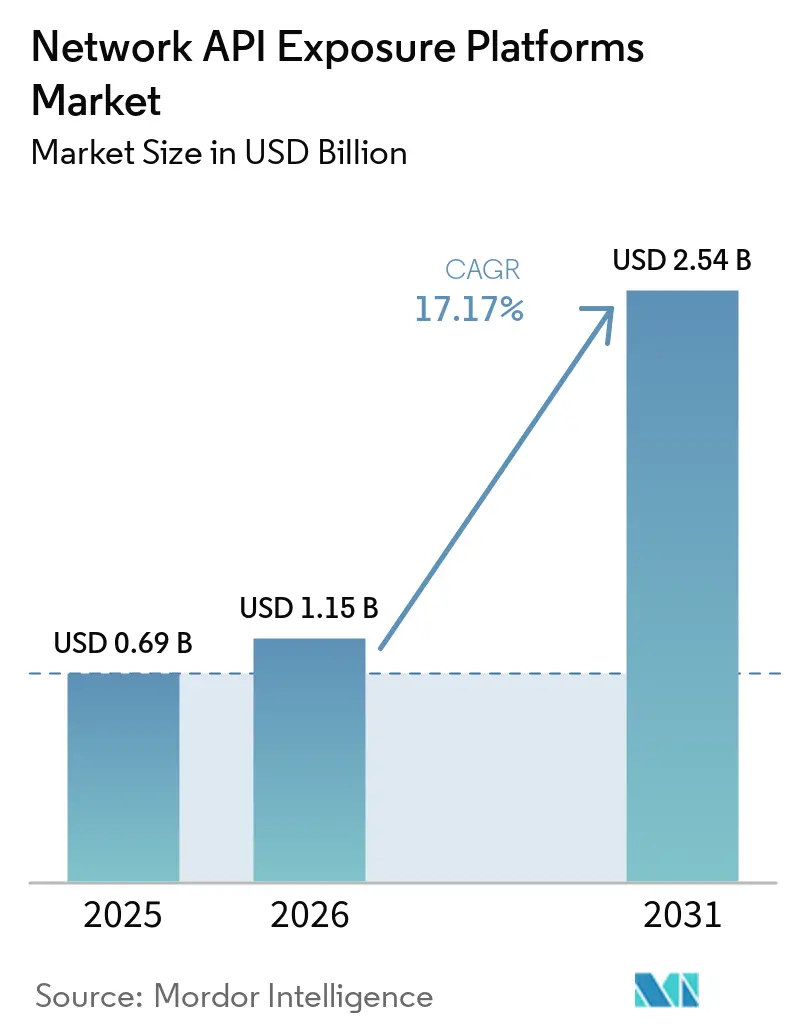
The Network API exposure platforms market size is projected to expand from USD 0.69 billion in 2025 and USD 1.15 billion in 2026 to USD 2.54 billion by 2031, registering a CAGR of 17.17% between 2026 to 2031. Standardized network APIs are moving operator capabilities from internal systems to enterprise applications, thereby enabling the broader use of identity, device, and network-quality data. GSMA Open Gateway has created a common commercial route for operators, developers, and distribution partners, reducing the need for separate bilateral carrier integrations. Enterprise demand is strongest where a network signal can improve authentication, fraud prevention, and transaction decisions. Platform providers are also competing to make APIs available in cloud marketplaces and established developer tools, rather than relying on operator-specific channels. The Network API exposure platforms market, therefore, depends on both reliable technical delivery and clear business outcomes that enterprise buyers can measure.
Key Report Takeaways
- By component, platform software held 63.11% of the Network API exposure platforms market share in 2025, while services are projected to expand at 18.12% CAGR through 2031.
- By API capability, identity and authentication APIs held 38.76% share in 2025, while fraud prevention and risk APIs are projected to expand at 19.65% CAGR through 2031.
- By deployment model, operator-hosted deployments held 33.21% share of the Network API exposure platforms market in 2025, while hybrid and federated architectures are projected to expand at 18.76% CAGR through 2031.
- By consumer, mobile network operators and communications service providers held 24.11% share in 2025, while enterprise developers and digital platforms are projected to expand at 19.58% CAGR through 2031.
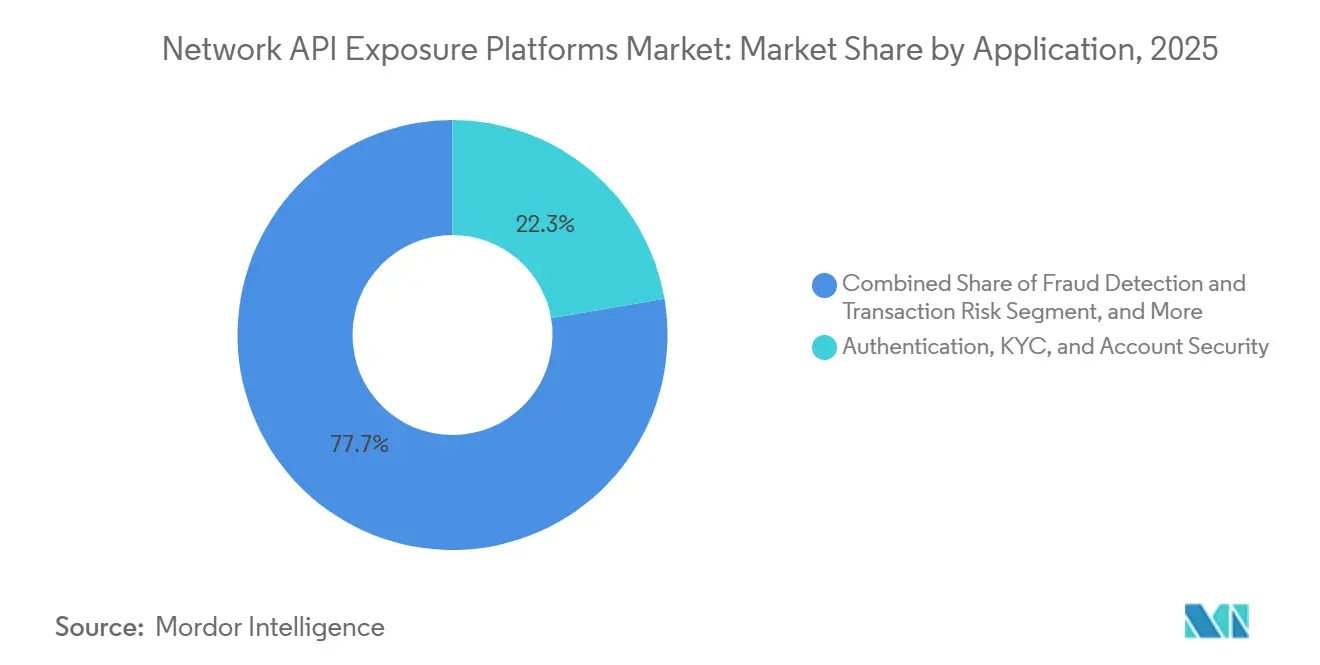
- By application, authentication, KYC, and account security held 22.31% share of the Network API exposure platforms market in 2025, while fraud detection and transaction risk is projected to expand at 18.98% CAGR through 2031.
- By geography, North America held 29.87% share in 2025, while Asia-Pacific is projected to expand at 19.23% CAGR through 2031.
Note: Market size and forecast figures in this report are generated using Mordor Intelligence’s proprietary estimation framework, updated with the latest available data and insights as of January 2026.
Market Trends and Insights
Drivers Impact Analysis of Network API Exposure Platforms Market*
| DRIVER | (~) % IMPACT ON CAGR FORECAST | GEOGRAPHIC RELEVANCE | IMPACT TIMELINE |
|---|---|---|---|
| GSMA Open Gateway and CAMARA Standardization | +4.2% | Global, with concentrated impact in North America, Europe, and the Asia-Pacific | Short term (≤ 2 years) |
| 5G Standalone and Edge Capability Commercialization | +3.8% | Asia-Pacific, North America, and the Middle East | Medium term (2-4 years) |
| Enterprise Demand for Real-Time Identity and Fraud Signals | +3.5% | North America and Europe, with spillover to the Asia-Pacific | Short term (≤ 2 years) |
| AI, IoT, and Mission-Critical Application Programmability | +2.8% | Global, led by Asia-Pacific and North America | Medium term (2-4 years) |
| Operator Need for Revenue Beyond Connectivity | +2.2% | Global, most acute in Europe and North America | Long term (≥ 4 years) |
| Multi-Operator Aggregation Reducing Developer Integration Friction | +1.8% | Global, concentrated in markets with multi-operator Aduna coverage | Short term (≤ 2 years) |
| Source: Mordor Intelligence | |||
GSMA Open Gateway and CAMARA Standardization Unlock Interoperable API Distribution
GSMA Open Gateway moved from a standards project into an operating commercial layer in 2026. By the first quarter of 2026, 280 API instances were commercially available across 85 networks in 50 markets. Twenty-seven markets had achieved 100% API alignment, meaning operators in those markets consistently implemented the same API version and behavior. The Network API exposure platforms market benefits because enterprise developers can use common interfaces instead of tailoring integrations to each carrier. The GSMA and TM Forum conformance program, available globally to communications service providers since 2025, allows CAMARA service APIs and TM Forum Operate APIs to be assessed through one program. That arrangement reduces duplicate validation work and gives buyers a clearer basis for selecting compliant platforms.[1]
5G Standalone and Edge Capability Commercialization Expands the Programmable Network Inventory
Commercial 5G Standalone networks provide the network controls needed for consistent quality, low latency, and service assurance. By February 2026, 5G Standalone was commercially available in dozens of markets. Its separation from 4G architecture enables operators to expose more precise network behavior through standardized API calls. This matters for IoT, industrial automation, and quality-sensitive digital services that need more than basic connectivity. The Network API exposure platforms market can offer a broader set of capabilities when operators can expose 5G core functions through their network exposure layers. Enterprise adoption will depend on whether these functions work reliably across device types, locations, and operator boundaries.[2]
Enterprise Demand for Real-Time Identity and Fraud Signals Accelerates Network API Adoption in Financial Services
Financial institutions increased their use of network APIs in authentication and fraud workflows during 2025. SMS-based one-time passwords can be compromised through SIM swaps, social engineering, and synthetic identity activity. Network signals add information that software-only systems may not see at the time of a transaction. Deutsche Telekom’s KYC Match API lets enterprises compare customer information with operator-verified records without sharing personal data. This helps organizations meet data minimization requirements while strengthening verification processes. The Network API exposure platforms market is gaining traction because these use cases directly translate into avoided fraud losses and smoother customer onboarding.
AI, IoT, and Mission-Critical Application Programmability Redefine the API Consumption Model
AI agents are beginning to use network APIs through tools that reduce manual integration work. In March 2026, Nokia and Google Cloud announced an integration of Google Cloud's agentic AI capabilities into Nokia’s Network as Code platform. The arrangement allows enterprise AI agents to consume network APIs through the Model Context Protocol. It reduces the need for direct REST integration in supported workflows. The Network API exposure platforms market can reach a wider set of application builders when network functions are available as tools within AI development environments. The commercial value depends on secure controls and reliable execution, especially for services that affect identity or network quality.[3]
Restraints Impact Analysis of Network API Exposure Platforms Market*
| RESTRAINT | (~) % IMPACT ON CAGR FORECAST | GEOGRAPHIC RELEVANCE | IMPACT TIMELINE |
|---|---|---|---|
| Legacy OSS and BSS Integration Complexity | -2.1% | Global, most acute in emerging markets with aging infrastructure | Medium term (2-4 years) |
| Privacy, Consent, and Cross-Border Data Governance | -1.7% | Europe, India, and North America | Medium term (2-4 years) |
| Uneven API Reliability and Commercial Readiness Across Operators | -1.3% | South America, Africa, and the rest of the Middle East | Long term (≥ 4 years) |
| Low Willingness to Pay Before Demonstrated Developer Pull | -0.9% | Global, most significant where production deployments are limited | Short term (≤ 2 years) |
| Source: Mordor Intelligence | |||
Legacy OSS and BSS Integration Limits Southbound API Delivery Speed
The southbound integration layer remains a major barrier to commercial API delivery. CAMARA APIs simplify the interface for developers, but requests for device status, SIM swap history, or location data can require multiple backend systems. Billing, provisioning, network management, and customer systems were not generally built for composable API access. These systems can use proprietary data models and older interfaces that take time to connect to open API standards. The Network API exposure platforms market is affected because an appealing API catalog has little value unless the underlying operator systems can consistently supply data. Integration complexity can delay launches and increase the cost of supporting API version changes.[4]
Privacy, Consent, and Cross-Border Data Governance Create Asymmetric Compliance Costs
Identity and fraud APIs use phone numbers, subscriber identifiers, device information, and location signals. These data types place network API deployments within privacy and telecommunications rules in every market where they operate. In February 2026, the European Data Protection Board and European Data Protection Supervisor issued Joint Opinion 2/2026 on the Digital Omnibus proposal. The proposal considered changes to the General Data Protection Regulation, ePrivacy Directive, and Data Governance Act. This created uncertainty for operators planning multi-country API portfolios. The Network API exposure platforms market needs privacy safeguards that are practical for product teams and defensible for regulators.
*Our forecasts treat driver/restraint impacts as directional, not additive. The impact forecasts reflect baseline growth, mix effects, and variable interactions.
Network API Exposure Platforms Market Segment Analysis
By Component:
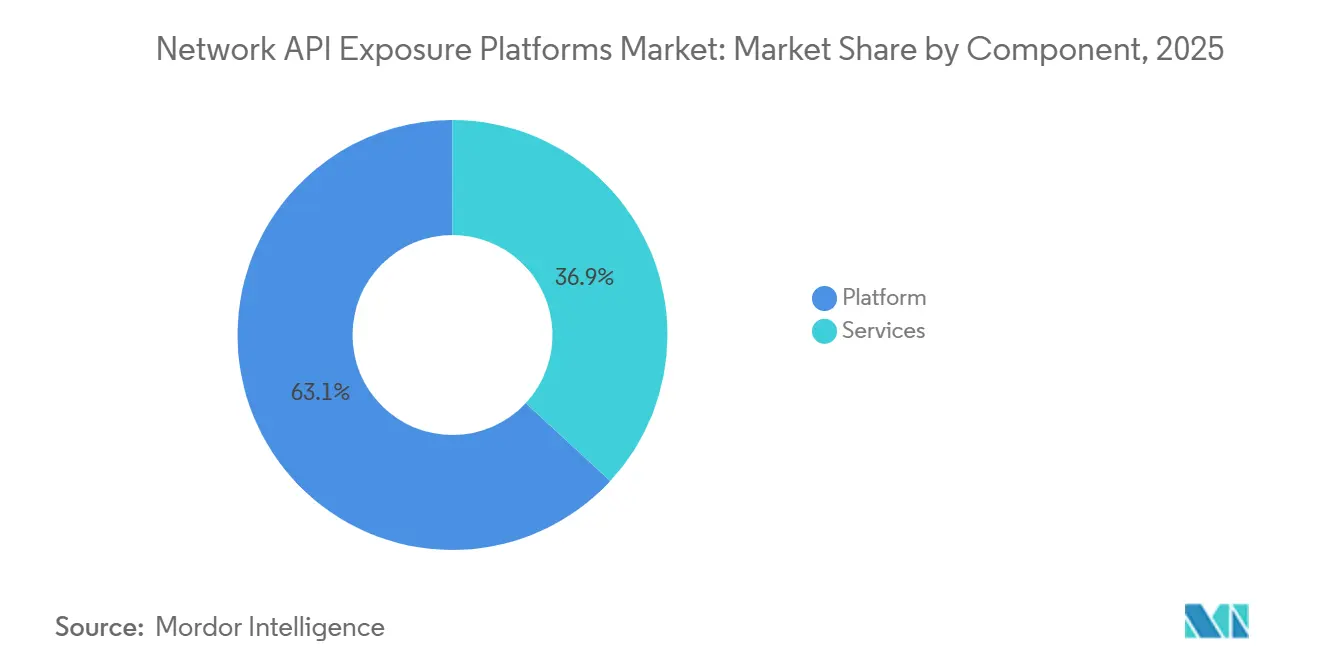
Platform Infrastructure Concentrates Operator InvestmentPlatform software is projected to account for 63.11% of market revenue in 2025 in the network API exposure platforms market, reflecting operators’ need for integrated OSS adapters, API gateways, developer portals, lifecycle management, and monetization tools. Fragmented tools can make it more difficult to meet the requirements of GSMA, TM Forum, and 3GPP within a single deployment. Nokia is expected to have 25 communications service provider deployments in 2025, with five anticipated to become commercially live in 2026. The company is also expected to rank first in ABI Research’s 2025 assessment, with an overall score of 85.9. Ericsson is expected to have more than 100 communications service provider deployments and more than 1.7 million registered developers through Vonage and Aduna. These established positions highlight the value of combining network expertise with enterprise-facing tools.
Services are projected to expand at a CAGR of 18.12% through 2031, supported by operators that prefer managed and professional support over self-built exposure stacks. This demand is particularly relevant for tier-2 and tier-3 operators in South America and Africa, which often have limited specialist engineering resources. Amdocs offers a modular API Monetization and Enablement solution for operators at different stages of their monetization programs. Services include API design, backend integration, consent management, developer portals, and commercial enablement. The Network API exposure platforms market will require this support, where legacy systems and regulatory requirements complicate deployment.
By API Capability:
Identity Leads Commercial Deployment, Fraud Prevention Scales FastestIdentity and authentication APIs are projected to hold 38.76% of market revenue in 2025, making them the most commercially established API capability. By the first quarter of 2026, Number Verification is expected to have 64 commercially launched operator instances, while SIM Swap is expected to have 75. These APIs address established enterprise requirements for login checks, onboarding verification, and account protection. Vonage plans to launch aggregated Number Verification and SIM Swap access across AT&T, T-Mobile, and Verizon in November 2025. Its single integration route will remove a commercial barrier for enterprise developers who require broad US carrier coverage. Real-time SIM swap data can provide transaction systems with information that software-only fraud tools may not receive.
Fraud prevention and risk APIs are projected to grow at a 19.65% CAGR through 2031 in the network API exposure platforms market, as financial institutions integrate network signals into transaction risk models. By the first quarter of 2026, TikTok is expected to use Number Verification and Age Verification APIs across five markets, while FICO is expected to deploy Scam Signal APIs across 15 markets. Device Information and Status APIs are expected to have 24 commercial instances, while Device Location Verification is expected to have 27 instances during the same period. These functions will broaden the portfolio beyond early identity and fraud use cases. The Network API exposure platforms market can expand into logistics, safety, service assurance, and transaction decisions as coverage and consent management improve.
By Deployment Model:
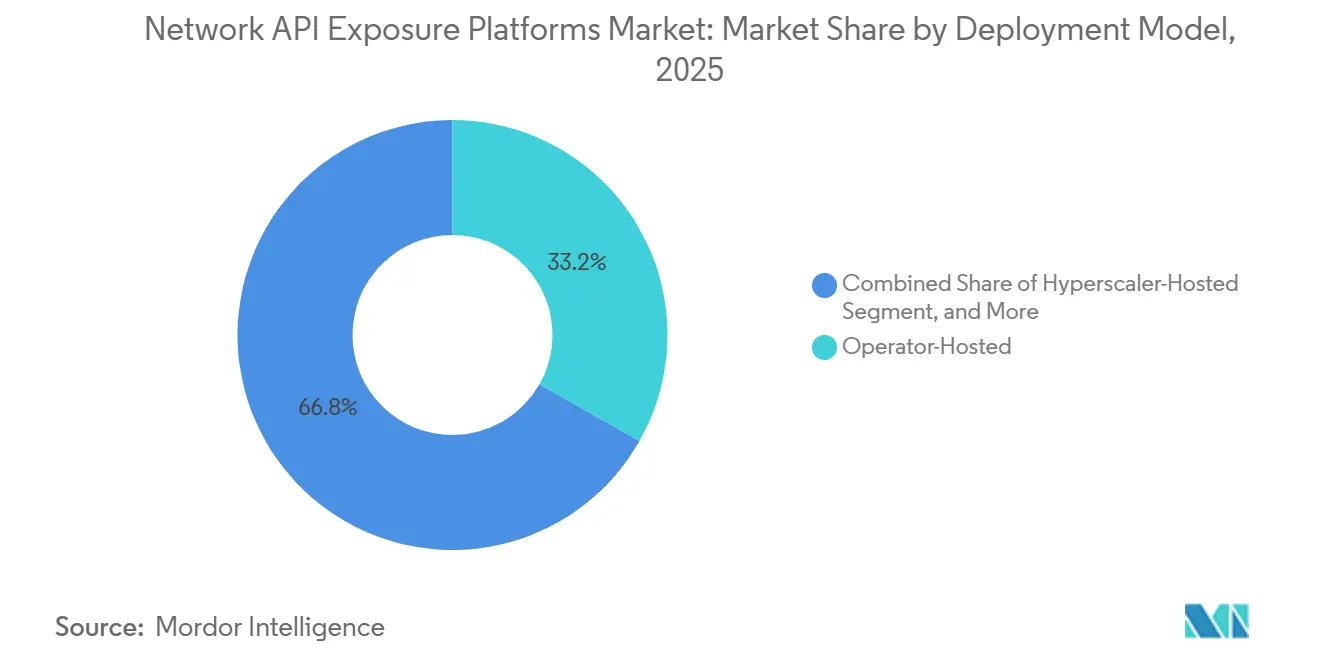
Operator Ownership Transitions Toward Federated DistributionOperator-hosted deployments are projected to account for 33.21% of market revenue in 2025. This model gives carriers direct control over subscriber data, technical policies, API monetization, and developer relationships. It suits operators with sufficient scale to invest in developer support, commercial operations, and international reach. Direct ownership does not prevent external distribution. Nokia plans to list three network APIs on Google Marketplace in July 2025, while Aduna’s arrangement with Microsoft will bring network APIs into Azure. These routes can improve discovery, but they may also increase dependence on external commercial channels.
Hybrid and federated architectures are projected to grow at a 18.76% CAGR through 2031 in the network API exposure platforms market. They combine operator control over core network functions with shared routes for cross-operator discovery, delivery, and settlement. Developers generally favor a single integration point that can reach multiple operators, strengthening aggregators in multi-operator markets. GSMA guidance scheduled for release in February 2026 will address aggregation, federation, and direct integration models together. The Network API exposure platforms market benefits when federation reduces integration effort while preserving clear responsibilities for performance, billing, and data handling.

By Consumer:
Enterprise Developer Momentum Rebalances the Consumer HierarchyMobile network operators and communications service providers are projected to account for 24.11% of market revenue in 2025. They act as both buyers of exposure solutions and providers of the network functions that platforms expose. Their choices depend on network readiness, legacy systems, developer strategies, and regulatory requirements. Operators may build their own functions, use a managed platform, or join an aggregation route. The Network API exposure platforms market must serve both large carriers with established digital teams and smaller operators with limited resources. Each decision affects an operator’s speed, cost, and pricing influence.
Enterprise developers and digital platforms are projected to grow at a 19.58% CAGR through 2031 in the network API exposure platforms market. Their growing role increases the importance of software development kits, documentation, test environments, authentication, and the first successful API call. Vonage plans to introduce a Verified Workspace on the Postman API Network, providing more than 40 million developers with certified access to its API portfolio. Cloud providers, API aggregators, communications platform providers, system integrators, and independent software vendors also connect operators with enterprise buyers. The Network API exposure platforms market requires these participants because many enterprises do not purchase network functions directly from carriers.
By Application:
Authentication and KYC Anchor Near-Term Revenue, Industrial Automation Builds Long-Term UpsideAuthentication, KYC, and account security are projected to account for 22.31% of the Network API exposure platforms market in 2025. Banks, fintech companies, and e-commerce platforms can use KYC Match and verification APIs to strengthen onboarding and account recovery checks. CAMARA alignment can reduce maintenance requirements for compliance teams operating across multiple operators. The value lies in using timely, permissioned network signals within established business decisions. A KYC API can support identity checks, while a SIM Swap API can help with account takeover controls. Consistent interfaces can help organizations extend proven use cases into additional markets.
Fraud detection and transaction risk are projected to expand at a CAGR of 18.98% through 2031 in the network API exposure platforms market. Telefónica and Nokia are expected to test a workflow in February 2026 in which AI agents evaluate the results of SIM Swap and Device Swap before high-value transactions are cleared. IoT, connected devices, and industrial automation offer longer-term potential for Quality on Demand and Simple Edge Discovery. Tata Elxsi is expected to deploy Quality on Demand across 17 markets, while Skydio is expected to use it for drone management in Japan, the United Kingdom, and the United States. The Network API exposure platforms market requires proven deployments in these areas before they reach the maturity of identity applications.
Geography Analysis
North America Network API Exposure Platforms Market
North America is expected to account for 29.87% of the regional market revenue in 2025. AT&T, T-Mobile, and Verizon are introducing standardized 5G network APIs through Aduna, creating a single integration point across major United States carriers and addressing a key barrier for enterprise developers. Vonage is expected to make aggregated Number Verification and SIM Swap APIs available across the three carriers in November 2025. Canada and Mexico are advancing at different speeds, with Canadian operators conducting Open Gateway pilots and América Móvil providing a commercial connection to Mexico through its participation in Aduna.
APAC Network API Exposure Platforms Market
Asia-Pacific is projected to expand at a CAGR of 19.23% through 2031. Japan, South Korea, and India combine 5G Standalone deployment with large digital services ecosystems. NTT DoCoMo is expected to agree with Aduna in January 2026, while SoftBank partnered with Aduna in June 2025. These arrangements are expected to cover Japan’s three largest operators and support CAMARA-aligned distribution. Reliance Jio’s founding membership in Aduna connects India’s payments and fintech ecosystem with network-based identity signals, while South Korea provides a testing environment for Quality on Demand and Device Status APIs. China operates a domestic standards framework supported by Huawei’s cloud and telecommunications infrastructure.
EMEA and South America Network API Exposure Platforms Market
Europe combines commercial opportunities with complex compliance requirements. The planned September 2025 United Kingdom launch by BT/EE, CK Hutchison Group Telecom, Virgin Media O2, and Vodafone is expected to establish a common commercial API model within a single regulatory jurisdiction. Deutsche Telekom and Orange have active KYC Match, SIM Swap, and Number Verification API initiatives through their developer channels. The proposed EU Digital Networks Act may simplify cross-border notification requirements, although national ePrivacy and cybersecurity obligations will remain relevant. Saudi Arabia and the United Arab Emirates benefit from digitization programs and modern 5G Standalone infrastructure, while South America, Africa, and smaller emerging markets depend more heavily on aggregation platforms. The Network API exposure platforms market varies across regions as commercial readiness, backend modernization, and developer demand progress at different rates.
Competitive Landscape
The Network API exposure platforms market demonstrates moderate to high concentration in infrastructure and aggregation, while operators, communications platform providers, and cloud providers compete across different layers. Nokia and Ericsson hold leading positions in infrastructure deployment and product development. Nokia ranked first in ABI Research’s 2025 assessment of internal network API exposure platforms, with an overall score of 85.9 and 25 communications service provider deployments. Ericsson reported more than 100 communications service provider deployments and more than 1.7 million registered developers through Vonage and Aduna.
Aduna, Vonage, Infobip, and Sinch compete in the aggregation and developer-access layer. Their core value proposition is a single integration point that provides access to multiple operators. Aduna’s partner ecosystem includes Google Cloud, Infobip, Sinch, and Vonage. Nokia’s planned July 2025 Google Marketplace listings and Microsoft’s Azure-linked Aduna distribution illustrate the growing importance of cloud channels, although these channels may increase operators’ reliance on external commercial routes.
Quality on Demand, location verification, and network slicing remain less developed than identity and fraud prevention offerings. Amdocs and Comviva serve mid-market and tier-2 operators through operator-facing software and modular solutions. Shabodi, LotusFlare, and Heksagon provide cloud-native exposure platforms that require less backend integration. Large providers support global standards, broad developer communities, and multi-country deployments, while specialized providers can deliver faster configuration for operators with limited requirements. The interaction among infrastructure, aggregation, cloud distribution, and enterprise applications will shape the Network API exposure platforms market.
Network API Exposure Platforms Industry Leaders
-
Ericsson AB
-
Nokia Corporation
-
Cisco Systems, Inc.
-
Microsoft Corporation
-
Huawei Investment & Holding Co., Ltd.
- *Disclaimer: Major Players sorted in no particular order
Network API Exposure Platforms Market Companies Covered in this Report
- Ericsson AB
- Nokia Corporation
- Cisco Systems, Inc.
- Microsoft Corporation
- AT&T Inc.
- T-Mobile US, Inc.
- Orange S.A.
- Deutsche Telekom AG
- Vodafone Group Plc
- Telefónica, S.A.
- Huawei Investment & Holding Co., Ltd.
- Amdocs Limited
- Infobip Ltd.
- Vonage Holdings Corp.
- Sinch AB
- Syniverse Technologies, LLC
- Comviva Technologies Limited
- LotusFlare, Inc.
- Shabodi Corporation
- GMS Global Media Services, Inc.
- Heksagon Technologies
Recent Industry Developments in Network API Exposure Platforms Market
- August 2026: Sinch launched Agent Tools, a developer suite including an MCP server exposing its full API portfolio, authentication, verification, voice, and messaging, directly to AI coding assistants such as Claude Code, Cursor, and GitHub Copilot. This positioned Sinch as the first major CPaaS provider to make its full API catalog natively consumable by AI agents, substantially reducing time-to-integration for developers building AI-powered communication workflows.
- June 2026: Bouygues Telecom signed a strategic partnership with Aduna, adding the French operator's network APIs to Aduna's CAMARA-compliant global aggregation platform. The agreement strengthened Aduna's fraud prevention and identity verification API coverage in France alongside Orange and Free, which had joined Aduna earlier, and extended the platform's reach to a broader share of French mobile subscribers.
- March 2026: Nokia and Google Cloud announced at MWC Barcelona 2026 a partnership embedding Google Cloud's agentic AI capabilities into Nokia's Network as Code platform, enabling enterprise AI agents to consume network APIs through MCP with no manual integration required. This followed Nokia's July 2025 listing of 3 network APIs on Google Marketplace and represented the most significant step to date toward hyperscaler-native network API distribution.
- February 2026: Telefónica and Nokia announced a collaboration to test Agentic AI methods to accelerate network API adoption, with initial testing focused on a bank fraud prevention use case in a laboratory environment, using Nokia's Network Exposure Platform to expose SIM Swap and Device Swap APIs via the Agent-to-Agent Protocol and MCP.
Global Network API Exposure Platforms Market Report Scope
The Network API Exposure Platforms Market Report is Segmented by Component (Platform, and Services), API Capability (Identity and Authentication APIs, Fraud Prevention and Risk APIs, Device Information and Status APIs, and Other API Capabilities), Deployment (Operator-Hosted, Hyperscaler-Hosted, Aggregator-Hosted, and Hybrid and Federated), Consumer (Mobile Network Operators and Communications Service Providers, Cloud Providers and Hyperscalers, API Aggregators and CPaaS Providers, Enterprise Developers and Digital Platforms, and System Integrators and Independent Software Vendors), Application (Authentication, KYC, and Account Security, Fraud Detection and Transaction Risk, IoT, Connected Devices, and Industrial Automation, and Other Application), and Geography (North America, Asia-Pacific, Europe, South America, and the Middle East and Africa). The Market Forecasts are Provided in Terms of Value (USD).
Segmentation Overview
| Platform |
| Services |
| Identity and Authentication APIs |
| Fraud Prevention and Risk APIs |
| Device Information and Status APIs |
| Other API Capabilities |
| Operator-Hosted |
| Hyperscaler-Hosted |
| Aggregator-Hosted |
| Hybrid and Federated |
| Mobile Network Operators and Communications Service Providers |
| Cloud Providers and Hyperscalers |
| API Aggregators and CPaaS Providers |
| Enterprise Developers and Digital Platforms |
| System Integrators and Independent Software Vendors |
| Authentication, KYC, and Account Security |
| Fraud Detection and Transaction Risk |
| IoT, Connected Devices, and Industrial Automation |
| Other Applications |
| North America | United States |
| Canada | |
| Mexico | |
| South America | Brazil |
| Argentina | |
| Rest of South America | |
| Europe | Germany |
| United Kingdom | |
| France | |
| Spain | |
| Rest of Europe | |
| Asia-Pacific | China |
| Japan | |
| South Korea | |
| India | |
| Rest of Asia-Pacific | |
| Middle East | Saudi Arabia |
| United Arab Emirates | |
| Rest of Middle East | |
| Africa | South Africa |
| Nigeria | |
| Rest of Africa |
| By Component | Platform | |
| Services | ||
| By API Capability | Identity and Authentication APIs | |
| Fraud Prevention and Risk APIs | ||
| Device Information and Status APIs | ||
| Other API Capabilities | ||
| By Deployment Model | Operator-Hosted | |
| Hyperscaler-Hosted | ||
| Aggregator-Hosted | ||
| Hybrid and Federated | ||
| By Consumer | Mobile Network Operators and Communications Service Providers | |
| Cloud Providers and Hyperscalers | ||
| API Aggregators and CPaaS Providers | ||
| Enterprise Developers and Digital Platforms | ||
| System Integrators and Independent Software Vendors | ||
| By Application | Authentication, KYC, and Account Security | |
| Fraud Detection and Transaction Risk | ||
| IoT, Connected Devices, and Industrial Automation | ||
| Other Applications | ||
| By Geography | North America | United States |
| Canada | ||
| Mexico | ||
| South America | Brazil | |
| Argentina | ||
| Rest of South America | ||
| Europe | Germany | |
| United Kingdom | ||
| France | ||
| Spain | ||
| Rest of Europe | ||
| Asia-Pacific | China | |
| Japan | ||
| South Korea | ||
| India | ||
| Rest of Asia-Pacific | ||
| Middle East | Saudi Arabia | |
| United Arab Emirates | ||
| Rest of Middle East | ||
| Africa | South Africa | |
| Nigeria | ||
| Rest of Africa | ||
Key Questions Answered in the Report
What is the projected size of the Network API exposure platforms market?
The market is projected to expand from USD 1.15 billion in 2026 to USD 2.54 billion by 2031, at a 17.17% CAGR.
Which component held the largest share in 2025?
Platform software held 63.11% share in 2025 because operators need integrated tools for exposure, lifecycle management, and monetization.
Which API capability is expanding fastest?
Fraud prevention and risk APIs are projected to expand at 19.65% CAGR through 2031, supported by demand for real-time identity and transaction signals.
Why are network APIs important for fraud prevention?
They can provide timely SIM swap, device, and verification signals that financial institutions can use in authentication and transaction risk decisions.
Which region is projected to expand fastest?
Asia-Pacific is projected to expand at a 19.23% CAGR through 2031, supported by 5G Standalone deployments and demand for digital services.
What is the main challenge for operators launching network APIs?
Connecting standardized APIs with legacy OSS and BSS systems can delay delivery and increase the cost of maintaining reliable services.