
Netherlands Seed Processing Machinery Market Size and Share
Market Overview
| Study Period | 2021 - 2031 |
|---|---|
| Forecast Data Period | 2026 - 2031 |
| Base Year Market Size (2025) | USD 274.41 Million |
| Market Size (2026) | USD 291.99 Million |
| Market Size (2031) | USD 398.36 Million |
| Growth Rate (2026 - 2031) | 6.41 % |
| Market Concentration | Medium |
Major Players *Disclaimer: Major Players sorted in no particular order Image © Mordor Intelligence. Reuse requires attribution under CC BY 4.0. | |
Netherlands Seed Processing Machinery Market Analysis by Mordor Intelligence
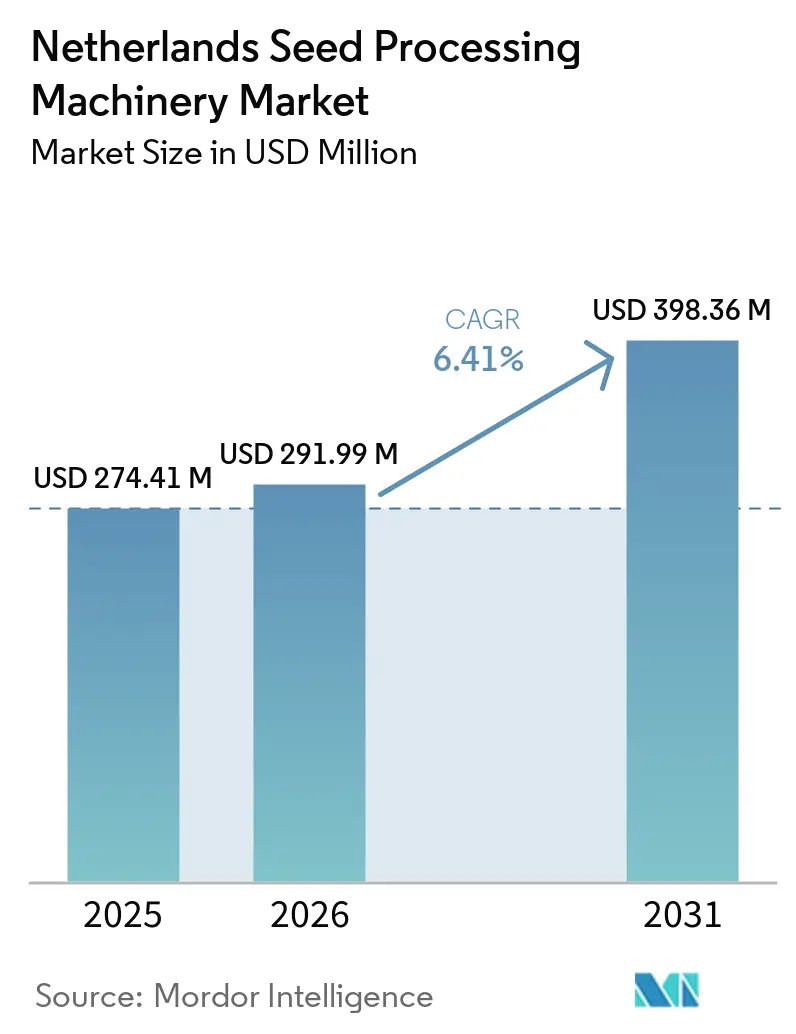
The Netherlands seed processing machinery market size is projected to expand from USD 274.41 million in 2025 and USD 291.99 million in 2026 to USD 398.36 million by 2031, registering a CAGR of 6.41% between 2026 and 2031. The Netherlands seed processing machinery market is supported by the country’s role in vegetable seed trade, which accounted for 40.0% of global vegetable seed trade and included the largest vegetable seed companies in 2026[1]. The sector also included more than 200 breeding companies and 7,000 businesses involved in seed production and trade in 2025, according to Social and Economic Research by Wageningen University. Plant reproductive material exports reached a substantial level in 2024, with vegetable seeds contributing a large share of the total. This export base supports equipment purchases for cleaning, grading, coating, and optical sorting at commercial facilities in Seed Valley, North Limburg, and Westland. The Netherlands seed processing machinery market also benefits as operators replace single-purpose machines with integrated lines that capture processing data and support quality documentation.
Key Report Takeaways
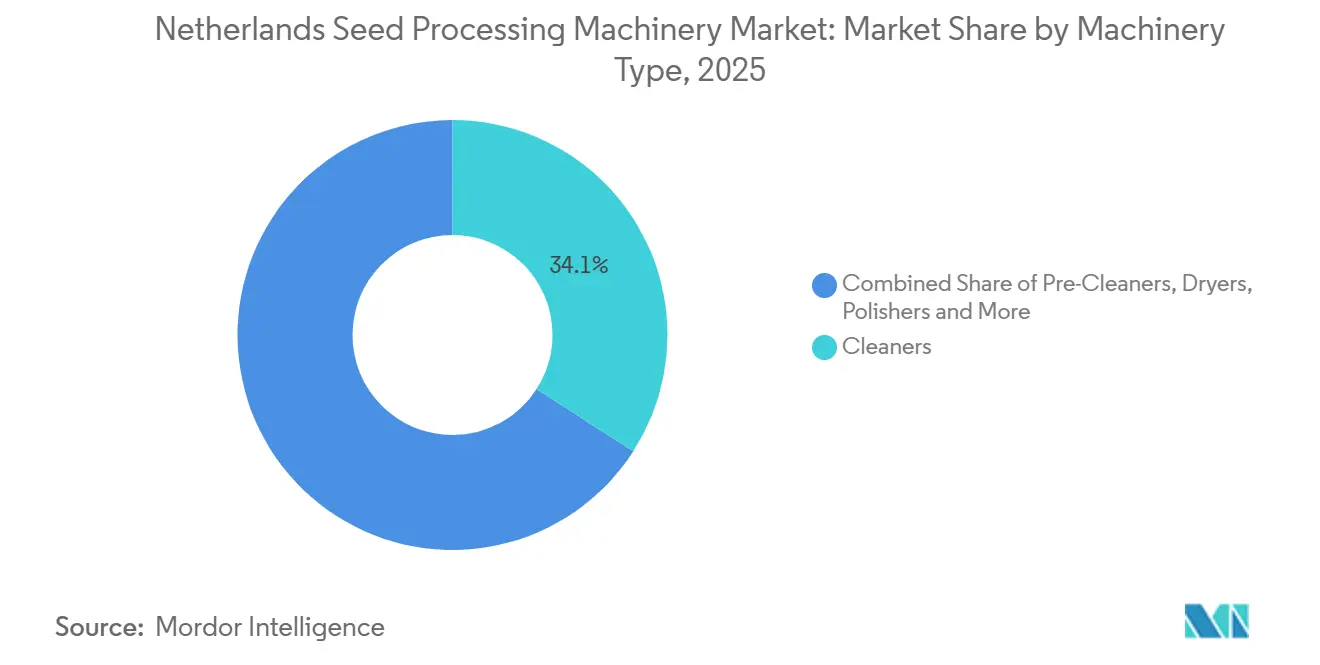
- By machinery type, cleaners accounted for 34.1% of the Netherlands' seed processing machinery market size in 2025, while optical sorters are forecast to grow at an 8.3% CAGR from 2026 to 2031.
- By operation mode, the automatic segment held 68.3% of the Netherlands' seed processing machinery market share in 2025 and is projected to register the fastest CAGR at 7.2% from 2026 to 2031.
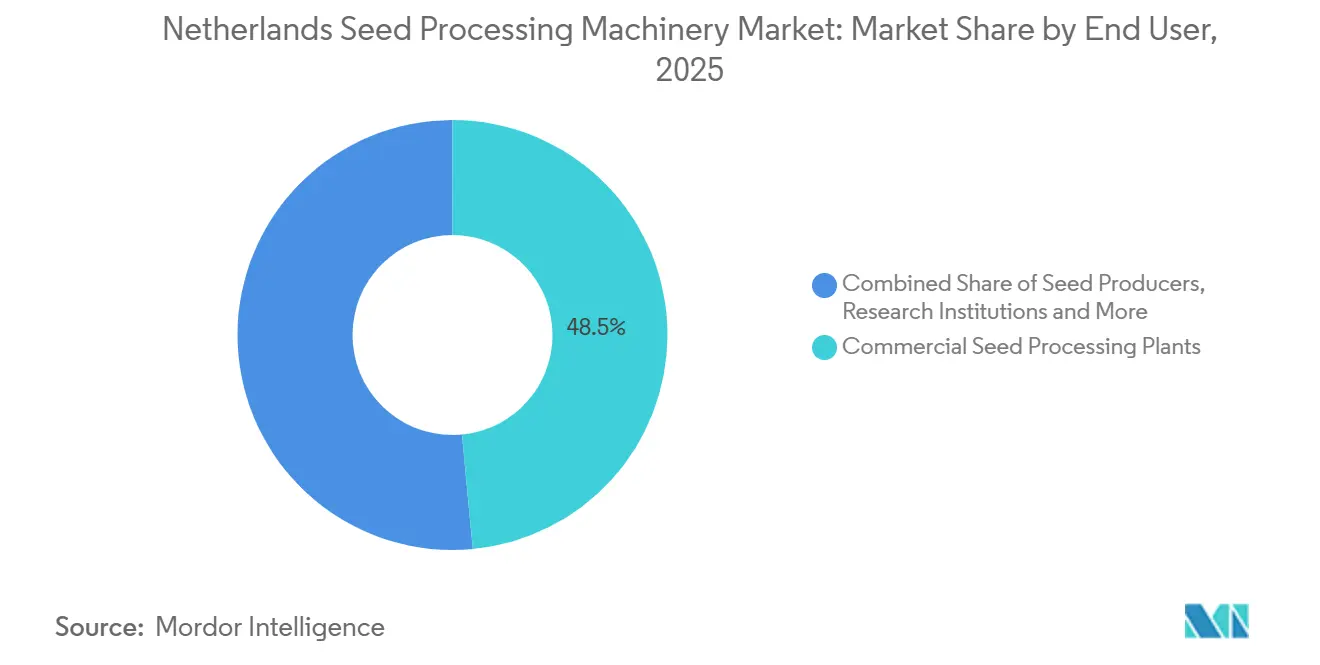
- By end user, commercial seed processing plants held 48.5% of the Netherlands seed processing machinery market size in 2025, while on-farm facilities are projected to register the fastest CAGR at 7.5% from 2026 to 2031.
Note: Market size and forecast figures in this report are generated using Mordor Intelligence’s proprietary estimation framework, updated with the latest available data and insights as of January 2026.
Netherlands Seed Processing Machinery Market Trends and Insights
Drivers Impact Analysis*
| Driver | (~) % Impact on CAGR Forecast | Geographic Relevance | Impact Timeline |
|---|---|---|---|
| Expansion of automated optical sorting | +1.50% | North Holland, South Holland, and Flevoland | Short term (≤ 2 years) |
| Rising demand for treated and value-added seeds | +1.20% | North Holland, South Holland, and Gelderland | Medium term (2-4 years) |
| Modernization of commercial seed processing plants | +1.10% | North Holland, Flevoland, and North Brabant | Medium term (2-4 years) |
| Growth of dutch vegetable and field-crop seed production | +1.00% | North Holland, Flevoland, and Zeeland | Short term (≤ 2 years) |
| Machine connectivity for lot-level traceability | +0.80% | South Holland, North Holland, and Flevoland | Medium term (2-4 years) |
| Seed quality gains from low-damage handling of delicate seeds | +0.70% | North Holland, Gelderland, and Flevoland | Long term (≥ 4 years) |
| Source: Mordor Intelligence | |||
Expansion of Automated Optical Sorting
Camera-based sorting has become core processing equipment in Dutch commercial seed operations. PETKUS Technologie GmbH introduced its OS G Iris sorter at Agritechnica 2025 with Intelligent Roeber Inspection System software that supports sorting by germination probability, genetic purity, color, and shape[2]. This capability brings functions previously handled through separate laboratory work into a single processing step. It also supports replacement of older single-spectrum sorters in the Netherlands seed processing machinery market. Satake Corporation launched the SLASH VQS Series globally in April 2026, combining red, green, and blue, near-infrared, and short-wave infrared cameras in a modular design. The design allows facilities of different sizes to add optical sorting capacity without committing to a full-scale line at the outset. Naktuinbouw’s Authorized Laboratories Conditions 2026 connect laboratory authorization to International Organization for Standardization and International Electrotechnical Commission 17025 and International Organization for Standardization 9001 requirements, making process-linked records more useful during certification. Connected sorters therefore help seed houses create quality records during routine operations and reduce manual reporting work.
Rising Demand for Treated and Value-Added Seeds
Coated, primed, pelleted, and biologically treated seeds require equipment beyond standard cleaning lines. The European Union Farm to Fork strategy seeks a 50.0% reduction in chemical pesticide use by 2030, which supports greater attention to biological seed treatments. These treatments can use fungal or bacterial inoculants that need controlled temperatures and precise application settings. Treating equipment must therefore manage lower-temperature dosing, dwell times, and cleaning between lots. Naktuinbouw’s NAFI authorization system is aligned with European Union Plant Health Regulation 2016/2031 and Organisation for Economic Co-operation and Development Seed Schemes 2021 requirements for phytosanitary traceability[3]. This framework increases the value of equipment that records recipes and dosing details for certified export lots. The Netherlands seed processing machinery market gains from higher equipment complexity because specialized coating platforms carry greater technical requirements than single-spray drum systems. Suppliers that can handle biological agents and support cleaning between varieties are positioned to address this demand.
Modernization of Commercial Seed Processing Plants
Commercial seed operations are replacing fragmented equipment fleets installed 15 to 25 years ago with integrated automatic lines. These lines combine cleaning, grading, coating, and data management in a single workflow. Dutch vegetable seed exports reached a substantial level in 2024, 31.0% higher than in 2020, according to Social and Economic Research by Wageningen University. The growth requires greater processing capacity at domestic commercial facilities. Private-sector annual research and development investment in Dutch plant breeding is substantial, and some companies invest 30.0% of turnover in this activity. That investment supports attention to processing quality and certification. Cimbria A/S and Fowler Westrup Group benefit when buyers procure full lines rather than individual machines. Standardized integrated platforms also strengthen recurring revenue from service and consumables in the Netherlands seed processing machinery market.
Machine Connectivity for Lot-Level Traceability
Digital links between machinery and lot-management databases are becoming necessary for Dutch commercial seed houses. Naktuinbouw’s NAFI authorization system requires companies to supervise and record phytosanitary quality for certified export lots. Equipment can record air velocity, screen settings, drying temperature, and treatment dosage at the lot level. PETKUS Technologie GmbH demonstrated its Intelligent Roeber Inspection System software at the World Seed Congress in Rotterdam. The software simplifies recipe creation, captures sorting-run data, and supports automated report generation. These records help companies retrieve the exact process conditions used for an exported lot. The information can support customs documentation, customer assurance, and certification audits. Buyers in the Netherlands seed processing machinery market increasingly assess software compatibility with quality-management and enterprise resource planning systems alongside mechanical performance. This requirement can lengthen purchasing decisions but also increases the value of integrated hardware and software offerings.
Restraints Impact Analysis*
| Restraint | (~) % Impact on CAGR Forecast | Geographic Relevance | Impact Timeline |
|---|---|---|---|
| High upfront cost of integrated processing lines | -1.40% | North Holland, Flevoland, and Gelderland | Short term (≤ 2 years) |
| Limited availability of skilled machinery operators | -1.00% | North Holland, South Holland, and Flevoland | Medium term (2-4 years) |
| Retrofit constraints in existing dutch facilities | -0.90% | North Holland, South Holland, and North Brabant | Medium term (2-4 years) |
| Data ownership and cybersecurity risks in connected equipment | -0.80% | North Holland, South Holland, and Flevoland | Long term (≥ 4 years) |
| Source: Mordor Intelligence | |||
High Upfront Cost of Integrated Processing Lines
A fully automated processing line can require a seven-figure investment for a mid-sized commercial operation. The cost covers pre-cleaning, optical sorting, coating, packaging, and associated line controls. Large Commercial Seed Processing Plants can spread this cost across high annual volumes. Seed Producers, On-Farm Facilities, and Research Institutions often handle smaller batches across several crop varieties. Their payback periods are less consistent. Financing for specialty agricultural machinery is less developed than for more common equipment categories in the Netherlands. PETKUS Technologie GmbH displayed its modular seed plant concept at EuroTier 2024, offering staged capital deployment for cleaning, sorting, and processing functions[4]. Modular designs reduce the immediate commitment but do not remove the final cost of full integration. Capital intensity therefore concentrates procurement in large commercial facilities and slows upgrades among smaller end users in the Netherlands seed processing machinery market.
Limited Availability of Skilled Machinery Operators
Advanced seed processing lines in the Netherlands require personnel with expertise in mechanical maintenance, digital control systems, and seed-quality management. Optical sorters, connected dryers, and seed treatment equipment increasingly rely on sensor-based automation and data-driven process control, expanding the technical skills required beyond traditional mechanical operations. Although the Netherlands has a well-developed vocational education system and a highly skilled agricultural workforce, rapid equipment digitalization has widened the industry's demand for specialized technical expertise. As a result, machinery suppliers are increasingly offering training, preventive maintenance, remote monitoring, and technical support services to ensure efficient operation and minimize downtime. These additional service requirements increase operating costs and can slow the adoption of advanced seed processing equipment, particularly among small and medium-sized processing facilities.
*Our forecasts treat driver/restraint impacts as directional, not additive. The impact forecasts reflect baseline growth, mix effects, and variable interactions.
Segment Analysis
By Machinery Type: Optical Sorting Reshapes Quality Economics
Cleaners held 34.1% of machinery-type revenue in 2025, making them the largest category and the universal first-stage machine across seed-processing workflows. Their large installed base drives recurring demand for screens, airflow components, and replacement drives, while also anchoring downstream equipment such as graders, calibrators, dryers, coaters, treaters, separators, and destoners. Seed packaging equipment supports lot documentation and traceability, and pre-cleaners and polishers handle intake conditioning and finishing work ahead of final grading and optical sorting.
Optical sorters are anticipated to record the fastest CAGR of 8.3% from 2026 to 2031, reflecting rising demand for germination assessment, lower sensor costs, and stricter documentation of lot purity. Satake Corporation’s SLASH VQS series provides modular sorting capacity suited to mid-volume facilities, while Carter Day International supplies disc separators and precision sizers for seed corn and specialty crops where mechanical grading remains critical. EU Council Directive 2002/55/EC ties vegetable-seed marketing to defined standards for varietal identity, analytical purity, and germination, reinforcing purchases of both mechanical graders and optical sorters to meet certification requirements. Graders and calibrators continue to serve crops and workflows where optical contrast alone cannot reliably separate useful seeds from contaminants or off-types.

By Operation Mode: Full Automation Claims the Commercial Core
Automatic systems held 68.3% of operation-mode revenue in 2025, making them the dominant segment as Dutch seed houses and other large commercial processors deploy programmable platforms across multiple crop varieties. In these environments, incorrect screen or coating settings can block lot certification, so automatic recipe management is increasingly used to reduce this risk and ensure consistent, repeatable output. Fowler Westrup Group’s Enkhuizen operations (via Seed Processing Holland) illustrate semi-automatic lines with clear upgrade paths toward greater automation, while Bühler AG reported CHF 2.147 billion (about USD 2.7 billion) in Grains and Food order intake in 2025, underpinning its automation portfolio for seed and grain processing.
Automatic operation is anticipated to register the fastest CAGR of 7.2% from 2026 to 2031 as connected processing expands automatic platforms beyond the largest commercial plants. Falling sensor costs and more accessible software licensing are lowering the ownership threshold, enabling mid-sized processors to adopt higher levels of automation. Semi-automatic platforms remain important for research institutions and on-farm facilities, where users value manual overrides and flexible controls for small-lot, multi-crop work. PETKUS Technologie GmbH’s 2025 release of the Batch Treater CM100 with automatic self-cleaning shows how targeted automation features can be added before full-line adoption, broadening use among semi-automatic operators.
By End User: Commercial Plants Anchor Demand, On-Farm Grows Fast
Commercial seed processing plants held 48.5% of end-user revenue in 2025, the largest share of the Netherlands seed processing machinery market. Their schedules need high-throughput equipment and service. They purchase integrated lines through tenders. These projects require engineering, installation, commissioning, and continuing service. Seed Producers are the second-largest group and often make targeted upgrades. Research Institutions buy precision Cleaners, Graders, and Optical Sorters for breeding support. Grain handling facilities are the smallest group. They mainly need cleaning and scalping equipment for seed-quality grain lots.
On-Farm Facilities are anticipated to record the fastest end-user CAGR of 7.5% from 2026 to 2031. Compact modular systems make on-site cleaning, treatment, and lot documentation more feasible. Naktuinbouw’s inspection framework supports facility-level quality control. Research Institutions retain a stable role through breeding programs requiring small-batch equipment. Commercial seed processing plants remain the principal buyers of integrated lines and services. Naktuinbouw’s NAFI authorization framework aligns with Official Controls Regulation 2017/625 of the European Union. The framework encourages seed producers to improve export traceability. This broadens the equipment buyer base.
Geography Analysis
The Netherlands seed processing machinery market is concentrated in North Holland’s Seed Valley, which includes Enkhuizen, Andijk, Hoorn, and Medemblik. This 30-kilometer cluster brings together vegetable seed companies, breeding stations, and contract processing facilities. The Netherlands accounted for 40.0% of global vegetable seed trade in 2025, according to Social and Economic Research by Wageningen University. Commercial plants in Seed Valley operate multi-crop schedules that support continued purchases of cleaners, optical sorters, coaters, and treating equipment for domestic supply and export programs.
Naktuinbouw increased statutory inspection fees by 6.5%, effective January 1, 2025, reflecting higher certification activity and tighter lot documentation requirements in the cluster. Westland and De Lier in South Holland form a second demand center for vegetable and substrate seed production for professional growers. Flevoland provides open-field seed multiplication for cereal, brassica, and root vegetable lots, which supports demand for high-throughput Cleaners and Graders. North Limburg benefits from its proximity to the Venlo horticultural hub, adding flower and vegetable seed volumes from contract multiplication farms operating under certified-seed frameworks.
On-farm facilities in Flevoland and North Limburg are anticipated to grow significantly during the forecast period. Lower entry-level automation costs are making compact systems more accessible to mid-sized growers seeking on-site quality control. The Netherlands Food and Consumer Product Safety Authority enforces seed control and phytosanitary inspection across Dutch production zones under applicable plant health rules. This common compliance framework creates different equipment needs because each area produces different crop varieties. Rotterdam’s port, inland waterways, and road network support faster delivery of machinery and replacement parts, while the country’s compact geography lowers service and aftermarket costs for processing facilities.
Competitive Landscape
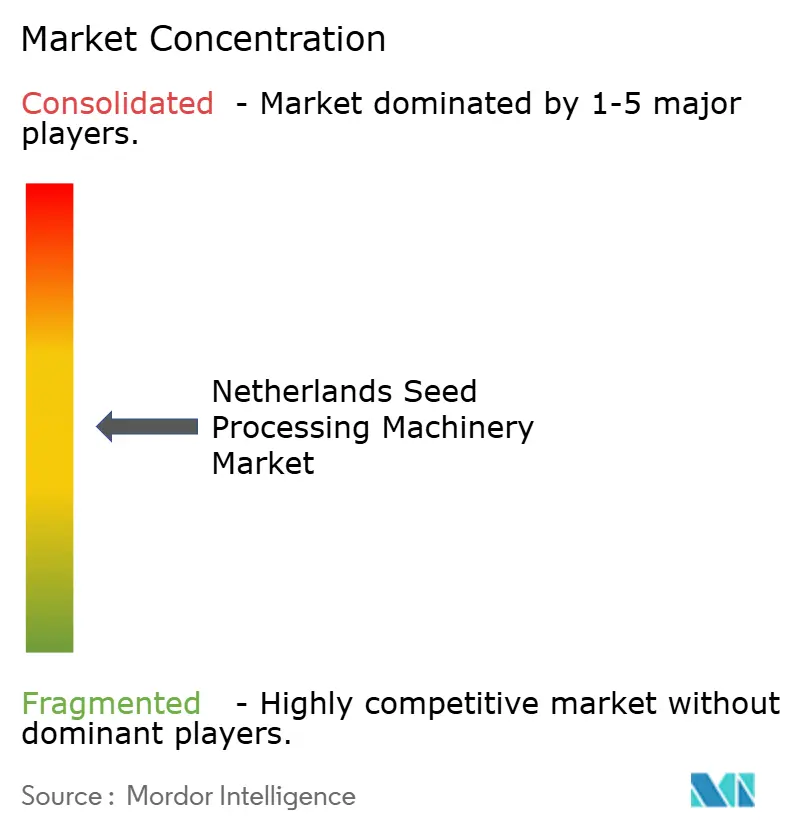
The Netherlands seed processing machinery market is moderately concentrated, with the top five companies holding a combined majority share in 2025. The largest supplier accounts for roughly one-fifth of the market, so no single company controls all machinery categories. Bühler AG is active in integrated optical sorting and grain-quality platforms, PETKUS Technologie GmbH in fine-seed sorting and treatment. This mix creates competition between broad platform suppliers and application-focused specialists. Bühler AG reported strong order intake in its Grains and Food division in 2025, supporting its position in automation and quality-control platforms.
Satake Corporation’s grain inspection system patent, published in February 2026, shows continued investment in sensing and quality-assessment technology. PETKUS Technologie GmbH’s OS G Iris, introduced in November 2025, added sorting for germination probability and genetic purity. Satake Corporation’s April 2026 global launch of the SLASH VQS Series provided modular optical sorting for facilities that cannot justify a full line. These actions focus competition on sorting quality, data capture, and line scalability. Suppliers with integrated hardware and software can raise switching costs when customers embed equipment data in quality-management workflows.
Commercial plants are the most competitive end-user segment because integrated-line projects are large and technically complex. On-Farm Facilities and Seed Producers offer room for modular connected systems without full-line project scales. Fowler Westrup Group’s Netherlands-based vegetable seed processing operations address the European mid-market, while Oliver Manufacturing Co., Inc. and Bratney rely on application expertise and dealer relationships. Recurring software for recipe management and traceability can lower one-time cost pressure and create recurring supplier revenue.
Netherlands Seed Processing Machinery Industry Leaders
-
Bühler AG
-
PETKUS Technologie GmbH
-
Grain & Protein Technologies (American Industrial Partners)
-
Satake Corporation
-
Alvan Blanch Development Company Ltd.
- *Disclaimer: Major Players sorted in no particular order
Recent Industry Developments
- April 2026: Satake Corporation launched the SLASH VQS Series modular optical sorter in the Netherlands following its successful introduction in the Japanese market, combining red, green, and blue, near-infrared, and short-wave infrared cameras with Satake Smart Sensitivity automated calibration.
- November 2025: PETKUS Technologie GmbH launched the OS G Iris next-generation optical sorter with Intelligent Roeber Inspection System software at Agritechnica 2025, together with the self-cleaning Batch Treater CM100, reinforcing the technology available to Dutch processors via PETKUS Selecta and raising performance benchmarks for optical sorting, treating, and cleaning in the Netherlands seed-processing market.
- November 2025: PETKUS Technologie GmbH presented the G2 Gravity Separator for fine seeds at Agritechnica 2025, providing density-based classification for lettuce, onion, and carrot seed categories.
Netherlands Seed Processing Machinery Market Report Scope
Seed processing machinery encompasses equipment used in agriculture to clean, sort, grade, dry, treat, and package seeds, improving their quality and viability for planting. These machines play a critical role in removing impurities, ensuring uniformity, and safeguarding seeds from pests and diseases. The Netherlands seed processing machinery market report is segmented by machinery type (pre-cleaners, cleaners, dryers, graders, coaters and treaters, separators and destoners, polishers, optical sorters, seed packagers, and other specialized equipment), by operation mode (automatic and semi-automatic), and by end-user (commercial seed processing plants, seed producers, research institutions, on-farm facilities, and grain handling facilities). The market forecasts are provided in terms of value (USD).
| Pre-Cleaners |
| Cleaners |
| Dryers |
| Graders and Calibrators |
| Coaters and Treaters |
| Separators and Destoners |
| Polishers |
| Optical Sorters |
| Seed Packaging Equipment |
| Other Specialized Seed Processing Equipment |
| Automatic |
| Semi-Automatic |
| Commercial Seed Processing Plants |
| Seed Producers |
| Research Institutions |
| On-Farm Facilities |
| Grain Handling Facilities |
| By Machinery Type | Pre-Cleaners |
| Cleaners | |
| Dryers | |
| Graders and Calibrators | |
| Coaters and Treaters | |
| Separators and Destoners | |
| Polishers | |
| Optical Sorters | |
| Seed Packaging Equipment | |
| Other Specialized Seed Processing Equipment | |
| By Operation Mode | Automatic |
| Semi-Automatic | |
| By End User | Commercial Seed Processing Plants |
| Seed Producers | |
| Research Institutions | |
| On-Farm Facilities | |
| Grain Handling Facilities |
Key Questions Answered in the Report
What is the projected value of the Netherlands seed processing machinery market by 2031?
The Netherlands seed processing machinery market is projected to reach USD 398.36 million by 2031, registering a CAGR of 6.41% between 2026 and 2031
Which machinery category is growing fastest in the Netherlands?
Optical Sorters are anticipated to grow at a CAGR of 8.3% through 2031, supported by demand for documented purity and germination assessment.
Why do Dutch seed companies invest in connected processing equipment?
Connected equipment records lot-level process settings, which supports phytosanitary traceability and quality documentation for export lots.
Which end users purchase the most seed processing equipment in the Netherlands?
Commercial seed processing plants held the largest share at 48.5% in 2025 because they operate high-throughput, multi-crop processing lines.