
Netherlands Cashew Market Analysis by Mordor Intelligence
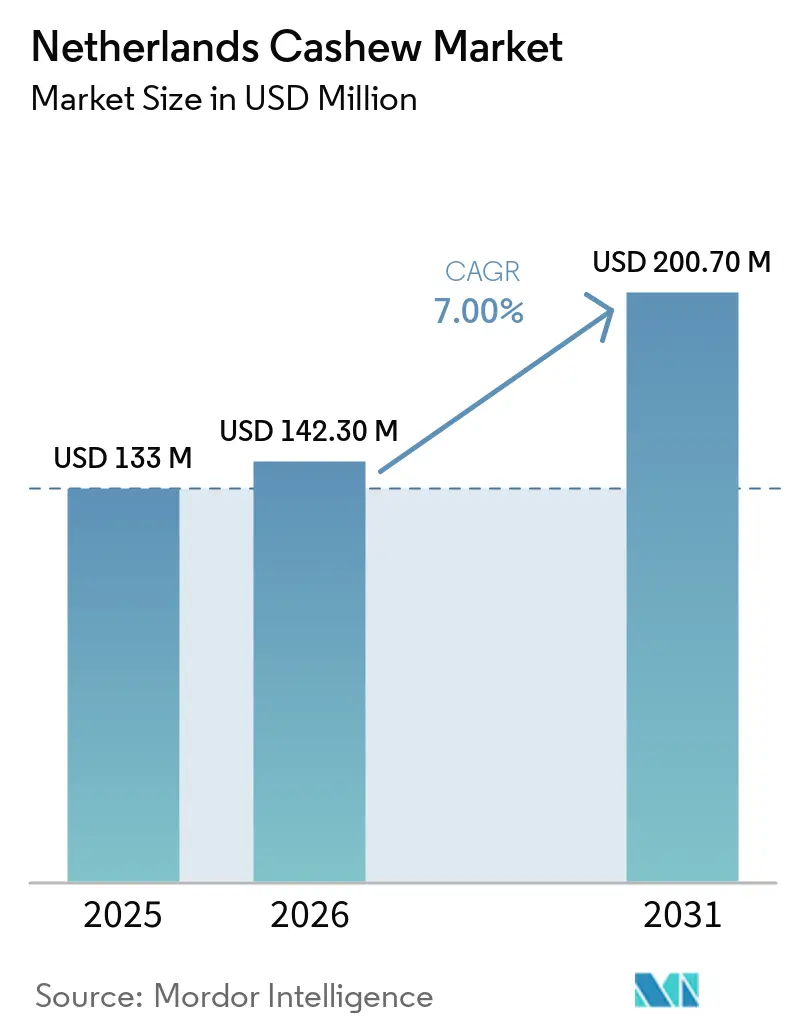
The Netherlands cashew market size is projected to grow from USD 133 million in 2025 and USD 142.3 million in 2026 to USD 200.7 million by 2031, registering a 7.0% CAGR between 2026 and 2031. The Netherlands holds a significant position in the cashew market, serving as a key entry point for high-volume shipments of kernels arriving in Rotterdam from Vietnam, India, and West Africa. These kernels are graded, roasted, and repackaged for distribution throughout Europe. The strong presence of private-label products in Dutch grocery retail sustains steady demand for competitively priced kernels, often flavored and branded by supermarket chains. The growing adoption of flexitarian diets is further boosting demand for cashew-based dairy alternatives and innovative snacks that leverage the nut’s creamy lipid profile. Technological advancements are improving yields and ensuring compliance with British Retail Consortium Global Standard (BRCGS) and International Featured Standard (IFS) requirements, which are essential for European retailers. On the supply side, strict European Union pesticide regulations and weather-related challenges in West Africa impact profit margins. Nevertheless, Rotterdam’s strategic role as a logistics and value-addition hub underscores the Netherlands' critical role in maintaining regional supply security for the cashew market.
Key Report Takeaways
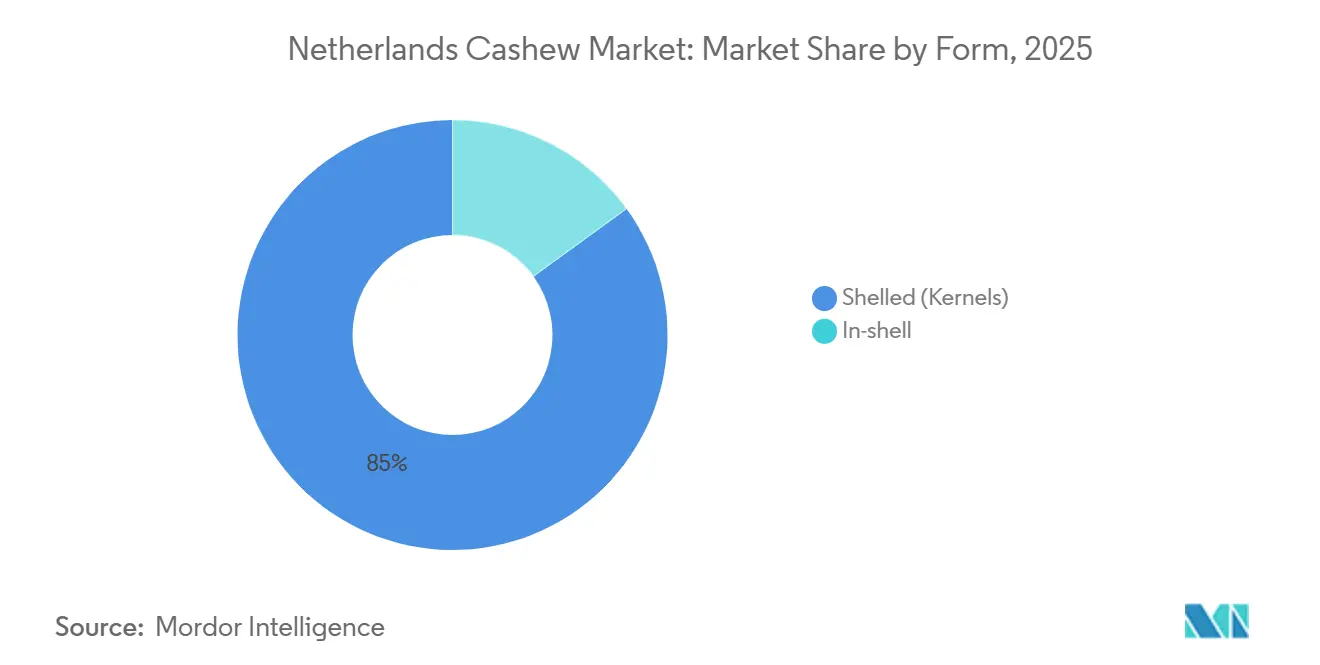
- By form, shelled kernels led with the largest 85% Netherlands cashew market share in 2025, while the in-shell cashews market size is forecast to expand at the fastest 8.7% CAGR from 2026 to 2031.
Note: Market size and forecast figures in this report are generated using Mordor Intelligence’s proprietary estimation framework, updated with the latest available data and insights as of January 2026.
Netherlands Cashew Market Trends and Insights
Drivers Impact Analysis*
| Driver | (~) % Impact on CAGR Forecast | Geographic Relevance | Impact Timeline |
|---|---|---|---|
| Rising demand for plant-based protein snacks | +1.2% | Amsterdam, Rotterdam, Utrecht, and The Hague | Medium term (2-4 years) |
| Increasing private-label presence in supermarkets | +1.5% | National, concentrated in Albert Heijn and Jumbo networks | Short term (≤ 2 years) |
| Health-focused innovations | +0.9% | Netherlands and wider Western Europe | Medium term (2-4 years) |
| Expansion of cashew-based ingredients for dairy alternatives | +1.1% | Wageningen and Randstad | Medium term (2-4 years) |
| AI-driven optical sorting improving kernel quality yields | +0.7% | Rotterdam and Giessen processing hubs | Long term (≥ 4 years) |
| European Union–Mercosur trade easing kernel imports | +0.5% | European Union wide, primary benefits to Netherlands re-export corridors | Long term (≥ 4 years) |
| Source: Mordor Intelligence | |||
Rising Demand for Plant-Based Protein Snacks
The Netherlands is undergoing a structural shift toward plant-based diets, which is increasing the demand for cashew-based snacks. According to Wageningen University & Research, plant-based protein products represented 38% of the online supermarket assortment in the Netherlands in 2024, marking a 6% increase compared to the previous year [1]Source: Wageningen University & Research, “Protein Monitor 2024: Plant-based products rise in supermarkets,” wur.nl. This indicates a rapid expansion in both availability and retail visibility. The growing presence of plant-based options in supermarkets is encouraging consumers to adopt alternative protein sources, including nuts like cashews, which are commonly used in snack products and dairy-alternative formats. As retail penetration grows, suppliers are adapting their offerings to align with changing dietary preferences and the demand for convenience-focused consumption options.
Increasing Private-Label Presence in Supermarkets
Private-label dominance in the Netherlands continues to drive steady demand for cashew kernels in retail snack assortments. According to Statistics Netherlands, private-label products accounted for 47% of total grocery retail sales, including food, beverages, and everyday consumer goods sold through supermarkets, in 2024 [2]Source: Statistics Netherlands (CBS), “Private Label Share of Grocery Retail in the Netherlands (2024),” cbs.nl. This significant market share supports bulk procurement and long-term supply agreements, providing advantages to cashew importers serving roasting and packaging operations. Suppliers adhering to stringent quality and certification requirements maintain consistent supply volumes, despite operating with lower profit margins.
Health-Focused Innovations
Health-conscious consumption trends are driving the market in cashew products. According to the International Trade Centre Trade Map, the Netherlands imported cashew nuts valued at USD 315.5 million, with a volume of 49,754 metric tons in 2024 [3]Source: International Trade Centre (ITC), “Trade Map – Netherlands Cashew Imports (2024),” trademap.org. This reflects strong and sustained demand for nuts as part of healthier snacking habits and plant-based dietary preferences. The significant import volume shows steady demand across retail and food processing, encouraging suppliers to develop differentiated, value-added cashew products. As consumers increasingly seek nutrient-rich snack options, product innovation continues to drive growth in the cashew market in the Netherlands.
Expansion of Cashew-Based Ingredients for Dairy Alternatives
The adoption of cashew-based ingredients in dairy alternatives is growing in the Netherlands, driven by the country's shift toward plant-based proteins. According to the researchers from Wageningen University & Research published in 2026, plant-based protein constitutes approximately 40% of the Dutch diet. The national goal is to raise this share to 50% by 2030, indicating alignment between policy initiatives and consumer preferences for plant-based consumption. This trend is prompting food manufacturers to utilize nuts like cashews in dairy alternatives due to their functional and textural benefits, thereby boosting the demand for cashew-based ingredients in the Netherlands market.
Restraints Impact Analysis*
| Restraint | (~) % Impact on CAGR Forecast | Geographic Relevance | Impact Timeline |
|---|---|---|---|
| High reliance on weather-sensitive African supply | -1.3% | Netherlands with upstream exposure to Ivory Coast, Benin, and Ghana | Short term (≤ 2 years) |
| Euro–West African franc exchange-rate volatility | -0.6% | Netherlands import channels linked to West African Communauté Financière Africaine (CFA) franc zone | Medium term (2-4 years) |
| Stricter European Union pesticide limits raising rejection rates | -0.8% | European Union wide, enforced at Rotterdam and Amsterdam ports | Medium term (2-4 years) |
| Increasing competition from almond and pistachio snacks | -0.5% | Netherlands retail and foodservice channels | Long term (≥ 4 years) |
| Source: Mordor Intelligence | |||
High Reliance on Weather-Sensitive African Supply
According to the Center for the Promotion of Imports from Developing Countries (CBI, 2024), the Netherlands continues to rely heavily on West African countries for cashew imports, with 98% of its cashew nut kernels sourced from them in 2024. This dependence exposes Dutch importers and processors to climate-related risks affecting African production regions, including irregular rainfall, crop diseases, and harvest disruptions. Since the Netherlands functions as a major trading and re-export hub for cashews in Europe, instability in upstream supply chains can lead to procurement uncertainty, shipment delays, and price fluctuations. Consequently, reliance on weather-sensitive African supply acts as a restraint on the Netherlands cashew market by affecting supply consistency and import stability.
Euro–West African Franc Exchange-Rate Volatility
Euro–West African Franc exchange-rate volatility continues to pose procurement challenges for the Netherlands cashew market. According to the African Cashew Alliance, farmgate prices in the Ivory Coast were set at 400 Communauté Financière Africaine (CFA) francs per kilogram (USD 0.68) for the 2026 season, reflecting adjustments influenced by currency movements and global market conditions. Such pricing shifts at origin directly affect exporter margins and translate into fluctuating export prices for European buyers. For Netherlands importers relying on stable sourcing from West Africa, these variations create uncertainty in cost planning, complicate long-term contracts, and increase exposure to margin volatility in a highly price-sensitive retail environment.
*Our forecasts treat driver/restraint impacts as directional, not additive. The impact forecasts reflect baseline growth, mix effects, and variable interactions.
Segment Analysis
By Form: Shelled Kernels Dominate, In-Shell Gains Niche Traction
Shelled (kernels) accounted for the largest 85% of the Netherlands cashew market share in 2025. This dominance is supported by strong integration with private-label roasting, confectionery applications, and growing demand for plant-based dairy alternatives. The Netherlands serves as a key redistribution hub, with bulk kernel imports processed through Rotterdam for grading, roasting, and repackaging across Europe. Standardization around common grades, such as W320 and W240, enhances supply consistency and processing efficiency. Additionally, private-label retail strategies drive demand for affordable, ready-to-consume formats, while the broad application of shelled kernels in snacks, bakery products, cereals, and dairy alternatives sustains their leading position.
The in-shell cashew market is forecast to grow at the fastest CAGR of 8.7% from 2026 to 2031, driven by niche demand in premium and specialty segments. Artisanal roasters and specialty retailers are promoting in-shell formats as authentic, minimally processed options that appeal to health-conscious consumers. This segment also benefits from experiential consumption trends, where manual cracking adds novelty and consumer engagement. Premium packaging and gifting formats further support higher margins in select channels. However, challenges such as shell handling requirements and by-product management limit large-scale retail adoption, keeping the segment smaller despite its faster growth trajectory within the market.



Geography Analysis
Rotterdam plays a key role in the Netherlands' cashew trade, utilizing its position as Europe’s largest port to manage significant volumes of edible nuts and support redistribution across the region. According to the International Trade Centre Trade Map, the Netherlands exported 44,678 metric tons of cashew nuts in 2024, valued at USD 295 million, highlighting its importance as a re-export hub within the European cashew supply chain. The advanced infrastructure in Rotterdam enables efficient bulk handling, processing, and redistribution to regional markets, while strong inland logistics connectivity ensures timely delivery to retail and foodservice buyers across Europe.
Amsterdam complements Rotterdam by specializing in high-value segments, including organic and certified cashew products. The city is home to specialized importers and traders connected to global sourcing networks, such as Tradin Organic Agriculture, which supplies certified organic nuts under European Union standards. Amsterdam Airport Schiphol's location makes it easy to ship samples and niche consignments to meet premium retail and e-commerce demand. Furthermore, integrated customs systems aligned with Import Control System 2 (ICS2) streamline clearance processes, reducing lead times and enhancing supply chain reliability for approved operators.
Origin countries are increasingly expanding their domestic processing capabilities, which could alter traditional trade flows historically centered on Dutch hubs. Leading cashew-producing nations in West Africa are strengthening their role in the global supply chain through investments in local shelling and value-added processing. This development enhances the potential for direct exports to European buyers, reducing dependence on intermediary trade channels. Despite these shifts, Rotterdam retains a competitive edge due to its scale, advanced processing infrastructure, and well-established distribution networks across Europe.
Competitive Landscape
The Netherlands cashew market exhibits a balanced competitive landscape, with multinational processors, regional traders, and niche specialists competing across sourcing and value-added segments. Companies like Intersnack Group operate vertically integrated supply chains encompassing procurement, roasting, and distribution. Global suppliers such as Olam Food Ingredients emphasize traceability and sustainability, aligning their operations with strict European retail standards. Mid-sized firms distinguish themselves through customized blends, private-label manufacturing, and flexible contracting, enabling them to adapt swiftly to changing retailer demands and consumer preferences.
Local traders, including Catz International and Rhumveld Winter & Konijn B.V., leverage long-standing supplier relationships to deliver tailored nut assortments and specialized roasting solutions. Ethical sourcing has emerged as a critical competitive factor, with companies increasingly forming partnerships in West Africa to ensure traceable and responsible supply chains. Additionally, the adoption of advanced technologies is enhancing competitiveness, as processors implement sophisticated sorting systems and automation to improve efficiency and maintain consistent product quality. These capabilities are particularly vital for meeting stringent private-label standards, especially regarding uniform grading and low defect tolerance.
At the origin level, expanding processing capabilities are intensifying competition for European importers by enabling greater value addition closer to the source. This development fosters more direct trade relationships between African processors and European buyers. Nevertheless, Dutch operators maintain a competitive advantage due to their advanced processing infrastructure, strong innovation capabilities, and well-established distribution networks, particularly in segments such as roasted snacks and dairy-alternative applications.
Recent Industry Developments
- August 2025: Olam Food Ingredients B.V. entered into a partnership with TechnoServe as part of the Prosper Cashew initiative. This collaboration aims to enhance cashew sourcing and processing value chains, ensuring improved supply stability for the Netherlands and other European markets.
- July 2024: The European Commission has reinforced contaminant control requirements for cashews under its regulation, maintaining the maximum cadmium residue limit at 0.20 mg/kg and enhancing monitoring and compliance measures for imported cashews in Netherlands.


Netherlands Cashew Market Report Scope
Cashew is an edible, kidney-shaped nut derived from the cashew tree. It is commonly consumed as a snack and utilized in cooking for its creamy texture and mildly sweet flavor. Cashews are also appreciated for their nutritional content, including healthy fats, protein, and essential minerals. The Netherlands cashew market report is segmented by form (in-shell and shelled (kernels)), and includes production analysis (production volume, area harvested and yield), consumption analysis (value and volume), trade analysis (value and volume), import market analysis (import value and volume, key supplying markets), export market analysis (export value and volume, key destination markets), wholesale price trend analysis and forecast, regulatory framework, and logistics and infrastructure. The market forecasts are provided in terms of value (USD) and volume (metric tons).
By Form (Value)
| In-shell |
| Shelled (Kernels) |
Netherlands
| Production Analysis | Production Volume | |
| Area Harvested and Yield | ||
| Consumption Analysis (Value and Volume) | ||
| Trade Analysis (Value and Volume) | Import Market Analysis | Import Value and Volume |
| Key Supplying Markets | ||
| Export Market Analysis | Export Value and Volume | |
| Key Destinations Markets | ||
| Wholesale Price Trend Analysis and Forecast | ||
| Regulatory Framework | ||
| Logistics and Infrastructure | ||
| Seasonality Analysis | ||
| By Form (Value) | In-shell | ||
| Shelled (Kernels) | |||
| Netherlands | Production Analysis | Production Volume | |
| Area Harvested and Yield | |||
| Consumption Analysis (Value and Volume) | |||
| Trade Analysis (Value and Volume) | Import Market Analysis | Import Value and Volume | |
| Key Supplying Markets | |||
| Export Market Analysis | Export Value and Volume | ||
| Key Destinations Markets | |||
| Wholesale Price Trend Analysis and Forecast | |||
| Regulatory Framework | |||
| Logistics and Infrastructure | |||
| Seasonality Analysis | |||


Key Questions Answered in the Report
What is the current value of the Netherlands cashew market?
The Netherlands cashew market size reached USD 142.3 million in 2026 and is on track to hit USD 200.7 million by 2031.
How fast is demand for in-shell cashews growing?
In-shell cashews market size is projected to expand at the fastest 8.7% CAGR during 2026-2031.
Which companies dominate Dutch cashew imports?
Intersnack Procurement B.V., Olam Food Ingredients, and Tradin Organic Agriculture are among the leading importers and processors.
Why is Rotterdam critical to European cashew trade?
Rotterdam’s port infrastructure enables high-volume kernel imports, quality grading, and re-export to Germany, France, and Belgium within tight delivery windows.
Page last updated on:





