
Nano Dentistry Market Size and Share
Market Overview
| Study Period | 2021 - 2032 |
|---|---|
| Market Size (2027) | USD 1.32 Billion |
| Market Size (2032) | USD 2.15 Billion |
| Growth Rate (2027 - 2032) | 10.25 % |
| Fastest Growing Market | Asia-Pacific |
| Largest Market | North America |
| Market Concentration | Medium |
Major Players *Disclaimer: Major Players sorted in no particular order Image © Mordor Intelligence. Reuse requires attribution under CC BY 4.0. | |
Nano Dentistry Market Analysis by Mordor Intelligence
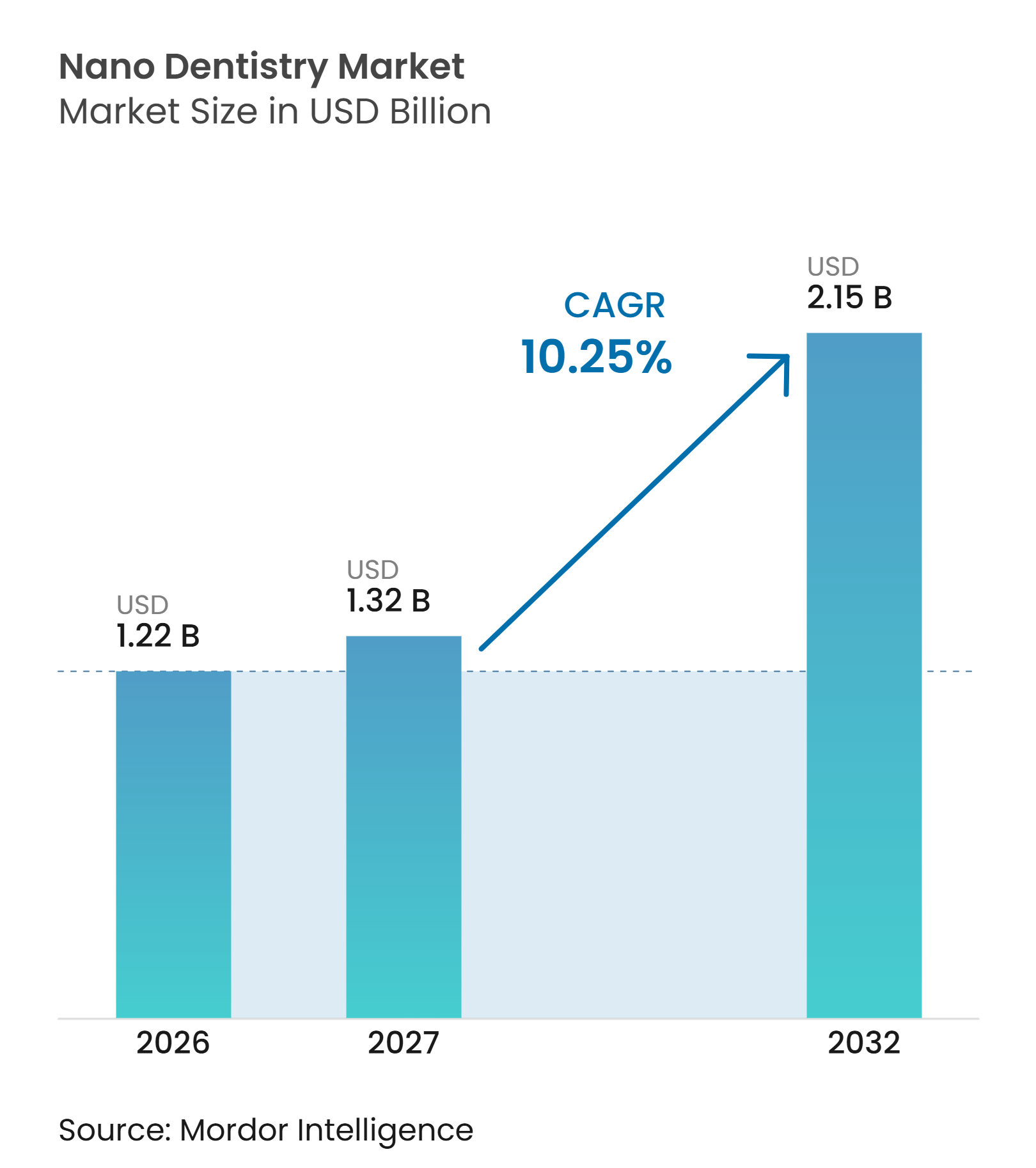
The Nano Dentistry Market size is expected to grow from USD 1.22 billion in 2026 to USD 1.32 billion in 2027 and is forecast to reach USD 2.15 billion by 2032 at 10.25% CAGR over 2027-2032.
Demand is moving toward tooth-colored restorations that combine appearance with greater mechanical performance. The Minamata Convention has encouraged the phase-out of mercury-added dental amalgam, which redirects some public procurement toward alternative restorative materials. A larger older population will sustain the need for restorative and implant procedures, as the United Nations projects that the population aged 65 and older will exceed 1.5 billion by 2030. Manufacturers are linking nano-enabled materials with digital workflows because clinicians need shorter treatment cycles and consistent results. The nano dentistry market also faces uneven access because evidence requirements and safety reviews differ across major regulatory systems.
Key Report Takeaways
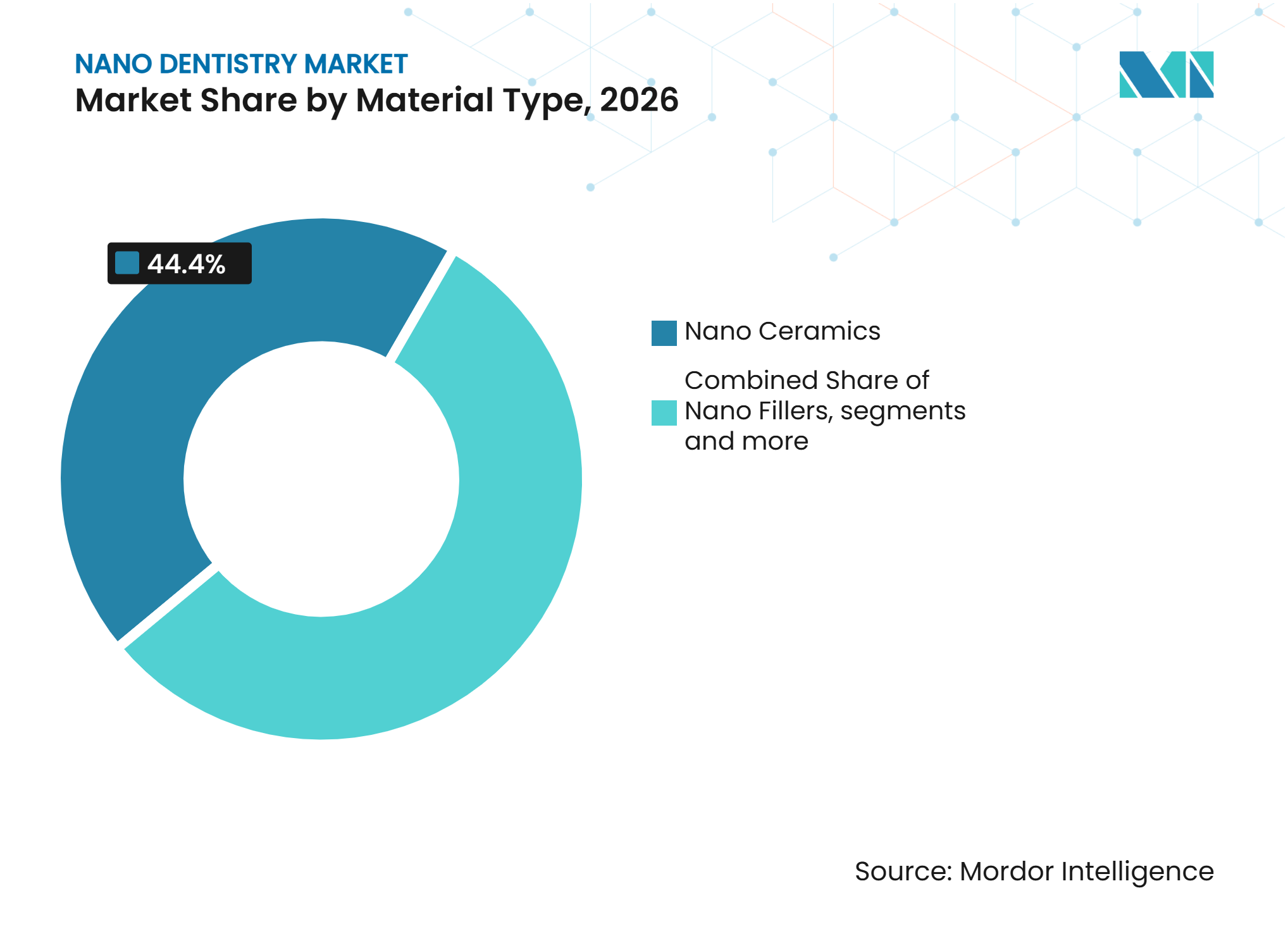
- By material type, nano ceramics led with a 44.35% revenue share in 2026, while nano fillers are forecast to expand at an 11.12% CAGR through 2032.
- By application, restorative dentistry held 41.12% in 2026, while implant dentistry recorded the highest projected CAGR at 12.27% through 2032.
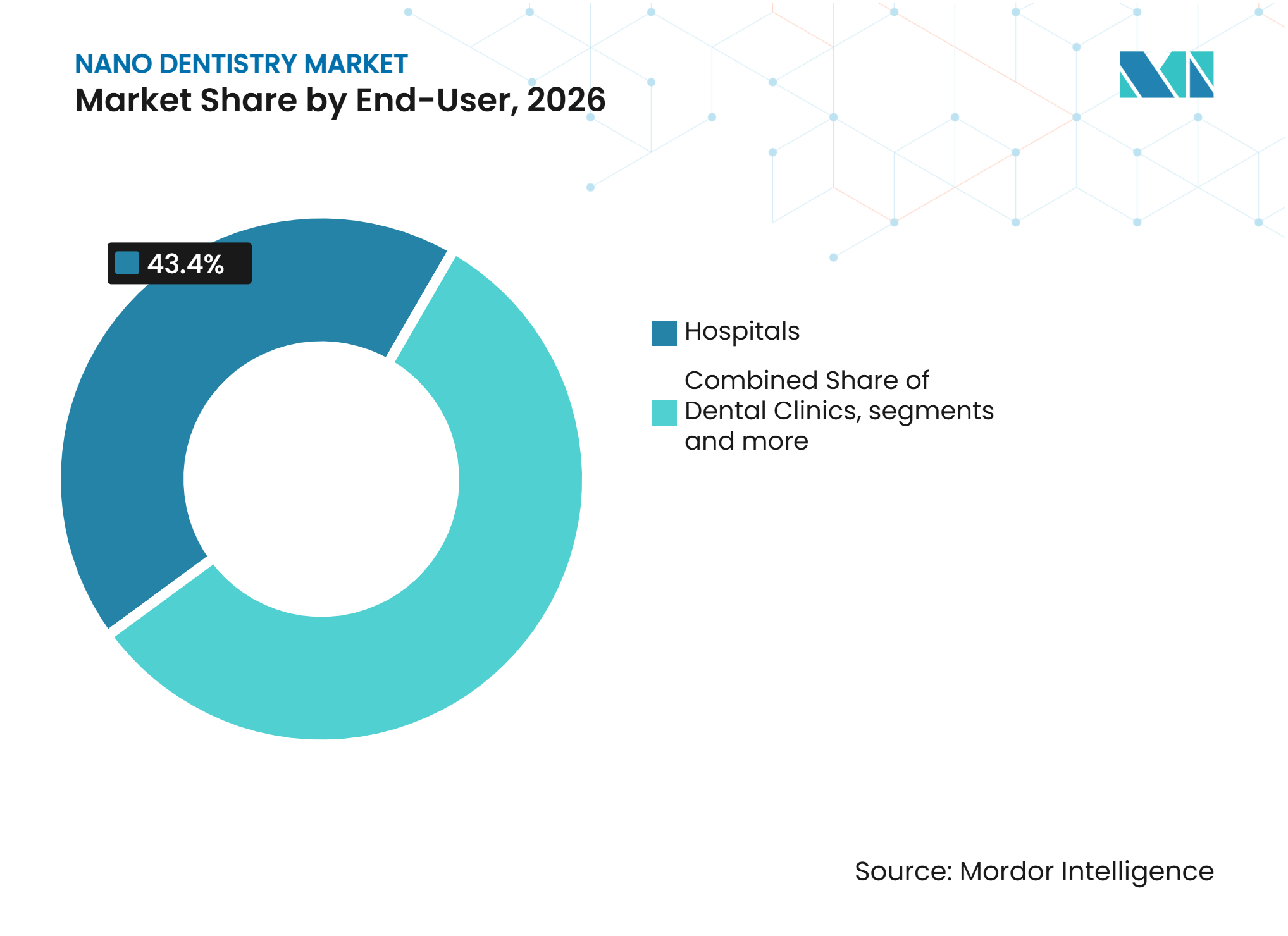
- By end-user, hospitals held 43.42% in 2026, while dental clinics are expected to grow at a 10.75% CAGR through 2032.
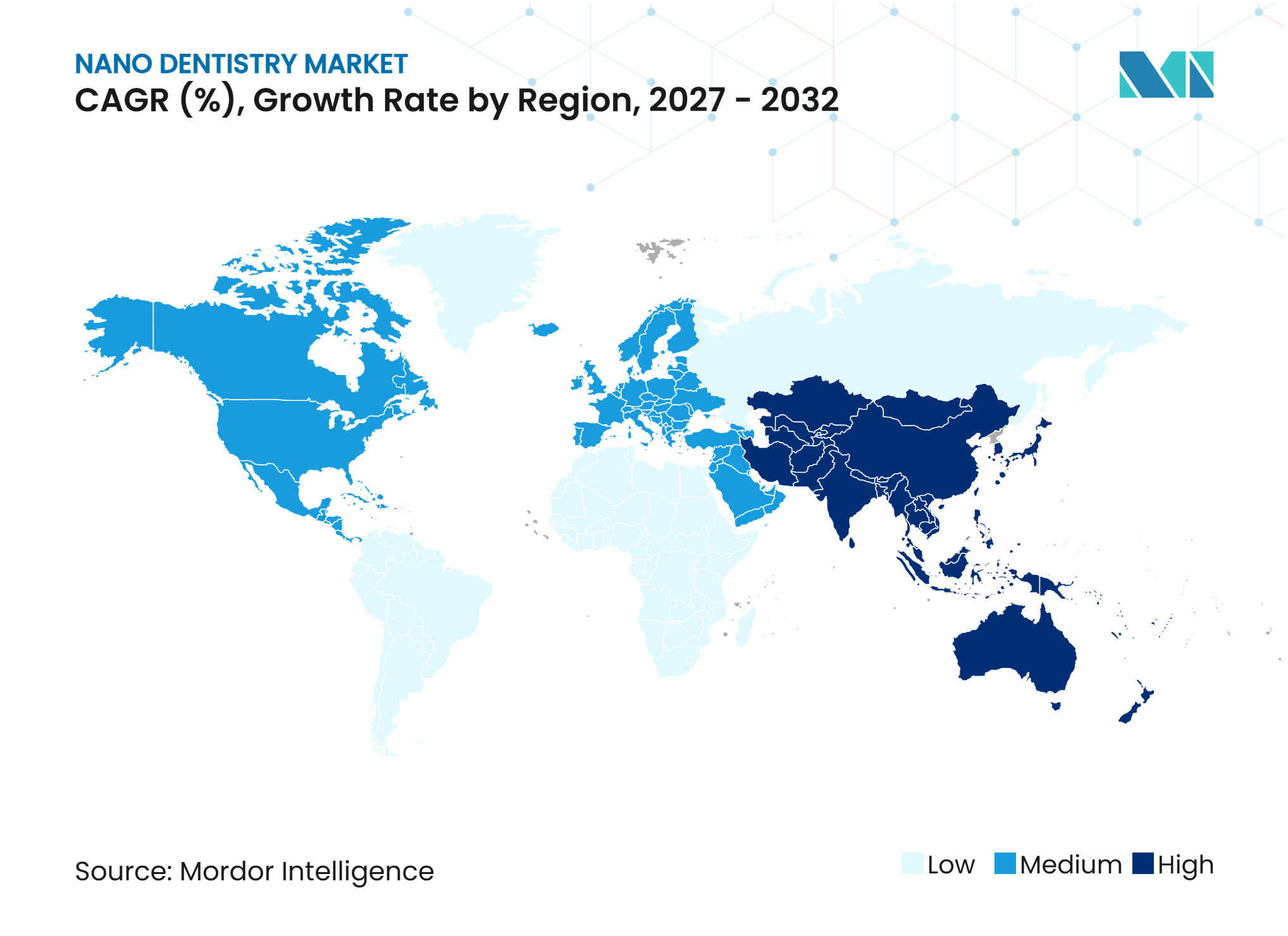
- By geography, North America held 43.34% in 2026, while Asia-Pacific is projected to grow at a 13.26% CAGR through 2032.
Note: Market numbers in this report are based on Mordor Intelligence's proprietary estimation framework, which combines nine months of actuals with Q4 projections for base year 2026.
Market Trends and Insights
Drivers Impact Analysis of Nano Dentistry Market*
| Driver | (~) % Impact on CAGR Forecast | Geographic Relevance | Impact Timeline |
|---|---|---|---|
| Rising Demand for Durable and Aesthetic Restorations | +2.8% | Global, with peak intensity in North America and Europe | Short term (≤ 2 years) |
| Nano-Engineered Implant Surfaces for Osseointegration and Infection Control | +2.1% | North America, Europe, and core Asia-Pacific markets | Medium term (2-4 years) |
| Shift Toward Biomimetic Remineralization and Preventive Care | +1.4% | Global, with early gains in Europe and East Asia | Medium term (2-4 years) |
| Digital Dentistry Accelerating Nano-Material Design and Workflows | +1.5% | North America, core Asia-Pacific markets, and spillovers to the Middle East and Africa | Medium term (2-4 years) |
| Controlled Local Drug Delivery for Periodontal and Endodontic Care | +0.9% | Global, with emerging traction among academic and hospital end users | Long term (≥ 4 years) |
| Dental Wastewater and Microbial-Resistance Monitoring Creating Demand for Safer Nano-Formulations | +0.4% | Europe, North America, and select Asia-Pacific markets | Long term (≥ 4 years) |
| Source: Mordor Intelligence | |||
Rising Demand for Durable and Aesthetic Restorations
Tooth-colored restorations increasingly need to meet clinical requirements for durability, wear resistance, and appearance. A 2026 multicenter study reported 96.8% survival for nano-zirconia restorations after 36 months, compared with 91.7% for conventional composites.[1] The same study reported a mean flexural strength of 148.3 MPa for nano-zirconia composites and 112.4 MPa for conventional composites. A 2025 randomized trial found comparable clinical performance and wear for BisGMA-based and BisGMA-free nanoceramic resin composites over 48 months.[2] This widens material choice for dental practices that want to avoid a chemistry constraint without reducing restorative performance. Updated FDA guidance for dental composite resin device submissions now provides current testing expectations, including shelf-life assessment, for manufacturers serving the nano dentistry market.
Nano-Engineered Implant Surfaces for Osseointegration and Infection Control
Nano-textured implant surfaces target early bone attachment and bacterial colonization, which are both important in implant outcomes. A 2025 systematic review and meta-analysis of 51 studies found stronger removal torque and bone-to-implant contact for nanostructured titanium coatings than for conventional micro-rough surfaces. A separate 2025 study reported bacterial reductions of 70% to 90% on nanospike titanium surfaces.[3] That study also reported a 56% bone contact index for nanospike surfaces and 41% for control implants. Nanotubular surfaces recorded 0.70 mm mean crestal bone loss at 12 weeks, compared with 1.2 mm for sandblasted acid-etched controls. These results support earlier prosthetic loading and create opportunities for innovation across the nano dentistry industry, although additional nanomaterial safety documentation under EU MDR Rule 19 raises the development burden for smaller suppliers.
Shift Toward Biomimetic Remineralization and Preventive Care
Nano-hydroxyapatite is broadening preventive care beyond a fluoride-only approach toward biomineralization-based products. Regulation (EU) 2024/858 updated the permitted use conditions for nano-hydroxyapatite in cosmetic products. The EU Scientific Committee on Consumer Safety issued its fourth opinion on nano-hydroxyapatite in July 2025. A 2025 systematic review of randomized trials found that nano-hydroxyapatite toothpastes delivered outcomes comparable with sodium fluoride for early carious lesions. In 2026, glass ionomer cements modified with nano-zirconia, nano-hydroxyapatite, and nano-alumina reached 160.4 MPa compressive strength without cytotoxicity in human dental pulp stem cells. This evidence gives suppliers a path from consumer oral care into adhesives, sealers, and other restorative materials. Local nano-drug delivery and safer formulations also fit this preventive direction, but both depend on sustained clinical validation.
Digital Dentistry Accelerating Nano-Material Design and Workflows
Digital workflows are reducing the time between material selection, restoration design, and chairside treatment. SHINING 3D Dental launched the Ceramix-Nano in June 2026 as a 2 kg chairside printer for permanent ceramic crowns. The company stated that the system used FDA-cleared LumiCera resin with more than 55% ceramic filler by weight and did not require a dedicated laboratory space. SprintRay launched Midas Restore in September 2026 for its Midas Digital Press platform. SprintRay reported that the material was glass ceramic and zirconia-filled, with 98% gloss retention after 5,000 abrasion cycles. These closed workflows make material compatibility important for suppliers competing in the nano dentistry market. They also shift some restorative work to clinics, while laboratories must adjust to a larger share of in-office production.
Restraints Impact Analysis of Nano Dentistry Market*
| Restraint | (~) % Impact on CAGR Forecast | Geographic Relevance | Impact Timeline |
|---|---|---|---|
| High Development Cost and Evidence Burden for Nano-Enabled Products | -2.1% | Global, with the greatest pressure in Europe and North America | Medium term (2-4 years) |
| Unresolved Long-Term Toxicity and Biological-Membrane Interaction Questions | -1.6% | Global, with heightened sensitivity among European and Asia-Pacific regulators | Long term (≥ 4 years) |
| Limited Reimbursement and Uneven Dentist Training | -0.8% | Emerging markets and public dental systems in South America, the Middle East, and Africa | Medium term (2-4 years) |
| Variability in Particle Dispersion, Batch Reproducibility, and Nano-Claim Verification | -0.5% | Global, with the greatest pressure on smaller manufacturers | Medium term (2-4 years) |
| Source: Mordor Intelligence | |||
High Development Cost and Evidence Burden for Nano-Enabled Products
Nano-enabled dental products require more evidence than conventional alternatives because agencies assess particle size, agglomeration, dissolution, and toxicological behavior. A 2025 review noted that explicit nanotechnology classification guidance was available from the EU and China’s NMPA, while other settings often relied on case-by-case review. The review stated that this uncertainty can add 12 to 24 months to product timelines. ISO 10993 biocompatibility testing adds cost and time for device developers that need to establish biological safety. Diversified manufacturers can spread these expenses across wider portfolios. In contrast, specialty developers face a limited ability to absorb them.
Unresolved Long-Term Toxicity and Biological-Membrane Interaction Questions
Nano-ceramic and nano-filler materials have a different maturity profile from metallic nanoparticle systems used for antibacterial purposes. A 2025 systematic review concluded that more work on long-term effects, optimal concentrations, and toxicity was needed before silver nanoparticle implant coatings could be translated safely into clinical use. Particles smaller than 100 nm may enter dentinal tubules and create potential pathways toward pulp tissue or systemic circulation. Nanoencapsulation can limit exposure by enclosing reactive metallic particles within polymer shells, but commercially consistent implementation remains incomplete.
*Our forecasts treat driver/restraint impacts as directional, not additive. The impact forecasts reflect baseline growth, mix effects, and variable interactions.
Nano Dentistry Market Segment Analysis
By Material Type:
Nano Ceramics Lead, Fillers Close the GapNano ceramics represented 44.35% of the nano dentistry market share in 2026. Their position rests on the established use of zirconia and lithium disilicate, with nanoscale modification intended to improve fracture toughness and marginal fit. The nano dentistry market size for this material group benefits from its suitability for premium CAD/CAM restorations. A 2026 clinical investigation found that finishing and polishing protocols materially affected surface roughness in nanoceramic resin, polymer-infiltrated ceramic, and leucite-reinforced glass ceramic after thermocycling. Other materials include nano-hydroxyapatite toothpastes, sealers, and remineralizing gels, which gain support from the EU’s nano-hydroxyapatite rules.
Nano fillers are expected to expand at an 11.12% CAGR through 2032. They use sub-100 nm silica and zirconia particles to improve polish retention while reducing polymerization shrinkage. Nano robots remain at a preclinical stage for root canal disinfection, periodontal drug delivery, and biofilm disruption. A 2026 review identified regulation and patient acceptance as key barriers to translation for dental micro- and nanorobots.



By Application:
Implant Dentistry Closes on Restorative’s LeadRestorative dentistry accounted for 41.12% of the nano dentistry market in 2026. Nano-composite resins and nano-ceramic CAD/CAM blocks have broad use in premium dental practices across North America and Western Europe. The 2025 randomized trial supported both BisGMA-based and BisGMA-free nanoceramic composites for Class I posterior restorations. This permits practices to select between chemistry platforms without a demonstrated loss in clinical outcome. Nanoparticle-loaded endodontic sealers and intracanal medicaments are also moving toward clinical evaluation.
Implant dentistry is projected to grow at 12.27% CAGR through 2032, the highest rate among application categories. In the nano dentistry market, nanostructured surfaces support osseointegration, while local delivery systems are being explored for peri-implant disease. A 2026 multicenter evaluation reported a 2.8 mm reduction in probing pocket depth with AI-guided nanoparticle gels, compared with 1.4 mm in the control arm. These results support nano-enabled drug delivery as a potential adjunct to implant maintenance, although the category has not reached a broad commercial scale. Prophylactic agents and salivary nano-biosensors for early caries detection remain limited to smaller applications with academic use.
By End-User:
Hospitals Hold Volume, Dental Clinics Drive the Growth CurveHospitals held 43.42% of the nano dentistry market share in 2026. Their role reflects the procedural intensity of implant placement, bone grafting, and maxillofacial surgery in hospital and day-surgery environments. FDA guidance issued in 2025 set out animal study considerations for dental bone grafting material device submissions. The added evidence standard supports suppliers with established preclinical data packages. Academic and research institutes act as validation channels for nano-robot and nano-drug delivery technologies. Their clinical evidence can influence future hospital procurement in the nano dentistry market once products meet regulatory and safety expectations.
Dental clinics are forecasted to grow at 10.75% CAGR through 2032. The shift reflects more implants and aesthetic restoration work moving from hospitals to specialist outpatient practices. SHINING 3D’s clinic-scale Ceramix-Nano system illustrates how compact printing systems can support this operating model. Chairside production can reduce dependence on dedicated laboratory infrastructure for selected restorations. Dental laboratories continue to serve high-volume milling demand for nano-ceramic CAD/CAM blocks.

Geography Analysis
North America
North America held 48.34% of the nano dentistry market in 2026. Dense dental service organization networks, composite resin reimbursement, and the FDA review pathway support the region’s position. Updated FDA guidance on dental composite resin devices finalized in September 2026 gives manufacturers current expectations for 510(k) submissions. This can reduce uncertainty before submission for nano-composite developers. Canada’s expanded dental coverage created additional institutional procurement channels for previously underserved adult populations. Mexico also benefits from dental tourism by patients seeking lower out-of-pocket costs for nano-ceramic restorations.
Europe
Europe has a substantial role in the nano dentistry market because the EU MDR requires specific safety evidence for devices incorporating nanomaterials. Rule 19 gives a relative advantage to companies with established regulatory functions and larger compliance resources. Regulation (EU) 2024/858 also signaled regulatory acceptance for well-characterized nano-hydroxyapatite systems used under defined conditions. Germany and the United Kingdom lead regional dental expenditure and clinical research activity. Italy, France, and Spain are developing through private aesthetic dentistry channels. European growth in the nano dentistry market remains shaped by the balance between innovation capacity and documentation requirements.
Asia-Pacific, the Middle East, Africa, and South America
Asia-Pacific is forecasted to grow at a 13.36% CAGR through 2032, the strongest regional rate in the nano dentistry market. China’s Healthy China 2030 framework and dental infrastructure investment support demand and supply development. South Korean research has demonstrated chemical-free nano-texturing approaches intended to improve bone integration. India’s private clinic network supports the adoption of nano-composite materials, while domestic nano-filler production can reduce unit costs. The Middle East, Africa, and South America remain smaller regions, with GCC dental tourism and developing nanoparticle testing approaches supporting future activity.
Competitive Landscape
Market Concentration
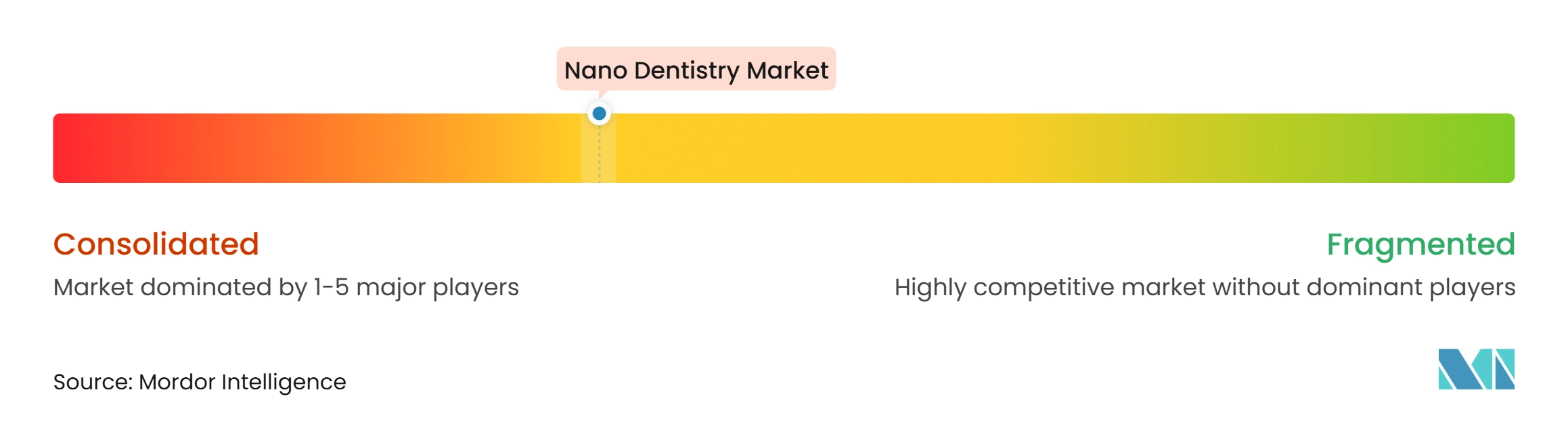
The nano dentistry market is semi-consolidated in materials and implant platforms. DENTSPLY SIRONA, Institut Straumann, Solventum Corporation, Ivoclar Vivadent, and ZimVie have established positions across nano-ceramics, implant surfaces, and digital workflows. Their competitive strength comes from materials that work within proprietary CAD/CAM software, digital impression systems, and guided implant protocols. These connected systems can raise switching costs for practitioners and procurement teams in the nano dentistry market. A 2025 patent granted to Biomet 3i, a ZimVie subsidiary, covered anodized tube-like structures on titanium implant surfaces. The claim described nanoscale diameters from 10 nm to 400 nm and heights extending to several microns.
Specialists compete where product depth matters more than portfolio breadth. FLUIDINOVA focuses on nano-hydroxyapatite synthesis, while Graphenano Dental and Nano Dentica AB address specialized materials categories. These companies can place pressure on larger groups in narrower nano dentistry market product areas. AI-guided local drug delivery for periodontal and peri-implant disease remains an open area for product development. The nano dentistry market, therefore, combines established platform competition with smaller fields that require further clinical and regulatory progress.
BioHorizons Camlog, Dentium, MegaGen, and Osstem differentiate through pricing flexibility and faster product iteration in the Asia-Pacific implant markets. Their position is relevant where regulatory timing and cost competitiveness influence purchasing decisions alongside clinical features. SprintRay’s September 2026 launch of Midas Restore added a glass ceramic and zirconia-filled material to its Midas Digital Press system. Zimmer Biomet’s Biomet 3i patent represents another strategic move to protect nano-surface implant technology. These actions show that product integration, clinical evidence, and intellectual property remain central to nano dentistry market competition.
Nano Dentistry Industry Leaders
-
Dentsply Sirona Inc.
-
Institut Straumann AG
-
Ivoclar Vivadent AG
-
Solventum Corporation
-
ZimVie Inc.
- *Disclaimer: Major Players sorted in no particular order
Nano Dentistry Market Companies Covered in this Report
- Solventum Corporation
- Adin Dental Implant Systems Ltd.
- BEGO GmbH & Co. KG
- BioHorizons Camlog
- Dentium Co., Ltd.
- Dentsply Sirona
- Envista
- FLUIDINOVA, S.A.
- Graphenano Dental
- Straumann Group
- Ivoclar Vivadent
- Kerr
- Kulzer GmbH (formerly Heraeus Kulzer)
- Kuraray Co., Ltd.
- MegaGen Implant Co., Ltd.
- Nano Dentica AB
- Osstem Implant Co., Ltd.
- Southern Implants (Pty) Ltd.
- Thommen Medical
- ZimVie
Recent Industry Developments in Nano Dentistry Market
- September 2026: SprintRay launched Midas Restore (FDA 510(k) clearance K260661), a glass ceramic and zirconia-filled restorative resin achieving 215 MPa biaxial flexural strength and 98% gloss retention after 5,000 abrasion cycles, commercially available for the Midas Digital Press. Clinicians in 33 countries had already produced over 100,000 restorations on the platform since its 2024 debut, establishing a substantial installed base for the new material.
- September 2026: The FDA published final guidance for Dental Composite Resin Devices 510(k) submissions (Docket FDA-2024-D-2511) and Dental Curing Lights (Docket FDA-2024-D-2512), superseding 2005-era guidelines and updating performance testing standards, including revised shelf-life requirements, directly governing nano-composite resin products in the market.
- June 2026: SHINING 3D Dental launched the Ceramix-Nano, a 2 kg chairside dental 3D printer producing permanent ceramic crowns in 30 minutes using FDA-cleared LumiCera resin with more than 55% ceramic filler, integrated with an AI Cloud Design platform, requiring no dedicated laboratory space.
Global Nano Dentistry Market Report Scope
According to the report’s scope, the nano dentistry market refers to the application of nanotechnology in dental care and treatment, using nanoscale materials, devices, and delivery systems to improve precision, durability, and patient outcomes. It includes innovations such as nanocomposites for fillings, nano‑coatings for implants, targeted drug delivery for oral diseases, and regenerative nanomaterials that enhance tissue repair.
The nano dentistry market is segmented into material type, application, end-user, and geography. By material type, the market is segmented into nano ceramics, nano fillers, nano robots, and other material types. By application, the market is segmented into restorative dentistry, implant dentistry, orthodontics, endodontics, and other applications. By end-user, the market is segmented into hospitals, dental clinics, academic and research institutes, and dental laboratories. By geography, the market is segmented into North America, Europe, Asia-Pacific, the Middle East and Africa, and South America. The report also covers the estimated market sizes and trends for 17 countries across major regions globally. The report offers values (USD) for all the above segments.
Segmentation Overview
| Nano Ceramics |
| Nano Fillers |
| Nano Robots |
| Other Material Types |
| Restorative Dentistry |
| Implant Dentistry |
| Orthodontics |
| Endodontics |
| Other Applications |
| Hospitals |
| Dental Clinics |
| Academic and Research Institutes |
| Dental Laboratories |
| North America | United States |
| Canada | |
| Mexico | |
| Europe | Germany |
| United Kingdom | |
| France | |
| Italy | |
| Spain | |
| Rest of Europe | |
| Asia-Pacific | China |
| Japan | |
| India | |
| Australia | |
| South Korea | |
| Rest of Asia-Pacific | |
| Middle East and Africa | GCC |
| South Africa | |
| Rest of Middle East and Africa | |
| South America | Brazil |
| Argentina | |
| Rest of South America |
| By Material Type | Nano Ceramics | |
| Nano Fillers | ||
| Nano Robots | ||
| Other Material Types | ||
| By Application | Restorative Dentistry | |
| Implant Dentistry | ||
| Orthodontics | ||
| Endodontics | ||
| Other Applications | ||
| By End-User | Hospitals | |
| Dental Clinics | ||
| Academic and Research Institutes | ||
| Dental Laboratories | ||
| By Geography | North America | United States |
| Canada | ||
| Mexico | ||
| Europe | Germany | |
| United Kingdom | ||
| France | ||
| Italy | ||
| Spain | ||
| Rest of Europe | ||
| Asia-Pacific | China | |
| Japan | ||
| India | ||
| Australia | ||
| South Korea | ||
| Rest of Asia-Pacific | ||
| Middle East and Africa | GCC | |
| South Africa | ||
| Rest of Middle East and Africa | ||
| South America | Brazil | |
| Argentina | ||
| Rest of South America | ||
Key Questions Answered in the Report
What is the forecast growth rate for nano dentistry?
The nano dentistry market is forecasted to grow at 10.25% CAGR from 2027 to 2032. It is projected to rise from USD 1.22 billion in 2026 to USD 1.32 billion in 2027, and to reach USD 2.15 billion by 2032, with restorative materials, implants, and digital workflows supporting demand.
Which material category leads nano dentistry?
Nano ceramics led with 44.35% share in 2026. They are used in premium CAD/CAM restorations, where fracture resistance, surface finishing, marginal fit, and natural appearance influence material selection.
Which application is growing fastest in nano dentistry?
Implant dentistry is the fastest-growing application, with a projected CAGR of 12.27% through 2032. The growth reflects the use of nano-textured implant surfaces and continuing evaluation of local delivery systems for peri-implant disease.
Which region is expected to grow fastest through 2032?
Asia-Pacific is projected to grow at 13.36% CAGR through 2032. China’s dental infrastructure plans, South Korean implant research, India’s private clinic growth, and cost-competitive regional manufacturing support the regional outlook.