
Mushroom Supplements Market Size and Share
Market Overview
| Study Period | 2021 - 2031 |
|---|---|
| Market Size (2026) | USD 5.83 Billion |
| Market Size (2031) | USD 8.83 Billion |
| Growth Rate (2026 - 2031) | 8.66 % |
| Fastest Growing Market | Asia-Pacific |
| Largest Market | North America |
| Market Concentration | Low |
Major Players
*Disclaimer: Major Players sorted in no particular order Image © Mordor Intelligence. Reuse requires attribution under CC BY 4.0. |
|
Mushroom Supplements Market Analysis by Mordor Intelligence
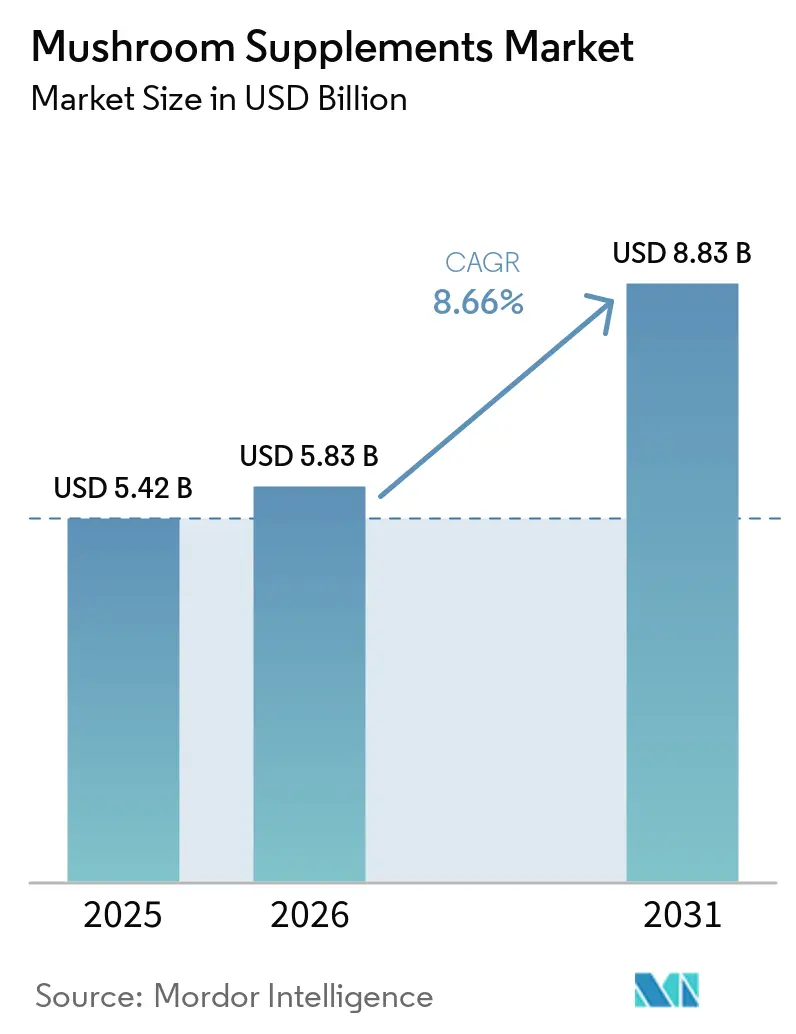
The mushroom supplements market grow from USD 5.42 billion in 2025 to USD 5.83 billion in 2026, and is forecast to reach USD 8.83 billion by 2031 at an 8.66% CAGR over 2026-2031. The mushroom supplements market is advancing as preventive health habits become more routine, and consumers seek products that fit daily wellness routines while retaining food-based ingredients. In April 2025, Frontiers Clinical research on Lion's Mane and other medicinal mushrooms has made the market more evidence-oriented by stating Lion's Mane enhance cognitive function and mood due to its bioactive metabolites, including erinacines and hericenones, supporting premium positioning for products with clearer bioactive content and more specific use cases[1]Source: Frontier in Nutrition, " Acute effects of a standardized extract of Hericium erinaceus (Lion’s Mane mushroom)," frontiersin.org. The market is also evolving under a clear regulatory split, as the United States continues to operate under a broad dietary supplement framework, while the European Union applies a more formal novel food pathway for certain mushroom-derived ingredients. This divide has pushed brands to compete less on scale alone and more on quality systems, sourcing transparency, and standardization, especially when they aim to serve multiple regions. The strongest opportunities are shifting toward premium products with clearer efficacy narratives, stronger documentation, and greater control over channel execution.
Key Report Takeaways
- By mushroom type, reishi led the mushroom supplements market with a share of 22.81% in 2025, while lion's mane is anticipated to register the fastest CAGR of 10.01% during 2026-2031.
- By form, capsules and tablets retained a 46.43% share in 2025, whereas powder is forecast to expand at a 9.78% CAGR through 2031.
- By function, immunity support led the market with a share of 24.67% in 2025, while cognitive health is anticipated to register the fastest CAGR of 9.79% during 2026-2031.
- By distribution channel, pharmacies & drug stores led the market with a share of 36.22% in 2025, while online retail is anticipated to register the fastest CAGR of 10.69% during 2026-2031.
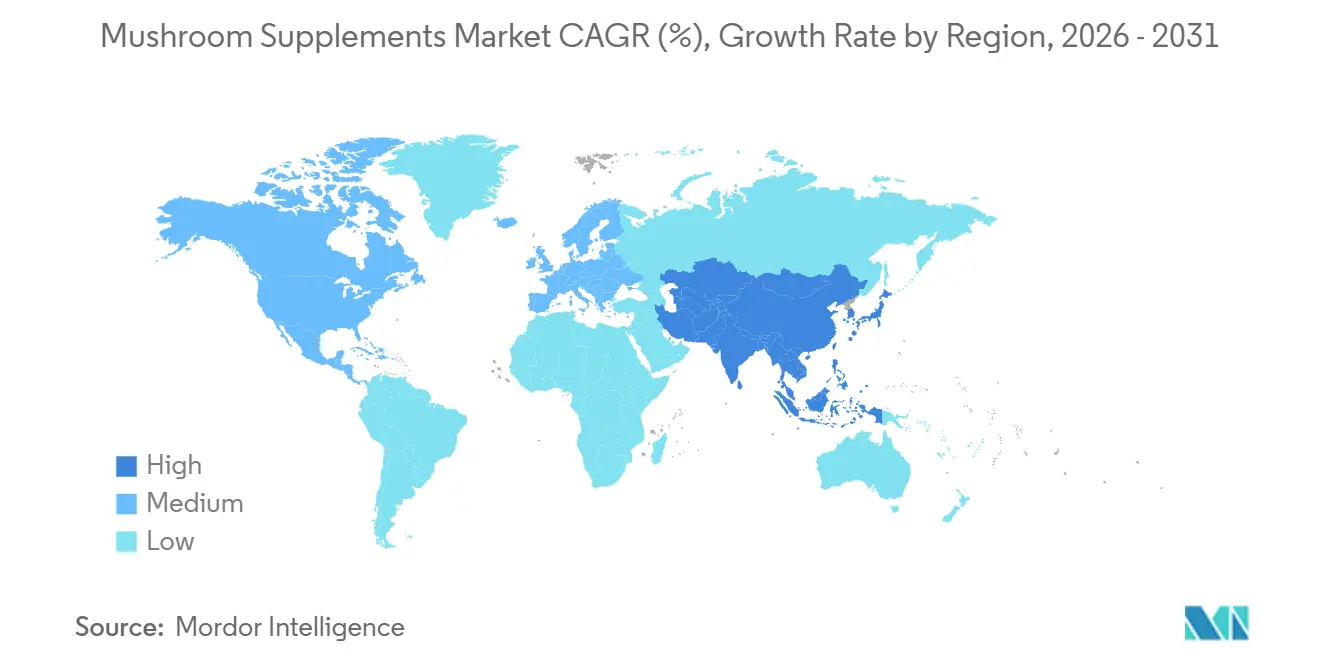
- By geography, North America led the mushroom supplements market in 2025 with a 34.57% share, while Asia-Pacific is projected to advance at a 9.96% CAGR through 2031.
Note: Market size and forecast figures in this report are generated using Mordor Intelligence’s proprietary estimation framework, updated with the latest available data and insights as of January 2026.
Market Trends and Insights
Drivers Impact Analysis of Mushroom Supplements Market*
| Driver | (~) % Impact on CAGR Forecast | Geographic Relevance | Impact Timeline |
|---|---|---|---|
| Rising consumer preference for natural and plant-based wellness supplements | +2.5% | Global, with strongest pull in North America and Western Europe | Short term (≤ 2 years) |
| Surging demand for cognitive health and nootropic ingredients | +1.4% | North America, Asia-Pacific (China, Japan, South Korea), and European Union | Medium term (2-4 years) |
| Widespread adoption of adaptogenic mushrooms for stress management and holistic wellness | +1.2% | Global, highest in urban markets in the United States, United Kingdom, Germany, and Australia | Medium term (2-4 years) |
| Increasing clinical research supporting the functional benefits of medicinal mushrooms | +1.0% | North America, European Union, Japan, and South Korea | Long term (≥ 4 years) |
| Consumer awareness driven by wellness influencers and digital health platforms | +0.9% | Global, concentrated in English-speaking and East Asian markets | Short term (≤ 2 years) |
| Heightened focus on preventive healthcare boosting immune health supplement demand | +0.8% | Global, accelerating in South and Southeast Asia and Middle East and Africa | Medium term (2-4 years) |
| Source: Mordor Intelligence | |||
Rising Consumer Preference for Natural and Plant-Based Wellness Supplements
The mushroom supplements market is benefiting from a broader shift in health spending toward products that consumers perceive as closer to food and less reliant on synthetic positioning. In this environment, naturalness has become a screening factor rather than a premium add-on, especially in North America and Europe, where clean-label expectations influence first purchase decisions. In May 2025, Laird Superfood launched six new Organic Mushroom Powders, including Lion's Mane, Reishi, Turkey Tail, Oyster, and specialized Focus & Memory and Calm & Relaxation blends, targeting consumers seeking plant-based wellness solutions. This product expansion highlights how evolving consumer preferences are accelerating innovation and supporting growth in the global mushroom supplements market. This preference also makes buyers more attentive to provenance, extraction methods, and testing language, reducing the effectiveness of weaker claims over time. As the mushroom supplements market matures, brands that clearly communicate sourcing and bioactive content are better positioned to defend premium pricing.
Surging Demand for Cognitive Health and Nootropic Ingredients
The mushroom supplements market is experiencing one of its strongest demand shifts in cognitive health, with Lion's Mane emerging as the primary growth catalyst. According to a study by Frontiers, a randomized, double-blind, placebo-controlled study published in 2025 found that a single acute dose of standardized Hericium erinaceus (Lion's Mane Mushroom) fruiting body extract improved psychomotor performance in healthy adults aged 18 to 35, giving the category stronger clinical support beyond broad wellness claims. In addition, National Center for Biotechnology Information (NCBI), in 2025, a study reported neuroprotective, antioxidant, and anti-inflammatory effects for Hericium erinaceus and highlighted erinacines as promising neural-stimulating compounds. This evidence aligns with Lion's Mane being the fastest-growing mushroom type. As a result, the mushroom supplements market is shifting from general brain-health positioning toward more specific cognition-led formulations that brands can differentiate more effectively and price at a premium.
Widespread Adoption of Adaptogenic Mushrooms for Stress Management and Holistic Wellness
The market is expanding through adaptogenic applications, as consumers seek support for stress management, mood balance, and daily resilience. Reishi and Cordyceps remain central to this shift because they align with routine wellness use and can complement energy, sleep, and focus claims within a single formula. This trend indicates that the mushroom supplements market is no longer driven only by immune-support positioning. Demand is extending to multi-benefit products that reflect broader wellness routines. Products that combine cognitive and stress-support messaging are gaining strategic value because they address multiple daily needs without requiring consumers to build complex supplement stacks. This pattern supports blended formulations and helps the mushroom supplements market move beyond a narrow specialty supplement audience.
Increasing Clinical Research Supporting the Functional Benefits of Medicinal Mushrooms
The growing volume of scientific and clinical research validating the health benefits of medicinal mushrooms is strengthening consumer confidence and supporting the wider adoption of mushroom supplements globally. Studies have identified bioactive compounds, such as β-glucans, polysaccharides, terpenoids, and erinacines, that support immune modulation, cognitive health, gut health, and antioxidant activity. A 2025 review published in the National Center for Biotechnology Information highlighted that medicinal mushrooms, including Lion's Mane (Hericium erinaceus), Reishi (Ganoderma lucidum), and Shiitake (Lentinula edodes), contain bioactive compounds with significant potential for disease prevention and overall health promotion[3]Source: National Center for Biotechnology Information, "Mushrooms as Nutritional Powerhouses," pubmed.ncbi.nlm.nih.gov. The expanding scientific evidence base is encouraging supplement manufacturers to invest in clinically supported formulations, thereby accelerating growth in the global mushroom supplements market.
Restraints Impact Analysis of Mushroom Supplements Market*
| Restraint | (~) % Impact on CAGR Forecast | Geographic Relevance | Impact Timeline |
|---|---|---|---|
| Limited global standardization of mushroom extract quality | -0.7% | Global, with acute impact in North America and European Union | Short term (≤ 2 years) |
| High production costs of premium fruiting body extracts | -0.6% | North America and European Union (premium segment), spill-over to Asia-Pacific premium tier | Medium term (2-4 years) |
| Supply chain dependence on specialty mushroom cultivation | -0.5% | Global, concentrated in North America and Europe due to China raw material reliance | Long term (≥ 4 years) |
| Price competition from low-cost, non-standardized mushroom supplements | -0.5% | Global, most acute in price-sensitive Asia-Pacific and Middle East and Africa markets | Short term (≤ 2 years) |
| Source: Mordor Intelligence | |||
Limited Global Standardization of Mushroom Extract Quality
Mushroom supplements continue to face a major credibility challenge because no single global standard defines how brands should assess or present extract quality to consumers. Industry guidance from the American Herbal Products Association and broader petition activity around fungi labeling indicate rising pressure for clearer language, especially regarding what qualifies as a mushroom ingredient on a supplement label. In Europe, regulators have adopted a more formal approach. The authorization of vitamin D2 mushroom powder under Commission Implementing Regulation 2025/691 shows that authorities are reviewing mushroom-derived ingredients within a more structured safety framework[2]Source: THE EUROPEAN COMMISSION, " authorizing the placing on the market of vitamin D2 mushroom powder as a novel food and amending Implementing Regulation" eur-lex.europa.eu. This development creates uneven compliance pressure, as brands that invest in high-quality extracts and documentation incur costs that lower-priced products do not always bear. As a result, the mushroom supplements market continues to grow amid an inherent tension between category expansion and category trust.
High Production Costs of Premium Fruiting Body Extracts
The market faces cost pressure because premium fruiting body extracts are significantly harder and more expensive to produce than lower-cost alternatives. Certification-grade indoor cultivation requires tighter environmental controls, longer production cycles, and more demanding post-harvest extraction processes, raising the cost base well before finished goods reach retail shelves. These requirements limit the number of manufacturers that can consistently produce at higher quality levels and restrict participation among smaller formulators. Investment in certified growing and manufacturing infrastructure can create a competitive moat for established players. The mushroom supplements market therefore rewards quality leadership, but these production economics can slow adoption across price-sensitive consumer tiers.
*Our forecasts treat driver/restraint impacts as directional, not additive. The impact forecasts reflect baseline growth, mix effects, and variable interactions.
Mushroom Supplements Market Segment Analysis
By Mushroom Type:
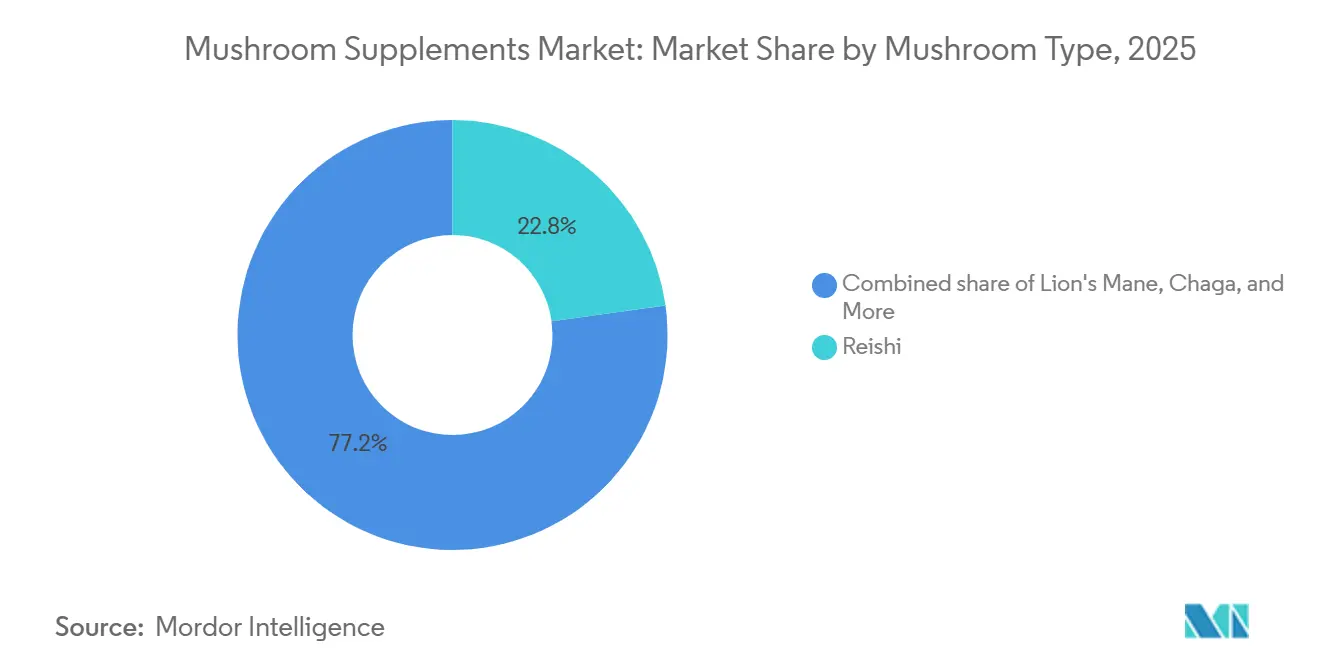
Reishi Leads Market Demand with Broad Consumer RecognitionReishi accounted for 22.81% of mushroom-type revenue in 2025, making it the leading species in the mushroom supplements industry. Its leadership stemmed from its long-standing use in traditional channels and its broad association with immune support and adaptogenic wellness. However, Lion’s Mane is the fastest-growing mushroom type, with a 10.01% CAGR through 2031, highlighting the mushroom supplements market’s shift toward more targeted positioning. The strongest support for this shift comes from peer-reviewed studies linking Hericium erinaceus to cognition, mood, and commercially relevant neuroactive compounds.
Cordyceps is also gaining traction, as its Adenosine Triphosphate (ATP) related positioning aligns more directly with sports nutrition and performance use cases than traditional immune-led messaging. Chaga remains relevant in antioxidant-led products, although the human clinical evidence remains less developed than the evidence supporting Reishi and Lion’s Mane. Turkey Tail stands out because its compound already plays a more clinically grounded role in integrative oncology settings in Japan and China, giving it an unusual medical adjacency within this category. Shiitake maintains a stable position because consumers widely recognize it and require a shorter learning curve, while newer species such as Tremella and Maitake provide the mushroom supplements market with more scope to develop differentiated claims in beauty and metabolic health.



By Form:
Capsules Anchor Credibility While Powder AcceleratesCapsules and tablets accounted for 46.43% of the revenue in 2025, and this format remains the clearest indicator of the mushroom supplements market’s link to routine supplement consumption. Capsules derive their strength from dosing convenience, familiar presentation, and a strong fit with pharmacy-led purchasing habits. Powder is the fastest-growing form, registering a CAGR of 9.78% through 2031, reflecting the mushroom supplements market’s expansion into beverages, smoothies, coffee, and other daily-use formats. This shift in form is significant because powders appeal to consumers who do not want another pill and may first enter the category through food and drink occasions.
Capsules remain relevant, as they continue to support trust, repeatability, and a stronger health-outcome positioning in retail environments. Liquid formats are gaining traction in tinctures and adaptogenic blends, particularly among premium direct-to-consumer brands seeking to offer a faster-acting or more lifestyle-oriented proposition. Other forms, including gummies, are also becoming more visible as brands aim to reduce adherence barriers for new users and broaden household appeal. Overall, the mushroom supplements market is moving toward a more balanced form mix, where capsules maintain credibility, powders drive new consumption occasions, and alternative formats help brands capture consumers at different levels of familiarity and convenience.
By Function:
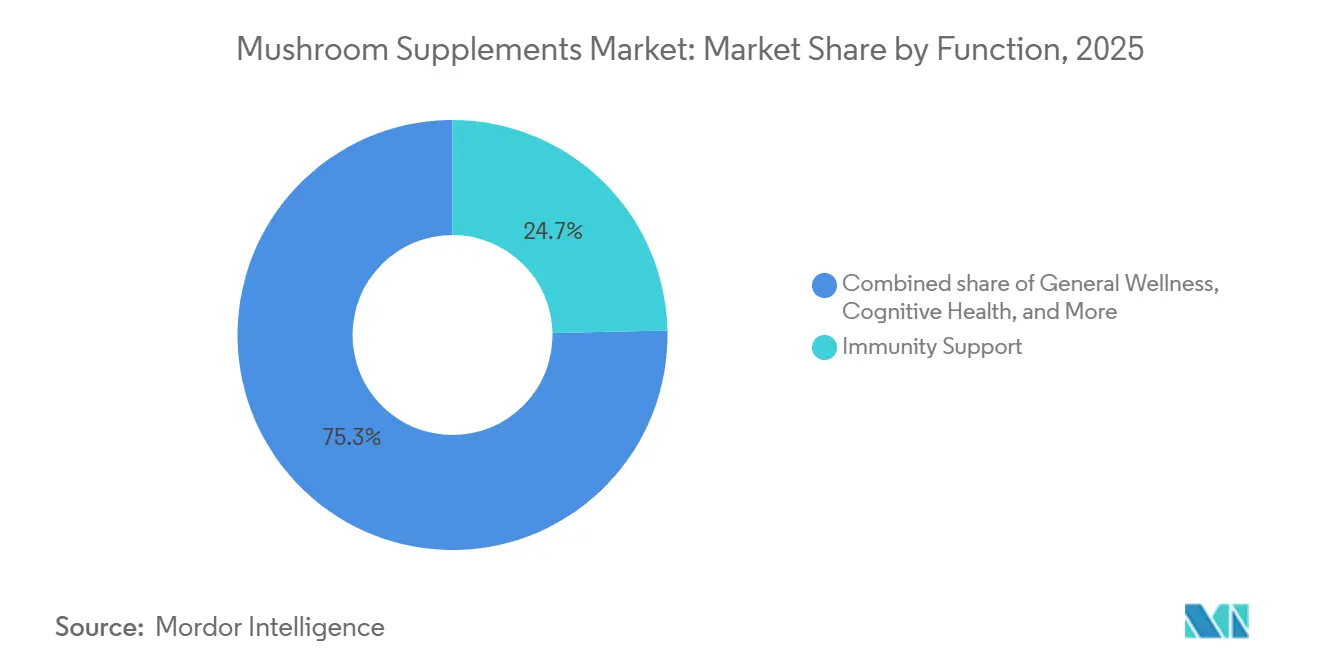
Immunity Leads, Cognitive Health Closes the GapImmunity support holds 24.67% of revenue in 2025, retaining its position as the largest use case as daily immune maintenance continues to anchor consumer understanding of the mushroom supplements market. This position remains durable because immune support is easy to explain, easy to merchandise, and already linked to routine supplement behavior. Cognitive Health is forecast to expand at a CAGR of 9.79% through 2031, making it the function with the strongest momentum in the mushroom supplements industry. The rise of cognition-led products also indicates that the mushroom supplements market is shifting from broad prevention claims toward performance, clarity, and quality-of-life messaging.
Energy and endurance applications are gaining momentum through cordyceps, particularly in sports and active lifestyle products, where oxygen utilization and stamina are familiar consumer benefits. Positioning around physical performance, exercise recovery, and sustained energy also enables brands to target consumers beyond traditional dietary supplement users. This trend is supporting the development of mushroom-based formulations for routine stress management, relaxation, and emotional well-being. From a functional perspective, the mushroom supplements market is becoming more targeted, providing brands with a clearer pathway to premium pricing, repeat purchases, and stronger product hierarchies.
By Distribution Channel:
Pharmacy Leads but Online Retail Rewrites the Growth EquationPharmacies and drug stores captured 36.22% of revenue in 2025, giving them the largest role in the distribution channel. This leading position reflects consumer trust, established supplement purchasing habits, and the credibility created by product adjacency to other health items. Online retail is forecast to grow at a CAGR of 10.69% through 2031. Digital channels allow brands to explain extraction methods, species differences, and daily use cases more effectively than shelf-based formats. The educational advantage is important because mushroom products often require more explanation than standard vitamin formats.
Online channels also help brands manage subscription models, bundles, and direct consumer feedback, improving retention for specialized brands. Hypermarkets and supermarkets continue to play an important role as mass access points, especially for product trial and mainstream visibility. Across the mushroom supplements market, the distribution shift is not simply from offline to online. It reflects a broader move from passive shelf discovery toward informed purchase journeys, where content, education, and product transparency carry greater weight.
Geography Analysis
North America Mushroom Supplements Market
North America holds 34.57% of the mushroom supplements market share in 2025. The region benefits from a mature supplement culture, strong brand-building capacity, and a regulatory framework that allows broad product development under dietary supplement rules. This flexibility helps direct-to-consumer brands move faster with new formats, new combinations, and more targeted claims. As a result, demand sophistication and brand proliferation are developing in parallel, making competition active while sustaining innovation.
APAC, South America and MEA Mushroom Supplements Market
Asia-Pacific is forecast to grow at a CAGR of 9.96% through 2031. The region combines deep cultural familiarity with medicinal mushrooms, large cultivation capacity, and rapidly modernizing e-commerce systems. India is emerging quickly as wellness spending rises and newer use cases, such as cognition and energy, gain visibility. Japan and South Korea remain mature, quality-oriented markets, where aging populations support stable demand for evidence-based cognitive and immune support. South America and the Middle East and Africa remain earlier-stage regions, but the mushroom supplements market has room to develop in these regions through direct selling, expanding wellness awareness, and broader product availability over time.
Europe Mushroom Supplements Market
Europe stands apart as novel food rules influence which mushroom ingredients or preparations can scale and how quickly they can reach consumers. The authorization of vitamin D2 mushroom powder in Europe in April 2025 opened commercial opportunities in the region. This regulatory environment favors companies that invest early in safety documentation, technical files, and disciplined claim language. Germany, the United Kingdom, France, the Netherlands, and Italy remain the main revenue anchors, as they combine strong health retail infrastructure with higher consumer familiarity with supplements.

Competitive Landscape
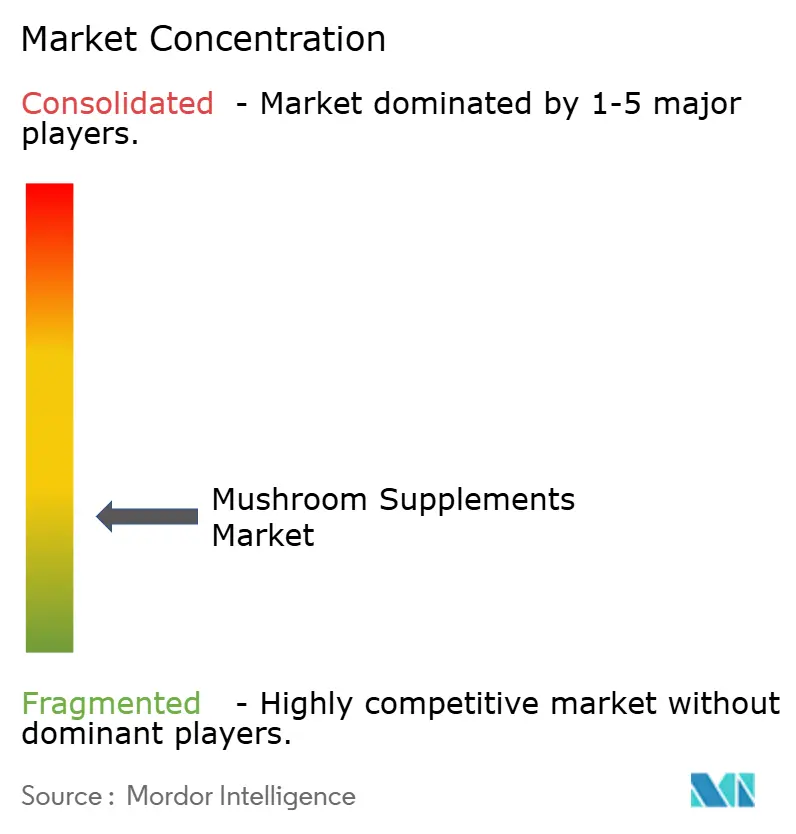
The mushroom supplements market remains highly fragmented, with leading companies such as Host Defense, Real Mushrooms, Four Sigmatic, Om Mushroom Superfood, DXN Holdings, Nature’s Way, and Gaia Herbs competing across functional wellness categories. Rather than relying on market dominance, these companies differentiate themselves through clinically backed mushroom species, premium fruiting body extracts, organic ingredient sourcing, and innovative delivery formats, including capsules, powders, gummies, tinctures, and functional beverages. Real Mushrooms emphasizes 100% fruiting body extracts with standardized beta-glucan content, while Host Defense focuses on mushroom mycelium-based formulations supported by educational outreach.
Host Defense products have won top product awards from multiple health supplement industry publications that recognize the best supplements in the United States. Respected health industry publications, including Taste for Life and Vitamin Retailer, have routinely honored Host Defense. Standardization remains another competitive fault line, as brands that specify beta-glucan levels or other bioactive markers are better positioned to maintain premium price points. Industry guidance on fungi labeling also suggests that compliance pressure may favor brands with stronger quality systems if labeling expectations tighten further.
Planned strategic moves indicate how companies are trying to widen addressable demand without giving up premium positioning. Real Mushrooms launched Real Mycelium in June 2026 with a clinically verified 5 mg dose of Erinacine A per serving, pushing the mushroom supplements market further toward quantified bioactive positioning. In February 2026, Host Defense launched Grateful Dead Gummies, marking the Grateful Dead’s first collaboration with a brand in the wellness supplements market. Grateful Dead Gummies combined organic mushroom mycelium blends with functional wellness benefits in a convenient gummy format. Each serving contained just 4 g of sugar and featured bold, natural flavors, making daily wellness easy, enjoyable, and accessible. More accessible formats became part of the competitive playbook as brands sought new consumer entry points.
Mushroom Supplements Industry Leaders
-
Four Sigmatic
-
Host Defense Mushrooms
-
Mushroom Wisdom
-
Om Mushroom Superfood
-
Gaia Herbs
- *Disclaimer: Major Players sorted in no particular order
Mushroom Supplements Market Companies Covered in this Report
- Four Sigmatic
- Om Mushroom Superfood
- Real Mushrooms
- Host Defense Mushrooms
- Gaia Herbs
- Fungi Perfecti
- DXN Holdings
- Mushroom Wisdom
- Nammex (North American Medicinal Mushroom Extracts)
- Oriveda
- NutriAvenue
- Bio Answer Holdings, Inc
- MycoNutri
- Sun Potion
- Hokkaido Reishi
- Sempera Organics
- Applied Food Sciences, Inc.
- ETHICAL NATURALS, INC.
- Nature's Way Brands, LLC.
- Walgreen Co.

Recent Industry Developments in Mushroom Supplements Market
- June 2026: Real Mushrooms launched Real Mycelium, a Lion’s Mane supplement designed to deliver a clinically verified 5 mg dose of Erinacine A per serving. It is the first commercially available Lion’s Mane product standardized to this specific bioactive threshold. The company developed the formulation to support cognitive performance in younger adults and auditory health in adults aged 65 and above, reflecting a deliberate demographic expansion strategy.
- April 2026: Lazarus Naturals expanded into the functional mushroom category with Functional Mushroom Clarity Gummies, formulated with Lion's Mane, Panax Ginseng, and Alpha-GPC to support cognitive health. The brand also emphasizes quality and safety. The United States Department of Agriculture-certified gummies contain no added sweeteners and undergo third-party testing for heavy metals, microbes, and pesticides.
- April 2026: Host Defense expanded its MycoBenefits line with the introduction of MycoBenefits PMS and MycoBenefits Peri Meno, formulations developed to address women’s wellness needs by combining certified organic mushroom mycelium with targeted vitamins and herbs. The launch represented the company’s strategic entry into the underserved women’s health segment within the functional mushroom supplement category.
- March 2025: Om Mushrooms unveiled a refreshed brand identity and expanded its Mushroom Gummies portfolio with new Cordyceps and Reishi Gummies at Natural Products Expo West 2025. The updated look will emphasize the brand’s commitment to educating consumers about the benefits of functional mushrooms as interest in the category continues to grow.


Global Mushroom Supplements Market Report Scope
Mushroom supplements are dietary products made from medicinal or functional mushrooms, such as reishi, lion’s mane, cordyceps, chaga, and turkey tail. Manufacturers process these mushrooms into capsules, powders, extracts, or tablets. They typically use cultivated mushrooms grown under controlled conditions to ensure quality and consistency.
The mushroom supplements market is segmented by mushroom type, form, function, distribution channel, and geography. By mushroom type, the market is segmented into Reishi, lion's mane, cordyceps, chaga, turkey tail, shiitake, and other mushroom types. By form, the market is segmented into capsules and tablets, powder, liquid, and other forms. By function, the market is segmented into general wellness, immunity support, cognitive health, energy and endurance, stress and anxiety relief, and other functions. By distribution channel, the market is segmented into hypermarkets and supermarkets, pharmacies and drug stores, online retail, and other distribution channels. Based on geography, the market is classified into North America, Europe, South America, Asia-Pacific, and the Middle East and Africa. The market forecasts are provided in terms of value (USD).
| Reishi |
| Lion's Mane |
| Cordyceps |
| Chaga |
| Turkey Tail |
| Shiitake |
| Other Mushroom Types |
| Capsules and Tablets |
| Powder |
| Liquid |
| Other Forms |
| General Wellness |
| Immunity Support |
| Cognitive Health |
| Energy and Endurance |
| Stress and Anxiety Relief |
| Other Functions |
| Hypermarkets and Supermarkets |
| Pharmacies and Drug Stores |
| Online Retail Stores |
| Other Distribution Channels |
| North America | United States |
| Canada | |
| Mexico | |
| Rest of North America | |
| Europe | Germany |
| United Kingdom | |
| Italy | |
| France | |
| Spain | |
| Netherlands | |
| Poland | |
| Belgium | |
| Sweden | |
| Rest of Europe | |
| Asia-Pacific | China |
| India | |
| Japan | |
| Australia | |
| Indonesia | |
| South Korea | |
| Thailand | |
| Singapore | |
| Rest of Asia-Pacific | |
| South America | Brazil |
| Argentina | |
| Colombia | |
| Chile | |
| Peru | |
| Rest of South America | |
| Middle East and Africa | South Africa |
| Saudi Arabia | |
| United Arab Emirates | |
| Nigeria | |
| Egypt | |
| Morocco | |
| Turkey | |
| Rest of Middle East and Africa |
| By Mushroom Type | Reishi | |
| Lion's Mane | ||
| Cordyceps | ||
| Chaga | ||
| Turkey Tail | ||
| Shiitake | ||
| Other Mushroom Types | ||
| By Form | Capsules and Tablets | |
| Powder | ||
| Liquid | ||
| Other Forms | ||
| By Function | General Wellness | |
| Immunity Support | ||
| Cognitive Health | ||
| Energy and Endurance | ||
| Stress and Anxiety Relief | ||
| Other Functions | ||
| By Distribution Channel | Hypermarkets and Supermarkets | |
| Pharmacies and Drug Stores | ||
| Online Retail Stores | ||
| Other Distribution Channels | ||
| By Geography | North America | United States |
| Canada | ||
| Mexico | ||
| Rest of North America | ||
| Europe | Germany | |
| United Kingdom | ||
| Italy | ||
| France | ||
| Spain | ||
| Netherlands | ||
| Poland | ||
| Belgium | ||
| Sweden | ||
| Rest of Europe | ||
| Asia-Pacific | China | |
| India | ||
| Japan | ||
| Australia | ||
| Indonesia | ||
| South Korea | ||
| Thailand | ||
| Singapore | ||
| Rest of Asia-Pacific | ||
| South America | Brazil | |
| Argentina | ||
| Colombia | ||
| Chile | ||
| Peru | ||
| Rest of South America | ||
| Middle East and Africa | South Africa | |
| Saudi Arabia | ||
| United Arab Emirates | ||
| Nigeria | ||
| Egypt | ||
| Morocco | ||
| Turkey | ||
| Rest of Middle East and Africa | ||


Key Questions Answered in the Report
What is the current and forecasted size of the mushroom supplements market?
The mushroom supplements market was valued at USD 5.42 billion in 2025 and is projected to reach USD 8.83 billion by 2031, reflecting sustained growth throughout the forecast period.
Which mushroom type held the largest market share in 2025?
Reishi mushroom supplements accounted for the largest share of the market in 2025, representing 22.81% of revenue.
Which form segment dominated the mushroom supplements market in 2025?
Capsules and tablets were the leading product form, capturing 46.43% of the market in 2025.
Which function segment accounted for the largest market share in 2025?
Immunity support was the leading functional category, holding 24.67% of the mushroom supplements market in 2025.
Which region is projected to grow at the fastest rate through 2031?
The Asia-Pacific region is anticipated to be the fastest-growing market, with a CAGR of 9.96% from 2026 to 2031.
Page last updated on:





