
Multispectral Industrial Camera Market Size and Share
Market Overview
| Study Period | 2020 - 2031 |
|---|---|
| Market Size (2026) | USD 356.47 Million |
| Market Size (2031) | USD 621.06 Million |
| Growth Rate (2026 - 2031) | 11.74 % |
| Fastest Growing Market | Asia-Pacific |
| Largest Market | North America |
| Market Concentration | Medium |
Major Players *Disclaimer: Major Players sorted in no particular order Image © Mordor Intelligence. Reuse requires attribution under CC BY 4.0. | |
Multispectral Industrial Camera Market Analysis by Mordor Intelligence
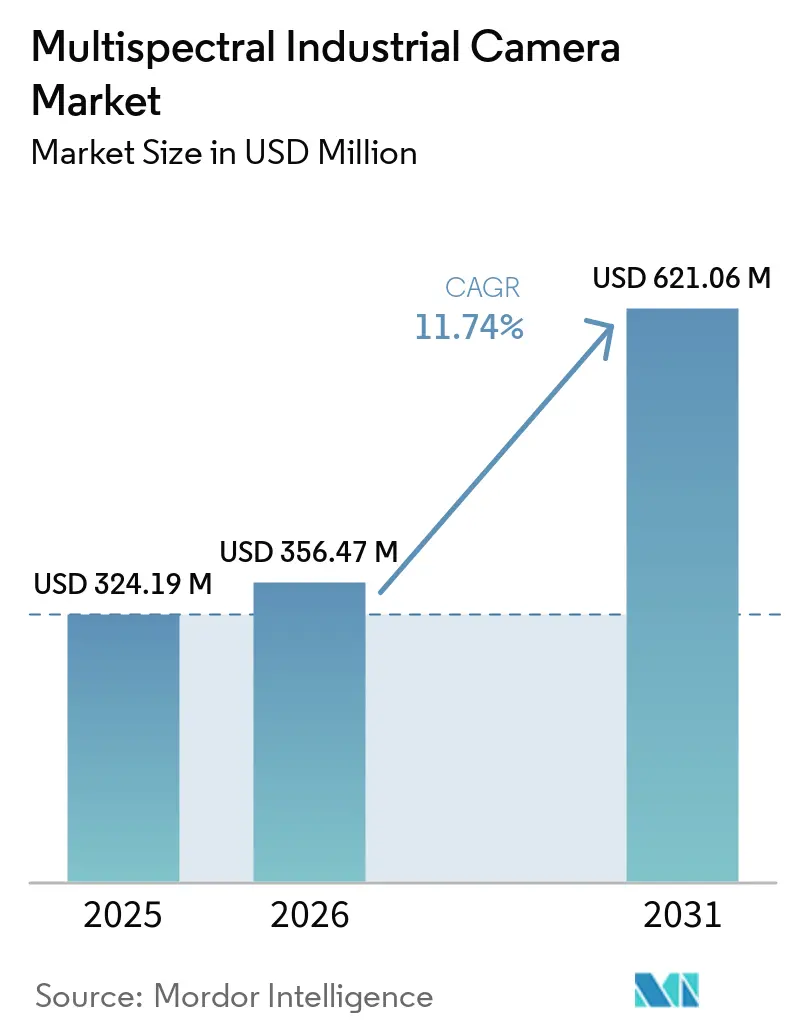
The multispectral industrial camera market size is projected to expand from USD 324.19 million in 2025 and USD 356.47 million in 2026 to USD 621.06 million by 2031, registering a CAGR of 11.74% between 2026 and 2031. Lower costs for InGaAs components and on-chip spectral filter arrays are making multispectral imaging more practical for mid-sized manufacturers. Curated spectral datasets are reducing the time required to train classification models, thereby supporting the broader use of AI-enabled inspection. Food, pharmaceutical, and recycling requirements are also shifting non-destructive inspection from an operational choice toward a compliance need. Unlike RGB cameras, these systems can identify contaminants, material errors, and some subsurface defects that remain outside conventional visual inspection. Competition is increasingly centered on edge AI, calibrated configurations, and software that reduces the need for specialized spectral expertise.
Key Report Takeaways
- By product type, Multispectral Camera Systems held 44.62% of the multispectral industrial camera market in 2025, while Multispectral Camera Modules and Sensors are projected to expand at a 14.18% CAGR through 2031.
- By technology, Pushbroom Imaging held 39.84% in 2025, while Snapshot Imaging is projected to expand at a 13.72% CAGR through 2031.
- By spectral range, VIS-NIR held 42.17% in 2025, while SWIR is projected to expand at a 14.36% CAGR through 2031.
- By end-user industry, Food and Agriculture held 27.86% in 2025, while Recycling and Waste Management is projected to expand at a 15.09% CAGR through 2031.
- By geography, North America held 34.91% in 2025, while Asia-Pacific is projected to expand at a 14.83% CAGR through 2031.
Note: Market size and forecast figures in this report are generated using Mordor Intelligence’s proprietary estimation framework, updated with the latest available data and insights as of January 2026.
Global Multispectral Industrial Camera Market Trends and Insights
Drivers Impact Analysis*
| Driver | (~) % Impact on CAGR Forecast | Geographic Relevance | Impact Timeline |
|---|---|---|---|
| AI-Enabled Automated Inspection | +3.2% | Global, concentrated in North America, Germany, Japan, and South Korea | Short term (≤ 2 years) |
| Spectral Inspection in Food and Pharmaceutical Production | +2.6% | Global, with early compliance-led gains in North America, Europe, and China | Medium term (2-4 years) |
| Precision Agriculture and Resource-Efficient Farming | +2.1% | North America, Europe, Asia-Pacific, China, India, and Australia | Medium term (2-4 years) |
| Defense and Border-Surveillance Modernization | +1.5% | North America, Europe, the Middle East, India, and South Korea | Medium term (2-4 years) |
| On-Chip Spectral Filters for Compact Industrial Cameras | +1.8% | Global, with innovation hubs in Belgium, Germany, and North America | Short term (≤ 2 years) |
| Curated Spectral Training Data for Material Classification | +1.2% | Global, concentrated in North America and Europe | Long term (≥ 4 years) |
| Source: Mordor Intelligence | |||
Expansion of AI-Enabled Automated Inspection
AI models trained on spectral signatures can extend industrial quality checks beyond RGB and structured-light systems, including full-line detection of contaminants, subsurface cracks, and active-ingredient distribution issues. A 2025 study demonstrated an inline, multi-wavelength pharmaceutical monitoring system using carbon nanotube photothermoelectric imagers across sub-THz and infrared frequencies without destroying the sample. This supports combined AI and spectral imaging at production speed. Processing spectral data near the camera can reduce transfer delays that previously limited inspection to sampled workflows. Suppliers that combine sensing, inference, and trained models can provide a more complete package for plants with limited spectral expertise. The multispectral industrial camera market, therefore, favors systems that make continuous spectral classification practical in ordinary production settings.
Spectral Inspection in Food and Pharmaceutical Production
Food and pharmaceutical lines require inspection methods that do not damage products. The US Food Safety Modernization Act and the European Union Official Controls Regulation establish compliance frameworks in which traceable checks matter. A 2025 pharmaceutical study found that near-infrared hyperspectral imaging improved tablet quality assessment through spectral maps of active ingredient distribution. These maps provide information that batch sampling cannot provide across every tablet. A 2025 food-quality review identified model transferability between production lines as a larger scaling issue than camera sensitivity. The multispectral industrial camera market benefits as audit practice increases demand for stable calibration, usable reporting, and repeatable inspection.
Precision Agriculture and Resource-Efficient Farming
Multispectral imaging supports crop-stress detection and variable-rate input decisions through near-infrared and red-edge measurements that produce NDVI and NDRE indicators. DJI Agriculture reported in April 2026 that more than 600,000 agricultural drones were active globally by the end of 2025, saving 410 million tons of water and reducing carbon emissions by 51 million tons compared with conventional farming practices. A 2025 study also showed that multispectral drone images can identify within-field yield variation at a scale useful for fertilizer decisions. The multispectral industrial camera market gains as commercial farms use drone imagery for timely field observations and targeted operational decisions. Large commercial farming activity in the United States, Brazil, Australia, and India supports demand for compact sensing systems. Drone policies can support more regular aerial spectral scouting.
Defense and Border-Surveillance Modernization
Multispectral and infrared imaging are used in counter-UAS and perimeter-security systems that must detect and identify objects under demanding conditions. Teledyne FLIR introduced the Neutrino SX8 ISR 50-1000 in 2025 with a cooled 1,280 × 1,024 MWIR sensor, specified for vehicle detection at 34 km and recognition at 23.5 km. LYNRED introduced its DRACO MW SL detector in 2025 with SXGA resolution and a 7.5 µm pixel pitch for counter-UAS and wide-area surveillance.[1]LYNRED, “LYNRED Unveils DRACO MW SL,” LYNRED, lynred.com MKS Instruments announced the Ophir SupIR 16-80 mm continuous-zoom lens in October 2025 for compact thermal imaging systems. Defense procurement supports higher-performance MWIR and SWIR components that can later enter civil industrial cameras as unit costs decline. The multispectral industrial camera market can benefit where commercial inspection requires performance beyond visible-light imaging.
Restraints Impact Analysis*
| Restraint | (~) % Impact on CAGR Forecast | Geographic Relevance | Impact Timeline |
|---|---|---|---|
| High System Integration and Calibration Costs | -1.3% | Global, more acute in small and medium-sized enterprise-heavy South and Southeast Asia and Middle East and Africa markets | Medium term (2-4 years) |
| Shortage of Spectral-Imaging and Machine-Vision Specialists | -0.9% | Global, with the skill gap most pronounced in South Asia, South America, and Africa | Long term (≥ 4 years) |
| Calibration Drift Under Variable Lighting and Temperature | -0.6% | Acute in tropical manufacturing environments in Southeast Asia and the Middle East and Africa | Medium term (2-4 years) |
| Limited Interoperability With Factory-Control Systems | -0.5% | Global, pronounced in fragmented industrial markets with many small and medium-sized enterprises | Long term (≥ 4 years) |
| Source: Mordor Intelligence | |||
High System Integration and Calibration Costs
Production-floor deployment requires coordination among optics, illumination, spectral software, and factory-control systems, which can add 40-80% to the camera unit cost before the first production scan. A 2025 review attributed many deployment failures to shortcomings in post-installation calibration rather than to hardware limitations. Large processors can distribute these costs across high-volume lines, while small- and mid-sized manufacturers may choose simpler RGB-plus-NIR configurations. Process analytical technology guidance and machine-safety requirements can add validation work after hardware commissioning. The multispectral industrial camera market remains less accessible when deployment time and commissioning work exceed a buyer’s internal capacity. Pre-calibrated systems and simplified interfaces can reduce variation between installations and lower the barrier for smaller users.
Shortage of Spectral-Imaging and Machine-Vision Specialists
Spectral imaging deployments require expertise in radiometric calibration, chemometrics, band selection, and AI model training, and these skills are not widely available within industrial teams. A 2025 review identified limited algorithm generalizability and the lack of standardized validation procedures as key constraints on scaling non-destructive analytical technologies. South Asia, South America, and Africa face a deeper shortage of personnel capable of configuring and maintaining production-grade models. This can delay rollout and keep customers reliant on proprietary software environments for longer equipment cycles. The multispectral industrial camera market becomes more accessible when suppliers include automated calibration and no-code operating interfaces. Specim has pursued unified spectral calibration across its FX series to simplify use across related camera models.
*Our forecasts treat driver/restraint impacts as directional, not additive. The impact forecasts reflect baseline growth, mix effects, and variable interactions.
Segment Analysis
By Product Type: Camera Systems Lead While Modules Scale Fastest
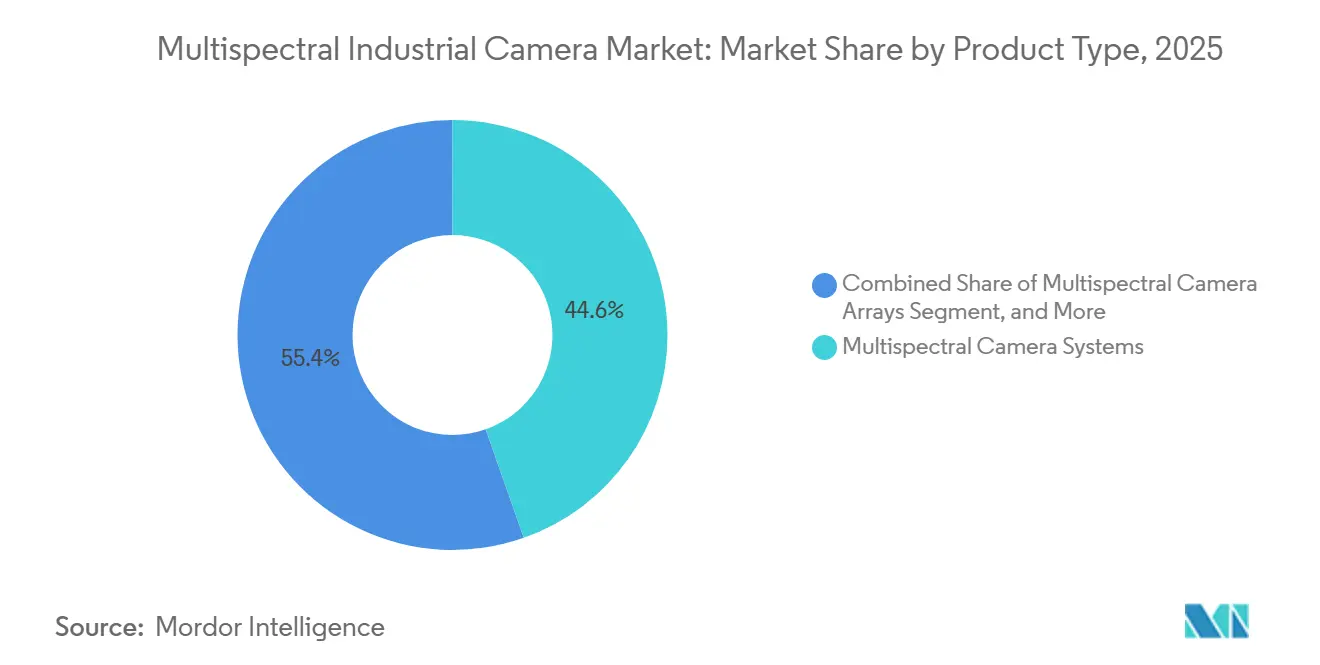
Multispectral Camera Systems captured 44.62% of the multispectral industrial camera market share in 2025. Food sorting, pharmaceutical inspection, and semiconductor wafer verification support demand for integrated optical and spectral systems. Buyers need the optics, illumination, sensing, and calibration elements to work together. They also seek documented performance for spectral resolution, throughput, and calibration stability. Multispectral Camera Arrays serve fixed, multi-angle inspection in warehouses and logistics sites.
Multispectral Camera Modules and Sensors are projected to expand at a 14.18% CAGR through 2031. OEMs are embedding compact modules in agricultural drones, robotic picking arms, and handheld inspection equipment. Leopard Imaging and Sony Semiconductor Solutions announced the LI-IMX454 camera in May 2025. The system used 8 spectral filters per photodiode to capture 41 wavelengths from 450-850 nm in a single shot. These products increase OEM demand in the multispectral industrial camera market and broaden the industry's role.



By Technology: Pushbroom Leads Line Inspection While Snapshot Gains Momentum
Pushbroom Imaging held 39.84% of the technology value in 2025. It remains important for conveyor-based food sorting and pharmaceutical tablet inspection. The design offers strong spectral resolution and signal-to-noise performance in controlled line-scan environments. Specim introduced the FX19 in February 2026 for the 1,130-1,920 nm range, with 640 spatial pixels and up to 527 fps. This release shows continued improvement in pushbroom throughput within the multispectral industrial camera market.
Snapshot Imaging is projected to expand at a 13.72% CAGR through 2031. It is used for robotic bin picking, UAV monitoring, and waste classification, where movement complicates sequential capture. A 2026 study demonstrated a 9-camera NIR bandpass array for household plastic classification. The reported system reached 86.7% classification accuracy with a 2.6 µs per-pixel runtime. The multispectral industrial camera market supports this shift toward fast-moving inspection applications.
By Spectral Range: VIS-NIR Holds Volume While SWIR Leads Expansion
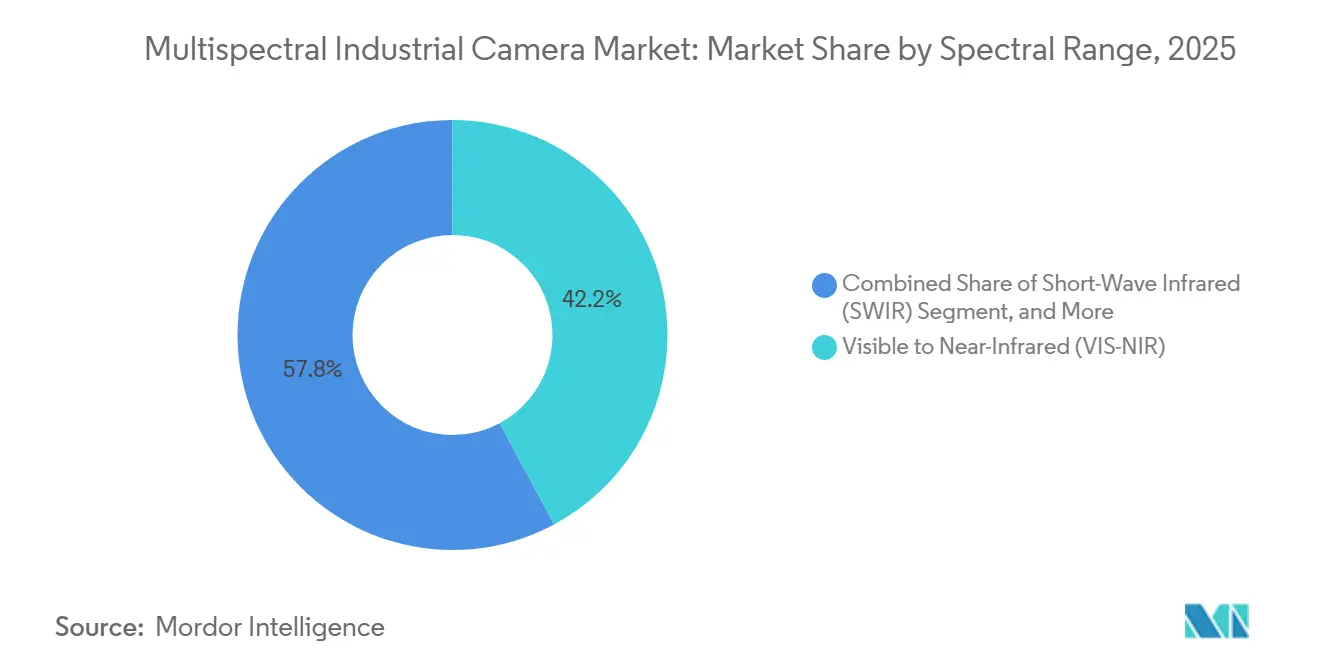
VIS-NIR accounted for 42.17% of the value in 2025. It is used across materials, crop conditions, and surface inspection tasks. Agricultural drone payloads use it to generate vegetation indices. Food lines use it for foreign-object detection, while electronics producers use it for surface-defect verification. VIS-NIR remains a practical starting point for many users entering the multispectral industrial camera market.
SWIR is projected to expand at a 14.36% CAGR through 2031. It supports wafer inspection where silicon transparency is relevant and plastic-type differentiation during recycling. Gpixel introduced the GIR1201 and GIR2505 SWIR line-scan sensors in October 2025 with 75% quantum efficiency at 1,550 nm and line rates up to 71.9 kHz. Teledyne DALSA introduced the Kaleido SWIR camera in May 2026 for recycling, food safety, and pharmaceutical inspection. Thermal infrared remains focused on defense, gas detection, and predictive maintenance uses.
By End-User Industry: Food and Agriculture Anchor Demand While Recycling Accelerates
Food and Agriculture held 27.86% of the end-user value in 2025. Commercial farms use drone-mounted spectral scouting, while food processors use conveyor-based sorting for quality and foreign-material checks. Pharmaceuticals, medical devices, electronics, semiconductors, and aerospace and defense also support demand. InGaAs SWIR cameras can visualize alignment marks and micro-cracks beneath silicon layers. Automotive uses include battery-cell inspection and EV component verification.
Recycling and Waste Management is projected to expand at a 15.09% CAGR through 2031. Extended Producer Responsibility rules are raising polymer-purity requirements in Europe, South Korea, Japan, and emerging Southeast Asian jurisdictions. A 2025 study obtained material abundance estimates with less than 1% error in mixed plastic samples. Specim launched RETEX for textile-material identification and automated sorting in April 2026. A 2026 study described real-time hyperspectral analysis software for material-sorting systems in the multispectral industrial camera market.
Geography Analysis
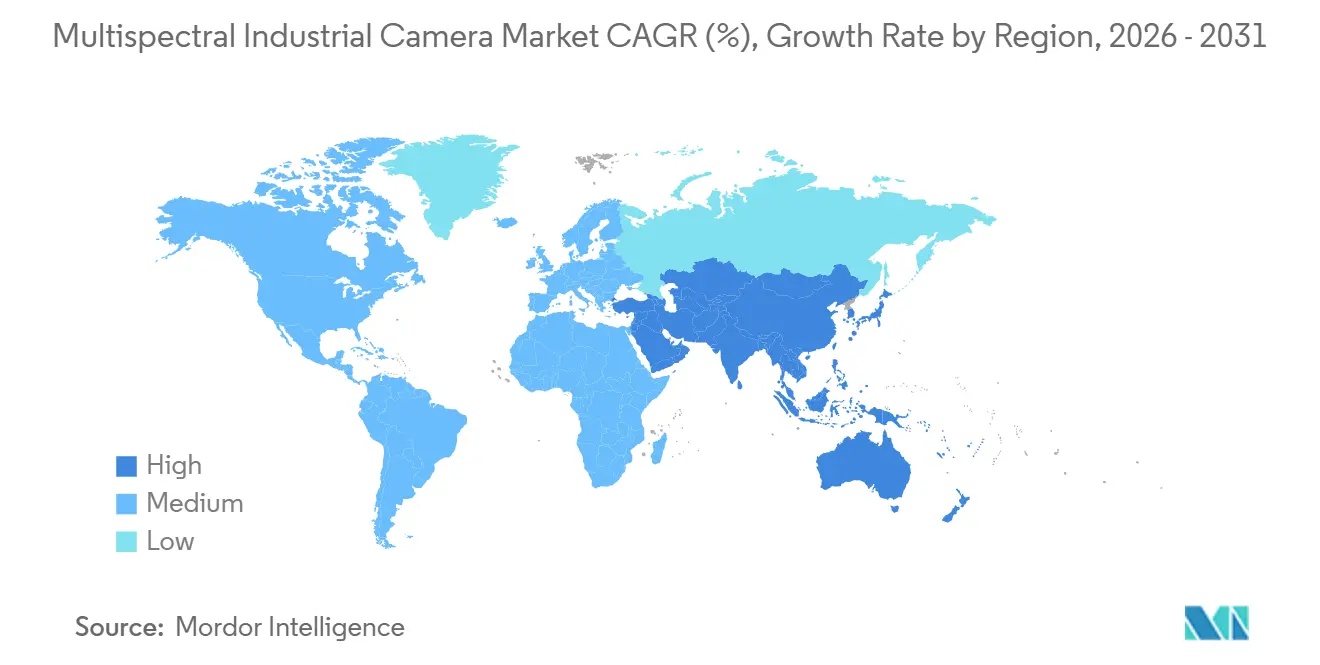
North America held 34.91% of the multispectral industrial camera market share in 2025. Its precision-agriculture infrastructure and advanced manufacturing base support broad deployment. Food processors, pharmaceutical producers, and semiconductor facilities can justify integrated inspection at scale. Federal defense procurement also sustains demand for MWIR and SWIR. Canada supports demand through mining applications, while Mexico’s automotive and electronics corridor supports inline quality inspection.
Asia-Pacific is projected to expand at a 14.83% CAGR through 2031. The multispectral industrial camera market in China is supported by demand from the food processing, electronics manufacturing, and recycling sectors. Domestic InGaAs sensor output can reduce reliance on imported components. Japan’s semiconductor fabrication ecosystem supports sophisticated SWIR and MWIR platforms. India’s drone policy liberalization and South Korea’s display panel and EV battery sectors drive inspection demand.
Europe is the second-largest regional market in the supplied analysis. The multispectral industrial camera market in Germany, the United Kingdom, the Netherlands, and the Nordic countries is supported by automation, food traceability, and recycling rules. The European Union Circular Economy Action Plan and Extended Producer Responsibility policies make spectral sorting more relevant for material recovery facilities.[2]European Commission, “Circular Economy Action Plan,” European Commission, europa.eu South America, the Middle East, and Africa remain earlier-stage markets, with demand tied to farming, water constraints, border security, deployment capacity, and skills availability.

Competitive Landscape
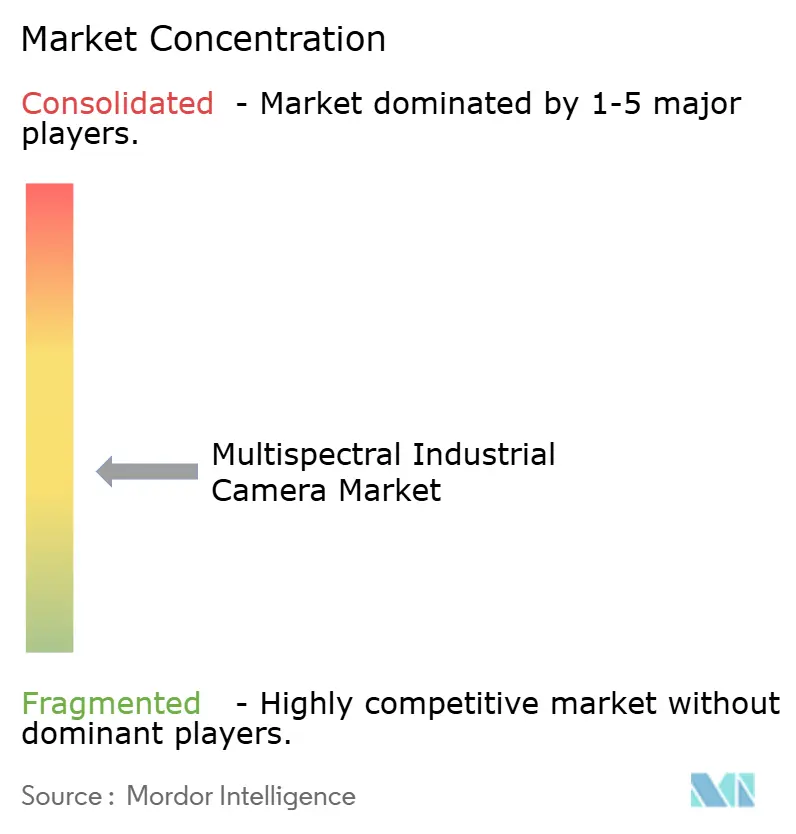
The multispectral industrial camera market is moderately fragmented, and no supplier holds a dominant position across all applications. JAI A/S, Specim Spectral Imaging Ltd., and Surface Optics Corporation compete through application knowledge, wavelength-focused hardware, and calibration software. ZEISS Group and imec bring broader optics and semiconductor research capabilities. Their March 2025 agreement extended collaboration through 2029 on semiconductor technologies below 2 nm.[3]ZEISS, “Imec and ZEISS Intensify Collaboration With the Signing of a New Strategic Partnership Agreement,” ZEISS, zeiss.com ZEISS acquired all equity shares of Pi Imaging Technology SA in 2025, extending its portfolio toward photon-counting technology.
Competition is especially visible in SWIR and food-inspection applications. Teledyne DALSA introduced the Kaleido SWIR camera in May 2026 for high-speed industrial inspection. Specim introduced FX19 and SX25 cameras to extend its SWIR and extended NIR portfolio. JAI expanded its Wave Series in June 2026 with the WAA-1300-GE-TEC, combining visible and SWIR imaging in a single sensor. Specim’s RETEX system reflects the move toward configured AI solutions for textile sorting.
Suppliers are combining sensing, processing, and software in integrated offerings. This can reduce customer integration work and create ongoing support opportunities. A 2025 study demonstrated wafer-scale plasmonic bandpass filters across the 900-1,700 nm range using a single lithographic step. The clearest opportunities in the multispectral industrial camera market are turnkey systems for smaller manufacturers, textile-recycling solutions, and mineral classification, where category leadership remains open.
Multispectral Industrial Camera Industry Leaders
JAI A/S
Specim, Spectral Imaging Ltd.
Spectral Devices Inc.
Surface Optics Corporation
HySpex
- *Disclaimer: Major Players sorted in no particular order

Recent Industry Developments
- June 2026: JAI A/S introduced the Wave WAA-1300-GE-TEC, a single-sensor area scan camera with 400-1,700 nm spectral sensitivity. It provided simultaneous visible and SWIR imaging at 1.3 MP and 90 fps with integrated thermoelectric cooling. The product removed dual-camera setups for material-characterization workflows and reduced system cost for machine builders in semiconductor and food inspection.
- May 2026: Teledyne DALSA introduced the Kaleido SWIR hyperspectral camera for high-speed recycling, food-safety, and pharmaceutical inspection. It offered 1,280-pixel spatial resolution and line rates above 2.3 kHz. Vertical integration of the sensor, spectrograph, and interface reduced field calibration variability and supported faster machine-builder deployment.
- April 2026: Specim launched RETEX, a complete AI and hyperspectral solution for textile-material identification and automated sorting. The system was available in 4 configurations from laboratory research and development to full industrial installations. The launch moved Specim into textile recycling and reflected a shift toward vertically configured AI solution bundles.
- February 2026: Specim introduced the FX19, a high-speed pushbroom hyperspectral camera in the 1,130-1,920 nm range. It had 640 spatial pixels and operated at up to 527 fps. The camera extended FX-series coverage for plastics sorting, thin-film analysis, and electronics inspection.


Global Multispectral Industrial Camera Market Report Scope
The Multispectral Industrial Camera Market comprises imaging systems, camera modules, sensor assemblies, camera arrays, and integrated camera-illumination solutions designed to capture and distinguish information across multiple discrete or continuous spectral bands beyond conventional RGB imaging. These systems combine specialized image sensors, optical filters, illumination, and image-processing capabilities to detect, classify, inspect, and measure material or surface characteristics that may not be visible through standard machine vision. The market includes snapshot, pushbroom, multiline, and time-delay integration (TDI) technologies, as well as filter-based multispectral imaging technologies, operating across visible-to-near-infrared (VIS-NIR), short-wave infrared (SWIR), thermal infrared, and other multi-band spectral ranges.
The Multispectral Industrial Camera Market Report is Segmented by Product Type (Multispectral Camera Systems, Multispectral Camera Modules and Sensors, Multispectral Camera Arrays, and Integrated Camera and Illumination Systems), Technology (Snapshot Imaging, Pushbroom Imaging, Multiline and TDI Imaging, and Filter-Based Imaging), Spectral Range (Visible to Near-Infrared (VIS-NIR), Short-Wave Infrared (SWIR), Thermal Infrared (Thermal IR), and Multi-Band Imaging), End-User (Food and Agriculture, Electronics and Semiconductor, Automotive and Transportation, Pharmaceuticals and Medical Devices, Aerospace and Defense, Recycling and Waste Management, Mining and Minerals, and Research and Scientific Laboratories), and Geography (North America, South America, Europe, Asia-Pacific, Middle East, and Africa). The Market Forecasts are Provided in Terms of Value (USD).
| Multispectral Camera Systems |
| Multispectral Camera Modules and Sensors |
| Multispectral Camera Arrays |
| Integrated Camera and Illumination Systems |
| Snapshot Imaging |
| Pushbroom Imaging |
| Multiline and TDI Imaging |
| Filter-Based Imaging |
| Visible to Near-Infrared (VIS-NIR) |
| Short-Wave Infrared (SWIR) |
| Thermal Infrared (MWIR/LWIR) |
| Multi-Band Systems |
| Food and Agriculture |
| Electronics and Semiconductors |
| Automotive and Transportation |
| Pharmaceuticals and Medical Devices |
| Aerospace and Defense |
| Recycling and Waste Management |
| Mining and Minerals |
| Research and Scientific Laboratories |
| Other End-User Industries |
| North America | United States |
| Canada | |
| Mexico | |
| South America | Brazil |
| Argentina | |
| Rest of South America | |
| Europe | Germany |
| United Kingdom | |
| France | |
| Italy | |
| Spain | |
| Rest of Europe | |
| Asia-Pacific | China |
| Japan | |
| India | |
| South Korea | |
| Australia | |
| Rest of Asia-Pacific | |
| Middle East | United Arab Emirates |
| Saudi Arabia | |
| Rest of Middle East | |
| Africa | South Africa |
| Egypt | |
| Rest of Africa |
| By Product Type | Multispectral Camera Systems | |
| Multispectral Camera Modules and Sensors | ||
| Multispectral Camera Arrays | ||
| Integrated Camera and Illumination Systems | ||
| By Technology | Snapshot Imaging | |
| Pushbroom Imaging | ||
| Multiline and TDI Imaging | ||
| Filter-Based Imaging | ||
| By Spectral Range | Visible to Near-Infrared (VIS-NIR) | |
| Short-Wave Infrared (SWIR) | ||
| Thermal Infrared (MWIR/LWIR) | ||
| Multi-Band Systems | ||
| By End-User Industry | Food and Agriculture | |
| Electronics and Semiconductors | ||
| Automotive and Transportation | ||
| Pharmaceuticals and Medical Devices | ||
| Aerospace and Defense | ||
| Recycling and Waste Management | ||
| Mining and Minerals | ||
| Research and Scientific Laboratories | ||
| Other End-User Industries | ||
| By Geography | North America | United States |
| Canada | ||
| Mexico | ||
| South America | Brazil | |
| Argentina | ||
| Rest of South America | ||
| Europe | Germany | |
| United Kingdom | ||
| France | ||
| Italy | ||
| Spain | ||
| Rest of Europe | ||
| Asia-Pacific | China | |
| Japan | ||
| India | ||
| South Korea | ||
| Australia | ||
| Rest of Asia-Pacific | ||
| Middle East | United Arab Emirates | |
| Saudi Arabia | ||
| Rest of Middle East | ||
| Africa | South Africa | |
| Egypt | ||
| Rest of Africa | ||


Key Questions Answered in the Report
What is the multispectral industrial camera market size?
The multispectral industrial camera market was USD 356.47 million in 2026 and is projected to reach USD 621.06 million by 2031 at an 11.74% CAGR.
Which product type leads demand for multispectral industrial cameras?
Multispectral Camera Systems led product demand with 44.62% of value in 2025, supported by integrated inspection needs in food, pharmaceutical, and semiconductor settings.
Which imaging technology is expanding fastest?
Snapshot Imaging is projected to expand at a 13.72% CAGR through 2031 because it can handle moving scenes in robotic, UAV, and waste-sorting applications.
Why is SWIR important for industrial inspection?
SWIR is used for semiconductor wafer inspection and plastic sorting, and it is projected to expand at a 14.36% CAGR through 2031.
Which end-user application is expanding fastest?
Recycling and Waste Management is projected to expand at a 15.09% CAGR through 2031 as material-purity requirements support spectral sorting.
Which region has the strongest growth outlook?
Asia-Pacific is projected to expand at a 14.83% CAGR through 2031, supported by manufacturing, recycling, semiconductor activity, and precision agriculture.
Page last updated on:





