
Mower-Conditioners Market Size and Share
Market Overview
| Study Period | 2022 - 2032 |
|---|---|
| Market Size (2027) | USD 1.95 Billion |
| Market Size (2032) | USD 2.58 Billion |
| Growth Rate (2027 - 2032) | 5.76 % |
| Fastest Growing Market | Asia-Pacific |
| Largest Market | North America |
| Market Concentration | Medium |
Major Players *Disclaimer: Major Players sorted in no particular order Image © Mordor Intelligence. Reuse requires attribution under CC BY 4.0. | |
Mower-Conditioners Market Analysis by Mordor Intelligence
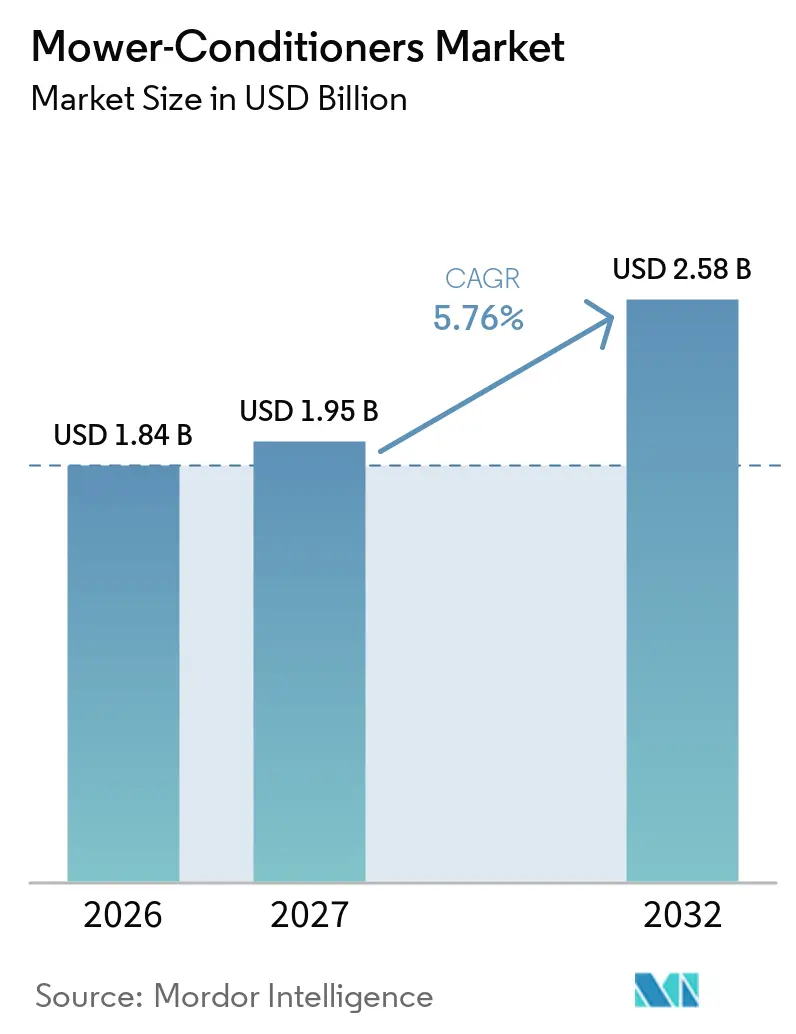
The mower-conditioners market was valued at USD 1.84 billion in 2026 and is projected to grow from USD 1.95 billion in 2027 to USD 2.58 billion by 2032, at a CAGR of 5.76% during the forecast period 2027 to 2032. Growth in the market is supported by rising livestock and dairy output, which increases the volume of forage that must be cut, conditioned, and stored. According to the Organisation for Economic Co-operation and Development-Food and Agriculture Organization (OECD-FAO) Agricultural Outlook 2025-2034, global meat, dairy, and egg output is forecast to rise 17% over the coming decade, supporting demand for efficient forage harvesting systems[1]. Equipment buyers are placing greater value on shorter drying times and forage quality, as delayed harvesting can expose crops to weather-related losses. Manufacturers are responding with connected implements, adjustable conditioning systems, and after-sale service support. However, the market also faces pressure from high purchase costs, the availability of used equipment, and seasonal weather conditions that can delay machine use.
Key Report Takeaways
- By product, disc mower conditioners were the largest segment and held 55.0% of the mower-conditioners market share in 2026, while drum mower conditioners are the fastest-growing segment and are forecast to expand at an 8.0% CAGR between 2027 and 2032.
- By application, hay production was the largest segment and held 38.0% of the mower-conditioners market size in 2026, while other forage harvesting applications are the fastest-growing segment and are forecast to expand at a 6.5% CAGR between 2027 and 2032.
- By farm size, large-scale farms were the largest segment and held 50.0% of the market share in 2026, while they are also the fastest-growing segment and are forecast to expand at a 6.5% CAGR between 2027 and 2032.
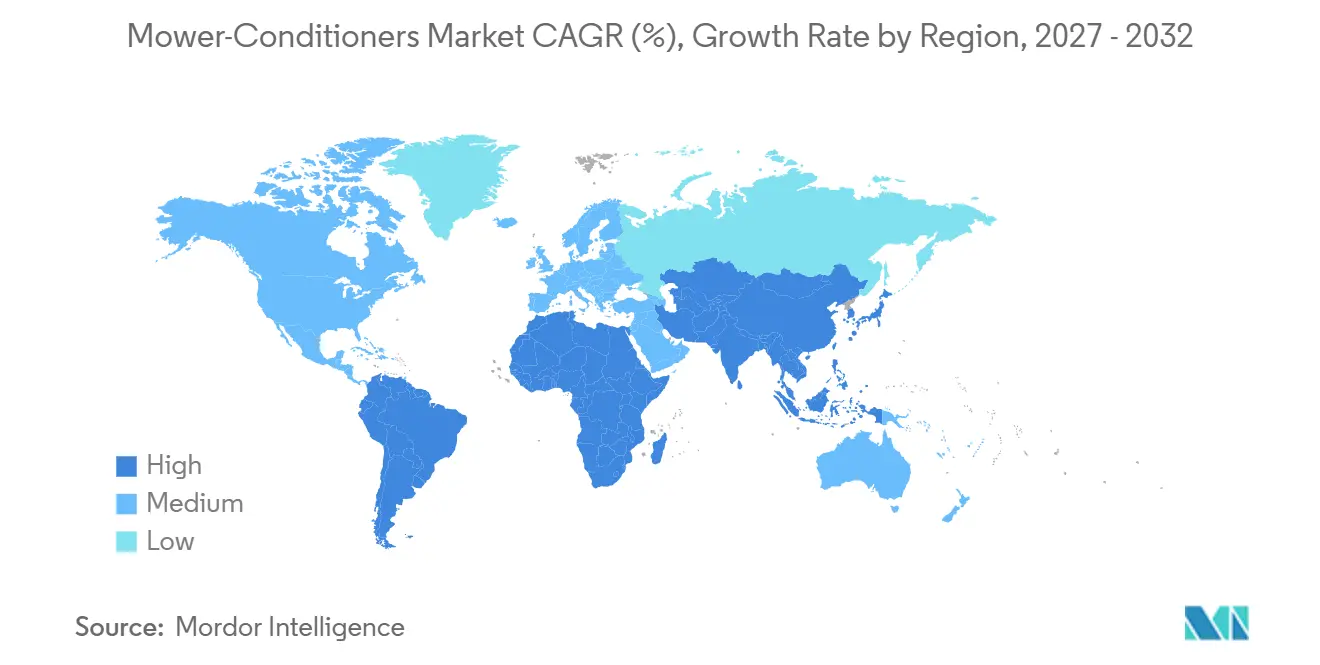
- By geography, North America was the largest segment and held 40.0% of the market share in 2026, while Asia-Pacific is the fastest-growing segment and is forecast to expand at a 7.8% CAGR between 2027 and 2032.
Note: Market numbers in this report are based on Mordor Intelligence's proprietary estimation framework, which combines nine months of actuals with Q4 projections for base year 2026.
Market Trends and Insights
Drivers Impact Analysis of Mower-Conditioners Market*
| Driver | (~) % Impact on CAGR Forecast | Geographic Relevance | Impact Timeline |
|---|---|---|---|
| Livestock and Dairy Forage Demand | +1.8% | Global, with concentrated gains in North America, Europe, India, Brazil, and China | Long term (≥ 4 years) |
| Rising Farm Mechanization and Labor Scarcity | +1.5% | Global, strongest in North America, Germany, China, and India | Medium term (2-4 years) |
| Faster Dry-Down and Higher Feed-Quality Economics | +0.9% | North America and Europe, with relevance in Australia and Brazil | Long term (≥ 4 years) |
| Precision Agriculture and Connected Implement Adoption | +0.6% | North America, Germany, Japan, and Australia | Medium term (2-4 years) |
| Government Modernization Incentives and Food-Security Programs | +0.7% | Asia-Pacific, Middle East and Africa, South America, and Europe | Short term (≤ 2 years) |
| Contractor and Custom-Harvesting Fleet Expansion | +0.5% | North America, France, Brazil, and Australia | Medium term (2-4 years) |
| Source: Mordor Intelligence | |||
Livestock and Dairy Forage Demand
Growing livestock and dairy production is supporting demand for mower-conditioners by increasing the need for reliable, high-quality forage supplies. According to the Organisation for Economic Co-operation and Development-Food and Agriculture Organization (OECD-FAO) Agricultural Outlook 2025–2034, global milk production is projected to grow by 1.8% annually, reaching 1,146 million metric tons by 2034. Rising demand for animal feed increases the importance of timely forage harvesting, particularly for dairy operations that depend on hay and silage to maintain consistent feed availability. Mower-conditioners cut forage crops and condition their stems to accelerate moisture loss, helping shorten wilting time and reduce exposure to unpredictable weather during harvest. This can improve harvesting efficiency and help preserve forage quality when crops must be collected within narrow weather windows. Consequently, dairy and livestock producers seeking dependable feed supplies and improved forage preservation are supporting demand for mower-conditioners, particularly in regions where forage-based feeding systems and mechanized harvesting are expanding.
Rising Farm Mechanization and Labor Scarcity
Labor shortages and rising pressure to complete forage harvesting within short weather windows are supporting demand for mower-conditioners. These machines combine cutting and conditioning in a single pass, reducing reliance on separate field operations and helping farmers harvest forage more efficiently when suitable weather is limited. According to a study published in Agriculture in March 2025, research based on a survey of 523 farm households in Jiangxi Province, China, found a significant positive association between agricultural machinery adoption and farmers’ subjective well-being, with mechanization also helping reduce labor intensity and facilitate transitions to non-agricultural employment. For forage producers, disc mower-conditioners and other high-capacity machines can reduce the time required to cut and condition crops, helping operators manage larger areas with fewer workers. These advantages are particularly relevant in regions facing rural workforce aging and seasonal labor shortages, where timely forage harvesting is essential for maintaining feed quality and securing supplies for livestock operations.
Faster Dry-Down and Higher Feed-Quality Economics
The need to reduce forage drying time and preserve nutritional quality is supporting demand for mower-conditioners, particularly among hay and dairy producers working within narrow weather windows. Conditioning rollers or tines crimp or crush forage stems during cutting, helping moisture escape more quickly and potentially reducing the time crops remain exposed to rainfall and other field losses. In February 2025, Massey Ferguson highlighted its steel-on-steel roller conditioning system as part of its expanded triple-mower lineup, emphasizing faster drying and forage-quality preservation. Faster and more uniform wilting can improve harvesting flexibility and help producers manage the risk of weather-related deterioration before baling or ensiling. These benefits are particularly important for farms producing high-quality hay and silage, where feed value influences livestock performance and production economics. Consequently, producers may favor mower-conditioners with adjustable roller pressure and conditioning intensity or tine-based systems suited to different forage crops, supporting demand for equipment that combines efficient cutting with effective moisture removal.
Government Modernization Incentives and Food-Security Programs
Government support for agricultural mechanization can encourage investment in modern farm equipment by reducing upfront costs and accelerating the replacement of older machinery. In February 2025, China expanded its agricultural machinery scrappage and renewal subsidy program by adding six equipment categories and increasing assistance for selected machinery. In India, the government’s Sub-Mission on Agricultural Mechanization had supported the distribution of 21.61 lakh (2.16 million) agricultural machines to individual farmers and the establishment of 27,554 Custom Hiring Centres through cumulative central assistance of ₹9,404.47 crore (USD 991.06 million) between 2014–15 and 2025–26, according to the Press Information Bureau in 2026[2]. These centres can improve access to machinery for farms that cannot justify individual ownership. In Europe, the Common Agricultural Policy provides rural-development funding through national and regional programs, some of which may support farm modernization investments. Where mower-conditioners qualify under specific schemes, financial assistance can reduce acquisition costs and support the adoption of higher-capacity equipment.
Restraints Impact Analysis of Mower-Conditioners Market*
| Restraint | (~) % Impact on CAGR Forecast | Geographic Relevance | Impact Timeline |
|---|---|---|---|
| High Upfront Cost and Financing Sensitivity | -1.2% | Global, sharpest in India, Brazil, South Africa, and price-sensitive small farms in North America | Short term (≤ 2 years) |
| Used-Equipment Substitution | -0.6% | North America and Europe, with growing relevance in South America | Medium term (2-4 years) |
| Weather-Window and Seasonal Utilization Risk | -0.5% | Global, most acute in France, the United States, Brazil, and China | Long term (≥ 4 years) |
| Maintenance Complexity and Skilled-Operator Shortage | -0.4% | North America, Germany, India, and South Africa | Medium term (2-4 years) |
| Source: Mordor Intelligence | |||
High Upfront Cost and Financing Sensitivity
High upfront costs can constrain mower-conditioner adoption among small and mid-sized farms, particularly where machinery purchases compete with other seasonal operating expenses. The cost of acquiring high-capacity equipment can make contract harvesting, machinery sharing, or purchasing used machines more financially attractive than buying new equipment. Financing conditions further influence these decisions because higher borrowing costs and limited access to suitable credit increase the total cost of ownership. According to the Food and Agriculture Organization of the United Nations (FAO), agriculture accounted for just 2.24% of global credit in 2024, down from 2.44% in 2015, even as real agricultural credit increased over the period[3]. This indicates that agricultural lending expanded more slowly than credit across the wider economy, highlighting the financing constraints that can affect capital-intensive machinery purchases. In Europe, Regulation (EU) 2023/1230 introduces updated machinery safety and conformity requirements and is scheduled to apply from 20 January 2027. Although compliance-related costs could add to manufacturers’ development and documentation expenses, the extent to which these costs affect mower-conditioner prices will depend on manufacturers’ implementation costs and pricing decisions. Together, equipment affordability and financing access can encourage price-sensitive buyers to delay replacement or rely on contractors and used machinery.
Weather-Window and Seasonal Utilization Risk
Weather variability can restrict the number of suitable operating days available to mower-conditioner users, particularly in regions where forage harvesting is concentrated into short seasonal periods. Rainfall, high humidity, and fluctuating temperatures can delay cutting and slow field drying, increasing the risk of forage quality deterioration and harvest losses. According to the University of Minnesota Extension’s August 2024 report on alfalfa production, frequent rainfall created narrow harvesting windows, and some producers could not secure the three to four drying days required for haymaking. Such disruptions can reduce machine utilization and make investment in new equipment less attractive when annual operating opportunities are uncertain. Although mower-conditioners accelerate moisture removal through mechanical conditioning, they cannot eliminate the effects of persistent rain or unfavorable drying conditions. Consequently, seasonal weather risk can encourage some farmers to defer equipment purchases or rely on custom-harvesting services, particularly where annual utilization may not justify the initial investment.
*Our forecasts treat driver/restraint impacts as directional, not additive. The impact forecasts reflect baseline growth, mix effects, and variable interactions.
Mower-Conditioners Market Segment Analysis
By Product Type:
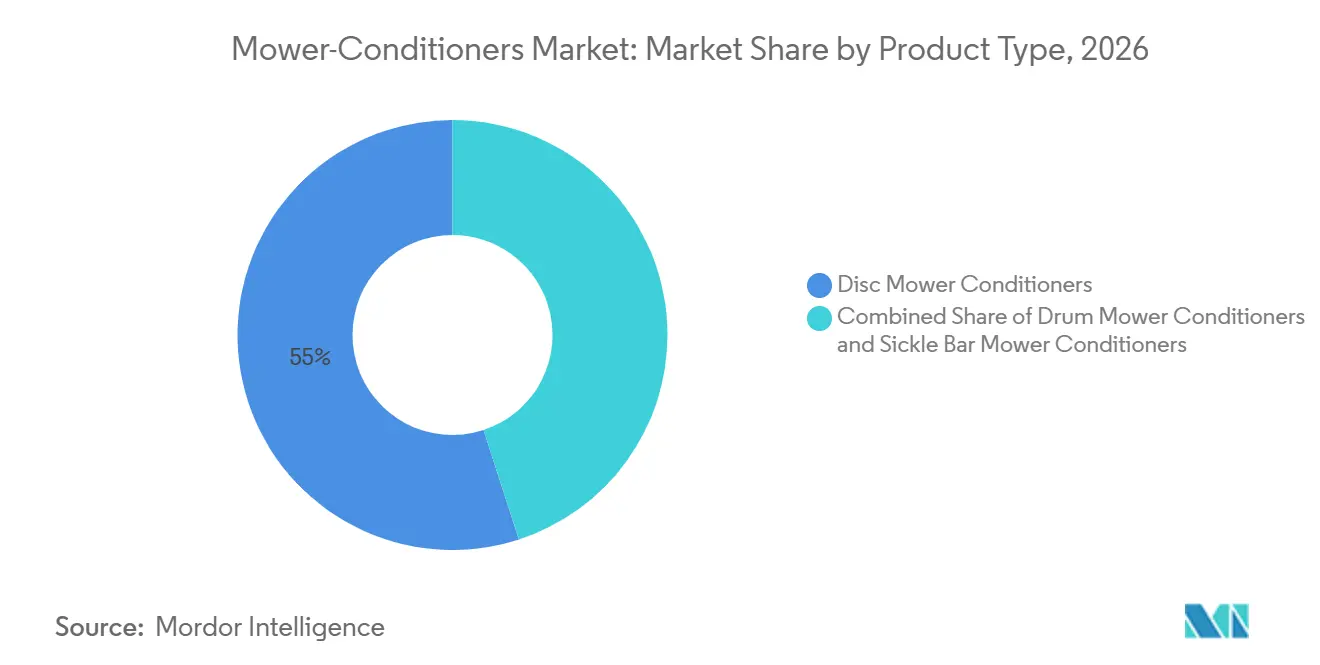
Disc Mower Conditioners Lead and Drum Formats Gain GroundDisc mower conditioners accounted for 55.0% of the mower-conditioners market share in 2026, making them the leading product category. Their position reflects widespread use in large-scale hay and haylage production, where high field capacity and efficient cutting are important during limited harvesting windows. Multi-disc cutterbars support rapid cutting, while integrated conditioning systems accelerate moisture removal and help operators prepare forage for storage. These advantages support demand among large farms and agricultural contractors seeking to cover more hectares within short seasonal periods.
Drum mower conditioners are forecast to grow at a CAGR of 8.0% from 2027 to 2032, making them the fastest-growing product category. Their growth prospects are supported by demand for cost-conscious equipment with straightforward maintenance and dependable performance under varied field conditions. These characteristics can appeal to smaller farms and contractors in price-sensitive markets where purchase cost and service accessibility influence machinery decisions. Sickle bar mower conditioners continue to serve specialized applications where reciprocating cutting systems suit local terrain and operating requirements. Meanwhile, manufacturers are enhancing disc mower-conditioners to improve performance and conditioning flexibility.

By Application:
Hay Production Leads and Other Forage Harvesting Applications AccelerateHay production accounted for 38.0% of the mower-conditioners market share in 2026, making it the leading application. Its position reflects the recurring need to cut and condition forage for livestock feed, with multiple harvesting cycles in suitable climates supporting equipment utilization. Conditioning accelerates moisture removal after cutting, helping producers prepare forage for storage while managing narrow weather windows. These requirements support demand among dairy farms, livestock producers, and agricultural contractors seeking consistent forage quality and timely harvesting.
Other forage harvesting applications are forecast to grow at a CAGR of 6.5% from 2027 to 2032, supported by opportunities to use mower-conditioners beyond conventional hay production, including cover crop management and selected biomass harvesting activities. Diversifying applications can help contractors extend seasonal equipment use and serve customers with different forage-management needs. Integrated harvesting systems are also shaping equipment choices. In September 2025, KUHN introduced the FC 9830 D RA rear-mounted mower-conditioner with an integrated windrow merger for authorized North American dealers. The system can cut, condition, and merge crop across a working width of up to 32 ft in one pass and features ISOBUS control. By combining multiple field operations, such systems can reduce separate passes and help contractors manage labor requirements and tight harvesting schedules. Conventional mower-conditioners remain suitable for farms that do not require an integrated merger or prioritize simpler equipment configurations.
By Farm Size:
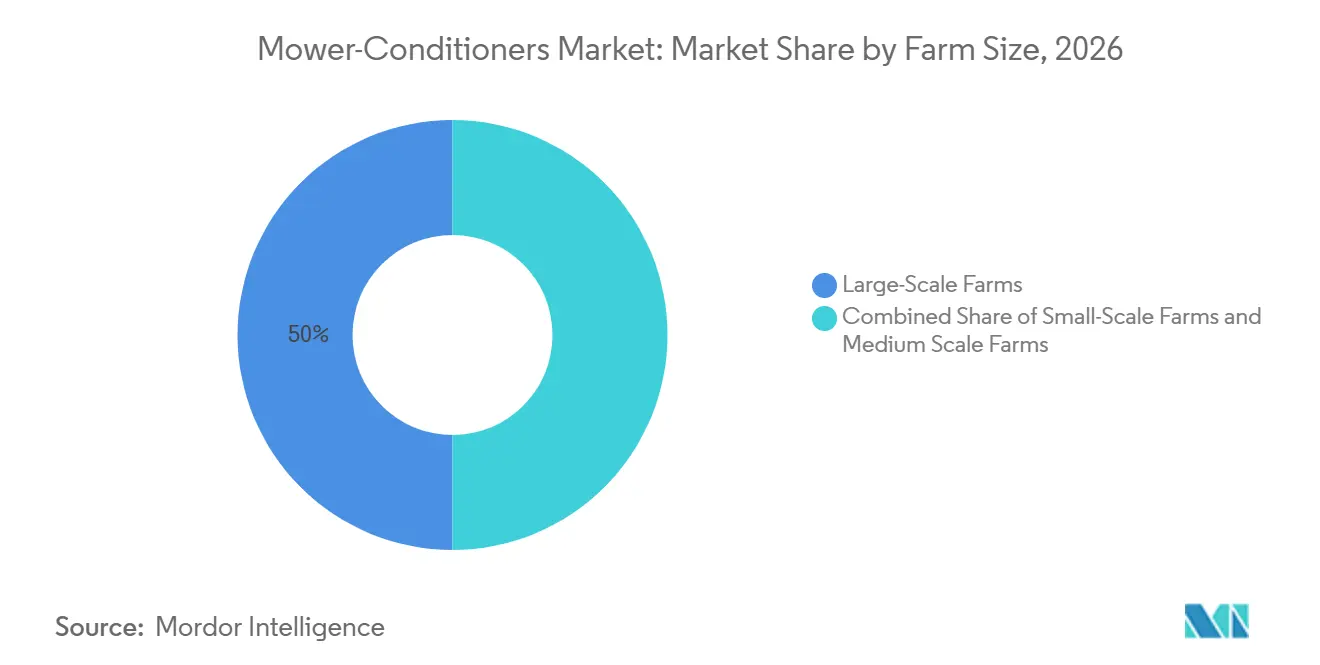
Large-Scale Farms LeadLarge-scale farms accounted for 50.0% of the mower-conditioners market share in 2026, making them the leading farm-size segment. Their position reflects extensive acreage, repeated forage-cutting cycles, and the ability to spread the cost of high-capacity machinery across more operating hours. Wider mower combinations and integrated conditioning systems help these farms cover larger areas within limited harvesting windows, while established maintenance arrangements support intensive seasonal use. These factors strengthen the business case for equipment investment among large farms and agricultural contractors serving extensive forage-producing areas.
Large-scale farms are also forecast to grow at a CAGR of 6.5% from 2027 to 2032, supported by continued investment in high-output machinery and equipment upgrades. Medium-scale farms remain important buyers of mid-range disc mower-conditioners, balancing field capacity with total ownership costs, while small-scale farms may favor compact equipment or custom-harvesting services where fragmented landholdings and limited capital constrain investment. Farm size also influences machinery access and financing decisions. In India, the Sub-Mission on Agricultural Mechanization supports machinery procurement and Custom Hiring Centres, enabling farmers to access equipment without purchasing every machine individually. Such arrangements can improve access to mechanized forage harvesting across different farm sizes. Overall, demand varies with acreage, annual utilization, available capital, and access to contractors or local servicing networks.
Geography Analysis
North America accounted for 40.0% of the mower-conditioners market share in 2026, supported by commercial hay and silage production, established machinery distribution networks, and agricultural contractors serving large areas. High-capacity mower-conditioners are suited to operations that need to complete multiple forage-cutting cycles within short seasonal windows, while dealer servicing and replacement-parts availability support intensive equipment use. Custom-harvesting businesses also allow farms to access specialized machinery without bearing the full cost of ownership. Europe remains an important market, supported by mechanized grassland management and livestock production in countries such as France, Germany, Ireland, and Italy. Machinery replacement programs and farm-modernization support can encourage investment.
Asia-Pacific is forecast to grow at a CAGR of 7.8% from 2027 to 2032, the fastest rate among regions. Growth opportunities are associated with dairy-sector development, greater access to agricultural machinery, and the expansion of custom-hiring services in China, India, and Southeast Asia. In February 2025, China expanded its agricultural machinery scrappage and renewal subsidy program by adding six equipment categories and increasing assistance for selected machinery. In India, machinery-access programs and custom-hiring centres can help smaller farms obtain mechanized equipment where individual ownership is difficult to justify. Adoption will nevertheless depend on farm size, forage production practices, equipment affordability, and the availability of locally suitable models and service networks.
South America offers opportunities for mower-conditioners through forage-based livestock production and silage demand, particularly in Brazil and Argentina. In the Middle East and Africa, investment in livestock productivity and food security may support longer-term demand for improved forage-harvesting systems, although adoption is likely to vary with climate, irrigation access, farm economics, and machinery-service infrastructure. According to the Organisation for Economic Co-operation and Development-Food and Agriculture Organization (OECD-FAO) Agricultural Outlook 2025–2034, the beef cattle herd in Sub-Saharan Africa is projected to increase by 15% over the decade to 2034. This expansion represents a potential opportunity for improved feed and forage management, but does not directly establish demand for mower-conditioners. Public machinery-renewal schemes can also influence equipment investment:
Competitive Landscape
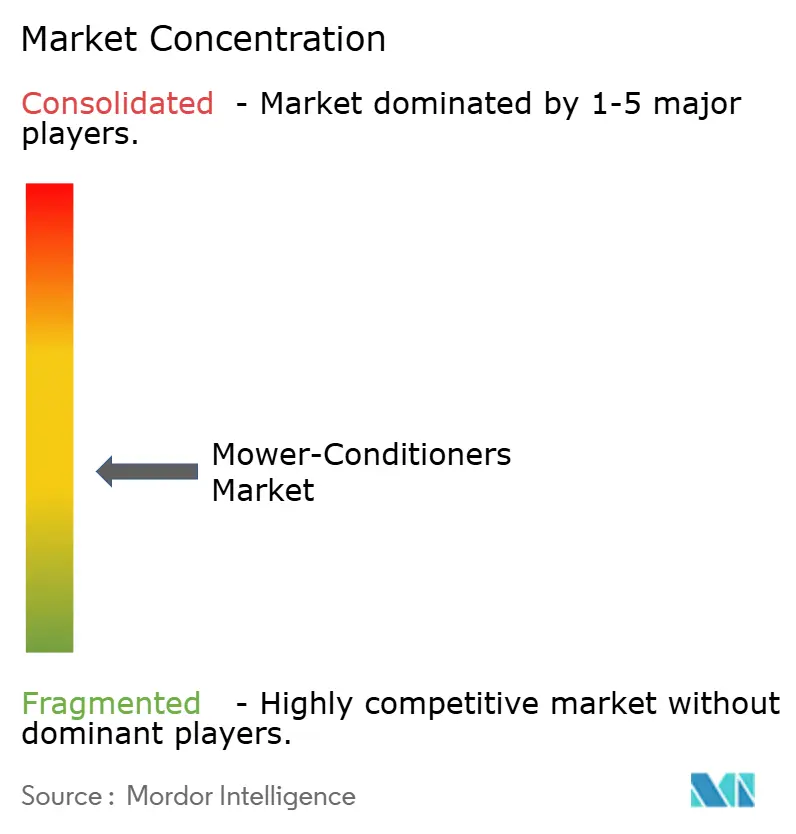
The mower-conditioners market was moderately concentrated in 2026, with KUHN SAS (Bucher Industries AG), CLAAS Saulgau GmbH (CLAAS KGaA mbH), CNH Industrial N.V., Deere & Company, and Maschinenfabrik Bernard KRONE GmbH & Co. KG identified as the leading players. Their competitive positions are supported by established forage-equipment portfolios, engineering capabilities, dealer networks, and experience serving commercial farms and agricultural contractors. Manufacturers compete through working width, cutting performance, conditioning options, equipment durability, tractor compatibility, and after-sales service. These factors encourage investment in high-capacity mower combinations and product configurations suited to different farm sizes and harvesting requirements.
Product development and equipment integration are shaping competitive differentiation. In August 2026, KUHN introduced its GMD+ mowers and FC+ mower-conditioners with optional ISOBUS compatibility, supporting integration with compatible tractor terminals and improved in-cab control. In May 2026, Maschinenfabrik Bernard KRONE GmbH & Co. KG presented the EasyCut B 1250 CV Fold Collect, a mower combination with a working width of up to 12.5 m, an integrated conditioner, and cross-conveyor belts for flexible swath merging. In April 2025, CNH Industrial N.V. announced a cooperation and licensing agreement with MASCHIO GASPARDO for the distribution and supply of New Holland-branded mowers, mower-conditioners, tedders, and rotary rakes in Europe, with MASCHIO GASPARDO also leading engineering efforts for future products. These developments illustrate how leading players are strengthening product differentiation through wider working widths, electronic integration, combined field operations, and partnerships that support product availability and servicing.
Long-term competitive positioning depends on equipment reliability, conditioning flexibility, dealer coverage, replacement-parts availability, and compatibility with evolving farm technologies. Opportunities remain for manufacturers offering high-capacity systems for contractors and large farms, as well as practical and cost-effective configurations for medium-sized and smaller operations. Connected controls and integrated swath-merging systems can help improve field productivity, although their value depends on farm scale, tractor compatibility, and local operating conditions. In Europe, Regulation (EU) 2023/1230 introduces updated machinery safety and conformity requirements that are scheduled to apply from 20 January 2027, creating a need for manufacturers to prepare for the updated framework. Established manufacturers can draw on their engineering and distribution resources, while competition will also depend on providing accessible servicing and equipment configurations that match regional forage-harvesting practices.
Mower-Conditioners Industry Leaders
-
KUHN SAS (Bucher Industries AG)
-
CLAAS Saulgau GmbH (CLAAS KGaA mbH)
-
CNH Industrial N.V.
-
Deere & Company
-
Maschinenfabrik Bernard KRONE GmbH & Co. KG
- *Disclaimer: Major Players sorted in no particular order
Mower-Conditioners Market Companies Covered in this Report
- KUHN SAS (Bucher Industries AG)
- CLAAS Saulgau GmbH (CLAAS KGaA mbH)
- CNH Industrial N.V.
- Deere & Company
- Maschinenfabrik Bernard KRONE GmbH & Co. KG
- AGCO Corporation
- Vermeer Corporation
- PÖTTINGER Landtechnik GmbH
- Kverneland Group Kerteminde AS (Kverneland Group AS)
- SIP Strojna Industrija d.d.
- SaMASZ Sp. z o.o.
- MASCHIO GASPARDO S.p.A.
- McHale Engineering Unlimited Company
- BCS S.p.A.
- MacDon Industries Ltd. (Linamar Corporation)
- GALFRÈ DOMENICO & C. S.r.l.
Recent Industry Developments in Mower-Conditioners Market
- September 2026: KUHN SAS announced its FC 30+ mower-conditioners as part of its summer 2026 product launches. The updated lineup includes ISOBUS-compatible models and options designed for large-scale forage harvesting.
- May 2026: Maschinenfabrik Bernard KRONE GmbH & Co. KG presented a mower combination with a working width of up to 12.5 m, an integrated CV conditioner with hardened V-shaped steel tines, and cross-conveyor belts for merging swaths. The system is designed for high-output forage harvesting and controlled-traffic farming.
- April 2025: Vermeer announced the addition of triple mowers to its product portfolio through a partnership with Slovenia-based SIP. The equipment offers a cutting width of 29.8 ft (9.1 m), with plain mower, rubber-roller conditioner, and flail-conditioner configurations.
Global Mower-Conditioners Market Report Scope
The mower-conditioners market comprises agricultural machines that cut forage crops and mechanically condition the cut material to accelerate moisture loss before baling or ensiling. These machines typically use disc or drum cutting systems combined with roller or tine conditioners to crimp, crush, or bruise plant stems, supporting faster drying and timely forage harvesting.
The Mower-Conditioners Market is Segmented by Product Type (Disc Mower Conditioners, Drum Mower Conditioners, and Sickle Bar Mower Conditioners), by Application (Hay Production, Silage and Haylage Production, and Other Forage Harvesting Applications), by Farm Size (Large-Scale Farms, Medium-Scale Farms, and Small-Scale Farms), and by Geography (North America, South America, Europe, Asia-Pacific, Africa, and the Middle East). The Market Forecasts are Provided in Terms of Value (USD).
Segmentation Overview
| Disc Mower Conditioners |
| Drum Mower Conditioners |
| Sickle Bar Mower Conditioners |
| Hay Production |
| Silage and Haylage Production |
| Other Forage Harvesting Applications |
| Large-Scale Farms |
| Medium-Scale Farms |
| Small-Scale Farms |
| North America | United States |
| Canada | |
| Mexico | |
| Rest of North America | |
| South America | Argentina |
| Brazil | |
| Chile | |
| Rest of South America | |
| Europe | Germany |
| United Kingdom | |
| France | |
| Spain | |
| Italy | |
| Russia | |
| Rest of Europe | |
| Asia-Pacific | China |
| Japan | |
| India | |
| Australia | |
| Singapore | |
| South Korea | |
| Rest of Asia-Pacific | |
| Middle East | Saudi Arabia |
| United Arab Emirates | |
| Turkey | |
| Rest of Middle East | |
| Africa | South Africa |
| Kenya | |
| Nigeria | |
| Rest of Africa |
| By Product Type | Disc Mower Conditioners | |
| Drum Mower Conditioners | ||
| Sickle Bar Mower Conditioners | ||
| By Application | Hay Production | |
| Silage and Haylage Production | ||
| Other Forage Harvesting Applications | ||
| By Farm Size | Large-Scale Farms | |
| Medium-Scale Farms | ||
| Small-Scale Farms | ||
| By Geography | North America | United States |
| Canada | ||
| Mexico | ||
| Rest of North America | ||
| South America | Argentina | |
| Brazil | ||
| Chile | ||
| Rest of South America | ||
| Europe | Germany | |
| United Kingdom | ||
| France | ||
| Spain | ||
| Italy | ||
| Russia | ||
| Rest of Europe | ||
| Asia-Pacific | China | |
| Japan | ||
| India | ||
| Australia | ||
| Singapore | ||
| South Korea | ||
| Rest of Asia-Pacific | ||
| Middle East | Saudi Arabia | |
| United Arab Emirates | ||
| Turkey | ||
| Rest of Middle East | ||
| Africa | South Africa | |
| Kenya | ||
| Nigeria | ||
| Rest of Africa | ||
Key Questions Answered in the Report
What is the mower-conditioners market size?
The mower-conditioners market was valued at USD 1.84 billion in 2026 and is projected to grow from USD 1.95 billion in 2027 to USD 2.58 billion by 2032, at a CAGR of 5.76% during the forecast period 2027 to 2032.
Which mower conditioner product type leads sales?
Disc mower conditioners lead with a 55.0% share in 2026 because they suit high-throughput hay and haylage operations.
Which mower conditioner product type is forecast to grow fastest?
Drum mower conditioners are forecast to expand at an 8.0% CAGR between 2027 and 2032, supported by lower ownership costs and simpler maintenance.
Which region is forecast to grow fastest?
Asia-Pacific is forecast to expand at a 7.8% CAGR between 2027 and 2032, supported by dairy expansion and machinery modernization programs.