
Motorcycle Accessories Market Size and Share
Market Overview
| Study Period | 2020 - 2032 |
|---|---|
| Market Size (2027) | USD 24.88 Billion |
| Market Size (2032) | USD 33.88 Billion |
| Growth Rate (2027 - 2032) | 6.37 % |
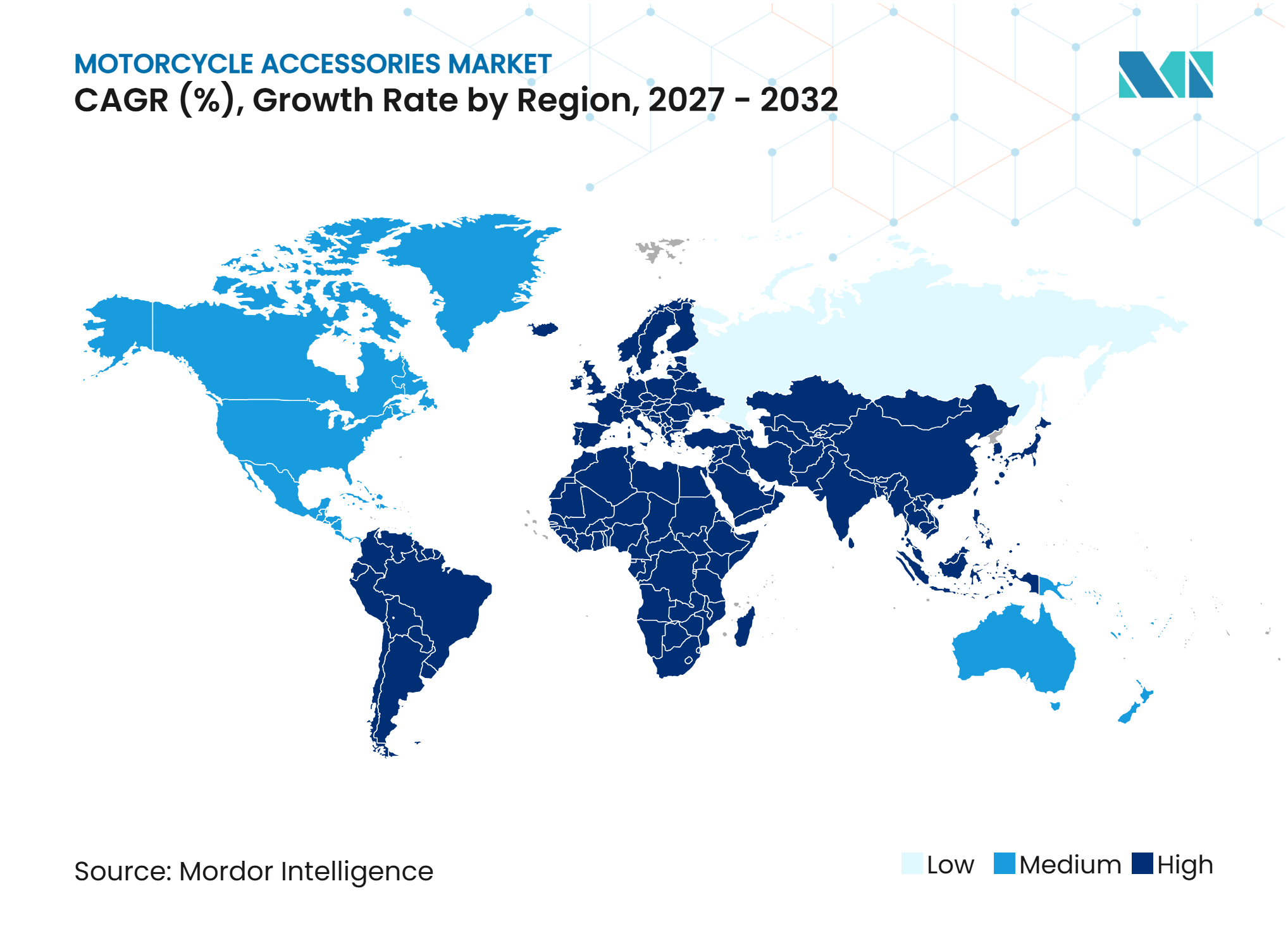
| Fastest Growing Market | Middle East and Africa |
| Largest Market | Asia-Pacific |
| Market Concentration | Low |
Major Players *Disclaimer: Major Players sorted in no particular order Image © Mordor Intelligence. Reuse requires attribution under CC BY 4.0. | |
Motorcycle Accessories Market Analysis by Mordor Intelligence
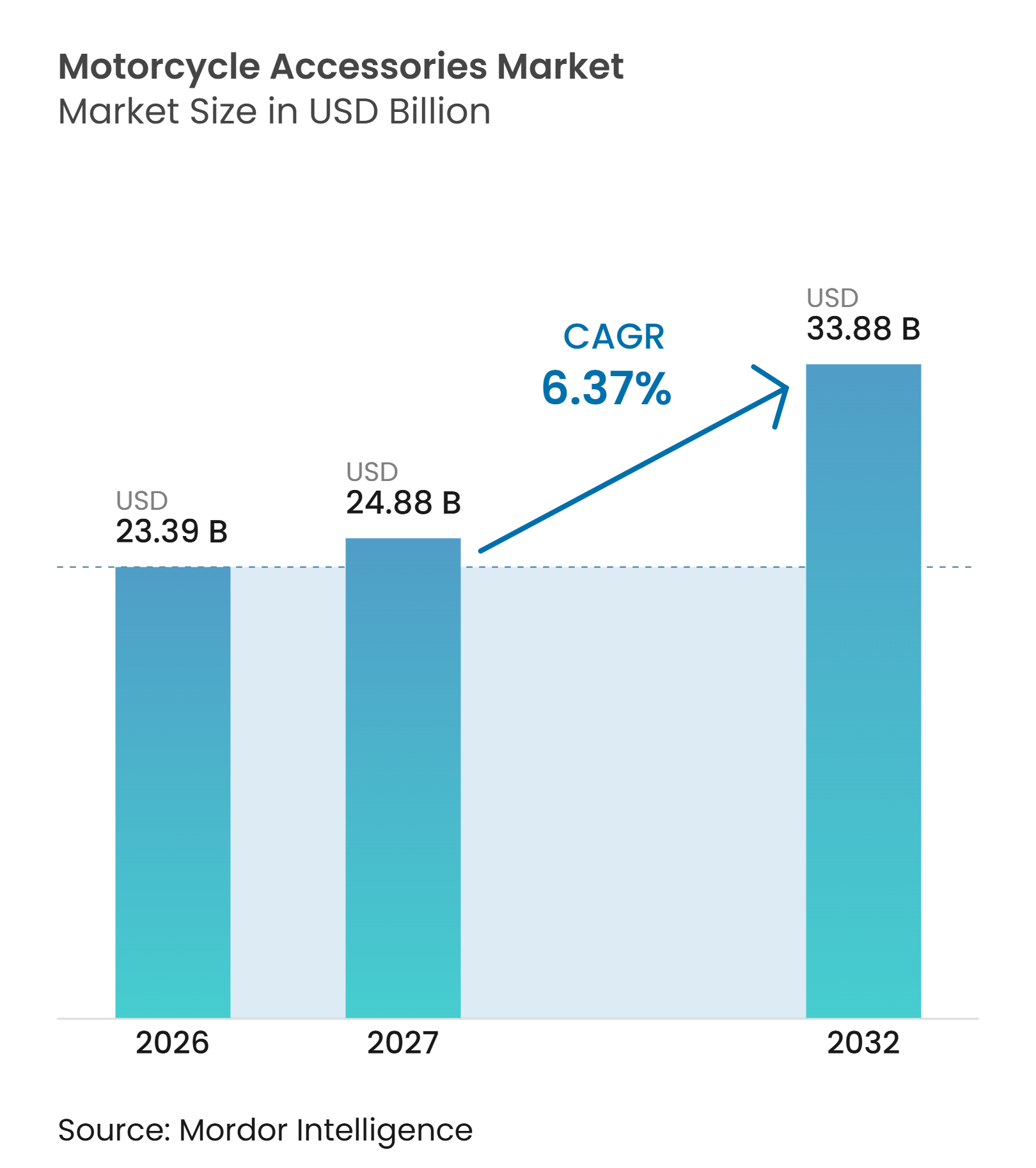
The motorcycle accessories market size was valued at USD 23.39 billion in 2026 and is expected to grow from USD 24.88 billion in 2027 to USD 33.88 billion by 2032, at a CAGR of 6.37% during 2027-2032. Demand is supported by tighter safety requirements, wider use of connected riding equipment, and sustained interest in touring and adventure motorcycles. These factors support both replacement purchases and purchases made when a motorcycle is acquired. Product choices increasingly combine physical protection with communication, navigation, and recording functions. The aftermarket remains important because riders can add equipment over the ownership cycle instead of selecting all accessories at purchase. Counterfeit products, uneven fitment practices, and limited interoperability between connected devices remain constraints for the motorcycle accessories market.
Key Report Takeaways
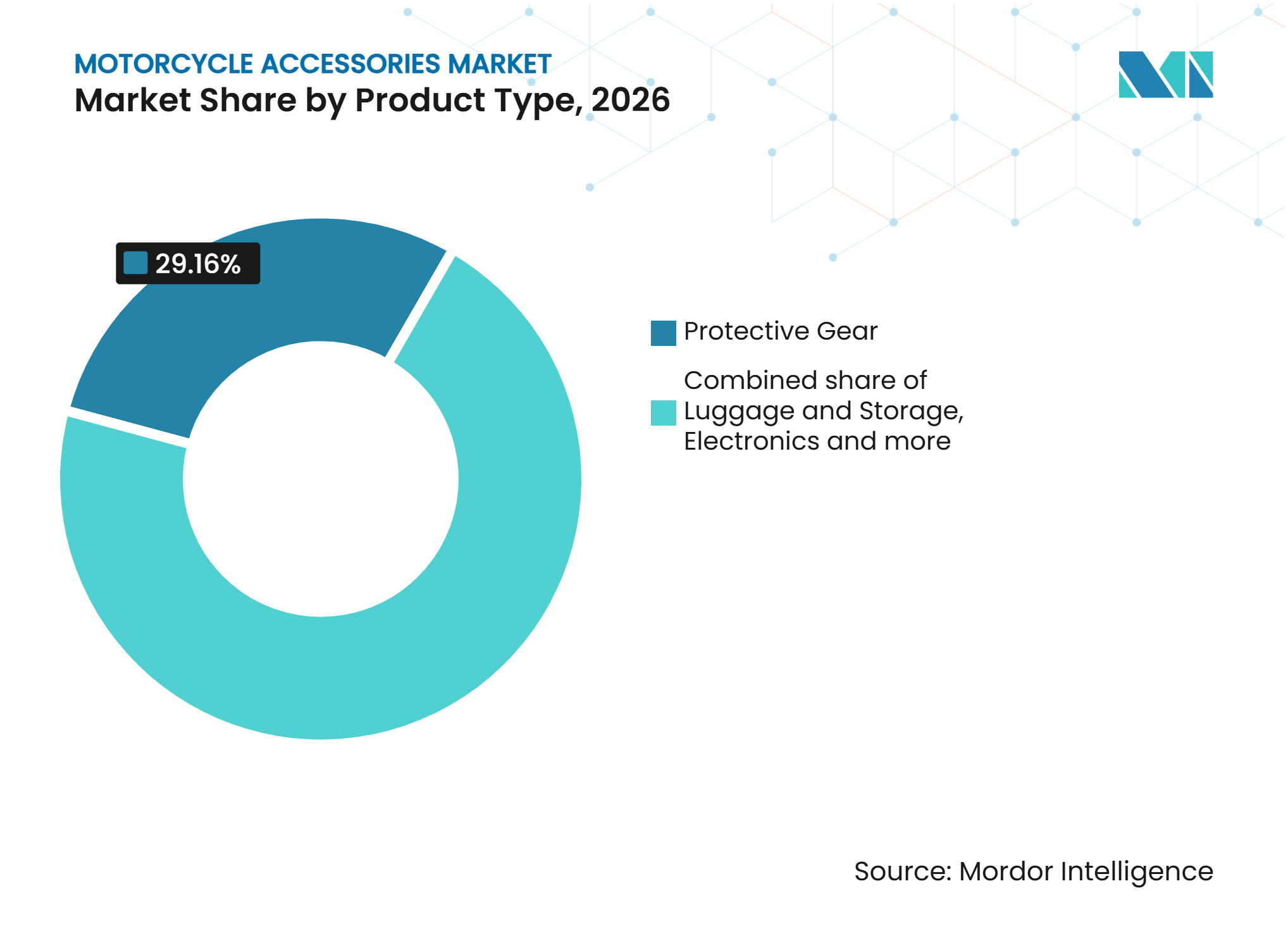
- By product type, protective gear held a 29.16% share in 2026, while electronics is projected to grow at a 12.79% CAGR through 2032.
- By motorcycle type, commuter motorcycles held a 31.20% share in 2026, while off-road motorcycles are projected to grow at an 8.19% CAGR through 2032.
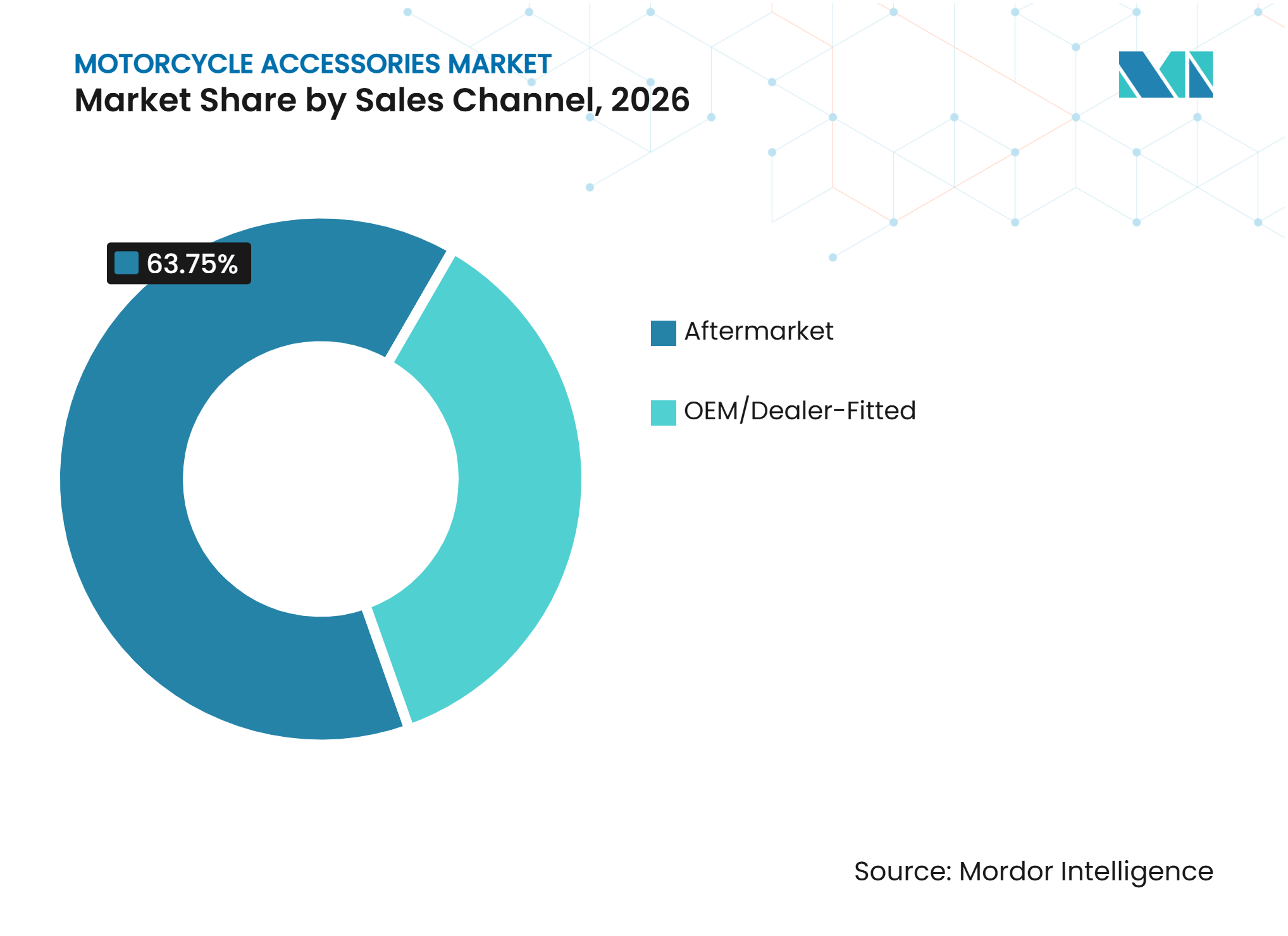
- By sales channel, the aftermarket held a 63.75% share in 2026 and is projected to grow at a 7.20% CAGR through 2032.
- By distribution channel, specialty stores held a 36.63% share in 2026, while online is projected to grow at a 9.09% CAGR through 2032.
- By geography, Asia-Pacific held a 39.09% share in 2026, while the Middle East and Africa is projected to grow at an 8.09% CAGR through 2032.
Note: Market numbers in this report are based on Mordor Intelligence's proprietary estimation framework, which combines nine months of actuals with Q4 projections for base year 2026.
Market Trends and Insights
Drivers Impact Analysis of Motorcycle Accessories Market*
| Driver | (~) % Impact on CAGR Forecast | Geographic Relevance | Impact Timeline |
|---|---|---|---|
| Connected Riding and Motorcycle Electronics Adoption | +2.1% | Global, led by North America and Asia-Pacific | Medium term (2–4 years) |
| Mandatory Helmet and Protective-Gear Compliance | +1.8% | Global, with highest intensity in Asia-Pacific and Middle East and Africa | Short term (≤ 2 years) |
| Rising Touring and Adventure Riding Participation | +1.5% | Global, concentrated in North America, Europe, and Asia-Pacific | Medium term (2–4 years) |
| E-Commerce Expansion and Wider Product Availability | +1.2% | Global, with strongest uplift in Asia-Pacific and South America | Short term (≤ 2 years) |
| Growing Demand for Integrated Electric-Motorcycle Accessories | +0.9% | Asia-Pacific, Europe, and North America | Long term (≥ 4 years) |
| Fitment Complexity and Model-Specific Accessory Bundling | +0.6% | Global, highest in premium motorcycle markets | Medium term (2–4 years) |
| Source: Mordor Intelligence | |||
Connected Riding and Motorcycle Electronics Adoption
Connected equipment increasingly serves riders on longer trips, group rides, and daily journeys. Communication systems, navigation devices, action cameras, and smart helmet features meet practical, safety, and convenience needs. Sena continues to refresh its communication range with mesh capability, audio functions, and accessible options for riders retaining existing equipment. This reduces the need for a complete hardware replacement. Helmet manufacturers are also considering space, wiring, controls, and visibility during product development. Riders may prefer fewer devices when communications, navigation, and emergency functions operate together. Clear compatibility information, software support, and straightforward installation will determine whether connected equipment creates repeat demand in the motorcycle accessories market.
Mandatory Helmet and Protective-Gear Compliance
Safety rules support recurring demand because riders need equipment that meets applicable standards. India has increased enforcement against noncompliant helmets, while the quality-control framework requires certification for helmets sold in the country[1]. Compliant suppliers must demonstrate credentials through packaging, documentation, and controlled distribution. This makes reliance on unverified inventory more difficult for retailers. Testing and traceability also become more important when manufacturers sell across jurisdictions with different labeling and approval expectations. Smaller suppliers may face higher compliance costs, whereas brands with established processes gain credibility. The motorcycle accessories market benefits as riders increasingly distinguish certified protective products from unverified alternatives and replace equipment when standards or personal needs change.
Rising Touring and Adventure Riding Participation
Touring and adventure riding create demand for luggage, protection, navigation, lighting, and communication equipment. Riders preparing for longer routes and varied conditions often purchase several complementary products. UK registration data from the Motorcycle Industry Association (MCIA) showed adventure motorcycles up 41.8% and touring motorcycles up 18.2% in July 2026[2]. Purchases commonly follow motorcycle acquisition as riders prepare for travel and upgrade their equipment over time. Smaller motorcycles broaden the potential customer base, particularly for riders gradually entering adventure riding. These buyers may begin with protective equipment and add travel-oriented products after gaining experience. Clear fitment information and practical demonstrations help manufacturers reach this group within the motorcycle accessories market.
E-Commerce Expansion and Wider Product Availability
Online channels make a wider product range available to riders outside specialty-store catchments. Fitment tools, product images, delivery options, and instructional content reduce uncertainty for luggage, mounts, covers, grips, and replacement parts. Digital availability also helps brands reach smaller cities and cross-border customers. Physical retailers remain relevant because helmet fitting, mounting advice, and complex equipment assessments still benefit from in-person support. Retailers can combine local service with online ordering without holding every item in stock. Brands should clearly explain which motorcycles each product fits, how it is installed, and how returns are handled. Credible information and authenticity controls remain essential as the motorcycle accessories market expands through digital retail.
Restraints Impact Analysis of Motorcycle Accessories Market*
| Restraint | (~) % Impact on CAGR Forecast | Geographic Relevance | Impact Timeline |
|---|---|---|---|
| High Counterfeit and Non-Compliant Aftermarket Product Availability | −1.5% | Asia-Pacific core, with spillover to Middle East and Africa and South America | Short term (≤ 2 years) |
| Discretionary Spending Sensitivity in Premium Accessories | −0.9% | North America and Europe | Short term (≤ 2 years) |
| Fragmented Fitment Standards and Installation Liability | −0.6% | Global | Medium term (2–4 years) |
| Limited Interoperability Across Connected Accessories | −0.4% | Global, most acute in developed markets | Long term (≥ 4 years) |
| Source: Mordor Intelligence | |||
High Counterfeit and Non-Compliant Aftermarket Product Availability
Counterfeit and noncompliant products create a direct risk for riders and legitimate manufacturers. The problem is particularly serious for helmets and protective equipment because performance cannot be fully assessed before use. India has taken enforcement action against products that do not meet certification conditions. Low-priced, unverified goods make it harder for compliant brands to explain the value of tested products and can weaken confidence in the category. Informal and online channels can make legitimate listings difficult to distinguish from copies. Product serialization, visible labels, retailer education, and verified sources can help, but different national rules add cross-border complexity. This restraint affects safety, pricing, and brand credibility across the motorcycle accessories market.
Discretionary Spending Sensitivity in Premium Accessories
Premium apparel, advanced electronics, and performance components are more vulnerable when riders limit discretionary spending. Consumers may retain functional equipment for longer or choose simpler alternatives, slowing demand for high-value upgrades. Touring-related products can be affected when riders defer longer trips or select lower-cost motorcycles. Safety-related replacement needs offer some protection, but not every accessory has the same urgency. Value-oriented products can gain importance when budgets are under pressure, especially when they provide a clear practical benefit. Brands can respond with modular systems, straightforward product guidance, and a balanced range across price points. The motorcycle accessories market is influenced by how well suppliers match durable, reliable products to changing rider budgets.
*Our forecasts treat driver/restraint impacts as directional, not additive. The impact forecasts reflect baseline growth, mix effects, and variable interactions.
Motorcycle Accessories Market Segment Analysis
By Product Type:
Protective Gear Leads While Electronics ExpandsProtective gear held a 29.16% share in 2026, while electronics is forecast to expand at a 12.79% CAGR through 2032. Protective gear remains essential because helmets, gloves, jackets, boots, and body protection serve everyday riding as well as longer travel. Safety requirements, retailer guidance, fit, comfort, and climate suitability make this category less discretionary than cosmetic upgrades. Replacement purchases arise when equipment is damaged, worn, uncomfortable, or no longer appropriate for the rider’s needs. Electronics include communication devices, navigation tools, cameras, and connected helmet features that support group riding, route planning, and emergency awareness. This combination keeps protective products central while connected equipment broadens the motorcycle accessories market.
Luggage and storage support commuters, tourers, and adventure riders who need secure mounting, useful capacity, waterproofing, and motorcycle-specific design. Performance parts retain interest among riders seeking a different riding feel, appearance, or sound, although high-cost upgrades may be deferred. Lighting improves visibility during extended travel, while security products address theft concerns where motorcycles are parked outdoors or in shared spaces. Covers, mirrors, and grips meet practical needs and provide accessible purchases for new riders. Electronics products must be simple to install, usable with gloves, weather resistant, and supported after purchase. The motorcycle accessories industry increasingly links digital products with helmets and protection, making compatibility and clear guidance more important for buyers.



By Motorcycle Type:
Commuter Motorcycles Lead While Off-Road AcceleratesCommuter motorcycles held a 31.20% share in 2026, while off-road is forecast to grow at an 8.19% CAGR through 2032. Touring and adventure riders often prepare for longer routes and changing conditions with luggage, guards, navigation, communications, apparel, and weather protection. Their requirements create several purchase occasions during ownership instead of a single transaction at the time of motorcycle purchase. Off-road riders prioritize equipment that withstands dirt, water, impacts, and varied terrain without restricting movement or adding unnecessary weight. Helmets, boots, gloves, body protection, guards, and compact luggage are relevant for trail riding and light adventure travel. These needs make both categories important sources of demand for the motorcycle accessories market.
Commuters and scooter riders tend to prioritize helmets, rain protection, storage, locks, phone mounts, and simple comfort items for daily travel. Their purchases are usually practical, while sport riders often choose protective apparel, communication products, performance parts, and styling accessories. Cruiser riders commonly consider comfort, luggage, wind protection, and aesthetic customization, yet still expect reliable fit and durability. Motorcycle type also shapes how customers research products, with adventure and off-road users often comparing durability and fitment before buying. Commuters may prioritize availability and straightforward installation, while sport and cruiser buyers may place more weight on brand and style. Suppliers benefit when motorcycle-specific guidance helps each rider find suitable equipment without treating every user as the same customer.
By Sales Channel:
Aftermarket Maintains Its Lead and GrowthThe aftermarket held a 63.75% share in 2026 and is forecast to expand at a 7.20% CAGR through 2032. It lets riders customize motorcycles after purchase and choose from more brands, price points, and product combinations than standard factory configurations. This flexibility is useful for luggage, protection, electronics, styling components, and equipment added gradually over the ownership cycle. Aftermarket suppliers can introduce products for new motorcycle models, emerging travel needs, or developing technologies without waiting for factory programs. Better fitment databases and instructions reduce the uncertainty that once directed many buyers toward dealer-installed products. These strengths make the aftermarket a key route to the motorcycle accessories market for new and experienced riders.
OEM and dealer-fitted accessories remain relevant because they can be ordered with the motorcycle and supported through the dealer relationship. Buyers may value bundled financing, factory warranty assurance, model-specific advice, and a single point of service. Factory programs, however, cannot always match the breadth available from specialists, and many riders later seek aftermarket upgrades. The choice depends on product complexity, with some consumers choosing factory-integrated items but buying luggage, apparel, or communications from specialist brands. Strong warranty practices and credible installation guidance help aftermarket sellers build repeat customer trust. The motorcycle accessories market is shaped by the interaction of dealer convenience, broad aftermarket choice, and product confidence.

By Distribution Channel:
Specialty Stores Lead While Online Builds ReachSpecialty stores held a 36.63% share in 2026, while online is forecast to grow at a 9.09% CAGR through 2032. Specialty stores remain relevant because helmets, jackets, luggage systems, and technical electronics often require fitting, comparison, or mounting advice. Customers can assess materials, comfort, build quality, and sizing with support from staff who understand motorcycle use. Online channels make products visible to riders outside major retail locations and simplify comparisons for less common motorcycle models. Digital content can explain installation, maintenance, compatibility, delivery, and returns before a buyer commits to a purchase. This combination of physical service and digital access supports the motorcycle accessories market.
Dealerships remain important for original equipment products, model-specific kits, and customers who want installation managed by a known service team. Informal retailers and general stores can have local reach where specialist coverage is limited, although technical support and certification visibility may vary. Online sellers must manage product authenticity carefully because convenience does not resolve concerns around safety, quality, or correct fit. Specialty stores can extend their catalog through digital ordering while retaining their advisory role. Online retailers can reduce returns through accurate photos, specifications, and fitment checks. The motorcycle accessories market is supported when customers can research online, verify fit with an expert, and buy through a convenient channel.
Geography Analysis
Asia-Pacific held a 39.09% share in 2026 and remains the largest regional base for the motorcycle accessories market. A large two-wheeler user base supports demand for practical safety and utility products, including helmets, storage, locks, rain equipment, and comfort items. India supports replacement demand because certified helmets are required under the applicable framework, and enforcement has addressed noncompliant products. Dense urban markets commonly emphasize commuting, theft prevention, weather protection, and simple installation, while other riders are moving toward touring and connected equipment. Suppliers must balance accessible choices with higher-specification products and adapt fitment information to local motorcycle types, road conditions, climate, and price sensitivity.
Europe and North America are important centers for premium equipment and specialized riding categories. Riders often seek apparel, travel systems, protective components, communications, and navigation tools for longer journeys, while mature retail networks support comparison across stores, dealers, and online sellers. UK registration data from the Motorcycle Industry Association (MCIA) showed adventure motorcycles up 41.8% in July 2026, which supports demand for touring and mixed-surface equipment. Buyers frequently value testing, brand reputation, warranty support, and product design, but discretionary spending pressure can delay nonessential upgrades. Brands need to show practical value through durability, weather resistance, safety, and easy installation while maintaining options across price points.
The Middle East and Africa is forecast to grow at an 8.09% CAGR through 2032 in the motorcycle accessories market. Gulf countries are supported by a developing rider culture, younger consumers, and improving access to dealers and online retail, while other areas focus more on functional products. South America provides additional aftermarket potential as motorcycle ownership supports urban travel and work-related mobility, with riders often starting with essential protection and utility products. In both regions, online discovery can expand reach where specialist stores are limited, but product durability, price, authenticity, fitment, and reliable installation remain decisive. Suppliers will need focused local assortments and capable distribution partners rather than a uniform global approach.
Competitive Landscape
Market Concentration
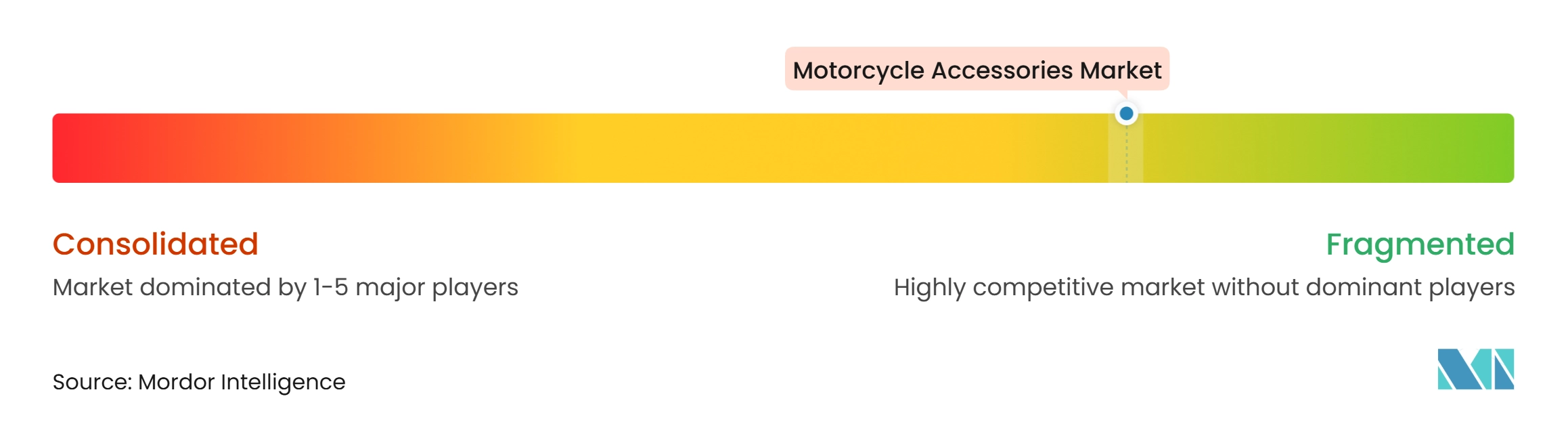
The motorcycle accessories market is fragmented because brands often specialize in protective gear, luggage, communications, performance parts, security equipment, or bodywork rather than every category. Competition depends on product quality, fitment credibility, brand recognition, technical support, and retailer relationships. Riders can assemble equipment from several manufacturers, which limits the influence of any single supplier across the full purchase basket. Alpinestars, Dainese, GIVI, Akrapovič, SHOEI, Sena Technologies, SW-MOTECH, and other recognized companies compete through their product expertise. This structure leaves room for established specialists and focused entrants that meet a clearly defined rider need.
Product development remains a central competitive tool, particularly in communications and connected equipment. Sena has continued to update its communication products for group riding, audio capability, and compatibility with existing rider equipment. These releases show how an electronics supplier can compete through ongoing improvements instead of price alone. SW-MOTECH has also expanded motorcycle-specific luggage and accessory applications, including products for the Royal Enfield Himalayan 450 and additions to its Legend Gear range. Such system-based offerings encourage repeat purchases by making racks, bags, guards, and smaller accessories easier to combine.
Channel partnerships are equally important because riders expect accurate product information, available stock, and reliable delivery when they plan a trip or acquire a motorcycle. Brands need specialty stores, dealers, and online sellers that can answer detailed questions on installation and compatibility. A weak retailer experience can harm a strong product, so distribution support is a material competitive consideration. No supplier yet provides a unified solution across certified protection, communications, navigation, crash awareness, and electric-motorcycle diagnostics, leaving scope for partnerships and improved interoperability. The motorcycle accessories market will favor companies that provide clear compatibility without trapping riders in a difficult or closed system.
Motorcycle Accessories Industry Leaders
-
Alpinestars S.p.A.
-
Dainese S.p.A.
-
GIVI S.r.l.
-
Akrapovič d.d.
-
SHOEI Co., Ltd.
- *Disclaimer: Major Players sorted in no particular order
Motorcycle Accessories Market Companies Covered in this Report
- GIVI S.r.l.
- SW-MOTECH GmbH & Co. KG
- Touratech GmbH
- NAD, S.L.
- Akrapovič d.d.
- Yoshimura Japan Co., Ltd.
- Alpinestars S.p.A.
- Dainese S.p.A.
- REV'IT! Sport International B.V.
- Cardo Systems Ltd.
- Sena Technologies, Inc.
- Garmin Ltd.
- National Cycle, Inc.
- Saddlemen, Inc.
- Oxford Products Ltd.
- R&G Racing Ltd.
- Arai Helmet Co., Ltd.
- SHOEI Co., Ltd.
- Puig Hi-Tech Parts, S.L.
- Hepco & Becker GmbH
Recent Industry Developments in Motorcycle Accessories Market
- October 2026: Quin partnered with Japanese helmet manufacturer Kabuto to bring connected safety capabilities to Kabuto's motorcycle helmet range, starting with the KF-2F.
- August 2026: Vega Auto's AXOR brand launched the MX Carbon, a carbon-fiber off-road helmet weighing about 1,050 grams and certified to ECE 22.06, DOT, and ISI standards.
- August 2026: Sena and BMW Motorrad revealed a co-developed intercom system, integrated into the BMW GS Rallye Carbon helmet, for the 2026 BMW Motorrad International GS Trophy.
- April 2026: Cardo Systems launched the PACKTALK-S and 4X-S communication systems for integration into SHOEI GT-Air 3, NEOTEC 3, and J-Cruise 3 helmets.
- March 2026: Alpinestars launched the Supertech R7 (S-R7) road and track helmet, which uses a carbon, aramid fiber, and fiberglass shell and is ECE 22.06 and DOT certified.
Global Motorcycle Accessories Market Report Scope
The Motorcycle Accessories Market is segmented by Product Type, Motorcycle Type, Sales Channel, Distribution Channel, and Geography. By Product Type, the market is segmented into Protective Gear (Helmets, Jackets, Gloves, Boots), Luggage and Storage (Saddlebags, Top Cases, Tank Bags), Electronics (Navigation, Communication Headsets, Dash Cams), Lighting, Performance Parts (Exhausts, Air Filters), Security (Locks, Alarms), Covers, Mirrors and Grips, and Others. By Motorcycle Type, the market is segmented into Commuter, Sports, Cruiser, Touring/Adventure, Off-Road, Scooters, and Others. By Sales Channel, the market is segmented into OEM/Dealer-Fitted and Aftermarket. By Distribution Channel, the market is segmented into Online, Specialty Stores, Dealerships, and Others. By Geography, the market is segmented into North America (United States, Canada, and Mexico), Europe (Germany, France, Italy, United Kingdom, Spain, Russia, Netherlands, Sweden, Poland, and Rest of Europe), Asia-Pacific (China, Japan, India, Indonesia, Thailand, Vietnam, South Korea, Australia, New Zealand, and Rest of Asia-Pacific), South America (Brazil, Argentina, Colombia, Chile, Peru, and Rest of South America), and Middle East and Africa (Saudi Arabia, United Arab Emirates, Turkey, Israel, South Africa, Egypt, Morocco, Nigeria, and Rest of Middle East and Africa). Market forecasts are provided in terms of Value (USD).
Segmentation Overview
| Protective Gear (Helmets, Jackets, Gloves, Boots) |
| Luggage and Storage (Saddlebags, Top Cases, Tank Bags) |
| Electronics (Navigation, Communication Headsets, Dash Cams) |
| Lighting |
| Performance Parts (Exhausts, Air Filters) |
| Security (Locks, Alarms) |
| Covers |
| Mirrors and Grips |
| Others |
| Commuter |
| Sports |
| Cruiser |
| Touring/Adventure |
| Off-Road |
| Scooters |
| Others |
| OEM/Dealer-Fitted |
| Aftermarket |
| Online |
| Specialty Stores |
| Dealerships |
| Others |
| North America | United States |
| Canada | |
| Mexico | |
| Europe | Germany |
| France | |
| Italy | |
| United Kingdom | |
| Spain | |
| Russia | |
| Netherlands | |
| Sweden | |
| Poland | |
| Rest of Europe | |
| Asia-Pacific | China |
| Japan | |
| India | |
| Indonesia | |
| Thailand | |
| Vietnam | |
| South Korea | |
| Australia | |
| New Zealand | |
| Rest of Asia-Pacific | |
| South America | Brazil |
| Argentina | |
| Colombia | |
| Chile | |
| Peru | |
| Rest of South America | |
| Middle East and Africa | Saudi Arabia |
| United Arab Emirates | |
| Turkey | |
| Israel | |
| South Africa | |
| Egypt | |
| Morocco | |
| Nigeria | |
| Rest of Middle East and Africa |
| By Product Type | Protective Gear (Helmets, Jackets, Gloves, Boots) | |
| Luggage and Storage (Saddlebags, Top Cases, Tank Bags) | ||
| Electronics (Navigation, Communication Headsets, Dash Cams) | ||
| Lighting | ||
| Performance Parts (Exhausts, Air Filters) | ||
| Security (Locks, Alarms) | ||
| Covers | ||
| Mirrors and Grips | ||
| Others | ||
| By Motorcycle Type | Commuter | |
| Sports | ||
| Cruiser | ||
| Touring/Adventure | ||
| Off-Road | ||
| Scooters | ||
| Others | ||
| By Sales Channel | OEM/Dealer-Fitted | |
| Aftermarket | ||
| By Distribution Channel | Online | |
| Specialty Stores | ||
| Dealerships | ||
| Others | ||
| By Geography | North America | United States |
| Canada | ||
| Mexico | ||
| Europe | Germany | |
| France | ||
| Italy | ||
| United Kingdom | ||
| Spain | ||
| Russia | ||
| Netherlands | ||
| Sweden | ||
| Poland | ||
| Rest of Europe | ||
| Asia-Pacific | China | |
| Japan | ||
| India | ||
| Indonesia | ||
| Thailand | ||
| Vietnam | ||
| South Korea | ||
| Australia | ||
| New Zealand | ||
| Rest of Asia-Pacific | ||
| South America | Brazil | |
| Argentina | ||
| Colombia | ||
| Chile | ||
| Peru | ||
| Rest of South America | ||
| Middle East and Africa | Saudi Arabia | |
| United Arab Emirates | ||
| Turkey | ||
| Israel | ||
| South Africa | ||
| Egypt | ||
| Morocco | ||
| Nigeria | ||
| Rest of Middle East and Africa | ||
Key Questions Answered in the Report
What is driving demand for motorcycle accessories?
Safety compliance, connected riding equipment, touring activity, and wider online access are the main factors supporting demand.
Which product category leads motorcycle accessories sales?
Protective gear led with a 29.16% share in 2026, supported by regular safety and replacement needs.
Which product category is expected to grow fastest?
Electronics is forecast to expand at a 12.79% CAGR through 2032 as riders adopt communication, navigation, and connected equipment.
Why do riders use the aftermarket for motorcycle accessories?
The aftermarket offers more choice and lets riders add or upgrade equipment over the life of a motorcycle.