
Morocco Argan Oil Market Size and Share
Market Overview
| Study Period | 2021 - 2031 |
|---|---|
| Forecast Data Period | 2026 - 2031 |
| Base Year Market Size (2025) | USD 95.38 Million |
| Market Size (2026) | USD 100.26 Million |
| Market Size (2031) | USD 120.36 Million |
| Growth Rate (2026 - 2031) | 7.21 % |
| Market Concentration | Medium |
Major Players *Disclaimer: Major Players sorted in no particular order Image © Mordor Intelligence. Reuse requires attribution under CC BY 4.0. | |
Morocco Argan Oil Market Analysis by Mordor Intelligence
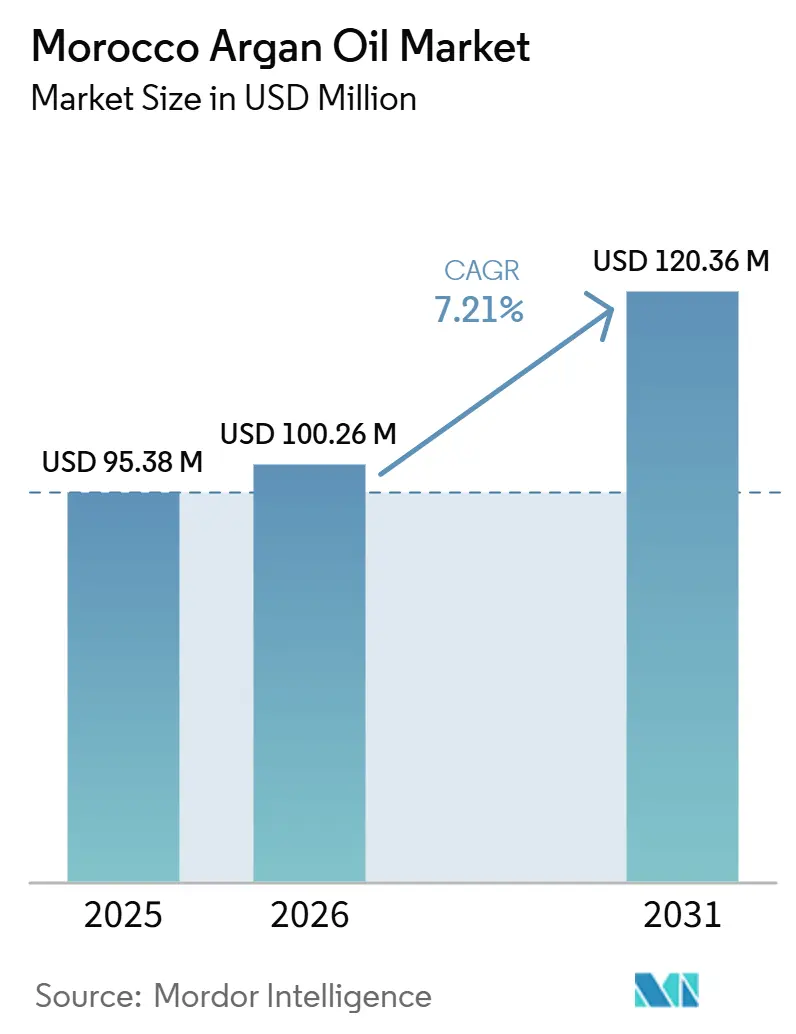
The Morocco Argan Oil Market size is projected to expand from USD 95.38 million in 2025 and USD 100.26 million in 2026 to USD 120.36 million by 2031, registering a CAGR of 7.21% between 2026 to 2031. Demand from cosmetic, food, and nutraceutical buyers supports value growth while available raw material remains constrained. Morocco supplies more than 90% of commercial argan oil globally, giving local processors a strong position in international sourcing chains. Drought, pressure on forests, and unsustainable harvesting have reduced supply and raised the importance of reliable procurement. The Morocco Argan Oil Market is therefore moving toward higher-value certified products and more controlled production systems. China’s duty-free access for Moroccan exports from May 2026 creates a new route for diversification, while Europe remains the core destination
Key Report Takeaways
- By product type, natural argan oil held 74.37% of the Morocco Argan Oil Market share in 2025, while organic argan oil is forecast to grow at an 8.43% CAGR through 2031.
- By form, absolute argan oil held 45.36% of the Morocco Argan Oil Market share in 2025, while blended argan oil is forecast to grow at an 8.22% CAGR through 2031.
- By application, cosmetics and personal care held 42.17% of the Morocco Argan Oil Market size in 2025, while food and beverages is forecast to grow at an 8.51% CAGR through 2031.
Note: Market size and forecast figures in this report are generated using Mordor Intelligence’s proprietary estimation framework, updated with the latest available data and insights as of January 2026.
Morocco Argan Oil Market Trends and Insights
Drivers Impact Analysis*
| Driver | (~) % Impact on CAGR Forecasts | Geographic Relevace | Impact Timeline |
|---|---|---|---|
| Rising Demand for Natural and Organic Cosmetic Ingredients | +1.8% | Global; strongest pull from EU and North America | Medium term (2-4 years) |
| Strong Export Demand from International Cosmetic Manufacturers | +1.3% | EU (France 60% of exports), North America, Middle East | Short term (≤ 2 years) |
| Growing Consumer Preference for Clean Label and Sustainable Ingredients | +0.9% | EU, North America; spillover to APAC and GCC | Medium term (2-4 years) |
| Government Support for Argan Forest Conservation and Rural Cooperatives | +0.7% | Morocco national; focus on Souss-Massa, Marrakech-Safi | Long term (≥ 4 years) |
| Rising Demand from Nutraceutical and Functional Food Industries | +0.7% | Global; early gains in North America and Western Europe | Medium term (2-4 years) |
| Increasing Certifications Enhancing Market Access | +0.5% | EU and US primary markets; spillover to GCC and APAC | Short to medium term |
| Source: Mordor Intelligence | |||
Rising Demand for Natural and Organic Cosmetic Ingredients
Natural and organic standards have become a purchasing requirement for many cosmetic buyers in Europe and North America. The Morocco Argan Oil Market benefits because argan oil can meet organic and traceability requirements used by premium skin care and hair care brands. ECOCERT certification, EU Organic Regulation 2018/848, and COSMOS Organic recognition support access to regulated cosmetic supply chains. These requirements make documented sourcing more important than basic commodity availability. Regulation (EU) 2025/877 added further CMR substance restrictions to the EU cosmetics framework in 2025, reinforcing attention to ingredient documentation and compliant formulations[1]Source: European Commission, “Commission Regulation (EU) 2025/877,” EUR-Lex, eur-lex.europa.eu. Moroccan suppliers that can provide consistent quality records and certification are better placed to serve these accounts. The Morocco Argan Oil Market also benefits when buyers seek plant-derived ingredients that can be traced to a defined origin.
Strong Export Demand From International Cosmetic Manufacturers
International cosmetic manufacturers use Moroccan argan oil in premium skin care and hair care products. This demand can support purchasing even when raw material costs increase because the ingredient is used in premium product lines. AP News reported that rising demand has placed pressure on Morocco’s rural economy and argan forests, showing the connection between export demand and local supply conditions. Europe remains the largest export destination, with France identified in the supplied research as a major buyer. China’s tariff-free treatment for products from 53 African countries took effect on May 1, 2026, and runs through April 2028[2]Source: Morocco World News, “Morocco’s Argan Oil Industry Targets China’s New Zero-Tariff Market,” Morocco World News, moroccoworldnews.com. The policy gives the Morocco Argan Oil Market an additional option beyond European demand cycles. Exporters must still establish local distribution and meet the quality requirements of Chinese personal care buyers.
Growing Consumer Preference for Clean Label and Sustainable Ingredients
Consumer interest in ingredient origin, traceability, and sustainability shapes procurement decisions in personal care. Argan oil has a defined Moroccan origin and is closely associated with rural cooperatives, which makes its sourcing story important for brands. The Morocco Argan Oil Market can use this identity where customers require information on ingredient origin and social sourcing practices. The Cooperative News reported that Morocco’s cooperative sector has been involved in a national plan for preserving argan trees and improving cooperative practices. This approach connects forest protection with the continuity of cooperative supply. It also increases the importance of credible verification because buyers need to distinguish authentic Moroccan oil from poorly documented material. Sustainability claims are most useful when they are supported by harvest, processing, and certification records.
Government Support for Argan Forest Conservation and Rural Cooperatives
Morocco’s Génération Green strategy targets 50,000 additional hectares of argan trees by 2030. The DARED project is funded at USD 49.2 million and targets 10,000 hectares of irrigated argan orchards across Souss-Massa, Marrakech-Safi, and Guelmim-Oued Noun. The program is expected to benefit 26,000 farmers under ANDZOA oversight. Irrigated orchards could reduce exposure to rainfall variability and create a more predictable supply base over time. The Cooperative News reported that Morocco’s Office of Cooperation Development adopted an action plan covering harvesting practices, cooperative consolidation, and modern extraction technology. Storage support planned for cooperatives can also help smaller producers retain stock and negotiate with aggregators AP NEWS. These measures matter to the Morocco Argan Oil Market because supply reliability affects long-term contracts with cosmetic and food buyers.
Restraints Impact Analysis*
| Restraint | (~) % Impact on CAGR Forecasts | Geographic Relevance | Impact Timeline |
|---|---|---|---|
| Limited Geographic Availability of Argan Trees | -1.5% | Global supply constraint; origin in Morocco's Souss-Massa belt | Long term (≥ 4 years) |
| Counterfeit and Adulterated Argan Oil in International Markets | -0.8% | EU, North America, GCC – key importing markets | Medium term (2-4 years) |
| Competition from Alternative Botanical Oils | -0.6% | Global; higher substitution risk in APAC and emerging markets | Medium term (2-4 years) |
| Strict International Regulatory and Certification Requirements | -0.4% | EU, US, GCC – requires ECOCERT, USDA NOP, ONSSA alignment | Short to medium term |
| Source: Mordor Intelligence | |||
Limited Geographic Availability of Argan Trees
The argan tree, Argania spinosa, is native to Morocco’s southwestern biosphere reserve. AP News reported that the productive argan forest had contracted by an estimated 40% from its early-2000s extent. Drought, overgrazing, and unsustainable fruit collection have reduced yields and limited the ability of supply to respond quickly to new demand. Newly planted trees require 7 to 10 years before reaching commercial production, so current planting programs cannot immediately resolve shortages. Smaller cooperatives often compete with industrial buyers for fruit, which can weaken their access to raw material. This places upward pressure on procurement risk across the Morocco Argan Oil Market. Competition from alternative botanical oils can become more relevant when argan oil is unavailable or does not meet a buyer’s cost requirement.
Counterfeit and Adulterated Argan Oil in International Markets
Pure argan oil retailing above USD 300 per liter creates an incentive to dilute it with less expensive oils. A 2025 study in Chemosensors used ATR-FTIR spectroscopy and modeling to quantify avocado, flaxseed, pumpkin seed, and walnut oil adulterants in argan oil. A separate 2025 Food Control study found that portable Raman spectrophotometers could quantify adulteration at levels as low as 5%. These tools can support screening by buyers and border authorities. Counterfeiting damages trust in authentic producers because consumers may not distinguish genuine oil from diluted products. Certification and regulatory requirements also raise costs for smaller processors, though they remain necessary for access to premium markets. Consistent enforcement and batch authentication are therefore important for the Morocco Argan Oil Market.
*Our forecasts treat driver/restraint impacts as directional, not additive. The impact forecasts reflect baseline growth, mix effects, and variable interactions.
Segment Analysis
By Product Type: Natural Volumes Dominate While Organic Reshapes Value Mix
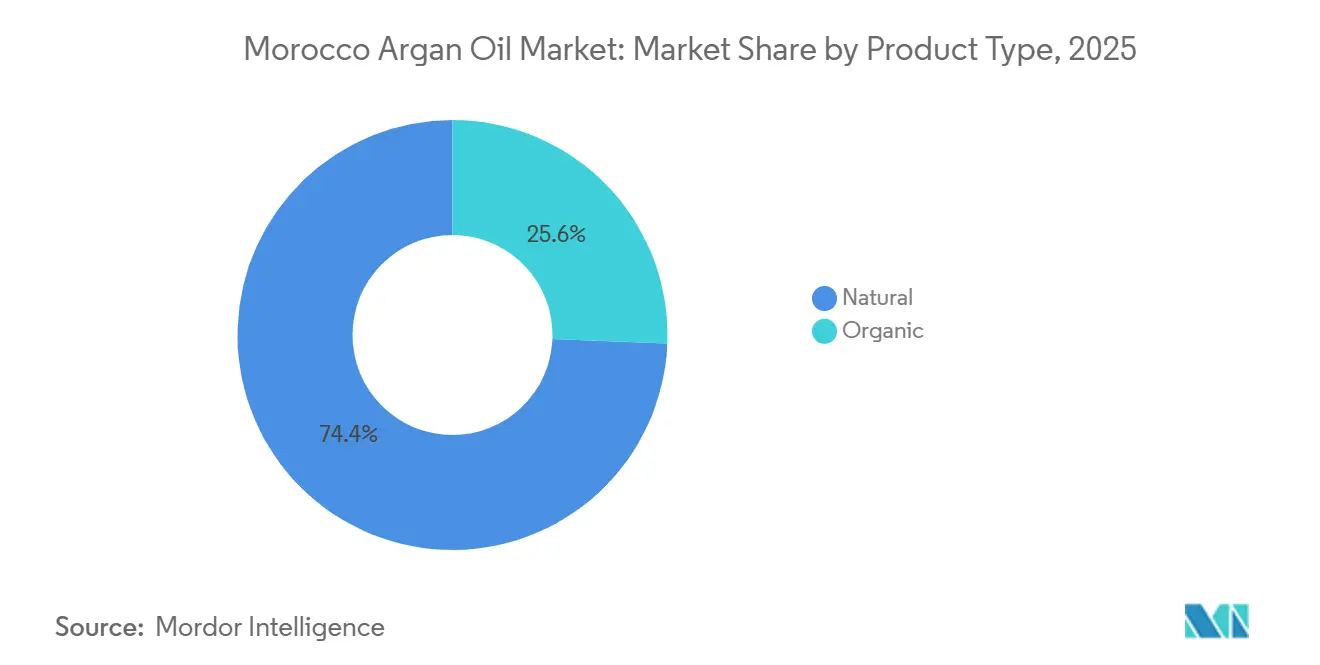
Natural argan oil held 74.37% of the product type segment in 2025. This leading position reflects the use of conventionally cold-pressed oil in bulk business-to-business supply for European cosmetic manufacturers. Natural oil serves established formulas where reliable availability and familiar processing specifications are important. It remains the main volume base for processors supplying skin care, hair care, and broader personal care applications. The Morocco Argan Oil Market industry continues to rely on this segment because conventional oil is central to large-scale export channels. Natural oil also provides a more accessible entry point for buyers that do not require organic certification. Its large base means that changes in procurement conditions can affect total sector revenue.
Organic argan oil is forecast to expand at an 8.43% CAGR through 2031. The segment benefits from demand among prestige and masstige cosmetic brands that require ECOCERT or COSMOS Organic-compliant ingredients. EU Organic Regulation 2018/848 and related certification documentation help buyers verify relevant sourcing practices. Organic products are lower in volume but can support stronger value realization when certification is accepted by international customers. The Morocco Argan Oil Market has an opportunity to expand certified supply where processors can maintain audit records and traceable sourcing. Smaller cooperatives can use wild-harvest certification to differentiate their supply, although continuous third-party audits can be difficult to fund. The segment is therefore divided between a high-volume natural tier and a lower-volume organic tier with stronger certification requirements.


By Form: Absolute Oil Anchors Volumes as Blends Unlock Formulator Demand
Absolute argan oil held 45.36% of the form segment in 2025. Its position reflects continued use in established cosmetic formulas that require a single-ingredient declaration. Absolute oil is suitable for buyers that want direct control over the final formula and ingredient list. It is also relevant in applications requiring a standardized oil profile. Concentrate formats serve pharmaceutical and high-performance dermocosmetic uses where a higher density of active compounds is needed. These formats remain important for applications that depend on controlled tocopherol and oleic acid characteristics. The Morocco Argan Oil Market industry uses absolute formats as a practical base for traditional cosmetic, supplement, and specialized product development.
Blended argan oil is forecast to grow at an 8.22% CAGR through 2031. Brands use blends with complementary ingredients such as jojoba, rosehip, or squalane to create multi-ingredient personal care products. Ready-to-use blends can reduce formulation time and simplify sourcing for smaller brands. They can also meet demand for facial oils and hair care products that combine several botanical ingredients. Growth in blends does not translate directly into the same increase in pure argan oil volume because each finished blend contains less argan oil. This can moderate raw material pressure even while value from blended products rises. Processors with private-label, export documentation, and cold-pressing capabilities are better positioned to serve this part of the Morocco Argan Oil Market. Traceable secondary ingredients remain necessary when blended products are sold into regulated markets.
By Application: Cosmetics and Personal Care Anchors Demand While Food and Beverages Gains Pace
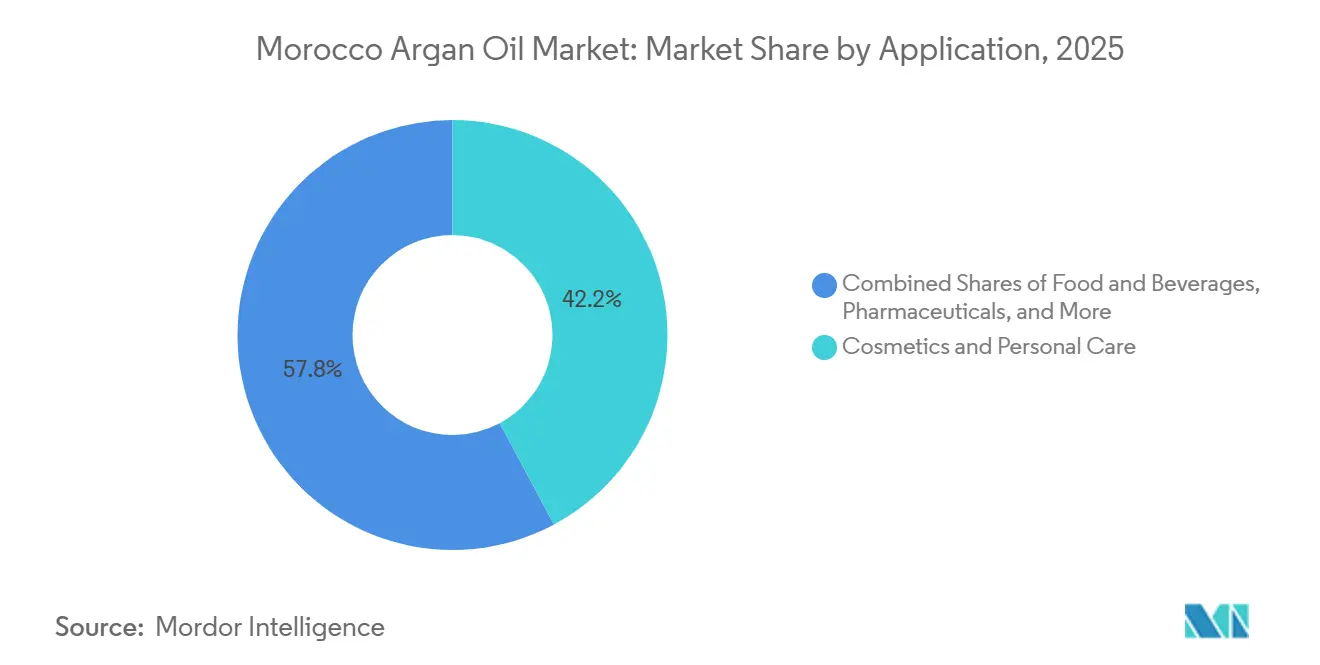
Cosmetics and personal care held 42.17% of the application segment in 2025. Skin care, hair care, and nail treatment makers use argan oil in premium product ranges. AP News described the international demand that has contributed to pressure on Morocco’s argan forests and rural supply chain. Cosmetic applications remain central because argan oil is recognized by formulators as a premium botanical ingredient. The segment also draws on established export links with European brands and private-label manufacturers. The Morocco Argan Oil Market size for cosmetic use remains closely tied to product quality, traceability, and reliable certification. Pharmaceuticals and dietary supplements form the next important group of applications, supported by research on the oil’s bioactive composition.
Food and beverages are forecast to expand at an 8.51% CAGR through 2031. Gourmet culinary oils, functional foods, and nutraceutical products are driving demand for edible-grade argan oil. A 2025 article indexed by the National Center for Biotechnology Information discussed argan oil as a bioactive lipid relevant to oxidative stress and inflammation[3]Source: National Center for Biotechnology Information, “Argan Oil: A Natural Bioactive Lipid Modulating Oxidative Stress and Inflammation,” PubMed Central, pmc.ncbi.nlm.nih.gov. The supplied research also identifies its tocopherols, polyphenols, and phytosterols as factors supporting food and supplement interest. Argan oil is used as a premium finishing oil in gourmet retail and as an ingredient in dietary supplements. Food-grade documentation and appropriate quality control are necessary because food buyers face different requirements from cosmetic buyers. Other applications remain smaller but support domestic and regional uses where argan oil has traditional multipurpose relevance. This diversification gives the Morocco Argan Oil Market a route to expand beyond personal care demand.

Geography Analysis
Europe absorbs close to 80% of Morocco’s argan oil exports, according to the supplied research, making it the main demand center. France accounts for close to 60% of Morocco’s shipments in the same research base. The region’s Morocco Argan Oil Market share is supported by cosmetic formulators and private-label producers in France, Germany, the Netherlands, and Spain. These buyers source the oil for prestige skin care and hair care products. Germany and the Netherlands operate as secondary re-export and repackaging hubs for European distribution. Spain and Portugal also offer demand through proximity and established trade links with Morocco. European buyers increasingly require certification, traceability, and documentation, which favors processors with established compliance systems.
North America, led by the United States, is the second-largest end market in the supplied research. Demand comes from specialty retail, luxury personal care, and buyers seeking USDA NOP-certified material. The Centre for the Promotion of Imports from developing countries reported increased consumer interest in natural ingredients used in makeup. The U.S.-EU organic equivalency arrangement can simplify compliance for Moroccan exporters that already hold relevant EU organic credentials. The Middle East and North Africa is both a domestic and near-export opportunity for the Morocco Argan Oil Market. Morocco’s domestic price reached MAD 600 per liter in 2025, equivalent to USD 60, which can restrict local consumption and move more supply to premium export channels. GCC buyers remain active for cosmetic-grade Moroccan argan oil.
China is the most important emerging export opportunity described in the supplied research. China-Africa trade reached USD 94.56 billion in the first quarter of 2026, up 23.7% year over year. China’s policy removes import duties on Moroccan argan oil through April 2028. This creates a defined two-year window for exporters to build distribution relationships and brand recognition. Domestic Chinese cosmetic brands are increasingly using heritage botanical ingredients in premium formulations. Argan oil can meet that interest when it is supported by clear scientific and sourcing documentation. The Morocco Argan Oil Market will need local market development and reliable export documentation to turn tariff access into sustained demand.
Competitive Landscape
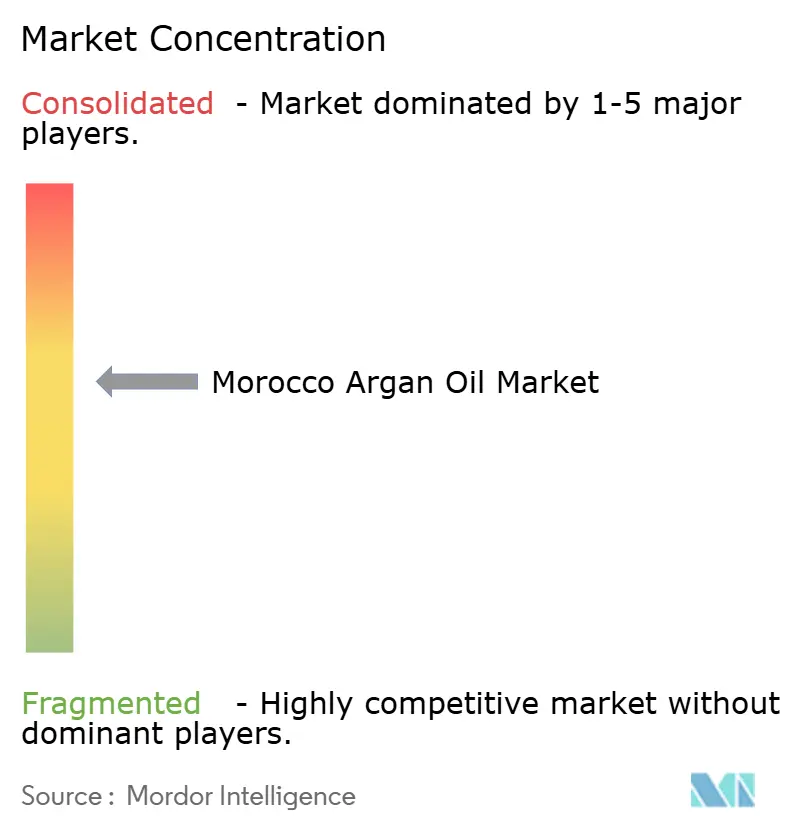
The Morocco Argan Oil Market is moderately concentrated, with 5 large industrial exporters and major cooperative unions accounting for the bulk of formal export volumes in the supplied research. AP News reported that one leading industrial exporter held close to 70% of export activity. This structure can create dependency for international buyers and reduce price negotiation options for smaller source cooperatives. At the same time, Morocco has 1,014 argan cooperatives, including 688 women-led cooperatives, according to the supplied research. The Cooperative News described government efforts to strengthen cooperative practices and preserve argan resources. Raw material scarcity makes it harder for smaller cooperatives to secure fruit when industrial buyers can pay more.
Leading suppliers are building their position through certification, vertical integration, and geographic diversification. Certification across ECOCERT, COSMOS Organic, USDA NOP, and ONSSA requirements can improve access to premium accounts. Some processors are extending into private-label packaging and blended carrier oils to capture more value beyond bulk exports. Export diversification toward China is another strategic move following the May 2026 tariff change. Cooperative aggregators can also compete for larger contracts by pooling output from several women-led cooperatives under common certification. This model helps them address the volume requirements that individual cooperatives may not meet. It also aligns with buyer interest in traceable and community-based sourcing.
Authentication technology is becoming more relevant to premium supply relationships. The 2025 Chemosensors study showed how FTIR-based methods can identify and quantify multiple oil adulterants. The 2025 Food Control research demonstrated the use of portable Raman equipment for screening adulteration. These methods give processors and buyers practical tools to support authenticity claims. Blockchain-enabled traceability was identified in the supplied research as an emerging lot-level capability for premium contracts. Opportunities remain for suppliers serving mid-sized buyers that need certified and traceable material below the minimum order volumes of large exporters. Food-grade documentation also offers room for suppliers that can meet the relevant quality and safety requirements.
Morocco Argan Oil Industry Leaders
Arganisme Organics
BioProGreen Morocco
Zineglob Ltd.
Groupe Oleavea
Arganfarm Sarl
- *Disclaimer: Major Players sorted in no particular order

Recent Industry Developments
- May 2026: China’s zero-tariff policy for 53 African countries takes effect on May 1, eliminating import duties on Moroccan argan oil exports to China through April 2028. Morocco, holding over 90% of global commercial argan oil supply, is among the principal African beneficiaries. China-Africa trade reached USD 94.56 billion in Q1 2026, a 23.7% year-on-year increase, providing strong baseline trade momentum for argan oil’s entry into Chinese cosmetic supply chains.


Morocco Argan Oil Market Report Scope
| Natural |
| Organic |
| Absolute |
| Blend |
| Concentrate |
| Food and Beverages |
| Cosmetics and Personal Care |
| Pharmaceuticals |
| Dietary Supplements |
| Other Applications |
| Product Type | Natural |
| Organic | |
| Form | Absolute |
| Blend | |
| Concentrate | |
| Application | Food and Beverages |
| Cosmetics and Personal Care | |
| Pharmaceuticals | |
| Dietary Supplements | |
| Other Applications |


Key Questions Answered in the Report
What is the forecast growth rate for Morocco argan oil through 2031?
The sector is projected to grow at a 7.21% CAGR from 2026 to 2031, reaching USD 120.36 million by 2031.
Which product type leads demand for Moroccan argan oil?
Natural argan oil led with 74.37% of the product type segment in 2025, supported by bulk cosmetic supply.
Why is Europe important for Moroccan argan oil exporters?
Europe absorbs close to 80% of Moroccan argan oil exports in the supplied research and remains a central base for cosmetic formulators.
What risks affect authentic argan oil supply?
Forest contraction, drought, raw material scarcity, and adulteration can affect supply reliability and buyer confidence.
Page last updated on:





