
Moisturizing Cream Market Size and Share
Market Overview
| Study Period | 2022 - 2032 |
|---|---|
| Market Size (2027) | USD 8.14 Billion |
| Market Size (2032) | USD 121.44 Billion |
| Growth Rate (2027 - 2032) | 7.11 % |
| Fastest Growing Market | South America |
| Largest Market | Asia-Pacific |
| Market Concentration | Low |
Major Players *Disclaimer: Major Players sorted in no particular order Image © Mordor Intelligence. Reuse requires attribution under CC BY 4.0. | |
Moisturizing Cream Market Analysis by Mordor Intelligence
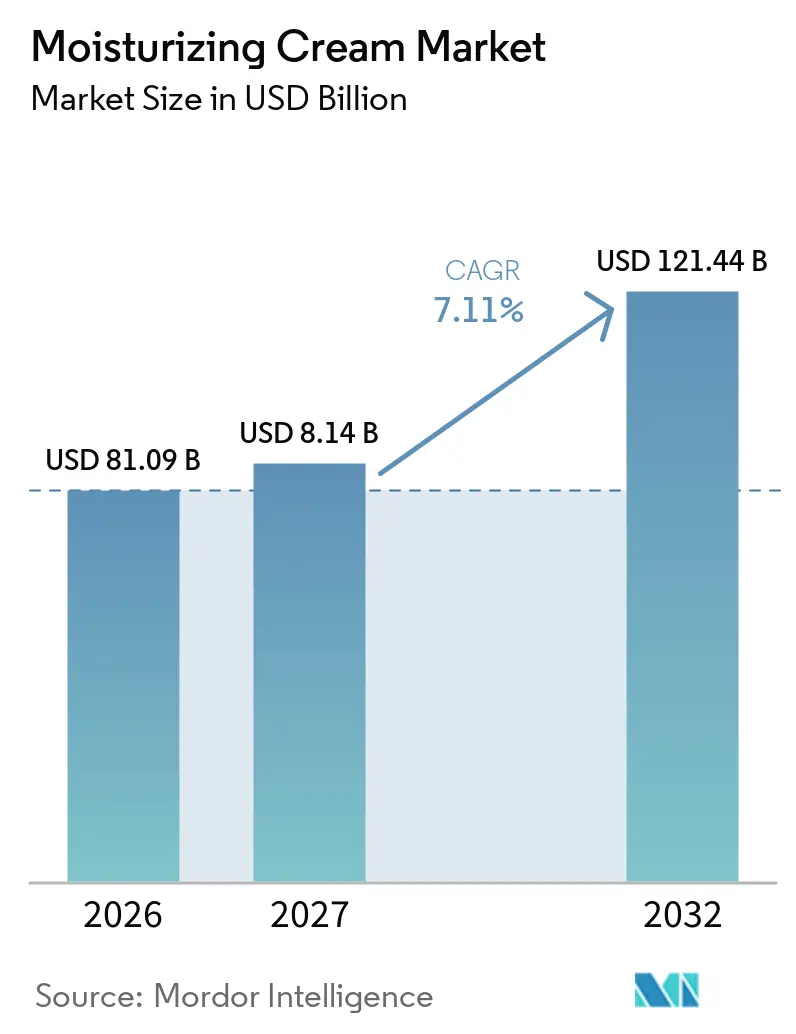
The moisturizing cream market is projected to grow from USD 81.09 billion in 2026 to USD 86.14 billion in 2027, reaching USD 121.44 billion by 2032, at a CAGR of 7.11% from 2027 to 2032. Demand is increasing for creams that provide hydration, support skin barrier repair, and offer ingredient transparency, particularly those containing ceramides and hyaluronic acid. Premiumization is also expanding as consumers seek clinically supported products with clear benefits. However, regulatory requirements and counterfeit products may increase costs and erode consumer trust in the Moisturizing Cream Market.
Key Report Takeaways
- By product type, day creams accounted for 87.80% of the Moisturizing Cream Market share in 2026, while night creams are forecast to grow at a 7.15% CAGR through 2032.
- By formulation, conventional products held 70.23% of the Moisturizing Cream Market share in 2026, while natural and organic products are projected to expand at an 8.76% CAGR through 2032.
- By category, mass products accounted for 71.19% of the Moisturizing Cream Market size in 2026, while premium products are expected to grow at an 8.43% CAGR through 2032.
- By distribution channel, beauty and health stores held 48.34% of the Moisturizing Cream Market share in 2026, while online retail stores are forecast to grow at a 9.65% CAGR through 2032.
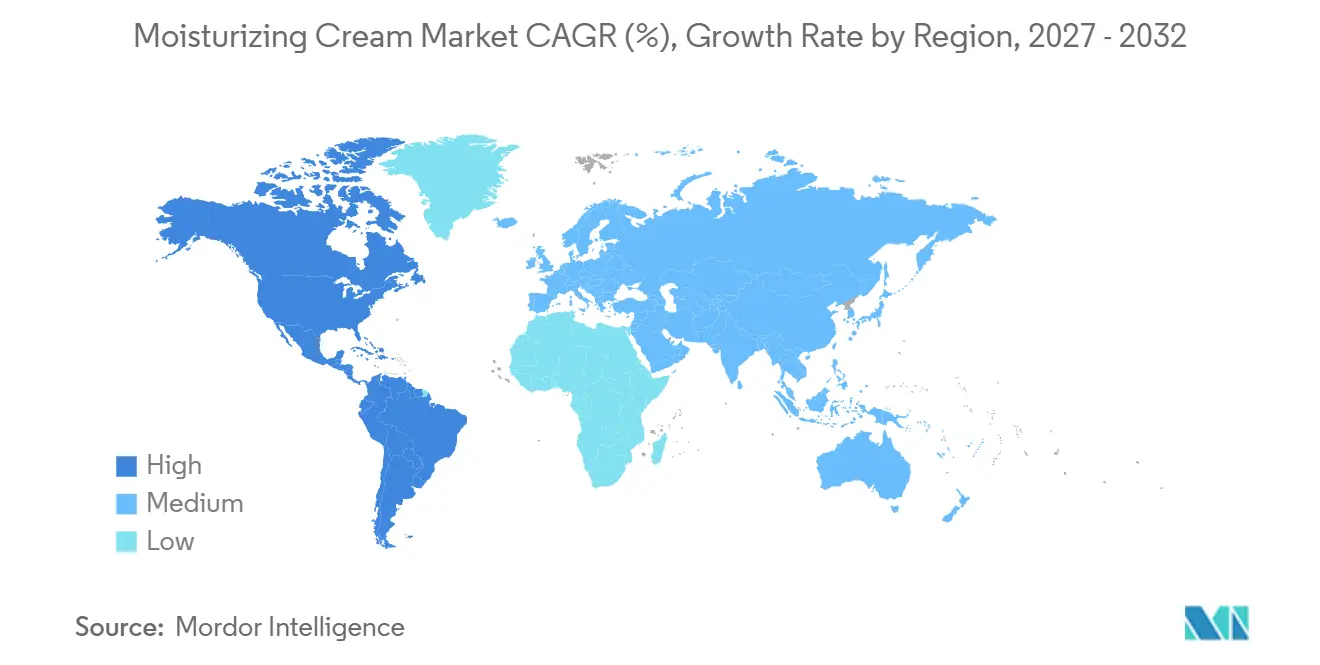
- By geography, Asia-Pacific accounted for 36.43% of the Moisturizing Cream Market size in 2026, while South America is forecast to expand at a 9.16% CAGR through 2032.
Note: Market numbers in this report are based on Mordor Intelligence's proprietary estimation framework, which combines nine months of actuals with Q4 projections for base year 2026.
Market Trends and Insights
Drivers Impact Analysis of Moisturizing Cream Market*
| Driver | (~) % Impact on CAGR Forecast | Geographic Relevance | Impact Timeline |
|---|---|---|---|
| Growing Emphasis for Skin Hydration and Skin-Barrier Repair | +1.8% | Global | Short term (≤ 2 years) |
| Increasing Consumer Focus on Ingredient Transparency and Clinically Supported Skincare | +1.4% | North America and Europe, extending to Asia-Pacific | Medium term (2-4 years) |
| Rising Consumer Preference for Natural, Vegan, and Clean-Label Formulations | +1.1% | Global, led by Asia-Pacific | Medium term (2-4 years) |
| Increasing Demand for Multifunctional Moisturizing Creams | +1.3% | North America and Europe, emerging in Asia-Pacific | Medium term (2-4 years) |
| Growing demand for advanced skin-compatible formulations | +0.7% | Asia-Pacific, extending to North America | Long term (≥ 4 years) |
| Increasing need for climate- and season-specific moisturizing solutions | +0.5% | Asia-Pacific, Middle East and Africa, and South America | Medium term (2-4 years) |
| Source: Mordor Intelligence | |||
Growing Emphasis for Skin Hydration and Skin-Barrier Repair
The growing emphasis on skin hydration and barrier protection is driving innovation in moisturizing cream formulations. For instance, in May 2026, a randomized 28-day clinical trial involving 35 participants with dry skin reported a 74.1% increase in measured skin hydration and a 14.1% reduction in transepidermal water loss after participants applied a topical emollient containing panthenol, niacinamide, and dipotassium glycyrrhizate twice daily [1]. This clinical evidence highlights the potential of barrier-supporting formulations and reinforces the importance of hydration efficacy in product development.
Increasing Consumer Focus on Ingredient Transparency and Clinically Supported Skincare
An increasing emphasis on ingredient transparency and substantiated product claims highlights the importance of accurate skincare information. For instance, in June 2026, the United States Food and Drug Administration (FDA) reported 16,398 active cosmetic product facility registrations and 1,298,361 active cosmetic product listings under the Modernization of Cosmetics Regulation Act (MoCRA) [2]. The framework requires applicable manufacturers and processors to register their facilities, while responsible persons must list marketed cosmetic products and their ingredients and update product listings annually.
Rising Consumer Preference for Natural, Vegan, and Clean-Label Formulations
Rising consumer interest in naturally derived ingredients and transparent formulations is encouraging manufacturers to expand their natural and organic skincare portfolios. For instance, in March 2025, the National Sanitation Foundation (NSF) reported that 74% of surveyed United States consumers considered organic ingredients important in personal care products, underscoring the role of ingredient origin and formulation transparency in purchasing decisions [3]. This preference creates opportunities for moisturizing creams formulated with plant-derived ingredients, organic claims, and clearly disclosed ingredient lists.
Increasing Demand for Multifunctional Moisturizing Creams
Consumers increasingly prefer multifunctional moisturizing creams that simplify skincare routines while providing multiple benefits. For instance, in February 2025, Olay launched Super Cream with SPF 30, combining hydration, antioxidant, anti-aging, and sun-protection benefits in a single formulation. The company is also expected to update its Regenerist Micro-Sculpting Cream in January 2026 with a Triple Collagen Peptide complex. These developments demonstrate how multifunctional formulations can strengthen product differentiation and consumer appeal by addressing multiple skincare needs through a single product.
Restraints Impact Analysis of Moisturizing Cream Market*
| Restraint | (~) % Impact on CAGR Forecast | Geographic Relevance | Impact Timeline |
|---|---|---|---|
| Ingredient Safety and Claim-Substantiation Requirements | -0.8% | Europe and North America | Medium term (2-4 years) |
| Counterfeit and Grey-Market Product Proliferation | -0.6% | Global, strongest in Asia-Pacific and online channels | Short term (≤ 2 years) |
| Sensitive and Biologically Derived Ingredient Stability | -0.4% | Global | Medium term (2-4 years) |
| Packaging Compliance and Refillable-Format Cost Pressure | -0.3% | Europe and North America | Medium term (2-4 years) |
| Source: Mordor Intelligence | |||
Ingredient Safety and Claim-Substantiation Requirements
Stringent safety, regulatory, and product-claim requirements can increase development costs and extend time-to-market for moisturizer manufacturers. Compliance with product safety assessments, ingredient restrictions, labeling standards, and adverse event reporting requires extensive documentation and regulatory expertise. These challenges are particularly significant for formulations containing complex active ingredients or botanical blends, as well as for mid-sized brands with limited compliance resources.
Counterfeit and Grey-Market Product Proliferation
Counterfeit products challenge consumer trust, brand reputation, and pricing integrity in the moisturizing cream market. Unauthorized products sold through online platforms may raise safety concerns because of uncertain ingredient quality, manufacturing standards, and product authenticity. These products can also divert sales from legitimate manufacturers and reduce consumer confidence in established brands. Consequently, manufacturers are increasingly prioritizing product authentication technologies, authorized seller networks, and collaboration with e-commerce platforms to protect brand credibility and market position.
*Our forecasts treat driver/restraint impacts as directional, not additive. The impact forecasts reflect baseline growth, mix effects, and variable interactions.
Moisturizing Cream Market Segment Analysis
By Product Type:
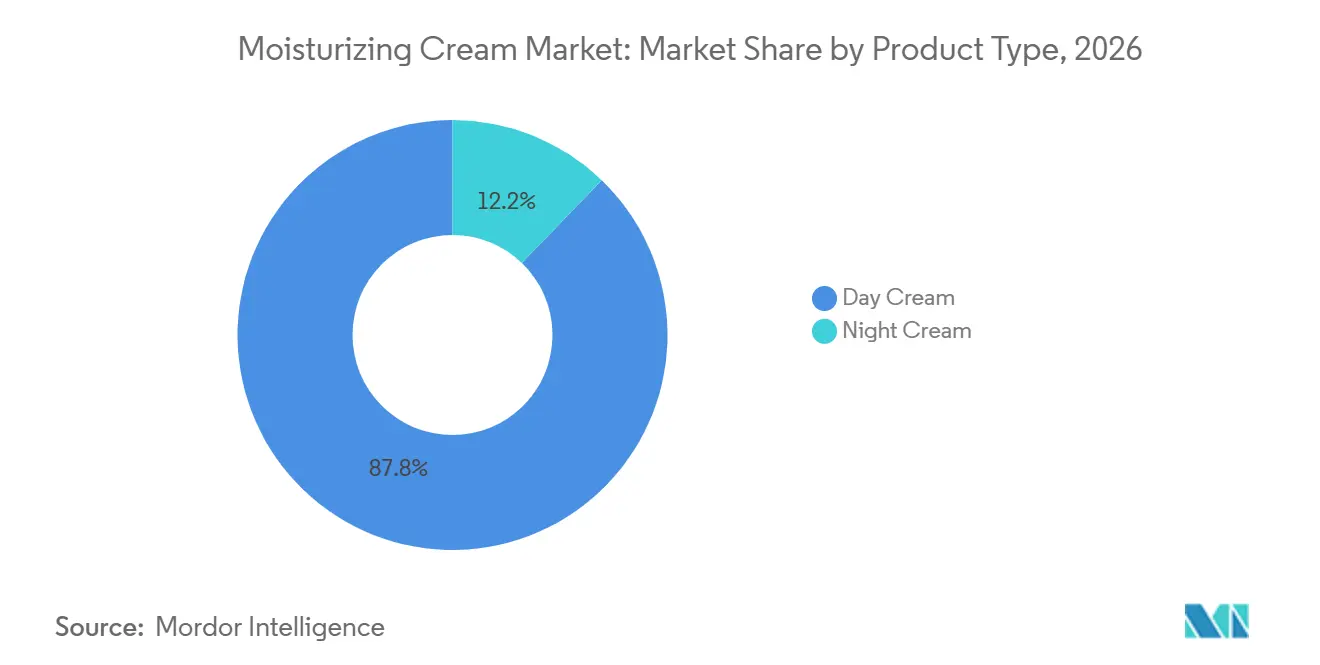
Day Creams Hold Scale While Night Creams Gain Through Repair-Focused RoutinesDay creams accounted for 87.80% of the moisturizing cream market in 2026. Their significant share reflects their role in morning skincare routines, where consumers seek hydration, sun protection, antioxidant support, and anti-aging benefits in a single product. Manufacturers have reformulated leading products with ingredients such as collagen peptides, encapsulated retinoids, and multi-molecular hyaluronic acid. These innovations have enabled broader price positioning, ranging from accessible mass-market products to premium launches. Day creams also appeal to consumers seeking a convenient, all-in-one moisturizer for daily use.
Night creams are projected to grow at a CAGR of 7.15% through 2032. Evening application enables the use of richer formulations and higher concentrations of active ingredients, including retinol and niacinamide. These products support overnight hydration, skin barrier maintenance, and skin repair, aligning with structured AM and PM skincare routines. Dermatologists and specialist retail staff also guide consumers with hydration and skin barrier concerns toward routine-based product selection. Consequently, night creams present significant opportunities in repair-focused and premium skincare applications.
By Formulation:
Conventional Products Support Volume While Natural and Organic Products Lead GrowthConventional products accounted for 70.23% of the moisturizing cream market share in 2026. Cost-efficient formulations, familiar ingredients, and broad availability across high-volume retail channels support their leading position. These products remain particularly important in price-sensitive markets and replenishment-driven categories. Established supply chains enable large brands to offer multiple formats and pack sizes at accessible price points. Conventional formulations also allow manufacturers to scale distribution through supermarkets, pharmacies, and online marketplaces. Consequently, conventional products are expected to remain significant despite growing consumer interest in clean-label products.
Natural and organic moisturizing creams are projected to grow at an 8.76% CAGR through 2032, supported by specialty retail, direct-to-consumer channels, and dermatologist-led brands emphasizing botanical ingredients and transparent product information. Certification systems such as NATRUE establish requirements for natural and organic cosmetics through third-party assessment. However, regulatory scrutiny of complex natural ingredients may pose challenges for smaller specialists with limited toxicology and regulatory resources. Larger companies may benefit from their ability to manage documentation, ingredient screening, and alternative sourcing.
By Category:
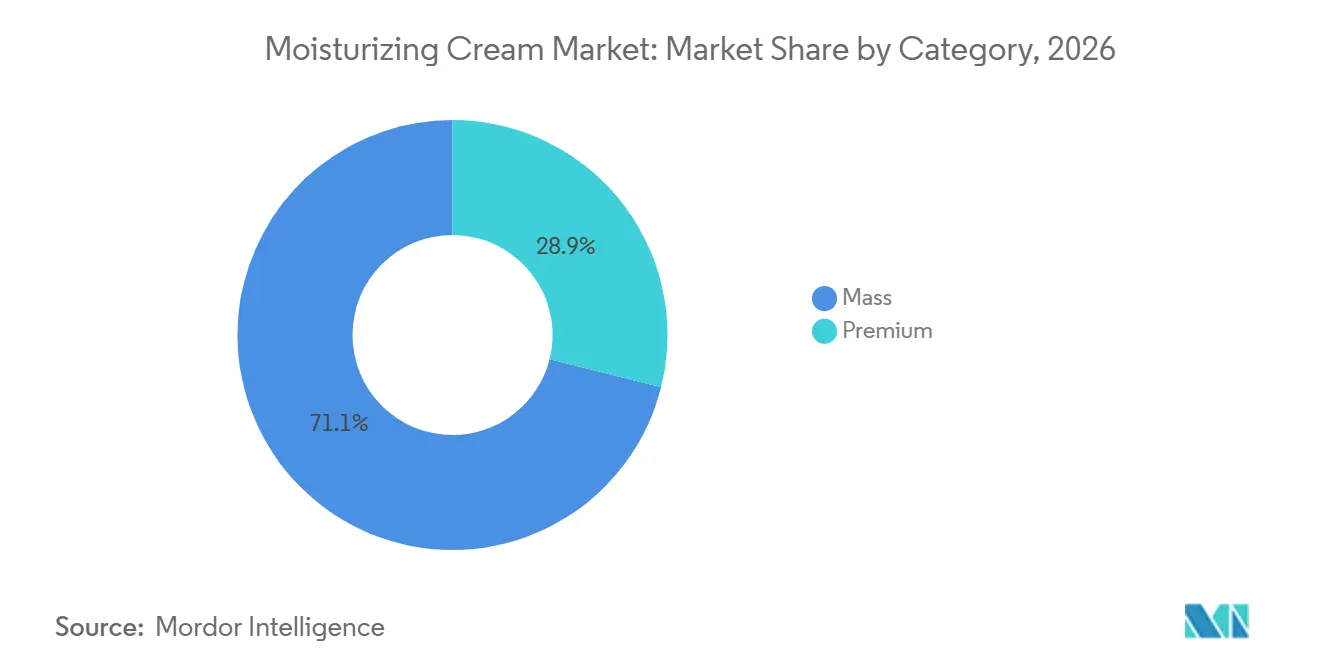
Mass Products Maintain Broad Reach While Premium Products Raise Value per UnitMass products accounted for 71.19% of the moisturizing cream market in 2026. Strong demand in emerging economies and accessible pricing across supermarkets, pharmacies, and mass beauty retailers support their market position. High-volume purchasing also benefits established brands that consumers rely on for everyday hydration needs. Mass products continue to generate consistent replenishment demand, particularly in body care and family care applications. Manufacturers are increasingly incorporating claims previously associated with premium products, including barrier care, hyaluronic acid, and vitamin-based benefits.
Premium products are projected to grow at a CAGR of 8.43% through 2032, driven by increasing consumer demand for clinically validated formulations, dermatologist endorsements, and targeted active ingredients. Companies are strengthening their premium beauty and skincare portfolios through capacity expansions and product innovation. Brands that offer proven efficacy, differentiated formulations, and specialized skincare benefits are well-positioned to capitalize on growing consumer interest in premium products across price segments.
By Distribution Channel:
Beauty and Health Stores Lead While Online Retail Changes Discovery and AccessBeauty and health stores accounted for 48.34% of the moisturizing cream market share in 2026. These stores remain important as they allow consumers to test product textures, compare offerings, and receive staff guidance before making purchase decisions. The channel is particularly relevant for premium, dermatological, and sensitive-skin products, where reassurance can significantly influence purchasing decisions. Curated product assortments also enable shoppers to compare ingredient claims in a trusted retail environment. Specialist stores can facilitate new product education more effectively than general retailers.
Online retail stores are forecast to grow at a CAGR of 9.65% through 2032, driven by consumers’ increasing use of online search, ingredient information, product ratings, and social commerce to evaluate skincare products. Brands are expanding their digital presence alongside physical retail channels to improve product accessibility and consumer engagement. Clear formulation information, effective customer support, and verified sellers can increase consumer confidence in online purchases. Meanwhile, supermarkets, hypermarkets, pharmacies, direct selling channels, and professional dispensaries continue to address complementary consumer needs.
Geography Analysis
APAC and South America Moisturizing Cream Market
Asia-Pacific accounted for 36.43% of the moisturizing cream market in 2026, supported by large consumer populations, established multi-step skincare routines, and growing interest in preventive skincare across China, South Korea, India, and Southeast Asia. Companies are expanding their regional presence through derma beauty brands, skincare innovation, and international market expansion. South America is projected to grow at a CAGR of 9.16% through 2032, driven by demand for facial care, sun protection, and body care products. Brazil remains a key beauty and personal care market in the region.
Europe and North America Moisturizing Cream Market
Europe continues to present opportunities for natural, certified organic, premium, and dermatological moisturizing creams, supported by consumer demand for specialized formulations and well-established product safety standards. North America remains an innovation-driven region, supported by demand for premium moisturizing creams, physician-dispensed skincare products, and multifunctional SPF formulations. Companies are expanding their dermatological skincare portfolios through strategic acquisitions and product innovation. Canada exhibits similar demand patterns, with opportunities in premium and dermatologist-recommended products.
MEA and North America Moisturizing Cream Market
The Middle East and Africa region benefits from strong premium product demand in Gulf markets, where consumers increasingly seek high-quality skincare and beauty products. North Africa is witnessing growing demand for halal-compliant formulas, supported by consumer preferences for products that align with religious and cultural requirements. Turkey remains significant as both a manufacturing base and a consumer market, supported by evolving skincare preferences, a developed cosmetics production base, and rising demand for innovative personal care products. Mexico is emerging as a manufacturing hub and growth market, driven by investments in beauty and personal care production, the expansion of modern retail channels, and rising skincare adoption among a growing consumer base.
Competitive Landscape
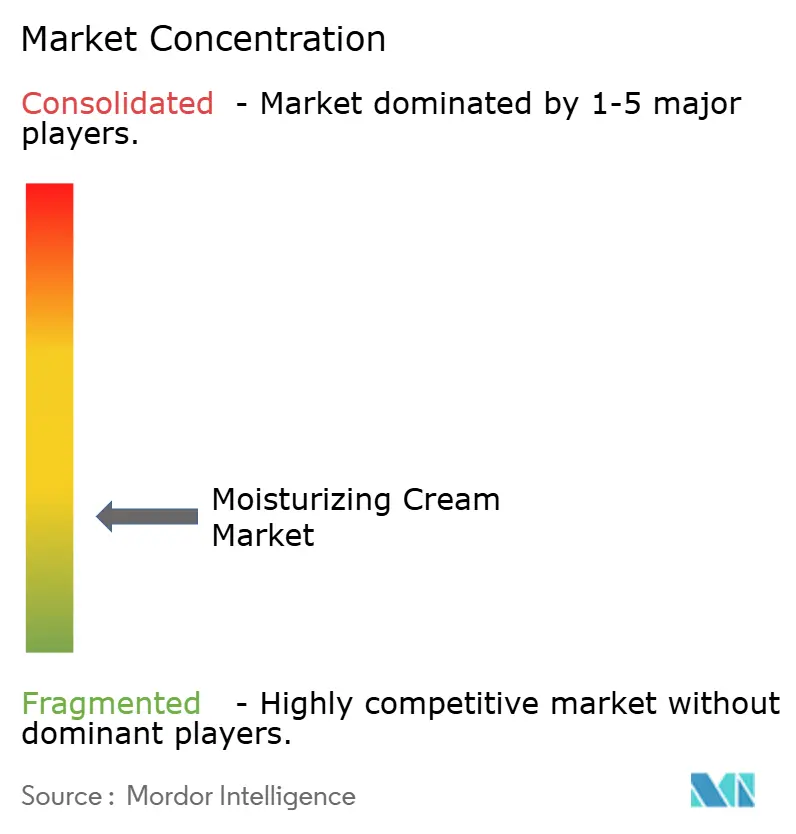
The moisturizing cream market is fragmented, with numerous global consumer goods companies, dermatology specialists, regional brands, and direct-selling companies competing across multiple price points, product categories, and distribution channels. Major players, including L’Oréal, Unilever, Beiersdorf, and Procter & Gamble, leverage established brand portfolios, strong marketing capabilities, and extensive distribution networks to maintain their market positions. However, specialized and regional competitors continue to limit overall market concentration by addressing local consumer preferences, offering targeted formulations, and competing in niche product segments.
Strategic activity in the moisturizing cream market centers on premium skincare, professional distribution channels, technological innovation, and international expansion. Companies are strengthening their portfolios through acquisitions, derma-beauty product development, and investments in artificial intelligence and skincare technologies. These initiatives help leading brands expand relationships with dermatologists and other skincare professionals, differentiate their product offerings, and capitalize on growing demand for premium and specialized moisturizing creams across global markets.
Brands that offer dermatologist-endorsed moisturizing creams with transparent ingredient labeling at accessible mid-market prices can capitalize on significant opportunities. Biotechnology-derived ingredients, advanced ceramide delivery systems, improved emulsification technologies, and climate-adaptive hydration formulations offer strong potential for product differentiation. Digital skin diagnostics can further enable personalized skincare recommendations and routine development. Companies that invest in clinical validation, innovative formulations, and differentiated product technologies are well positioned to strengthen their market presence and compete with established global brands and specialized regional innovators.
Moisturizing Cream Industry Leaders
-
L’Oréal S.A.
-
Unilever PLC
-
The Procter & Gamble Company
-
Kenvue Inc.
-
Shiseido Company, Limited
- *Disclaimer: Major Players sorted in no particular order
Moisturizing Cream Market Companies Covered in this Report
- L’Oréal S.A.
- Unilever PLC
- The Procter & Gamble Company
- Kenvue Inc.
- Shiseido Company, Limited
- Kao Corporation
- Amorepacific Corporation
- Galderma Group AG
- Clarins
- Oriflame
- Mary Kay Inc.
- Amway Corporation
- NAOS (Bioderma)
- Embryolisse
- Laboratoires Dermatologiques d’Uriage
- WALA Heilmittel GmbH (Dr. Hauschka)
- Sebapharma GmbH & Co. KG (sebamed)
- Weleda AG
- Biogened S.A. (Dermedic)
- Laboratoire SVR (SVR)
Recent Industry Developments in Moisturizing Cream Market
- March 2026: Olay upgraded its Regenerist Retinol24 Night Cream with Triple Collagen Peptide technology, Pro-Retinol, and carnosine. The reformulated cream hydrates the skin overnight, smooths skin texture, and reduces the appearance of wrinkles, dark spots, and uneven skin tone, while remaining suitable for daily use.
- December 2025: Dr. Rashel launched Rice Water Day Cream and Rice Water Night Cream, a day-to-night skincare duo designed to support hydration and skin care. The day cream contains SPF 30 to help protect against UV exposure, while both products feature rice water as a key ingredient.
- September 2025: KANEBO introduced CREAM IN DAY II and CREAM IN NIGHT II. CREAM IN DAY II provides hydration and UV protection with SPF 30, while CREAM IN NIGHT II contains niacinamide and the TAISHI Complex to moisturize the skin overnight and improve the appearance of wrinkles and dark spots.
Global Moisturizing Cream Market Report Scope
The moisturizing cream market comprises products designed to hydrate, nourish, and protect the skin. The market is segmented by product type, formulation, category, distribution channel, and geography. Product types include night creams and day creams. Based on formulation, the market includes conventional and natural/organic products. By category, it comprises mass and premium products. Distribution channels include supermarkets/hypermarkets, beauty and health stores, online retail stores, and other distribution channels. Geographically, the market covers North America, Europe, Asia-Pacific, South America, and the Middle East and Africa, with country-level analysis for major markets within each region. The report provides market size estimates and forecasts in terms of value (USD).
Segmentation Overview
| Night Creams |
| Day Creams |
| Conventional |
| Natural/Organic |
| Mass |
| Premium |
| Supermarkets/Hypermarkets |
| Beauty and Health Stores |
| Online Retail Stores |
| Others Distribution Channel |
| North America | United States |
| Canada | |
| Mexico | |
| Rest of North America | |
| Europe | Germany |
| United Kingdom | |
| Italy | |
| France | |
| Spain | |
| Netherlands | |
| Poland | |
| Belgium | |
| Sweden | |
| Rest of Europe | |
| Asia-Pacific | India |
| Japan | |
| Australia | |
| China | |
| Indonesia | |
| South Korea | |
| Thailand | |
| Singapore | |
| Rest of Asia-Pacific | |
| South America | Brazil |
| Argentina | |
| Colombia | |
| Chile | |
| Peru | |
| Rest of South America | |
| Middle East and Africa | South Africa |
| Saudi Arabia | |
| United Arab Emirates | |
| Nigeria | |
| Egypt | |
| Morocco | |
| Turkey | |
| Rest of Middle East and Africa |
| By Product Type | Night Creams | |
| Day Creams | ||
| By Formulation | Conventional | |
| Natural/Organic | ||
| By Category | Mass | |
| Premium | ||
| By Distribution Channel | Supermarkets/Hypermarkets | |
| Beauty and Health Stores | ||
| Online Retail Stores | ||
| Others Distribution Channel | ||
| By Geography | North America | United States |
| Canada | ||
| Mexico | ||
| Rest of North America | ||
| Europe | Germany | |
| United Kingdom | ||
| Italy | ||
| France | ||
| Spain | ||
| Netherlands | ||
| Poland | ||
| Belgium | ||
| Sweden | ||
| Rest of Europe | ||
| Asia-Pacific | India | |
| Japan | ||
| Australia | ||
| China | ||
| Indonesia | ||
| South Korea | ||
| Thailand | ||
| Singapore | ||
| Rest of Asia-Pacific | ||
| South America | Brazil | |
| Argentina | ||
| Colombia | ||
| Chile | ||
| Peru | ||
| Rest of South America | ||
| Middle East and Africa | South Africa | |
| Saudi Arabia | ||
| United Arab Emirates | ||
| Nigeria | ||
| Egypt | ||
| Morocco | ||
| Turkey | ||
| Rest of Middle East and Africa | ||
Key Questions Answered in the Report
What is the projected value of the moisturizing cream market by 2032?
The market is forecast to reach USD 121.4 billion by 2032, growing at a 7.11% CAGR from 2027.
Which moisturizing cream product type leads global demand?
Day creams lead, representing 87.80% of value in 2026, supported by their role in daily hydration, SPF, and treatment routines.
Which sales channel is expanding the fastest for moisturizing creams?
Online retail stores are forecast to grow at a 9.65% CAGR through 2032 as consumers research ingredients and buy through digital channels.
What are the main risks for moisturizing cream brands?
Safety and claim-substantiation requirements, counterfeit products, active-ingredient stability, and packaging compliance can increase cost and reduce consumer trust.