
Model Risk Management Software For AI Market Size and Share
Market Overview
| Study Period | 2020 - 2031 |
|---|---|
| Market Size (2026) | USD 7.91 Billion |
| Market Size (2031) | USD 15.71 Billion |
| Growth Rate (2026 - 2031) | 14.71 % |
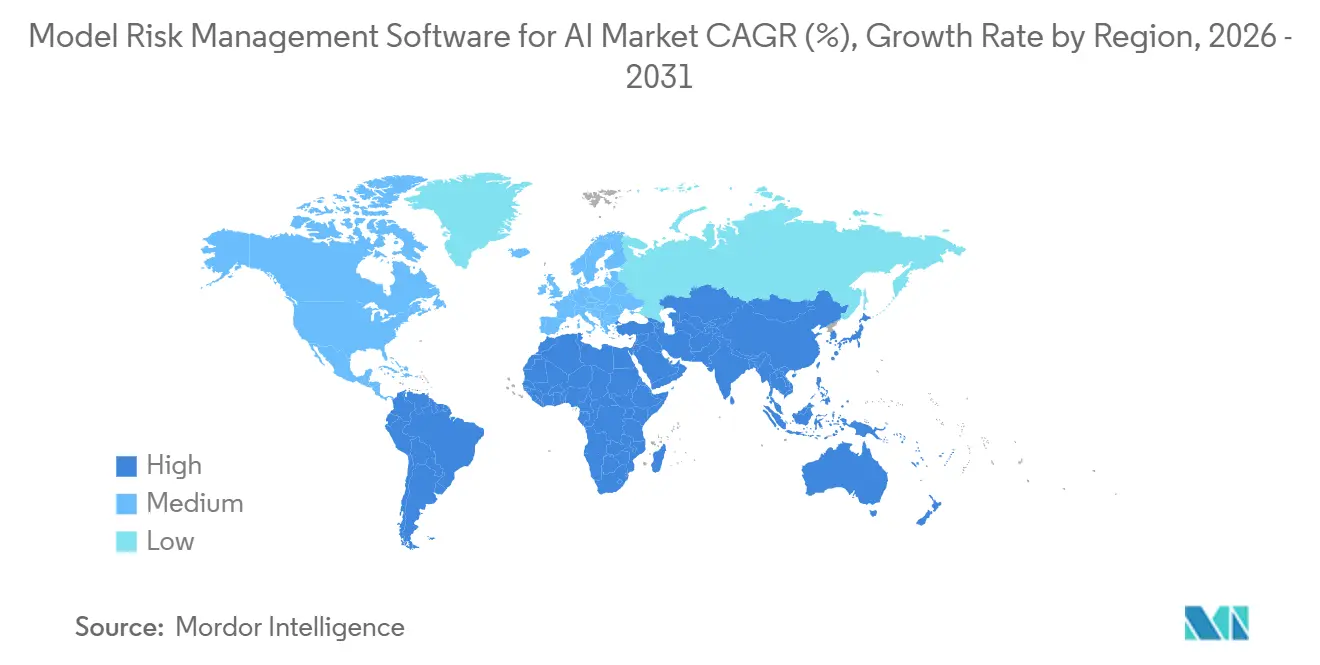
| Fastest Growing Market | Asia-Pacific |
| Largest Market | North America |
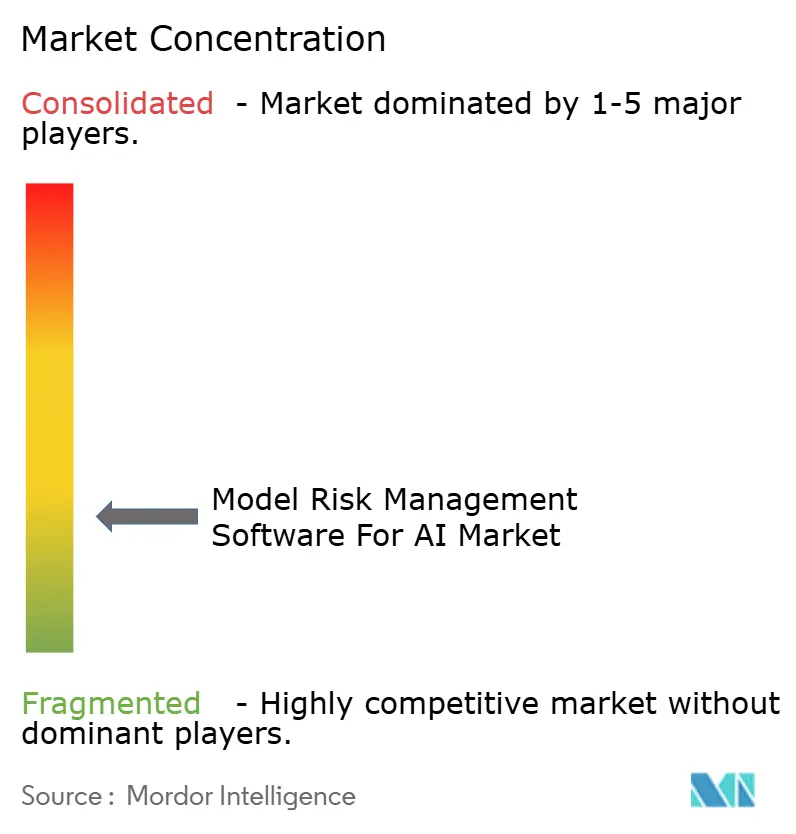
| Market Concentration | Low |
Major Players *Disclaimer: Major Players sorted in no particular order Image © Mordor Intelligence. Reuse requires attribution under CC BY 4.0. | |
Model Risk Management Software For AI Market Analysis by Mordor Intelligence
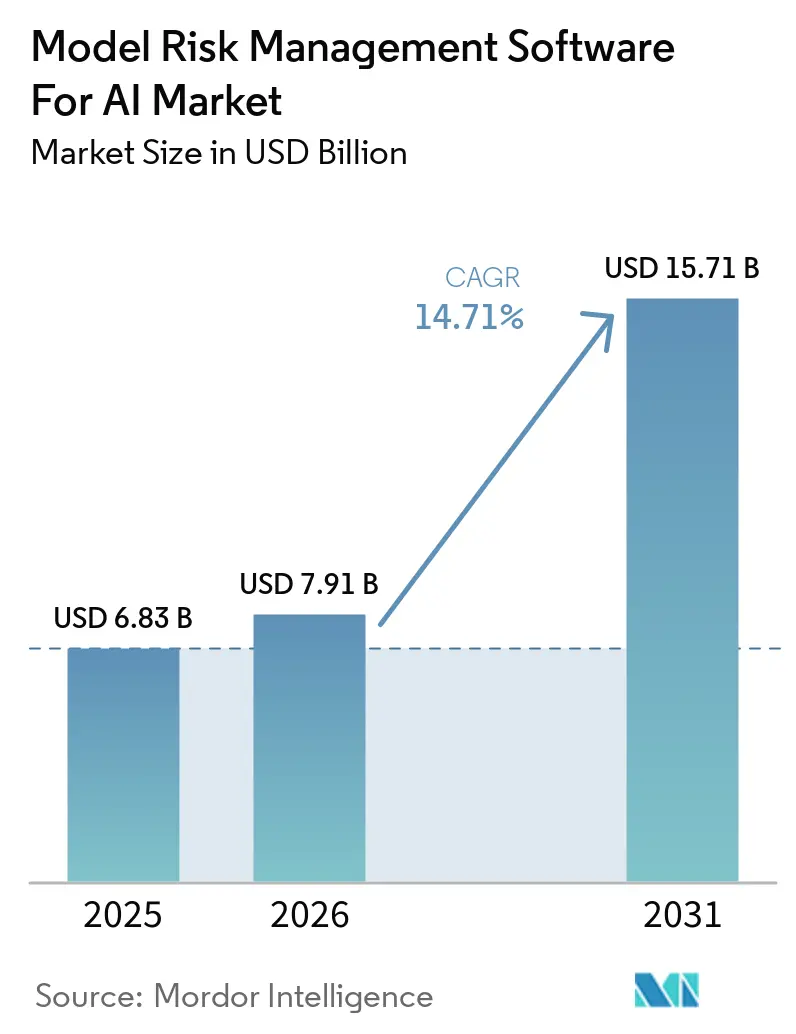
The Model Risk Management Software for AI Market size was valued at USD 6.83 billion in 2025 and is estimated to grow from USD 7.91 billion in 2026 to reach USD 15.71 billion by 2031, at a CAGR of 14.71% during the forecast period (2026-2031). The Model Risk Management Software for AI Market is expanding as organizations move generative AI from pilots into customer, clinical, and financial workflows. Governance buying is increasingly tied to ongoing monitoring, documented validation, and clear responsibility for models that change after deployment. Vendors are combining model inventories, workflow controls, and security capabilities because buyers want fewer disconnected records. Regulatory uncertainty can delay individual projects, but it also encourages institutions to invest in tools that support multiple frameworks. This creates room for platforms that can govern conventional models, large language models, and autonomous systems without splitting audit evidence.
Key Report Takeaways
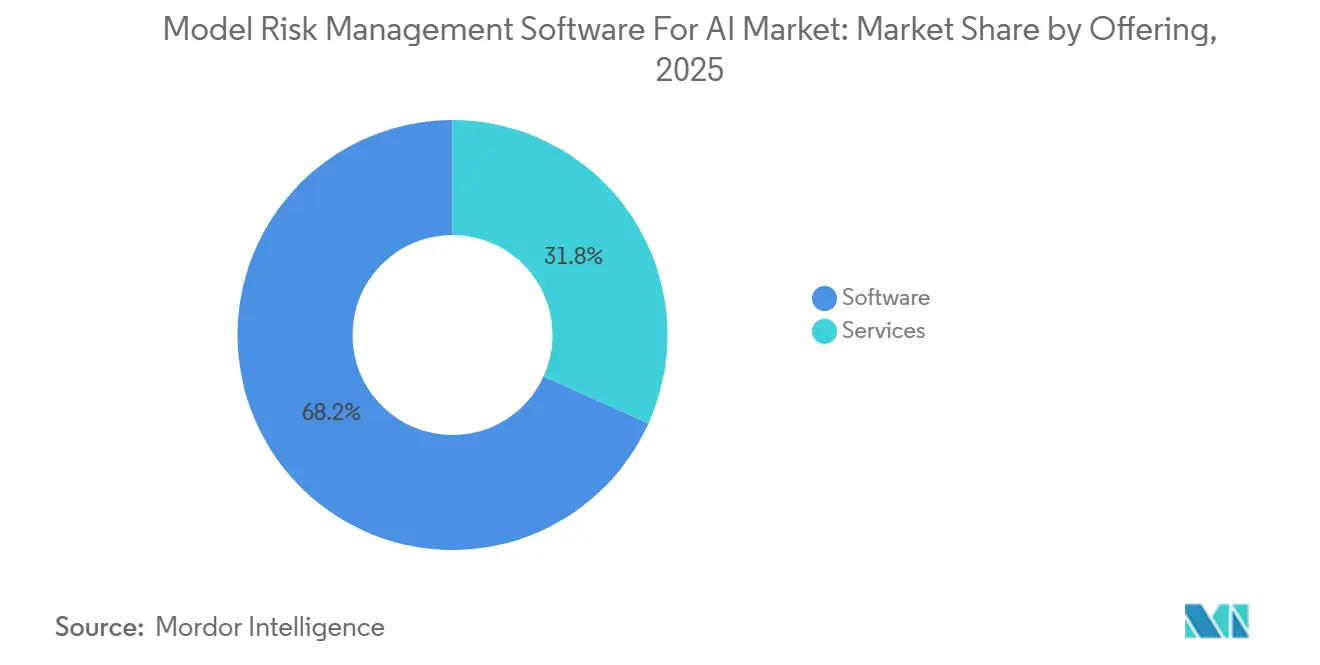
- By offering, software held 68.24% revenue share of Model Risk Management Software For AI Market in 2025, while services are forecast to grow at a 16.83% CAGR through 2031.
- By software type, Model Management held 32.17% revenue share in 2025, while Explainable AI Tools is forecast to grow at a 17.62% CAGR through 2031.
- By deployment mode, cloud held 54.81% revenue share of the Model Risk Management Software For AI Market in 2025, while hybrid is forecast to grow at an 18.41% CAGR through 2031.
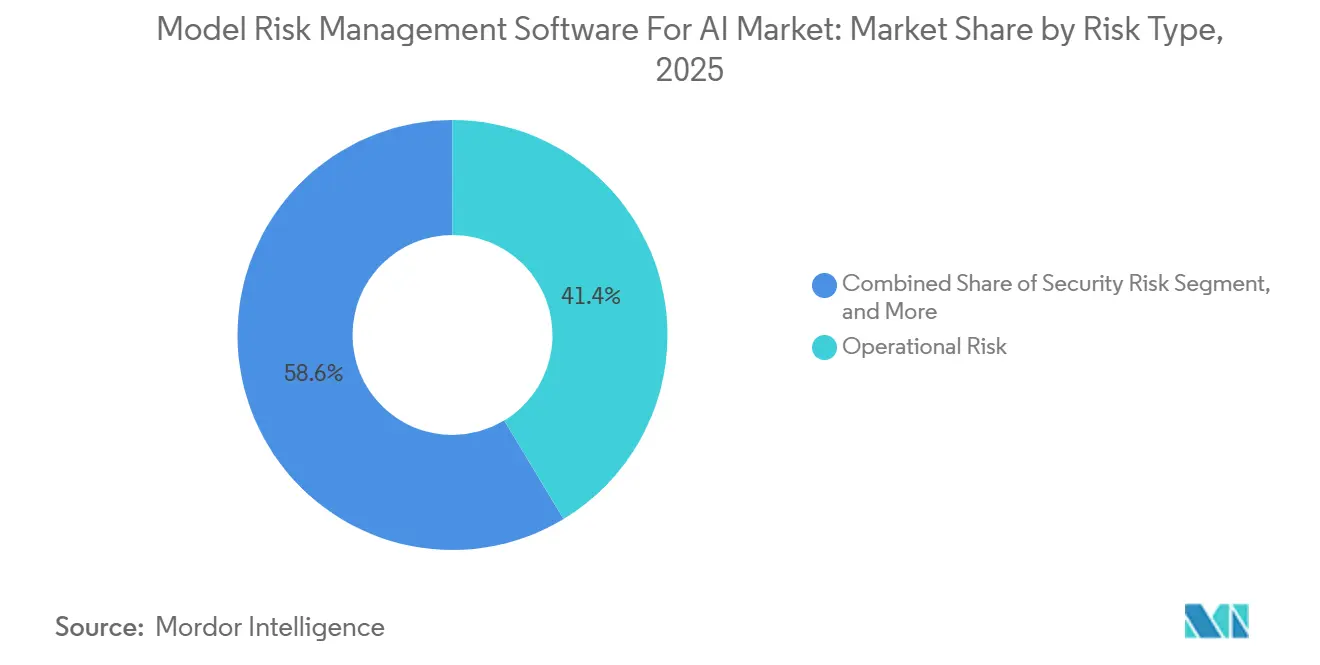
- By risk type, operational risk held 41.36% revenue share in 2025, while security risk is forecast to grow at a 16.19% CAGR through 2031.
- By end user, BFSI held 38.92% revenue share of Model Risk Management Software For AI Market in 2025, while healthcare and life sciences are forecast to grow at a 19.24% CAGR through 2031.
Note: Market size and forecast figures in this report are generated using Mordor Intelligence’s proprietary estimation framework, updated with the latest available data and insights as of January 2026.
Market Trends and Insights
Drivers Impact Analysis of Model Risk Management Software For AI Market*
| Driver | (~) % Impact on CAGR Forecast | Geographic Relevance | Impact Timeline |
|---|---|---|---|
| Enterprise Adoption of Generative AI and Large Language Models | +3.8% | Global | Short term (≤ 2 years) |
| Expanding Regulatory and Supervisory Requirements | +3.2% | North America and Europe, spillover to Asia-Pacific | Medium term (2-4 years) |
| Rising Demand for Automated Model Lifecycle Controls | +2.5% | Global | Short term (≤ 2 years) |
| Increasing Cyberattacks and Adversarial AI Exposure | +1.8% | Global | Short term (≤ 2 years) |
| Automated Evidence Generation for Multi-Framework Compliance | +1.2% | North America and Europe | Medium term (2-4 years) |
| Governance Requirements for Agentic AI and Autonomous Workflows | +0.9% | Global | Medium term (2-4 years) |
| Source: Mordor Intelligence | |||
Enterprise Adoption of Generative AI and Large Language Models
The Model Risk Management Software for AI Market benefits as generative AI moves from tests into production systems. Organizations increasingly use AI in business functions, but governance controls are not always applied consistently. Large language models can produce different results under changing prompts and context, so a single approval before launch is rarely sufficient. Financial institutions, health systems, and other regulated users need records that show how a model was tested, monitored, and changed. Teams also need clear escalation paths when an output raises a safety, fairness, or customer service concern. That requirement increases demand for centralized inventories, approval workflows, and runtime evidence across the Model Risk Management Software for AI Market.
Expanding Regulatory and Supervisory Requirements
The Model Risk Management Software for AI Market is supported by the move from voluntary principles toward formal AI governance requirements. The EU AI Act makes traceable lifecycle records more important for organizations operating in Europe. Institutions working across borders often need to map 1 model to several control sets rather than create separate records for every jurisdiction. This favors platforms that can link validation results, approvals, and monitoring evidence to different requirements. ISO/IEC 42001 gives procurement teams a structured reference point for assessing AI management practices. The resulting demand favors products that can update control mappings without requiring teams to rebuild the underlying model record.
Rising Demand for Automated Model Lifecycle Controls
Manual documentation becomes difficult to maintain when organizations operate many models across different business teams. Each model can require evidence on design, data, validation, monitoring, and change management before an internal review is complete. SAS released automated documentation generation in its Model Risk Management LTS 2025.09 release, showing how vendors are reducing repetitive reporting work. Automation still depends on reliable metadata, ownership details, and model lineage. It can reduce preparation time, but it cannot resolve missing inputs or unclear accountability. As a result, buyers increasingly evaluate data governance and model governance together in the Model Risk Management Software for AI Market.[1]
Increasing Cyberattacks and Adversarial AI Exposure
AI security concerns are making model governance a broader operational priority. Google documented the adversarial use of AI for vulnerability exploitation, operational augmentation, and initial access. The OWASP GenAI LLM Top 10 identifies prompt injection, insecure output handling, and supply-chain weaknesses as significant application risks.[2] These risks require organizations to examine the model, its inputs, tools, connected data, and production behavior. Security teams also need governance records that show which controls apply to each use case and who accepted the remaining risk. Vendors are responding by combining adversarial testing, model lineage, and runtime monitoring within Model Risk Management Software for AI Market workflows.[3]
Restraints Impact Analysis of Model Risk Management Software For AI Market*
| Restraint | (~) % Impact on CAGR Forecast | Geographic Relevance | Impact Timeline |
|---|---|---|---|
| High Implementation Cost and Integration Complexity | -2.8% | Global, most acute in the mid-market | Medium term (2-4 years) |
| Limited Explainability of Advanced Foundation Models | -1.9% | Global, with particular pressure in North America and Europe | Long term (≥ 4 years) |
| Fragmented Cross-Border AI Regulation | -1.3% | Global, especially for multinationals | Medium term (2-4 years) |
| Model Risk Ownership Gaps Across the Three Lines of Defense | -0.8% | Global | Medium term (2-4 years) |
| Source: Mordor Intelligence | |||
High Implementation Cost and Integration Complexity
A full deployment can require connections to development tools, data pipelines, validation processes, audit systems, and reporting records. That work is difficult for organizations with legacy spreadsheets, separate databases, and manual exception logs. Costs can also increase when teams need advisory support to define ownership and control requirements. Mid-market institutions may find it difficult to justify enterprise platforms when their model portfolios are smaller. Longer integration cycles can delay the value expected from a Model Risk Management Software for AI Market purchase. Buyers may therefore begin with a narrower workflow before extending the platform across their organization.
Limited Explainability of Advanced Foundation Models
Advanced foundation models can show behavior that existing attribution tools do not fully explain. Conventional approaches work better for structured models than for complex language and multimodal systems. Research deposited on Zenodo examined regulatory-grade explainability evidence and highlighted the need for methods that connect explanations to compliance needs. Organizations may still struggle to provide useful explanations to auditors, operators, and affected users simultaneously. This technical gap can slow deployments in high-consequence decisions, even when a governance platform provides strong documentation. It also makes human review and use-case limits important within the Model Risk Management Software for AI Market.[4]
*Our forecasts treat driver/restraint impacts as directional, not additive. The impact forecasts reflect baseline growth, mix effects, and variable interactions.
Model Risk Management Software For AI Market Segment Analysis
By Offering:
Software Platforms Lead Revenue While Services Demand BuildsSoftware accounted for 68.24% of the Model Risk Management Software for AI Market share in 2025. Licensed platforms are the primary entry point because they centralize model inventory, validation, documentation, and monitoring. Established suites and specialized vendors offer these functions through structured workflows instead of isolated spreadsheets. Buyers use them to create a common record for models used across financial services, healthcare, and regulated technology operations. A shared platform can also make overdue reviews and ownership gaps easier to identify in the Model Risk Management Software for AI Market.
Services are projected to grow at a 16.83% CAGR from 2026 to 2031. Many institutions still need help interpreting requirements, connecting systems, and designing controls for their own risk profile. Consulting teams can help translate policy expectations into procedures that the platform can support. Implementation services are also needed when firms must integrate legacy records into new governance workflows. Services, therefore, complement software rather than replace it, especially when an organization is establishing a formal Model Risk Management Software for AI Market program.
By Software Type:
Model Management Leads While Explainable AI Tools Grow FastestModel Management held 32.17% revenue share in 2025. Centralized inventory systems give organizations a record of each model’s purpose, owner, status, performance, and risk classification. That visibility supports validation planning and makes it easier to identify models that have changed or lack current evidence. It also provides a practical starting point for firms that are moving beyond scattered business-unit records. A complete inventory helps Model Risk Management Software for AI Market teams set priorities according to risk and use.
Explainable AI Tools are forecast to expand at a 17.62% CAGR through 2031. Demand is driven by the need to explain model outcomes to reviewers, operators, and affected individuals across different circumstances. Bias Detection and Fairness Tools also support governance programs where automated decisions require closer review. Risk Scoring and Stress Testing Tools continue to meet performance testing needs, while Security and Privacy Management Tools address new concerns related to inference activity and supply chains. Regulatory reporting automation creates additional demand for Model Risk Management Software in the AI Market, where teams must prepare repeatable evidence for audits or internal committees.
By Deployment Mode:
Cloud Is Largest While Hybrid Gains GroundCloud deployment accounted for 54.81% of revenue in 2025. Centralized dashboards, elastic infrastructure, and application programming interface connections have made cloud delivery a common option for organizations with permissive data-residency requirements. IBM offers watsonx governance as a service, while Databricks introduced Unity AI Gateway to govern model inference through a shared policy and audit layer. These offerings help buyers bring monitoring and access controls closer to the environments where models are used. They can also simplify Model Risk Management Software for AI Market rollout when several teams already use the same cloud platform.
Hybrid deployment is projected to grow at an 18.41% CAGR through 2031. Some enterprises need private or on-premises capability for sensitive information, while still using cloud services where appropriate. DataRobot launched its Agent Workforce Platform in July 2026 with support for air-gapped, on-premises, and multicloud deployments. Hybrid users need consistent policies even when models and data remain in separate locations. Vendors that preserve the same approvals and audit history across private and public environments are better placed in the Model Risk Management Software for AI Market.
By Risk Type:
Operational Risk Leads While Security Risk AcceleratesOperational risk accounted for 41.36% revenue share in 2025. Organizations continue to prioritize model performance, outcomes analysis, monitoring, and process controls because these activities affect day-to-day decision quality. Operational controls also provide the core evidence used by validation teams and internal audit. This keeps the category central to deployments across established model portfolios. It is particularly important when a model supports a recurring business decision.
Security risk is forecast to grow at a 16.19% CAGR from 2026 to 2031. AI systems can face threats arising from prompts, connected tools, external data, and attempts to copy or manipulate model behavior. Google’s threat intelligence reporting and OWASP’s 2026 guidance show why governance programs now need stronger links with security functions. Security reviews need to account for both a model’s technical design and the systems it can access. Platforms that integrate testing and monitoring with compliance workflows can address these interconnected risks without creating another isolated process.

By End User:
BFSI Holds the Largest Position While Healthcare and Life Sciences ExpandsBFSI held 38.92% revenue share in 2025. Banks and insurers have long used formal processes for credit, market, and operational models, which gives them a foundation for broader AI governance. Their exposure to regulated decisions also makes audit readiness and model traceability ongoing priorities. The Model Risk Management Software for AI Market remains closely tied to this established user base. Financial institutions also need controls that can work across business lines with different models and approval cycles.
Healthcare and life sciences are forecast to grow at a 19.24% CAGR through 2031. The FDA’s January 2025 draft guidance addressed lifecycle management, validation, performance monitoring, and change control for AI-enabled device software functions. These requirements increase the need for evidence that a clinical AI system remains suitable after deployment. IT and telecommunications, government, retail, manufacturing, and media organizations are also adopting governance tools as their AI use cases mature. Their needs vary, but they share a requirement for clearer ownership and repeatable review processes.
Geography Analysis
North America Model Risk Management Software for AI Market
North America held 42.73% of the Model Risk Management Software for AI Market share in 2025. The region benefits from high AI use across financial services, health care, and technology companies. The NIST AI Risk Management Framework provides a reference point for structuring AI risk activities and communication across internal teams. Canada adds demand through its financial services and fintech sectors, while Mexico is developing earlier-stage demand through digital.
Europe Model Risk Management Software for AI Market
Europe was the second-largest regional market in 2025. The EU AI Act raises the importance of ongoing risk management, transparency, and human oversight for relevant AI systems. This drives demand for tools that can connect model evidence to compliance requirements throughout the lifecycle. Cross-border banks can benefit from systems that avoid duplicate documentation across regional requirements.
APAC, South America and MEA Model Risk Management Software for AI Market
Asia-Pacific is forecast to grow at a 20.16% CAGR from 2026 to 2031. China, India, Japan, and South Korea are expanding the use of enterprise AI across financial services, manufacturing, and health care. India’s digital lending activity supports demand for bias detection and operational monitoring in AI credit decisions. Japan and South Korea add to demand through financial services and the use of AI-enabled medical technology. Australia’s prudential environment provides another reason for banks to formalize AI risk controls. South America, the Middle East, and Africa remain smaller markets, but national AI programs and evolving data rules create longer-term opportunities for vendors that build local partnerships.
Competitive Landscape
The Model Risk Management Software for AI Market is fragmented. IBM, Microsoft, SAS, FICO, Amazon Web Services, and Oracle compete through broad platform integration and established enterprise relationships. ValidMind, ModelOp, Credo AI, Holistic AI, Fiddler AI, ArthurAI, Fairly AI, and Monitaur focus more closely on governance workflows, explainability, and compliance automation. Buyers often compare the depth of a specialist’s controls with the operational convenience of a wider technology platform. No player-share information was supplied, so a market concentration score cannot be calculated without estimating the positions of the leading companies.
IBM integrated watsonx governance and Guardium AI Security in June 2025, bringing governance and security functions into a combined offering. Microsoft Azure AI Foundry Models and Microsoft Security Copilot achieved ISO/IEC 42001:2023 certification, providing buyers with independently verified management-system assurance. These moves show that large vendors are treating governance, security, and assurance as connected purchasing requirements. Their advantage lies in the ability to connect controls to widely used cloud and data environments. Specialist vendors can compete where buyers need detailed regulatory workflows or faster adaptation to new model types.
Fiddler AI released end-to-end observability for the agentic AI lifecycle in July 2026, linking evaluation with production monitoring. IBM also added AI Asset Discovery for Azure AI Foundry in July 2026 to help organizations identify untracked AI assets in Microsoft environments. These releases reflect demand for controls that work across agent discovery, pre-production testing, runtime behavior, and approvals. Opportunities remain in cross-framework compliance automation and real-time oversight of multi-agent workflows. Vendors that can offer these functions without increasing documentation burdens should remain competitive.
Model Risk Management Software For AI Industry Leaders
-
International Business Machines Corporation
-
Microsoft Corporation
-
Alphabet Inc.
-
Alphabet Inc.
-
Fair Isaac Corporation
- *Disclaimer: Major Players sorted in no particular order
Model Risk Management Software For AI Market Companies Covered in this Report
- International Business Machines Corporation
- Microsoft Corporation
- Alphabet Inc.
- SAS Institute Inc.
- Fair Isaac Corporation
- Amazon Web Services, Inc.
- Accenture plc
- Oracle Corporation
- Salesforce, Inc.
- ServiceNow, Inc.
- DataRobot, Inc.
- Databricks, Inc.
- H2O.ai, Inc.
- ModelOp, Inc.
- ValidMind Inc.
- Credo AI, Inc.
- Monitaur, Inc.
- Fiddler AI, Inc.
- Holistic AI
- OneTrust, LLC
- Collibra NV
- Domino Data Lab, Inc.
- ArthurAI
- Fairly AI
Recent Industry Developments in Model Risk Management Software For AI Market
- July 2026: DataRobot launched the Agent Workforce Platform, the only agentic AI platform running fully outside the public cloud, supporting air-gapped, on-premises, and multi-cloud governance with unified monitoring and controls, directly addressing sovereign AI concerns among defense, financial services, and healthcare enterprises whose boardrooms have registered the overnight-access-cutoff risk from cloud AI dependencies.
- July 2026: IBM’s watsonx.governance added AI Asset Discovery for Azure AI Foundry, enabling automated daily scanning of AI assets deployed in Microsoft environments, assigning governance status to previously untracked agents and models, and synchronizing discovered assets into the governance console, addressing a critical shadow AI blind spot in decentralized enterprise deployments.
- July 2026: Databricks’ Unity AI Gateway reached general availability, providing organizations a single governance, policy-enforcement, and auditability layer across all foundation models, governing every model inference request with access controls, guardrails, spend monitoring, and Delta-table-based audit logging.
- July 2026: Fiddler AI released enterprise-grade, end-to-end agentic AI observability, integrating pre-production evaluation with production monitoring across the full agent lifecycle, using the Fiddler Trust Service as an inline guardrail and latency-optimized scoring engine for regulated enterprises managing large-scale agent deployments.
Global Model Risk Management Software For AI Market Report Scope
The Model Risk Management Software for AI Market refers to software and professional services designed to identify, assess, and mitigate risks associated with AI and machine learning models. These solutions provide tools for model management, bias detection, explainability, risk scoring, and security management. Deployed across cloud, on-premises, or hybrid environments, they help organizations manage operational, compliance, and security risks, ensuring their AI models perform reliably and adhere to regulatory standards.
The Model Risk Management Software for AI Market Report is Segmented by Offering (Software, and Services), Software Type (Model Management, Bias Detection and Fairness Tools, Explainable AI Tools, Risk Scoring and Stress Testing Tools, Security and Privacy Management Tools, and Other Software Types), Deployment Mode (Cloud, On-Premises, and Hybrid), Risk Type (Operational Risk, Compliance Risk, Security Risk, and Other Risk Types), End User (Banking, Financial Services and Insurance, IT and Telecommunications, Healthcare and Life Sciences, Government and Public Sector, Retail and E-Commerce, Manufacturing, Media and Entertainment, and Other End Users), and Geography (North America, South America, Europe, Asia-Pacific, Middle East, and Africa). The Market Forecasts are Provided in Terms of Value (USD).
Segmentation Overview
| Software |
| Services |
| Model Management |
| Bias Detection and Fairness Tools |
| Explainable AI Tools |
| Risk Scoring and Stress Testing Tools |
| Security and Privacy Management Tools |
| Other Software Types |
| Cloud |
| On-Premises |
| Hybrid |
| Operational Risk |
| Compliance Risk |
| Security Risk |
| Other Risk Types |
| Banking, Financial Services and Insurance |
| IT and Telecommunications |
| Healthcare and Life Sciences |
| Government and Public Sector |
| Retail and E-Commerce |
| Manufacturing |
| Media and Entertainment |
| Other End Users |
| North America | United States |
| Canada | |
| Mexico | |
| South America | Brazil |
| Argentina | |
| Chile | |
| Rest of South America | |
| Europe | Germany |
| United Kingdom | |
| France | |
| Italy | |
| Spain | |
| Rest of Europe | |
| Asia-Pacific | China |
| Japan | |
| India | |
| South Korea | |
| Australia | |
| Rest of Asia-Pacific | |
| Middle East | United Arab Emirates |
| Saudi Arabia | |
| Qatar | |
| Rest of Middle East | |
| Africa | South Africa |
| Egypt | |
| Nigeria | |
| Rest of Africa |
| By Offering | Software | |
| Services | ||
| By Software Type | Model Management | |
| Bias Detection and Fairness Tools | ||
| Explainable AI Tools | ||
| Risk Scoring and Stress Testing Tools | ||
| Security and Privacy Management Tools | ||
| Other Software Types | ||
| By Deployment Mode | Cloud | |
| On-Premises | ||
| Hybrid | ||
| By Risk Type | Operational Risk | |
| Compliance Risk | ||
| Security Risk | ||
| Other Risk Types | ||
| By End User | Banking, Financial Services and Insurance | |
| IT and Telecommunications | ||
| Healthcare and Life Sciences | ||
| Government and Public Sector | ||
| Retail and E-Commerce | ||
| Manufacturing | ||
| Media and Entertainment | ||
| Other End Users | ||
| By Geography | North America | United States |
| Canada | ||
| Mexico | ||
| South America | Brazil | |
| Argentina | ||
| Chile | ||
| Rest of South America | ||
| Europe | Germany | |
| United Kingdom | ||
| France | ||
| Italy | ||
| Spain | ||
| Rest of Europe | ||
| Asia-Pacific | China | |
| Japan | ||
| India | ||
| South Korea | ||
| Australia | ||
| Rest of Asia-Pacific | ||
| Middle East | United Arab Emirates | |
| Saudi Arabia | ||
| Qatar | ||
| Rest of Middle East | ||
| Africa | South Africa | |
| Egypt | ||
| Nigeria | ||
| Rest of Africa | ||
Key Questions Answered in the Report
What is the Model Risk Management Software for AI Market size?
The Model Risk Management Software for AI Market was valued at USD 6.83 billion in 2025 and is estimated at USD 7.91 billion in 2026. It is forecast to reach USD 15.71 billion by 2031 at a 14.71% CAGR, as organizations seek stronger documentation, monitoring, and control over production AI systems.
What is driving demand for model risk management software for AI?
Production use of generative AI, governance requirements, automated lifecycle controls, and adversarial AI risks are increasing demand in the Model Risk Management Software for AI Market. Organizations need evidence that models are suitable for their intended use and remain controlled when their data, behavior, or business context changes.
Which offering is the largest in model risk management software for AI?
Software led with 68.24% revenue share in 2025 because platforms centralize inventories, validation, documentation, and monitoring. Services is forecast to grow at 16.83% CAGR because many institutions need help connecting systems and converting governance principles into practical procedures.
Which deployment model is growing fastest?
Hybrid deployment is forecast to expand at an 18.41% CAGR through 2031, supported by data control and sovereignty requirements. It lets organizations retain private infrastructure for sensitive models while applying shared governance practices to cloud services used by Model Risk Management Software for AI Market teams.
Which end user segment is growing fastest?
Healthcare and life sciences is forecast to grow at a 19.24% CAGR through 2031 as clinical AI requires lifecycle evidence and post-deployment monitoring. BFSI remains the largest end-user segment because banks and insurers already have established model validation, audit, and governance programs.
Why is security risk becoming more important for AI governance?
Prompt injection, insecure outputs, supply-chain weaknesses, and adversarial use require governance processes that extend into production monitoring and security testing. Teams need to understand which connected tools and data sources a model can access, and how exceptions are approved and recorded.