
Middle East Feed Acidifiers Market Size and Share
Market Overview
| Study Period | 2021 - 2031 |
|---|---|
| Forecast Data Period | 2026 - 2031 |
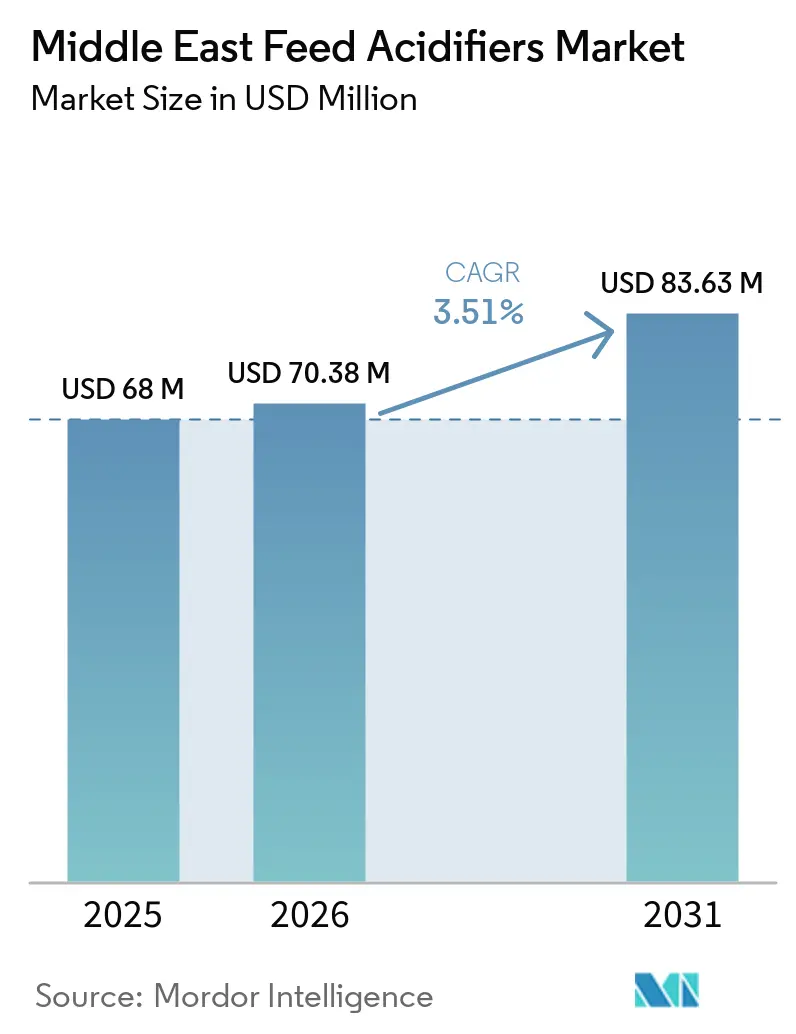
| Base Year Market Size (2025) | USD 68 Million |
| Market Size (2026) | USD 70.38 Million |
| Market Size (2031) | USD 83.63 Million |
| Growth Rate (2026 - 2031) | 3.51 % |
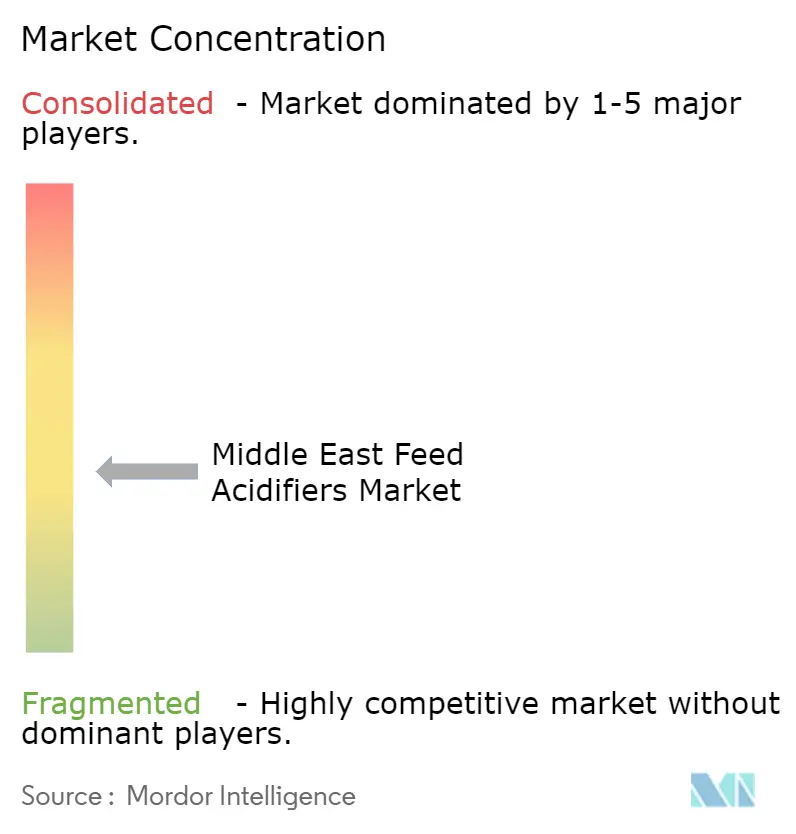
| Market Concentration | Medium |
Major Players *Disclaimer: Major Players sorted in no particular order Image © Mordor Intelligence. Reuse requires attribution under CC BY 4.0. | |
Middle East Feed Acidifiers Market Analysis by Mordor Intelligence
The Middle East feed acidifiers market size was valued at USD 68.0 million in 2025 and is forecast to grow from USD 70.38 million in 2026 to USD 83.63 million by 2031, at a CAGR of 3.51% from 2026 to 2031. This growth is driven by the steady expansion of commercial poultry, dairy, and aquaculture systems, which increasingly rely on compound feed instead of farm-mixed rations. Organic acids, including propionic acid, fumaric acid, and lactic acid, remain integral to feed programs as they address both preservation and animal performance requirements. The region's dependence on imported grains sustains the relevance of acidifiers, as long shipping routes, port storage conditions, and warm climates heighten the risk of spoilage and mold in feed supply chains. Competitive dynamics in the Middle East feed acidifiers market are becoming more segmented. Larger buyers in Saudi Arabia and the United Arab Emirates are shifting toward buffered and specialized formulations, while smaller, price-sensitive markets continue to prefer single-acid commodity products. Additionally, demand opportunities in aquaculture are improving. Saudi Arabia's domestic production plans necessitate more specialized feed programs with enhanced pathogen control and feed stability, further driving the adoption of feed acidifiers in the region.
Key Report Takeaways
- By sub-additive, propionic acid held the largest Middle East feed acidifiers market share at 33.3% in 2025, while fumaric acid is forecast to grow at the fastest CAGR of 4.0% from 2026 to 2031.
- By animal type, poultry accounted for the largest share at 55.8% in 2025, while the Middle East feed acidifiers market size for poultry is forecast to grow at a CAGR of 3.6% from 2026 to 2031.
- By geography, Saudi Arabia held the largest share at 40.0% in 2025, while Iran is forecast to grow at the fastest CAGR of 3.8% from 2026 to 2031.
Note: Market size and forecast figures in this report are generated using Mordor Intelligence’s proprietary estimation framework, updated with the latest available data and insights as of January 2026.
Market Trends and Insights
Drivers Impact Analysis of Middle East Feed Acidifiers Market*
| Driver | (~) % Impact on CAGR Forecast | Geographic Relevance | Impact Timeline |
|---|---|---|---|
| Poultry Self-Sufficiency Investments in Saudi Arabia and the Gulf | +1.0% | Saudi Arabia, United Arab Emirates, and Kuwait | Short term (≤ 2 years) |
| Antibiotic Replacement After Colistin and Growth-Promotion Restrictions | +0.9% | Gulf Cooperation Council (GCC), especially United Arab Emirates, Saudi Arabia, and Qatar | Medium term (2-4 years) |
| Feed-Mill Modernization and Higher Compound-Feed Penetration | +0.7% | Saudi Arabia and Iran | Medium term (2-4 years) |
| Feed Hygiene and Mold-Control Needs in Imported Grains | +0.5% | Regional, all geographies | Short term (≤ 2 years) |
| Heat-Stress-Driven Water and Feed Acidification in Gulf Cooperation Council Poultry | +0.4% | Core Gulf Cooperation Council countries, with spillover into Iran | Medium term (2-4 years) |
| Red Sea Aquaculture Expansion and Species-Specific Feed Programs | +0.3% | Saudi Arabia and the rest of the Middle East | Long term (≥ 4 years) |
| Source: Mordor Intelligence | |||
Poultry Self-Sufficiency Investments in Saudi Arabia and the Gulf
Saudi Arabia remains a significant demand center for feed acidifiers, driven by continued investments in poultry self-sufficiency and commercial livestock production. According to the United States Department of Agriculture (USDA) Grain and Feed Annual Report 2026, the Ministry of Environment, Water, and Agriculture (MEWA) reported that Saudi Arabia is 90% self-sufficient in chicken meat, with total production reaching 1.3 million metric tons[1]. The expansion of commercial poultry production has increased demand for high-quality compound feed, driving the use of feed acidifiers to improve feed hygiene, enhance nutrient utilization, maintain feed stability, and support animal health and production efficiency in intensive poultry farming systems.
Antibiotic Replacement After Colistin and Growth-Promotion Restrictions
The Middle East feed acidifiers market is experiencing growth due to the increasing use of non-antibiotic feed additives. Livestock producers are adopting these additives to maintain animal performance while adhering to evolving antimicrobial stewardship practices. Acidifiers are being integrated into feed programs to enhance gut health, improve nutrient utilization, and boost production efficiency, particularly in intensive poultry systems. A study published in Research on Animal Production in 2025 revealed that broilers fed diets supplemented with acidifiers and multi-enzyme complexes demonstrated significantly better growth performance and intestinal morphology compared to the control group. These results support the broader commercial use of feed acidifiers as part of preventive nutrition strategies in poultry production.
Feed Hygiene and Mold-Control Needs in Imported Grains
The Middle East feed acidifiers market is driven by the region's significant dependence on imported feed ingredients, highlighting the need for effective feed preservation and hygiene management during transportation and storage. Extended supply chains and warm climatic conditions increase the risk of microbial and fungal contamination in feed materials before they reach livestock producers. As reported in the United States Department of Agriculture Grain and Feed Annual Report 2025, Saudi Arabia imported 4.8 million metric tons of corn during the 2024/25 marketing year. This substantial volume of imported feed grains underscores the necessity of acidifiers to maintain feed quality, prevent mold growth, and enhance storage stability across the supply chain.
Heat-Stress-Driven Water and Feed Acidification in Gulf Cooperation Council Poultry
The Middle East feed acidifiers market is driven by the extensive use of heat-mitigation strategies in intensive poultry production systems within the Gulf region. Elevated ambient temperatures adversely impact feed intake, gut health, and overall flock performance, highlighting the need for nutritional interventions that promote digestive stability. According to Eastman Chemical Company's 2025 technical guidance, continuous water acidification is advised during periods of heat stress and reduced feed intake to maintain water hygiene and support bird performance[2]. This approach is fostering the increased adoption of acidifiers in both feed and water applications across commercial poultry operations.
Restraints Impact Analysis of Middle East Feed Acidifiers Market*
| Restraint | (~) % Impact on CAGR Forecast | Geographic Relevance | Impact Timeline |
|---|---|---|---|
| Imported Acid Raw Materials and Feed-Grain Cost Volatility | -0.6% | Regional, all geographies | Short term (≤ 2 years) |
| Distributor Fragmentation and Price Sensitivity Outside Saudi Arabia and the United Arab Emirates | -0.4% | Iran and the rest of the Middle East | Medium term (2-4 years) |
| Red Sea and Strait of Hormuz Shipping Disruption Risk | -0.3% | All import-dependent geographies | Short term (≤ 2 years) |
| Tighter Feed-Additive Compliance and Impurity-Control Rules | -0.2% | Gulf Cooperation Council countries, especially United Arab Emirates and Saudi Arabia | Medium term (2-4 years) |
| Source: Mordor Intelligence | |||
Imported Acid Raw Materials and Feed-Grain Cost Volatility
The Middle East feed acidifiers market faces challenges due to fluctuations in the costs of imported feed ingredients and additives, which can impact purchasing decisions in commercial feed operations. Many countries in the region depend significantly on imported feed grains and raw materials for feed additives, making them vulnerable to global commodity price changes and supply chain disruptions. As reported in the United States Department of Agriculture Grain and Feed Annual Report 2025, cost and freight (CFR) barley prices in Saudi Arabia ranged between USD 240 and USD 260 per metric ton in March 2025[3]. Variability in feed input costs influences feed production economics, prompting manufacturers to manage additive expenditures carefully, especially in cost-sensitive livestock production systems.
Distributor Fragmentation and Price Sensitivity Outside Saudi Arabia and the United Arab Emirates
The Middle East feed acidifiers market encounters challenges due to fragmented distribution networks and inconsistent levels of technical support across various regional markets. In regions where feed additive distribution is less structured, purchasing decisions are often influenced by cost considerations rather than product performance, which hampers the adoption of higher-quality acidifier solutions. The World Bank's Middle East and North Africa Macro Poverty Outlook, published in April 2025, projected Yemen's inflation rate at 20.0% for 2025. Ongoing inflationary pressures can reduce purchasing power throughout agricultural value chains, prompting feed producers to prioritize lower-cost inputs and limiting the demand for premium feed acidifier formulations in price-sensitive markets.
*Our forecasts treat driver/restraint impacts as directional, not additive. The impact forecasts reflect baseline growth, mix effects, and variable interactions.
Middle East Feed Acidifiers Market Segment Analysis
By Sub-Additive:
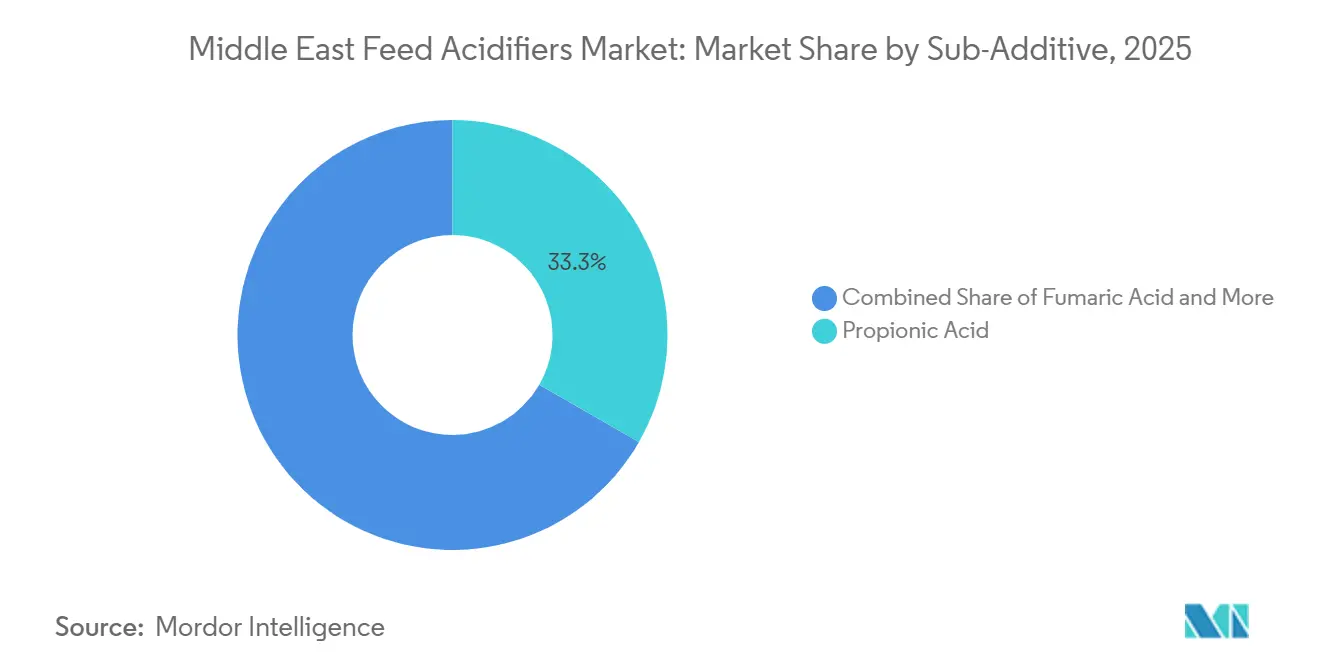
Propionic Acid Leads, While Fumaric Acid Records the Fastest GrowthThe Middle East feed acidifiers market share for propionic acid accounted for the largest 33.3% in 2025. This dominance is attributed to its versatile functionality in feed preservation, mold inhibition, and extending shelf life within commercial livestock production systems. Its widespread adoption is further supported by its compatibility with large-scale feed manufacturing processes and its proven effectiveness in maintaining feed quality under challenging storage conditions. Demand remains particularly robust in poultry and compound feed applications, where maintaining feed hygiene is a critical operational requirement. The product's cost-effectiveness and established performance profile continue to drive its use among both integrated producers and independent feed manufacturers.
The Middle East feed acidifiers market size for fumaric acid is forecast to grow at the fastest CAGR of 4.0% from 2026 to 2031. This growth is driven by increasing interest in feed additives that enhance digestive health and nutrient utilization, aligning with evolving livestock nutrition strategies. Fumaric acid is gaining traction in poultry, aquaculture, and selected ruminant applications, where improving feed efficiency and gut performance is becoming a priority. Beyond its preservation functions, fumaric acid is being positioned within broader animal health programs, reflecting the rising demand for specialized acidifier solutions that provide both nutritional and operational benefits.

By Animal Type:
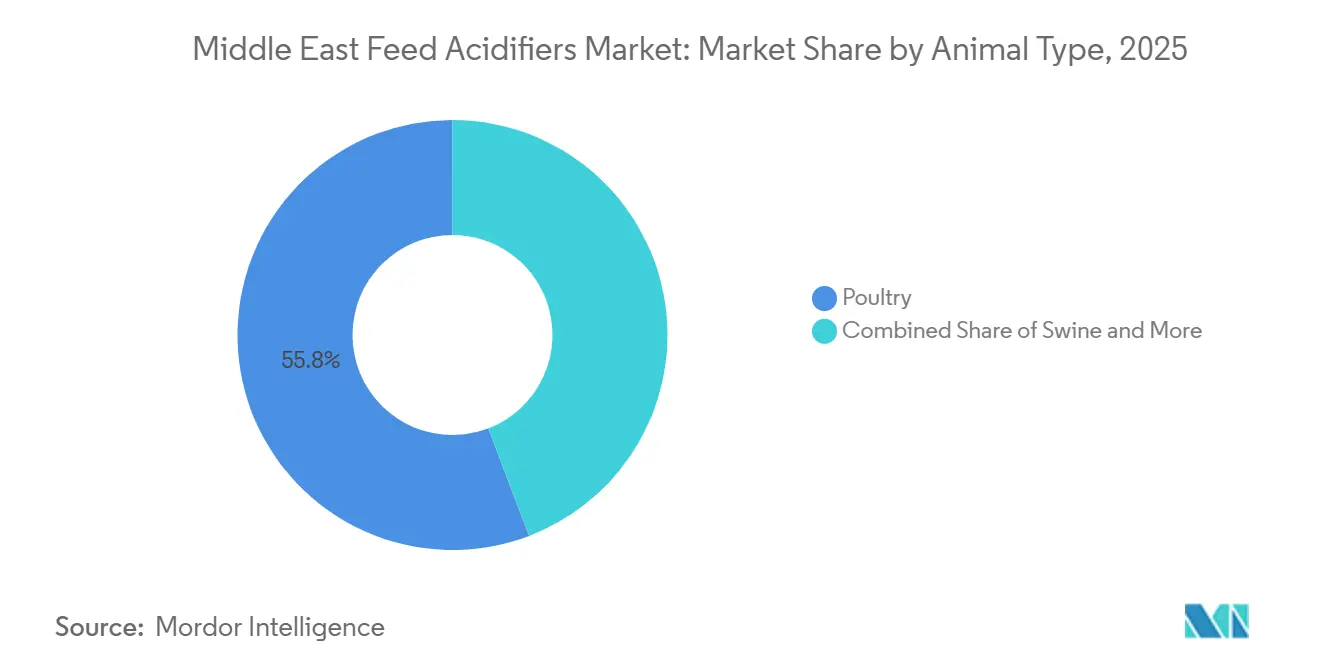
Poultry Leads Market Share and GrowthPoultry accounted for the largest share of the Middle East feed acidifiers market, at 55.8% in 2025, and is also forecast to be the fastest-growing animal-type segment, with a CAGR of 3.6% from 2026 to 2031. This dominance reflects the reliance of commercial broiler and layer production systems on compound feed and consistent feed quality. High feed consumption rates, short production cycles, and a strong focus on performance optimization support demand for feed acidifiers, which help improve feed hygiene, support digestive health, and enhance nutrient utilization. Investments in domestic poultry production, food security initiatives, and integrated farming systems across the region are anticipated to sustain demand for feed acidifiers in commercial poultry feed programs.
Aquaculture offers additional long-term growth potential as producers seek feed solutions that support feed preservation, digestive performance, and animal health under intensive production conditions. The expansion and diversification of marine and freshwater farming systems are increasing the need for species-specific feed formulations and tailored nutritional programs. As aquaculture operations modernize and adopt specialized feed management practices, demand for feed acidifiers is likely to benefit, although poultry remains the leading segment in both market share and forecast growth.
Geography Analysis
Saudi Arabia Feed Acidifiers Market
Saudi Arabia accounted for the largest share, 40.0%, in 2025. The country's position is supported by its extensive commercial poultry sector, the highest compound feed production capacity in the Middle East, and strong demand from integrated livestock enterprises. Continued investments in large-scale broiler and dairy operations have accelerated the adoption of feed acidifiers to improve nutrient utilization, extend feed shelf life, and maintain consistent feed quality under high-temperature conditions. Additionally, the country's increasing reliance on imported feed ingredients and expanding aquaculture production continue to drive demand for acidifiers across multiple livestock segments, reinforcing Saudi Arabia's position as the region's largest market.
Iran Feed Acidifiers Market
Iran is forecast to grow at the fastest CAGR of 3.8% from 2026 to 2031. This growth is supported by the country's extensive poultry industry and an increasing focus on feed efficiency under challenging raw material and production conditions. Feed acidifiers are becoming increasingly important as producers seek solutions to improve feed utilization, digestive health, and overall flock performance. Commercial livestock producers are adopting feed management strategies that improve nutrient absorption, feed hygiene, and production efficiency. Furthermore, continued investments in poultry production and rising awareness of non-antibiotic nutritional solutions are driving the adoption of feed acidifiers in intensive livestock systems across the country.
United Arab Emirates, Oman, Bahrain and Qatar Feed Acidifiers Market
The rest of the Middle East accounts for a significant portion of regional demand, with consumption spread across multiple smaller countries rather than being concentrated in a single national market. The United Arab Emirates plays a key role, driven by the growing adoption of non-antibiotic feed management strategies and a well-established livestock production sector. Oman, Bahrain, and Qatar contribute to demand through investments in food security, poultry production, and feed industry development. Suppliers with Gulf Cooperation Council registrations and established distribution networks are well-positioned to expand in these markets, facilitating the continued use of feed acidifiers in commercial livestock and aquaculture production systems.
Competitive Landscape
The market is moderately fragmented, with multinational feed additive manufacturers and regional distributors competing across the commercial livestock sector. Key players include BASF SE, Kemin Industries, Inc., NOVUS International, Inc. (Mitsui and Co., Ltd.), Perstorp Holding AB (PETRONAS Chemicals Group Berhad), and DSM-Firmenich AG. Competition is primarily driven by product efficacy, regulatory compliance, pricing strategies, and the ability to provide species-specific feed acidification solutions for poultry, ruminants, swine, and aquaculture. Established supplier relationships with commercial feed mills and integrated livestock producers further influence market positioning.
Companies are pursuing growth through capacity expansion, innovation in organic acid formulations, and broader product portfolios tailored to different livestock applications. Manufacturers are investing in regional production, distribution infrastructure, and technical expertise to improve product availability and address evolving feed-preservation and gut-health requirements. Product innovation and collaboration with feed manufacturers enable suppliers to strengthen customer retention, expand regional market penetration, and respond to growing demand for efficient and sustainable animal nutrition solutions.
Supplier strategies increasingly focus on strengthening regional production and distribution networks to improve customer access and supply reliability. Local manufacturing capabilities help companies respond to regional demand, reduce logistical complexity, and maintain consistent product availability for commercial livestock producers. Proximity to customers also supports technical assistance, product customization, and collaboration with feed manufacturers and agricultural businesses. Companies that combine regional presence with technical expertise, reliable distribution, and product innovation can improve customer relationships and strengthen their competitive position in the animal nutrition and health market.
Middle East Feed Acidifiers Industry Leaders
-
BASF SE
-
Kemin Industries, Inc.
-
NOVUS International, Inc. (Mitsui & Co., Ltd.)
-
Perstorp Holding AB (PETRONAS Chemicals Group Berhad)
-
DSM-Firmenich AG
- *Disclaimer: Major Players sorted in no particular order
Middle East Feed Acidifiers Market Companies Covered in this Report
- BASF SE
- Kemin Industries, Inc.
- NOVUS International, Inc. (Mitsui & Co., Ltd.)
- Perstorp Holding AB (PETRONAS Chemicals Group Berhad)
- Corbion N.V.
- Impextraco NV
- DSM-Firmenich AG
- Cargill, Incorporated
- Archer-Daniels-Midland Company
- Nutreco N.V. (SHV Holdings N.V.)
- Bluestar Adisseo Company (China National BlueStar (Group) Co., Ltd.)
- Phibro Animal Health Corporation
- Nutrex NV
- Eastman Chemical Company
- Yara International ASA
Recent Industry Developments in Middle East Feed Acidifiers Market
- September 2024: DSM-Firmenich AG inaugurated a new Animal Nutrition and Health premix and feed additives manufacturing facility in Sadat City, Egypt. The facility strengthens regional production capabilities for specialty feed additives that support feed acidification, feed hygiene, gut health, and livestock productivity across the Middle East and Africa.
- June 2024: Kemin Industries, Inc. introduced FORMYL, a feed acidifier for swine that includes encapsulated calcium formate and citric acid. This launch expands the company's organic acid portfolio and enhances its offerings for gut health and feed acidification in the Middle East market.
- May 2024: Eastman Chemical Company highlighted innovations in formic acid-based water acidification for poultry production, emphasizing improvements in gut health, feed hygiene, and bird performance during heat stress and periods of reduced feed intake, supporting the adoption of acidifier solutions in intensive livestock systems.
Middle East Feed Acidifiers Market Report Scope
Feed acidifiers are additives containing organic or inorganic acids designed to improve feed hygiene, enhance nutrient utilization, support gut health, and optimize animal performance in livestock and aquaculture production systems.
The Middle East feed acidifiers market report is segmented by sub-additive (fumaric acid, lactic acid, propionic acid, and other acidifiers), by animal type (aquaculture, poultry, ruminants, swine, and other animals), and by geography (Iran, Saudi Arabia, and Rest of Middle East). The market sizes and forecasts are provided in terms of value (USD) and volume (metric tons).
Segmentation Overview
| Fumaric Acid |
| Lactic Acid |
| Propionic Acid |
| Other Acidifiers |
| Aquaculture | Fish |
| Shrimp | |
| Other Aquaculture Species | |
| Poultry | Broiler |
| Layer | |
| Other Poultry Birds | |
| Ruminants | Beef Cattle |
| Dairy Cattle | |
| Other Ruminants | |
| Swine | |
| Other Animals |
| Iran |
| Saudi Arabia |
| Rest of Middle East |
| By Sub-Additive | Fumaric Acid | |
| Lactic Acid | ||
| Propionic Acid | ||
| Other Acidifiers | ||
| By Animal Type | Aquaculture | Fish |
| Shrimp | ||
| Other Aquaculture Species | ||
| Poultry | Broiler | |
| Layer | ||
| Other Poultry Birds | ||
| Ruminants | Beef Cattle | |
| Dairy Cattle | ||
| Other Ruminants | ||
| Swine | ||
| Other Animals | ||
| By Geography | Iran | |
| Saudi Arabia | ||
| Rest of Middle East | ||
Key Questions Answered in the Report
What is the market size of the Middle East feed acidifiers in 2026?
The Middle East feed acidifiers market size is estimated at USD 70.38 million in 2026.
Which country leads regional demand for feed acidifiers?
Saudi Arabia accounted for the largest share of the Middle East feed acidifiers market at 40.0% in 2025, supported by poultry expansion, feed mill growth, and food security policies driving steady demand.
Why does poultry account for the largest share of feed acidifier use in the region?
Poultry accounted for the largest share of the Middle East feed acidifiers market at 55.8% in 2025, supported by the heavy reliance of broiler and layer systems on compound feed, feed conversion efficiency, and improved feed hygiene.
Which sub-additive category is growing the fastest?
Fumaric acid is the fastest-growing sub-additive and is forecast to grow at the fastest CAGR of 4.0% from 2026 to 2031.