
Middle East and Africa Robotic Lawn Mower Market Size and Share
Market Overview
| Study Period | 2021 - 2031 |
|---|---|
| Forecast Data Period | 2026 - 2031 |
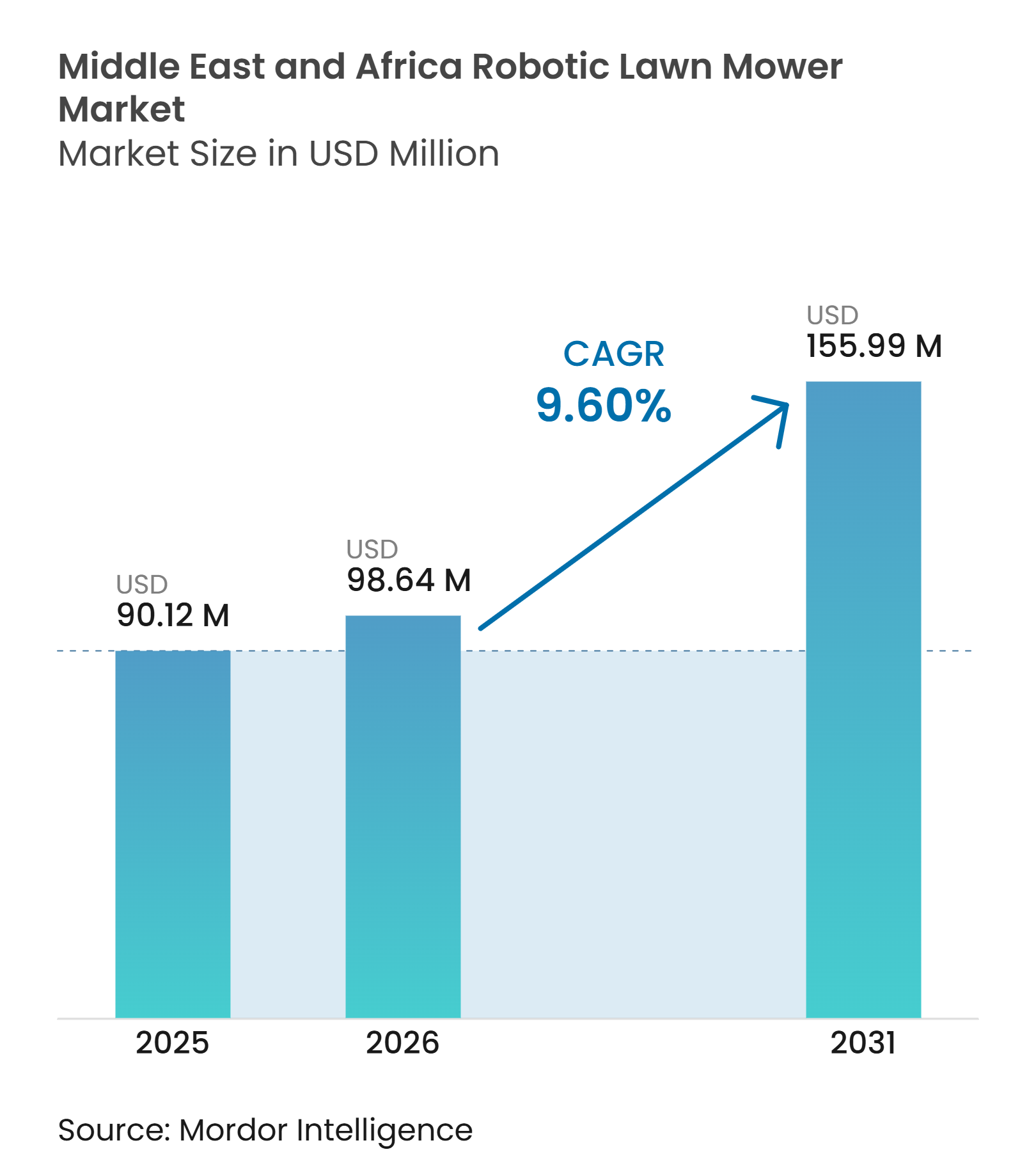
| Base Year Market Size (2025) | USD 90.12 Million |
| Market Size (2026) | USD 98.64 Million |
| Market Size (2031) | USD 155.99 Million |
| Growth Rate (2026 - 2031) | 9.60 % |
| Market Concentration | Medium |
Major Players *Disclaimer: Major Players sorted in no particular order Image © Mordor Intelligence. Reuse requires attribution under CC BY 4.0. | |
Middle East and Africa Robotic Lawn Mower Market Analysis by Mordor Intelligence
The Middle East and Africa robotic lawn mower market size is projected to expand from USD 90.1 million in 2025 to USD 98.6 million in 2026, and to USD 156.0 million by 2031, registering a CAGR of 9.6% from 2026 to 2031. The market is supported by premium residential construction, resort landscaping, and managed public green space in the Gulf. Larger sites place greater value on regular mowing schedules that do not depend on the availability of outdoor labor. Wire-free navigation also reduces installation complexity for properties with complex turf layouts. Commercial buyers favor suppliers that provide installation, service, and replacement parts locally. Water scarcity, high equipment prices, and harsh operating conditions constrain the addressable base.
Key Report Takeaways
- By range, Medium Range was the largest segment with 45.3% revenue share in 2025, while High Range is forecast to grow at the fastest CAGR of 12.8% from 2026 to 2031.
- By battery capacity, 20 to 30 V was the largest segment with 48.6% revenue share in 2025, while More Than 30 V is forecast to grow at the fastest CAGR of 13.6% from 2026 to 2031.
- By sales channel, Specialty Stores was the largest segment with 43.1% share in 2025, while Online is forecast to grow at the fastest CAGR of 15.2% from 2026 to 2031.
- By application, Residential was the largest segment with 64.3% share in 2025, while Commercial is forecast to grow at the fastest CAGR of 12.9% from 2026 to 2031.
- By end-user, Homeowners were the largest segment with 52.6% share in 2025, while Sports Grounds and Parks are forecast to grow at the fastest CAGR of 14.8% from 2026 to 2031.
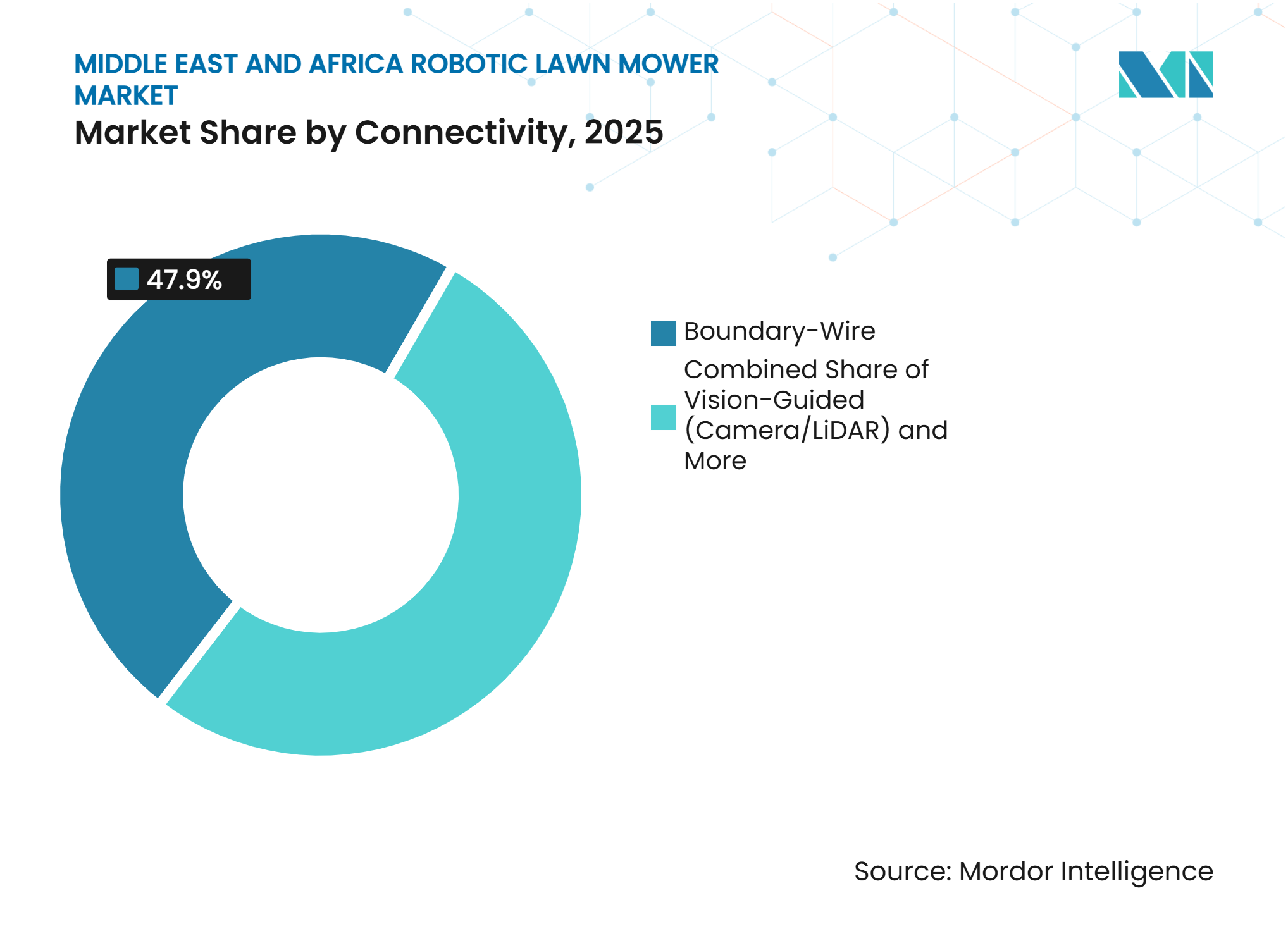
- By connectivity, Boundary-Wire was the largest segment with 47.9% share in 2025, while Vision-Guided, Camera, and LiDAR Systems are forecast to grow at the fastest CAGR of 16.8% from 2026 to 2031.
- By geography, the Middle East held 68.5% of the Middle East and Africa robotic lawn mower market share in 2025, while Africa is forecast to grow at the fastest CAGR of 10.7% from 2026 to 2031. The Middle East and Africa robotic lawn mower market size is forecast to reach USD 156.0 million by 2031.
Note: Market size and forecast figures in this report are generated using Mordor Intelligence’s proprietary estimation framework, updated with the latest available data and insights as of January 2026.
Market Trends and Insights
Drivers Impact Analysis of Middle East and Africa Robotic Lawn Mower Market*
| Driver | (~) % Impact on CAGR Forecast | Geographic Relevance | Impact Timeline |
|---|---|---|---|
| Expansion of Luxury Residential and Hospitality Landscapes | +3.0% | UAE and Saudi Arabia, luxury projects. South Africa, estate landscaping. | Long term (≥ 4 years) |
| Commercial Landscaping Labor Availability and Cost Pressure | +2.2% | UAE and Saudi Arabia, commercial sites. South Africa, estate contracts. | Medium term (2-4 years) |
| Smart Landscaping and Connected-Property Adoption | +1.8% | UAE, Saudi Arabia, and Qatar, connected new-build homes. | Medium term (2-4 years) |
| Demand for Quiet, Low-Emission Lawn Maintenance | +1.2% | UAE and Saudi Arabia, hospitality zones. South Africa, estate complexes. | Short term (≤ 2 years) |
| Premium Green-Space Maintenance in Water-Stressed Climates | +1.0% | UAE, Saudi Arabia, and Oman, irrigated premium landscapes. | Long term (≥ 4 years) |
| Increasing Suitability for Complex and Large Managed Lawns | +0.8% | UAE and Saudi Arabia, resorts and compounds. South Africa, estates. | Medium term (2-4 years) |
| Source: Mordor Intelligence | |||
Expansion of Luxury Residential and Hospitality Landscapes
Saudi Arabia’s tourism and residential project pipeline is adding professionally maintained green areas across high-value developments. The Saudi Green Initiative identifies Green Riyadh as a program to plant 7.5 million trees and expand urban green space in the capital[1]. Such projects create recurring requirements for turf upkeep across parks, hotels, and residential compounds. The Middle East and Africa robotic lawn mower market can benefit where operators need predictable mowing without frequent crew movements through guest areas. Luxury properties also place a high value on consistent presentation, which makes scheduled autonomous mowing more relevant than occasional manual cutting. This demand is strongest where developers fund both landscaping and long-term property management.
Commercial Landscaping Labor Availability and Cost Pressure
Commercial grounds teams must maintain lawns at fixed intervals, even when the heat reduces safe outdoor working hours. This makes labor scheduling more difficult at hotels, gated communities, and sports facilities. Robotic mowers can undertake repeated cutting tasks while grounds teams focus on irrigation, pruning, and horticultural work. The commercial case depends on reliable operation and a service partner that can quickly return equipment for use. The Middle East and Africa robotic lawn mower market, therefore, gains most from labor constraints at sites with large lawns and formal service standards. Smaller operators may still prefer manual equipment where their capital budgets are limited.
Demand for Quiet, Low-Emission Lawn Maintenance
Noise is a practical concern at hotels, residential compounds, and parks with extended operating hours. GARDENA stated in 2025 that its smart SILENO free 600 model operates at 58 dB(A). Quiet electric equipment gives operators more flexibility to mow before guest activity begins. It also avoids local exhaust emissions at the point of use. The Middle East and Africa robotic lawn mower market can therefore appeal to locations where maintenance activity directly affects resident or visitor experience.
Increasing Suitability for Complex and Large Managed Lawns
Large sites often have slopes, trees, walkways, and irregular boundaries that complicate manual mowing plans. Newer products increasingly use cameras, satellite positioning, and LiDAR to map these spaces without buried wires. Husqvarna Group introduced 13 boundary-wire-free models in 2025 for areas from 600 square meters to more than 50,000 square meters. Greater coverage capability expands the practical use case for resorts, golf facilities, and compounds. The Middle East and Africa robotic lawn mower market still requires proof that these systems can withstand local dust and heat. Installation simplicity remains valuable where landscaping designs make buried cable work disruptive or expensive.
Restraints Impact Analysis of Middle East and Africa Robotic Lawn Mower Market*
| High Upfront Purchase and Installation Cost | -1.5% | Africa and price-sensitive Middle East markets, small operators. | Medium term (2-4 years) |
|---|---|---|---|
| Limited After-Sales Service and Spare-Parts Coverage | -1.2% | Outside UAE and South Africa, limited authorized support. | Long term (≥ 4 years) |
| Heat, Dust, Sand, and Uneven-Terrain Reliability Risks | -0.8% | UAE, Saudi Arabia, Oman, and Iran, arid operating conditions. | Medium term (2-4 years) |
| Limited Addressable Lawn Area Due to Water Scarcity | -0.5% | UAE, Saudi Arabia, Iran, and Oman, constrained irrigated turf. | Long term (≥ 4 years) |
| Source: Mordor Intelligence | |||
High Upfront Purchase and Installation Cost
Purchase prices remain a barrier for buyers comparing robotic units with manual labor or conventional equipment. Boundary-wire installation can add cost and disrupt existing landscaping. High-capability models for large lawns require a larger initial capital commitment than entry-level products. The long ownership cycle can improve the operating case, but buyers need confidence in service availability and equipment life. This is particularly difficult for smaller landscaping companies with limited access to equipment financing. The Middle East and Africa robotic lawn mower market will remain concentrated in premium properties until lower-cost models and service packages gain wider acceptance.
Limited Addressable Lawn Area Due to Water Scarcity
Water scarcity limits the amount of irrigated turf that many properties can maintain. This restricts the physical lawn area available for autonomous mowing. Public and private projects can still support demand when green areas form part of their amenity strategy. Dubai’s 2026 Blue and Green Spaces Roadmap 2030 includes new parks and tree planting supported by recycled-water irrigation. The equipment is most relevant where water-efficient landscape planning already supports permanent turf maintenance. In locations that shift from lawn to hardscape or drought-tolerant planting, the addressable opportunity narrows.
*Our forecasts treat driver/restraint impacts as directional, not additive. The impact forecasts reflect baseline growth, mix effects, and variable interactions.
Middle East and Africa Robotic Lawn Mower Market Segment Analysis
By Range:
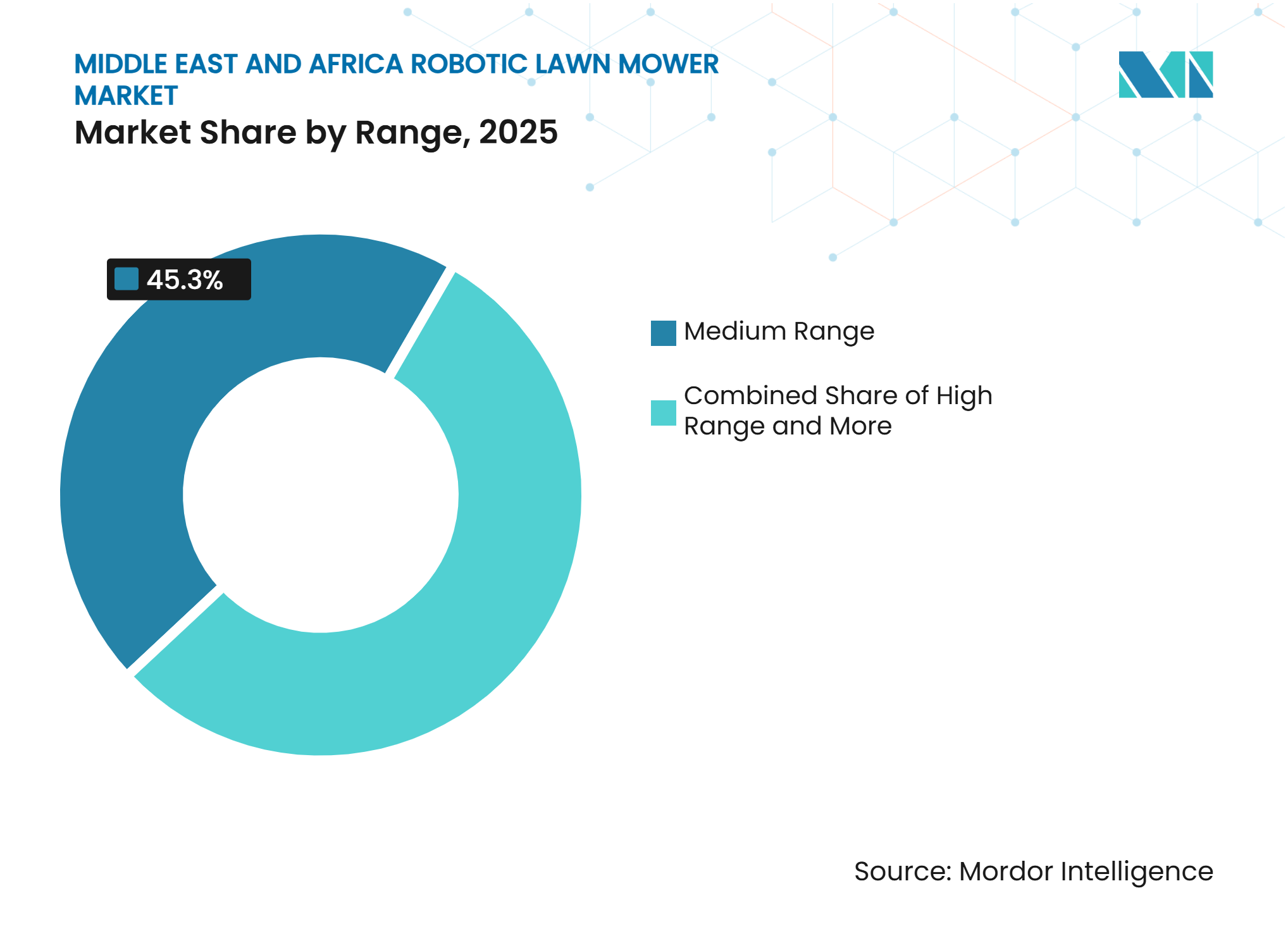
Premium Tiers Support Larger Managed SitesMedium Range held 45.3% of 2025 revenue and remained the largest range group as it aligns with villa gardens and smaller managed properties. These products cover the primary residential demand base in the UAE and Saudi Arabia. Low-range products suit small gardens and price-sensitive households, but their coverage and terrain capability are more limited. Buyers in this category remain sensitive to the cost of installation and repairs. Product selection depends on lawn size, slope, and the need for autonomous navigation. The Middle East and Africa robotic lawn mower market retains a large residential base because private villas often have defined garden areas.
High Range is forecast to grow at the fastest CAGR of 12.8% from 2026 to 2031. It is designed for golf courses, resort grounds, sports facilities, and larger compounds. These sites need longer runtime, broader coverage, and fewer interruptions. Husqvarna’s 2025 wire-free portfolio expansion showed that larger-area capability is moving beyond a narrow group of commercial models. The pricing gap between medium and high ranges remains material for buyers. Commercial demand will favor higher-tier units when their coverage and service performance reduce operational risk.



By Battery Capacity:
Higher Voltage Supports Longer Operating WindowsThe 20 to 30 V group held 48.6% of 2025 revenue and was the largest battery-capacity segment. It serves mainstream residential systems and smaller commercial lawns. This capacity range provides a balance between runtime, equipment weight, and purchase price. Less than 20 V products remain relevant for compact gardens with simpler mowing needs. Their performance can be less suitable for irregular terrain or long unattended cycles. The Middle East and Africa robotic lawn mower market is likely to keep this voltage band central to residential sales.
More Than 30 V is forecast to grow at the fastest CAGR of 13.6% from 2026 to 2031. Higher-voltage platforms are suited to sites that need longer runtime and heavier duty cycles. Golf, hospitality, and sports facilities can schedule equipment during low-traffic hours. Abu Dhabi City Municipality promoted sustainable building practices in 2025 through its Estidama Pearl Rating System[2].That setting supports consideration of efficient electric equipment, even though it does not mandate robotic mowers. Larger battery systems must still demonstrate safe charging performance in high ambient temperatures.
By Sales Channel:
Specialist Advice Remains ImportantSpecialty Stores held 43.1% of 2025 sales and were the largest sales channel. Buyers use these outlets to assess mower suitability, installation requirements, and local repair options. Specialist dealers also explain the practical differences between boundary-wire, satellite, and vision-based systems. This support matters in a category that remains unfamiliar to many first-time purchasers. Retailers account for another part of demand through large home-improvement and garden formats. The Middle East and Africa robotic lawn mower market relies on specialist channels where buyers value local demonstration and support.
Online is forecast to grow at the fastest CAGR of 15.2% from 2026 to 2031. Direct digital sales expand access where dedicated dealers are scarce. WORX South Africa listed its Landroid Vision AI M600 through its local online store in 2025. Online channels reduce search costs and broaden model choice for informed buyers. They do not remove the requirement for local installation help or after-sales service. A mixed model of online discovery and specialist fulfillment, therefore, remains important.
By Application:
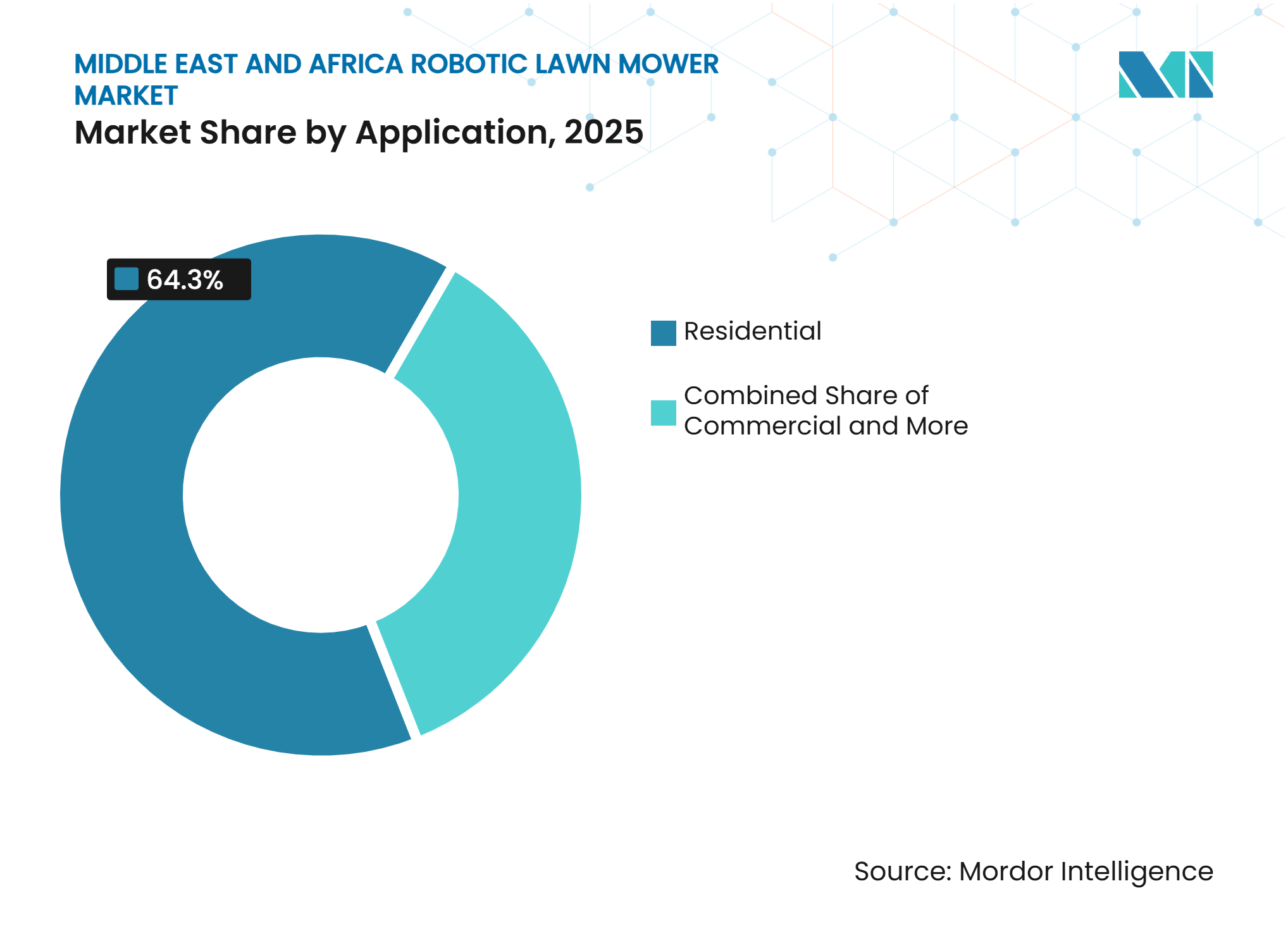
Commercial Demand Broadens the Customer BaseResidential applications held 64.3% of 2025 sales and were the largest application segment. Villa owners and managed residential compounds form the core demand base. These users value quiet operation, programmed schedules, and a well-kept lawn without frequent crew visits. The purchase decision depends on garden size, product price, and the availability of local service. Residential demand is strongest in affluent communities across the Gulf and South Africa. The Middle East and Africa robotic lawn mower market benefits from the concentration of landscaped villa developments in these locations.
Commercial applications are forecast to grow at the fastest CAGR of 12.9% from 2026 to 2031. Hotels, parks, golf courses, and sports sites have larger turf areas and more demanding maintenance schedules. These buyers assess equipment against operating continuity, labor deployment, and presentation standards. Husqvarna announced its autonomous mowing deployment at the 2026 U.S. Senior Women’s Open, showing that robotic mowing is entering professional turf-maintenance settings. Such deployments provide a reference point for buyers evaluating professional equipment. Regional commercial adoption depends on local dealer coverage and evidence of reliable performance in heat and dust.

By End-User:
Sports Grounds and Parks Create Higher-Growth DemandHomeowners held 52.6% of 2025 revenue and were the largest end-user group. They purchase products for private lawns in villas, estates, and gated communities. Ease of setup has become important because many homeowners do not want to install or repair boundary wires. App control and scheduled cutting improve the user experience for households that already use connected devices. This group still compares equipment costs with manual gardening services. The Middle East and Africa robotic lawn mower industry has a substantial homeowner base but requires stronger consumer awareness beyond established markets.
Sports Grounds and Parks is forecast to grow at the fastest CAGR of 14.8% from 2026 to 2031. Turf quality matters at facilities where surface consistency affects player use and visitor perception. Large sites also have repetitive mowing requirements that suit autonomous equipment. Husqvarna robotic mowers cut all 18 fairways at the 2025 AIG Women’s Open, according to reporting on the event. Parks and sports facilities in the region follow the same operating logic where equipment is supported locally. Municipalities, golf courses, landscaping companies, and institutional users add demand, although their purchasing cycles are longer.
By Connectivity:
Vision-Guided Systems Reduce Installation BarriersBoundary-Wire systems held 47.9% of the 2025 installed base and remained the largest connectivity group. Their installed base reflects earlier technology adoption and established operating practices. They provide defined operating boundaries at properties with stable landscaping. However, installing and repairing buried wire is inconvenient at complex sites. Smart-GPS and Wi-Fi systems reduce dependence on physical wire but require reference equipment or signal planning. The Middle East and Africa robotic lawn mower market is moving away from wire-only configurations as buyers seek simpler deployment.
Vision-Guided, Camera, and LiDAR Systems are forecast to grow at the fastest CAGR of 16.8% from 2026 to 2031. These products use onboard sensing to navigate without buried wires and simplify installation. This approach addresses a key issue for gardens with irregular boundaries or changing layouts. Buyers continue to assess sensing reliability in dust and strong sunlight. As product choice expands, the Middle East and Africa robotic lawn mower market shifts toward systems that minimize site preparation.
Geography Analysis
The Middle East held 68.5% of 2025 revenue and was the largest sub-region. The United Arab Emirates and Saudi Arabia combine high-value development with concentrated hospitality and residential landscaping. Dubai Municipality’s 2026 roadmap targets 120 new parks covering nearly 3 million square meters and 1.5 million trees over 5 years. These projects require planned maintenance, particularly where public spaces use permanent irrigated lawns. The Middle East and Africa robotic lawn mower market presents a stronger commercial opportunity, with property managers deploying equipment across multiple sites. Oman and other Middle Eastern markets have narrower demand pools centered on estates, corporate campuses, and hospitality properties.
Saudi Arabia offers a sizable long-term opportunity because green-space programs accompany wider urban and tourism development. Green Riyadh’s planned tree planting and public-space investment support the broader maintenance environment. The United Arab Emirates benefits from dense clusters of villas, resorts, and professionally managed communities. Qatar had 127 public parks and more than 3 million square meters of developed green space, as reported in 2025[3]. Iran and Oman have smaller immediate markets due to purchasing constraints, service limitations, and uneven product availability. Across the sub-region, quiet electric operation aligns with urban maintenance requirements, although local laws do not create a robotic-mower-specific mandate.
Africa is forecast to grow at the fastest CAGR of 10.7% from 2026 to 2031. South Africa is the regional anchor because it has suburban estate demand and an established robotic mower presence. Hospitality and landscaped commercial sites underpin demand in other African markets, while dealer coverage and affordability limit adoption. The Middle East and Africa robotic lawn mower market develops unevenly across Africa until local support networks are more established.
Competitive Landscape
Market Concentration
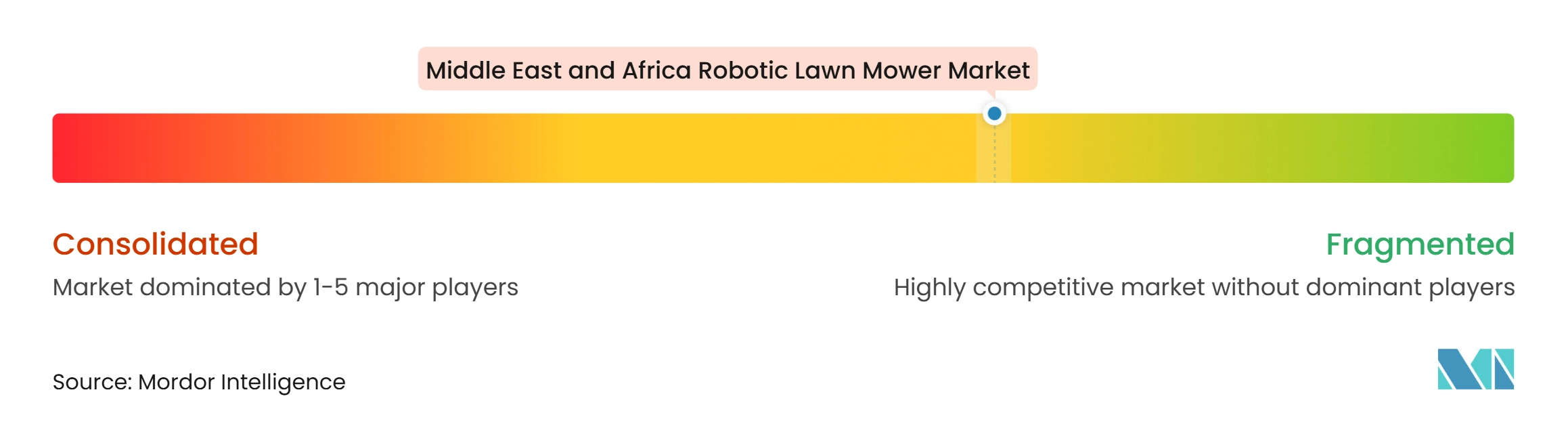
The Middle East and Africa robotic lawn mower market is fragmented across residential and commercial channels. Husqvarna AB, Positec Group Ltd., GARDENA, MAMMOTION, and Dreame Global are visible brands in the region. Husqvarna AB has a professional turf portfolio and a dealer base in parts of sub-Saharan Africa. GARDENA operates within Husqvarna AB and serves consumer channels with its smart SILENO product range. Competition centers on wire-free navigation, coverage capability, local availability, and after-sales support.
Strategic activity centers on reducing setup time and expanding coverage for larger sites. Husqvarna AB introduced 13 wire-free robotic lawnmowers in February 2025, including retail-oriented GARDENA models. Positec Group Ltd. announced USD 250 million in equity financing in January 2025 for global autonomous mowing expansion and Kress commercial penetration. STIGA S.p.A. launched 8 autonomous robot mowers in March 2026 using its Vista camera-navigation technology. Suppliers that pair product launches with trained local support establish a more durable commercial position.
Commercial buyers evaluate products for dependable performance in heat, dust, sand, and uneven terrain. Vendors that demonstrate these attributes address a local operating concern. Rapid parts supply and fleet support also shape decisions by commercial accounts. Digital-first brands gain awareness through online channels, but physical service remains important after purchase.
Middle East and Africa Robotic Lawn Mower Industry Leaders
-
Husqvarna AB
-
Positec Group Ltd.
-
GARDENA
-
Makita Corporation
-
Greenworks Tools Canada Inc
- *Disclaimer: Major Players sorted in no particular order
Middle East and Africa Robotic Lawn Mower Market Companies Covered in this Report
- Husqvarna AB
- Positec Group Ltd.
- GARDENA
- Makita Corporation
- Greenworks Tools Canada Inc
- Dreame Global
- STIHL Pty Ltd
- STIGA S.p.A.
- Robert Bosch Power Tools GmbH
- YAMABIKO Corporation (Belrobotics)
- Zucchetti Centro Sistemi S.p.a. (Ambrogio Robot )
- Robomow
- MAMMOTION
- Navimow
- AL-KO Geräte GmbH
Recent Industry Developments in Middle East and Africa Robotic Lawn Mower Market
- September 2026: Navimow unveiled the H5 Pro with an extendable arm for zero-edge mowing, reducing the manual edge work that can limit product value for managed properties
- March 2026: STIGA S.p.A. launched 8 wire-free autonomous mowers using Vista camera-navigation technology for areas from 600 square meters to 14,000 square meters, expanding options for residential and commercial sites with different coverage needs.
- January 2026: Positec Group Ltd. launched Landroid Vision Cloud without boundary wires or a local base station, which can reduce installation barriers for prospective buyers.
Middle East and Africa Robotic Lawn Mower Market Report Scope
A robotic lawn mower is an autonomous device equipped with sensors and programming to perform grass-cutting tasks without human intervention. These are used for residential and commercial purposes by homeowners, apartment owners, in parks and playgrounds, and in other places.
The Middle East and Africa Robotic Lawn Mower Market Report is Segmented by Range (Low Range, Medium Range, and High Range), by Battery Capacity (Less Than 20 V, 20 to 30 V, and More Than 30 V), by Sales Channel (Retailers, Specialty Stores and Online), by Application (Residential and Commercial), by End-User (Homeowners, Landscaping Companies, Sports Grounds and Parks, Municipalities, Golf Courses and Others), by Connectivity (Boundary-Wire, Smart-GPS / Wi-Fi and Vision-Guided) and by Geogrpahy (Middle East and Africa). The Market Forecasts are Provided in Terms of Value (USD).
Segmentation Overview
| Low Range |
| Medium Range |
| High Range |
| Less Than 20 V |
| 20 to 30 V |
| More Than 30 V |
| Retailers |
| Specialty Stores |
| Online |
| Residential |
| Commercial |
| Homeowners |
| Landscaping Companies |
| Sports Grounds and Parks |
| Municipalities |
| Golf Courses |
| Others |
| Boundary-Wire |
| Smart-GPS / Wi-Fi |
| Vision-Guided (Camera/LiDAR) |
| Middle East | United Arab Emirates |
| Saudi Arabia | |
| Iran | |
| Oman | |
| Rest of Middle East | |
| Africa | South Africa |
| Rest of Africa |
| By Range | Low Range | |
| Medium Range | ||
| High Range | ||
| By Battery Capacity | Less Than 20 V | |
| 20 to 30 V | ||
| More Than 30 V | ||
| By Sales Channel | Retailers | |
| Specialty Stores | ||
| Online | ||
| By Application | Residential | |
| Commercial | ||
| By End-User | Homeowners | |
| Landscaping Companies | ||
| Sports Grounds and Parks | ||
| Municipalities | ||
| Golf Courses | ||
| Others | ||
| By Connectivity | Boundary-Wire | |
| Smart-GPS / Wi-Fi | ||
| Vision-Guided (Camera/LiDAR) | ||
| By Geography | Middle East | United Arab Emirates |
| Saudi Arabia | ||
| Iran | ||
| Oman | ||
| Rest of Middle East | ||
| Africa | South Africa | |
| Rest of Africa | ||
Key Questions Answered in the Report
What is the projected value of the Middle East and Africa robotic lawn mower market in 2031?
The Middle East and Africa robotic lawn mower market is forecast to reach USD 156.0 million by 2031.
What drives robotic lawn mower adoption in the Middle East and Africa?
Premium green spaces, labor constraints, and demand for quiet mowing support adoption.
Which connectivity type grows fastest from 2026 to 2031?
Vision-Guided, Camera, and LiDAR Systems are forecast to grow at the fastest CAGR of 16.8% from 2026 to 2031.
Which countries have the strongest demand base?
The United Arab Emirates, Saudi Arabia, and South Africa have the strongest demand base.