
Middle East and Africa Prefabricated Bathroom Modules Market Size and Share
Market Overview
| Study Period | 2020 - 2031 |
|---|---|
| Forecast Data Period | 2026 - 2031 |
| Base Year Market Size (2025) | USD 0.11 Billion |
| Market Size (2026) | USD 0.12 Billion |
| Market Size (2031) | USD 0.18 Billion |
| Growth Rate (2026 - 2031) | 8.45 % |
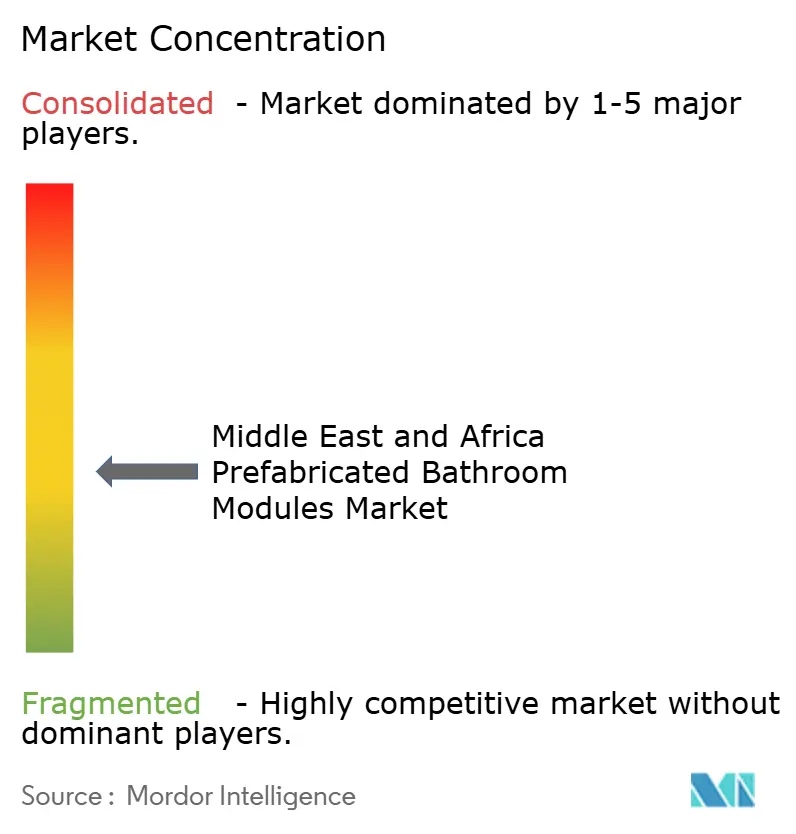
| Market Concentration | Medium |
Major Players *Disclaimer: Major Players sorted in no particular order Image © Mordor Intelligence. Reuse requires attribution under CC BY 4.0. | |
Middle East and Africa Prefabricated Bathroom Modules Market Analysis by Mordor Intelligence
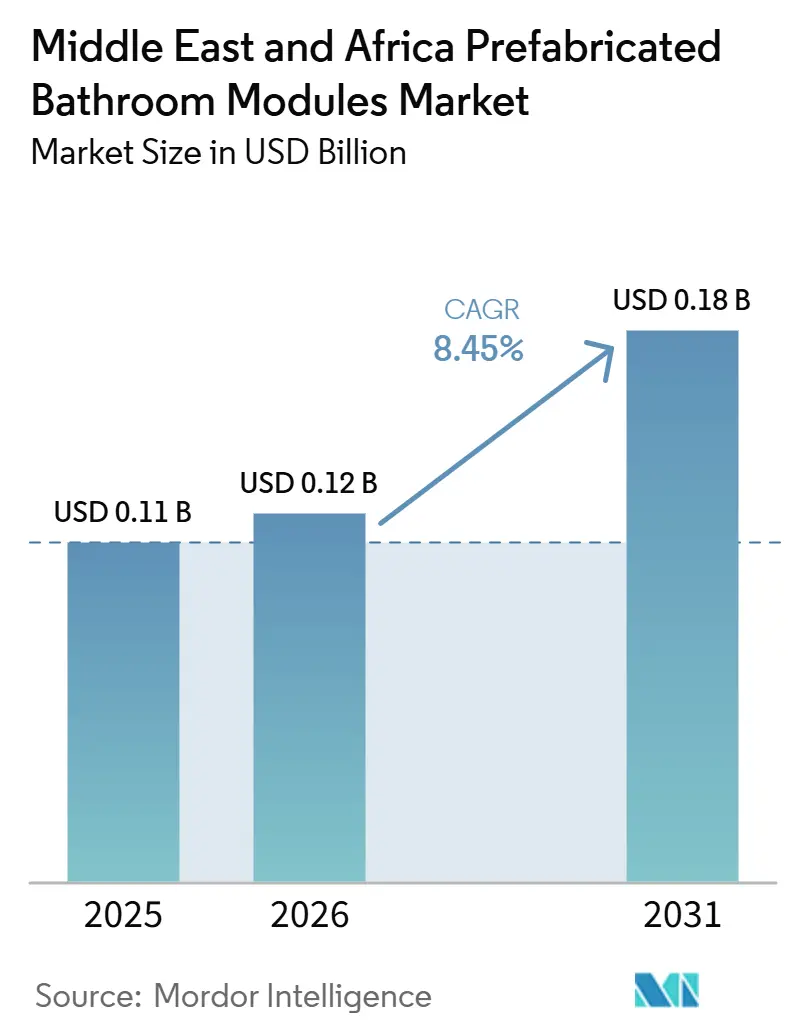
The Middle East And Africa Prefabricated Bathroom Modules Market size is expected to grow from USD 0.11 billion in 2025 to USD 0.12 billion in 2026 and is forecast to reach USD 0.18 billion by 2031 at 8.45% CAGR over 2026-2031.
Large hospitality, healthcare, residential, and worker accommodation programs are increasing the need for repeatable bathroom construction across the Gulf Cooperation Council. Developers are seeking shorter installation schedules, consistent finishes, and less dependence on specialized on-site trades. Factory production also supports quality control, as projects that require documented waterproofing, antimicrobial surfaces, and predictable handover schedules. These conditions strengthen the position of suppliers that can coordinate designs early and deliver within local approval requirements. The Middle East and Africa prefabricated bathroom modules market also faces pressure from import dependence, transport constraints, and differing building approvals across countries.
Key Report Takeaways
- By product type, steel framed modules held 37.80% of the Middle East and Africa prefabricated bathroom modules market share in 2025, while hybrid modules are forecast to grow at a 10.30% CAGR through 2031.
- By installation type, new build represented 75.60% of the Middle East and Africa prefabricated bathroom modules market size in 2025, while retrofit and renovation are forecast to grow at a 9.20% CAGR through 2031.
- By end user, hospitality accounted for 36.7% of the Middle East and Africa prefabricated bathroom modules market share in 2025, while healthcare is forecast to grow at a 10.10% CAGR through 2031.
- By country, Saudi Arabia held 34.90% of regional demand in 2025, while the United Arab Emirates is forecast to grow at a 10.60% CAGR through 2031.
Note: Market size and forecast figures in this report are generated using Mordor Intelligence’s proprietary estimation framework, updated with the latest available data and insights as of January 2026.
Middle East and Africa Prefabricated Bathroom Modules Market Trends and Insights
Drivers Impact Analysis*
| Drivers | (~) % Impact on CAGR Forecast | Geographic Relevance | Impact Timeline |
|---|---|---|---|
| Mega Projects Accelerate Bathroom Module Demand | +2.3% | Saudi Arabia and the United Arab Emirates giga-project corridors | Short term (≤ 2 years) |
| Skilled Wet-Trade Labor Shortages Drive Offsite Construction | +1.7% | Global, concentrated in the United Arab Emirates and Saudi Arabia | Short term (≤ 2 years) |
| Factory-Verified Quality Supports Module Adoption | +1.1% | United Arab Emirates, Saudi Arabia, and South Africa | Medium term (2-4 years) |
| Hygiene Compliance Increases Healthcare and Hospitality Demand | +0.9% | Saudi Arabia, United Arab Emirates, and Egypt | Medium term (2-4 years) |
| Digital Design Coordination Improves Module Integration | +0.7% | United Arab Emirates and Saudi Arabia | Medium term (2-4 years) |
| Industrialized Construction Adoption Supports Demand | +0.6% | Saudi Arabia, South Africa, and Egypt | Long term (≥ 4 years) |
| Source: Mordor Intelligence | |||
Mega Projects Accelerate Bathroom Module Demand
Projects in Saudi Arabia and the United Arab Emirates have driven the Middle East and Africa prefabricated bathroom modules market toward wider use in hospitality, housing, healthcare, and worker accommodation, as their standardized room formats can be specified and tested before site delivery. Large developments need repeated room layouts and fixed completion schedules, which favor factory-made units over sequential site work. New Murabba Development Company issued a January 2026 request for information on bathroom, kitchen, and dressing room modules for the 375-meter Mukaab towers in Riyadh. DuPod began supplying 5,642 bathroom pods for 6 mid-rise towers at Al Marjan Island in 2026, showing the order volumes now associated with resort-led development in the United Arab Emirates[1]DuPod, “DuPod Commences Work on Record-Breaking Bathroom Pod Contract at Al Marjan Island,” DuPod, . These programs allow capable suppliers to plan capacity across several projects rather than pursue isolated contracts. They also increase the value of local fabrication, logistics planning, and product files that meet Gulf Cooperation Council (GCC) requirements.
Skilled Wet-Trade Labor Shortages Redirect Construction Procurement Toward Offsite
The availability of certified tilers, plumbers, and waterproofing specialists remains important to the Middle East and Africa prefabricated bathroom modules market, particularly when developers must finish many hotel rooms or clinical spaces to one documented standard. Bathroom fit-out brings several trades into a small area, so delays in any one activity can affect the project handover date. Offsite production removes much of the tiling, waterproofing, and pipe fitting work from the site sequence. This can make labor planning more predictable for developers managing multiple buildings. The benefit is strongest where high volumes of similar rooms allow manufacturers to repeat the same design and inspection process. It also makes early coordination between the developer, designer, structural contractor, and pod supplier more important.
Factory-Verified Quality Supports Module Adoption
The Middle East and Africa prefabricated bathroom modules market benefits when hotel owners and healthcare developers require consistent finishes across many rooms, since bathroom quality can affect guest experience, clinical usability, maintenance planning, and the timing of phased handovers. Factory environments allow suppliers to test drainage, waterproofing, electrical connections, and surface fit before dispatch. Group AMANA delivered 1,404 modular concrete studio units with fitted bathrooms for the AMAALA Staff Village in June 2026. The project reported a 30% reduction in construction time, a 35% reduction in on-site workforce, and a 70% improvement in HSE metrics across 2.5 million safe person-hours. George Sanitary Ware delivered 420 modular bathroom units to a medical and elderly care hospital in Jeddah, in compliance with Saudi Building Code and Saudi Central Board for Accreditation of Healthcare Institutions requirements. Such reference projects can support repeat orders when developers want comparable quality across a portfolio.
Hygiene Compliance Increases Healthcare and Hospitality Demand
Healthcare specifications are raising the technical requirements for prefabricated bathroom modules in the Middle East and Africa, where material selection, drainage details, accessibility, and cleanable surface transitions are considered together. Seamless waterproofing, controlled drainage, durable finishes, and antimicrobial surfaces are easier to verify before a unit arrives on site. MODUPOD supplied 317 customized bathroom pods for the Suleiman Al-Habib Hospital in Saudi Arabia, including antimicrobial materials and enhanced soundproofing. The company also delivered bathroom modules for hotel projects, demonstrating that suppliers can apply controlled production methods across multiple end uses. Healthcare accreditation and green building requirements can narrow the field to manufacturers that maintain documented quality systems. This favors suppliers that can demonstrate compliance from product design through installation.
Restraints Impact Analysis*
| Restraints | (~) % Impact on CAGR Forecast | Geographic Relevance | Impact Timeline |
|---|---|---|---|
| Transport and Crane Access Constraints Increase Complexity | -0.8% | United Arab Emirates and Saudi Arabia, dense urban cores and remote giga-project sites | Short term (≤ 2 years) |
| Fragmented Approval and Fire Safety Requirements Delay Delivery | -0.6% | Middle East and Africa-wide, especially Gulf Cooperation Council (GCC) cross-border projects | Medium term (2-4 years) |
| Limited Local Specialized Materials Restrict Production | -0.5% | Saudi Arabia, Egypt, and South Africa | Medium term (2-4 years) |
| Imported Component Dependence Increases Costs | -0.4% | Middle East and Africa-wide | Long term (≥ 4 years) |
| Source: Mordor Intelligence | |||
Transport and Crane Access Constraints Increase Complexity
Bathroom modules require careful handling from the factory through final installation, which can limit the schedule benefit of off-site delivery. Units usually occupy 3-6 cubic meters when packing frames are included, so dense city sites need planned unloading areas and lifting windows. Central Riyadh and Downtown Dubai can impose crane access restrictions, traffic plans, and permit lead times. Remote projects need coordinated land or marine transport, temporary crane pads, and controlled delivery routes. Heavy concrete units are more affected by these requirements than lighter steel-framed and GRP alternatives. The result is a practical advantage for products that balance structural performance with lower transport and installation complexity.
Fragmented Approval and Fire Safety Requirements Delay Delivery
The Middle East and Africa prefabricated bathroom modules market operates under separate rules for fire resistance, acoustics, plumbing, and structural certification, which means a proven module cannot always be moved from one country to another without additional review. Saudi Building Code requirements, United Arab Emirates Civil Defence processes, and South African National Standards can require different technical submissions. Manufacturers may need to prepare separate product files even when a module design is unchanged. This can add administrative time before a supplier converts a project opportunity into an order. Suppliers with local testing records and established approval experience can therefore hold an advantage over first-time entrants. The same condition encourages manufacturers to build regional compliance teams and standardize their documentation.
*Our forecasts treat driver/restraint impacts as directional, not additive. The impact forecasts reflect baseline growth, mix effects, and variable interactions.
Segment Analysis
By Product Type: Steel Framed Modules Lead While Hybrid Modules Gain Momentum
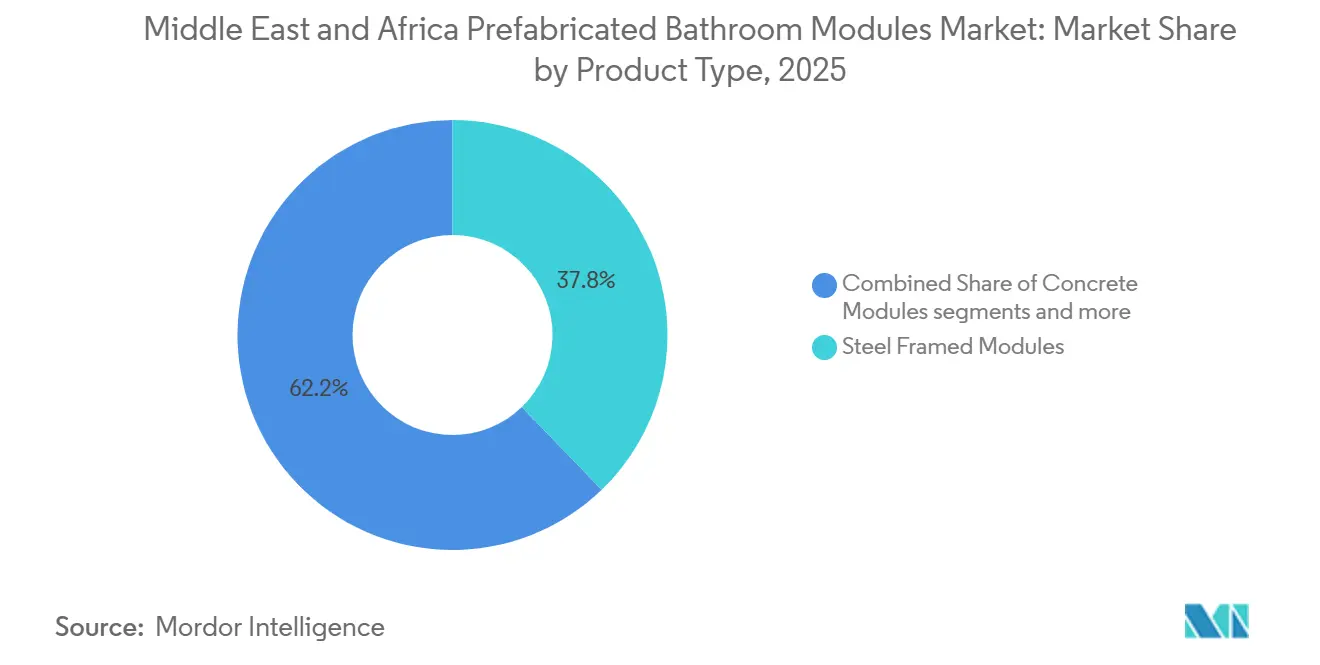
Steel framed modules held 37.80% of regional revenue in 2025. Steel frames suit high-rise residential and hospitality projects because they can be lifted into place without requiring substantial changes to the building design. Their use is relevant to the tall hotel and apartment developments that remain common in Dubai and Riyadh. Hybrid modules are expected to grow at a 10.30% CAGR through 2031. They combine a structural steel frame with GRP or composite interior finishes, which support both lifting performance and smooth internal surfaces. Product selection in the Middle East and Africa prefabricated bathroom modules market is therefore tied to building height, lifting methods, transport access, surface requirements, and the degree of design repetition achievable in a project.
Concrete modules remain relevant in volume housing and worker accommodation programs where permanent structural performance and thermal mass are valued. Group AMANA used concrete modular units for the AMAALA Staff Village, demonstrating the role of this approach in large Saudi projects[2]Group AMANA, “Saudi: Group AMANA Delivers 1,400 Modular Concrete Studio Units at AMAALA,” Group AMANA. Their weight can limit use at high-rise sites or remote locations, leaving space for steel and hybrid systems. GRP units are useful for corrosion resistance and lighter crane handling at coastal developments. Timber-based systems remain limited, with use focused on projects that prioritize low-carbon embodied materials. The prefabricated bathroom modules industry is likely to see hybrid designs gain attention, as developers seek structural strength and a premium internal finish from a single unit. Digital production systems can also improve repeatability when the same module is supplied across many rooms.


By Installation Type: New Build Remains the Main Demand Base
New build installations accounted for 75.60% of the Middle East and Africa prefabricated bathroom modules market in 2025. Greenfield resorts, smart cities, health facilities, and new housing schemes continue to shape regional construction activity. These projects can include pod locations and service routes at the design stage, which reduces later coordination work. The large share of new build demand reflects the scale of planned construction rather than replacement activity. It also allows suppliers to produce long runs of standardized units for repeated room types. In the Middle East and Africa prefabricated bathroom modules market, this early design certainty can reduce changes after manufacturing begins and provide contractors with clearer installation sequences.
Retrofit and renovation are expected to expand at a 9.20% CAGR through 2031. Hotel assets from the 2000s are approaching major refurbishment cycles, and modules can help operators renew bathrooms while keeping part of the property open. The approach may reduce structural disruption compared with a conventional strip-out and rebuild. It is also relevant to hospitals that update bathroom finishes as infection-control requirements change. Temporary, relocatable units provide worker accommodation at major construction sites and may be redeployed during later project phases. This reuse model provides developers with a different cost structure compared to a one-time, permanent installation. The prefabricated bathroom modules industry can serve these different needs when units are designed for removal, access, and reuse.
By End User: Hospitality Leads While Healthcare Grows Fastest
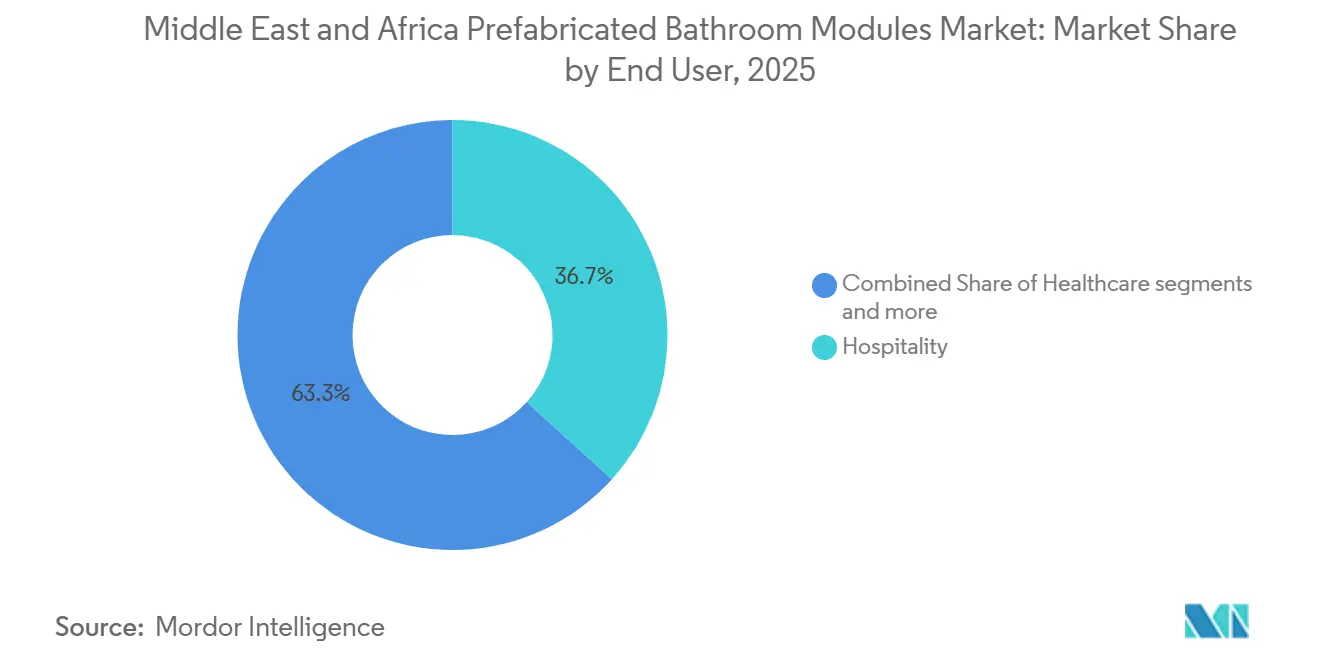
Hospitality retained 36.70% of regional revenue in 2025. Hotel groups need consistent room finishes, and pods can support a repeated bathroom design across a large property. The scale of DuPod's 5,642-pod contract for the Nikki Beach and Rosso Bay project illustrates how resort developments can create high-volume demand. Healthcare is projected to grow at a 10.10% CAGR through 2031. New clinical facilities require bathrooms that meet controlled-surface, drainage, accessibility, and waterproofing specifications. The Middle East and Africa prefabricated bathroom modules market can address these needs when manufacturers retain test records and use repeatable inspection processes for every unit.
MODUPOD delivered 833 bathroom pods for a Madinah hotel development and 317 units for the Suleiman Al-Habib Hospital. These deliveries demonstrate how a regional supplier can serve hospitality and healthcare from a single manufacturing base. Residential demand is supported by standardized housing programs that require large quantities of similar units. MODUPOD reported cumulative delivery of 2,500 bathroom pods to ElSeif Development Company in Saudi Arabia as of January 2026. Commercial offices remain a smaller part of demand but can benefit from replaceable, factory-sealed systems during refurbishment. Education facilities, transport hubs, and retail properties add demand where public procurement adopts performance-based construction specifications. The prefabricated bathroom modules industry, therefore, depends on both high-volume standardized projects and specialized compliance-led applications.

Geography Analysis
Saudi Arabia held 34.90% of the Middle East and Africa prefabricated bathroom modules market in 2025. Its project pipeline spans tourism, housing, healthcare, and worker accommodation, allowing suppliers to use similar manufacturing processes across several customer groups. Developers are increasingly considering modular production early in procurement, rather than treating it only as a late construction alternative. Group AMANA delivered 1,404 modular concrete studio units for the AMAALA Staff Village in June 2026, including fully fitted bathrooms. The project reported a 30% reduction in construction time and a 35% reduction in on-site workforce. Saudi Building Code, healthcare accreditation, and green building requirements increase the value of factory-controlled quality records. Local manufacturing investment can reduce reliance on imports over time and create more direct competition with overseas suppliers.
The United Arab Emirates is forecast to grow at a 10.60% CAGR through 2031. High-rise residential construction and resort development create demand for units that can be coordinated with building designs before structural work is complete. The Middle East and Africa prefabricated bathroom modules market benefits from this design-led approach, as early coordination reduces clashes around services and lifting routes while allowing suppliers to confirm dimensions, connection points, and installation sequences before production begins. DuPod's 2026 supply program at Al Marjan Island covered 5,642 pods across 6 mid-rise towers. The project demonstrates resort developers' ability to use a common module design at a substantial scale. The United Arab Emirates's mix of premium hospitality, residential development, and labor constraints supports demand for suppliers that can maintain finish quality and delivery discipline. This provides the Middle East and Africa prefabricated bathroom modules market with a useful reference point for projects that require close coordination among developers, contractors, and manufacturers.
South Africa, Egypt, and the rest of the region present more varied demand conditions. South African housing and workforce accommodation can favor standardized products at lower price points than premium Gulf projects. Egypt is developing demand through government and commercial construction, as well as private healthcare projects. Andalusia Health Group's development of an in-house prefabrication factory for the 225-bed Andalusia October hospital indicates growing interest in local production capacity. Qatar, Oman, Kuwait, Bahrain, and sub-Saharan markets add demand through energy, mining, tourism, and temporary accommodation projects. Suppliers entering these markets need to balance transport costs, local standards, and the scale of each project before committing capacity.
Competitive Landscape
The Middle East and Africa prefabricated bathroom modules market is moderately fragmented, with suppliers differentiated by certification, manufacturing location, design capability, and project delivery record. European specialists include Walker Modular, Offsite Solutions, Bathsystem S.p.A., Eurocomponents, BAUDET, StercheleGroup, DEBA Badsysteme GmbH, Hellweg Badsysteme GmbH, and Schwörer Fertigbad-Systeme. Chinese suppliers include Suzhou COZY House Equipment, Guangzhou Seagull Housing Industry, Hunan Xinling Housing Equipment, and Changsha Broad Homes Industrial Group. Regional operators, including Al Bandar Pre-Fabricated Houses and Al Arab Prefab Houses, benefit from local manufacturing, logistics advantages, and familiarity with country-specific approval processes. International suppliers differentiate themselves through advanced engineering capabilities, product customization, and established quality systems, while regional manufacturers compete through faster project execution and local market expertise.
Technology adoption is becoming a key competitive differentiator in the Middle East and Africa prefabricated bathroom modules market. BAUDET integrated SOLIDWORKS and the 3DEXPERIENCE platform into its bathroom unit design and manufacturing process in 2025, creating a connected workflow across design, manufacturing, and installation. StercheleGroup expanded BIM integration to link design data with production codes and material bills, improving production accuracy and traceability. These developments demonstrate how manufacturers are using digital engineering to reduce design-to-production errors and strengthen project delivery. DuPod's 2026 Al Marjan Island contract further highlights the importance of manufacturing scale and Design for Manufacturing and Assembly (DfMA) capabilities in securing large hospitality projects.
Strategic opportunities continue to emerge in healthcare-compliant bathroom systems, hybrid modules with steel frames and GRP interiors, and removable pods for hotel refurbishment. Large developers are increasingly adopting framework agreements that favor suppliers with proven production capacity, consistent quality, and strong compliance records across multiple projects. As a result, competition is expected to remain centered on technical expertise, manufacturing reliability, regulatory compliance, and project execution rather than price alone. Although opportunities remain for new participants in specialized applications and underserved markets, established suppliers with strong regional delivery capabilities and certification experience are expected to maintain a competitive advantage.
Middle East and Africa Prefabricated Bathroom Modules Industry Leaders
Walker Modular
Offsite Solutions
Bathsystem S.p.A.
Interpod
DEBA Badsysteme GmbH
- *Disclaimer: Major Players sorted in no particular order

Recent Industry Developments
- June 2026: Group AMANA delivered 1,404 modular concrete studio units, each with fully fitted bathrooms, for Red Sea Global's AMAALA Staff Village in Saudi Arabia, achieving a 30% reduction in construction time, a 35% reduction in on-site workforce, and a 70% improvement in HSE metrics across 2.5 million safe person-hours. The project demonstrated that concrete module production can operate at scale on a complex desert-coastal project while addressing accommodation needs for a major tourism development. It also provided a regional delivery reference for developers considering modular construction, where site labor, safety management, quality control, and program duration must be managed together.
- March 2026: DuPod commenced work at Al Marjan Island, Ras Al Khaimah, supplying 5,642 bathroom pods across 6 mid-rise towers for the Nikki Beach and Rosso Bay Beachfront Apartments project. The project uses a DfMA-led approach, with first dispatch from May 2026 and completion targeted for February 2027. The contract is the largest by pod quantity in DuPod's history and reflects the scale of bathroom pod procurement in United Arab Emirates resort development. It also shows the production planning required when 1 supplier must align repeated bathroom designs, dispatch sequencing, crane access, and installation across several towers within a single waterfront project.
- January 2026: MODUPOD confirmed cumulative delivery of 2,500 bathroom pod units to ElSeif Development Company in Saudi Arabia. The delivery indicates the commercial scale achieved by a Yanbu-based manufacturer working within Saudi residential and commercial programs. It highlights the relevance of local production capacity in the Middle East and Africa prefabricated bathroom modules market, where shorter supply routes and local familiarity can support developer procurement requirements.


Middle East and Africa Prefabricated Bathroom Modules Market Report Scope
The Middle East and Africa Prefabricated Bathroom Modules Market Report is Segmented by Product Type (Steel Framed Modules, Concrete Modules, Hybrid Modules, and More), Installation Type (New Build, and More), End User (Hospitality, Healthcare, Residential, Commercial Offices, and Others), and Geography (United Arab Emirates, Saudi Arabia, South Africa, Egypt, and More). The Market Forecasts are Provided in Terms of Value (USD).
| Steel Framed Modules |
| Concrete Modules |
| Hybrid Modules |
| Glass Reinforced Plastic Modules |
| Timber-Based Modules |
| New Build |
| Retrofit and Renovation |
| Temporary and Relocatable Units |
| Hospitality |
| Healthcare |
| Residential |
| Commercial Offices |
| Others |
| United Arab Emirates |
| Saudi Arabia |
| South Africa |
| Egypt |
| Rest of Middle East and Africa |
| By Product Type | Steel Framed Modules |
| Concrete Modules | |
| Hybrid Modules | |
| Glass Reinforced Plastic Modules | |
| Timber-Based Modules | |
| By Installation Type | New Build |
| Retrofit and Renovation | |
| Temporary and Relocatable Units | |
| By End User | Hospitality |
| Healthcare | |
| Residential | |
| Commercial Offices | |
| Others | |
| By Country | United Arab Emirates |
| Saudi Arabia | |
| South Africa | |
| Egypt | |
| Rest of Middle East and Africa |


Key Questions Answered in the Report
What is the forecast for Middle East and Africa prefabricated bathroom modules demand?
The regional value is forecast to increase from USD 0.12 billion in 2026 to USD 0.18 billion by 2031 at an 8.45% CAGR. Growth is linked to hotel, healthcare, housing, and worker accommodation projects that need repeated bathroom layouts and reliable delivery schedules. Demand is also supported when developers plan bathroom design, factory production, transport, lifting, and installation as one coordinated part of the wider construction program, rather than treating bathroom finishing as a sequence of separate on-site trades.
Which product type held the largest share in 2025?
Steel framed modules led with 37.80% in 2025 because they suit high-rise residential and hospitality projects. They can be lifted into structural frames and provide a practical base for a range of internal finishes.
Which end-user application is growing fastest?
Healthcare is expected to expand at a 10.10% CAGR through 2031, supported by controlled quality and hygiene requirements. Factory production helps suppliers test waterproofing, drainage, accessibility, and surface details before installation.
Why are bathroom pods used in Gulf projects?
Developers use them to coordinate repeated room designs, reduce on-site trade work, and maintain consistent finishes across large projects. The approach is particularly useful when room layouts, service routes, and lifting plans can be established early.
Which country is expected to grow fastest through 2031?
The United Arab Emirates is forecast to grow at a 10.60% CAGR, supported by residential and resort construction. The 5,642-pod Al Marjan Island project illustrates the type of high-volume hospitality order that supports this demand.
Page last updated on:





