
Middle East and Africa Modern Methods Of Construction Market Size and Share
Market Overview
| Study Period | 2021 - 2032 |
|---|---|
| Forecast Data Period | 2027 - 2032 |
| Base Year Market Size (2026) | USD 13.04 Billion |
| Market Size (2027) | USD 14.10 Billion |
| Market Size (2032) | USD 20.85 Billion |
| Growth Rate (2027 - 2032) | 8.14 % |
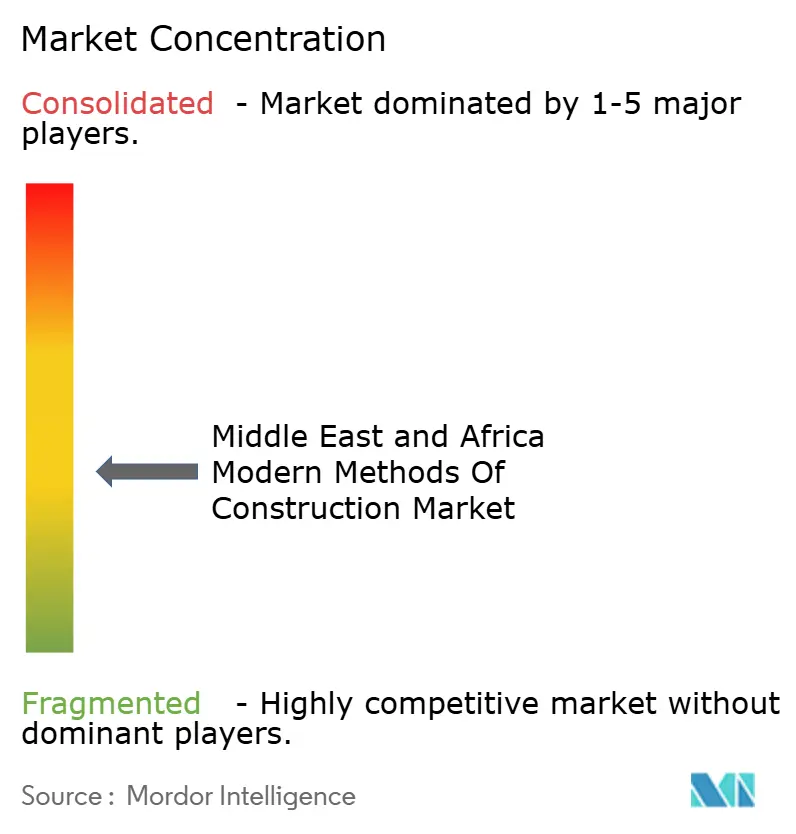
| Market Concentration | Medium |
Major Players *Disclaimer: Major Players sorted in no particular order Image © Mordor Intelligence. Reuse requires attribution under CC BY 4.0. | |
Middle East and Africa Modern Methods Of Construction Market Analysis by Mordor Intelligence
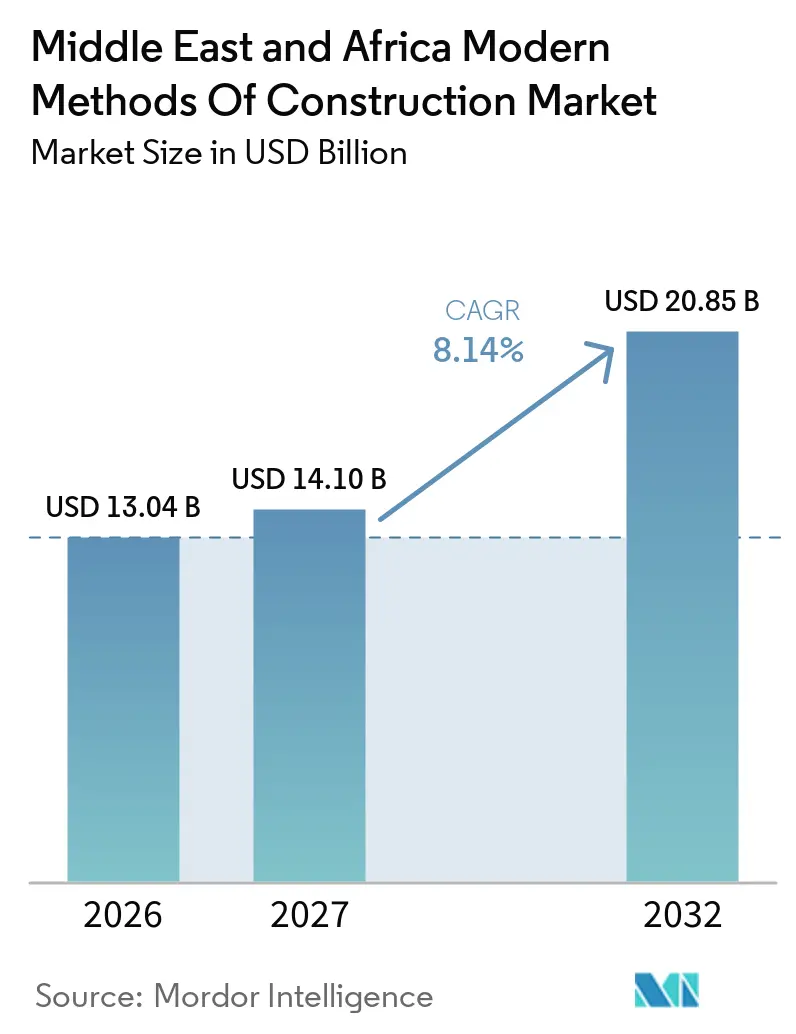
The Middle East And Africa Modern Methods Of Construction Market size is projected to expand from USD 13.04 billion in 2026 and USD 14.10 billion in 2027 to USD 20.85 billion by 2032, registering a CAGR of 8.14% between 2027 and 2032.
The Middle East and Africa modern methods of construction market is supported by Gulf development programs and the need for faster housing delivery across African countries. Saudi Arabia’s project pipeline generates concentrated demand for repeatable building solutions, while housing shortages across Africa drive demand for scalable, lower-cost construction systems. The market also benefits from developers’ increasing need for predictable factory quality, shorter construction schedules, and reduced reliance on on-site labor. Suppliers are responding through local production facilities, modular systems, and integrated delivery models that combine design, manufacturing, transportation, and installation. However, project pacing, limited factory capacity outside major hubs, logistics challenges, and financing conditions remain key constraints for the Middle East and Africa modern methods of construction market.
Key Report Takeaways
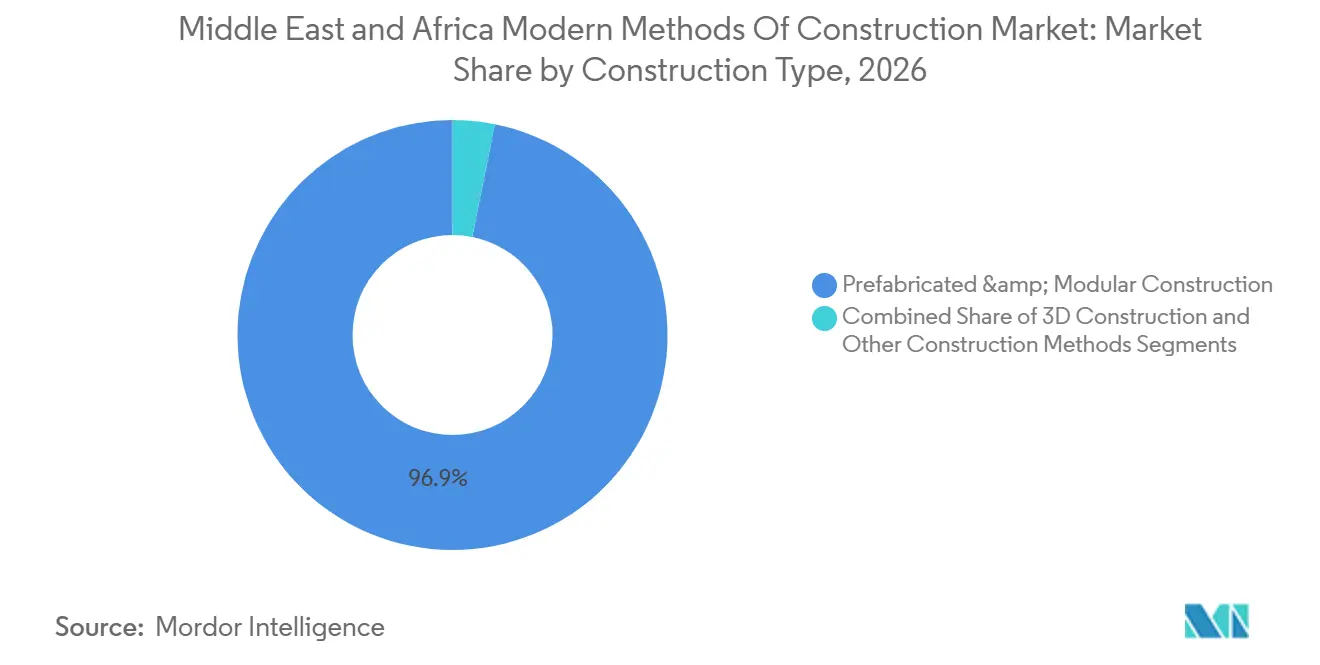
- By construction type, prefabricated and modular construction held 96.85% of the Middle East and Africa modern methods of construction market share in 2026, while 3D construction is forecast to grow at a 39.6% CAGR through 2032.
- By material type, concrete accounted for 45.6% of the Middle East and Africa modern methods of construction market size in 2026, while timber is forecast to expand at a 9.49% CAGR through 2032.
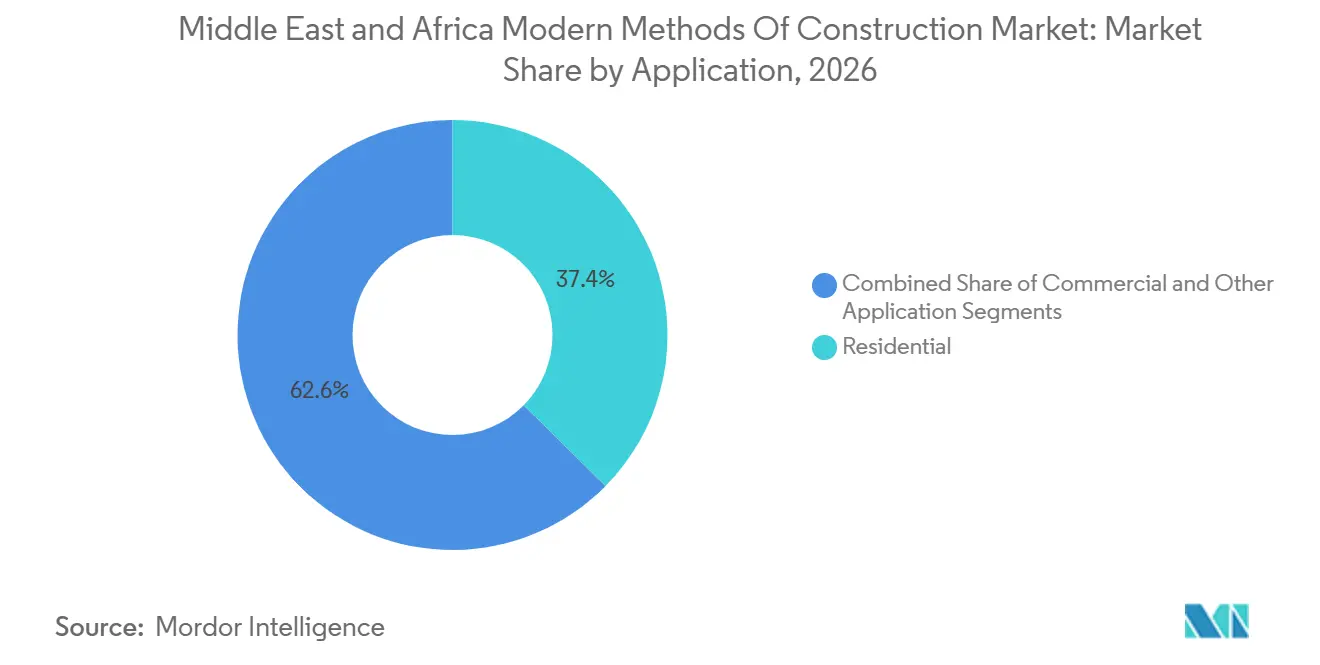
- By application, residential held a 37.4% share in 2026, while commercial is forecast to grow at a 9.07% CAGR through 2032.
- By geography, Saudi Arabia held a 22.22% share in 2026, while Saudi Arabia is forecast to grow at an 8.37% CAGR through 2032.
Note: Market numbers in this report are based on Mordor Intelligence's proprietary estimation framework, which combines nine months of actuals with Q4 projections for base year 2026.
Middle East and Africa Modern Methods Of Construction Market Trends and Insights
Drivers Impact Analysis*
| Drivers | (~) % Impact on CAGR Forecast | Geographic Relevance | Impact Timeline |
|---|---|---|---|
| Megaproject and New-City Development in the Gulf | +2.5% | Saudi Arabia, UAE, Qatar, with spillover to Egypt and Jordan | Short term (≤ 2 years) |
| Affordable Housing and Rapid Urban Population Growth | +1.5% | Nigeria, Egypt, South Africa, and Ivory Coast, with secondary relevance in Saudi Arabia and UAE | Medium term (2-4 years) |
| Extreme-Climate Requirements for Factory-Controlled Quality | +1% | Saudi Arabia, UAE, Qatar, Kuwait, Bahrain, and North Africa | Medium term (2-4 years) |
| Fast Workforce Accommodation and Institutional Building Demand | +0.8% | Saudi Arabia, UAE, Oman, Qatar, Nigeria, and South Africa | Short term (≤ 2 years) |
| Government Localization and Industrial-Diversification Programs | +0.5% | Saudi Arabia, UAE, Morocco, and Egypt | Long term (≥ 4 years) |
| African Infrastructure and Housing Delivery Gaps | +0.3% | Nigeria, Democratic Republic of the Congo, Zambia, Kenya, Ghana, and Ivory Coast | Long term (≥ 4 years) |
| Source: Mordor Intelligence | |||
Megaproject and New-City Development in the Gulf
Saudi Arabia’s Vision 2030 program combines NEOM, Diriyah, AMAALA, Qiddiya, the Red Sea Project, and King Salman International Airport into a substantial demand pipeline. These projects require buildings in remote or greenfield locations, where skilled labor and conventional supply chains remain limited. They also operate under fixed delivery schedules and require repeated development of accommodation, residential, and hospitality buildings. This demand profile favors standardized components that manufacturers can produce before sites are ready, supporting the Middle East and Africa modern methods of construction market. DORCE is expected to deliver a modular living city for 10,000 people at the NEOM OXAGON Pioneer Camp in 2025, demonstrating the scale required by giga-project clients[1]. Permanent buildings that must meet Leadership in Energy and Environmental Design (LEED) Gold requirements favor manufacturers with documented factory quality systems over suppliers that rely solely on on-site assembly.
Affordable Housing and Rapid Urban Population Growth
Africa’s housing shortage exceeded 56 million units in 2025, with Nigeria accounting for 17 million units, according to a peer-reviewed study published in 2025. Conventional housing programs have not kept pace with urban population growth, creating demand for repeatable construction systems that require less on-site labor. Consequently, the Middle East and Africa modern methods of construction market supports public housing programs that require large volumes of standardized housing units. In March 2025, the International Finance Corporation approved a USD 27 million local-currency loan for Douja Promotion Groupe Addoha Ivory Coast to develop 5,600 affordable homes in Grand Abidjan[2]. This financing represented the International Finance Corporation’s first direct funding for a residential developer in West Africa and included 4,600 homes for middle- and lower-income households. Such project financing supports panelized and modular construction systems, as lenders can evaluate repeatable construction outputs rather than assess individual project designs.
Extreme-Climate Requirements for Factory-Controlled Quality
High temperatures across the Arabian Peninsula limit outdoor construction activity during the hottest periods. Heat-protection regulations in Saudi Arabia and the United Arab Emirates also restrict working hours when conditions become unsafe[3]. Factory-based production can sustain output during these periods while providing more consistent conditions for precast concrete production and modular assembly. This quality advantage gives the Middle East and Africa modern methods of construction market a practical role in projects with stringent delivery schedules and performance requirements.
On-site concrete placement may experience variations in workability, hydration, strength development, and long-term performance when heat-control measures are inadequate. In 2025, Dubai Municipality approved DuBox’s modular construction system, recognizing factory production as a defined quality-control method.
Fast Workforce Accommodation and Institutional Building Demand
Giga-project sites in Saudi Arabia require worker housing faster than conventional contractors can typically deliver. In 2025, Red Sea International disclosed a USD 70.87 million contract with Baker Hughes Saudi Arabia to design, build, supply, and operate furnished modular camps in the Eastern Province through November 2031. The camps include offices, dining facilities, laundry services, a gymnasium, and a mosque, demonstrating the broader institutional scope of modular projects. The rapid delivery of these facilities provides the Middle East and Africa modern methods of construction market with a clear advantage in projects where operations cannot wait for conventional on-site construction. A 2026 peer-reviewed study found that light-gauge steel and hybrid systems ranked highly for Egyptian school construction based on technical performance, regulatory compliance, and delivery speed. Public agencies, oil and gas operators, and hospitality clients increasingly require short delivery timelines, making factory-based output a practical project requirement.
Restraints Impact Analysis*
| Restraints | (~) % Impact on CAGR Forecast | Geographic Relevance | Impact Timeline |
|---|---|---|---|
| Limited Local Manufacturing Capacity Outside Major Hubs | -1.5% | Sub-Saharan Africa, inland Saudi Arabia, and Oman | Long term (≥ 4 years) |
| Desert, Port, and Long-Haul Logistics Constraints | -1.2% | NEOM corridor, Saudi Red Sea coast, and Sub-Saharan African hinterland | Medium term (2-4 years) |
| Fragmented Approval and Certification Processes | -0.8% | Pan-MEA, particularly Nigeria, Egypt, South Africa, and non-Gulf Middle East markets | Medium term (2-4 years) |
| Foreign-Exchange, Project-Finance, and Contractor-Credit Risk | -0.6% | Nigeria, Egypt, South Africa, Democratic Republic of the Congo, and Ghana | Medium term (2-4 years) |
| Source: Mordor Intelligence | |||
Limited Local Manufacturing Capacity Outside Major Hubs
Precast and modular facilities require sustained order volumes to justify fixed investments. Current production clusters are concentrated in Dammam, Riyadh, Dubai Industrial City, and Egypt’s 6th of October City industrial area. As a result, remote Gulf locations and much of Sub-Saharan Africa rely on long-distance supply chains, which reduce the scheduling benefits of off-site delivery. This capacity gap limits the ability of the Middle East and Africa modern methods of construction market to serve geographically dispersed demand efficiently. A 2025 peer-reviewed study identified limited local production capacity as a key constraint on the adoption of modern methods of construction in Nigeria. In 2025, Zambia commissioned a USD 12 million prefabricated housing plant with an annual capacity of more than 300 homes, highlighting the capital investment required to establish a new production node.
Desert, Port, and Long-Haul Logistics Constraints
Volumetric modules require specialized transport, storage, road access, port handling, and on-site lifting equipment. Remote locations along the Saudi Red Sea coast and in inland Oman may lack the necessary receiving infrastructure. High transport temperatures can also affect modules, requiring controlled storage before installation. In West and East Africa, poor road conditions, customs processing delays, and limited port capacity can extend the movement of heavy cargo by several weeks. These constraints can erode the cost and time advantages that factory production is expected to offer the Middle East and Africa modern methods of construction market. They also make panelized and hybrid systems more suitable than full volumetric modules in locations with limited freight capacity.
*Our forecasts treat driver/restraint impacts as directional, not additive. The impact forecasts reflect baseline growth, mix effects, and variable interactions.
Segment Analysis
By Construction Type: Prefabricated Systems Lead; 3D Printing Redefines the Growth Ceiling
Prefabricated and modular construction is projected to account for 96.85% of the Middle East and Africa modern methods of construction market in 2026, supported by established GCC investment in precast concrete, panelized steel, and volumetric modular production. In the Middle East and Africa modern methods of construction market, panelized systems include structural insulated panels, light-gauge steel panels, and timber- or wood-frame panels used in residential and institutional projects. Volumetric steel, timber, and concrete modules serve hospitality, health care, and worker accommodation projects. In May 2026, Group AMANA received a USD 185.2 million contract for Lantana Hills in Dubai. The company is delivering 2,730 DuBox modular units and 2,020 DuPod bathroom pods for the 390-townhouse community. The project uses a combined module-and-pod approach and targets 85% off-site completion.
3D construction is forecast to expand at a CAGR of 39.6% through 2032, making it the fastest-growing construction type. In the Middle East and Africa modern methods of construction market, concrete printing is transitioning from pilot projects to commercial applications in Saudi Arabia, the United Arab Emirates, and Egypt. In 2026, Artificial Engineering used the MASAR concrete printer for the ADRENA entertainment district at Red Sea Global. Layn Technologies operates proprietary printers for developers, including Sodic and Mountain View, in Egypt. However, the region lacks a common certification framework for structural 3D concrete printing, limiting its near-term adoption in multistory structural applications.

By Material Type: Concrete Dominates; Timber Gains Structural Ground
Concrete is projected to account for 45.6% of the Middle East and Africa modern methods of construction market in 2026. Established limestone and aggregate supplies, precast plants, and demand for mid-rise and high-rise structural performance support its leading position. Residential programs in Saudi Arabia and Egypt use insulated precast panels and autoclaved aerated concrete blocks. Metal systems, primarily pre-engineered steel and light-gauge steel, remain important for buildings requiring large spans and rapid fabrication. In July 2026, Zamil Steel Egypt is expected to ship 10,000 metric tons in a single month, demonstrating the region's pre-engineered building capacity.
Timber is forecast to grow at a CAGR of 9.49% through 2032, the highest rate among material types. Cross-laminated timber and light timber-frame panels are gaining traction in low-rise housing projects in South Africa and Morocco, as well as sustainable development projects in the United Arab Emirates. GSO 3000:2025, which is expected to adopt the Global Sustainability Assessment System as a Gulf standard, will support the consideration of bio-based materials in regional sustainability assessments. A review expected in 2025 indicates that compressed earth blocks in Rwanda could reduce wall costs by up to 60%, highlighting the relevance of locally produced materials for African projects. Therefore, the material mix in the Middle East and Africa modern methods of construction industry will vary based on local material availability, building codes, and project type.
By Application: Residential Anchors Demand; Commercial Outpaces the Field
Residential is projected to account for 37.4% of the Middle East and Africa modern methods of construction market in 2026. Demand in this segment is driven by worker accommodation for Saudi giga-projects and government-backed affordable housing programs in Egypt, South Africa, and Nigeria. Group AMANA is delivering 1,404 modular studio units across 27 buildings, covering 81,000 square meters, for the AMAALA Staff Village. The project is expected to record more than 2.5 million safe person-hours, highlighting the operational scale of large residential modular construction projects. Industrial, institutional, energy, utility, and transport projects also require specialized modules that meet specific mechanical, electrical, plumbing, and certification requirements.
The commercial segment is forecast to grow at a CAGR of 9.07% through 2032, supported by hotel development and data center construction. In August 2026, CIMC Modular Building is expected to ship 104 modules for Earth Hotels Riyadh, including 96 guestrooms across three floors. The company estimates that the project will achieve a schedule reduction of more than 40% and generate 70% less on-site waste than conventional construction methods. Factory-assembled mechanical, electrical, and plumbing skids can also reduce commissioning times for data center projects. Standardized rooms, shorter delivery timelines, and predictable schedules will support commercial segment growth in the Middle East and Africa modern methods of construction market.
Geography Analysis
Saudi Arabia is projected to account for 22.22% of regional value in 2026 and register an 8.37% CAGR through 2032. Giga-projects impose stringent requirements for certification, local content, and the rapid delivery of repetitive building designs. In 2026, Saudi Roshn is expected to report that it sources 60% of its supplies domestically, creating opportunities for local precast and modular construction producers. The Saudi Building Code and the regional GSO 3000:2025 sustainability standard serve as key compliance references for suppliers. Dubai Municipality’s approval of DuBox provides a regulatory precedent for other Gulf municipalities.
Turkey remains an important external production base for the Middle East and Africa modern methods of construction market, exporting prefabricated buildings to more than 100 countries. DORCE has delivered projects in Saudi Arabia, Nigeria, Sudan, and Morocco, leveraging its geographic position and steel supply relationships. Oman, Qatar, Kuwait, Bahrain, Jordan, and Iraq have smaller but technically demanding requirements, including remote oil and gas camps, post-conflict housing, and institutional buildings. Larsen & Toubro operates a modular fabrication joint venture yard in Sohar with an annual capacity of 60,000 metric tons. These markets offer specialized opportunities despite having lower total project volumes than Saudi Arabia.
South Africa has a relatively mature regulatory and financial base for precast and structural steel fabrication. Afripanel supplies modular buildings from Kempton Park to Zambia, Namibia, and other Southern African Development Community markets. Nigeria’s housing deficit of 17 million to 20 million units and its 100,000-unit Renewed Hope Cities and Estates program demonstrate the scale of unmet demand. Ivory Coast, the Democratic Republic of the Congo, Zambia, Kenya, Morocco, and Egypt can generate significant medium-term volumes when housing plans are supported by funded and bankable procurement structures. Foreign exchange volatility, project financing constraints, contractor credit risk, and fragmented approval processes remain material constraints across these markets.
Competitive Landscape
The Middle East and Africa modern methods of construction market is moderately concentrated in the Gulf but remains fragmented across African markets. Group AMANA, Red Sea International, KPC Precast, and ALEC Holdings hold strong positions in the Gulf through manufacturing assets, regulatory approvals, and relationships with sovereign developers. Their delivery models typically integrate design, factory production, transportation, mechanical, electrical, and plumbing (MEP) work, and on-site assembly. This integrated approach reduces coordination risks for projects with demanding delivery schedules. In May 2026, Zamil Structural Steel is expected to sign a USD 96.7 million contract for the Baladna dairy project in Algeria, expanding its pre-engineered building activities into North Africa’s agri-industrial sector.
Compliance also influences competition in the Middle East and Africa modern methods of construction market. GSO 3000:2025 and local municipal approval requirements favor suppliers that can demonstrate quality and sustainability performance. Group AMANA’s Lantana Hills award illustrates the use of volumetric modules and bathroom pods in large-scale residential developments. Similarly, Red Sea International’s contract with Baker Hughes highlights demand for operational workforce accommodation, rather than the supply of physical modules alone.
High-rise modular systems, 3D concrete printing, health care facilities, data centers, and battery energy storage systems represent areas in which suppliers are developing differentiated capabilities. In February 2026, BROAD Group is expected to complete the 16-story Earth Tower in Abu Dhabi using 259 prefabricated Holon stainless-steel modules. The company plans to assemble the modules on site within 96 hours following a 30-day manufacturing phase. Artificial Engineering and Layn are using proprietary 3D concrete printing systems for projects requiring more customized forms. African markets remain accessible to Turkish, Chinese, and South African suppliers that can operate with lower local fixed costs. Consequently, the Middle East and Africa modern methods of construction market combines a small group of established Gulf suppliers with a broader, less concentrated base of regional importers and local fabricators.
Middle East and Africa Modern Methods Of Construction Industry Leaders
-
Group AMANA
-
Red Sea International
-
ALEC Holdings
-
Zamil Steel / Zamil Structural Steel
-
DORCE Prefabricated Building and Construction
- *Disclaimer: Major Players sorted in no particular order
Recent Industry Developments
- July 2026: ALEC Holdings and AtkinsRéalis announced their design-and-build partnership to deliver Sphere Abu Dhabi on Yas Island, a USD 1.7 billion project for the Department of Culture and Tourism, Abu Dhabi, scheduled to open in 2029. ALEC leads construction delivery using its modular and prefabrication capabilities while AtkinsRéalis provides multidisciplinary design and supervision.
- May 2026: Group AMANA secured a USD 185.2 million contract from Dubai Holding Asset Management to deliver Lantana Hills, a 390-townhouse community at Dubai Science Park. The project deploys 2,730 DuBox volumetric modular units and 2,020 DuPod bathroom pods, with 85% of construction completed off-site and handover targeted for H2 2027.
- May 2026: Zamil Structural Steel signed a USD 96.7 million contract with Elegancia Steel Co. to design, manufacture, and supply pre-engineered steel structures and insulated cladding for Baladna Algeria S.P.A.’s dairy project in Adrar, Algeria. Execution runs from May 2026 to November 2027.
Middle East and Africa Modern Methods Of Construction Market Report Scope
| Prefabricated & Modular Construction | Panelized Systems | Structural Insulated Panels (SIPs) |
| Timber / Wood Frame Panels | ||
| Light Gauge Steel (LGS) Panels | ||
| Others | ||
| Volumetric Modules | Steel-Framed Volumetric Modules | |
| Timber-Framed Volumetric Modules | ||
| Concrete (Precast/Monolithic) Volumetric Modules | ||
| Others | ||
| Hybrid Modular Construction | ||
| 3D Construction | Extrusion Method | |
| Power Bonding Method | ||
| Others | ||
| Other Construction Methods | ||
| Concrete |
| Glass |
| Metal |
| Timber |
| Other Material Type |
| Residential |
| Commercial |
| Other Application (Industrial, Institutional, Energy and Utilities, Infrastructure) |
| Middle East | United Arab Emirates |
| Saudi Arabia | |
| Turkey | |
| Rest of Middle East | |
| Africa | South Africa |
| Nigeria | |
| Rest of Africa |
| By Construction Type | Prefabricated & Modular Construction | Panelized Systems | Structural Insulated Panels (SIPs) |
| Timber / Wood Frame Panels | |||
| Light Gauge Steel (LGS) Panels | |||
| Others | |||
| Volumetric Modules | Steel-Framed Volumetric Modules | ||
| Timber-Framed Volumetric Modules | |||
| Concrete (Precast/Monolithic) Volumetric Modules | |||
| Others | |||
| Hybrid Modular Construction | |||
| 3D Construction | Extrusion Method | ||
| Power Bonding Method | |||
| Others | |||
| Other Construction Methods | |||
| By Material Type | Concrete | ||
| Glass | |||
| Metal | |||
| Timber | |||
| Other Material Type | |||
| By Application | Residential | ||
| Commercial | |||
| Other Application (Industrial, Institutional, Energy and Utilities, Infrastructure) | |||
| By Geography | Middle East | United Arab Emirates | |
| Saudi Arabia | |||
| Turkey | |||
| Rest of Middle East | |||
| Africa | South Africa | ||
| Nigeria | |||
| Rest of Africa | |||
Key Questions Answered in the Report
What is the forecast growth rate for modern methods of construction in the Middle East and Africa?
The sector is forecast to grow at an 8.14% CAGR from 2027 to 2032, reaching USD 20.85 billion by 2032. Growth is supported by Gulf development programs, factory-controlled quality needs, workforce accommodation demand, commercial project schedules, and the need for faster housing delivery across Africa.
Which construction type has the largest share in the Middle East and Africa?
Prefabricated and modular construction held a 96.85% share in 2026, supported by established precast, panelized steel, and volumetric modular supply chains. These systems serve residential, institutional, hospitality, and worker accommodation projects, particularly where repeated building layouts and controlled delivery schedules are required.
Why is 3D construction growing quickly in the region?
3D construction is forecast to grow at a 39.6% CAGR through 2032 as concrete printing moves into commercial use in Saudi Arabia, the United Arab Emirates, and Egypt. It is particularly suited to customized architectural elements, although the lack of a unified structural certification standard remains a constraint.
Which material is growing fastest for off-site construction projects?
Timber is forecast to grow at a 9.49% CAGR through 2032, supported by sustainability standards and use in lower-rise residential projects. Its role differs by country because locally available bio-based materials can improve supply security.
Which country leads regional demand?
Saudi Arabia held a 22.22% share in 2026 and is forecast to grow at an 8.37% CAGR through 2032 because of giga-project demand and localization programs. Its delivery requirements favor suppliers with local manufacturing and documented quality systems.
What limits wider adoption across African countries?
Limited local factories, transport and port constraints, fragmented approvals, and financing risks can reduce the time and cost benefits of off-site building systems. These conditions can make panelized systems more practical than large volumetric modules in remote areas and can delay wider procurement adoption.