
Middle East and Africa Home and Furnishing Technical Textile Market Size and Share
Market Overview
| Study Period | 2021 - 2032 |
|---|---|
| Forecast Data Period | 2027 - 2032 |
| Base Year Market Size (2026) | USD 525 Million |
| Market Size (2027) | USD 549 Million |
| Market Size (2032) | USD 784 Million |
| Growth Rate (2027 - 2032) | 7.39 % |
| Market Concentration | Medium |
Major Players *Disclaimer: Major Players sorted in no particular order Image © Mordor Intelligence. Reuse requires attribution under CC BY 4.0. | |
Middle East and Africa Home and Furnishing Technical Textile Market Analysis by Mordor Intelligence
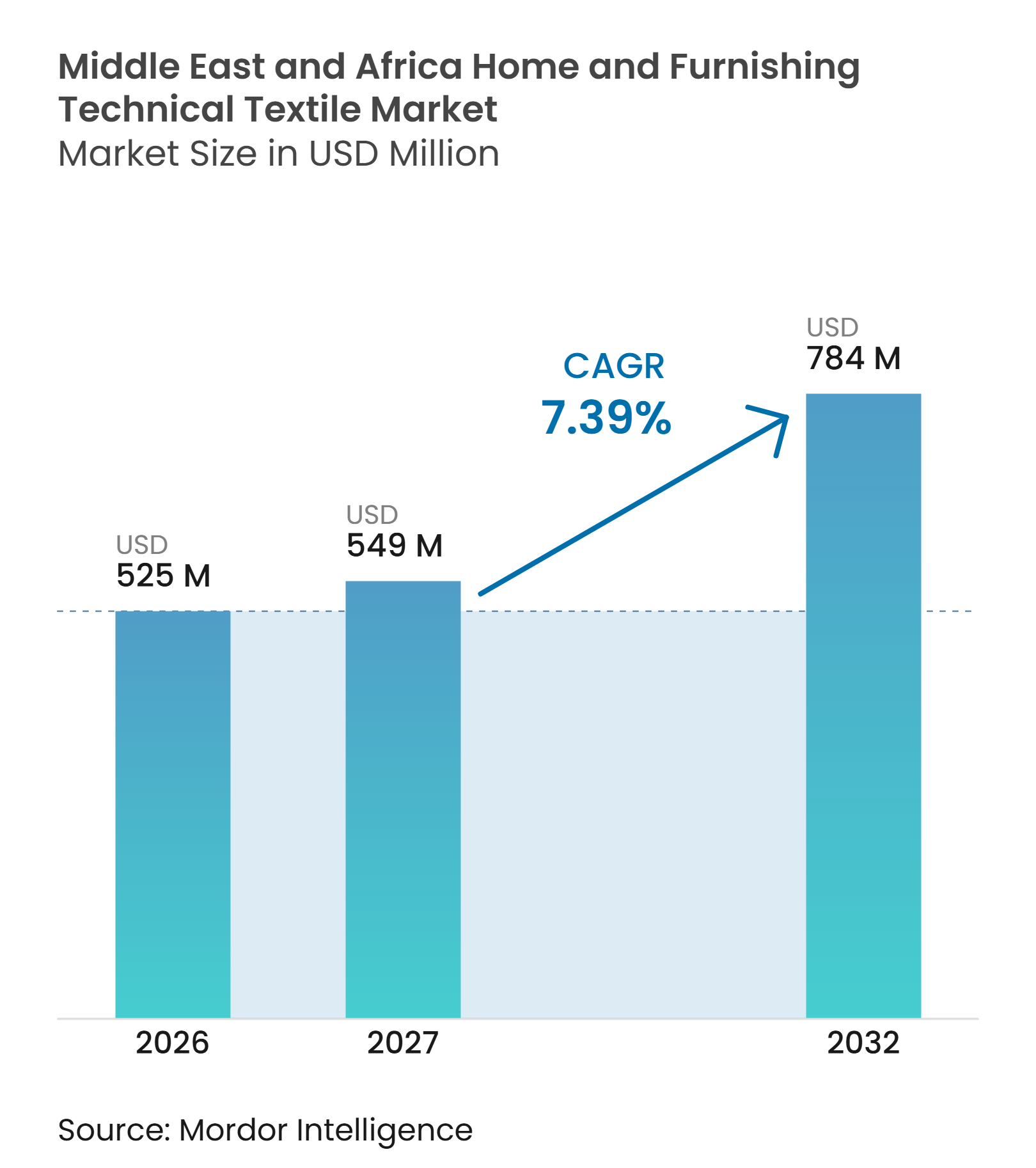
The Middle East And Africa Home And Furnishing Technical Textile Market size is expected to grow from USD 525 million in 2026 to USD 549 million in 2027 and is forecast to reach USD 784 million by 2032 at 7.39% CAGR over 2027-2032.
Growth is tied to hotel construction, new residential supply, and wider use of textiles designed for durability, heat management, hygiene, and safety. The Middle East and Africa home and furnishing technical textile market benefits when developers specify these materials early in a project because this raises the value and technical requirements of procurement. Saudi Arabia, the United Arab Emirates, and Egypt support demand through housing, hospitality, and manufacturing activity. Regional sourcing is also becoming more relevant as Egyptian and Gulf manufacturing capacity develops, reducing some dependence on distant suppliers. Input costs and shipping disruption remain material risks because producers use synthetic polymers, cotton, coatings, and other imported inputs.
Key Report Takeaways
- By product type, technical upholstery and furniture textiles accounted for 30.5% of the Middle East and Africa home and furnishing technical textile market share in 2026, while household mosquito nets and insect-screening textiles recorded the highest projected CAGR at 9.5% through 2032.
- By material type, polyester accounted for 43.5% of the Middle East and Africa home and furnishing technical textile market size in 2026, while polypropylene recorded the highest projected CAGR at 8.6% through 2032.
- By end-use application, residential households accounted for 62.0% of the Middle East and Africa home and furnishing technical textile market size in 2026, while hospitality and accommodation recorded the highest projected CAGR at 9.0% through 2032.
- By geography, Saudi Arabia held 22.0% revenue share in 2026, while Egypt recorded the highest projected CAGR at 9.4% through 2032.
Note: Market numbers in this report are based on Mordor Intelligence's proprietary estimation framework, which combines nine months of actuals with Q4 projections for base year 2026.
Market Trends and Insights
Drivers Impact Analysis of Middle East and Africa Home and Furnishing Technical Textile Market*
| Driver | (~) % Impact on CAGR Forecast | Geographic Relevance | Impact Timeline |
|---|---|---|---|
| Hospitality and Tourism Project Expansion | +1.8% | Saudi Arabia, UAE, Qatar, Egypt, and Morocco | Medium term (2-4 years) |
| Residential Construction and Home Renovation | +1.5% | Saudi Arabia, Egypt, UAE, and Rest of MEA | Short term (≤ 2 years) |
| Demand for Durable Fabrics in Heat, Dust, and High-Use Interiors | +1.2% | Saudi Arabia, UAE, Qatar, and other GCC countries | Long term (≥ 4 years) |
| E-Commerce and Digital Interior Design Adoption | +0.9% | UAE, Saudi Arabia, Egypt, South Africa, and Morocco | Short term (≤ 2 years) |
| Localization of Textile Manufacturing and Procurement | +0.7% | Saudi Arabia, Oman, Egypt, and other GCC countries | Medium term (2-4 years) |
| Regional Demand for Water- and Energy-Efficient Finishing | +0.5% | GCC countries, especially UAE and Saudi Arabia | Long term (≥ 4 years) |
| Source: Mordor Intelligence | |||
Hospitality and Tourism Project Expansion
Saudi Arabia had 401 active hotel projects with 109,320 rooms in Q3 2026, creating a large pipeline for contract textiles. Full-service hotels require upholstery, mattress ticking, carpet backing, and curtain fabrics that meet defined performance requirements. The Tourism Development Fund announced SAR 2.9 billion (USD 772.7 million) in projects at TOURISE 2025, covering 1,211 hotel keys across 5 integrated destinations.[1] Luxury and upper-upscale properties increase demand for flame-resistant and certified furnishing materials. Saudi Arabia expects 150 million domestic and international visitors by 2030, which supports continued hotel development.[2] The Middle East and Africa home and furnishing technical textile market benefits when project specifications are planned well before a hotel opens.
Residential Construction and Home Renovation
Saudi Arabia launched more than 108,000 housing units in off-plan sales during 2025, and the government is working with the private sector to deliver 300,000 additional units over 3 years.[3] New homes need mattress materials, floor coverings, filling materials, and window textiles during the initial fit-out. Homeownership rose from 47% in 2016 to 66.24% by the end of 2025, showing a larger base of owner-occupied homes. Owner-occupied homes can support more customized furnishings than rental replacement purchases. Egypt adds a volume-based demand channel because housing development and local manufacturing expansion run alongside each other. This supports the Middle East and Africa home and furnishing technical textile market through a mix of premium and broad-based residential demand.
Demand for Durable Fabrics in Heat, Dust, and High-Use Interiors
High temperatures, dust exposure, and continuous air conditioning create demanding conditions for interior textiles across GCC countries. Hospitality operators in Doha and Lusail are increasingly specifying durability, UV resistance, flame resistance, and acoustic performance at the design stage. These requirements favor technical upholstery, coatings, laminated fabrics, and spacer fabrics over decorative products with limited performance characteristics. Public spaces such as hotel lobbies, airport lounges, and government reception areas also have frequent use and recurring refurbishment needs. The UAE Civil Defence applies material testing requirements to textiles used in public and hospitality settings, including ASTM, EN, BS, and NFPA standards. This regulatory influence gives compliant suppliers a stronger position in the Middle East and Africa home and furnishing technical textile market.
E-Commerce and Digital Interior Design Adoption
Digital shopping and interior design tools are changing how homeowners and buyers select furnishing materials. Consumers increasingly use digital layouts and product information to compare fabrics against a defined interior design plan. This can favor acoustic treatments, solar-control weaves, and antimicrobial upholstery when performance information is clearly presented. Homzmart has expanded digital access to home goods across Egypt and Saudi Arabia, showing how online platforms can broaden product discovery. Faster comparison of lead times and technical features also puts pressure on retailers to replenish more quickly. That pressure supports suppliers that can serve the region with shorter delivery cycles. E-commerce is therefore widening the buyer base for the Middle East and Africa home and furnishing technical textile market without replacing professional project procurement.
Restraints Impact Analysis of Middle East and Africa Home and Furnishing Technical Textile Market*
| Restraint | (~) % Impact on CAGR Forecast | Geographic Relevance | Impact Timeline |
|---|---|---|---|
| Import Dependence and Long Replenishment Cycles | -1.5% | GCC countries, especially Saudi Arabia and UAE | Short term (≤ 2 years) |
| Volatility in Synthetic Polymer, Cotton, and Chemical Input Costs | -1.1% | GCC countries and North Africa | Short term (≤ 2 years) |
| Limited Regional Testing and Certification Infrastructure | -0.7% | GCC countries, smaller GCC states, and Sub-Saharan Africa | Medium term (2-4 years) |
| Shortage of Specialized Textile Engineering Skills | -0.4% | GCC countries and Sub-Saharan African manufacturing clusters | Long term (≥ 4 years) |
| Source: Mordor Intelligence | |||
Import Dependence and Long Replenishment Cycles
Saudi Arabia relied on imports for an estimated 78% of textile supply in 2025, leaving buyers exposed to overseas delivery schedules. Technical textiles also require polyester staple fiber, polypropylene yarn, and specialty coatings that are often sourced from outside the region. Typical lead times of 8-14 weeks can conflict with compressed hospitality construction schedules. The Local Content and Government Procurement Authority reported that local content in government procurement reached 48% at the end of 2024, compared with 43% a year earlier. This progress reduces some exposure, but significant import volumes remain. Shipping disruption can raise inventory needs, restrict product choice, and weaken the ability of smaller converters to invest in new capabilities.
Volatility in Synthetic Polymer, Cotton, and Chemical Input Costs
Polypropylene cost volatility affected carpet backing, nonwoven furniture components, filling materials, filtration textiles, and mosquito netting during 2026. Borouge reported a 13% year-on-year volume decline in Q1 2026 and identified logistics disruption as a contributing factor. Egypt's mill consumption was 158,000 metric tons in the 2024-2025 season and was expected to rise 3.4% in 2025-2026, which can tighten cotton availability for domestic processors. Smaller regional converters have less scale to absorb these changes within fixed customer contracts. Cost volatility can delay investment and put pressure on prices across the Middle East and Africa home and furnishing technical textile market.
*Our forecasts treat driver/restraint impacts as directional, not additive. The impact forecasts reflect baseline growth, mix effects, and variable interactions.
Middle East and Africa Home and Furnishing Technical Textile Market Segment Analysis
By Product Type:
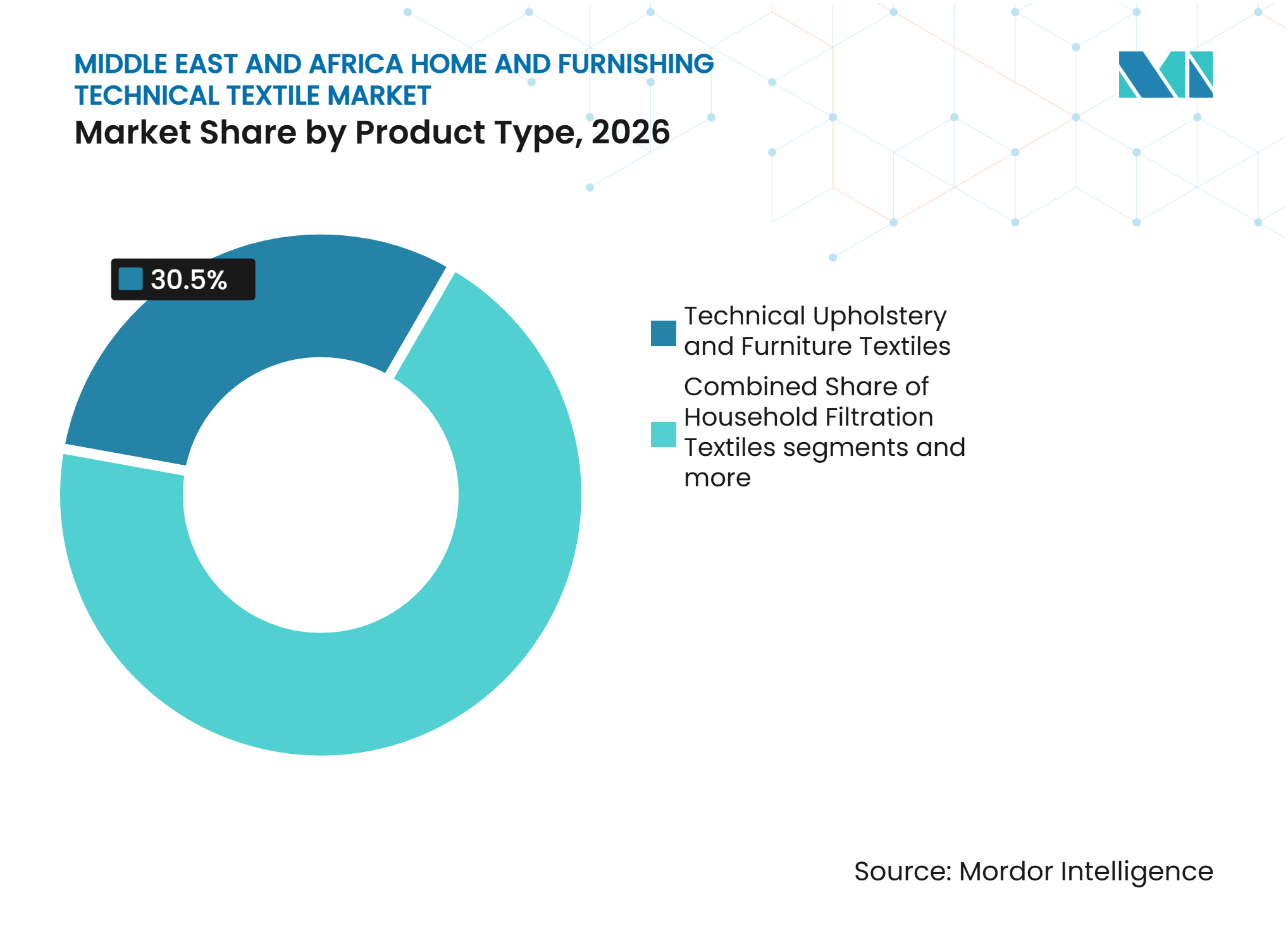
Technical Upholstery Leads as Mosquito Nets Grow FastestTechnical upholstery and furniture textiles held 30.5% of the Middle East and Africa home and furnishing technical textile market share in 2026. Luxury residential fit-outs and hospitality interiors require soil release, UV resistance, abrasion durability, and materials that retain their appearance under frequent use. Hotel projects increasingly specify these fabrics during design, not after construction. The Tourism Development Fund's hospitality projects support requirements for upholstery, mattress ticking, carpet backing, and curtains. Coated and laminated products combine appearance with barrier and cleaning performance.
Household mosquito nets and insect-screening textiles are projected to grow at a 9.5% CAGR through 2032. Public-health procurement and population growth are the main drivers in Sub-Saharan African markets. Household filtration textiles, cleaning wipes, mattress components, and floor-covering substrates serve distinct replacement cycles. The Middle East and Africa home and furnishing technical textile market size for these products is supported by institutional purchasing and routine household replacement.



By Material Type:
Polyester Remains the Core Material as Polypropylene ExpandsPolyester accounted for 43.5% of the Middle East and Africa home and furnishing technical textile market share in 2026. It is used in upholstery, mattress ticking, and fiber fill because it offers a familiar cost and performance balance. The material can receive antimicrobial, soil-release, and flame-resistant finishes for GCC hospitality projects. Polyamide remains important in premium upholstery and carpet face fibers, while acrylic and modacrylic fibers serve flame-resistant upholstery. Cotton supports residential bedding and cleaning products, including premium applications that use Egyptian long-staple varieties.
Polypropylene is forecast to expand at an 8.6% CAGR through 2032 in the Middle East and Africa home and furnishing technical textile market. It is used in nonwoven carpet backing, household filtration media, and mosquito netting because of its chemical resistance and processing flexibility. Needlepunch and spunbond formats support bedding and flooring substrates, as well as cleaning and filtration applications. Regenerated cellulosic fibers and inorganic fibers serve premium, fire-protection, and thermal-insulation applications.
By End-Use Application:
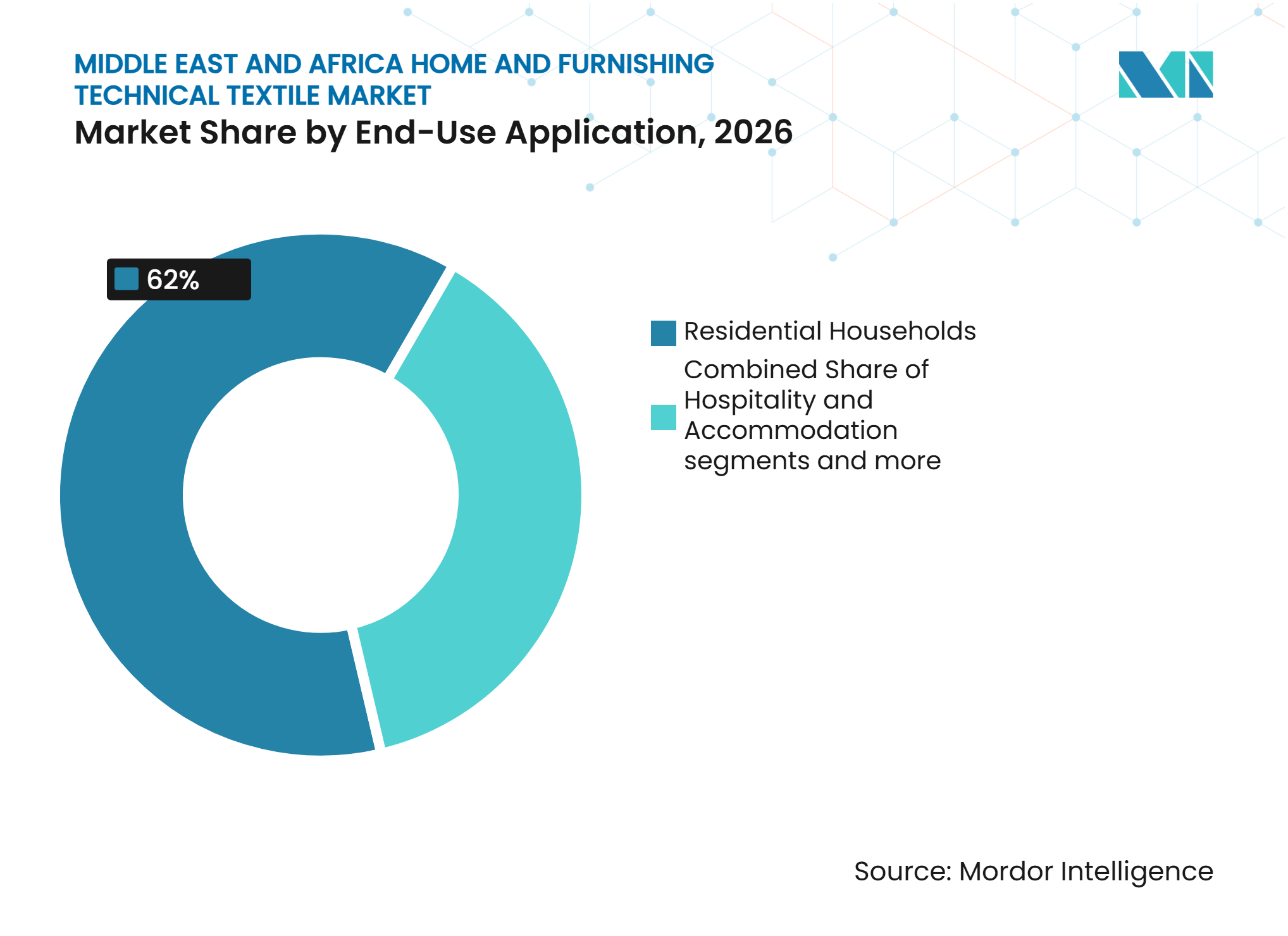
Residential Volume Supports Hospitality's Higher-Value GrowthResidential households accounted for 62.0% of the Middle East and Africa home and furnishing technical textile market size in 2026. New homes require mattress components, floor coverings, window textiles, and filling materials during fit-out. Saudi Arabia's Sakani program supported more than 28,000 families through beneficiary financing in 2026, contributing to housing-related furnishing demand. Rising urbanization, household formation, and residential development across major cities further support recurring demand for functional and decorative textile products. Offices, healthcare facilities, and public institutions also procure acoustic, durable, antimicrobial, allergen-barrier, and flame-resistant textiles. Dubai villas support customized upholstery and acoustic furnishing materials, while premium residential developments increasingly require coordinated furnishing solutions that combine aesthetics with durability and indoor comfort.
Hospitality and accommodation is projected to record a 9.0% CAGR through 2032. Hotels and resorts are the main value driver because high-end properties need several specified textile categories, including upholstery fabrics, mattress protection, blackout curtains, carpets, decorative textiles, and acoustic materials. Serviced apartments, mosques, airports, and government buildings add contract demand. Expansion of tourism infrastructure, hotel refurbishment, and investment in luxury accommodation across Saudi Arabia and the UAE further strengthen procurement opportunities. Hospitality operators also prioritize stain resistance, fire safety, ease of maintenance, and longer replacement cycles to manage operating costs. The Middle East and Africa home and furnishing technical textile market is therefore closely linked to construction and renovation schedules, tourism investment, residential handovers, and institutional infrastructure development.

Geography Analysis
Saudi Arabia: Housing Delivery and Hotel Development Support Demand
Saudi Arabia held 22.0% of the Middle East and Africa home and furnishing technical textile market share in 2026. More than 300,000 housing units have been delivered since the launch of the Sakani initiative, and homeownership reached 66.24% at the end of 2025. This housing base supports first-fit-out buying across residential fiber fill, carpet backing, and window textiles. Hotel development raises demand for flame-resistant upholstery and bedding materials. Local-content procurement and sustainability requirements favor suppliers that can provide compliance documentation, water-efficient dyeing, and recycled polymer content.
Egypt: Manufacturing Expansion Supports the Fastest Regional Growth
Egypt is projected to grow at a 9.4% CAGR through 2032, the highest rate among the covered geographies. Its spinning capacity exceeded 2.4 million spindles and 15,750 rotor spinning units in 2025. Active spinning companies increased from 36 in 2024 to 39 in 2025 as investment expanded integrated capacity. Textile and apparel exports reached USD 3.4 billion in 2025, while the sector targeted USD 4.4 billion in 2026. This production base can shorten delivery times for GCC buyers of nonwovens, carpet backing, and functional bedding components.
United Arab Emirates, South Africa, Qatar, and Rest of Middle East and Africa: Diversified Demand Broadens the Regional Base
The United Arab Emirates remains important for premium fit-outs that favor acoustic, thermal-regulating, and low-VOC textiles. South Africa supplies needlepunch nonwovens and carpet substrates, while Fibertex operates an African polypropylene nonwoven geotextile plant certified to EN durability standards. Qatar supports demand through hospitality development and independently tested flame-resistant, UV-resistant, and acoustic fabrics. Morocco, Nigeria, Kenya, other GCC countries, and East Africa add demand for mosquito netting, household wipes, and carpet backing.
Competitive Landscape
Market Concentration
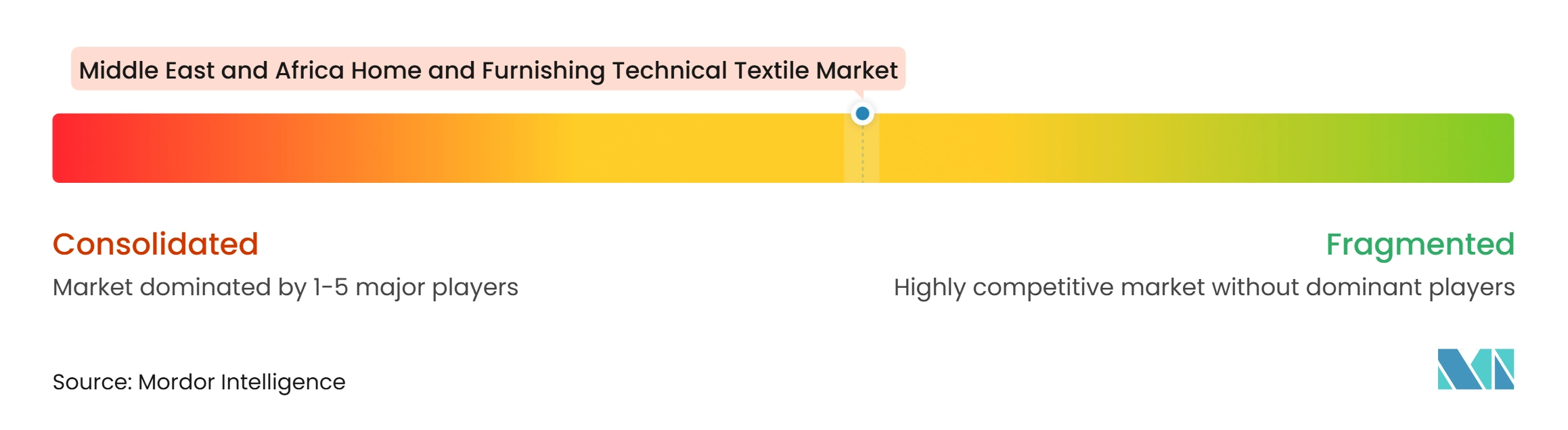
The Middle East and Africa home and furnishing technical textile market exhibits a medium level of market concentration. Saudi producers supply polypropylene yarn, carpet backing, nonwoven substrates, and finished carpets to government and hospitality customers. Local-content requirements favor domestic production in public procurement. Artex Industrial Investment Company reported SAR 413.3 million (USD 110.1 million) in consolidated revenue for the 9 months ended September 30, 2025 across its Carpets, Rugs, and Blankets divisions.
South African manufacturers support the regional supply base through needlepunch nonwovens and mattress-related materials. Fibertex Nonwovens reported continued investment in advanced nanofiltration production lines for higher-margin technical nonwovens. BekaertDeslee introduced PURIFAIR in January 2026, a mattress textile treatment designed to capture VOC molecules at the foam interface. Welspun Living deployed WelVisionAi to support real-time output, utilization, throughput, and safety monitoring.
Certification creates a barrier for smaller converters seeking public and hospitality work. Suppliers without accredited testing access can be excluded from these projects. Global suppliers compete through patented finishes, quality systems, and product documentation. Regional firms compete through local content, shorter lead times, and familiarity with domestic procurement. The available evidence does not provide combined market shares for the leading companies.
Middle East and Africa Home and Furnishing Technical Textile Industry Leaders
-
Al Abdullatif Industrial Investment Co.
-
Al Sorayai Trading and Industrial Group
-
Obeikan Technical Fabrics
-
Kazareen Textile Group
-
Da Gama Textiles
- *Disclaimer: Major Players sorted in no particular order
Middle East and Africa Home and Furnishing Technical Textile Market Companies Covered in this Report
- Al Abdullatif Industrial Investment Co.
- Al Sorayai Trading and Industrial Group
- Obeikan Technical Fabrics
- Kazareen Textile Group
- Da Gama Textiles
- Fibertex South Africa
- Richbond Industry
- Helm Textile Mills
- Weave It Textile
- Sesli Textiles
- Standerton Mills
- DesleeMattex
- Shatta
- Welspun Living Limited
- Ahlstrom Oyj
- DuPont de Nemours, Inc.
- Berry Global Group, Inc.
- Kimberly-Clark Corporation
- Toray Industries, Inc.
- Sioen Industries NV
- SRF Limited
Recent Industry Developments in Middle East and Africa Home and Furnishing Technical Textile Market
- November 2026: Artex Industrial Investment Company (Tadawul: 2340) reported Q3 2026 revenue of SAR 107.78 million (USD 28.7 million) and a net loss of SAR 32.12 million (USD 8.6 million), against prior-year revenue of SAR 112.74 million (USD 30.04 million) and a net profit of SAR 6.16 million (USD 1.6 million), reflecting near-term procurement delays in the Saudi hospitality contract pipeline and signalling competitive pressure on domestic GCC carpet and rug manufacturers.
- May 2026: AlUla Development Company (a wholly-owned Public Investment Fund entity) commenced construction on NUMAJ Autograph Collection, a 250-key luxury hotel at AlUla, Saudi Arabia, to be operated by Marriott International and expected to open in 2027, generating immediate specification and procurement cycles for high-performance hospitality upholstery, bedding components, and curtain textiles.
- March 2026: Red Sea Global confirmed that Phase One of both the Red Sea destination (Shura Island Hub) and Amaala would open by the end of 2026, together comprising 25-27 hotels, completing the first operational phase of a development that creates a large, sustained institutional procurement channel for technically specified furnishing textiles across Saudi Arabia's Red Sea coast.
- January 2026: BekaertDeslee introduced PURIFAIR, a proprietary mattress textile treatment that captures VOC molecules emitted from mattress foam cores at the source through physical molecular binding, validated by independent GC-MS gas chromatography and blinded sensory panel testing.
Middle East and Africa Home and Furnishing Technical Textile Market Report Scope
The Middle East And Africa Home and Furnishing Technical Textile Market Report is Segmented by Product Type (Technical Upholstery and Furniture Textiles, Household Filtration Textiles, and More), by Material (Polyester, Polypropylene, and More), by End-Use (Residential Households, Hospitality and Accommodation, and More), and by Geography (Saudi Arabia, South Africa, and More). The Market Forecasts are Provided in Terms of Value (USD).
Segmentation Overview
| Technical Upholstery and Furniture Textiles | Performance Upholstery Fabrics |
| Coated and Laminated Upholstery Fabrics | |
| Furniture Construction and Reinforcement Textiles | |
| Mattress Ticking and Functional Bedding Component Textiles | |
| Fibre Fill and Functional Cushioning Textiles | |
| Carpet Backing and Functional Floor Covering Textiles | |
| Interior Window Shading and Functional Curtain Textiles | |
| Household Filtration Textiles | |
| Household Cleaning and Nonwoven Wipe Textiles | |
| Household Mosquito Nets and Insect-Screening Textiles | |
| Other Specialty Home Technical Textiles (Plush and Stuffed Toy Fabrics, Specialty Acoustic Furnishing Textiles, Other Engineered Household Textile Components) |
| Polyester |
| Polypropylene |
| Polyamide |
| Acrylic and Modacrylic Fibers |
| Cotton |
| Wool and Other Animal Fibers |
| Regenerated Cellulosic Fibers |
| Glass and Other Inorganic Fibers |
| Other Materials |
| Residential Households | Furniture and Interior Furnishings |
| Bedding and Sleep Products | |
| Flooring and Window Coverings | |
| Household Cleaning, Filtration, and Other Applications | |
| Hospitality and Accommodation | Hotels and Resorts |
| Serviced Apartments and Other Accommodation | |
| Offices and Commercial Interiors | |
| Healthcare and Care Facilities | |
| Education and Public Institutions | |
| Other Contract and Institutional Interiors |
| Saudi Arabia |
| United Arab Emirates |
| South Africa |
| Egypt |
| Qatar |
| Rest of Middle East and Africa |
| By Product Type | Technical Upholstery and Furniture Textiles | Performance Upholstery Fabrics |
| Coated and Laminated Upholstery Fabrics | ||
| Furniture Construction and Reinforcement Textiles | ||
| Mattress Ticking and Functional Bedding Component Textiles | ||
| Fibre Fill and Functional Cushioning Textiles | ||
| Carpet Backing and Functional Floor Covering Textiles | ||
| Interior Window Shading and Functional Curtain Textiles | ||
| Household Filtration Textiles | ||
| Household Cleaning and Nonwoven Wipe Textiles | ||
| Household Mosquito Nets and Insect-Screening Textiles | ||
| Other Specialty Home Technical Textiles (Plush and Stuffed Toy Fabrics, Specialty Acoustic Furnishing Textiles, Other Engineered Household Textile Components) | ||
| By Material Type | Polyester | |
| Polypropylene | ||
| Polyamide | ||
| Acrylic and Modacrylic Fibers | ||
| Cotton | ||
| Wool and Other Animal Fibers | ||
| Regenerated Cellulosic Fibers | ||
| Glass and Other Inorganic Fibers | ||
| Other Materials | ||
| By End-Use Application | Residential Households | Furniture and Interior Furnishings |
| Bedding and Sleep Products | ||
| Flooring and Window Coverings | ||
| Household Cleaning, Filtration, and Other Applications | ||
| Hospitality and Accommodation | Hotels and Resorts | |
| Serviced Apartments and Other Accommodation | ||
| Offices and Commercial Interiors | ||
| Healthcare and Care Facilities | ||
| Education and Public Institutions | ||
| Other Contract and Institutional Interiors | ||
| By Geography | Saudi Arabia | |
| United Arab Emirates | ||
| South Africa | ||
| Egypt | ||
| Qatar | ||
| Rest of Middle East and Africa | ||
Key Questions Answered in the Report
What is the forecast growth rate for home and furnishing technical textiles in the Middle East and Africa?
The sector is projected to grow at a 7.39% CAGR from 2027 to 2032, reaching USD 784.00 million by 2032.
Which product category leads demand in the Middle East and Africa?
Technical Upholstery and Furniture Textiles led with a 30.5% share in 2026, supported by hospitality and premium residential fit-outs.
Which material is most widely used for furnishing technical textiles?
Polyester held a 43.5% share in 2026 because it is used in upholstery, mattress ticking, and fiber fill applications.
Why is Saudi Arabia important for furnishing textile suppliers?
Saudi Arabia held a 22.0% share in 2026 and has substantial housing and hotel development that requires fit-out and contract materials.
Why is Egypt growing faster than other geographies?
Egypt is forecast to grow at 9.40% CAGR through 2032, supported by expansion in spinning capacity, textile exports, and domestic demand.
What is the main risk facing suppliers in this sector?
Import dependence and volatility in polymer, cotton, and chemical costs can raise working capital needs and put pressure on converter margins.