
Middle East and Africa Data Center Transformer Market Size and Share
Market Overview
| Study Period | 2021 - 2032 |
|---|---|
| Forecast Data Period | 2027 - 2032 |
| Base Year Market Size (2026) | USD 551.61 Million |
| Market Size (2027) | USD 594.14 Million |
| Market Size (2032) | USD 822.14 Million |
| Growth Rate (2027 - 2031) | 6.71 % |
| Market Concentration | Medium |
Major Players *Disclaimer: Major Players sorted in no particular order Image © Mordor Intelligence. Reuse requires attribution under CC BY 4.0. | |
Middle East and Africa Data Center Transformer Market Analysis by Mordor Intelligence
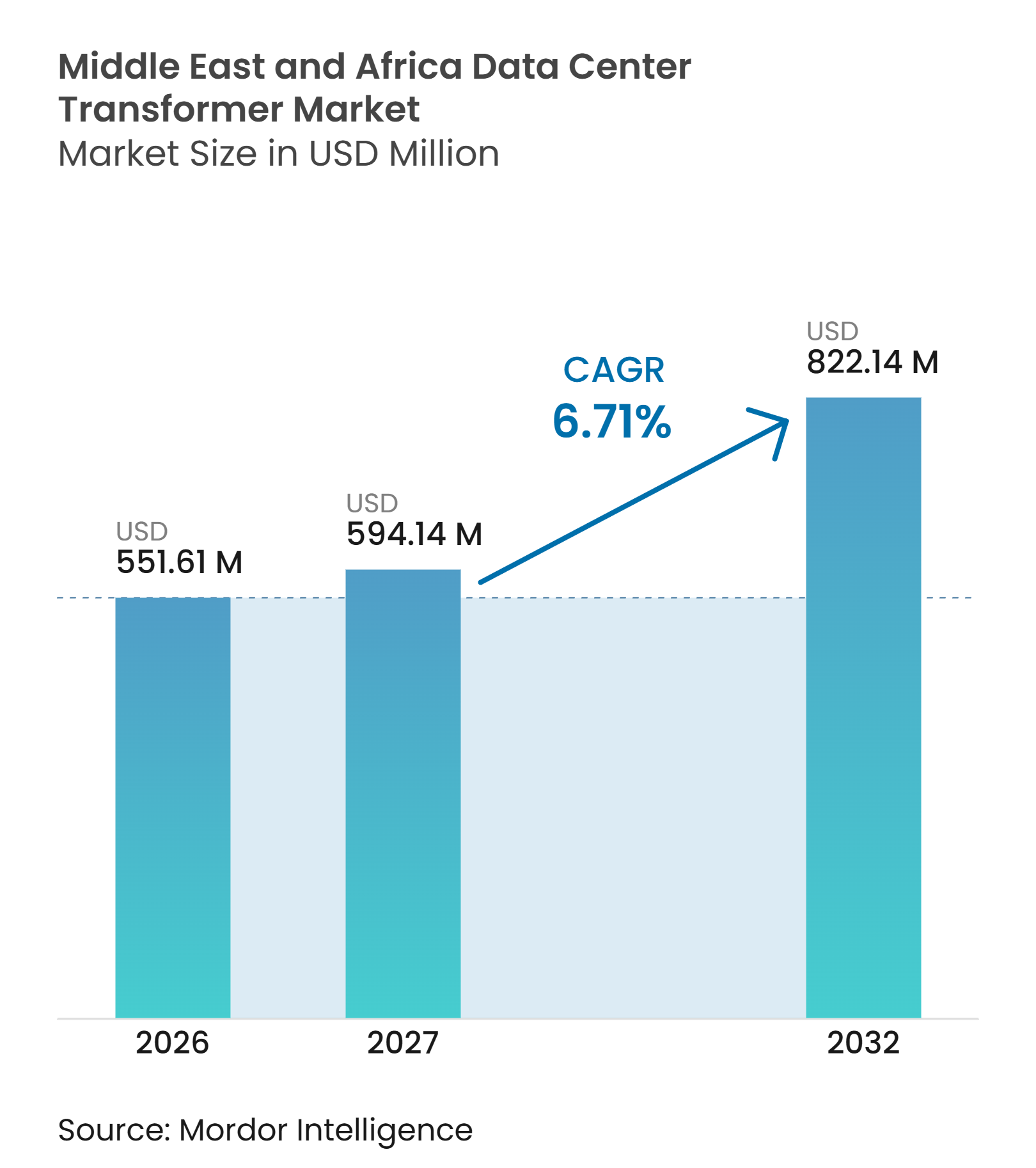
The Middle East and Africa data center transformer market size was valued at USD 551.61 million in 2026 and is estimated to expand from USD 594.14 million in 2027 to reach USD 822.14 million by 2032, at a CAGR of 6.71% during the forecast period 2027-2032. Demand is being shaped by large AI and cloud campuses planned in Gulf countries, where power systems are becoming a central part of data center design. Higher rack loads require more capacity at utility connections and within each facility, which changes both equipment specifications and procurement schedules. Supply remains constrained because data center developers, grid operators, and renewable energy projects are seeking many of the same transformer categories. This favors suppliers that can meet qualification requirements, deliver large units on time, and support installation across the region. Local manufacturing programs may improve supply access, but their effect will depend on how quickly new facilities reach full production, establish quality assurance processes, qualify materials, recruit specialist labor, and develop the testing and service capabilities needed for reliable operation.
Key Report Takeaways
- By transformer type, liquid-immersed transformers held 63.24% of the Middle East and Africa data center transformer market share in 2026, while dry-type transformers are projected to expand at an 8.13% CAGR through 2032.
- By power rating, the above 10 to 30 MVA segment accounted for 38.27% of revenue in 2026, while the above 30 MVA segment is projected to expand at an 8.34% CAGR through 2032.
- By voltage level, medium voltage held 52.61% of the Middle East and Africa data center transformer market share in 2026, while high voltage is projected to expand at an 8.53% CAGR through 2032.
- By installation, outdoor systems accounted for 54.72% of revenue in 2026 and are projected to expand at a 7.69% CAGR through 2032.
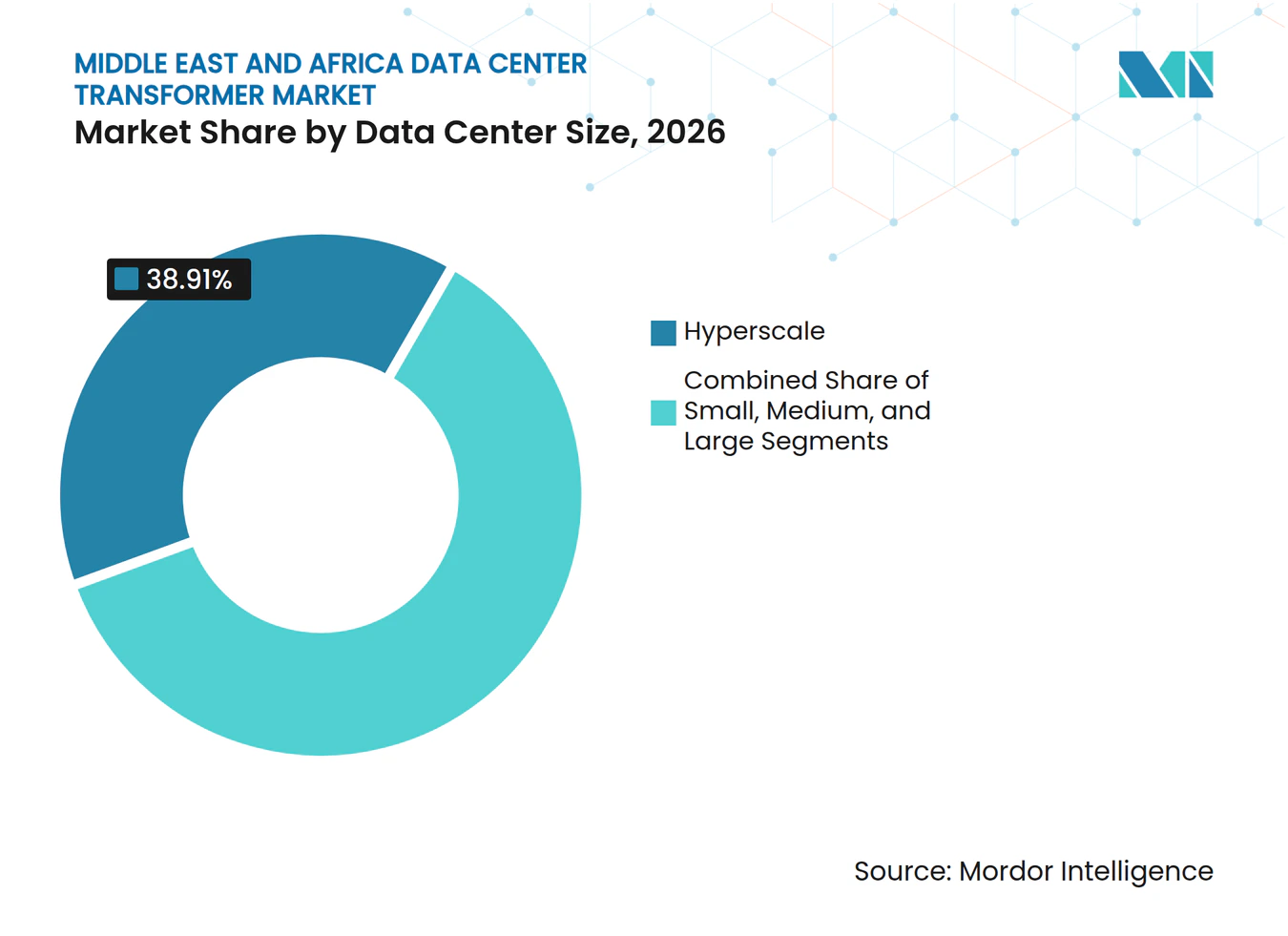
- By data center size, hyperscale facilities held 38.91% of the Middle East and Africa data center transformer market share in 2026 and is projected to expand at an 9.26% CAGR through 2032.
- By data center type, colocation facilities held 41.39% of revenue in 2026, while cloud service providers are projected to expand at an 8.72% CAGR through 2032.
- By geography, Saudi Arabia held 37.47% of revenue in 2026 and is projected to expand at an 8.21% CAGR through 2032.
Note: Market numbers in this report are based on Mordor Intelligence's proprietary estimation framework, which combines nine months of actuals with Q4 projections for base year 2026.
Market Trends and Insights
Drivers Impact Analysis of Middle East and Africa Data Center Transformer Market*
| Driver | (~) % Impact on CAGR Forecast | Geographic Relevance | Impact Timeline |
|---|---|---|---|
| AI and Hyperscale Data Center Expansion | +1.8% | Global, concentrated in Saudi Arabia and UAE | Short term (≤ 2 years) |
| Sovereign Cloud and Digital Economy Investments | +1.0% | Saudi Arabia, UAE, South Africa, Nigeria | Medium term (2-4 years) |
| Rising Power Density in Data Center Facilities | +0.8% | Global, with early gains in Abu Dhabi and Riyadh | Short term (≤ 2 years) |
| Saudi Arabia and UAE Data Center Construction Pipeline | +0.7% | Saudi Arabia and UAE core, spillover to Kuwait and Bahrain | Medium term (2-4 years) |
| Grid Modernization and Renewable Energy Integration | +0.7% | MENA-wide, with Gulf core and North Africa emerging | Long term (≥ 4 years) |
| Transformer Demand from Modular and Prefabricated Data Center Designs | +0.5% | Global, with near-term gains across GCC hyperscale campuses | Medium term (2-4 years) |
| Source: Mordor Intelligence | |||
AI and Hyperscale Data Center Expansion
AI infrastructure is being treated as strategic national capacity in several Gulf countries. Saudi Arabia’s HUMAIN and the UAE’s Stargate initiative are planning large AI data center capacity programs. A conventional enterprise rack may draw 10-12 kW, while an AI training rack can require 200-1,000 kW. This difference changes the required capacity of primary transformers, distribution transformers, substations, and protection systems. The Middle East and Africa data center transformer market therefore depends not only on additional data center floorspace but also on the electrical intensity of the computing deployed there. Large campuses also concentrate procurement into fewer, higher-value packages, and this effect is central to the Middle East and Africa data center transformer market because early electrical design decisions shape later equipment orders, technical approvals, and commissioning plans.
Sovereign Cloud and Digital Economy Investments
Data residency policies are making local cloud infrastructure a compliance need in many countries. Cloud investment programs in Saudi Arabia and the UAE support a wider regional buildout. The Cassava Technologies and Accenture alliance signed in September 2025 to deploy GPU-as-a-Service across facilities in South Africa, Egypt, Kenya, Morocco, and Nigeria. These commitments extend demand beyond the largest Gulf hubs and create projects with different grid conditions, delivery models, and requirements for locally available technical support. For the Middle East and Africa data center transformer market, sovereign cloud projects link policy, computing investment, and power equipment demand in a direct way. The Middle East and Africa data center transformer market can therefore benefit as cloud operators establish local capacity across several national power systems.
Rising Power Density in Data Center Facilities
Rising facility power density is changing equipment requirements across the data center power chain. Utility connections that historically used 50-100 MVA transformers are being considered at 200-500 MVA for AI campuses with far larger electrical loads. Dry-type units are becoming more relevant inside medium-voltage electrical rooms because they can suit harmonic-rich loads and indoor safety requirements. IEEE research states that next-generation solid-state transformers for AI data centers must address rack power levels moving toward the megawatt range. The Middle East and Africa data center transformer market is consequently moving toward equipment designed for higher capacity, stricter cooling needs, more complex power quality conditions, and carefully coordinated fault protection. Suppliers also need to coordinate transformer selection with switchgear, protection, cooling, and control systems.
Saudi Arabia and UAE Data Center Construction Pipeline
Saudi Arabia and the UAE provide a visible pipeline of large projects, which reduces uncertainty for equipment suppliers. A planned HUMAIN campus in Riyadh includes a 380 kV, 132 kV, and 33 kV network with 500 MVA and 200 MVA substations. This type of project requires long lead planning for transformers and the associated switching equipment. The International Energy Agency reported that power sector investment in the Middle East and North Africa reached USD 44 billion in 2024, with 40% directed to grids.[1] Grid investment supports the transmission backbone needed for large data center connections, including the substations and network reinforcements that precede facility energization. The Middle East and Africa data center transformer market also benefits when developers can align facility construction with utility upgrades and approved interconnection capacity.
Restraints Impact Analysis of Middle East and Africa Data Center Transformer Market*
| Restraint | (~) % Impact on CAGR Forecast | Geographic Relevance | Impact Timeline |
|---|---|---|---|
| Extended Lead Times for Large Power Transformers | -1.2% | Global, with concentrated exposure in Saudi Arabia and UAE | Short term (≤ 2 years) |
| High Capital Costs and Grid Interconnection Delays | -0.8% | Saudi Arabia, UAE, infrastructure delays in South Africa and Nigeria | Medium term (2-4 years) |
| Electrical Steel and Core Material Supply Constraints | -0.7% | Global, affecting all MEA transformer procurement | Medium term (2-4 years) |
| Limited Regional Maintenance and Commissioning Expertise | -0.4% | Sub-Saharan Africa core, extending to smaller Gulf markets | Long term (≥ 4 years) |
| Source: Mordor Intelligence | |||
Extended Lead Times for Large Power Transformers
Large power transformer supply is constrained because Gulf buyers compete with customers in North America and Europe. Long delivery schedules and higher equipment costs can delay projects that require large primary units. Major suppliers serve many regions and often allocate capacity to projects with early commitments, proven credit, completed technical specifications, and clear delivery windows. This can delay smaller projects even when the underlying computing demand is clear. The Middle East and Africa data center transformer market, therefore, rewards buyers who place orders early and can secure equipment within a defined project schedule. The Middle East and Africa data center transformer market also gives greater weight to manufacturers with credible production plans and commissioning support.
High Capital Costs and Grid Interconnection Delays
The cost of transformer equipment and the time required for grid connection can affect smaller operators most sharply. Higher equipment prices increase upfront requirements before a site begins earning revenue, particularly when related civil works and protection systems must be ordered at the same time. In South Africa, grid reliability risks can require redundant designs that increase transformer counts per facility. Nigeria often needs private power arrangements because consistent supply from the national grid is limited. These site conditions can require dedicated substations, on-site generation interfaces, and more complex operating arrangements. The Middle East and Africa data center transformer market faces different constraints in each country, even when the technical need for reliable power is similar.
*Our forecasts treat driver/restraint impacts as directional, not additive. The impact forecasts reflect baseline growth, mix effects, and variable interactions.
Middle East and Africa Data Center Transformer Market Segment Analysis
By Transformer Type:
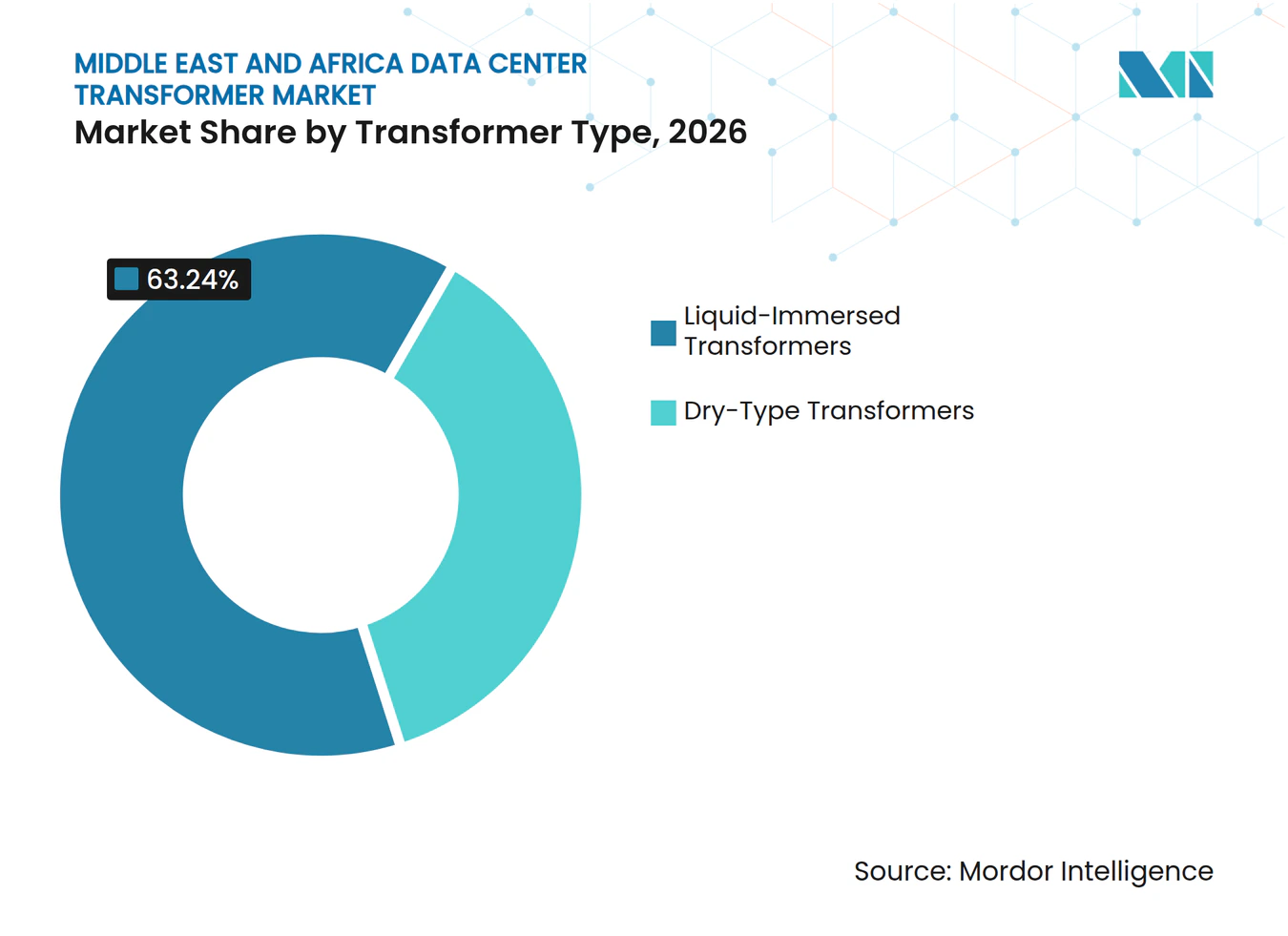
Liquid-Immersed Units Lead, While Indoor Requirements Support Dry-Type DemandLiquid-immersed transformers accounted for 63.24% of revenue in 2026. They suit primary substation connections because their thermal performance and cost structure support sustained, high-load operation in hot ambient conditions. Gulf operators often select oil-filled units for utility interconnections where equipment is installed outdoors, and capacity requirements are large. Their use requires containment, fire protection, and oil-management measures, which can add planning requirements at dense urban sites. These requirements are increasingly important as national technical codes apply international standards. The liquid-immersed category remains central to the Middle East and Africa data center transformer market because large campuses need dependable equipment at the grid connection point.
Dry-type transformers are projected to expand at an 8.13% CAGR through 2032. They are suited to indoor medium-voltage distribution rooms where fire-risk controls and space conditions carry more weight. Their ability to support certain harmonic-rich load environments can justify a higher initial cost. IEC 60076-11:2022 establishes performance requirements that help clarify dry-type specifications for buyers and suppliers. ABB introduced its Infinitus Direct Current portfolio for AI data centers in 2025, combining medium-voltage powertrains with hybrid AC/DC architectures. This development shows that transformer selection is increasingly connected with integrated power electronics and data center distribution design.


By Power Rating:
Above 10 To 30 MVA Leads, While Larger Units Gain RelevanceThe above 10 to 30 MVA segment accounted for 38.27% of revenue in 2026. This range aligns with 20-60 MW campuses that were prominent during the first wave of Gulf colocation and cloud construction. Multiple tenants can share a primary substation in this configuration, making the rating a practical fit for aggregated tenant demand. It also serves facilities that expand electrical capacity in defined phases. The segment is relevant for developers balancing present utilization against future buildout. It provides an established base of demand for the Middle East and Africa data center transformer industry.
The above 30 MVA segment is projected to expand at an 8.34% CAGR through 2032. Hyperscale AI campuses increasingly need larger units because their utility connection requirements extend well beyond earlier facility designs. The planned Riyadh project with 200 MVA and 500 MVA substations illustrates the direction of equipment demand. Up to 10 MVA equipment still serves enterprise and edge deployments, especially where facilities are smaller. Hitachi Energy committed USD 9 billion in 2025 to expand global transformer and switchgear production.[2] Suppliers able to deliver large units can have stronger positions in GCC procurement, while distribution-class producers remain important in African enterprise sites.
By Voltage Level:
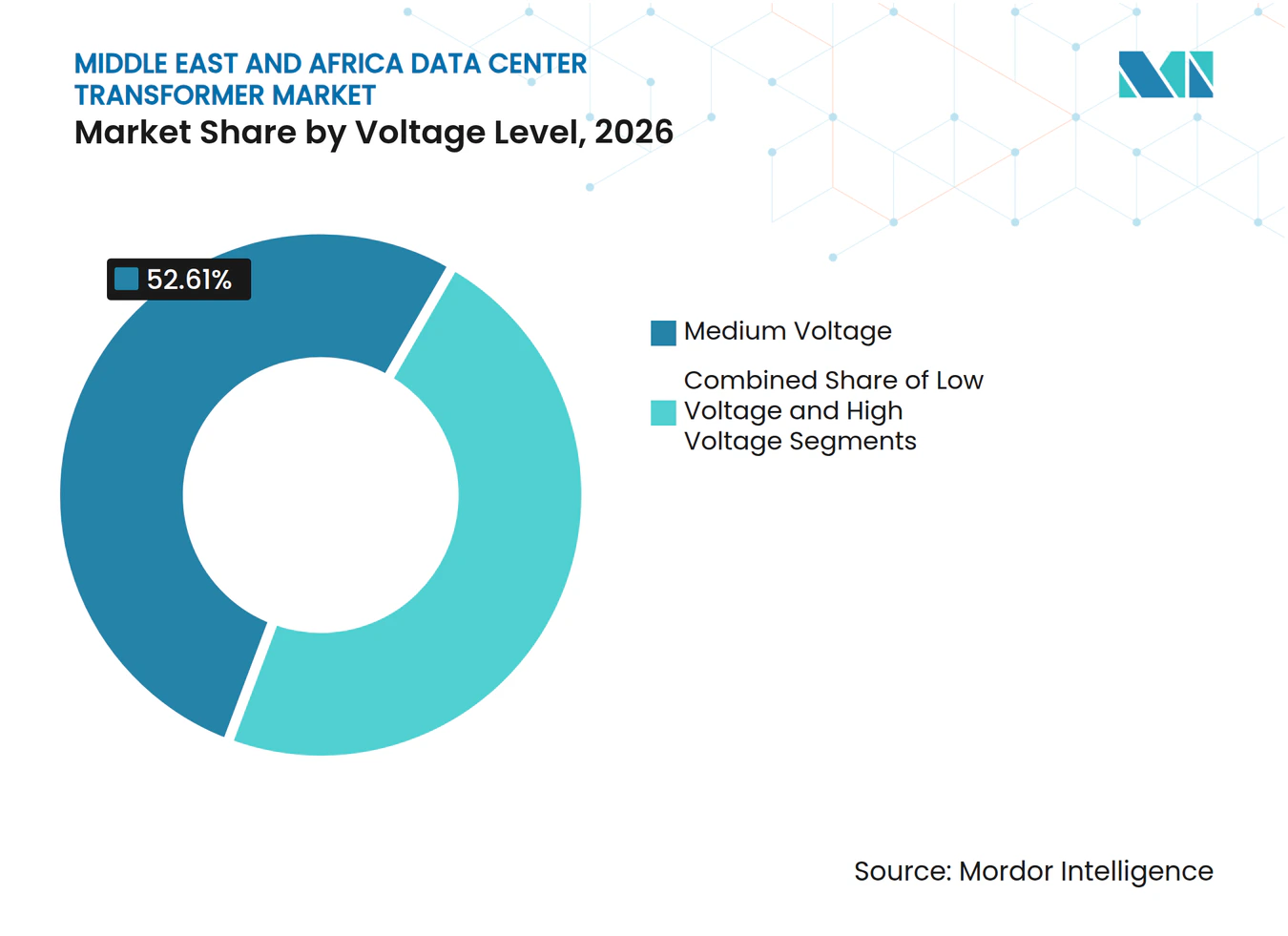
Medium Voltage Forms The Core, While High Voltage Expands FastestMedium voltage accounted for 52.61% of revenue in 2026. It connects primary substations with data halls and supports equipment deployed across most data center formats. Each facility needs distribution infrastructure beyond its main utility connection, which gives this segment a broad installed base. Technical approvals at this level can limit market access for suppliers without the required test records. These approval processes can improve reliability but may lengthen entry timelines. Medium-voltage demand is therefore a durable part of the Middle East and Africa data center transformer market.
High voltage is projected to expand at an 8.53% CAGR through 2032. Large campuses are seeking direct 132 kV or 380 kV interconnections to meet high and concentrated electrical demand. Kuwait issued a government tender for 3 132/11 kV transformer substations for Google Cloud data centers, with a budget of KWD 22 million (USD 71 million). The scale of this tender shows the electrical scope of a single hyperscale connection. Voltamp Energy received Saudi Electricity Company type-test approval in July 2025 for its first Saudi project. Qualification milestones can determine whether a producer can participate in future utility-linked contracts.


By Installation:
Outdoor Systems Lead And Maintain The Fastest ExpansionOutdoor systems accounted for 54.72% of revenue in 2026 and are projected to expand at a 7.69% CAGR through 2032. This pattern reflects the large-campus designs used by many hyperscale operators in Saudi Arabia and the UAE. Outdoor oil-filled equipment can use natural convective cooling, which reduces dependence on added cooling infrastructure. This matters at sites with high ambient temperatures and significant electrical loads. Outdoor configurations also allow primary electrical assets to sit outside sensitive computing spaces. The Middle East and Africa data center transformer market is supported by this practical alignment between campus layout and transformer design.
Indoor installation remains important where sites have tighter footprints or use dry-type distribution equipment. It accounted for 45.28% of revenue in 2026. African facilities may use indoor transformers with on-site generation systems that create rapid load changes and voltage variation. Containerized designs in Nigeria and South Africa are also increasing interest in outdoor-rated modular packages. These options can reduce site work and support phased deployment. Installation decisions depend on grid reliability, available land, climate, fire requirements, and the facility’s intended operating model.
By Data Center Size:
Hyperscale Facilities Lead Demand For High-Value EquipmentHyperscale facilities held 38.91% of revenue in 2026. These customers use transformer systems across utility interconnection, primary distribution, and individual data halls, which creates large equipment requirements per project. Large data centers were the next important group because colocation operators are expanding to serve enterprise AI and cloud demand. Medium and small facilities remain important in African countries where data center capacity is still developing. Nigeria and South Africa together account for more than 65% of Africa’s operational colocation capacity, with many facilities in the 5-20 MW range. This combination creates a Middle East and Africa data center transformer market with both high-value campuses and smaller distributed deployments.
Microsoft’s South African expansion involved USD 300 million between 2025 and 2027.[3] This scale is consistent with large facilities that can require equipment in the 10-30 MVA range. Kasi Cloud planned a 100 MW campus in Lekki, Lagos, supported by a private 132 kV substation and a 60 MW transformer. Such projects indicate that a hyperscale tier is emerging in West Africa alongside a larger mid-market base. The two groups require different equipment ratings, delivery schedules, and service models. Suppliers that can serve both may be better placed as country-level deployment patterns change.
By Data Center Type:
Colocation Leads, While Cloud Service Providers Expand FasterColocation facilities held 41.39% of revenue in 2026. Operators in Dubai, Johannesburg, and Lagos provide shared power infrastructure for enterprises using hybrid cloud environments. Their procurement programs often add capacity in phases as tenant commitments are secured. This can create recurring orders rather than a single purchase at the start of the facility. Tier III and Tier IV requirements can also increase transformer counts through N+1 or 2N redundancy arrangements. Colocation demand remains a stable source of activity across the Middle East and Africa data center transformer market.
Cloud service providers are projected to expand at an 8.72% CAGR through 2032. Sovereign cloud commitments are supporting this demand because they require local capacity that meets data residency expectations. The planned AWS Saudi region and Microsoft’s South African investment illustrate the scale of these programs. Gulf countries had 111 existing data centers and 72 upcoming facilities in 2026, with Saudi Arabia holding more than 60% of upcoming power capacity. The cloud service provider category therefore creates demand for both major utility connections and on-campus distribution assets. Its expansion also increases the value of suppliers that can support standardization across multiple sites.
Geography Analysis
Saudi Arabia held 37.47% of revenue in 2026 and is projected to expand at an 8.21% CAGR through 2032. The Middle East and Africa data center transformer market share in Saudi Arabia reflects the scale of planned cloud and AI capacity. HUMAIN’s planned Riyadh campus implies transformer demand measured in thousands of MVA. Localization is also becoming a procurement factor alongside price and technical qualification, and Saudi Power Transformers Company secured a SAR 1.4 billion (USD 376 million) Saudi Electricity Company contract in September 2025. This position makes Saudi Arabia a major source of project activity for the Middle East and Africa data center transformer market.
The UAE ranks second in regional data center activity and is developing major AI infrastructure. Stargate UAE targets an initial 1 GW, creating demand for large grid connections and distribution systems. South Africa anchors a large portion of African demand through its established colocation base and new hyperscale investment, including Microsoft’s data center program.[4] These country patterns broaden the Middle East and Africa data center transformer market beyond its Gulf project base.
Nigeria has attracted data center investment focused on private, high-voltage infrastructure, and Kasi Cloud’s planned 132 kV private substation and 60 MW transformer in Lekki show how developers respond to grid reliability constraints. Kuwait, Oman, Qatar, and Bahrain also contribute structured procurement outside the largest GCC markets, with Kuwait’s 132/11 kV substation tender for cloud facilities providing one example. The wider region gives the Middle East and Africa data center transformer market several routes for demand, although grid conditions and procurement rules differ by country. This diversity requires suppliers in the Middle East and Africa data center transformer market to tailor technical and service offers to each country.
Competitive Landscape
Market Concentration
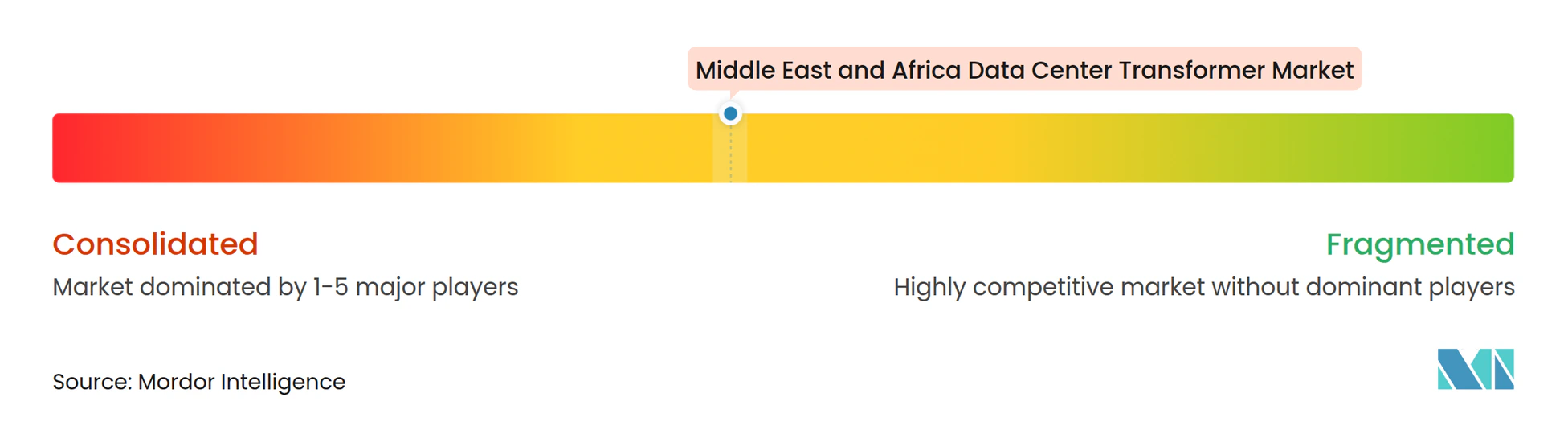
The Middle East and Africa data center transformer market is moderately consolidated. ABB, Hitachi Energy, Siemens Energy, GE Vernova, and Hyosung Heavy Industries are important suppliers for large utility interconnection projects. Their position depends on technical qualifications, capacity for large units, and delivery certainty. Price remains important, but project owners also need suppliers that can coordinate with utilities and EPC contractors where transformer delivery determines whether a facility can be energized. Regional suppliers such as Alfanar, Elsewedy Electric, Saudi Power Transformers Company, Voltamp Energy, Toshiba Energy Systems, and SGB-SMIT Group add local manufacturing and service capability.
Competition is increasingly shaped by localization requirements. Elsewedy Electric’s planned Dammam transformer plant is intended to expand Saudi capacity, while Voltamp Energy increased its stake in National Transformer Company from 49% to 80% in March 2026, with 132 kV production planned in the first phase and 380 kV capability by 2027. ABB and Specialist Services signed an agreement in October 2025 to deliver integrated modular substation solutions for data centers in the region. Siemens Energy and Elsewedy Electric also agreed to support Saudi Arabia’s first SF6-free GIS installation in August 2025.
Sub-Saharan Africa offers room for integrated transformer, switchgear, and generator solutions for 10-60 MW facilities. Grid-bypass designs need equipment that can be delivered as a coordinated system and commissioned under difficult local power conditions. The competitive balance varies between large Gulf projects and smaller African deployments, where service coverage and the ability to integrate private power arrangements are important. These differences make the Middle East and Africa data center transformer market competitive on both equipment capability and local execution.
Middle East and Africa Data Center Transformer Industry Leaders
-
Eaton Corporation plc
-
Schneider Electric SE
-
Siemens Energy AG
-
Mitsubishi Electric Corporation
-
Legrand SA
- *Disclaimer: Major Players sorted in no particular order
Middle East and Africa Data Center Transformer Market Companies Covered in this Report
- ABB Ltd.
- Eaton Corporation plc
- Schneider Electric SE
- Siemens Energy AG
- Hitachi Energy Ltd.
- GE Vernova Inc.
- ACTOM (Pty) Ltd.
- Legrand SA
- Mitsubishi Electric Corporation
- Toshiba Energy Systems and Solutions Corporation
- Hyosung Heavy Industries Corporation
- SGB-SMIT Group
- Eaton's Cooper Power Systems
- HD Hyundai Electric Co., Ltd.
- Elsewedy Electric S.A.E.
- Alfanar Company
- Saudi Power Transformers Company
- Voltamp Energy SAOG
- Wilson Power Solutions Ltd.
- Emirates Transformer & Switchgear Manufacturing LLC
Recent Industry Developments in Middle East and Africa Data Center Transformer Market
- October 2026: Alfanar announced a USD 150 million investment at LEAP 2026 to localize power module manufacturing in Saudi Arabia, positioning the company to capture Vision 2030 in-country value requirements in HUMAIN's and Saudi Electricity Company's procurement programs.
- October 2026: Siemens Energy is investing USD 150 million to expand its Dammam facility, which will include a new transformer factory and create 130 to 150 jobs. With this, the company aims to establish local manufacturing capabilities to bolster energy security and reduce reliance on international supply chains.
- June 2026: Chinese power equipment manufacturer Kerun Intelligent Control has launched an integrated transformer and substation solution targeting AI data centers. The package will focus on locations with high-heat climates, such as the Middle East, and will combine transformers, prefabricated substations, switchgear, and intelligent monitoring systems.
- March 2026: Voltamp Energy SAOG increased its stake in its Saudi joint venture, National Transformer Company, from 49% to 80%, securing majority ownership and management control of a USD 10 million high-voltage transformer manufacturing facility near Jeddah targeting 132 kV production in phase 1 and 380 kV capability by 2027.
Middle East and Africa Data Center Transformer Market Report Scope
The Middle East and Africa data center transformer market refer to the regional industry focused on supplying specialized power transformers engineered to support the rapid scaling of data facilities across MEA territories. This market is primarily driven by massive sovereign investments in digital transformation, the strategic expansion of hyper-scale cloud hubs in the GCC and South Africa, and the critical need for robust power infrastructure capable of withstanding extreme environmental conditions.
The Middle East and Africa Data Center Transformer Market Report is Segmented by Transformer Type (Liquid-Immersed Transformers and Dry-Type Transformers), Power Rating (Up to 10 MVA, Above 10 MVA to 30 MVA, and Above 30 MVA), Voltage Level (Low Voltage, Medium Voltage, and High Voltage), Installation (Indoor Installation and Outdoor Installation), Data Center Size (Small, Medium, Large, and Hyperscale), Data Center Type (Colocation, Cloud Service Provider, and Enterprise Data Centers/Edge), and Country (Saudi Arabia, United Arab Emirates, South Africa, Nigeria, and Rest of Middle East and Africa). The Market Forecasts are Provided in Terms of Value (USD).
Segmentation Overview
| Liquid-Immersed Transformers |
| Dry-Type Transformers |
| Up to 10 MVA |
| Above 10 MVA to 30 MVA |
| Above 30 MVA |
| Low Voltage |
| Medium Voltage |
| High Voltage |
| Indoor Installation |
| Outdoor Installation |
| Small |
| Medium |
| Large |
| Hyperscale |
| Colocation |
| Cloud Service Provider |
| Enterprise Data Centers/Edge |
| Saudi Arabia |
| United Arab Emirates |
| South Africa |
| Nigeria |
| Rest of Middle East |
| By Transformer Type | Liquid-Immersed Transformers |
| Dry-Type Transformers | |
| By Power Rating | Up to 10 MVA |
| Above 10 MVA to 30 MVA | |
| Above 30 MVA | |
| By Voltage Level | Low Voltage |
| Medium Voltage | |
| High Voltage | |
| By Installation | Indoor Installation |
| Outdoor Installation | |
| By Data Center Size | Small |
| Medium | |
| Large | |
| Hyperscale | |
| By Data Center Type | Colocation |
| Cloud Service Provider | |
| Enterprise Data Centers/Edge | |
| By Geography | Saudi Arabia |
| United Arab Emirates | |
| South Africa | |
| Nigeria | |
| Rest of Middle East |
Key Questions Answered in the Report
What is the size of the Middle East and Africa data center transformer market?
It is valued at USD 551.61 million in 2026 and is forecast to reach USD 822.14 million by 2032, at a 6.71% CAGR from 2027 to 2032.
What is driving demand for data center transformers in the region?
AI campuses, sovereign cloud investment, rising rack power density, and large construction programs in Saudi Arabia and the UAE are central drivers.
Which transformer type has the largest position in 2026?
Liquid-immersed transformers account for 63.24% of revenue because they suit high-capacity utility connections and hot outdoor operating conditions.
Which data center customer type is expanding fastest?
Cloud service providers are projected to expand at an 8.72% CAGR through 2032 as local cloud capacity is developed for data residency and AI workloads.
Which country leads regional demand?
Saudi Arabia accounts for 37.47% of 2026 revenue and is projected to expand at an 8.21% CAGR through 2032.
What limits deployment of large transformer systems?
Long lead times, high capital costs, connection delays, material constraints, and limited maintenance capability in some countries can delay projects.