
Middle East and Africa Data Center Demand Response and Energy Management Market Size and Share
Market Overview
| Study Period | 2021 - 2032 |
|---|---|
| Forecast Data Period | 2027 - 2032 |
| Base Year Market Size (2026) | USD 0.45 Billion |
| Market Size (2027) | USD 0.52 Billion |
| Market Size (2032) | USD 1.13 Billion |
| Growth Rate (2027 - 2032) | 16.84 % |
| Market Concentration | Medium |
Major Players *Disclaimer: Major Players sorted in no particular order Image © Mordor Intelligence. Reuse requires attribution under CC BY 4.0. | |
Middle East and Africa Data Center Demand Response and Energy Management Market Analysis by Mordor Intelligence
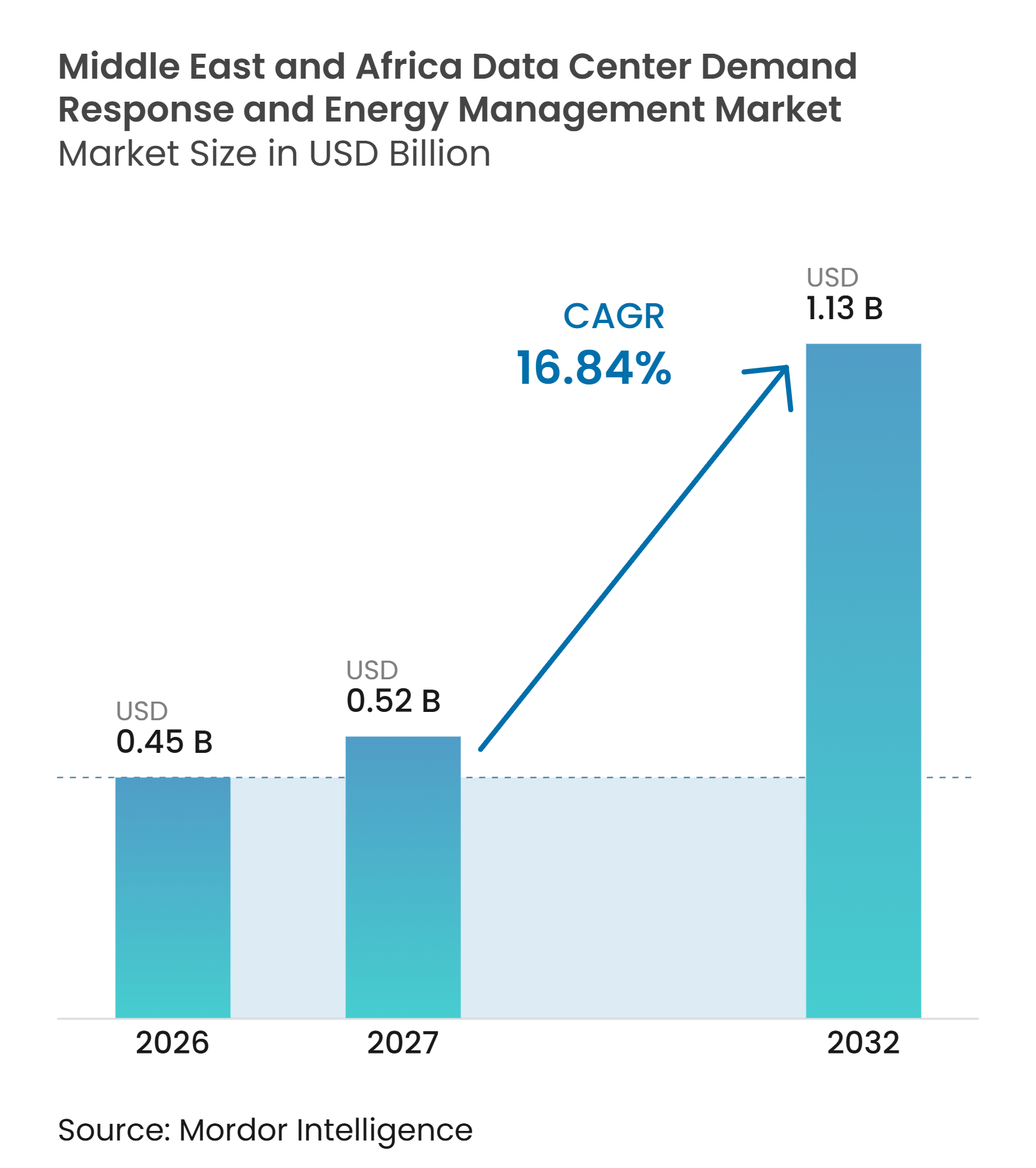
The Middle East and Africa data center demand response and energy management market size is projected to expand from USD 0.45 billion in 2026 to USD 0.52 billion in 2027, and to USD 1.13 billion by 2032, registering a CAGR of 16.84% between 2027 and 2032. Sovereign investment and public digital programs in the Gulf are financing large AI campuses that place sustained and variable loads on power systems. This makes demand response and energy management a core operating requirement rather than a secondary facility function. Higher rack density also increases the value of systems that can coordinate electricity use in real time. Operators that can demonstrate flexible operations may have an advantage when seeking grid connections. The Middle East and Africa data center demand response and energy management market is therefore moving toward software-led control, managed services, and automation that links energy decisions with computing workloads.
Key Report Takeaways
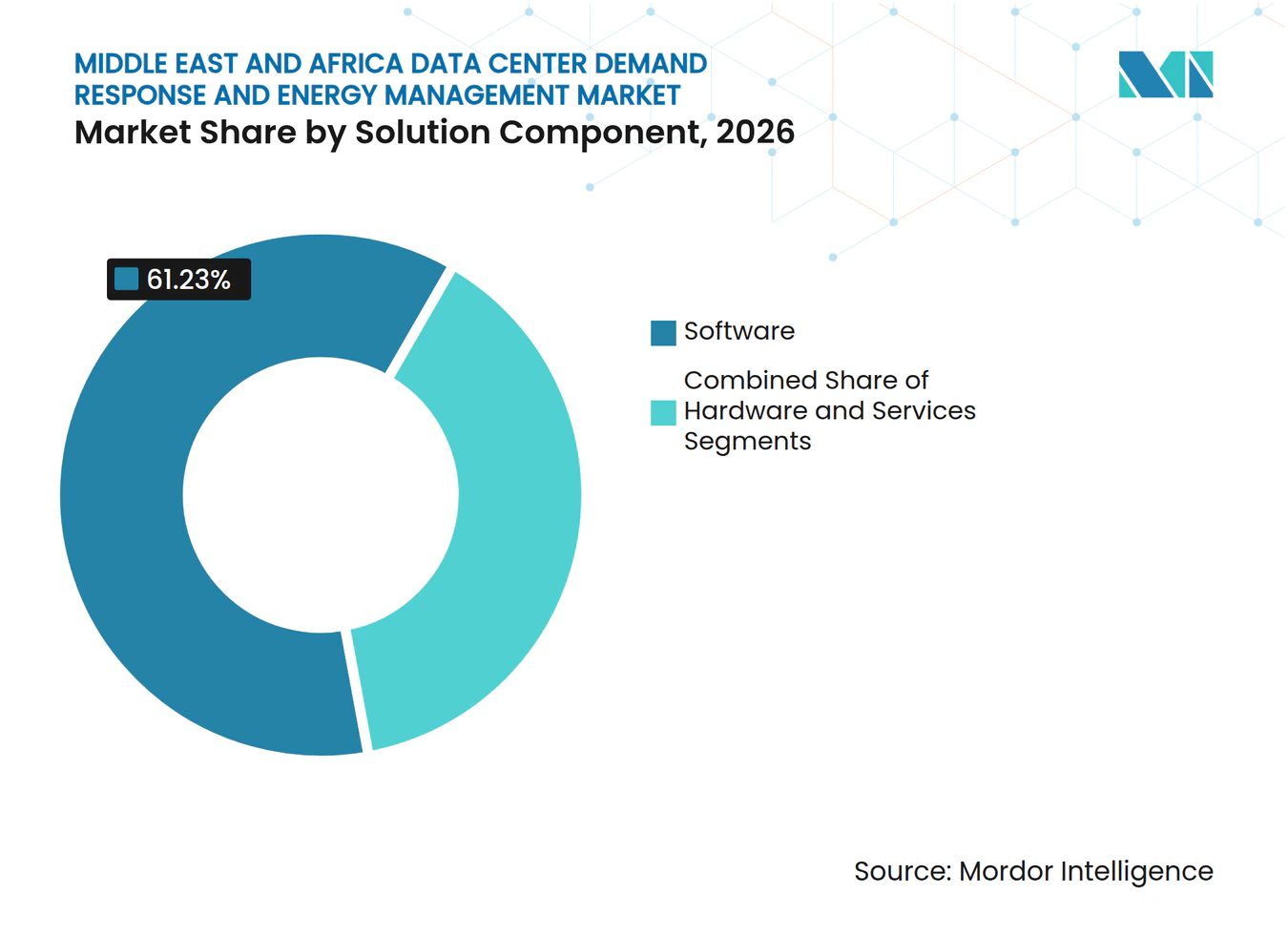
- By solution component, software held 61.23% of the Middle East and Africa data center demand response and energy management market revenue share in 2026, while services are projected to expand at an 18.80% CAGR through 2032.
- By software solution type, energy management software held 58.29% of the Middle East and Africa data center demand response and energy management market revenue share in 2026, while energy forecasting and optimization software is projected to expand at an 18.51% CAGR through 2032.
- By demand response program type, incentive-based programs held 68.19% of the Middle East and Africa data center demand response and energy management market share in 2026 and are projected to expand at a 19.34% CAGR through 2032.
- By automation level, manual and non-automated solutions held 67.45% of the Middle East and Africa data center demand response and energy management market revenue share in 2026, while automated and advanced demand response solutions are projected to expand at a 19.67% CAGR through 2032.
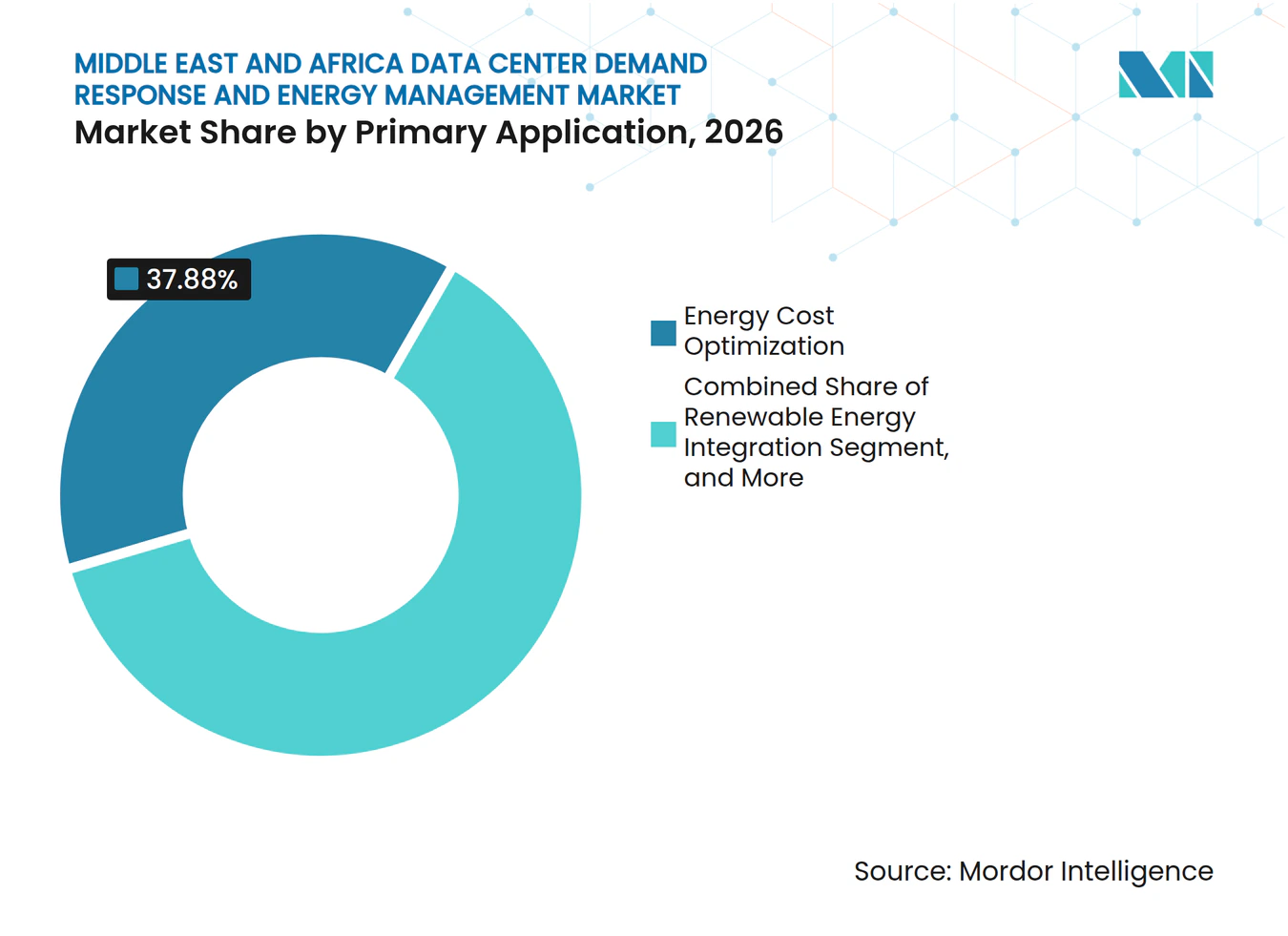
- By primary application, energy cost optimization held 37.88% of the Middle East and Africa data center demand response and energy management market revenue share in 2026, while renewable energy integration is projected to expand at a 17.81% CAGR through 2032.
- By data center size, hyperscale data centers held 56.14% of the Middle East and Africa data center demand response and energy management market revenue share in 2026 and are projected to expand at an 18.20% CAGR through 2032.
- By data center type, colocation held 64.11% of the Middle East and Africa data center demand response and energy management market revenue share in 2026, while cloud service providers are projected to expand at a 19.18% CAGR through 2032.
- By geography, Saudi Arabia held 31.23% of the Middle East and Africa data center demand response and energy management market revenue share in 2026, while the United Arab Emirates is projected to expand at a 17.56% CAGR through 2032.
Note: Market numbers in this report are based on Mordor Intelligence's proprietary estimation framework, which combines nine months of actuals with Q4 projections for base year 2026.
Market Trends and Insights
Drivers Impact Analysis of Middle East and Africa Data Center Demand Response and Energy Management Market*
| Driver | (~) % Impact on CAGR Forecast | Geographic Relevance | Impact Timeline |
|---|---|---|---|
| Rising AI and Hyperscale Data Center Power Density | +4.5% | Global, concentrated in the United Arab Emirates and Saudi Arabia | Short term (≤ 2 years) |
| Data Center Expansion Across Gulf Digital Hubs | +3.8% | Saudi Arabia, United Arab Emirates, Qatar | Short term (≤ 2 years) |
| Rising Peak-Demand Charges and Grid Reliability Requirements | +2.9% | United Arab Emirates, Saudi Arabia, South Africa | Medium term (2-4 years) |
| Renewable Energy Integration and Grid Flexibility Needs | +2.1% | United Arab Emirates, Saudi Arabia, Egypt, and South Africa | Medium term (2-4 years) |
| Sovereign Digital Infrastructure and Energy-Transition Investment | +1.8% | Gulf-wide, with early gains in Riyadh, Abu Dhabi, and Dubai | Long term (≥ 4 years) |
| Grid-Interactive UPS, Battery, and Workload Flexibility Monetization | +1.2% | United Arab Emirates and Saudi Arabia | Long term (≥ 4 years) |
| Source: Mordor Intelligence | |||
Rising AI and Hyperscale Data Center Power Density
AI and hyperscale workloads are making grid connection a central operating constraint for regional operators. The World Economic Forum states that AI-focused facilities create sustained and variable power demand that conventional grids were not built to manage. Higher-density computing equipment raises the need for coordinated cooling, power delivery, and workload control. The Middle East and Africa data center demand response and energy management market benefits when operators need to lower demand without interrupting critical computing services. Facilities need automated controls that can act within the operating limits set for critical computing services. These operating requirements favor automated controls over manual facility responses.
Data Center Expansion Across Gulf Digital Hubs
The Gulf data center buildout is increasing demand for power management systems to be deployed alongside new capacity. Schneider Electric reported several agreements in Saudi agreements in 2025 covering digital transformation and sustainability projects, including work with Dulb Company, Edarat Group, and Mobily. Ooredoo and Iron Mountain also announced a plan to expand Syntys beyond 120 MW of colocation capacity through a USD 1 billion medium-term investment. New facilities can include grid-aware control systems during design and commissioning. This reduces the retrofit burden that limits flexibility in older sites. The Middle East and Africa data center demand response and energy management market is consequently supported by construction activity and rising energy costs.
Rising Peak-Demand Charges and Grid Reliability Requirements
Peak demand and grid reliability are becoming more important operating issues for data center owners. Abu Dhabi's Department of Energy launched the second phase of its demand response pilot in May 2025, targeting more than 250 MW of flexible demand from over 30 entities.[1] The earlier pilot reduced peak demand by an average of 106 MW across 10 events and avoided 1,600 tons of carbon emissions. KAPSARC finds that demand response in the Gulf remains strategically important yet underused, as market design and participation pathways are still developing. In South Africa, unreliable supply increases the operational value of battery storage and backup systems. These conditions make monitoring and automated dispatch more relevant across the Middle East and Africa data center demand response and energy management market.
Renewable Energy Integration and Grid Flexibility Needs
Renewable procurement is linking data center operating decisions to the timing of generation. Dubai's D33 Industry-Friendly Power Policy allows certified data centers to install photovoltaic systems that cover up to 100% of peak load, while offering feed-in compensation and priority access to I-REC purchases. The policy gives facilities a clearer commercial reason to match consumption with renewable supply. A Society of Petroleum Engineers paper on GCC data centers identifies AI-driven load management as an important pathway to efficient decarbonization, supported by supportive policies and ancillary service revenues. The Middle East and Africa data center demand response and energy management market gains relevance when renewable commitments must be translated into daily operating actions. Operators can use flexible controls for workloads, storage, and cooling to respond to solar output. This creates a closer link between sustainability targets and facility performance.
Restraints Impact Analysis of Middle East and Africa Data Center Demand Response and Energy Management Market*
| Restraint | (~) % Impact on CAGR Forecast | Geographic Relevance | Impact Timeline |
|---|---|---|---|
| Legacy OT, BMS, and Utility-System Integration Complexity | -2.8% | Global; pronounced in older Gulf colocation and enterprise facilities | Medium term (2-4 years) |
| Fragmented Demand-Response Market Rules and Compensation Models | -1.9% | MEA-wide; most acute outside Abu Dhabi and South Africa | Long term (≥ 4 years) |
| Data Sovereignty and Cybersecurity Constraints on Cloud Control | -1.4% | Saudi Arabia, UAE, Israel; spill-over to Egypt and Qatar | Long term (≥ 4 years) |
| Limited Local Energy-Analytics and Demand-Response Operations Talent | -0.9% | Africa-wide; acute in Egypt, Nigeria, Kenya; moderate in Gulf | Medium term (2-4 years) |
| Source: Mordor Intelligence | |||
Legacy OT, BMS, and Utility-System Integration Complexity
Legacy operational technology, building management systems, and utility interfaces can delay the adoption of demand response. Many existing sites were designed to operate at continuous maximum draw, rather than to provide grid flexibility. The Atlantic Council identifies the absence of unified grid-code frameworks for battery and hybrid plant remuneration as a factor that extends investment payback periods in emerging markets. Retrofitting may require firmware upgrades, protocol translation, and new utility telemetry. Colocation sites also face divided responsibility between owners and tenants for energy-side changes. Greenfield hyperscale projects can reduce this constraint because energy management is incorporated before the facility enters service.
Fragmented Demand-Response Market Rules and Compensation Models
Demand response rules and compensation models differ across the region. Abu Dhabi has the most structured incentive-based program, but the program covers commercial and industrial entities broadly rather than setting out a dedicated data center route. KAPSARC notes that unclear price signals and distribution-level participation pathways limit the broader use of demand response in the GCC. Without published tariffs or dependable payment models, operators cannot quantify the return from automation investments. This slows capital allocation for platforms that depend on dispatch revenue. More consistent market rules would improve the commercial case for the data center demand response and energy management market in the Middle East and Africa.
*Our forecasts treat driver/restraint impacts as directional, not additive. The impact forecasts reflect baseline growth, mix effects, and variable interactions.
Middle East and Africa Data Center Demand Response and Energy Management Market Segment Analysis
By Solution Component:
Software Leads Revenue While Services Gain Through Managed DeliverySoftware accounted for 61.23% of the segment's value in 2026, reflecting the need to integrate energy control into daily data center operations. The segment is used to monitor power usage effectiveness, coordinate equipment, and record data required for facility reporting. Software's leading position reflects platform-first buying by hyperscale and colocation operators. Vendors can connect software with UPS equipment, cooling systems, batteries, and utility signals. This gives operators a central view of power consumption and available flexibility.
Services are projected to expand at an 18.80% CAGR through 2032. Managed contracts can help smaller operators without in-house energy analytics teams. Schneider Electric's 2025 Saudi agreements show how automation offerings can be combined with implementation and operational support.[2] Hardware remains necessary where battery storage and grid-interactive UPS systems provide the physical means to reduce demand. The Middle East and Africa data center demand response and energy management industry, therefore, has different sales approaches for software buyers and managed-service customers.



By Software Solution Type:
Energy Management Leads While Forecasting Gains Strategic WeightEnergy management software accounted for 58.29% of the software solution type segment in 2026. It provides the main control interface for electricity monitoring and operational decision-making. The installed base reflects immediate needs around visibility, alarm management, and power usage effectiveness. Monitoring and analytics tools also support reporting obligations within formal incentive programs. These systems form the data layer for wider automation projects.
Energy forecasting and optimization software is projected to expand at an 18.51% CAGR through 2032. Its role is to predict AI-related load changes before they affect demand peaks. Forecasting adds value when a facility must schedule cooling, battery use, and flexible workloads together. Operators can use these tools to test operating scenarios before responding to grid conditions. The Middle East and Africa data center demand response and energy management market is shifting from systems that respond to conditions toward systems that anticipate them.
By Demand Response Program Type:
Incentive-Based Programs Lead Under Emerging Gulf FrameworksIncentive-based programs held 68.19% of the segment in 2026 and are projected to expand at a 19.34% CAGR through 2032. This is the only program type that leads both in current share and forecast expansion. Abu Dhabi's pilot provides a regional example of structured payments for flexible demand. KAPSARC identifies structured incentives as a practical near-term route for Gulf demand response.
Price-based programs have a smaller role because many regional markets lack mature real-time pricing and long histories of price data. They are more relevant where operators have wholesale-market exposure or corporate power purchase agreements. South Africa offers a more favorable setting for price-responsive energy management as commercial tariff structures develop. Incentive programs give operators clearer payment expectations than newly introduced time-of-use tariffs. The Middle East and Africa data center demand response and energy management market can gain depth if more Gulf jurisdictions adopt similar programs.
By Automation Level:
Manual Systems Lead Today While Automated Solutions Expand FastestManual and non-automated solutions held 67.45% of the segment in 2026. This reflects the early stage of energy automation across many facilities in the region. Operators often use manual approval processes for changes to critical power and cooling systems. Such practices are more common where grid signals and compensation programs remain limited. Manual systems can provide visibility, but they cannot reliably respond to rapid changes in AI workloads.
Automated and advanced demand response solutions are projected to expand at a 19.67% CAGR through 2032. Khazna Data Centers and Presight signed a 2025 memorandum covering an AI-driven facility management system with predictive fault detection, cooling optimization, and continuous oversight across Khazna's UAE network. Automated controls can issue dispatch decisions faster than facility staff can act. The Middle East and Africa data center demand response and energy management market size for automated solutions is supported by the need for repeatable responses at large facilities. Operators may also use automation to demonstrate performance when regulators require dependable load reduction.
By Primary Application:
Cost Optimization Holds the Largest Role While Renewable Integration AcceleratesEnergy cost optimization accounted for 37.88% of the primary application segment in 2026. Electricity is a major variable expense for data centers, especially in regions where peak-load charges apply. Operators use management platforms to identify inefficient equipment and reduce demand during expensive periods. The application is relevant to both new facilities and retrofits. It also provides a direct financial rationale before demand response revenues are available.
Renewable energy integration is projected to expand at a 17.81% CAGR through 2032. DEWA's policy allows certified data centers to pair on-site photovoltaic generation with their peak demand requirements. Flexible scheduling helps operators match consumption with variable solar output. The Middle East and Africa data center demand response and energy management market is also relevant to peak load management, emergency reduction, and future ancillary services. Commercial tariffs for data center-provided grid services remain limited in many countries.

By Data Center Size:
Hyperscale Facilities Lead on Value and Forecast ExpansionHyperscale data centers held 56.14% of the segment in 2026 and are projected to expand at an 18.20% CAGR through 2032. Their scale increases the savings available from small improvements in power use. Greenfield projects can also integrate renewable energy sourcing, battery dispatch, and grid-interactive UPS systems. Large campuses need controls that can coordinate these assets without compromising availability. Hyperscale leadership reflects this higher operational complexity.
Saudi projects are adding demand for large-scale power management systems as sovereign AI infrastructure expands. Schneider Electric's Saudi agreements show that energy management is being included during the wider digital infrastructure buildout. Smaller sites also need lightweight monitoring and curtailment tools as edge computing expands in Egypt, South Africa, and secondary Gulf cities. Medium and large sites sit between these two models. The Middle East and Africa data center demand response and energy management industry can address each size band through different levels of automation and service support.
By Data Center Type:
Colocation Leads While Cloud Service Providers Expand Through LocalizationColocation held 64.11% of the data center type segment in 2026. The position reflects the established role of third-party facilities in the United Arab Emirates and Saudi Arabia. Colocation providers must manage power across multiple tenants with different uptime and operating requirements. This can make energy-side interventions more complex. It also creates a large installed base for metering, monitoring, and managed energy services.
Cloud service providers are projected to expand at a 19.18% CAGR through 2032. Cloud regions are being localized to meet data residency requirements and to support sovereign AI programs. Ooredoo and Iron Mountain's Syntys plan illustrates continued investment in regional colocation capacity and operating capability. Enterprise and edge facilities in South Africa and Egypt often already use batteries and microgrids because of supply reliability concerns. The Middle East and Africa data center demand response and energy management market can leverage the installed base to achieve more flexible operations.
Geography Analysis
Saudi Arabia
Saudi Arabia accounted for 31.23% of the 2026 Middle East and Africa data center demand response and energy management market share. Public investment under Vision 2030 is supporting data center construction and broader digital infrastructure, while Schneider Electric announced several 2025 agreements linking digital transformation with energy management and sustainability. New facilities can incorporate power controls before commissioning, which avoids some legacy integration work. Government support for electricity can reduce the immediate savings case for curtailment. It can also increase the strategic value of demand flexibility as grid planning and data center regulation develop.
United Arab Emirates
The United Arab Emirates is projected to expand at a 17.56% CAGR through 2032. The country combines hyperscale construction activity with grid-interactive demand management, including Abu Dhabi's pilot, which targets over 250 MW of flexible demand through advanced digital energy management technologies. DEWA's D33 policy supports photovoltaic deployment, feed-in compensation, and priority I-REC purchases for certified data centers.[3] The Ministry of Energy and Infrastructure formed a national team in February 2025 to review the impact of data centers on the energy sector. These compliance factors may widen adoption beyond operators that act voluntarily.
South Africa, Israel, Egypt, and Qatar
South Africa's demand is shaped by grid reliability, which makes batteries and microgrid controls standard operational assets. The International Finance Corporation reports that the country has attracted more than USD 5 billion in foreign direct investment in data centers since 2020. Israel favors efficiency monitoring and peak-charge management, while Egypt's renewable-powered data center plans create a longer-term opening for new energy management deployments. Qatar is expanding its colocation platform through Syntys, supported by Ooredoo and Iron Mountain, while regional demand depends on grid rules and commercial tariffs that give flexible assets a reliable value.
Competitive Landscape
Market Concentration
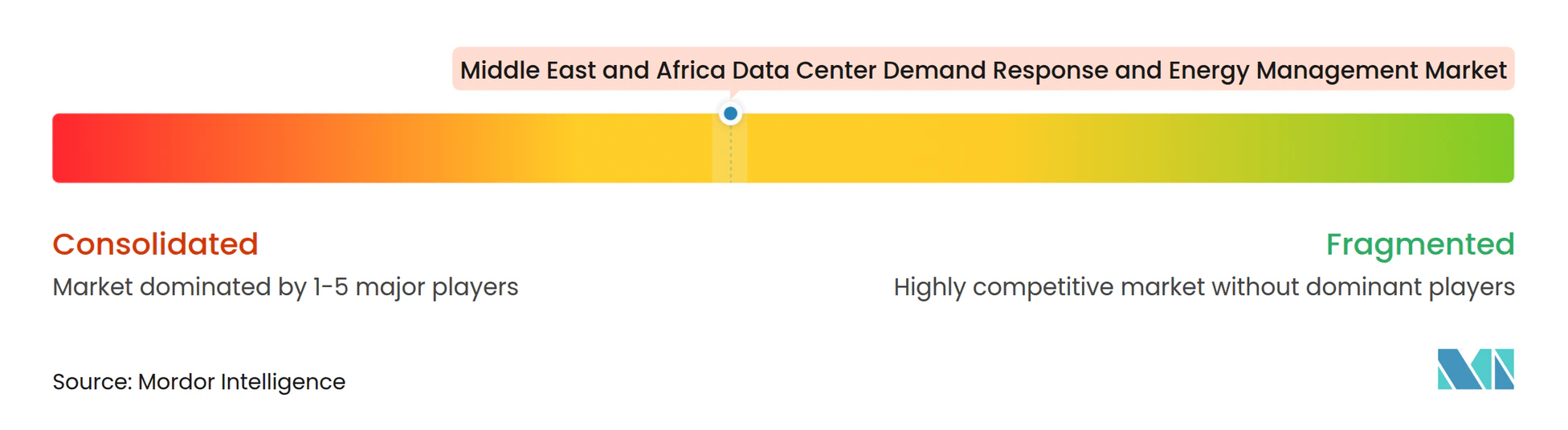
The Middle East and Africa data center demand response and energy management market is moderately concentrated. Global power management and building automation companies benefit from long-standing equipment relationships with operators. ABB is strengthening regional channel coverage through its partner network across the Middle East, Africa, and Türkiye. These companies can combine equipment, controls, and service offerings while helping customers manage certification, implementation, and system integration requirements.
Strategic moves increasingly combine power equipment with software and on-site generation. Eaton and Siemens Energy announced a joint offering in June 2025 for modular data centers featuring 500 MW gas-turbine configurations, battery storage, and optional grid-services capabilities.[4] Enova and Schneider Electric also announced a collaboration in the UAE covering microgrids, photovoltaic systems, EV charging, and energy performance services. These approaches extend competition beyond software licenses. They position vendors to address both the physical and operational aspects of flexibility.
AI-native orchestration platforms and specialist aggregators are challenging incumbent software models. Their systems can connect workload decisions with dispatch signals and equipment controls. IEC 62443 cybersecurity requirements can lengthen procurement cycles for new software providers. This requirement favors suppliers that can demonstrate secure integration with operational technology environments. Competition is likely to remain divided between infrastructure incumbents, regional managed-service firms, and specialized platforms for automated workloads.
Middle East and Africa Data Center Demand Response and Energy Management Industry Leaders
-
Schneider Electric SE
-
Siemens AG
-
ABB Ltd
-
Eaton Corporation plc
-
Honeywell International Inc.
- *Disclaimer: Major Players sorted in no particular order
Middle East and Africa Data Center Demand Response and Energy Management Market Companies Covered in this Report
- Schneider Electric SE
- Siemens AG
- ABB Ltd
- Eaton Corporation plc
- Vertiv Holdings Co
- Legrand SA
- Delta Electronics, Inc.
- Rittal GmbH & Co. KG
- Huawei Technologies Co., Ltd.
- Johnson Controls International plc
- Honeywell International Inc.
- Trane Technologies plc
- Carrier Global Corporation
- AutoGrid Systems, Inc.
- CPower Energy Management LLC
- Voltus, Inc.
- Enel X Way S.r.l.
- Kraken Technologies Limited
- Itron, Inc.
- Landis+Gyr Group AG
Recent Industry Developments in Middle East and Africa Data Center Demand Response and Energy Management Market
- October 2026: The World Economic Forum published "Powering AI at Scale: Optimizing Hyperscale Data Center Infrastructure in MENA," collaborating with SRMG Think Research and Advisory; the report introduces a resource-intelligence matrix for AI-enabled demand management and outlines actions on energy optimization, cooling, and regulatory reform expected to inform policy in Saudi Arabia and the UAE.
- October 2026: Middle East data center portfolio reporting confirmed over 180 existing facilities, with the UAE exceeding 430 MW of existing IT power capacity and Saudi Arabia accounting for more than 50% of planned upcoming power capacity; Khazna Data Centers, Saudi Telecom Company, and Gulf Data Hub collectively account for approximately 35% of existing regional IT power capacity.
- August 2026: FlexSysAI, backed by Nvidia's Inception program, launched an AI workload orchestration platform designed to shift compute loads across locations to reduce grid stress, enable participation in demand response services, and lower power bills by scheduling workloads during low-cost, low-carbon grid conditions.
- February 2026: CPower Energy Management, Bentaus, and Supermicro completed an AI data center energy-orchestration demonstration, maintaining AI workloads and service-level agreements while achieving up to a 75% reduction in electricity draw during dispatch events; GPU infrastructure responded to a full dispatch signal cycle in under 20 milliseconds.
Middle East and Africa Data Center Demand Response and Energy Management Market Report Scope
The Middle East and Africa Data Center Demand Response and Energy Management Market includes technologies, platforms, and services that help data center operators optimize electricity consumption, manage peak demand, integrate renewable energy resources, and participate in utility demand response and energy-market programs across Saudi Arabia, the United Arab Emirates, South Africa, Israel, Egypt, Qatar, and the rest of the region. These solutions are increasingly adopted to address growing hyperscale capacity needs, energy cost volatility, grid reliability challenges, sustainability initiatives, and the need for resilient, efficient power management across mission-critical digital infrastructure.
The Middle East and Africa Data Center Demand Response and Energy Management Market Report is Segmented by Solution Component (Hardware, Software, and Services), Software Solution Type (Demand Response Management Platforms, Energy Management Software, Energy Monitoring and Analytics Software, and Energy Forecasting and Optimization Software), Demand Response Program Type (Price-Based Programs, and Incentive-Based Programs), Automation Level (Manual and Non-Automated Solutions, and Automated and Advanced Demand Response Solutions), Primary Application (Peak Load Management, Emergency Load Reduction, Capacity Market Participation, Ancillary Services, Energy Cost Optimization, and Renewable Energy Integration), Data Center Size (Small, Medium, Large, and Hyperscale), Data Center Type (Colocation, Cloud Service Providers [CSPs], and Enterprise and Edge), and Geography (Saudi Arabia, United Arab Emirates, South Africa, Israel, Egypt, Qatar, and Rest of Middle East and Africa). The Market Forecasts are Provided in Terms of Value (USD).
Segmentation Overview
| Hardware |
| Software |
| Services |
| Demand Response Management Platforms |
| Energy Management Software |
| Energy Monitoring and Analytics Software |
| Energy Forecasting and Optimization Software |
| Price-Based Programs |
| Incentive-Based Programs |
| Manual and Non-Automated Solutions |
| Automated and Advanced Demand Response Solutions |
| Peak Load Management |
| Emergency Load Reduction |
| Capacity Market Participation |
| Ancillary Services |
| Energy Cost Optimization |
| Renewable Energy Integration |
| Small |
| Medium |
| Large |
| Hyperscale |
| Colocation |
| Cloud Service Providers (CSPs) |
| Enterprise and Edge |
| Saudi Arabia |
| United Arab Emirates |
| South Africa |
| Israel |
| Egypt |
| Qatar |
| Rest of Middle East and Africa |
| By Solution Component | Hardware |
| Software | |
| Services | |
| By Software Solution Type | Demand Response Management Platforms |
| Energy Management Software | |
| Energy Monitoring and Analytics Software | |
| Energy Forecasting and Optimization Software | |
| By Demand Response Program Type | Price-Based Programs |
| Incentive-Based Programs | |
| By Automation Level | Manual and Non-Automated Solutions |
| Automated and Advanced Demand Response Solutions | |
| By Primary Application | Peak Load Management |
| Emergency Load Reduction | |
| Capacity Market Participation | |
| Ancillary Services | |
| Energy Cost Optimization | |
| Renewable Energy Integration | |
| By Data Center Size | Small |
| Medium | |
| Large | |
| Hyperscale | |
| By Data Center Type | Colocation |
| Cloud Service Providers (CSPs) | |
| Enterprise and Edge | |
| By Geography | Saudi Arabia |
| United Arab Emirates | |
| South Africa | |
| Israel | |
| Egypt | |
| Qatar | |
| Rest of Middle East and Africa |
Key Questions Answered in the Report
What is the Middle East and Africa data center demand response and energy management market size?
The market is projected to increase from USD 0.45 billion in 2026 and USD 0.52 billion in 2027 to USD 1.13 billion by 2032. This represents a 16.84% CAGR over the 2027-2032 forecast period.
What is driving demand for data center energy management in the Middle East and Africa?
AI campus construction, higher power density, grid constraints, peak-demand management, and renewable integration are supporting adoption.
Which solution component has the largest revenue share?
Software held 61.23% of revenue in 2026 because operators need centralized control and monitoring across power assets.
Which automation approach is expanding fastest?
Automated and advanced demand response solutions are projected to expand at a 19.67% CAGR through 2032.
Which country leads regional demand response and energy management spending?
Saudi Arabia held 31.23% of regional revenue in 2026, supported by sovereign digital infrastructure investment.
Why is the United Arab Emirates a fast-expanding location for these systems?
The United Arab Emirates is projected to expand at a 17.56% CAGR through 2032 because it combines data center construction with grid-interactive policy initiatives.