
Middle East and Africa Bottling Line Sterilization Machinery Market Size and Share
Market Overview
| Study Period | 2021 - 2032 |
|---|---|
| Forecast Data Period | 2027 - 2032 |
| Base Year Market Size (2026) | USD 1.81 Million |
| Market Size (2027) | USD 1.98 Million |
| Market Size (2032) | USD 3.01 Million |
| Growth Rate (2027 - 2032) | 8.74 % |
| Market Concentration | Medium |
Major Players *Disclaimer: Major Players sorted in no particular order Image © Mordor Intelligence. Reuse requires attribution under CC BY 4.0. | |
Middle East and Africa Bottling Line Sterilization Machinery Market Analysis by Mordor Intelligence
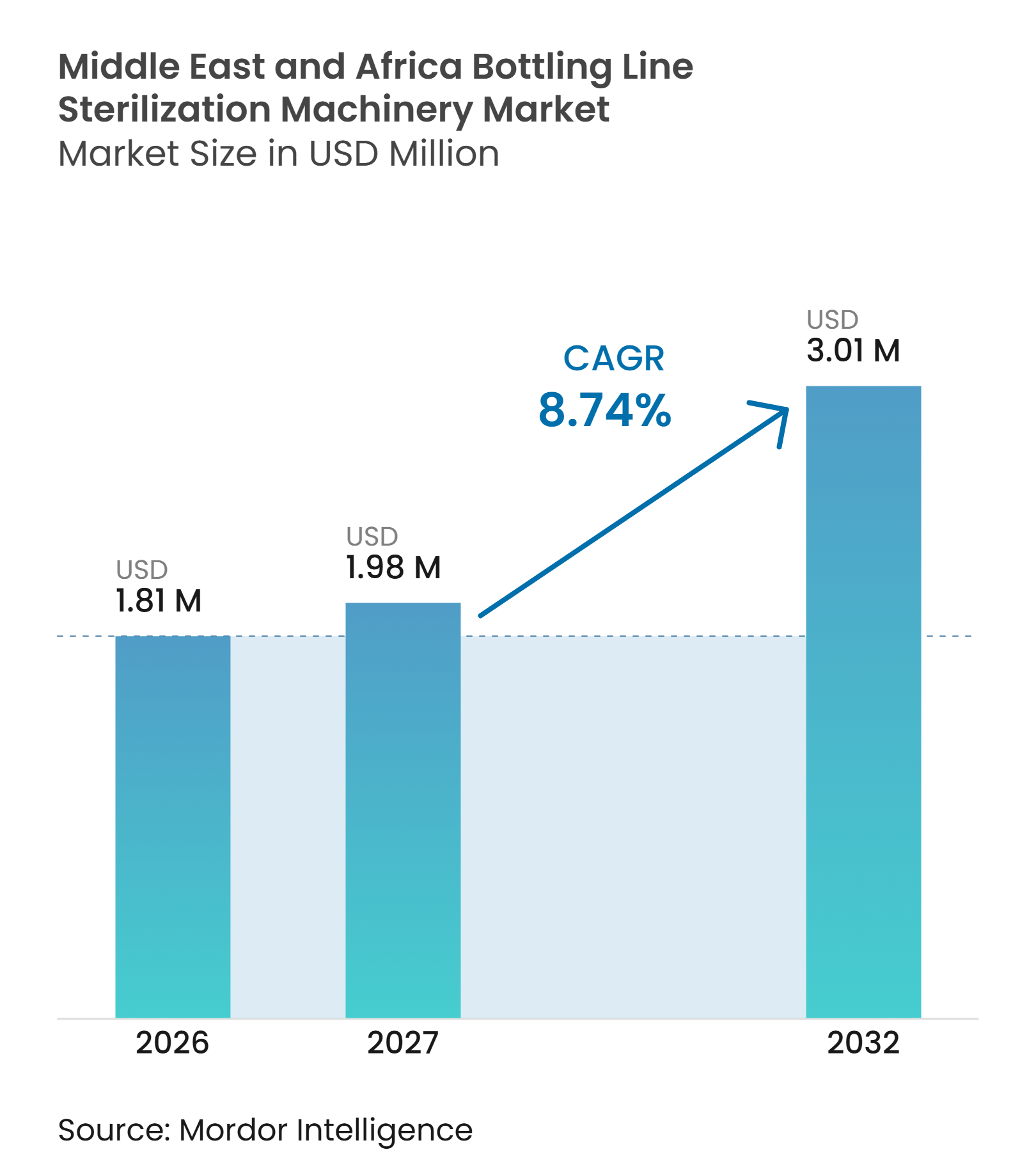
The Middle East And Africa Bottling Line Sterilization Machinery Market size is expected to grow from USD 1.81 million in 2026 to USD 1.98 million in 2027 and is forecast to reach USD 3.01 million by 2032 at 8.74% CAGR over 2027-2032.
Demand is supported by investment in shelf-stable beverages and aseptic filling across the Gulf, North Africa, and sub-Saharan Africa. Water scarcity continues to support bottled-water capacity additions, while export-oriented producers are raising their validation standards. Equipment suppliers are responding with integrated lines, faster automation, and lower-chemical sterilization technologies. Procurement decisions also reflect the need for dependable local service, financing support, and equipment that can meet different national compliance requirements. The Middle East and Africa bottling line sterilization machinery market also faces uneven infrastructure and technical capacity across its geography.
Key Report Takeaways
- By equipment type, integrated sterilization-filling-capping monoblocs accounted for 26.32% of the Middle East and Africa bottling line sterilization machinery market size in 2026 and are projected to expand at a 9.28% CAGR through 2032.
- By sterilization technology, hydrogen peroxide held 43.09% of the segment in 2026, while UV-C and pulsed light systems are projected to expand at a 9.31% CAGR through 2032.
- By format, PET bottles accounted for 43.45% of the segment in 2026, while preforms are projected to expand at a 9.22% CAGR through 2032.
- By line configuration, rotary systems accounted for 31.77% of the segment in 2026 of the Middle East and Africa bottling line sterilization machinery market, while automatic and semi-automatic systems are projected to expand at a 9.36% CAGR through 2032.
- By end user, bottled water producers held 31.29% of the Middle East and Africa bottling line sterilization machinery market share in 2026 and are projected to expand at a 9.07% CAGR through 2032.
- By geography, the Rest of the Middle East and Africa held 38.89% of the segment in 2026, while Saudi Arabia is projected to expand at a 9.58% CAGR through 2032.
Note: Market numbers in this report are based on Mordor Intelligence's proprietary estimation framework, which combines nine months of actuals with Q4 projections for base year 2026.
Market Trends and Insights
Drivers Impact Analysis of Middle East and Africa Bottling Line Sterilization Machinery Market*
| Driver | (~) % Impact on CAGR Forecast | Geographic Relevance | Impact Timeline | |
|---|---|---|---|---|
| Expansion of Ambient Shelf-Stable Beverage Distribution | +2.1% | Global, with strong concentration in GCC and North Africa | Medium term (2-4 years) | |
| Water Scarcity and Bottled-Water Infrastructure Investment | +1.8% | GCC core, with spillover to Sub-Saharan Africa and North Africa | Short term (≤ 2 years) | |
| Regional Shift Toward High-Speed Automated Lines | +1.5% | Saudi Arabia and UAE primarily, with large-volume producers across Rest of MEA | Medium term (2-4 years) | |
| Aseptic Packaging Demand From Dairy, Juice, Tea, and Functional Beverages | +1.2% | GCC, South Africa, and North Africa | Medium term (2-4 years) | |
| Export-Oriented Beverage Manufacturing in the Gulf | +0.8% | Saudi Arabia and UAE primarily | Long term (≥ 4 years) | |
| Sterility Validation for Recycled and Lightweight PET | +0.5% | GCC, with emerging relevance in South Africa and North Africa | Long term (≥ 4 years) | |
| Source: Mordor Intelligence | ||||
Expansion of Ambient Shelf-Stable Beverage Distribution
Ambient distribution is increasing the sterility performance requirements for bottling equipment. Hypermarkets, modern retail, and cross-border e-commerce need products that can remain safe without refrigeration. Almarai reported a fragmented Saudi bottled-water retail landscape with more than 200 players and 350 brands in 2025. This structure favors producers that can document long shelf life through aseptic production lines. Exporting producers also need equipment that supports the validation standards required in destination markets. These conditions raise the value of proven cleaning, filling, and capping systems in the Middle East and Africa bottling line sterilization machinery market.
Water Scarcity and Bottled-Water Infrastructure Investment
Water scarcity remains a direct reason for investment in bottled-water capacity across the region. Desalinated water is central to the water supply of Gulf states, linking water infrastructure to the demand for reliable bottling and sterilization systems. The Syrian General Authority for Water Resources allowed filtered-water bottling plants from any source in May 2025.[1] The decision opened a potential route for new investment in bottling lines and sterilization machinery in the Middle East and Africa. Bottlers require equipment that can maintain hygienic filling conditions despite different source-water treatments. This makes water availability and water treatment part of the equipment decision rather than a separate utility issue.
Regional Shift Toward High-Speed Automated Lines
High-speed automation is becoming more important because it limits manual contact in controlled production areas. KHS stated that the Middle East and Africa zone is seeing demand for filling lines with capacities of up to 90,000 containers per hour. PET applications accounted for 85% of KHS regional sales, underscoring the connection between high-speed investment and PET-oriented sterilization needs. Krones installed a 100,000-container-per-hour ErgoBloc L at Alesayi Beverage in Saudi Arabia in 2025. At these operating speeds, a connected design for sterilization, filling, and capping can reduce handoff points between machines. The Middle East and Africa bottling line sterilization machinery market therefore benefits from demand for line consistency and capacity.
Aseptic Packaging Demand From Dairy, Juice, Tea, and Functional Beverages
Dairy, juice, tea, and functional drinks are expanding the addressable market for aseptic equipment beyond bottled water. Aseptic lines that reduce chemical use are becoming more relevant where producers prioritize resource efficiency and hygiene performance. Tetra Pak also began a 3-year modernization project with Al Rabie that targets water savings of up to 36 million liters each year in cleaning operations. SIG deployed an XSlim 24 Aseptic filling line with Nuitree in Dubai to fill plant-based milks, juices, soups, and beverages containing particulates. These projects indicate that producers are weighing resource use and product range alongside sterility requirements.
Restraints Impact Analysis of Middle East and Africa Bottling Line Sterilization Machinery Market*
| Restraint | (~) % Impact on CAGR Forecast | Geographic Relevance | Impact Timeline |
|---|---|---|---|
| High Imported-Equipment Capital Cost and Currency Exposure | -1.8% | Sub-Saharan Africa and North Africa most affected, GCC least affected | Short term (≤ 2 years) |
| Fragmented Regulatory and Validation Requirements | -1.3% | Global, with highest impact across Rest of MEA country markets | Medium term (2-4 years) |
| Shortage of Specialized Sterility-Engineering and Maintenance Skills | -0.9% | Sub-Saharan Africa and emerging MEA markets | Long term (≥ 4 years) |
| Utility Reliability and Hydrogen Peroxide Handling Constraints | -0.6% | Sub-Saharan Africa and remote or off-grid sites across MEA | Short term (≤ 2 years) |
| Source: Mordor Intelligence | |||
High Imported-Equipment Capital Cost and Currency Exposure
Imported equipment remains difficult to finance for producers whose revenues are denominated in local currencies. KHS identified exchange-rate weakness, high public debt, and limited access to affordable financing as persistent obstacles in sub-Saharan markets. The company also noted that letters of credit are effectively required in North African markets. Currency changes can extend the payback period for premium sterilization systems and delay replacement decisions. Gulf purchasers are less exposed because several regional currencies are linked to the U.S. dollar. This difference helps explain the stronger adoption of high-specification machinery in Saudi Arabia and the UAE than in many other countries in the Middle East and Africa bottling line sterilization machinery market.
Fragmented Regulatory and Validation Requirements
Bottlers serving several export markets often need to maintain separate validation records. U.S. regulations set a hydrogen peroxide limit of no more than 0.5 ppm for food-contact surfaces under 21 CFR 178.1005. The US Food and Drug Administration also amended the food-additive regulations for hydrogen peroxide in September 2025.[2] Producers supplying Gulf, European, and U.S. customers may need to demonstrate that the same line meets the different requirements of these customers and regulators. The documentation burden favors larger producers with specialized quality teams. It can also delay trade in the Middle East and Africa bottling line sterilization machinery market, where a line must be retrofitted or revalidated before an export order can be accepted.
*Our forecasts treat driver/restraint impacts as directional, not additive. The impact forecasts reflect baseline growth, mix effects, and variable interactions.
Middle East and Africa Bottling Line Sterilization Machinery Market Segment Analysis
By Equipment Type:
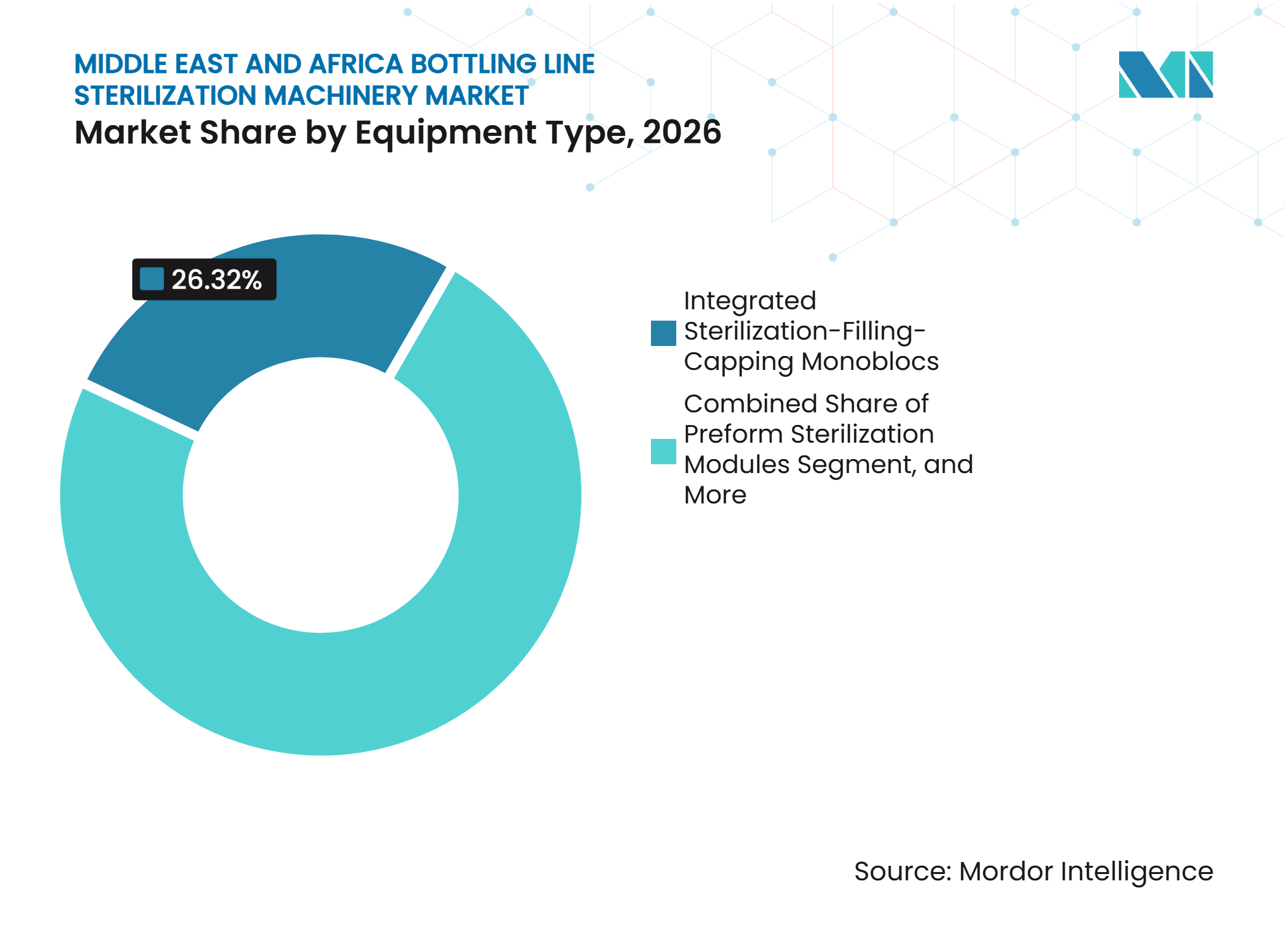
Monoblocs Support Integrated Production LinesIntegrated sterilization-filling-capping monoblocs accounted for 26.32% of the Middle East and Africa bottling line sterilization machinery market size in 2026 and are projected to expand at a 9.28% CAGR through 2032. This combined position reflects demand for equipment with a compact footprint and fewer interfaces between critical production stages. A monobloc can reduce the number of qualification steps compared with separate sterilization, filling, and capping units, thereby supporting shorter installation and validation periods. Bottle sterilization and rinsing modules remain important for existing lines, especially where full replacement cannot be justified. Preform sterilization becomes more relevant as high-speed producers seek to control contamination before blow molding.
Cap and closure modules occupy a smaller but precise role in production hygiene. A 2025 scientific review reported that pulsed UV light technologies have applications in decontaminating food, water, and food-processing surfaces. KHS reported that PET formats account for 85% of its Middle East and Africa sales, supporting demand for equipment that handles preforms and closures. Krones' 2025 installation at Alesayi Beverage shows that regional producers are adopting integrated high-throughput designs. The bottling line sterilization machinery industry is shifting toward equipment that simplifies line operation without removing the need for specialized modules.



By Sterilization Technology:
Hydrogen Peroxide Retains the Installed BaseHydrogen peroxide held 43.09% of the sterilization technology segment in 2026, while UV-C and pulsed light systems are projected to expand at a 9.31% CAGR through 2032. Hydrogen peroxide retains a strong position because it is familiar to operators and supported by established validation practices. VDMA published updated methods for determining residual peroxide in packaging in 2025. The protocol supports consistent sampling and measurement for hydrogen peroxide-based systems. Peracetic acid, steam, hot water, dry heat, and hot air remain relevant where line design, wastewater requirements, or product characteristics favor those methods.
UV-C and pulsed light systems offer dry processing and avoid routine chemical handling. Iwasaki Electric reported the full-scale deployment of pulsed xenon sterilization technology for beverage applications in 2025. Electron-beam systems are moving from early use to commercial reference installations in the Middle East and Africa bottling-line sterilization machinery market. These emerging systems can reduce reliance on conventional chemical processing. Lower residue requirements can strengthen the case for UV-C, eBeam, and hybrid approaches.
By Format:
PET Bottles Remain the Core FormatPET bottles accounted for 43.45% of the format segment in 2026, while preforms are projected to expand at a 9.22% CAGR through 2032. PET remains widely used because it is lightweight, supports ambient distribution, and is compatible with high-volume beverage production. Glass remains relevant for premium spirits, beer, and certain juice products, but returnable glass systems require additional handling and rinsing capacity. HDPE bottles are used in dairy and functional-beverage applications. Caps and closures are a separate control point because their sterility can affect the sterility of the completed package.
Preform sterilization can place an aseptic control step before blow molding and reduce the possibility of recontamination during later line stages. South Africa's Department of Forestry, Fisheries and the Environment reported that Extrupet's food-grade bottle-to-bottle recycling plant in the Western Cape is scheduled to open in 2025. The facility added 15,000 tons of food-grade rPET capacity each year. Lines using recycled PET may need renewed sterility validation as their material mix changes. This can create demand for equipment upgrades in the Middle East and Africa bottling line sterilization machinery market.
By Line Configuration:
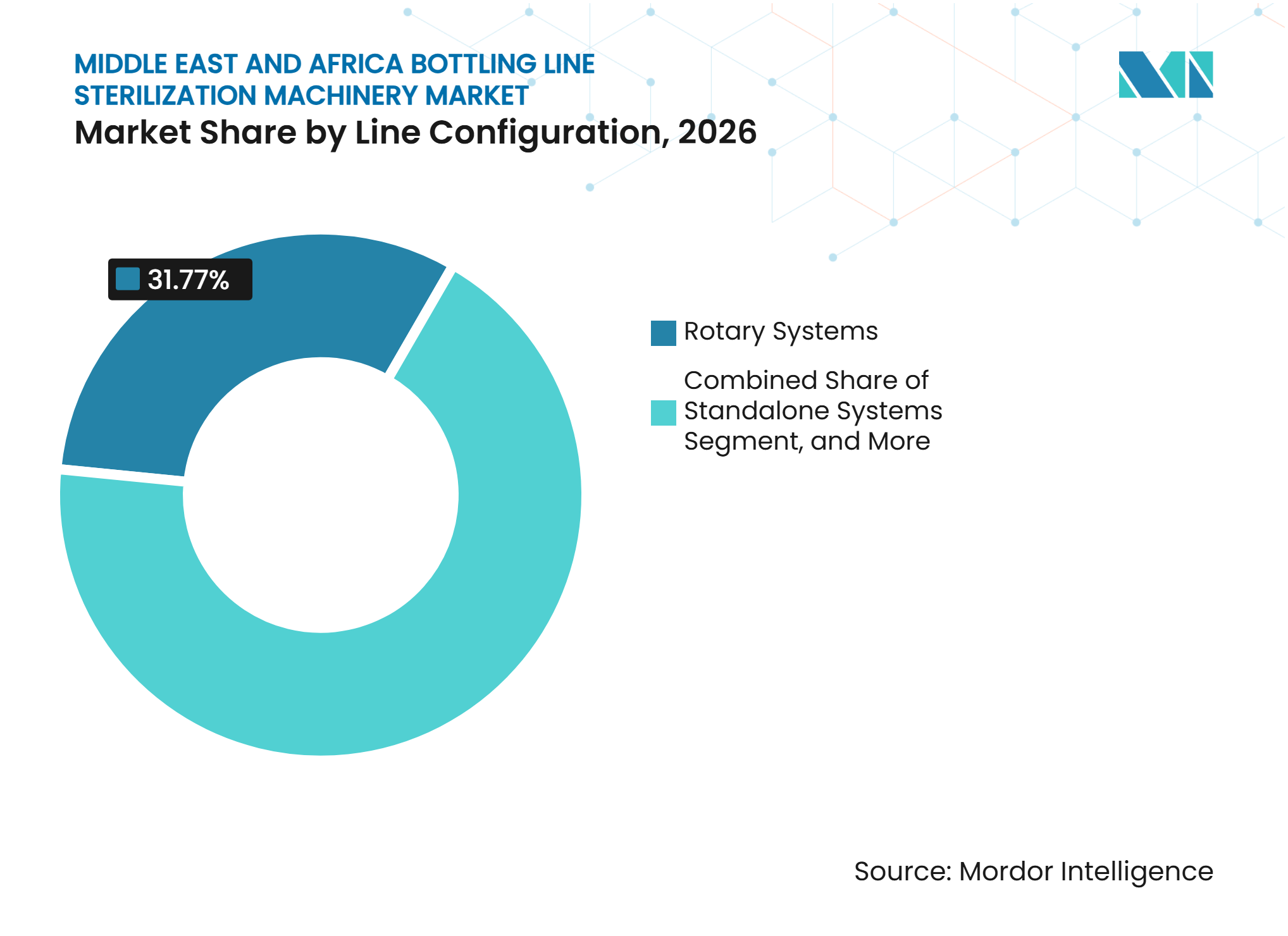
Automation Broadens Across Production ScalesRotary systems accounted for 31.77% of the line configuration segment in 2026, while automatic and semi-automatic systems are projected to expand at a 9.36% CAGR through 2032. Rotary systems continue to serve high-speed continuous filling and are widely used by larger bottlers. Their layout helps maintain output consistency where production volumes exceed the capabilities of smaller line types. Automatic and semi-automatic systems are gaining attention for reducing manual contact in clean zones. Integrated systems are aligned with the wider move toward monobloc equipment.
Linear and inline configurations continue to serve lower and medium-speed applications. Standalone sterilization systems are relevant where a bottler needs to improve an existing facility without buying a complete production line. Large greenfield facilities are increasingly designed around connected production systems and limited manual intervention. Large Gulf facilities are moving toward connected production systems, while other bottlers prioritize scalable additions. Suppliers therefore need to support high-output projects and staged modernization.

By End User:
Bottled Water Producers Anchor Equipment DemandBottled water producers held 31.29% of the Middle East and Africa bottling line sterilization machinery market share in 2026 and are projected to expand at a 9.07% CAGR through 2032. The segment benefits from chronic water stress and the continued development of dedicated water-bottling capacity. Almarai reported that Saudi Arabia's bottled-water retail market exceeded SAR 17.2 billion (USD 4.59 billion) and that 57.2% of households relied on bottled water as their primary source of hydration. Almarai acquired Pure Beverages Industry Co. for SAR 1.04 billion (USD 277.3 million) in 2025. The transaction brought Riyadh and Jeddah production facilities into the company's portfolio.
Dairy and plant-based beverage producers form another major demand group. Their UHT, plant-based, and functional products need aseptic performance to remain stable at ambient temperatures. Juice, tea, and functional beverage producers need flexible filling solutions as product ranges broaden. Contract bottlers and aseptic packaging organizations are an additional customer group, and Krones stated that the Alesayi Beverage facility in Saudi Arabia was designed to serve external co-manufacturing customers. Pharmaceutical, biopharmaceutical, and cosmetics producers complete the end-user base, with their validation practices influencing expectations for beverage equipment.
Geography Analysis
Saudi Arabia
Saudi Arabia is projected to expand at a 9.58% CAGR through 2032, making it the fastest-growing geography in the Middle East and Africa bottling line sterilization machinery market. Its bottled-water demand base supports sustained investment in aseptic filling and sterilization capacity. Almarai's 2025 acquisition of Pure Beverages aligned a large food producer with the country's bottled-water segment. Naqi Water Company announced a EUR 8.54 million (USD 9.22 million) production-line purchase in 2025, with a capacity of 700 million bottles each year. Saudi Arabia's National Industrial Development Center and Sidel signed a 2025 memorandum to explore local packaging operations and services.
United Arab Emirates and South Africa
SIG signed agreements for 17 filling lines with regional food and beverage producers at Gulfood Manufacturing 2026 and received the UAE Industrial Excellence Award for its Dubai hub. Jafza reported that Solico Group launched an AED 130 million (USD 35.4 million) SoFood facility in 2026, equipped with European aseptic technologies and capable of processing up to 40 tons per day. The Coca-Cola system announced a R17.6 billion (USD 1 billion) investment through 2030, while Coca-Cola Beverages South Africa invested R365 million (USD 20.3 million) in a 72,000-bottle-per-hour line in 2025. South Africa's recycled-PET requirements make sterility revalidation important as material streams change.
Rest of Middle East and Africa
The rest of the Middle East and Africa accounted for 38.89% of the geographic segment in 2026. The segment includes North Africa, the Levant, East Africa, West Africa, and other sub-Saharan markets, where bottling capacity is spread across many countries. Algeria became a notable investment destination after GEA received a EUR 140 million to EUR 170 million contract, equivalent to USD 161 million to USD 196 million, for an integrated dairy farm and milk powder facility in Adrar province. Syria's 2025 decision to permit filtered-water bottling plants creates an additional route for capacity additions. Krones installed an 82,500-bottle-per-hour carbonated soft drink line at Watercom in Tanzania, which shows the region's adoption of compact high-speed systems
Competitive Landscape
Market Concentration
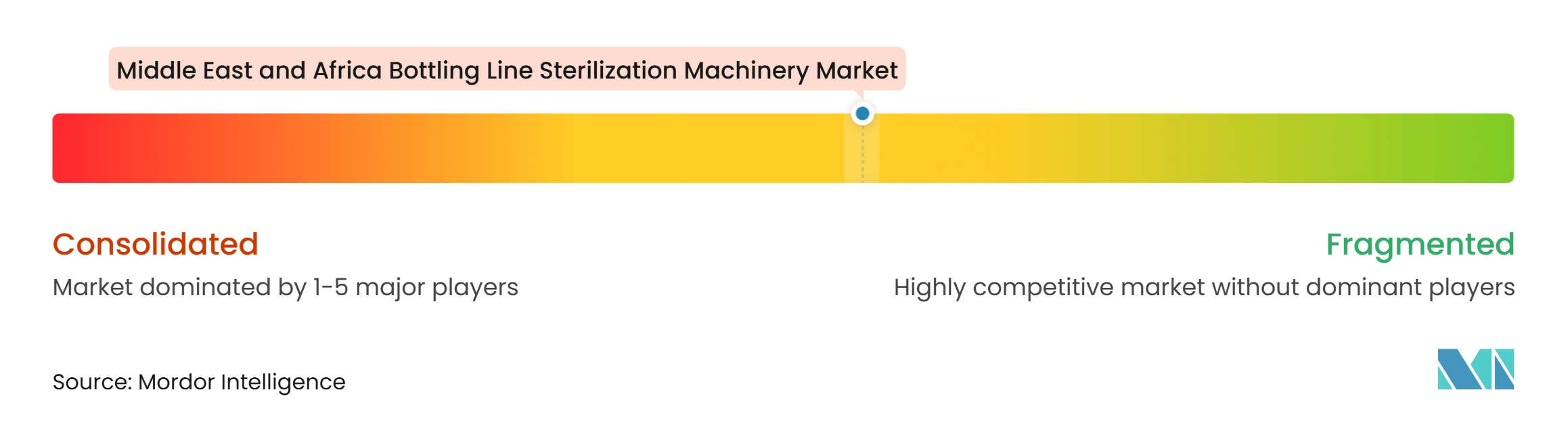
The Middle East and Africa bottling line sterilization machinery market is moderately fragmented and is served mainly by European engineering groups with global manufacturing and regional service networks. Service quality, parts availability, and local engineering support are important because plants need rapid assistance when a sterile filling line stops. KHS reported that its Middle East and Africa market zone contributed more than 20% of global turnover in 2025, up by one-third from 2020. The company's approach relies on regional centers and locally based service engineers. This model helps established suppliers build long-term relationships with beverage producers.
Suppliers are competing through localization, geographic expansion, and lower-resource technologies. Sidel opened a Lagos office in 2025 to serve Nigeria, Ghana, Côte d'Ivoire, and nearby West African markets with project management, engineering, and after-sales support. Sidel and Saudi Arabia's National Industrial Development Center also agreed to assess local services and programs aligned with Vision 2030. VDMA's residual-peroxide testing methods provide a consistent way for suppliers to demonstrate system performance. These actions show that documented quality and local technical capability can be as important as price.
Chinese suppliers are increasing competition at lower throughput levels, particularly for smaller sub-Saharan bottlers. Their lower initial equipment cost can appeal to customers facing currency volatility and restricted financing. Krones described the Alesayi project as incorporating digital line-management systems with high-speed filling equipment.[3] UV-C and pulsed-light suppliers also present a focused competitive challenge in cap, closure, and preform decontamination.
Middle East and Africa Bottling Line Sterilization Machinery Industry Leaders
-
Krones AG
-
KHS GmbH
-
Tetra Laval International SA
-
GEA Group Aktiengesellschaft
-
ProMach, Inc.
- *Disclaimer: Major Players sorted in no particular order
Middle East and Africa Bottling Line Sterilization Machinery Market Companies Covered in this Report
- Krones AG
- Sidel Group
- GEA Group AG
- KHS GmbH
- Tetra Pak International S.A.
- SIG Group AG
- Serac Group
- SIPA S.p.A.
- CFT S.p.A.
- Syntegon Technology GmbH
- SACMI Imola S.C.
- Arol S.p.A.
- ABE Beverage Equipment
- ProMach, Inc.
- IMA Group
- OPTIMA packaging group GmbH
- OCME S.r.l.
- Mettler-Toledo International Inc.
- Aseptic Technologies S.A.
- Scholle IPN, Inc.
Recent Industry Developments in Middle East and Africa Bottling Line Sterilization Machinery Market
- November 2026: SIG Group AG signed agreements for 17 new filling lines with regional food and beverage producers at Gulfood Manufacturing 2026 in Dubai, covering aseptic carton, spouted pouches, and bag-in-box products for India, Middle East, and Africa markets. SIG also received the UAE Industrial Excellence Award for its Dubai-based Product Innovation and Application Hub, reinforcing the UAE's position as the GCC's leading hub for packaging technology deployment.
- March 2026: The Coca-Cola system in South Africa announced a planned R17.6 billion (USD 1 billion) investment through 2030, covering expanded production capacity, distribution strengthening, and R4.8 billion earmarked for plastic packaging circularity initiatives.
- January 2026: Solico Group launched SoFood, an AED 130 million (USD 35.4 million) production facility in Jebel Ali Free Zone, UAE, equipped with European aseptic technologies and an initial capacity of up to 40 tons per day, designed as the company's GCC innovation hub and international manufacturing base.
- October 2025: Sidel Group opened a new office in Lagos, Nigeria, its third African location alongside existing offices in South Africa and Nairobi, to serve Nigeria, Ghana, Côte d'Ivoire, and neighboring West African markets with project management, engineering, and after-sales service capabilities.
Middle East and Africa Bottling Line Sterilization Machinery Market Report Scope
The Middle East and Africa Bottling Line Sterilization Machinery Market includes sales of machinery, equipment, and integrated systems used to sterilize bottles, preforms, caps, and closures in bottling and liquid packaging operations across the food and beverage, pharmaceutical, cosmetics, personal care, and other liquid-product industries. These systems help eliminate or reduce microbial contamination on packaging materials and product-contact surfaces, supporting product safety, hygiene, shelf-life stability, and compliance with relevant food safety and pharmaceutical manufacturing standards.
The Middle East and Africa Bottling Line Sterilization Machinery Market Report is Segmented by Equipment Type (Bottle Sterilization and Rinsing Modules, Preform Sterilization Modules, Cap and Closure Sterilization Modules, Integrated Sterilization-Filling-Capping Monoblocs), Sterilization Technology (Hydrogen Peroxide, Peracetic Acid, Steam and Hot Water, Dry Heat and Hot Air, UV-C and Pulsed Light, Electron Beam and Other Emerging Technologies), Format (PET Bottles, HDPE Bottles, Glass Bottles, Preforms, Caps and Closures, and Other Formats), Line Configuration (Rotary Systems, Linear and Inline Systems, Standalone Systems, Integrated Systems, Automatic and Semi-Automatic Systems), End User (Dairy and Plant-Based Beverage Producers, Juice, Tea, and Functional Beverage Producers, Bottled Water Producers, Pharmaceutical and Biopharmaceutical Manufacturers, Contract Beverage and Aseptic Packaging Organizations, Cosmetics, Personal Care, and Other Liquid Product Producers), and Geography (Saudi Arabia, United Arab Emirates, South Africa, and Rest of Middle East and Africa). The Market Forecasts are Provided in Terms of Value (USD).
Segmentation Overview
| Bottle Sterilization and Rinsing Modules |
| Preform Sterilization Modules |
| Cap and Closure Sterilization Modules |
| Integrated Sterilization-Filling-Capping Monoblocs |
| Hydrogen Peroxide |
| Peracetic Acid |
| Steam and Hot Water |
| Dry Heat and Hot Air |
| UV-C and Pulsed Light |
| Electron Beam and Other Emerging Technologies |
| PET Bottles |
| HDPE Bottles |
| Glass Bottles |
| Preforms |
| Caps and Closures |
| Other Formats |
| Rotary Systems |
| Linear and Inline Systems |
| Standalone Systems |
| Integrated Systems |
| Automatic and Semi-Automatic Systems |
| Dairy and Plant-Based Beverage Producers |
| Juice, Tea, and Functional Beverage Producers |
| Bottled Water Producers |
| Pharmaceutical and Biopharmaceutical Manufacturers |
| Contract Beverage and Aseptic Packaging Organizations |
| Cosmetics, Personal Care, and Other Liquid Product Producers |
| Saudi Arabia |
| United Arab Emirates |
| South Africa |
| Rest of Middle East and Africa |
| By Equipment Type | Bottle Sterilization and Rinsing Modules |
| Preform Sterilization Modules | |
| Cap and Closure Sterilization Modules | |
| Integrated Sterilization-Filling-Capping Monoblocs | |
| By Sterilization Technology | Hydrogen Peroxide |
| Peracetic Acid | |
| Steam and Hot Water | |
| Dry Heat and Hot Air | |
| UV-C and Pulsed Light | |
| Electron Beam and Other Emerging Technologies | |
| By Format | PET Bottles |
| HDPE Bottles | |
| Glass Bottles | |
| Preforms | |
| Caps and Closures | |
| Other Formats | |
| By Line Configuration | Rotary Systems |
| Linear and Inline Systems | |
| Standalone Systems | |
| Integrated Systems | |
| Automatic and Semi-Automatic Systems | |
| By End User | Dairy and Plant-Based Beverage Producers |
| Juice, Tea, and Functional Beverage Producers | |
| Bottled Water Producers | |
| Pharmaceutical and Biopharmaceutical Manufacturers | |
| Contract Beverage and Aseptic Packaging Organizations | |
| Cosmetics, Personal Care, and Other Liquid Product Producers | |
| By Geography | Saudi Arabia |
| United Arab Emirates | |
| South Africa | |
| Rest of Middle East and Africa |
Key Questions Answered in the Report
What is the Middle East and Africa bottling line sterilization machinery market size?
The market is projected to expand from USD 1.81 million in 2026 and USD 1.98 million in 2027 to USD 3.01 million by 2032, at an 8.74% CAGR.
Which equipment type leads demand for bottling line sterilization machinery?
Integrated sterilization-filling-capping monoblocs accounted for 26.32% in 2026 and are projected to expand at a 9.28% CAGR through 2032.
Which sterilization technology has the highest share?
Hydrogen peroxide held 43.09% of the technology segment in 2026, while UV-C and pulsed light systems are projected to expand at a 9.31% CAGR.
Why are bottled-water producers important buyers of sterilization equipment?
Bottled water producers held 31.29% in 2026 and are projected to expand at a 9.07% CAGR because regional water scarcity supports new bottling capacity.
Which geography is expected to expand fastest through 2032?
Saudi Arabia is projected to expand at a 9.58% CAGR through 2032, supported by bottled-water investment and production localization programs.
How are recycled PET requirements affecting filling lines?
Food-grade rPET capacity additions can require producers to revalidate sterility controls as they incorporate recycled material into existing PET lines.