
Middle East and Africa Bottling Line Cleaning Machinery Market Size and Share
Market Overview
| Study Period | 2021 - 2032 |
|---|---|
| Forecast Data Period | 2027 - 2032 |
| Base Year Market Size (2026) | USD 3.79 Million |
| Market Size (2027) | USD 4.13 Million |
| Market Size (2032) | USD 5.81 Million |
| Growth Rate (2027 - 2032) | 7.06 % |
| Market Concentration | Low |
Major Players *Disclaimer: Major Players sorted in no particular order Image © Mordor Intelligence. Reuse requires attribution under CC BY 4.0. | |
Middle East and Africa Bottling Line Cleaning Machinery Market Analysis by Mordor Intelligence
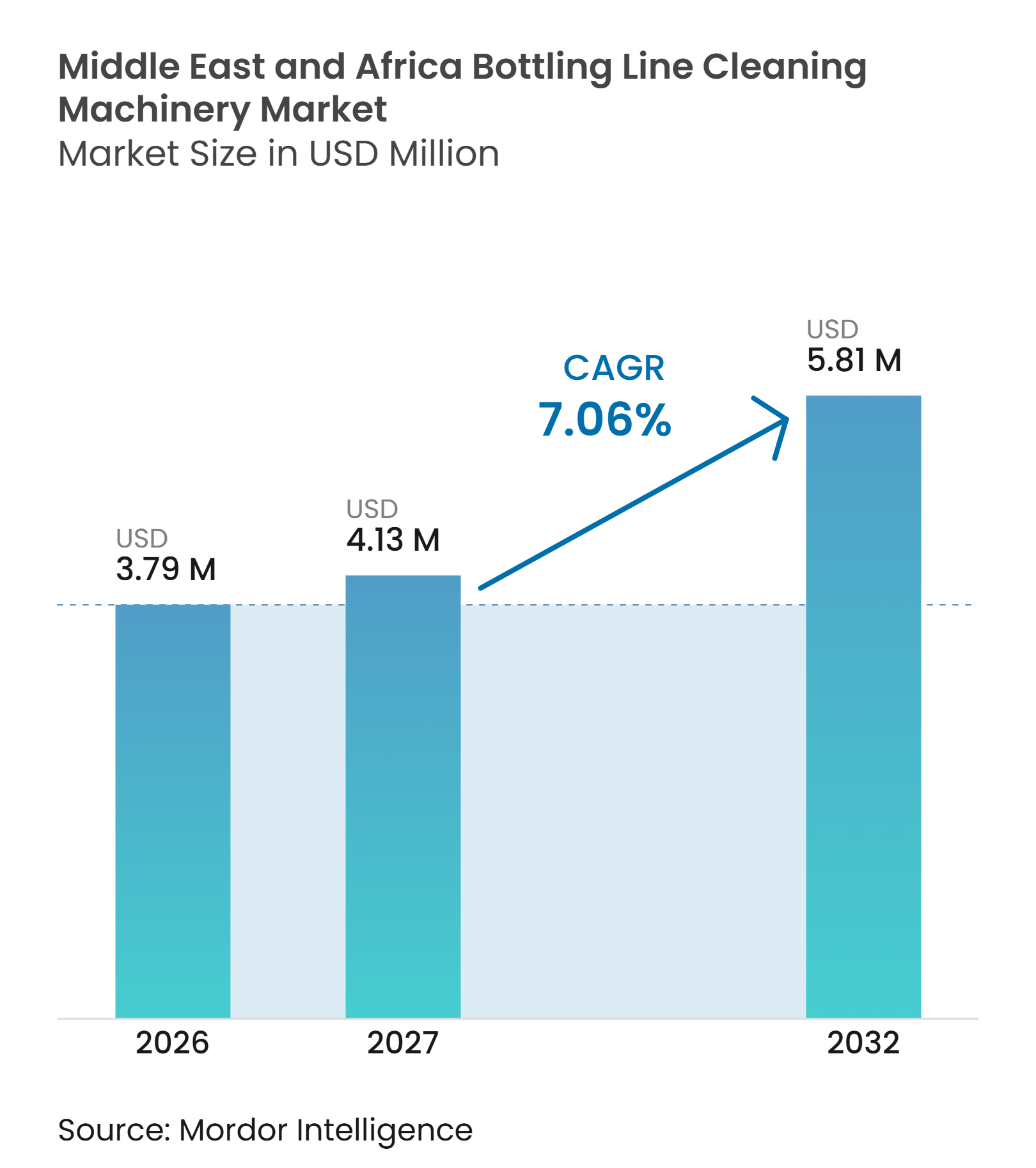
The Middle East And Africa Bottling Line Cleaning Machinery Market size is projected to expand from USD 3.79 million in 2026 and USD 4.13 million in 2027 to USD 5.81 million by 2032, registering a CAGR of 7.06% between 2027 and 2032.
The Middle East and Africa bottling line cleaning machinery market is shifting from imported, aging equipment toward automated systems that can be maintained locally and use less water. Beverage and pharmaceutical capacity additions are increasing demand for equipment that meets higher hygiene and documentation requirements. Water reuse projects and tighter operating standards are increasing interest in recirculating washers and integrated washer-dryer systems. European original equipment manufacturers retain a strong position in integrated lines, while regional and Chinese suppliers compete for lower-cost replacement orders. Foreign-currency exposure, uneven utility quality, and a limited supply of trained validation engineers continue to affect purchase decisions across the region.
Key Report Takeaways
- By machine type, Rotary Bottle Washers held 26.15% of the Middle East and Africa bottling line cleaning machinery market share in 2026, while Combined Washer-Dryer Systems are projected to expand at an 8.44% CAGR through 2032.
- By automation level, Fully Automatic Systems accounted for 47.76% of the market in 2026 and are projected to expand at a 7.64% CAGR through 2032.
- By bottle material, Glass Bottles accounted for 49.77% of the Middle East and Africa bottling line cleaning machinery market size in 2026, while Plastic Bottles are projected to expand at a 7.61% CAGR through 2032.
- By end user, Breweries and Soft-Drink Producers held 35.84% of the market in 2026, while Pharmaceutical Manufacturers are projected to expand at an 8.23% CAGR through 2032.
- By geography, the Rest of the Middle East and Africa held 42.11% of the market in 2026, while Saudi Arabia is projected to expand at an 8.04% CAGR through 2032.
Note: Market numbers in this report are based on Mordor Intelligence's proprietary estimation framework, which combines nine months of actuals with Q4 projections for base year 2026.
Market Trends and Insights
Drivers Impact Analysis of Middle East and Africa Bottling Line Cleaning Machinery Market*
| Driver | (~) % Impact on CAGR Forecast | Geographic Relevance | Impact Timeline |
|---|---|---|---|
| Expansion of Bottled-Water and Non-Alcoholic Beverage Capacity | +2.1% | Saudi Arabia, UAE, Algeria, Nigeria, Kenya | Short term (≤ 2 years) |
| Rising Food Safety and Microbiological Control Requirements | +1.5% | Saudi Arabia, UAE, South Africa, Egypt | Medium term (2-4 years) |
| Growth of Automated Cleaning and Reduced Utility Consumption | +1.3% | Saudi Arabia, UAE, South Africa, GCC Core | Medium term (2-4 years) |
| Replacement of Imported and Aging Bottle-Washing Equipment | +1.1% | Nigeria, Egypt, Algeria, Kenya, Morocco | Short term (≤ 2 years) |
| Water Scarcity Increasing Demand for Water-Recovery Cleaning Systems | +0.8% | Saudi Arabia, UAE, North Africa, spill-over to Sub-Saharan Africa | Medium term (2-4 years) |
| Local Serviceability Becoming a Purchase-Critical Requirement | +0.6% | Nigeria, Algeria, Tanzania, Kenya | Long term (≥ 4 years) |
| Source: Mordor Intelligence | |||
Expansion of Bottled-Water and Non-Alcoholic Beverage Capacity
New beverage plants and upgrades are creating demand for washing machinery based on line additions rather than beverage sales alone. New high-volume lines require cleaning equipment that matches filler speed, bottle format, and local water conditions. This has made cleaning equipment a core part of line design, rather than an item added after filling equipment is selected. Capacity expansion also requires existing plants to upgrade washers when faster fillers are installed. That creates replacement demand even when a site does not build a new production line. In water-constrained markets, operators increasingly need equipment specifications that account for local utility limits from the start of a project.
Rising Food Safety and Microbiological Control Requirements
Food safety compliance has become a licensing and market-access requirement for bottled-water and beverage producers in major countries across the Middle East and Africa, in the bottling line cleaning machinery market. The UAE requires bottled drinking water to meet Emirates Conformity Assessment System and Emirates Quality Mark requirements, which include compliance with UAE.S 1016:2017 microbiological criteria for foodstuffs.[1] Saudi Arabia applies related good manufacturing practice expectations through the Saudi Food and Drug Authority. Dubai's Law No. 5 of 2025 introduced hygiene and equipment-maintenance obligations for food-related establishments. Producers need documented cleaning cycles to support modern retail supply and public procurement requirements. Fully automatic equipment is favored where logged processes and repeatable cleaning cycles are needed for compliance.
Growth of Automated Cleaning and Reduced Utility Consumption
Water and energy targets are making automated cleaning equipment more relevant to larger beverage plants. Coca-Cola HBC invested EUR 10.9 million, USD 11.8 million, in water optimization and wastewater-treatment upgrades during 2025. The company reported ISO 46001 certification at nearly 88% of its 60 beverage production sites and targeted full certification in 2026. ISO 46001 supports structured water-efficiency management and aligns with the capabilities of closed-loop rinsing equipment. Manual and semi-automatic systems have less capacity to maintain consistent process records and to control utility use. As a result, supplier discussions increasingly begin with compliance and utility performance rather than with machine price alone.
Replacement of Imported and Aging Bottle-Washing Equipment
A significant share of the region's installed washing equipment was commissioned between 2008 and 2016 and is approaching replacement age. KHS identified the Middle East as its largest sales region and reported strong beverage investment activity in Saudi Arabia, Algeria, and Iraq during 2025. Older single-stage soaking and low-pressure rinsing equipment uses more water and chemicals than newer multi-zone washers with heat recovery. This operating gap makes replacement a practical option for plants facing higher utility costs or stricter hygiene controls. Export-credit structures can improve the affordability of line investments for operators with limited capital budgets. Suppliers that pair equipment with financing and service support can address both buyers' cost and maintenance concerns.
Restraints Impact Analysis of Middle East and Africa Bottling Line Cleaning Machinery Market*
| Restraint | (~) % Impact on CAGR Forecast | Geographic Relevance | Impact Timeline |
|---|---|---|---|
| High Capital Cost of Fully Automatic and Integrated Systems | -0.9% | Nigeria, Egypt, Sub-Saharan Africa, smaller GCC operators | Medium term (2-4 years) |
| Unreliable Utilities and Variable Water Quality | -0.6% | Nigeria, Kenya, Tanzania, Mozambique, Sub-Saharan Africa | Long term (≥ 4 years) |
| Limited Availability of Specialized Maintenance and Validation Personnel | -0.4% | Sub-Saharan Africa, North Africa excluding Egypt | Long term (≥ 4 years) |
| Chemical, Heat, and Effluent-Management Risks in Cleaning Operations | -0.3% | South Africa, Saudi Arabia, UAE | Medium term (2-4 years) |
| Source: Mordor Intelligence | |||
High Capital Cost of Fully Automatic and Integrated Systems
Fully automatic washers and combined washer-dryer systems require materially higher initial investment than semi-automatic alternatives. The difference is especially difficult for operators in weaker-currency markets across Sub-Saharan Africa. For facilities producing 10,000 to 30,000 bottles per hour, a European integrated system can require a payback period that exceeds local planning horizons. This has created different buying patterns across the region. GCC operators are more likely to specify integrated automation, while many Sub-Saharan African buyers retain lower-capital semi-automatic equipment. Suppliers seeking mid-tier customers need modular offerings that meet practical payback expectations without removing the core hygiene functions.
Unreliable Utilities and Variable Water Quality
Unreliable power and uneven water supply can limit the performance of washers designed for stable grid and municipal inputs. Statistics South Africa reported that food and beverage manufacturing output fell 3.9% year-over-year in June 2026, reflecting infrastructure challenges affecting the production environment. Variable water hardness in desalination-blended or aquifer-dependent supplies can affect detergent chemistry and rinse effectiveness. Operators may need water conditioning equipment, which adds cost and complexity to cleaning projects. Local engineering support can therefore be as important as the initial machine specification. KHS has built regional service capacity in Dubai and Lagos, reflecting the importance of after-sales support where infrastructure conditions are difficult.
*Our forecasts treat driver/restraint impacts as directional, not additive. The impact forecasts reflect baseline growth, mix effects, and variable interactions.
Middle East and Africa Bottling Line Cleaning Machinery Market Segment Analysis
By Machine Type:
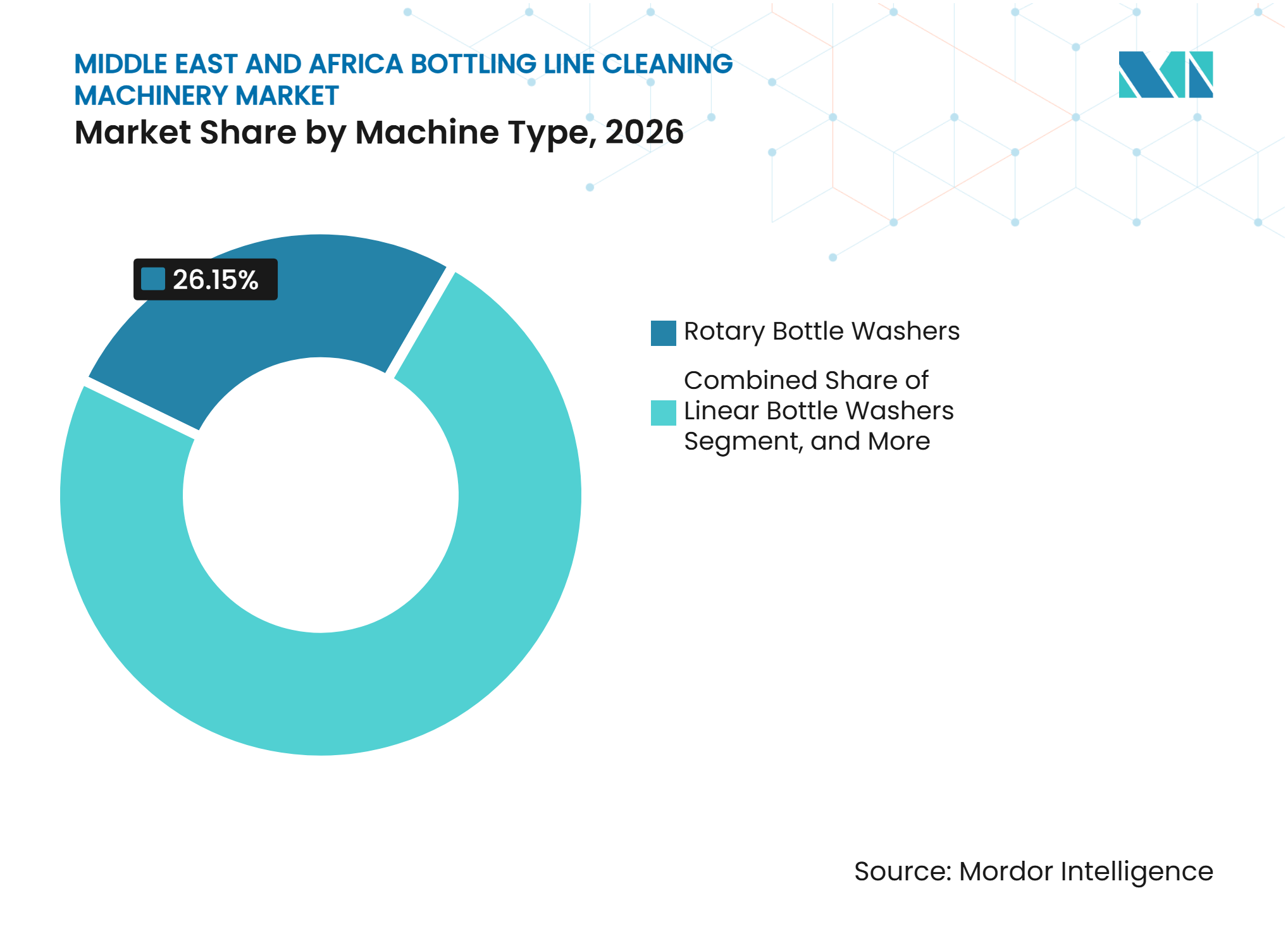
Rotary Washers Lead While Integrated Systems AccelerateRotary Bottle Washers held 26.15% of the Middle East and Africa bottling line cleaning machinery market share in 2026. Their position reflects the need for continuous rinsing in high-volume carbonated soft drink and water lines. Plants in Algeria, Saudi Arabia, and South Africa use rotary systems because they integrate reliably with established filler blocks. Rotary configurations also fit multi-shift production environments where line availability is important. Linear Bottle Washers and Tunnel Bottle Washers support mid-speed lines and returnable-glass operations. Breweries and wineries in South Africa and Morocco continue to use these designs for reusable containers. Immersion Bottle Washers are used where longer chemical contact time is needed. This is particularly relevant to pharmaceutical and chemical bottling operations. Bottle Rinsers and Blowers serve lower-intensity PET preparation requirements. Ionized-air systems are gaining relevance in PET-only greenfield lines where wet cleaning would add utility cost without a corresponding hygiene benefit.
Combined Washer-Dryer Systems are projected to expand at an 8.44% CAGR through 2032, the fastest pace among machine types. Their appeal comes from combining cleaning and drying functions in facilities with limited floor space. The USD 500 million industrial wastewater reuse project announced for Jubail illustrates the regional move toward closed-loop water management. Integrated systems with recirculating rinsing can support those water-management objectives. Separate washers and dryers can require more space and additional handling between stages. Greenfield projects can therefore favor integrated designs where water recovery is part of the line specification. This creates a defined opportunity for specialized manufacturers in the Middle East and Africa bottling line cleaning machinery market. The opportunity in the Middle East and Africa bottling line cleaning machinery market is most visible where a new plant is designed around utility efficiency rather than around an existing equipment layout. Product plans that offer water recovery and compact footprints are well aligned with this demand. The pace of adoption will still depend on access to financing and capable local service support.



By Automation Level:
Fully Automatic Systems Define the Compliance ThresholdFully Automatic Systems accounted for 47.76% of the market in 2026 and are projected to expand at a 7.64% CAGR through 2032. This combination shows that the leading automation category is also maintaining the strongest demand profile. Process documentation, repeatable cycle control, and lower manual intervention support the preference for this equipment. UAE bottled-water compliance requirements support the need for validated and recorded cleaning processes. Fully automatic equipment can provide the control loops needed for those requirements. It also supports consistent operation at larger production sites. Saudi pharmaceutical localization activity adds demand for sterile vial washers and tunnel sterilizers. These systems require a level of process control that semi-automatic configurations cannot provide for regulated use. The automation choice is therefore tied to product quality, audit readiness, and throughput. It is not only a labor-saving decision.
Manual systems remain relevant within the Middle East and Africa bottling line cleaning machinery market for small artisanal and community bottling operations across Sub-Saharan Africa. Semi-automatic equipment serves mid-tier bottlers in Egypt and Morocco, where labor costs remain high enough to support hybrid operating models. These buyers often balance lower capital expenditure with a need for basic repeatability in cleaning. Their selection criteria differ from those of larger GCC plants with formal compliance roadmaps. Nigeria still has an opportunity to upgrade its automation as packaging operators face tighter food-safety requirements and rising operating costs. That upgrade path will depend on financing and local technical support. The Middle East and Africa bottling line cleaning machinery market therefore includes several automation models rather than a single regional purchasing pattern. Fully automatic systems lead where documentation and utility efficiency are essential. Semi-automatic systems retain demand where upfront affordability remains the main constraint. Manual systems serve the smallest operations but offer limited scope for controlled cleaning records.
By Bottle Material:
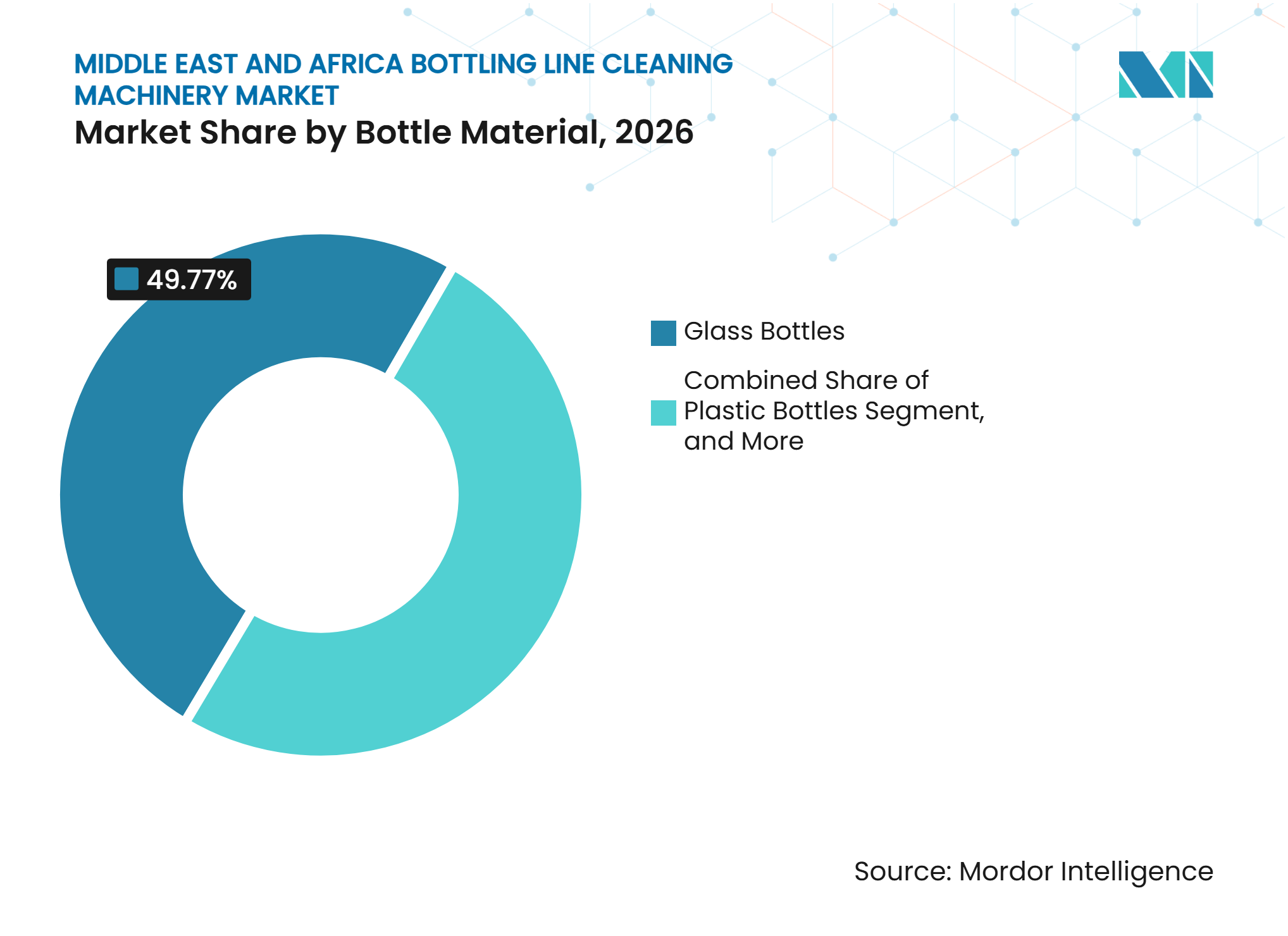
Glass Maintains Dominance While Plastic Gains GroundGlass Bottles accounted for 49.77% of the market in 2026. Returnable glass programs in breweries and wineries support this position across South Africa, Morocco, and the GCC. Reusable bottles need intensive washing before refill. The process typically uses elevated-temperature caustic cleaning followed by multistage rinsing and inspection. This requirement supports demand for tunnel and immersion washers with higher technical specifications. These systems generally have higher resale values than PET rinsers. Glass is also important for brand owners that maintain returnable packaging systems with established collection networks. Metal and Aluminum Containers account for a smaller share of cleaning demand. Their use is rising with new canning activity in the GCC. Mai Dubai's expanded production site included a canning line scheduled for spring 2026.
Plastic Bottles are projected to expand at a 7.61% CAGR through 2032. The growth reflects rising PET bottled-water capacity across the region. Krones commissioned a carbonated soft drink line at Watercom in Tanzania with a rated output of 82,500 bottles per hour in 2025. This scale of PET infrastructure creates related demand for rinsers and air-cleaning equipment. High-speed PET lines need machinery suited to preform and bottle-cleaning requirements. Ionized-air rinsers can be relevant where operators aim to avoid the cost of wet washing. Wet rinser systems remain relevant where production specifications require them. The plastic segment provides the Middle East and Africa bottling line-cleaning machinery market with a route for mid-tier suppliers to offer equipment suited to local line speeds. Coverage among suppliers focused specifically on MEA PET applications remains incomplete. The Middle East and Africa bottling line cleaning machinery market is therefore likely to see both wet and dry cleaning solutions develop alongside new PET capacity.

By End User:
Breweries Lead While Pharmaceutical Manufacturers AccelerateBreweries and Soft-Drink Producers held 35.84% of the market in 2026. Their leading position results from the frequent cleaning cycles required in high-volume beverage production. A brewery that washes returnable glass bottles may run cleaning equipment for 20 or more hours per day. That operating intensity shortens replacement cycles and increases the importance of robust equipment. Bottled-Water Producers form another major buyer group, particularly in the GCC where packaged drinking water is structurally important. Wineries and distilleries provide stable demand in South Africa and Morocco. Food and dairy producers require hygienic systems compatible with cleaning-in-place validation requirements. Contract packers are also becoming more relevant in Egypt and Kenya as brand owners use outsourced production. Each end-user group has different throughput, validation, and container-handling requirements. Suppliers in the Middle East and Africa bottling line cleaning machinery market must match the cleaning configuration to those operational differences.
Pharmaceutical Manufacturers are projected to expand at an 8.23% CAGR through 2032. Their demand is tied to investments in fill-finish, packaging, serialization, and quality-control operations. The African Development Bank approved a EUR 15 million (USD 16.2 million) senior loan for Minapharm Pharmaceuticals to expand biosimilar production in Egypt in March 2025. Pharmaceutical projects require dedicated vial washers and tunnel sterilizers where sterile containers are part of the process. Saudi Arabia's manufacturing localization efforts also support the need for this equipment. New regulated capacity can create a separate demand stream from beverage production. These orders have higher validation requirements than standard beverage installations. Suppliers need local personnel who can support qualification, testing, and documentation. This makes technical competence a key selection factor for pharmaceutical customers. The Middle East and Africa bottling line-cleaning machinery market can therefore benefit from pharmaceutical investment, even when beverage capital expenditure slows.
Geography Analysis
Saudi Arabia
Saudi Arabia is projected to expand at an 8.04% CAGR through 2032, the strongest geographic pace in the Middle East and Africa bottling line cleaning machinery market. Food and beverage capacity, pharmaceutical localization, and water-efficiency requirements are supporting demand across several equipment types. Sidel signed a memorandum of understanding with Saudi Arabia's National Industrial Development Center in May 2025 to explore local service and manufacturing programs for food and beverage packaging. The agreement shows that suppliers see localization as a practical route to serve Saudi customers. Krones also agreed to supply production lines to SAMA Healthy Water Factory during 2025 with export-credit financing. The transaction illustrates how financial structures can support capital equipment demand. Veolia's industrial wastewater reuse project in Jubail provides evidence of the country's move toward water reuse in industrial settings. Water-recovery-capable washer-dryer configurations are well placed for projects that include these utility objectives. Saudi requirements are also increasing the value of rapid service response and technically capable local teams.
UAE and South Africa
The UAE and South Africa have distinct demand patterns in the Middle East and Africa bottling line cleaning machinery market, but both support established cleaning equipment requirements. The UAE relies on premium packaged water and carbonated beverages, where ECAS and EQM requirements encourage fully automatic equipment with documented cleaning performance. Mai Dubai completed new filling-line and water-treatment investments during 2025, including an ErgoBloc L PET line designed to produce up to 100,000 bottles per hour. This type of investment creates demand for compatible high-throughput cleaning systems. In South Africa, food and beverage manufacturing accounted for 24.4% of manufacturing sales in June 2026. Infrastructure pressure can delay large capital upgrades and shift purchasing toward service, parts, and replacement work. South Africa's established returnable beer and carbonated soft-drink systems sustain demand for multistage caustic-washing equipment. Its operating base differs from the UAE's newer high-speed packaged-water investments. Suppliers in both markets need to combine compliance support with reliable service coverage.
Rest of Middle East and Africa
The rest of the Middle East and Africa held 42.11% of the Middle East and Africa bottling line cleaning machinery market share in 2026. The segment includes Algeria, Egypt, Nigeria, Kenya, Tanzania, Morocco, Zimbabwe, and other markets. Algeria has attracted beverage investment as domestic brands expand and replace older lines. KHS described strong regional activity and identified Algeria as an important area for beverage investment during 2025.[2] Egypt's pharmaceutical manufacturing expansion supports demand for bottle- and vial-cleaning systems. The African Development Bank financing for Minapharm shows the role of industrial finance in supporting regulated production capacity. Tanzania's Watercom line has received FSSC 22000 certification and operates at high output, raising the standard for compatible hygienic rinsing equipment. Markets within the Middle East and Africa in the bottling line cleaning machinery market have different levels of access to capital, utilities, and technical support. That variation favors suppliers that can provide modular equipment and local service. Food safety certification is also becoming more relevant as regional producers supply modern retail and export channels.
Competitive Landscape
Market Concentration
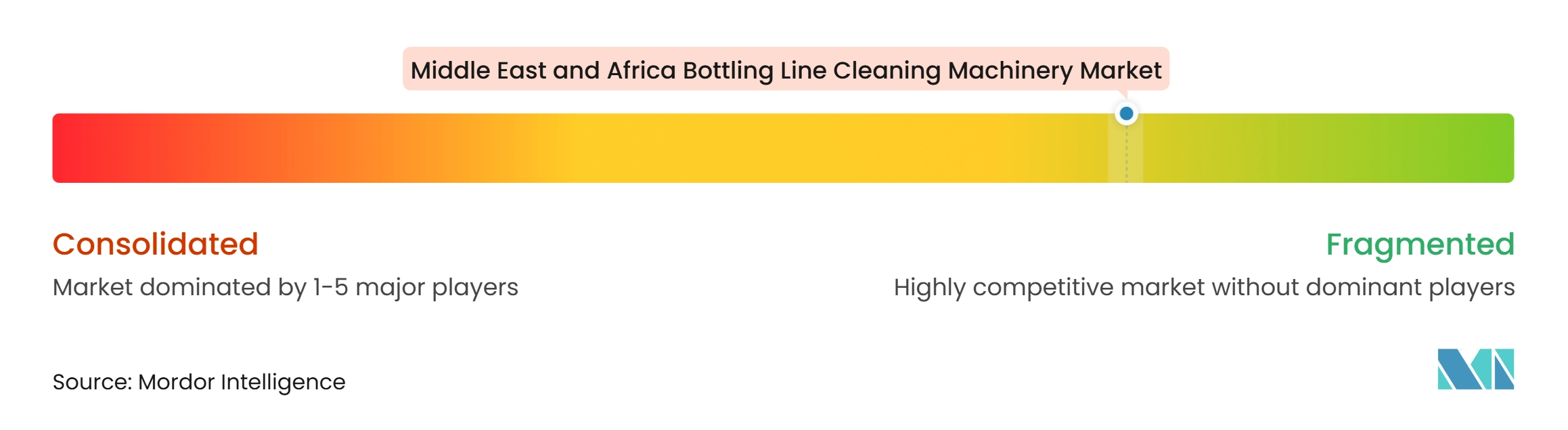
The Middle East and Africa bottling line cleaning machinery market is fragmented across the region. European original equipment manufacturers lead premium integrated projects, while regional and Chinese suppliers compete for replacement orders and semi-automatic equipment. Krones AG, KHS GmbH, GEA Group, and Sidel supply fully automatic and tunnel-washer configurations to large beverage producers. Their positions reflect established installations, line-integration capability, and service networks. Krones strengthened its relationship with Mai Dubai by installing new filling lines and integrating water treatment at the UAE facility.[3]
KHS has identified the Middle East and Africa as a strategically important sales region, reflecting sustained investment in beverage capacity. Local service capacity is a central feature of competition because difficult infrastructure conditions affect equipment performance. Krones used export-credit financing in its 2025 agreement with SAMA Healthy Water Factory for two Saudi bottled-water lines. Sidel's May 2025 Saudi memorandum of understanding focused on local services and manufacturing programs. These actions show that the Middle East and Africa bottling line cleaning machinery market rewards providers that can combine equipment, financing, and responsive support.
Syntegon Technology GmbH and SPX FLOW hold relevant positions in pharmaceutical-grade cleaning applications. Mid-tier automation offers an opening for suppliers that provide compliance benefits at lower initial costs in Morocco, Algeria, and Kenya. Water-recovery features and cleaning-in-place validation provide further differentiation in Saudi Arabia, the UAE, and regulated pharmaceutical settings. The Middle East and Africa bottling line cleaning machinery market remains open to global line integrators and specialized suppliers because customer needs vary by country, project size, and automation level.
Middle East and Africa Bottling Line Cleaning Machinery Industry Leaders
-
Krones AG
-
KHS GmbH
-
Tetra Laval International SA
-
GEA Group Aktiengesellschaft
-
ProMach, Inc.
- *Disclaimer: Major Players sorted in no particular order
Middle East and Africa Bottling Line Cleaning Machinery Market Companies Covered in this Report
- Krones AG
- KHS GmbH
- Tetra Laval International SA
- GEA Group Aktiengesellschaft
- Sidel Group
- ProMach, Inc.
- SACMI Cooperativa Meccanici Imola S.C.
- Coesia S.p.A.
- Syntegon Technology GmbH
- Serac Group
- SPX FLOW, Inc.
- Alfa Laval AB
- JBT Marel Corporation
- Arol S.p.A.
- IC Filling Systems S.r.l.
- Filtec Automation (Pty) Ltd
- Middle East Factory for Machines
- Karmelle Ltd
- GEA Tuchenhagen GmbH
- Jiangsu Jinrong Machinery Co., Ltd.
Recent Industry Developments in Middle East and Africa Bottling Line Cleaning Machinery Market
- November 2026: Moroccan pharmaceutical group Laprophan announced a MAD 374 million (USD 38.1 million) investment in a new sterile injectable drugs facility in Ain El Aouda, near Rabat, expected to begin operations in 2027. The 30 million consumer sales unit annual capacity marks a significant pharmaceutical packaging equipment demand trigger in North Africa, including dedicated vial-washing and tunnel sterilization systems.
- June 2026: Statistics South Africa reported that food and beverage manufacturing output fell 3.9% year over year in June 2026 against June 2025. The result highlighted infrastructure headwinds that affected operating conditions and reinforced the importance of local service capacity for cleaning-equipment suppliers.
- November 2025: Krones AG and Mai Dubai scheduled the commissioning of a canning line at Mai Dubai's UAE facility for 2026, following the ErgoBloc L PET line's operational start. Following the completion of two new filling lines and an integrated Hydronomic water-treatment system, the site's need for compatible high-throughput cleaning systems increased.
- June 2025: Krones AG planned commissioning of its first ErgoBloc L integrated filling block at SML CI in Ivory Coast, the first installation of its type in Northwest and Western Africa. The line integrated stretch blow-molding, labeling, filling, and capping with built-in digital monitoring, requiring hygienic rinsing systems validated to international food safety standards.
Middle East and Africa Bottling Line Cleaning Machinery Market Report Scope
The Middle East and Africa Bottling Line Cleaning Machinery Market encompasses industrial machinery and equipment used to clean, wash, rinse, and prepare bottles and containers for filling, packaging, and subsequent processing across the beverage, food and dairy, pharmaceutical, and other manufacturing industries in the Middle East and Africa. The market covers rotary, linear, tunnel, and immersion bottle washers; bottle rinsers and blowers; combined washer-dryer systems; and other specialized bottle-cleaning equipment.
The Middle East and Africa Bottling Line Cleaning Machinery Market Report is Segmented by Machine Type (Rotary Bottle Washers, Linear Bottle Washers, Tunnel Bottle Washers, Immersion Bottle Washers, Bottle Rinsers and Blowers, Combined Washer-Dryer Systems, ad Other Machine Types), Automation Level (Manual, Semi-Automatic, and Fully-Automatic), Bottle Material (Glass Bottles, Plastic Bottles, and Metal and Aluminum Containers), End User (Breweries and Soft-Drink Producers, Bottled Water Producers, Wineries and Distilleries, Food and Dairy Producers, Pharmaceutical Manufacturers, and Contract Packaging and Bottling Companies), and Geography (Saudi Arabia, United Arab Emirates, and Rest of Middle East and Africa). The Market Forecasts are Provided in Terms of Value (USD).
Segmentation Overview
| Rotary Bottle Washers |
| Linear Bottle Washers |
| Tunnel Bottle Washers |
| Immersion Bottle Washers |
| Bottle Rinsers and Blowers |
| Combined Washer-Dryer Systems |
| Other Machine Types |
| Manual |
| Semi-automatic |
| Fully-automatic |
| Glass Bottles |
| Plastic Bottles |
| Metal and Aluminum Containers |
| Breweries and Soft-Drink Producers |
| Bottled-Water Producers |
| Wineries and Distilleries |
| Food and Dairy Producers |
| Pharmaceutical Manufacturers |
| Contract Packaging and Bottling Companies |
| Saudi Arabia | United Arab Emirates |
| South Africa | |
| Rest of Middle East and Africa |
| By Machine Type | Rotary Bottle Washers | |
| Linear Bottle Washers | ||
| Tunnel Bottle Washers | ||
| Immersion Bottle Washers | ||
| Bottle Rinsers and Blowers | ||
| Combined Washer-Dryer Systems | ||
| Other Machine Types | ||
| By Automation Level | Manual | |
| Semi-automatic | ||
| Fully-automatic | ||
| By Bottle Material | Glass Bottles | |
| Plastic Bottles | ||
| Metal and Aluminum Containers | ||
| By End User | Breweries and Soft-Drink Producers | |
| Bottled-Water Producers | ||
| Wineries and Distilleries | ||
| Food and Dairy Producers | ||
| Pharmaceutical Manufacturers | ||
| Contract Packaging and Bottling Companies | ||
| By Geography | Saudi Arabia | United Arab Emirates |
| South Africa | ||
| Rest of Middle East and Africa | ||
Key Questions Answered in the Report
What is the size of the Middle East and Africa bottling line cleaning machinery market?
The market is projected to expand from USD 3.79 million in 2026 and USD 4.13 million in 2027 to USD 5.81 million by 2032, at a 7.06% CAGR.
Which machine type leads bottling line cleaning machinery demand in Middle East and Africa?
Rotary Bottle Washers lead with 26.15% share in 2026, supported by their use in high-throughput water and carbonated soft-drink lines.
Why are combined washer-dryer systems gaining adoption?
They are projected to expand at an 8.44% CAGR through 2032 because they combine cleaning and drying while supporting water recovery and efficient use of floor space.
Which end user has the strongest projected expansion through 2032?
Pharmaceutical Manufacturers are projected to expand at an 8.23% CAGR as regional fill-finish and regulated manufacturing capacity increases.
Why do fully automatic bottle-cleaning systems hold a leading position?
Fully Automatic Systems account for 47.76% share in 2026 because they provide repeatable cleaning cycles, process records, and control needed for hygiene compliance.
Which geography is expected to expand fastest through 2032?
Saudi Arabia is projected to expand at an 8.04% CAGR, supported by beverage capacity, pharmaceutical localization, and industrial water-efficiency investment.