
Middle East and Africa Bonsai Market Size and Share
Market Overview
| Study Period | 2021 - 2031 |
|---|---|
| Forecast Data Period | 2026 - 2031 |
| Base Year Market Size (2025) | USD 17.09 Million |
| Market Size (2026) | USD 18.70 Million |
| Market Size (2031) | USD 29.30 Million |
| Growth Rate (2026 - 2031) | 9.40 % |
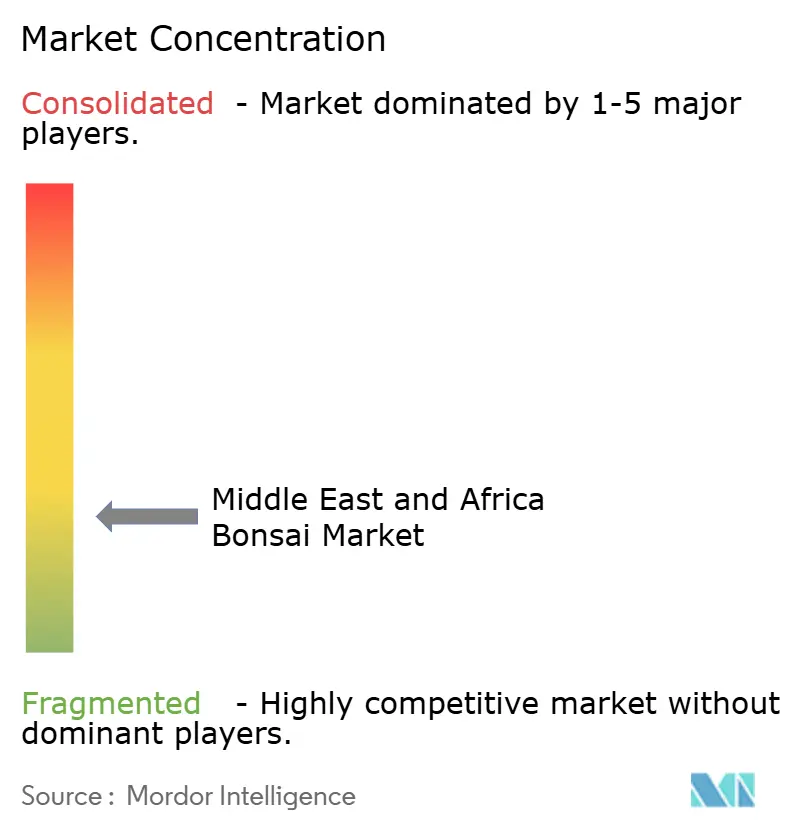
| Market Concentration | Low |
Major Players *Disclaimer: Major Players sorted in no particular order Image © Mordor Intelligence. Reuse requires attribution under CC BY 4.0. | |
Middle East and Africa Bonsai Market Analysis by Mordor Intelligence
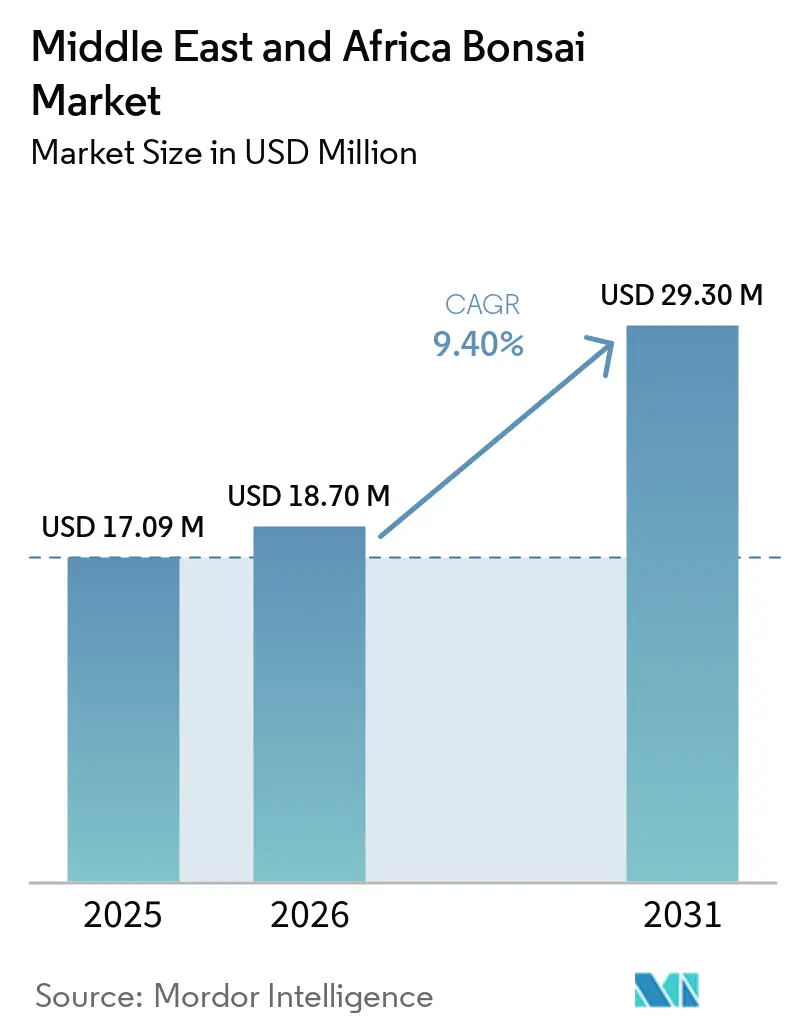
The Middle East and Africa bonsai market was valued at USD 17.09 million in 2025 and is projected to grow from USD 18.70 million in 2026 to USD 29.30 million by 2031, at a CAGR of 9.40% during the forecast period from 2026 to 2031. Urban greening initiatives, wellness-focused interiors, and broader access to specialty plant e-commerce are supporting demand across the region. Premium residential projects and hospitality developments are incorporating curated greenery into design and procurement. This creates opportunities for nurseries that can supply mature specimens, reliable care, and specialist advice. Import regulations and challenging growing conditions continue to favor operators with cultivation expertise, climate-controlled facilities, and dependable aftercare services.
Key Report Takeaways
- By species, indoor species accounted for the largest 38.0% of the Middle East and Africa bonsai market share in 2025, while outdoor species is projected to grow at the fastest CAGR of 9.7% from 2026 to 2031.
- By distribution channel, offline accounted for the largest share at 61.0% in 2025, while the online segment of the Middle East and Africa bonsai market size is projected to grow at the fastest CAGR of 13.6% from 2026 to 2031.
- By application, residential accounted for the largest share at 54.0% in 2025, while commercial applications are projected to grow at the fastest CAGR of 11.8% from 2026 to 2031.
- By geography, the United Arab Emirates accounted for the largest share at 27.0% in 2025 and is projected to grow the fastest CAGR of 11.4% from 2026 to 2031.
Note: Market size and forecast figures in this report are generated using Mordor Intelligence’s proprietary estimation framework, updated with the latest available data and insights as of January 2026.
Market Trends and Insights
Drivers Impact Analysis of Middle East and Africa Bonsai Market*
| Driver | (~) % Impact on CAGR Forecast | Geographic Relevance | Impact Timeline |
|---|---|---|---|
| Rising Urban Indoor-Gardening Adoption | 2.5% | United Arab Emirates, Saudi Arabia, South Africa, and Egypt | Medium term (2-4 years) |
| Expansion of Premium Residential Landscaping | 2.0% | United Arab Emirates, Qatar, and Saudi Arabia | Short term (≤ 2 years) |
| Growth of Online Specialty-Plant Retail | 1.8% | United Arab Emirates, Saudi Arabia, South Africa, and Morocco | Medium term (2-4 years) |
| Increasing Bonsai Workshops and Hobbyist Communities | 1.5% | United Arab Emirates, Qatar, and Saudi Arabia | Short term (≤ 2 years) |
| Hotel, Office, and Wellness-Center Greening | 1.2% | South Africa, United Arab Emirates, and Israel | Long term (≥ 4 years) |
| Climate-Controlled Cultivation and Display Systems | 1.0% | United Arab Emirates, Saudi Arabia, and Israel | Long term (≥ 4 years) |
| Source: Mordor Intelligence | |||
Rising Urban Indoor-Gardening Adoption
Urban living and compact residential spaces across the Middle East and Africa create opportunities for bonsai as decorative greenery suited to indoor settings. In the Gulf Cooperation Council, apartment living and smaller villas encourage interest in space-efficient plants, with bonsai offering an option for year-round interior decoration. The South African Bonsai Association (SABA) supports this interest through educational activities, events, and member clubs that promote bonsai knowledge. These community networks and indoor gardening preferences can broaden consumer awareness, encourage participation, and support demand for bonsai trees, tools, and cultivation supplies.
Expansion of Premium Residential Landscaping
Premium residential developments across the United Arab Emirates are incorporating landscaped open spaces, native planting, and nature-oriented amenities, creating opportunities for ornamental horticulture. On February 19, 2025, Aldar Properties announced The Wilds, a Dubai residential community featuring almost 1,700 homes, eco-corridors[1], wildlife habitats, and extensive greenery. These nature-focused designs can encourage interest in decorative plants, including bonsai, among homeowners and property managers. Although bonsai procurement is not confirmed for the project, a premium landscaping investment can expand the potential applications of bonsai in private gardens and shared residential spaces, thereby supporting regional market growth.
Increasing Bonsai Workshops and Hobbyist Communities
Bonsai workshops and hobbyist communities across the Middle East and Africa can strengthen consumer knowledge, encourage participation, and generate repeat purchases of trees, soil, wire, tools, and accessories. In 2025, Pretoria Bonsai Kai scheduled beginner courses, practical workshops, and regular club meetings, according to its published annual program. These activities help newcomers develop cultivation skills while connecting them with experienced growers and suppliers. Community-led learning and exhibition activities can expand awareness and support customer retention, creating recurring opportunities for bonsai retailers and contributing to regional market growth.
Hotel, Office, and Wellness-Center Greening
Hotels and wellness facilities across the Middle East and Africa are incorporating greenery into guest environments, creating opportunities for ornamental plants, including bonsai, in hospitality design. In 2025, the Dubai government announced approval of Therme Dubai, a wellness resort integrating natural environments and an indoor botanical garden. A study published in MDPI's Tourism and Hospitality Journal in 2025 found that the quality of biophilic design influenced guest well-being and perceived value in Egyptian hotels[2]. These developments suggest that nature-focused hospitality design can support demand for distinctive plant displays and associated maintenance services, benefiting the regional bonsai market.
Restraints Impact Analysis of Middle East and Africa Bonsai Market*
| Restraint | (~) % Impact on CAGR Forecast | Geographic Relevance | Impact Timeline |
|---|---|---|---|
| High Maintenance and Skill Requirements | -0.8% | Middle East and Africa, most acute in United Arab Emirates, Saudi Arabia, and Egypt | Medium term (2-4 years) |
| Import, Phytosanitary, and Biosecurity Complexity | -0.7% | United Arab Emirates, Saudi Arabia, Qatar, and Kuwait | Short term (≤ 2 years) |
| Heat Stress, Pest Pressure, and Water Constraints | -0.6% | Saudi Arabia, Kuwait, Oman, and United Arab Emirates | Long term (≥ 4 years) |
| Limited Availability of Mature Local Stock | -0.5% | Nigeria, Kenya, Morocco, and rest of Africa | Long term (≥ 4 years) |
| Source: Mordor Intelligence | |||
Import, Phytosanitary, and Biosecurity Complexity
Plant imports across the Middle East and Africa are subject to documentation, inspection, and quarantine requirements that can increase nursery operating costs and extend procurement timelines. In 2025, the United Arab Emirates Ministry of Climate Change and Environment (MOCCAE) introduced Federal Law No. 7 of 2025 on agricultural quarantine, which requires that imported agricultural consignments undergo inspection and bear authenticated phytosanitary certificates[3]. These requirements can complicate international sourcing, particularly for smaller nurseries handling limited shipments of mature bonsai trees. As a result, regulatory compliance can constrain sourcing flexibility and limit the growth of the regional bonsai market.
Heat Stress, Pest Pressure, and Water Constraints
Extreme heat, pest risks, and water-quality challenges can increase cultivation costs and limit bonsai availability across the Middle East and Africa. On August 1, 2025, the National Center of Meteorology (NCM) recorded a high of 51.8°C in Sweihan, highlighting the extreme temperatures that outdoor growers may need to manage. Such conditions increase requirements for shade, climate control, irrigation management, and pest monitoring. Nurseries without adequate infrastructure may face plant losses and limited cultivation options, while higher maintenance costs can reduce profitability and slow the growth of the regional bonsai market.
*Our forecasts treat driver/restraint impacts as directional, not additive. The impact forecasts reflect baseline growth, mix effects, and variable interactions.
Middle East and Africa Bonsai Market Segment Analysis
By Species:
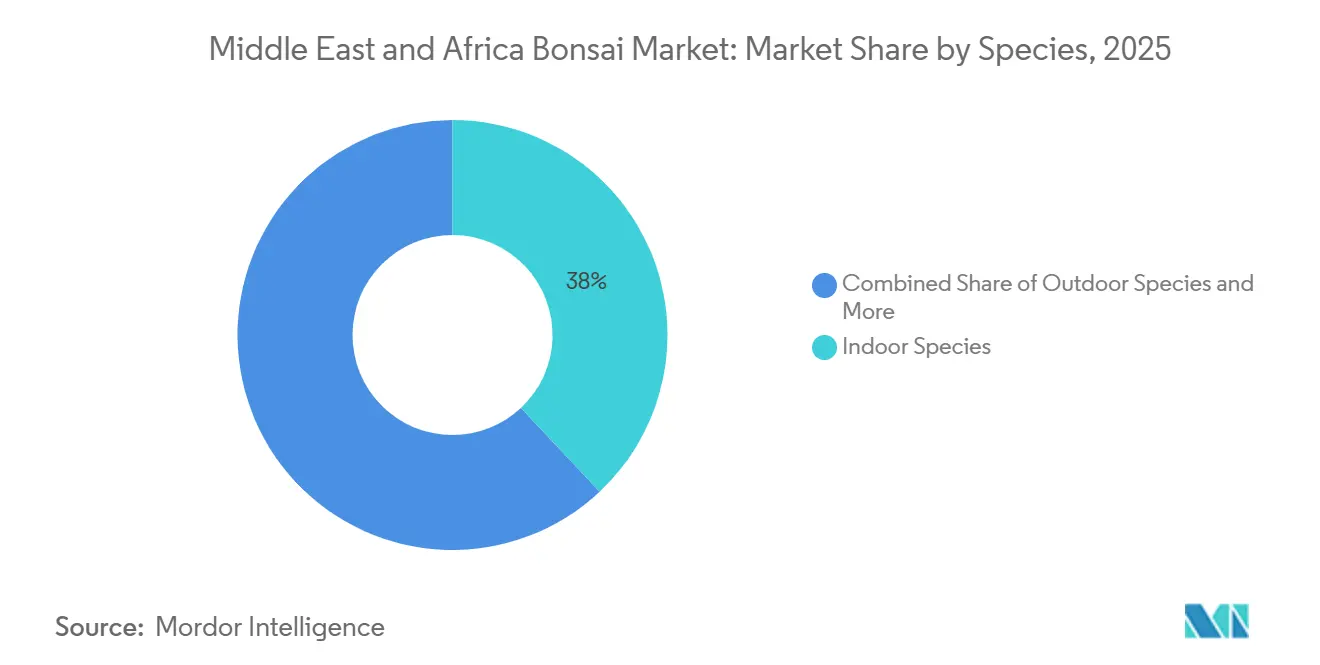
Indoor Species Anchor Current Demand, Outdoor Species Gain GroundIndoor species accounted for the largest 38.0% of the Middle East and Africa bonsai market share in 2025. Indoor bonsai appeal to buyers seeking decorative plants for homes, apartments, offices, and hospitality interiors. Ficus varieties are well-suited to this demand, as they are commonly offered for indoor settings and can be maintained as ornamental specimens. Al Qalamoon Nurseries lists Ficus bonsai in its tree catalog, indicating local availability in the United Arab Emirates. Indoor placement also allows owners to manage light, watering, and exposure more directly than in open gardens. Demand is supported by decorative preferences, plant-care interest, and the suitability of compact specimens for interior spaces.
Outdoor species are projected to grow at the fastest CAGR of 9.7% from 2026 to 2031. Outdoor bonsai present opportunities for gardens, terraces, courtyards, and landscaped commercial properties, although species selection must reflect local growing conditions. In South Africa, bonsai clubs and exhibitions help enthusiasts learn about cultivation and styling across different varieties. The South African Bonsai Association provides access to provincial clubs and educational resources, supporting knowledge exchange among hobbyists. Outdoor cultivation appeals to experienced growers and property owners with suitable shaded or protected areas. Demand will depend on plant survival, water management, and growers' ability to match species with local temperatures and seasonal conditions.

By Distribution Channel:
Offline Segment Retains Scale, Online Segment ExpandsThe offline segment accounted for the largest share at 61.0% in 2025. Physical nurseries and garden centers remain relevant because customers can examine a tree's trunk, roots, foliage, pot, and styling before purchasing. This is particularly important when selecting mature or individually shaped specimens. Specialist retailers can also provide care guidance and recommendations on suitable growing media, tools, and placement. In the United Arab Emirates, Al Qalamoon Nurseries offers Ficus bonsai through its plant catalog, illustrating the presence of specialist products in the local nursery channel. In-person access supports buyer confidence and ongoing relationships for maintenance advice and repeat purchases.
The online segment is projected to grow at the fastest CAGR of 13.6% from 2026 to 2031. Online retail gives bonsai buyers access to trees, pots, tools, soil components, and accessories without requiring a visit to a specialist nursery. Digital catalogs allow customers to compare available specimens and browse supplies, while delivery extends sellers' reach beyond local areas. South African retailers such as Bishopsford Bonsai Nursery offer online shopping and nationwide shipping, demonstrating an established route to market beyond physical visits. Live-plant delivery requires careful packaging and suitable logistics, particularly for delicate or mature specimens. Online growth will therefore depend on product presentation, reliable fulfillment, and customer support.
By Application:
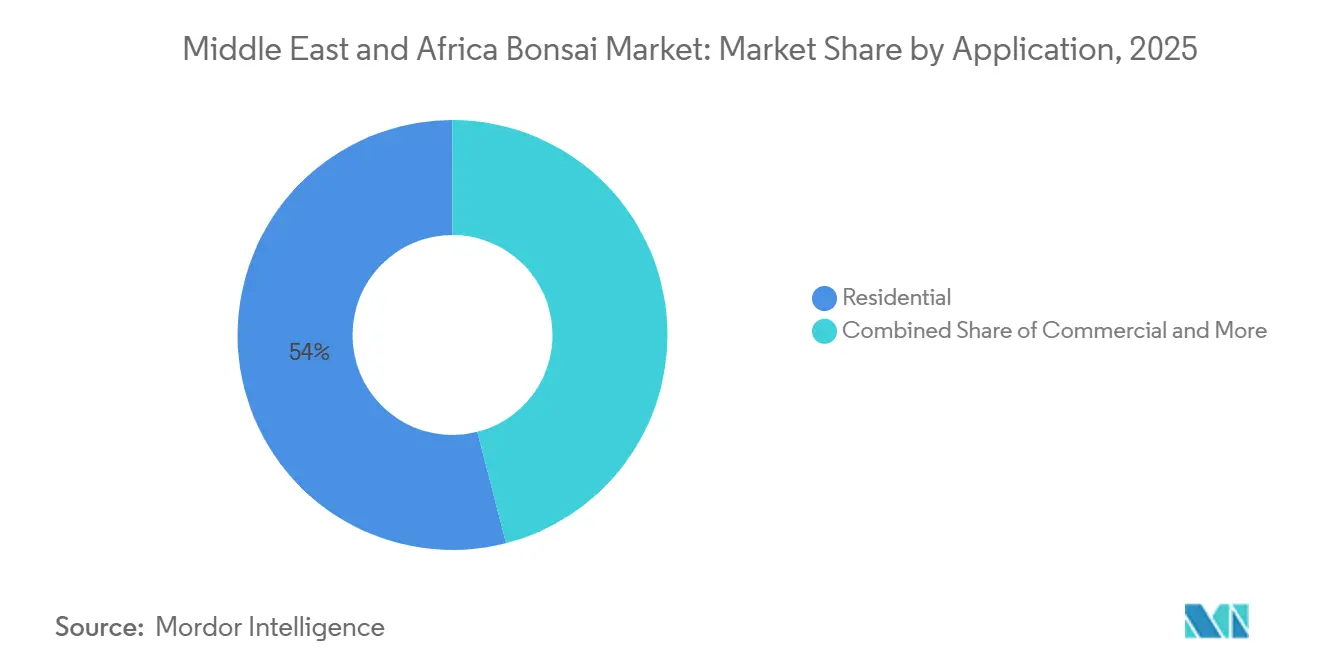
Residential Demand Provides the Base, Commercial Demand Grows FasterResidential applications accounted for the largest share at 54.0% in 2025. Residential buyers use bonsai as decorative accents in living rooms, on balconies, on patios, and in private gardens. The appeal combines ornamental value with the hands-on activity of pruning, shaping, and maintaining a living tree. Smaller specimens suit limited spaces, while larger trees may be incorporated into villas and landscaped properties. Specialist sellers support new owners with plant selection and care guidance, helping to reduce uncertainty about maintenance. In the United Arab Emirates, Al Qalamoon Nurseries lists Ficus bonsai, confirming local availability for residential customers and other buyers seeking ornamental trees.
Commercial applications are projected to grow at the fastest CAGR of 11.8% from 2026 to 2031. Commercial demand arises from hotels, wellness facilities, offices, restaurants, and other properties seeking distinctive plant displays. Bonsai can serve as focal points in reception areas, courtyards, and curated interior landscapes, provided that their light, watering, and maintenance requirements are addressed. The Dubai government's announcement of the Therme Dubai project describes an indoor botanical garden, illustrating investment in plant-centered commercial environments, although it does not confirm bonsai procurement.
Geography Analysis
The United Arab Emirates held the largest share of the Middle East and Africa bonsai market at 27.0% in 2025 and is projected to record the fastest growth, with a CAGR of 11.4% from 2026 to 2031. High-value residential properties, hospitality facilities, and specialist nursery activities provide a relevant market context. Al Qalamoon Nurseries lists Ficus bonsai, while Wahat Al Sahraa Nurseries operates within the country's broader nursery and specialty-plant supply network. These businesses reflect local horticultural activity, although their presence does not independently verify bonsai market size or growth forecasts.
Saudi Arabia's landscaping and greening initiatives provide context for broader interest in planted environments, but they should not be interpreted as direct evidence of bonsai purchasing. The National Greening Program identifies afforestation and vegetation development across the country as priorities and describes the use of native plant species, rainwater, treated water, and seawater for different planting settings. Such activity may support horticultural awareness and supplier capabilities, while bonsai demand will remain dependent on specialist retail, suitable growing conditions, and consumer interest.
South Africa has a visible bonsai community supported by specialist nurseries, clubs, and public exhibitions. Bishopsford Bonsai Nursery supplies trees and accessories and offers courses, while Sawasdee Exotic Plants, Orchids and Bonsai markets bonsai, including indigenous and internationally sourced varieties. The South African Bonsai Association connects enthusiasts with provincial clubs and learning resources. Its 2025 exhibition activities provide a recent example of public engagement, while specialist retailers and organized clubs help sustain cultivation knowledge, hobbyist participation, and access to bonsai products across the country.
Competitive Landscape
The Middle East and Africa bonsai market is fragmented in 2025, with key players including Wahat Al Sahraa Nurseries, Mountain City Landscape LLC, Al Qalamoon Nurseries, Bishopsford Bonsai Nursery (Pty) Ltd., and Sawasdee Exotic Plants, Orchids and Bonsai. Competition is shaped by differences in product selection, customer service, specialist knowledge, and access to residential and commercial buyers. Businesses differentiate through specimen quality, cultivation guidance, workshops, delivery services, and aftercare. Import requirements, plant health management, and the practical challenges of transporting live trees also influence sourcing and distribution across the region.
Competition varies by country depending on specialist availability, horticultural communities, online access, and the ability to maintain and deliver live plants. Specialist nurseries compete through specimen quality, advice, workshops, and aftercare, while general garden centers serve customers seeking ornamental plants. In South Africa, Bishopsford Bonsai Nursery offers online ordering, nationwide shipping, courses, and practical advice. Sawasdee also advertises bonsai sales and delivery arrangements. These services illustrate how sellers differentiate through access and customer support.
Bonsai specialists compete by offering distinctive tree varieties, well-developed styling, and cultivation expertise that help customers maintain healthy specimens. Product selection, including indoor Ficus and outdoor varieties suited to local conditions, allows retailers to serve hobbyists, collectors, and landscape buyers with different requirements. Workshops, demonstrations, and care advice strengthen customer engagement and encourage repeat purchases of trees, tools, pots, and growing media. Commercial differentiation also depends on sourcing consistency, plant health, and careful handling during delivery. These capabilities shape brand recognition and competitive positioning across the region's specialist bonsai trade.
Middle East and Africa Bonsai Industry Leaders
-
Wahat Al Sahraa Nurseries
-
Mountain City Landscape LLC
-
Al Qalamoon Nurseries
-
Bishopsford Bonsai Nursery (Pty) Ltd.
-
Sawasdee Exotic Plants, Orchids and Bonsai
- *Disclaimer: Major Players sorted in no particular order
Middle East and Africa Bonsai Market Companies Covered in this Report
- Al Qalamoon Nurseries
- Wahat Al Sahraa Nurseries
- Bishopsford Bonsai Nursery (Pty) Ltd.
- Sawasdee Exotic Plants, Orchids and Bonsai
- Mountain City Landscape LLC
- Hennie's Bonsai
- Kranspoort Bonsai Nursery
- Shohin Bonsai Dubai
- Jo-Da Bonsai
- Misty Moon Bonsai Nursery
- Egy Plants
- Bonsai Tree (Pty) Ltd.
Recent Industry Developments in Middle East and Africa Bonsai Market
- September 2025: Shohin Bonsai Dubai introduced Yuugen no Chikara, a curated bonsai composition paired with handcrafted Middle Eastern ceramic pottery, targeting premium bonsai collectors in the United Arab Emirates.
- May 2025: Shohin Bonsai Dubai introduced Kazekage Ne Kon, a wood-apple bonsai styled in the Fukinagashi (windswept) form, targeting the premium ornamental plant market in the United Arab Emirates with handcrafted, collector-oriented bonsai.
- September 2024: Desert Group became part of Al Ghandi Group Enterprises, which may support bonsai availability through Wahat Al Sahraa Nurseries' ornamental plant supply and landscaping services in the United Arab Emirates.
Middle East and Africa Bonsai Market Report Scope
Bonsai is the Japanese art of cultivating miniature trees in containers through pruning, wiring, and root management to replicate the form and proportions of mature trees. It is primarily used for ornamental, cultural, residential, commercial, and institutional applications.
The Middle East and Africa bonsai market report is segmented by species (indoor species, outdoor species, needle tree species, and deciduous tree species), by distribution channel (online and offline), by application (residential, commercial, and others, including institutional gifts and art fairs), and by geography (Middle East and Africa). The market forecasts are provided in terms of value (USD).
Segmentation Overview
| Indoor Species |
| Outdoor Species |
| Needle Tree Species |
| Deciduous Tree Species |
| Online |
| Offline |
| Residential |
| Commercial |
| Institutional and Other Applications |
| Middle East | Saudi Arabia |
| United Arab Emirates | |
| Qatar | |
| Kuwait | |
| Oman | |
| Israel | |
| Rest of Middle East | |
| Africa | South Africa |
| Egypt | |
| Kenya | |
| Nigeria | |
| Morocco | |
| Rest of Africa |
| By Species | Indoor Species | |
| Outdoor Species | ||
| Needle Tree Species | ||
| Deciduous Tree Species | ||
| By Distribution Channel | Online | |
| Offline | ||
| By Application | Residential | |
| Commercial | ||
| Institutional and Other Applications | ||
| By Geography | Middle East | Saudi Arabia |
| United Arab Emirates | ||
| Qatar | ||
| Kuwait | ||
| Oman | ||
| Israel | ||
| Rest of Middle East | ||
| Africa | South Africa | |
| Egypt | ||
| Kenya | ||
| Nigeria | ||
| Morocco | ||
| Rest of Africa | ||
Key Questions Answered in the Report
What is the projected value of bonsai market in the Middle East and Africa by 2031?
The Middle East and Africa bonsai market is forecast to reach USD 29.30 million by 2031.
Which bonsai species leads demand in the Middle East and Africa?
Indoor species led with the largest 38.0% share in 2025 because air-conditioned interiors offer more stable growing conditions.
Why is online bonsai retail growing in the region?
Online segment is forecast to grow at the fastest CAGR of 13.6% from 2026 to 2031.
Which country leads regional bonsai demand?
The United Arab Emirates held the largest 27.0% share in 2025 and is projected to grow at the fastest CAGR of 11.4% from 2026 to 2031.