
Microwave Imaging For Non-Destructive Testing Market Size and Share
Market Overview
| Study Period | 2024 - 2031 |
|---|---|
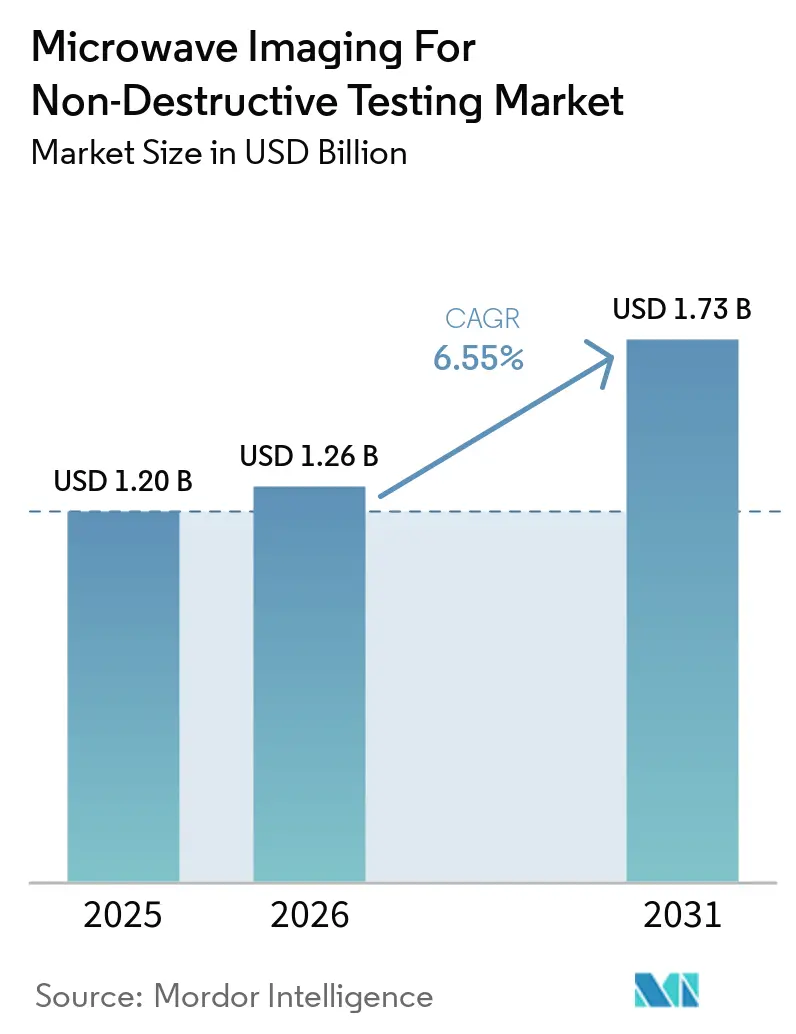
| Market Size (2026) | USD 1.26 Billion |
| Market Size (2031) | USD 1.73 Billion |
| Growth Rate (2026 - 2031) | 6.55 % |
| Fastest Growing Market | Asia-Pacific |
| Largest Market | Asia-Pacific |
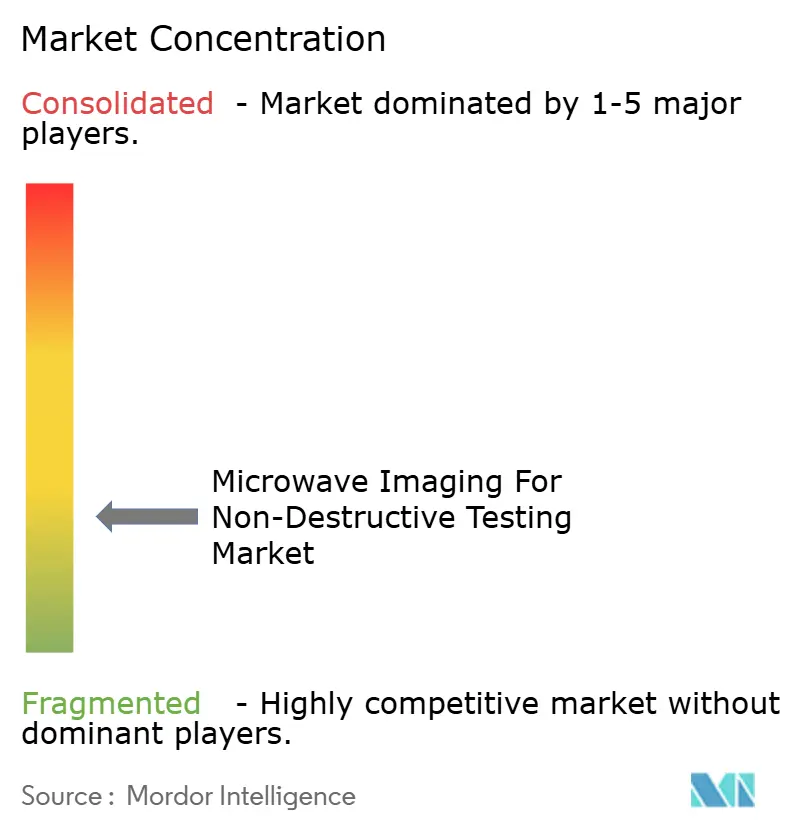
| Market Concentration | Low |
Major Players *Disclaimer: Major Players sorted in no particular order Image © Mordor Intelligence. Reuse requires attribution under CC BY 4.0. | |
Microwave Imaging For Non-Destructive Testing Market Analysis by Mordor Intelligence
The Microwave Imaging for Non-Destructive Testing Market size was valued at USD 1.20 billion in 2025 and estimated to grow from USD 1.26 billion in 2026 to reach USD 1.73 billion by 2031, at a CAGR of 6.55% during the forecast period (2026-2031). The Microwave Imaging for Non-Destructive Testing Market serves inspection needs for dielectric and nonmetallic materials in aerospace, energy, and electronics. Composite adoption increases the need for methods that assess internal defects without contact or ionizing radiation. Suppliers are pairing specialized probes with imaging software and established test instruments. The opportunity is strongest where inspection records, low downtime, and safe operating conditions matter.
Key Report Takeaways
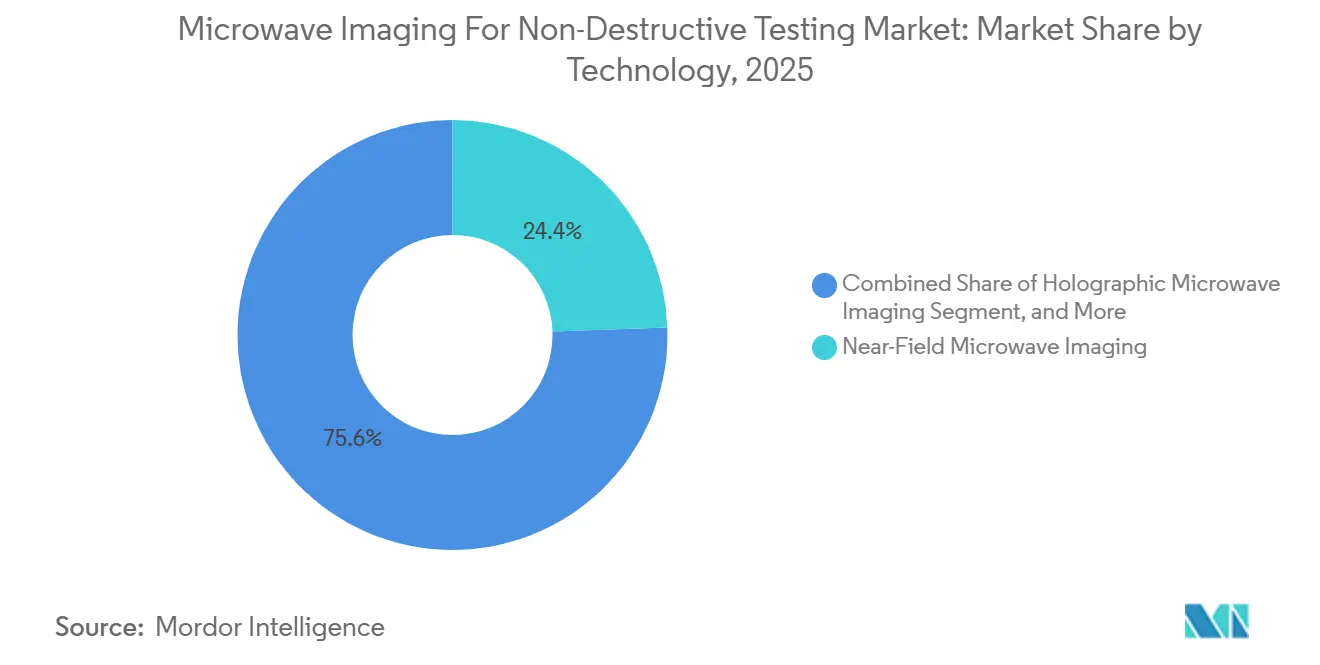
- By technology, near-field microwave imaging held 24.44% of the Microwave Imaging for Non-Destructive Testing Market share in 2025, while holographic microwave imaging is projected to expand at an 8.21% CAGR through 2031.
- By application, delamination detection accounted for 22.51% of the Microwave Imaging for Non-Destructive Testing Market size in 2025, while void and porosity detection is projected to expand at a 7.41% CAGR through 2031.
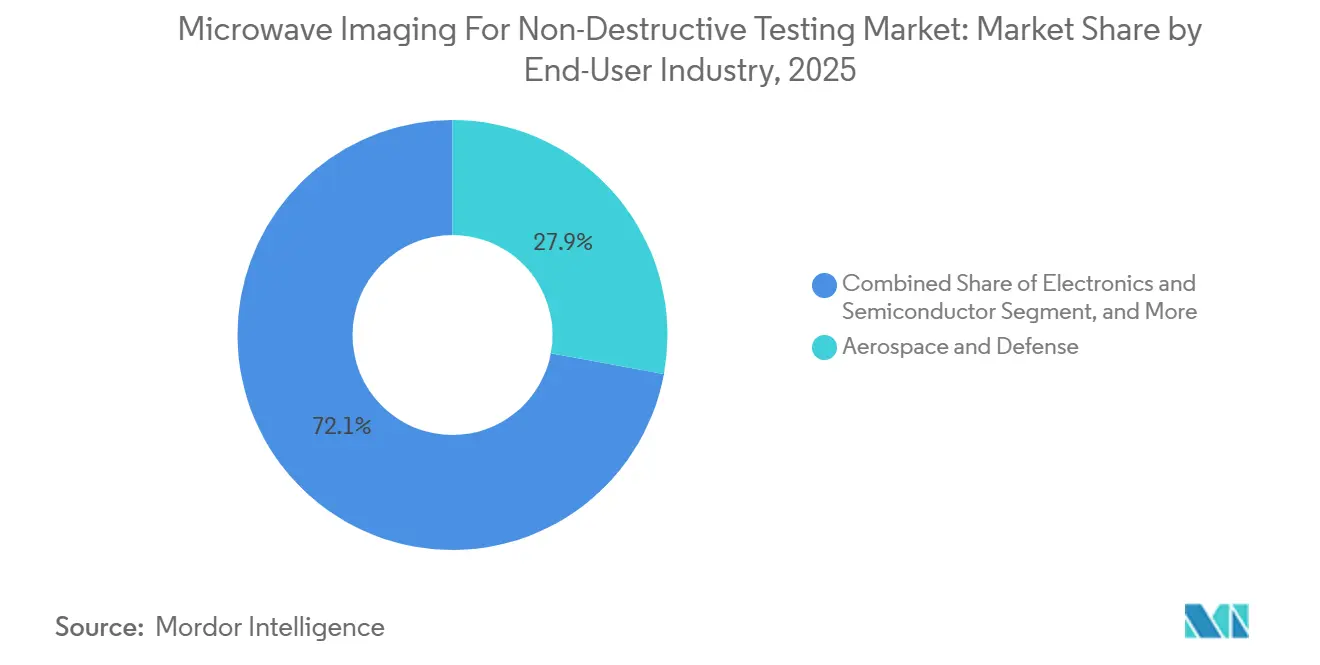
- By end-user industry, aerospace and defense held a 27.91% share in 2025, while electronics and semiconductors are expected to expand at a 7.89% CAGR through 2031.
- By material, composite materials held 29.59% share in 2025, while electronic components and PCBs are projected to expand at a 7.74% CAGR through 2031.
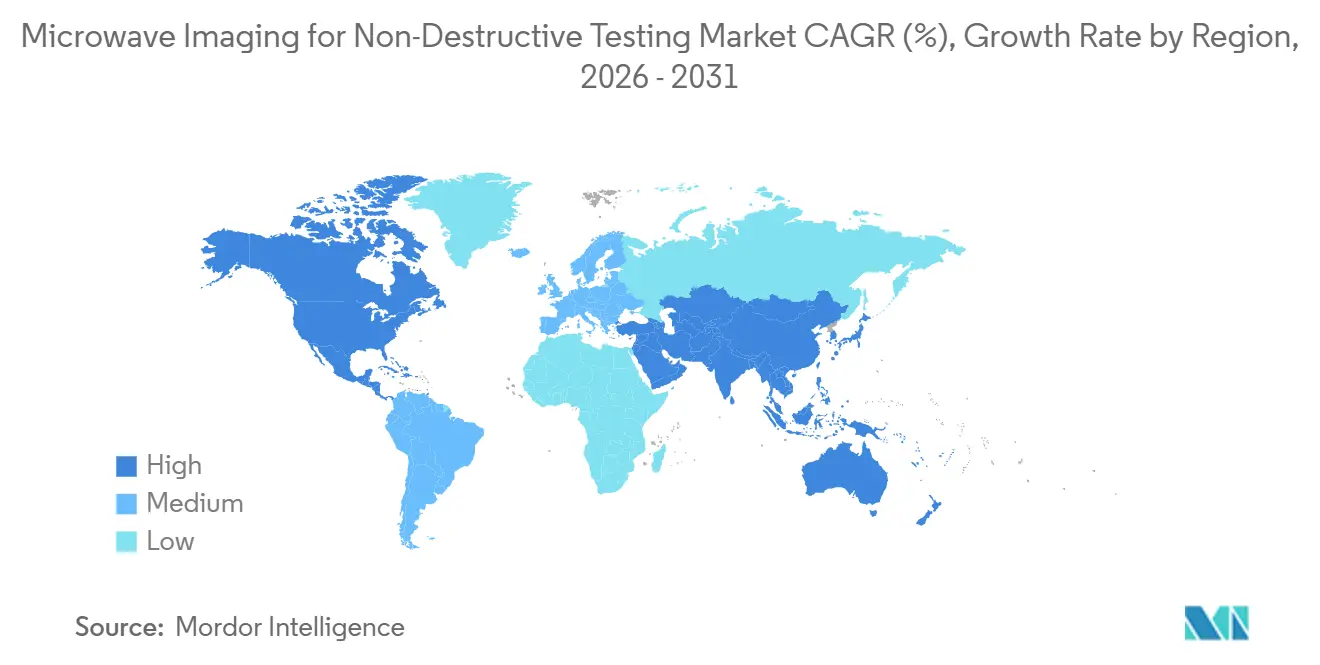
- By geography, Asia-Pacific held 31.29% share in 2025 and is projected to expand at a 7.42% CAGR through 2031.
Note: Market size and forecast figures in this report are generated using Mordor Intelligence’s proprietary estimation framework, updated with the latest available data and insights as of January 2026.
Market Trends and Insights
Aging Composite and Nonmetallic Infrastructure Requiring Volumetric Inspection
GFRP pipelines, polymer liners, and reinforced rubber joints are entering more regular inspection cycles. Conventional ultrasonic testing requires a liquid couplant and accessible surface. X-ray computed tomography also requires radiation shielding and qualified operators. Microwave scanning is contactless, uses milliwatt power, and can assess wall cross-sections in one pass. EvisiveScan has been qualified for GFRP and HDPE piping under an ISO 9001:2015-certified program. Near-field microwave methods imaged internal debonding in thermal protection composites while suppressing speckle noise in research published in 2026.[1]
Adoption of Lightweight Dielectric Components in Aerospace, Wind Energy, and Transportation
CFRP and GFRP structures require inspection during service and after repair. Microwave methods can assess material thickness without contact or ionizing radiation. A 2026 study reported X-band strategies for GFRP panels that resolved defects below 2 mm.[2] A 60 GHz FMCW radar system was field-deployed on a Nordex N117 2.4 MW turbine blade in 2026. These applications link demand for Microwave Imaging for Non-Destructive Testing Market to the needs of composite production and maintenance. Aerospace production schedules, therefore, influence inspection purchases over several years.
Industrial Automation and Contactless Inline Quality Control
Manufacturers are evaluating microwave systems for inline checks of polymer and composite products. These systems can avoid the radiation-protection infrastructure used for X-ray inspection. A D-band line camera demonstrated a 32-channel MIMO design and real-time 3D image reconstruction for conveyor-based inspection at ECNDT 2026.[3] Semiconductor equipment can use millimeter-wave probes to identify conductor and dielectric defects that optical systems may miss. Electronics assembly requirements are becoming more demanding as components become smaller. This creates a potential buyer base in the Asia-Pacific semiconductor manufacturing.
Stricter Safety, Asset Integrity, and Product Quality Requirements
Aerospace and energy operators need dependable records for structural inspections. Microwave systems can support volumetric checks without X-ray licensing requirements. A 2025 study reported 96.67% accuracy for a ridge-waveguide approach to identifying and sizing delamination beneath ceramic insulation. The result supports documentation needs under aerospace qualification frameworks. Asset owners with GFRP infrastructure are incorporating appropriate methods into their maintenance programs. These requirements support the broader use of Microwave Imaging for Non-Destructive Testing in regulated applications.[4]
Restraints Impact Analysis of Microwave Imaging For Non-Destructive Testing Market*
| Restraint | (~) % Impact on CAGR Forecast | Geographic Relevance | Impact Timeline |
|---|---|---|---|
| Limited Penetration in Conductive or Highly Lossy Materials | -0.9% | Global | Long term (≥ 4 years) |
| Shortage of Qualified Microwave NDT Personnel and Procedures | -0.7% | Global, most acute in South America and the Middle East and Africa | Medium term (2-4 years) |
| Cost of Multichannel Hardware and Validation | -0.6% | Global, most constraining in price-sensitive Asia-Pacific tiers and South America | Medium term (2-4 years) |
| Dielectric Variability From Moisture and Temperature | -0.4% | Global, particularly tropical and high-humidity locations | Short term (≤ 2 years) |
| Source: Mordor Intelligence | |||
Limited Penetration in Electrically Conductive or Highly Lossy Materials
Microwave fields reflect off electrically conductive surfaces and attenuate rapidly in high-loss materials. Carbon-fiber laminates with high fiber volume present a particular challenge. This limits the addressable base to GFRP, polymers, ceramics, and concrete rather than all composite structures. A 2026 study found that dielectric-loaded waveguide probes delivered high-resolution images, but performance declined as carbon-fiber volume increased. Dual-modality platforms can combine microwave scanning with eddy-current methods across different material zones. Such systems increase cost and operational complexity.
Shortage of Qualified Microwave NDT Personnel and Procedures
Qualified microwave testing practitioners remain less common than ultrasonic and radiographic technicians. This gap can delay an inspection after an end user specifies the method. Procedure development also lacks the mature reference standards available for conventional ultrasonic testing. Evisive offers service contracts that combine equipment with qualified operators. The model addresses immediate needs but can limit broader scale and keep inspection costs high. The restraint remains more significant in regions with limited certification infrastructure.
*Our forecasts treat driver/restraint impacts as directional, not additive. The impact forecasts reflect baseline growth, mix effects, and variable interactions.
Microwave Imaging For Non-Destructive Testing Market Segment Analysis
By Technology:
Near-Field Systems Lead Composite InspectionNear-field microwave imaging held 24.44% of the Microwave Imaging for Non-Destructive Testing Market’s share in 2025. Its established position reflects long-running development of waveguide probes for composite inspection. These systems can deliver sub-wavelength resolution when placed close to the test surface. A dielectric-loaded probe demonstrated multiscale defect imaging in aerospace composites in 2026. The capability supports qualification work in aerospace maintenance. Tomography, synthetic-aperture imaging, and radar imaging remain more specialized options.
Holographic microwave imaging is projected to expand at an 8.21% CAGR through 2031. The method produces three-dimensional images through reconstruction across cylindrical apertures. A 2025 study demonstrated a convolution-based near-field system that reduced mechanical scanning time. Separate 2025 research used convolutional neural networks to process phaseless data with fewer measurements. Chip-integrated millimeter-wave transceivers may support further system development. The technology is particularly relevant to faster industrial inspection workflows.

By Application:
Delamination Remains the Core Use CaseDelamination detection accounted for 22.51% of the Microwave Imaging for Non-Destructive Testing Market size in 2025. It remains important for aerospace structures and GFRP pipeline verification. Microwave systems identify dielectric contrast along an interlaminar boundary. They can operate at useful standoff distances without the coupling required by phased-array ultrasonic testing. This supports inspections of difficult-to-access composite structures. Layer separation, therefore, remains a central driver of demand for the Microwave Imaging for Non-Destructive Testing Market.
Void and porosity detection is projected to expand at a 7.41% CAGR through 2031. Wind turbine blade manufacturing is a key use case because resin-starved areas and cure voids can affect fatigue performance. Larger blades make full volumetric inspection with contact ultrasonics more time-consuming. Crack detection, inclusion detection, and moisture detection also address distinct inspection needs. Corrosion detection has more limited potential because metal cladding restricts microwave performance. A 2025 study showed that millimeter-wave quasi-optical methods could characterize internal composite flaws in near-field production configurations.
By End-User Industry:
Aerospace and Defense Sets the Adoption BenchmarkAerospace and defense held 27.91% of the Microwave Imaging for Non-Destructive Testing Market’s share in 2025. The sector has a high concentration of inspectable composite structures. It also requires traceable records in accordance with EN 4179, NAS 410, and NADCAP frameworks. Microwave imaging can provide inspection evidence without radiation licensing requirements. These conditions support demand in repair, maintenance, and production settings. Aerospace remains the reference sector for qualified microwave inspection procedures.
Electronics and semiconductor is projected to expand at a 7.89% CAGR through 2031. Near-field scanning microwave microscopy has been validated for PCB defects at 13 µm resolution. This supports non-contact checks of packaged circuits and wafer-level packages. Automotive, energy, construction, and industrial machinery offer additional use cases. A 2025 EuCAP paper described microwave imaging for inline food-quality assessment and foreign-body detection. These applications broaden the buyer base beyond aerospace.
By Material:
Composites Anchor Demand While Electronic Components and PCBs AdvanceComposite materials held 29.59% of the Microwave Imaging for Non-Destructive Testing Market share in 2025. Aerospace airframes, wind blades, GFRP piping, and automotive panels support this position. These materials are generally suited to microwave penetration and contrast-based imaging. Frequencies from 1 GHz to 18 GHz can balance penetration and resolution for common laminate thicknesses. Polymers and plastics are another important group for liners, tanks, and automotive parts. Ceramics remain a specialized use case for thermal barrier coatings.
Electronic components and PCBs are projected to expand at a 7.74% CAGR through 2031. Advanced packaging can create dielectric defects that surface optical inspection may not detect. Samsung Electro-Mechanics piloted terahertz inspection for glass substrates with Actro in 2026. The work targeted microscopic cracks in glass-core PCB architectures. Detection methods developed for glass substrates may also support inspection of dense organic PCB structures. Metals and metal-composite structures remain limited by their conductive properties.
Geography Analysis
APAC Microwave Imaging for Non-Destructive Testing Market
Asia-Pacific held 31.29% of the Microwave Imaging for Non-Destructive Testing Market’s share in 2025. China, Japan, South Korea, and India support regional demand through the production of composites and electronics. China’s C919 program requires domestic capabilities for composite inspection. Japan combines carbon-fiber production with advanced electronics manufacturing. South Korea adds semiconductor capital investment. India supports demand through aerospace maintenance, infrastructure, and defense composite programs.
North America, Europe and APAC Microwave Imaging for Non-Destructive Testing Market
Asia-Pacific is projected to expand at a 7.42% CAGR through 2031. Vietnam, Thailand, and Malaysia are entering the inspection demand curve as local electronics and automotive production expand. North America and Europe have mature certification systems and a comparatively deep base of qualified personnel. U.S. demand includes aerospace maintenance, defense platforms, and GFRP assets in industrial facilities. Europe benefits from Airbus manufacturing and wind blade inspection needs. The regional mix gives the Microwave Imaging for Non-Destructive Testing Market a stable base in established applications.
MEA and South America Microwave Imaging for Non-Destructive Testing Market
South America, the Middle East,, and Africa form a smaller emerging-demand cluster. Brazil has demand from Embraer’s composite aircraft activities and Petrobras-linked infrastructure needs. Saudi Arabia and the UAE have petrochemical assets with nonmetallic piping and composite-insulated tanks. South Africa contributes inspection requirements from mining and energy operations. Limited local certification infrastructure and personnel availability constrain adoption in these locations. These regions are expected to remain below the global average during the forecast period.
Competitive Landscape
The Microwave Imaging for Non-Destructive Testing Market is fragmented at the system level. Malcam Ltd., Evisive LLC, 2π-LABS GmbH, and Becster ApS compete through application-specific probes and image-processing capabilities. Their service models can also include qualified inspection delivery. Rohde and Schwarz and Keysight Technologies provide the vector network analyzer hardware used by system builders. Large providers such as MISTRAS Group, Eddyfi Technologies, Baker Hughes, and Evident offer microwave imaging as part of broader inspection portfolios. This structure gives specialist vendors technical focus and larger suppliers established customer access.
Rohde and Schwarz unveiled the R&S ZNB3044 and extended the R&S ZNB3000 platform to 54 GHz in September 2025. Keysight launched frequency extenders that support measurements up to 170 GHz and, in 2025, up to 250 GHz. ESAB signed an agreement to acquire Eddyfi Technologies for USD 1.45 billion in February 2026. The transaction shows the strategic importance placed on advanced inspection capability. It may also support further consolidation among multimodal inspection providers.
Embedded antennas in smart composites remain an early product opportunity. Automated defect classification could make scans easier to convert into inspection records. Both capabilities could reduce reliance on scarce specialist operators. Certification under ASNT SNT-TC-1A is increasingly relevant in aerospace procurement. Vendors with documented evidence of qualification may have an advantage with aerospace primes. The Microwave Imaging for Non-Destructive Testing Market, therefore, combines specialized engineering competition with broader portfolio competition.
Microwave Imaging For Non-Destructive Testing Industry Leaders
-
Rohde & Schwarz GmbH & Co. KG
-
Keysight Technologies, Inc.
-
Teledyne Technologies Incorporated
-
Baker Hughes Company
-
Compass Technology Group, Inc.
- *Disclaimer: Major Players sorted in no particular order
Microwave Imaging For Non-Destructive Testing Market Companies Covered in this Report
- Rohde & Schwarz GmbH & Co. KG
- Becster ApS
- Compass Technology Group, Inc.
- Evisive, LLC
- Optikan SAS
- TRILITEC GmbH
- Malcam Ltd.
- Texas Research Institute Austin, Inc.
- Rohde and Schwarz GmbH and Co. KG
- Keysight Technologies, Inc.
- Teledyne Technologies Incorporated
- Qorvo, Inc.
- Richardson Electronics, Ltd.
- Baker Hughes Company
- Eddyfi Technologies
- MISTRAS Group, Inc.
- Evident Corporation
- Comet Holding AG
- Nikon Metrology NV
- SGS Société Générale de Surveillance SA
- Bureau Veritas SA
Recent Industry Developments in Microwave Imaging For Non-Destructive Testing Market
- July 2026: MISTRAS Group expanded its Los Angeles, CA laboratory with new welding, grinding, CNC machining, and vertical turning capabilities, specifically targeting commercial and military aerospace and defense composite manufacturing inspection backlogs. The expansion strengthens MISTRAS's position as a full-service aerospace NDT provider, complementing composite inspection with machining and rework under one roof.
- June 2026: MISTRAS Group expanded its Houston, TX in-house laboratory with dedicated immersion ultrasonic tanks, TacTic rotary ultrasonic systems, a 320 kV X-ray digital radiography system, and fluorescent penetrant inspection, all certified to ISO 9001 with NADCAP accreditation targeted for late 2026. The expansion directly supports aerospace and defense clients managing composite and forging inspection requirements.
- February 2026: ESAB Corporation signed a definitive agreement to acquire Eddyfi Technologies for USD 1.45 billion, funded through a combination of cash, debt, and USD 318 million of equity. Eddyfi projected 2026 revenue of USD 270 million from advanced NDT instrumentation, robotics, and sensing across aerospace, nuclear, energy, and civil infrastructure. The transaction expands ESAB's total addressable opportunity by USD 5 billion.
- September 2025: Rohde and Schwarz unveiled the R&S ZNB3044, a next-generation vector network analyzer, and extended the R&S ZNB3000 platform to 54 GHz at European Microwave Week 2025 in Utrecht. The development broadened the frequency range available for millimeter-wave composite and material inspection applications.
Global Microwave Imaging For Non-Destructive Testing Market Report Scope
Microwave Imaging for Non-Destructive Testing refers to advanced inspection technologies that use electromagnetic waves in the microwave frequency range to detect subsurface defects, material inconsistencies, and structural anomalies in various materials without causing damage, providing a non-contact, often real-time alternative to traditional testing methods.
The Microwave Imaging for Non-Destructive Testing Market Report is Segmented by Technology (Near-Field Microwave Imaging, Microwave Tomography, Synthetic Aperture Microwave Imaging, Microwave Radar Imaging, Holographic Microwave Imaging, and Other Technologies), Application (Crack and Fracture Detection, Delamination Detection, Void and Porosity Detection, Inclusion / Foreign-Object Detection, Moisture and Water-Ingress Detection, Corrosion Detection, and Other Applications), End-User Industry (Aerospace and Defense, Automotive and Transportation, Electronics and Semiconductor, Energy and Power, Construction and Infrastructure, Manufacturing and Industrial Machinery, and Other End-User Industries), Material (Composite Materials, Polymers and Plastics, Ceramics, Concrete and Construction Materials, Metals and Metal–Composite Structures, Electronic Components and PCBs, and Other Materials), and Geography (North America, South America, Europe, Asia-Pacific, Middle East and Africa). The Market Forecasts are Provided in Terms of Value (USD).
Segmentation Overview
| Near-Field Microwave Imaging |
| Microwave Tomography |
| Synthetic Aperture Microwave Imaging |
| Microwave Radar Imaging |
| Holographic Microwave Imaging |
| Other Technologies |
| Crack and Fracture Detection |
| Delamination Detection |
| Void and Porosity Detection |
| Inclusion and Foreign-Object Detection |
| Moisture and Water-Ingress Detection |
| Corrosion Detection |
| Other Applications |
| Aerospace and Defense |
| Automotive and Transportation |
| Electronics and Semiconductor |
| Energy and Power |
| Construction and Infrastructure |
| Manufacturing and Industrial Machinery |
| Other End-User Industries |
| Composite Materials |
| Polymers and Plastics |
| Ceramics |
| Concrete and Construction Materials |
| Metals and Metal Composite Structures |
| Electronic Components and PCBs |
| Other Materials |
| North America | United States | |
| Canada | ||
| Mexico | ||
| South America | Brazil | |
| Argentina | ||
| Rest of South America | ||
| Europe | Germany | |
| United Kingdom | ||
| France | ||
| Italy | ||
| Spain | ||
| Rest of Europe | ||
| Asia-Pacific | China | |
| Japan | ||
| India | ||
| South Korea | ||
| Rest of Asia-Pacific | ||
| Middle East and Africa | Middle East | Saudi Arabia |
| Turkey | ||
| United Arab Emirates | ||
| Rest of the Middle East | ||
| Africa | South Africa | |
| Kenya | ||
| Rest of Africa | ||
| By Technology | Near-Field Microwave Imaging | ||
| Microwave Tomography | |||
| Synthetic Aperture Microwave Imaging | |||
| Microwave Radar Imaging | |||
| Holographic Microwave Imaging | |||
| Other Technologies | |||
| By Application | Crack and Fracture Detection | ||
| Delamination Detection | |||
| Void and Porosity Detection | |||
| Inclusion and Foreign-Object Detection | |||
| Moisture and Water-Ingress Detection | |||
| Corrosion Detection | |||
| Other Applications | |||
| By End-User Industry | Aerospace and Defense | ||
| Automotive and Transportation | |||
| Electronics and Semiconductor | |||
| Energy and Power | |||
| Construction and Infrastructure | |||
| Manufacturing and Industrial Machinery | |||
| Other End-User Industries | |||
| By Material | Composite Materials | ||
| Polymers and Plastics | |||
| Ceramics | |||
| Concrete and Construction Materials | |||
| Metals and Metal Composite Structures | |||
| Electronic Components and PCBs | |||
| Other Materials | |||
| By Geography | North America | United States | |
| Canada | |||
| Mexico | |||
| South America | Brazil | ||
| Argentina | |||
| Rest of South America | |||
| Europe | Germany | ||
| United Kingdom | |||
| France | |||
| Italy | |||
| Spain | |||
| Rest of Europe | |||
| Asia-Pacific | China | ||
| Japan | |||
| India | |||
| South Korea | |||
| Rest of Asia-Pacific | |||
| Middle East and Africa | Middle East | Saudi Arabia | |
| Turkey | |||
| United Arab Emirates | |||
| Rest of the Middle East | |||
| Africa | South Africa | ||
| Kenya | |||
| Rest of Africa | |||
Key Questions Answered in the Report
What is the size of the Microwave Imaging for Non-Destructive Testing Market?
The market is estimated at USD 1.26 billion in 2026 and is forecast to reach USD 1.73 billion by 2031 at a 6.55% CAGR.
Which technology leads microwave imaging for non-destructive testing?
Near-field microwave imaging led with a 24.44% share in 2025, supported by its established use in composite inspection.
Which application is expanding fastest through 2031?
Void and porosity detection is projected to expand at a 7.41% CAGR, supported by wind turbine blade manufacturing needs.
Why do aerospace companies use microwave imaging systems?
The systems can inspect composite structures without contact or ionizing radiation and support traceable inspection records.
Which region has the strongest demand?
Asia-Pacific held 31.29% share in 2025 and is projected to expand at a 7.42% CAGR through 2031.
What limits wider adoption of microwave NDT?
Conductive materials, high hardware costs, and shortages of qualified personnel limit deployment in several applications.