
Microbial Enhanced Oil Recovery Market Size and Share
Market Overview
| Study Period | 2022 - 2032 |
|---|---|
| Market Size (2027) | USD 1.43 Billion |
| Market Size (2032) | USD 2.29 Billion |
| Growth Rate (2027 - 2032) | 9.81 % |
| Fastest Growing Market | Asia-Pacific |
| Largest Market | North America |
| Market Concentration | Medium |
Major Players *Disclaimer: Major Players sorted in no particular order Image © Mordor Intelligence. Reuse requires attribution under CC BY 4.0. | |
Microbial Enhanced Oil Recovery Market Analysis by Mordor Intelligence
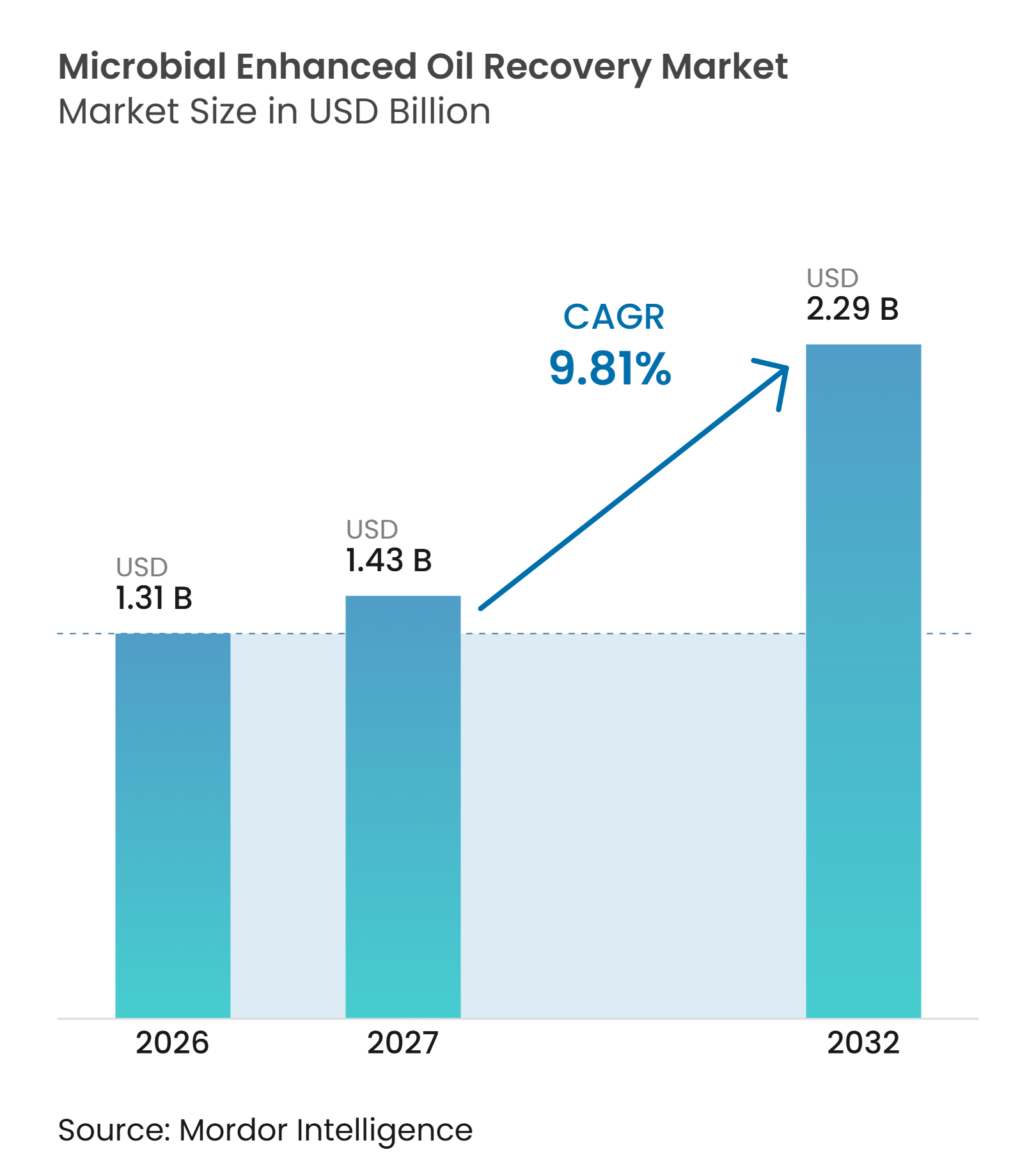
The Global microbial enhanced oil recovery market size is projected to expand from USD 1.31 billion in 2026 and USD 1.44 billion in 2027 to USD 2.29 billion by 2032, at a CAGR of 9.81% from 2027 to 2032. The Global microbial enhanced oil recovery market addresses residual crude oil that remains after primary and secondary recovery, with scientific literature noting that close to 70% can remain trapped in reservoir pore spaces.[1] Microbial treatments can improve recovery while using existing well infrastructure, which supports their use in mature assets where thermal or chemical methods may be unsuitable.[2] Operators are also considering lower-toxicity treatment options as capital discipline, field aging, and operating risk shape recovery plans. The Global microbial enhanced oil recovery market is therefore shaped by the ability to demonstrate repeatable field performance, shorten qualification work, and manage reservoir-specific risks.
Key Report Takeaways
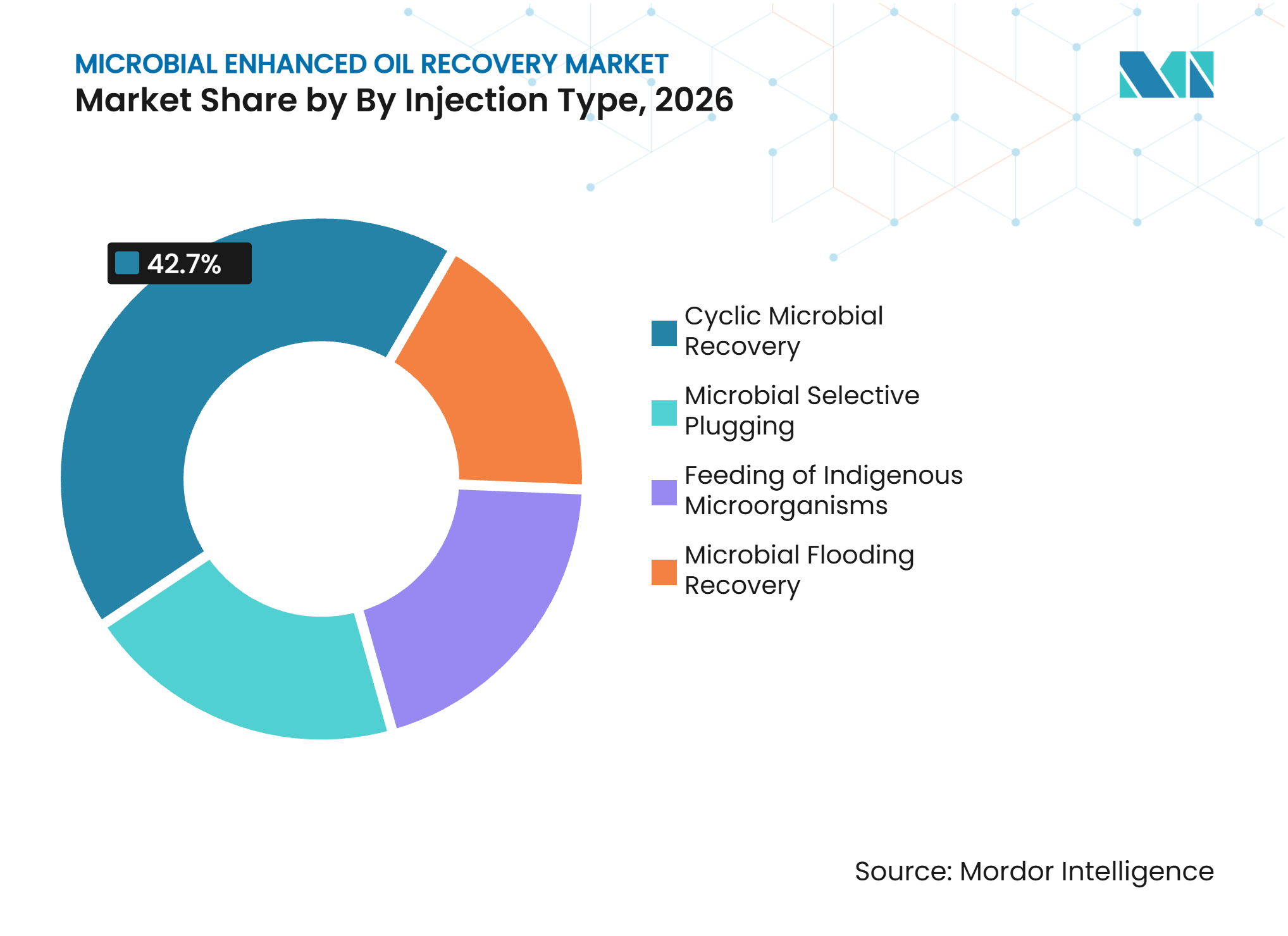
- By injection type, cyclic microbial recovery held 42.7% share in 2026, while microbial flooding recovery is forecast to grow at a 10.5% CAGR through 2032.
- By mechanism, in-situ Microbial Enhanced Oil Recovery (MEOR) held 46.1% share in 2026, while ex-situ Microbial Enhanced Oil Recovery (MEOR) is forecast to grow at an 11.4% CAGR through 2032.
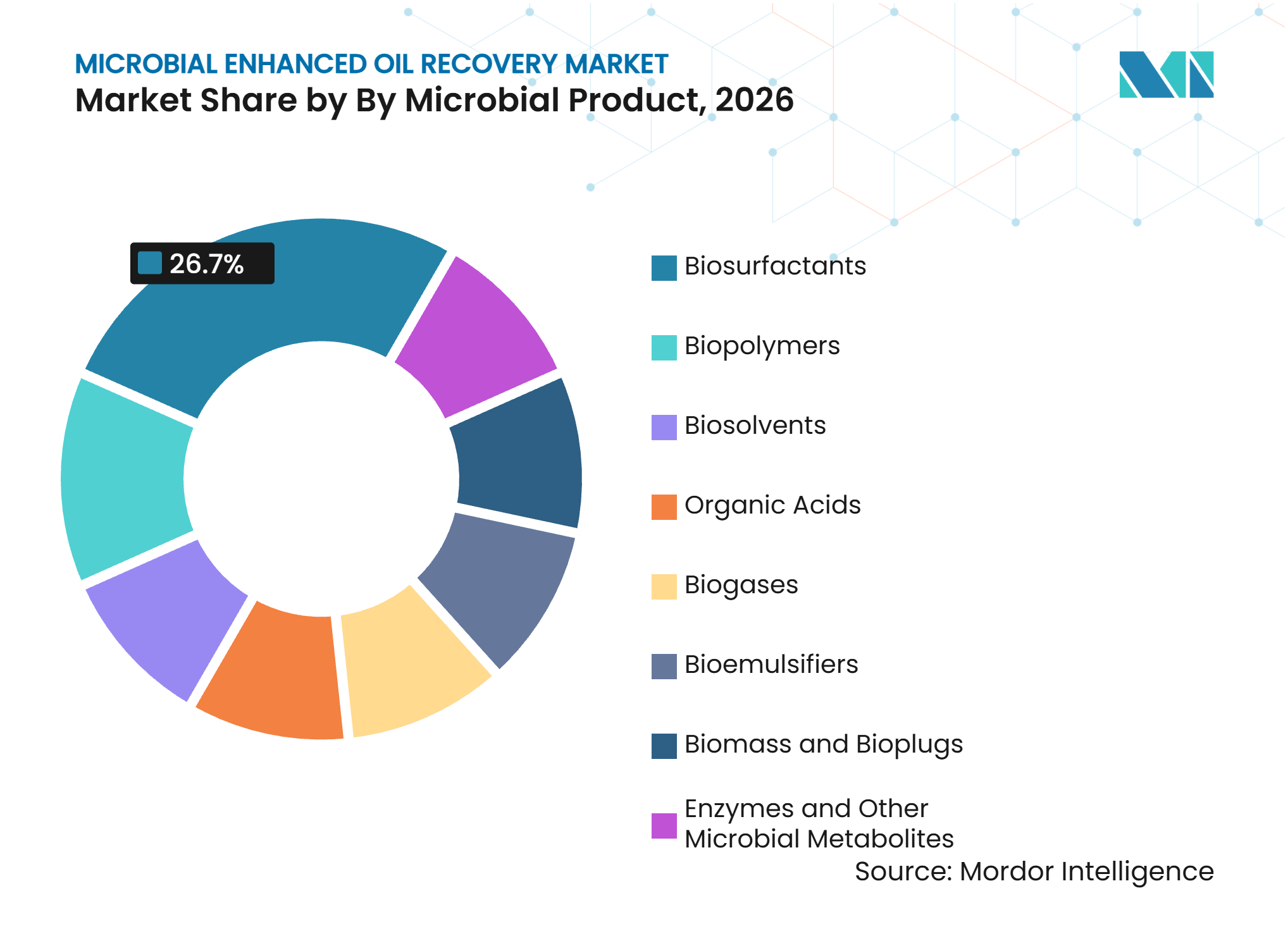
- By microbial product, biosurfactants held 26.7% share in 2026, while biopolymers are forecast to grow at an 11.3% CAGR through 2032.
- By well location, onshore oilfields held 71.3% share in 2026, while offshore oilfields are forecast to grow at a 10.7% CAGR through 2032.
- By geography, North America held 38.5% share in 2026, while Asia-Pacific is forecast to grow at an 11.8% CAGR through 2032.
Note: Market numbers in this report are based on Mordor Intelligence's proprietary estimation framework, which combines nine months of actuals with Q4 projections for base year 2026.
Market Trends and Insights
Drivers Impact Analysis of Microbial Enhanced Oil Recovery Market*
| Driver | (~) % Impact on CAGR Forecast | Geographic Relevance | Impact Timeline |
|---|---|---|---|
| Mature-Field Life Extension Demand | +3.5% | Global | Long term (≥ 4 years) |
| Lower Capital Intensity Than Chemical EOR | +1.8% | Global | Short term (≤ 2 years) |
| Regulatory Preference for Lower-Toxicity Recovery Chemistries | +1.2% | North America and Europe | Medium term (2-4 years) |
| Biosurfactant and Biopolymer Performance Improvements | +1.5% | Global | Medium term (2-4 years) |
| Reservoir-Specific Indigenous Microbe Activation | +0.8% | Asia-Pacific and Middle East and Africa | Medium term (2-4 years) |
| Microbial Treatment Integration With Existing Waterflood Infrastructure | +0.6% | Global | Short term (≤ 2 years) |
| Source: Mordor Intelligence | |||
Mature-Field Life Extension Demand
Mature waterflooded reservoirs are a durable source of demand for the Global microbial enhanced oil recovery market because their production declines while a large residual oil resource remains in place. Many of these fields are not suited to thermal or chemical Enhanced Oil Recovery (EOR) because of cost, reservoir conditions, or operating constraints. Six Chinese pilot projects presented at the Society of Petroleum Engineers (SPE) Improved Oil Recovery Conference in April 2026 showed the breadth of this need across Xinjiang, Daqing, and Changqing. Air-assisted endogenous activation at Xinjiang increased daily production by 40%, while Daqing’s hybrid microbial consortium raised daily production by 53.1% and recovery by 4.95% using 0.03 pore-volume injection.[3] Nutrient or microbe injection through existing wellbores gives the Global microbial enhanced oil recovery market a lower-intervention option for fields with aging infrastructure. Oil and Natural Gas Corporation (ONGC) TERI Biotech Limited reported FY 2025-26 revenue of INR 41.67 crore, equivalent to USD 5 million, and 21.24% year-on-year revenue growth, which supports the commercial relevance of microbial treatment in price-sensitive mature-field settings.[4]
Lower Capital Intensity Than Chemical EOR
The global microbial enhanced oil recovery market benefits from a cost structure that can differ from chemical and thermal recovery programs. Nutrients and inocula can be introduced through existing waterflood equipment, reducing the need for dedicated mixing plants and extensive topside modifications. A Society of Petroleum Engineers (SPE) study presented in September 2025 reported a 5-to-10-fold Net Present Value improvement over conventional waterflooding in an optimized in-situ biosurfactant case. The same work reported 15-20% additional original oil in place recovery across its tested oil price and microbial-cost assumptions. This lower capital requirement can make the Global microbial enhanced oil recovery market relevant to operators that must preserve spending flexibility. It also strengthens the Global microbial enhanced oil recovery market in mature assets, where major surface investments are difficult to justify. It also gives smaller, well-clustered programs an opportunity to test recovery improvements before committing to a larger field program.
Biosurfactant and Biopolymer Performance Improvements
Improved biosurfactant yields and better control over biopolymer behavior are expanding the reservoir conditions considered for microbial treatments. A 2025 review reported that microbially derived biosurfactants can match or exceed synthetic surfactant interfacial performance over a range of salinity conditions. The same review identified lower toxicity and improved biodegradability as relevant properties for petroleum applications. The Global microbial enhanced oil recovery market can use these products for both interfacial tension reduction and flow control, depending on the formulation and reservoir needs. Research published in February 2026 described a microbial-plus approach that combines microbial metabolite generation with chemical Enhanced Oil Recovery (EOR) additives. This approach indicates that microbial formulations can be used alongside, rather than only instead of, established Enhanced Oil Recovery (EOR) materials.
Reservoir-Specific Indigenous Microbe Activation
Indigenous microbe activation can reduce the need to introduce non-native or genetically modified organisms into the reservoir. This route can also avoid some regulatory review considerations that may apply to engineered strains. A Physics of Fluids study published in January 2025 used Pseudomonas aeruginosa for in-situ foam generation under reservoir-representative temperature and salinity conditions. It reported 96.26% crude-oil viscosity reduction and recovery of up to 91.47% in its study conditions. This approach requires reservoir characterization and microbial community mapping before a nutrient-injection protocol is selected. The added screening step favors providers with reservoir microbiome expertise, while avoiding ex-situ fermentation logistics can support smaller campaigns below USD 10 million.
Restraints Impact Analysis of Microbial Enhanced Oil Recovery Market*
| Restraint | (~) % Impact on CAGR Forecast | Geographic Relevance | Impact Timeline |
|---|---|---|---|
| Inconsistent Performance Under Harsh Reservoir Conditions | -1.8% | Global | Long term (≥ 4 years) |
| Long Site-Specific Qualification and Pilot Cycles | -1.2% | Global | Medium term (2-4 years) |
| Reservoir Souring, Corrosion and Formation-Damage Risk | -0.9% | Global | Medium term (2-4 years) |
| Limited Bankable Full-Field Commercial Evidence | -0.7% | Global | Short term (≤ 2 years) |
| Source: Mordor Intelligence | |||
Inconsistent Performance Under Harsh Reservoir Conditions
Performance in the Global microbial enhanced oil recovery market depends strongly on reservoir temperature, salinity, pressure, rock properties, and microbial community composition. Most commercial strains have reduced activity above 80-90 °C and at salinity levels above 10% total dissolved solids. These conditions are common in deep carbonate reservoirs in the Middle East, offshore West Africa, and deepwater Brazil. A July 2026 review specified that suitable sandstone conditions include depths of 3,030-3,335 meters, permeability of 400-1,000 millidarcies, and American Petroleum Institute (API) gravity of 34-42. Those operating limits exclude a meaningful share of technically recoverable resources from immediate treatment consideration. Pilot failures in high-temperature or high-salinity targets can also slow reinvestment, even where field-level economics remain positive, while commercial validation of thermophilic and salt-adapted consortia remains limited.
Long Site-Specific Qualification and Pilot Cycles
A typical qualification path includes reservoir screening, laboratory core flooding, reservoir simulation, pilot injection, incubation, and production monitoring. The process usually takes 18-36 months before a full-field decision has sufficient operational evidence. This is longer than many chemical-treatment qualification processes and can create a constraint for operators with short project approval windows. Results also rarely transfer directly between blocks in the same field because indigenous communities and rock wettability vary at the pattern level. A 2025 review identified the absence of standardized screening criteria and qualification protocols as a material barrier to commercialization. Digital reservoir simulation and metagenomics-informed treatment design may address this gap, but broad adoption is still expected to take 2-4 years.
*Our forecasts treat driver/restraint impacts as directional, not additive. The impact forecasts reflect baseline growth, mix effects, and variable interactions.
Microbial Enhanced Oil Recovery Market Segment Analysis
By Injection Type:
Cyclic Recovery Dominates, Flooding Accelerates at ScaleCyclic microbial recovery held 42.7% of Global microbial enhanced oil recovery market share in 2026. Its position reflects single-well simplicity and compatibility with mature wellbores that lack nearby injection infrastructure. The huff-and-puff operating design is familiar to reservoir engineers. That familiarity can support internal approval for first Microbial Enhanced Oil Recovery (MEOR) programs. It also has the broadest commercial case-study base among the injection approaches in the Global microbial enhanced oil recovery market. Oil and Natural Gas Corporation (ONGC) TERI Biotech’s thermophilic bacterial consortium S2 has been deployed across more than 97 Indian wells on a cyclic basis. The company reported that the consortium has tripled daily production in some wells. This performance illustrates its potential in temperature-stressed reservoir settings.
Microbial flooding recovery is projected to expand at a 10.5% CAGR through 2032. Pattern-scale treatment can deliver greater incremental recovery than a single-well cycle where reservoir conditions support distribution through the pattern. Sinopec activated 4 well groups at the Pingfangwang reservoir in July 2025. The target was a high-temperature, high-salinity reservoir that had been considered unsuitable for Microbial Enhanced Oil Recovery (MEOR). The project generated 1,495 tonnes of cumulative additional oil production. Flooding also supports combined biosurfactant and biopolymer slugs. Those slugs can address mobility control and interfacial tension reduction in the same injection cycle. Microbial selective plugging and indigenous feeding remain smaller approaches, with plugging used in heterogeneous carbonates and indigenous feeding suited to operators seeking limited logistics.



By Mechanism:
In-Situ Scale, Ex-Situ Earns the Growth PremiumIn-situ Microbial Enhanced Oil Recovery (MEOR) accounted for 46.1% of the Global microbial enhanced oil recovery market size in 2026. The mechanism has lower supply-chain complexity because treatments are activated or generated within the reservoir environment. Its broader evidence base for indigenous microbe activation further supports its use. Sinopec deployed microbial injection-production coupling flooding at Linpan Block 18-6 in October 2025. The project reported a daily oil increase of 2 tonnes and a 5-percentage-point reduction in water content. The reservoir was a complex fault-block setting. The microbial-plus approach offers a possible next step because it combines in-situ activation with targeted chemical additives.
Ex-situ Microbial Enhanced Oil Recovery (MEOR) is projected to grow at an 11.4% CAGR through 2032. Improved fermentation can make externally produced biosurfactants more competitive where consistency is a priority. Manufacturing outside the reservoir allows control over product quality, concentration, and storage stability before injection. That control is important in heterogeneous reservoirs where in-situ activation may vary between wells. The approach can also align with fracture-fluid and waterflood applications. Other microbial recovery mechanisms include enzyme-enhanced recovery. These mechanisms remain mainly at laboratory or early pilot stages. They have nonetheless developed a scientific evidence base around selectivity and lower formation-damage risk. This growth outlook places fermentation capability and application-specific formulation at the center of the Global microbial enhanced oil recovery market.
By Microbial Product:
Biosurfactants Lead, Biopolymers Capture GrowthBiosurfactants held a 26.7% share of the Global microbial enhanced oil recovery market in 2026. They reduce oil-water interfacial tension and can modify rock wettability. These 2 effects support their use in cyclic recovery, waterflooding, and hydraulic-fracture designs. Their wide application base gives them the largest addressable product category. Shandong Aikang Biotechnology’s bio-sophorolipid oil displacement agent entered Shengli, Karamay, Changqing, and a China National Offshore Oil Corporation (CNOOC) offshore project in July 2025. The simultaneous deployment demonstrates the use of biosurfactant products across multiple Chinese oilfield systems. Biosolvents support heavy-crude viscosity reduction, organic acids can mobilize carbonate minerals, and biogases may support reservoir pressure maintenance. These categories remain smaller but are technically validated.
Biopolymers are forecast to grow at an 11.3% CAGR through 2032. This expansion is linked to demand for conformance control in heterogeneous reservoirs. An ACS Energy & Fuels study published in January 2026 reported stress-induced bioflocculation by Geobacillus WJ-8 under extra-heavy oil reservoir conditions. The work showed autonomous construction of adaptive bioplugs. This self-regulating effect differs from conventional biopolymer injection. Bioemulsifiers can support mobility by stabilizing oil-water emulsions. Biomass-based bioplugs can divert flow physically. Enzymes are the smallest product group, although their selectivity and lower formation-damage risk continue to attract research interest.

By Well Location:
Onshore Volume Base, Offshore the Strategic FrontierOnshore oilfields accounted for 71.3% of the Global microbial enhanced oil recovery market size in 2026. Large waterflood systems, accessible wellbores, and a dense inventory of mature fields underpin this position. North America, Russia, China, and India provide large onshore operating bases. India’s onshore program in the Mehsana fields reduced oil viscosity by up to 35%. The program generated more than 43,590 metric tonnes of additional oil across Oil and Natural Gas Corporation (ONGC) and Oil India wells during a 6-month deployment. Onshore operations also simplify produced-water sampling for microbial monitoring. Surface nutrient preparation is generally easier than in offshore settings. These conditions reduce operational complexity and treatment-failure risk.
Offshore oilfields are projected to grow at a 10.7% CAGR through 2032. The growth outlook reflects the need to extend output from aging North Sea, Gulf of Mexico, and Southeast Asian installations without major infrastructure investment. A North Sea controlled pilot reported a 30-35% overall production increase through nutrient injection using existing wellhead equipment. This result offers a lower-modification example for comparable brownfield assets. Offshore projects still face higher costs than onshore projects. Subsea equipment qualification can lengthen preparation. Hydrogen sulfide monitoring remains necessary. Produced-water discharge requirements also add to economic and operational complexity, including standards set by the UK North Sea Transition Authority.
Geography Analysis
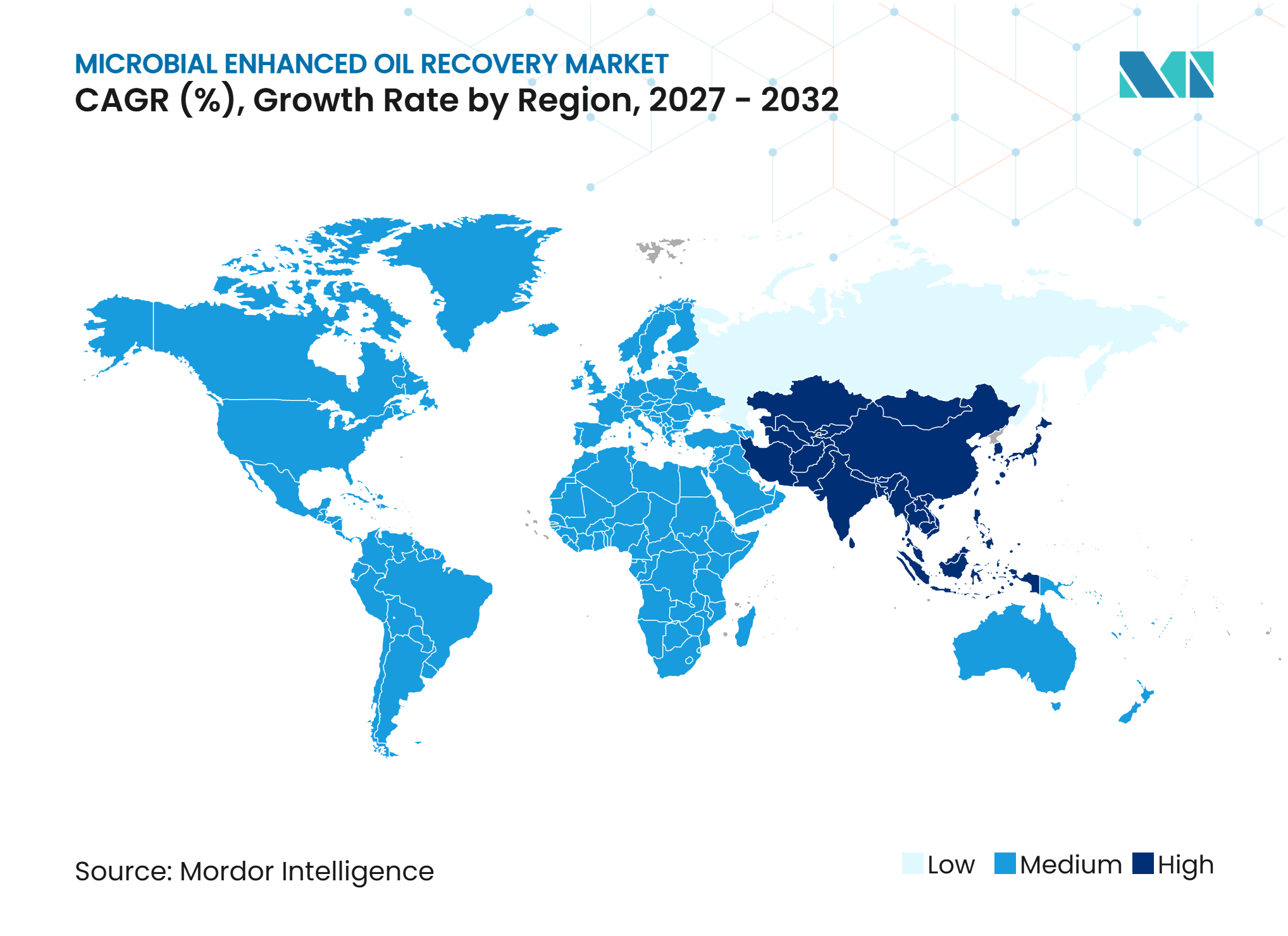
North America held 38.5% of the Global microbial enhanced oil recovery market share in 2026. The Permian Basin and Delaware sub-basin are active commercial settings for microbial recovery programs. Biosurfactant-augmented fracture completions provide an entry point for operators without conventional waterflood Microbial Enhanced Oil Recovery (MEOR) experience. U.S. Environmental Protection Agency Class II injection-well rules frame the regulatory setting for relevant oil and gas injection activities. The agency’s Oil and Gas Extraction Effluent Guidelines also frame discharge management under 40 CFR Part 435. Canada’s heavy-oil assets and Mexico’s mature Gulf of Mexico onshore fields provide additional demand pools that remain underpenetrated relative to their technical fit.
Asia-Pacific is projected to record an 11.8% CAGR through 2032. China has positioned Microbial Enhanced Oil Recovery (MEOR) as a national energy-security tool through activity by CNPC and Sinopec. This activity supports Asia-Pacific’s position in the Global microbial enhanced oil recovery market. Xinjiang pilots achieved a 40% increase in daily production. Daqing’s hybrid microbial program reported a 53.1% production increase. Changqing’s closed-loop integration cut wastewater costs by 40% and reported 3.1x return on investment (ROI). India’s national oil companies are increasing well counts through Oil and Natural Gas Corporation (ONGC) TERI Biotech’s turnkey services, while Indonesia, Malaysia, and Australia present a further group of mature offshore targets.
Europe concentrates activity in the UK Continental Shelf and Norwegian Continental Shelf, where extending brownfield production can take priority over greenfield exploration. South American activity is centered on Argentina’s mature sandstone provinces and Brazil’s pre-salt carbonates. A 2026 review identified the Mishrif and Zubair formations at Rumaila and West Qurna as technically eligible targets for Microbial Enhanced Oil Recovery (MEOR). The review also cited 70% total oil-in-place recovery in comparable Egyptian and Omani reservoirs. South Oman organic oil recovery waterflood campaigns reported 15-25% oil production increases and 60-75% surge yields against projected decline. These references support consideration of microbial recovery in Middle East and Africa fields where reservoir and water-management conditions are favorable.
Competitive Landscape
Market Concentration
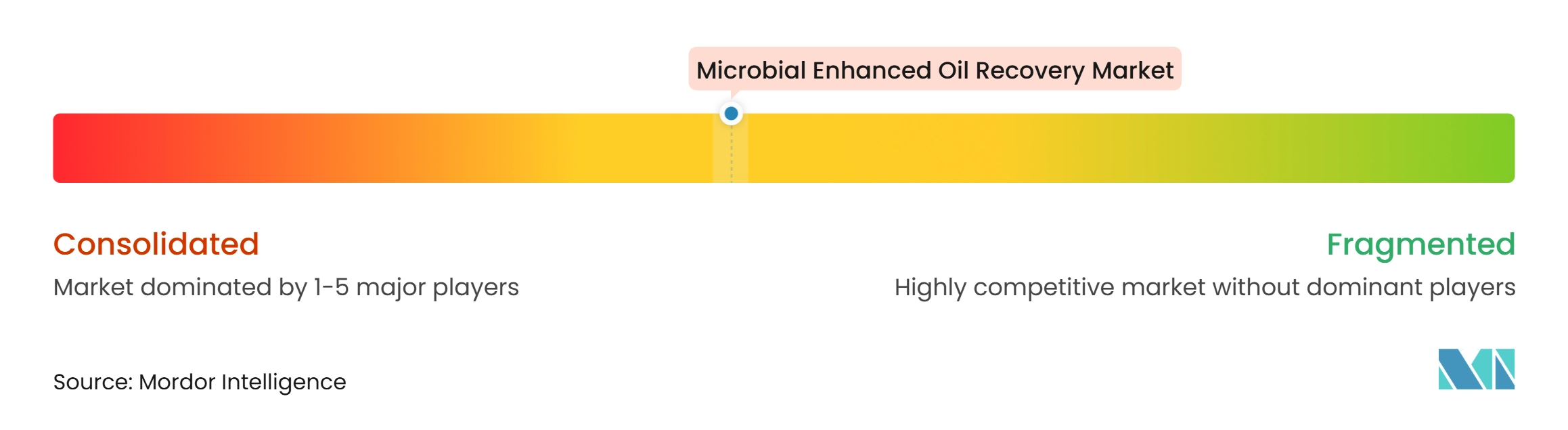
The Global microbial enhanced oil recovery market has a divided competitive structure. Large integrated oilfield service companies compete through reservoir assessment, treatment design, and production-monitoring packages. Specialist biotechnology firms compete through microbiology expertise, pilot iteration, and field-performance credentials. Baker Hughes, Halliburton, and SLB have advantages in large-field projects above USD 20 million because their reservoir-engineering networks and operator relationships can reduce deployment risk. Specialist providers can be more competitive in mid-market projects with lower upfront commitments. This creates room for both integrated service models and focused biological-treatment models. The Global microbial enhanced oil recovery market, therefore, rewards firms that can combine field access with credible reservoir-specific data.
Intellectual property remains important in this competitive setting. Oil and Natural Gas Corporation (ONGC) TERI Biotech holds joint U.S., Indian, and Canadian patents related to its thermophilic bacterial consortium S2. The consortium is operational to 90°C, which addresses a temperature range that many commercial formulations cannot match. Sinopec’s October 2025 injection-production coupling work at Linpan Block 18-6 showed how a modified injection design can serve a complex fault-block reservoir. Shandong Aikang Biotechnology’s July 2025 deployment of a biosurfactant agent across 4 oilfield systems demonstrated a product-led route to commercial scale. These moves show that field validation, not laboratory performance alone, is central to competitive position.
The clearest open areas are offshore carbonate reservoirs and high-temperature, high-salinity onshore systems. No specialist provider has established a repeatable commercial method across these conditions in the supplied evidence base. Digital reservoir simulation and metagenomics-based treatment design may change competitive rankings by reducing the time required for site qualification. A provider that reduces a 30-month qualification cycle to 12 months could secure a larger share of the field pipeline. Commercial-scale regulatory acceptance for glycolipid biosurfactants is also relevant in U.S. operator procurement decisions. The global microbial enhanced oil recovery market remains constrained by performance uncertainty, which increases the value of reservoir-specific operating data. Competition is consequently based on the ability to verify results, manage souring and corrosion risk, and execute pilot programs through to full-field decisions.
Microbial Enhanced Oil Recovery Industry Leaders
-
Shell plc
-
bp p.l.c.
-
ConocoPhillips
-
Equinor ASA
-
Titan Oil Recovery, Inc.
- *Disclaimer: Major Players sorted in no particular order
Microbial Enhanced Oil Recovery Market Companies Covered in this Report
- Baker Hughes Company
- bp p.l.c.
- Chemiphase Ltd.
- China National Petroleum Corporation (CNPC)
- ConocoPhillips
- Environmental BioTechnologies, Inc.
- Equinor ASA
- Glori Energy Inc.
- Halliburton Company
- Locus Bio-Energy Solutions
- Micro-Bac International, Inc.
- National Energy Services Reunited Corp.
- Occidental Petroleum Corporation
- ONGC TERI Biotech Limited
- Qyrin Petroleum Technology
- RAM Biochemicals, Inc.
- Shell plc
- SLB
- Titan Oil Recovery, Inc.
- Weatherford International plc
Recent Industry Developments in Microbial Enhanced Oil Recovery Market
- April 2026: Society of Petroleum Engineers (SPE) Improved Oil Recovery Conference published results from six China Microbial Enhanced Oil Recovery (MEOR) pilots. Xinjiang achieved 40% daily oil production increase. Daqing recorded 53.1% production uplift and 4.95% recovery rate gain with 0.03 pore-volume injection. Changqing’s closed-loop integration delivered 40% wastewater cost reduction and return on investment (ROI) of 3.1.
- February 2026: Critical Reviews in Biotechnology introduced the “Microbial plus” concept in a China oilfield Microbial Enhanced Oil Recovery (MEOR) review, a hybrid framework combining microbial metabolite generation with chemical Enhanced Oil Recovery (EOR) additives.
- January 2026: ACS Energy & Fuels published findings on mild-thermal-assisted Microbial Enhanced Oil Recovery (MEOR) using Geobacillus WJ-8 bioflocculation, demonstrating autonomous bioplug construction for conformance control in extra-heavy oil post-thermal reservoirs.
- October 2025: Sinopec’s Shengli oilfield deployed microbial injection-production coupling flooding at Block Linpan 18-6, achieving a daily oil increase of 2 tonnes and a 5-percentage-point water content decline in a structurally complex fault-block reservoir.
Global Microbial Enhanced Oil Recovery Market Report Scope
Microbial enhanced oil recovery (MEOR) refers to the application of microorganisms and their metabolic products to improve the recovery of crude oil from existing oilfields. These techniques involve introducing selected microorganisms, stimulating indigenous microbial populations, or injecting microbial products into oil-bearing formations to modify reservoir conditions and facilitate oil mobilization. Microorganisms can produce substances such as biosurfactants, biopolymers, biosolvents, organic acids, biogases, bioemulsifiers, and other metabolites that help reduce oil-water interfacial tension, alter reservoir wettability, improve fluid mobility, generate pressure, or selectively block high-permeability flow channels. MEOR techniques are implemented through approaches such as cyclic microbial recovery, microbial flooding, microbial selective plugging, and feeding of indigenous microorganisms. These solutions are applied in onshore and offshore oilfields to improve the recovery of residual oil, enhance reservoir sweep efficiency, and extend the productive life of mature wells. Their effectiveness depends on reservoir temperature, pressure, salinity, permeability, microbial compatibility, and the availability of suitable nutrients and operating conditions.
The Global Microbial Enhanced Oil Recovery Market is segmented by injection type, mechanism, microbial product, and well location. By injection type, the market is segmented into cyclic microbial recovery, microbial flooding recovery, microbial selective plugging, and feeding of indigenous microorganisms. By mechanism, the market is segmented into in-situ microbial enhanced oil recovery, ex-situ microbial enhanced oil recovery, and other microbial recovery mechanisms. By microbial product, the market is segmented into biosurfactants, biopolymers, biosolvents, organic acids, biogases, bioemulsifiers, biomass and bioplugs, and enzymes and other microbial metabolites. By well location, the market is segmented into onshore oilfields and offshore oilfields. The report also covers the market size and forecasts for the global microbial enhanced oil recovery market across 26 countries in key regions, including North America, Europe, Asia-Pacific, South America, and the Middle East and Africa. For each segment, market sizing and forecasts are provided on the basis of value (USD).
Segmentation Overview
| Cyclic Microbial Recovery |
| Microbial Flooding Recovery |
| Microbial Selective Plugging |
| Feeding of Indigenous Microorganisms |
| In-Situ Microbial Enhanced Oil Recovery |
| Ex-Situ Microbial Enhanced Oil Recovery |
| Other Microbial Recovery Mechanisms |
| Biosurfactants |
| Biopolymers |
| Biosolvents |
| Organic Acids |
| Biogases |
| Bioemulsifiers |
| Biomass and Bioplugs |
| Enzymes and Other Microbial Metabolites |
| Onshore Oilfields |
| Offshore Oilfields |
| North America | United States |
| Canada | |
| Mexico | |
| Europe | Germany |
| France | |
| Italy | |
| Spain | |
| United Kingdom | |
| Norway | |
| Netherlands | |
| Russia | |
| Rest of Europe | |
| Asia-Pacific | China |
| India | |
| Japan | |
| South Korea | |
| Australia | |
| Indonesia | |
| Malaysia | |
| Rest of Asia-Pacific | |
| South America | Brazil |
| Argentina | |
| Colombia | |
| Ecuador | |
| Rest of South America | |
| Middle East and Africa | Saudi Arabia |
| United Arab Emirates | |
| Qatar | |
| Kuwait | |
| Oman | |
| Egypt | |
| Nigeria | |
| Rest of Middle East and Africa |
| By Injection Type | Cyclic Microbial Recovery | |
| Microbial Flooding Recovery | ||
| Microbial Selective Plugging | ||
| Feeding of Indigenous Microorganisms | ||
| By Mechanism | In-Situ Microbial Enhanced Oil Recovery | |
| Ex-Situ Microbial Enhanced Oil Recovery | ||
| Other Microbial Recovery Mechanisms | ||
| By Microbial Product | Biosurfactants | |
| Biopolymers | ||
| Biosolvents | ||
| Organic Acids | ||
| Biogases | ||
| Bioemulsifiers | ||
| Biomass and Bioplugs | ||
| Enzymes and Other Microbial Metabolites | ||
| By Well Location | Onshore Oilfields | |
| Offshore Oilfields | ||
| By Geography | North America | United States |
| Canada | ||
| Mexico | ||
| Europe | Germany | |
| France | ||
| Italy | ||
| Spain | ||
| United Kingdom | ||
| Norway | ||
| Netherlands | ||
| Russia | ||
| Rest of Europe | ||
| Asia-Pacific | China | |
| India | ||
| Japan | ||
| South Korea | ||
| Australia | ||
| Indonesia | ||
| Malaysia | ||
| Rest of Asia-Pacific | ||
| South America | Brazil | |
| Argentina | ||
| Colombia | ||
| Ecuador | ||
| Rest of South America | ||
| Middle East and Africa | Saudi Arabia | |
| United Arab Emirates | ||
| Qatar | ||
| Kuwait | ||
| Oman | ||
| Egypt | ||
| Nigeria | ||
| Rest of Middle East and Africa | ||
Key Questions Answered in the Report
What is microbial enhanced oil recovery?
It uses microbes, nutrients, or microbial products to mobilize residual oil by changing interfacial tension, wettability, viscosity, flow paths, or reservoir pressure.
How large is the global microbial enhanced oil recovery market?
The market is projected to increase from USD 1.31 billion in 2026 to USD 2.29 billion by 2032 at a 9.81% CAGR from 2027 to 2032.
Which injection approach leads microbial enhanced oil recovery?
Cyclic microbial recovery leads with 42.7% share in 2026, while microbial flooding has the fastest projected growth at a 10.5% CAGR through 2032.
Why do operators use biosurfactants for oil recovery?
Biosurfactants can reduce oil-water interfacial tension and modify rock wettability, allowing use across cyclic, waterflood, and fracture-treatment designs.
What are the main limits on Microbial Enhanced Oil Recovery (MEOR) deployment?
Temperature, salinity, pressure, reservoir biology, and qualification periods of 18-36 months can limit use or delay full-field investment decisions.
Which region is growing fastest for microbial enhanced oil recovery?
Asia-Pacific is forecast to grow at an 11.8% CAGR through 2032, supported by pilot and deployment activity in China and expanding well programs in India.