
Micro Forceps Market Size and Share
Market Overview
| Study Period | 2020 - 2031 |
|---|---|
| Market Size (2026) | USD 45.29 Million |
| Market Size (2031) | USD 55.40 Million |
| Growth Rate (2026 - 2031) | 4.11 % |
| Fastest Growing Market | Asia-Pacific |
| Largest Market | North America |
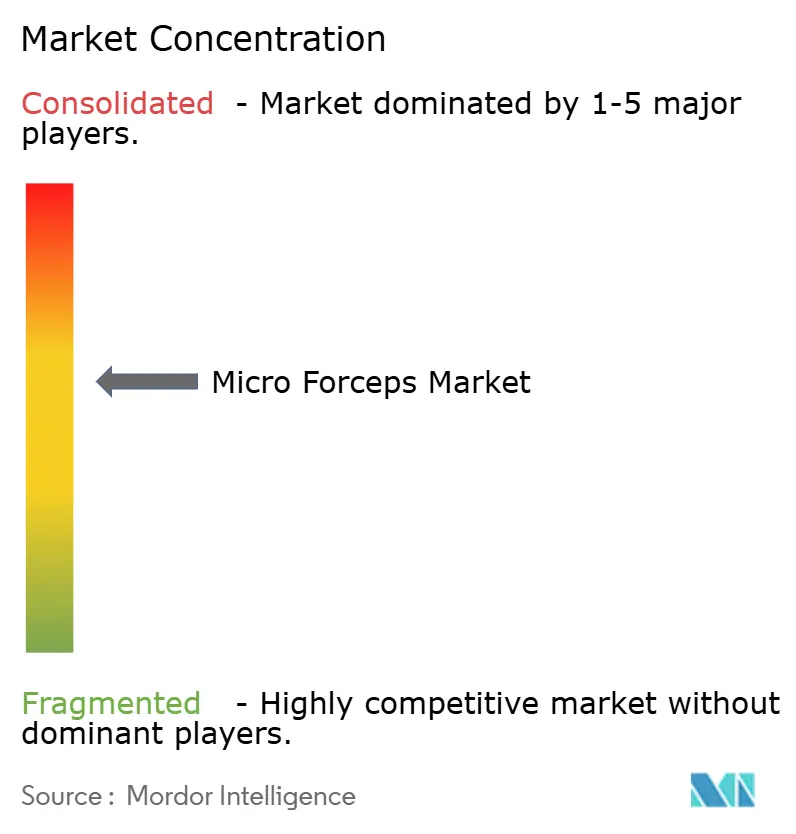
| Market Concentration | Medium |
Major Players *Disclaimer: Major Players sorted in no particular order Image © Mordor Intelligence. Reuse requires attribution under CC BY 4.0. | |
Micro Forceps Market Analysis by Mordor Intelligence
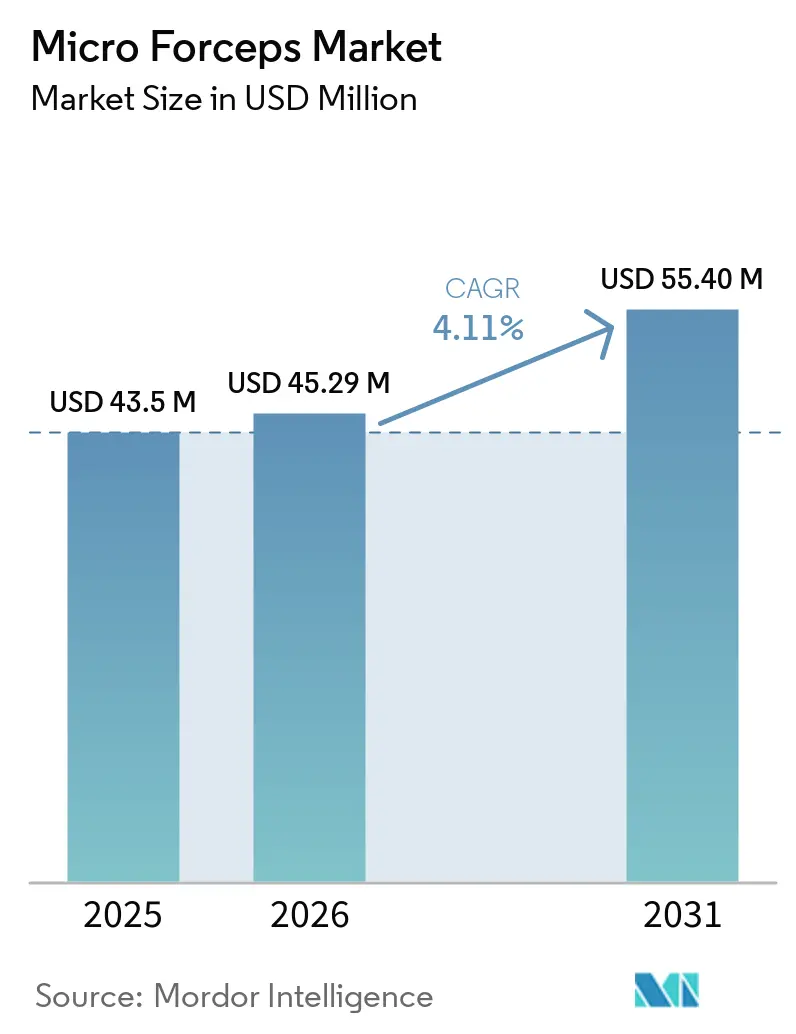
The Micro Forceps Market size was valued at USD 43.5 million in 2025 and is estimated to grow from USD 45.29 million in 2026 to reach USD 55.40 million by 2031, at a CAGR of 4.11% during the forecast period (2026-2031).
The micro forceps market is supported by rising procedure volumes that require controlled tissue handling in ophthalmology, reconstruction, neurosurgery, and related specialties. Demand depends on routine clinical use of precision handheld instruments rather than a broad replacement cycle. More procedures are being performed in settings that require fine tips, dependable alignment, and instruments suited to particular surgical steps. Manufacturers are responding through custom packs, wider reusable and single-use options, and links with ophthalmic equipment platforms. Procurement pressures and reprocessing requirements continue to shape purchasing decisions, which creates an opening for suppliers that can combine clinical fit with reliable workflow support.
Key Report Takeaways
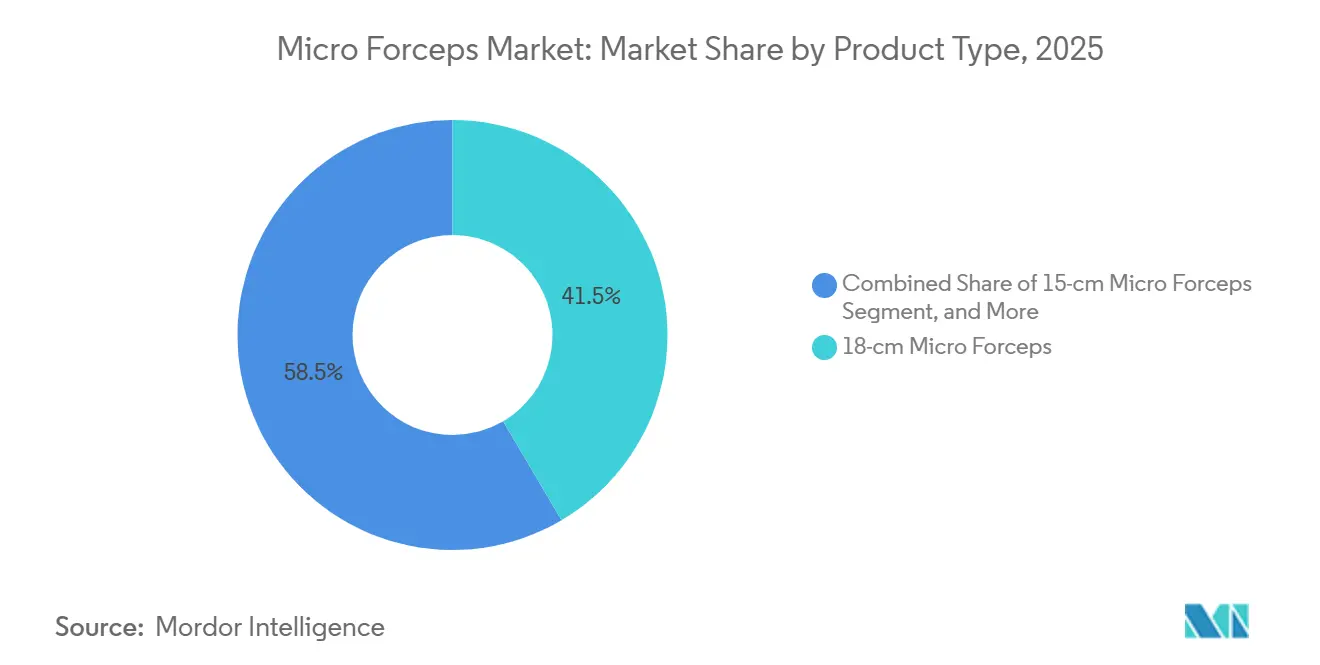
- By product type, 18-cm micro forceps held 41.54% of the micro forceps market share in 2025, while 15-cm instruments are forecast to grow at a 6.54% CAGR through 2031.
- By material, stainless steel held 58.76% of the micro forceps market share in 2025, while titanium is forecast to expand at a 6.71% CAGR through 2031.
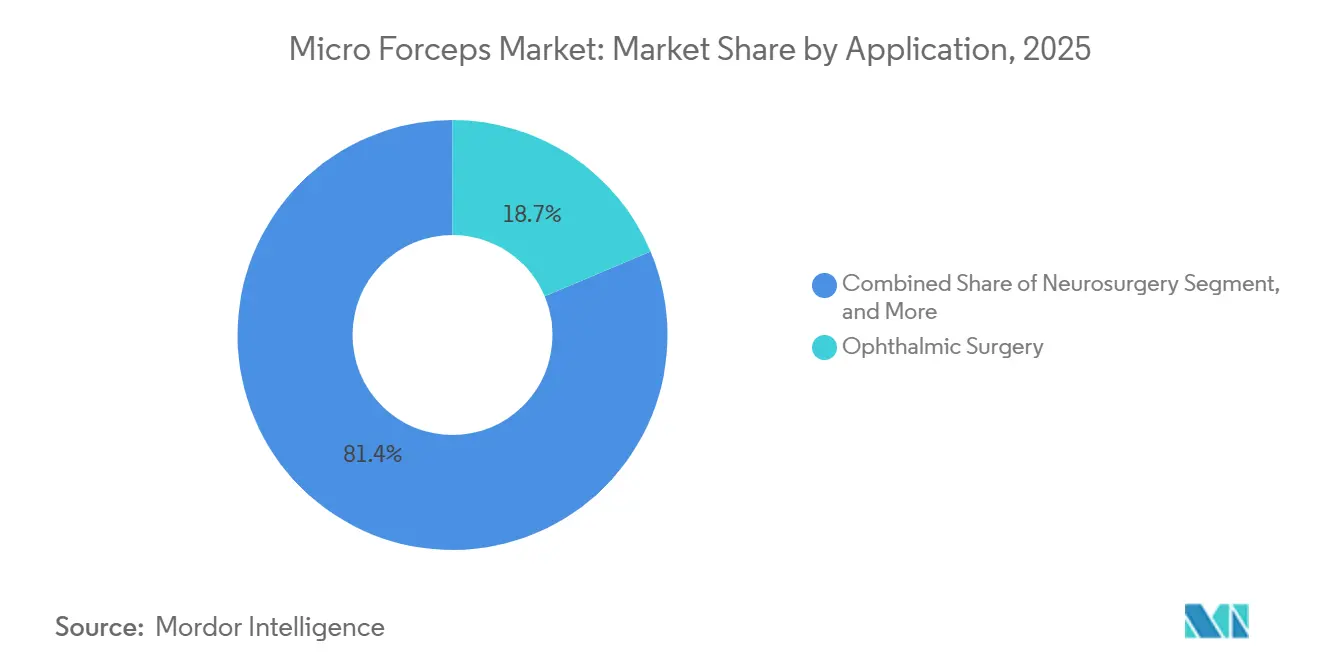
- By application, ophthalmic surgery accounted for 18.65% of the micro forceps market size in 2025, while plastic and reconstructive surgery is forecast to grow at a 7.21% CAGR through 2031.
- By end user, hospitals held 56.54% of the micro forceps market size in 2025, while academic and research centers are forecast to grow at a 7.54% CAGR through 2031.
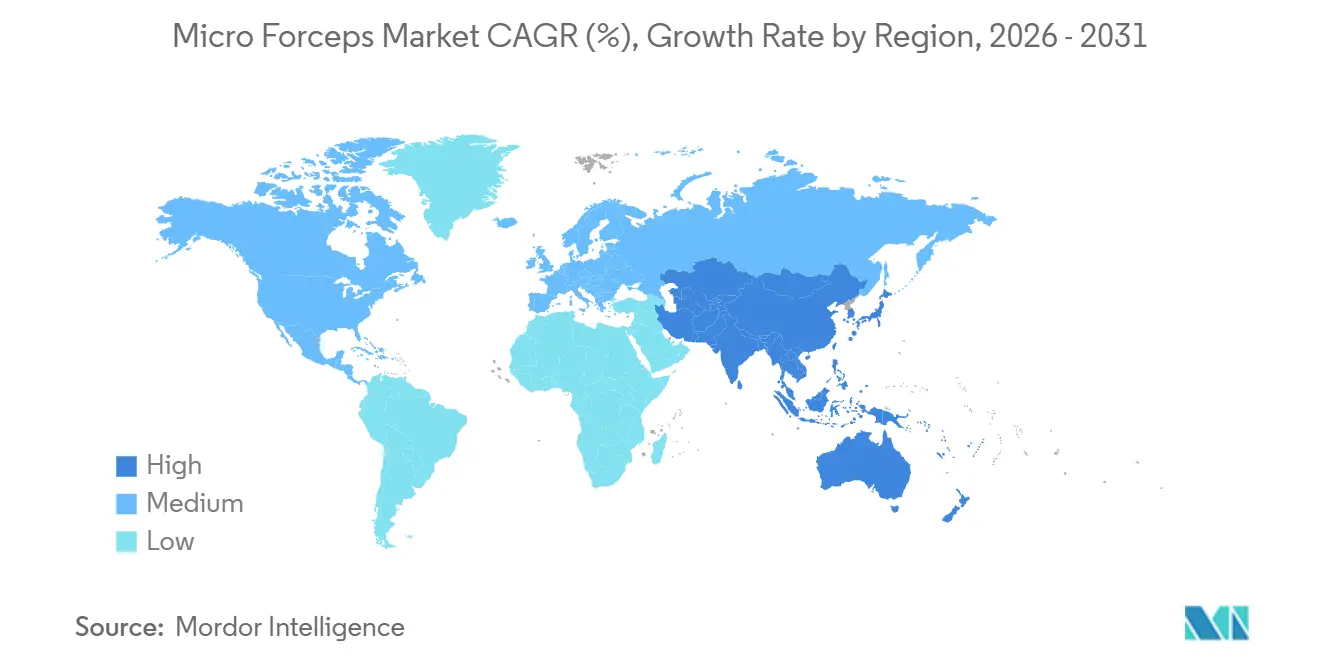
- By geography, North America held 40.43% of the micro forceps market share in 2025, while Asia-Pacific is forecast to grow at a 5.87% CAGR through 2031.
Note: Market size and forecast figures in this report are generated using Mordor Intelligence’s proprietary estimation framework, updated with the latest available data and insights as of January 2026.
Market Trends and Insights
Drivers Impact Analysis of Micro Forceps Market*
| Driver | (~) % Impact on CAGR Forecast | Geographic Relevance | Impact Timeline |
|---|---|---|---|
| Rising Minimally Invasive And Microsurgical Procedure Volumes | +1.10% | Global | Short term (≤ 2 years) |
| Increasing Demand For Precision Tissue Handling | +0.80% | North America and Europe, with spillover to Asia-Pacific | Medium term (2-4 years) |
| Growth In Ophthalmic And Vitreoretinal Surgery | +0.70% | Global, with concentrated gains in Asia-Pacific and North America | Short term (≤ 2 years) |
| Shift Toward Lightweight Titanium And Coated-Jaw Instruments | +0.60% | North America and Europe | Medium term (2-4 years) |
| Expansion Of Ambulatory Ophthalmic Surgery | +0.50% | North America, with spillover to Asia-Pacific | Short term (≤ 2 years) |
| Procurement Demand For Single-Use And Procedure-Ready Kits | +0.40% | North America and the European Union | Medium term (2-4 years) |
| Source: Mordor Intelligence | |||
Rising Minimally Invasive and Microsurgical Procedure Volumes
The micro forceps market benefits when more surgical procedures require manual precision work. Intuitive Surgical reported that da Vinci systems supported 3.15 million procedures in 2025, up 18% from 2.68 million in 2024. The company expects procedure volume to increase by 13% to 15% in 2026. Robotic growth does not remove the need for handheld micro forceps in ophthalmology, ENT, and reconstructive care. Bimanual microsurgical steps remain dependent on instruments that give the surgeon direct control. This supports parallel demand for manual precision instruments across different care pathways.
The effect is especially relevant where surgical teams use microscopes and specialized forceps during the same procedure. A growing procedure base can raise instrument use without requiring a change in the clinical role of forceps. The micro forceps market, therefore, remains linked to the number and mix of procedures performed. Demand is not limited to robotic operating rooms, because many manual steps continue before, during, or after assisted procedures. Providers also need instrument availability across specialties with different workflow requirements. This relationship gives suppliers a reason to align product ranges with procedure-specific needs.
Increasing Demand for Precision Tissue Handling
Precision tissue handling is important when surgeons work on small vessels or delicate ocular tissue. Tip alignment and jaw control can affect whether tissue is held cleanly during a procedure. These requirements make micro forceps a surgeon-preferred purchase in many specialty settings. Procurement teams may standardize common instruments, but clinicians still need designs that fit specific surgical techniques. Product designs that meet those requirements can retain relevance in specialist surgical workflows.
Custom packs can reduce the presence of nonpreferred instruments in a surgical setup. They can also help providers organize products around a defined procedure and surgeon preference. This approach is relevant to the micro forceps market because it can preserve differentiation where standard purchasing processes favor comparable products. It also shifts the discussion from an individual instrument price to the usefulness of a complete kit. The value of a kit depends on whether it improves clinical preparation without adding avoidable complexity. Suppliers that can offer configuration choices may be better placed to serve specialized ophthalmic accounts.
Growth in Ophthalmic and Vitreoretinal Surgery
Ophthalmic surgery creates high use of micro forceps because cases can require several tip profiles. Vitreoretinal work may use different instruments for membrane peeling, tissue stabilization, lens manipulation, and suture handling. A study of a Chinese tertiary hospital projected vitreoretinal procedures to reach 9,231 by 2032. The projected increase was associated with diabetic retinopathy and macular disease caseloads. These clinical needs support continued demand for instruments matched to fine intraocular work.
ZEISS received approval from China’s National Medical Products Administration for the ARTEVO 750 and ARTEVO 850 ophthalmic surgical microscopes in 2026. New microscope installations broaden the settings where surgical teams use micro forceps. The micro forceps market gains from this link between capital equipment deployment and instrument workflow. Hospitals generally require a range of forceps for the procedures supported by their ophthalmic platforms. Capacity additions can therefore increase the need for compatible surgical instruments. This connection is important in markets where ophthalmic infrastructure is expanding.
Shift Toward Lightweight Titanium and Coated-Jaw Instruments
The adoption of titanium micro forceps is not primarily about material science—it is about surgeon fatigue economics and digital operating room compatibility. Titanium instruments weigh approximately 50% less than equivalent stainless steel designs, a meaningful factor in procedures that exceed two hours and require sustained fine-motor control. The wider implication, often underweighted, is that MRI-safe titanium instruments are becoming operationally necessary in hybrid suites where intraoperative imaging is routine. In 2026, B. Braun introduced its Aesculap AEOS digital exoscope system at the Royal Hospital for Children in Glasgow for paediatric neurosurgery—cases where instrument weight management and digital visualisation interact directly with micro forceps selection. This integration of instrument choice with visualisation platform architecture is a pull factor for titanium instruments that standard procurement analytics do not capture.
Restraints Impact Analysis of Micro Forceps Market*
| Restraint | (~) % Impact on CAGR Forecast | Geographic Relevance | Impact Timeline |
|---|---|---|---|
| High Cost Of Titanium And Coated Micro Forceps | -0.40% | Global, most acute in Asia-Pacific and South America | Medium term (2-4 years) |
| Sterilization, Reprocessing, And Instrument-Tracking Burden | -0.40% | Global | Short term (≤ 2 years) |
| Surgeon Training And Technique-Specific Adoption Barriers | -0.30% | Asia-Pacific, the Middle East and Africa, and South America | Long term (≥ 4 years) |
| Pricing Pressure From Group Purchasing Organizations | -0.40% | North America | Short term (≤ 2 years) |
| Source: Mordor Intelligence | |||
High Cost of Titanium and Coated Micro Forceps
Titanium and coated micro forceps have a higher cost than standard stainless steel instruments. This can limit adoption in hospitals that closely review acquisition costs and reuse cycles. Lower-priced instruments from Chinese manufacturers can create a price reference for comparable products. This pressure affects standard stainless steel designs as well as premium categories. Established suppliers may need to separate standard and premium portfolios more clearly. The micro forceps market can remain sensitive to cost when hospitals consider material benefits against constrained budgets.
The pricing issue is strongest when a provider does not perform enough specialized procedures to justify a premium instrument. A supplier may reserve titanium and coated-jaw products for direct clinical discussions with surgeons. Standard stainless steel products may be used in broader contracted purchasing channels. This can help preserve product choice, but it adds complexity for smaller suppliers. Hospitals will continue to assess whether a higher-cost instrument has a clear clinical or operational role. Product positioning must therefore be matched to the procedure setting and expected use.
Sterilization, Reprocessing, And Instrument-Tracking Burden
Micro forceps require careful reprocessing because their tips and mechanisms are small and precise. The 2025 Surgical Asset Management Industry Benchmark Report found that 76% of surveyed sterile-processing leaders identified human error as the main tracking challenge[1]. The report also found that 58% had experienced delays because instruments were not ready when needed. These findings show that instrument readiness can affect operating room flow. Providers may consider tracking support and tray organization alongside product quality.
A 2025 Scientific Reports study found that occlusive features, including leaf springs and sliding shafts, failed standardized soil-removal tests under extended drying conditions. Such features can be present in reusable micro forceps. Cleaning instructions and actual sterile processing workflows may not always align. Documentation and validation requirements add to the burden for providers and manufacturers. The micro forceps market may benefit from designs and kits that make reprocessing clearer and instrument availability easier to manage. These needs also reinforce demand for dependable workflow processes rather than instruments alone.
*Our forecasts treat driver/restraint impacts as directional, not additive. The impact forecasts reflect baseline growth, mix effects, and variable interactions.
Micro Forceps Market Segment Analysis
By Product Type:
Standard 18-cm Instruments Lead, Compact Variants Drive Premium Growth18-cm instruments held 41.54% of the micro forceps market in 2025. Their position reflects their fit with common operating distances used with surgical microscopes. Ophthalmic, neurosurgical, and ENT teams use this reach dimension in established procedures. Surgeon familiarity also supports continued use, since reach preferences can be closely tied to technique. The 18-cm format remains useful where clinicians want consistent handling across routine microsurgical steps.
20-cm instruments support longer-reach work in deep neurosurgical corridors and spinal microsurgery. Other formats serve narrower needs in dental microsurgery and specialty ENT procedures. The 15-cm category is forecast to grow at a 6.54% CAGR through 2031. Smaller-gauge vitreoretinal and anterior segment procedures support demand for compact instruments. Compatibility with 23G, 25G, and 27G cannula systems can favor shorter designs. Compact forceps can help teams limit leverage and disturbance during micro-incision procedures.

By Material:
Stainless Steel Anchors Volume, Titanium Reshapes The Premium SegmentStainless steel held 58.76% of the micro forceps market in 2025. The material remains established in high-volume settings that focus on acquisition cost and reuse. Stainless steel instruments work with standard autoclave cycles and are widely available. Hospitals with high instrument turnover often favor robust reusable tools. The material also remains common in neurosurgical settings where the cost per use is important.
Titanium is forecast to grow at a 6.71% CAGR through 2031. Its lower weight can support use in long-duration procedures requiring fine motor control. Its nonmagnetic characteristics also fit MRI-enabled hybrid surgical environments. Repeated sterilization can make corrosion resistance a relevant consideration for some users. Manufacturers in Germany, Switzerland, and Japan have built quality reputations around specialized instruments. These suppliers can address clinical preferences that are not met by price-led standard products.
By Application:
Ophthalmology Commands Largest Share, Reconstruction Rapidly AcceleratesOphthalmic surgery held 18.65% of the micro forceps market size in 2025. It is the largest single application because individual cases can require several forceps designs. A vitreoretinal procedure may use five to seven designs for different handling tasks. Neurosurgery and cardiovascular surgery form the next major application groups. ENT surgery, dental microsurgery, and other specialties provide stable demand across narrower clinical uses.
Plastic and reconstructive surgery is forecast to grow at a 7.21% CAGR through 2031. Free-flap and lymphovenous bypass procedures require careful handling of very small vessels. These procedures can increase demand for fine instruments as case volumes develop. Product qualification timelines can also be affected by FDA Class II clearances and EU MDR conformity assessments. These requirements matter to companies entering specialized reconstructive applications. Suppliers need clinical designs and regulatory readiness to serve this application effectively.
By End User:
Hospitals Drive Volume, Academic Centers Power Frontier DemandHospitals held 56.54% of the micro forceps market size in 2025. Their scale supports centralized procurement and inventories across several surgical specialties. Hospitals also manage high procedure volumes that require reliable access to reusable instruments. This makes them the primary volume channel for suppliers. Their purchasing decisions are shaped by clinical requirements, reprocessing capacity, and the ability to maintain suitable inventories.
Ambulatory surgical centers are growing buyers as ophthalmic procedures move to outpatient settings. Specialty clinics and dedicated ophthalmic centers can increase procurement as their surgical capacity expands. Academic and research centers are forecast to grow at a 7.54% CAGR through 2031. Surgical simulation curricula require instruments for training as well as patient care. This creates demand that is separate from routine hospital and ambulatory surgical center use. Suppliers can serve this group with products suited to both practice and clinical learning environments.
Geography Analysis
North America Micro Forceps Market
North America held 40.43% of the micro forceps market in 2025. The region has extensive ophthalmic, neurosurgical, and reconstructive surgical infrastructure. The United States is the largest national setting within the region. High procedure standards support demand for specialized instruments and broad product availability. Canada and Mexico add secondary procedure volumes. ZEISS received COFEPRIS approval for the ARTEVO 850 microscope and MICOR 700 handheld lens extraction device in Mexico during 2026.
Europe Micro Forceps Market
Europe is the second-largest regional setting for the micro forceps market. Germany, the United Kingdom, and France are the key demand centers. Germany also hosts Geuder AG, KLS Martin, Faulhaber Pinzetten, and B. Braun. KLS Martin reported double-digit revenue growth in 2024, driven by oral and maxillofacial surgery, hand surgery, and traumatology. EU MDR requirements can make European entry more difficult for smaller manufacturers[2]. Established companies with existing certifications can hold an advantage during this process.
APAC, MEA and South America Micro Forceps Market
Asia-Pacific is forecast to grow at a 5.87% CAGR through 2031. China, Japan, India, South Korea, and Australia are important locations for ophthalmic capacity development. Japan remains a high-specification setting where local manufacturers compete through precision workmanship. India and South Korea offer growth potential as ophthalmic networks develop. The cited Chinese tertiary hospital study projected continued vitreoretinal procedure growth through 2032. The Middle East and Africa and South America remain smaller opportunities that depend strongly on distribution partnerships and access to imported instruments.
Competitive Landscape
The micro forceps market is moderately fragmented and has a two-tier competitive structure. Specialized companies include ASICO LLC, Geuder AG, MicroSurgical Technology, Rumex International, S&T AG, and Faulhaber Pinzetten. These companies compete through tip design, material quality, and direct clinical relationships. Diversified companies include B. Braun through Aesculap, INTEGRA LifeSciences through Miltex, and KLS Martin. Their scale and distribution can support sales across several surgical specialties.
ZEISS expanded its DORC cataract portfolio in 2026 by integrating MicroSurgical Technology irrigation and aspiration handpieces, tips, and sleeves with the DORC EVA NEXUS system. The integration offers reusable and single-use options within a larger ophthalmic surgical system. This approach places ancillary instruments within an established equipment workflow. It can make procurement easier for facilities that prefer connected product ecosystems. ZEISS also launched the DORC EVA NEXUS system in a cataract-only configuration at the ESCRS Congress in September 2026.
Price-focused Chinese manufacturers, including Ningbo Cheng-He Microsurgical Instruments Factory, add pressure in standard stainless steel products. This can encourage established suppliers to focus on titanium, coated-jaw, and surgeon-configured ranges. A 2026 patent application described axially actuated micro forceps with force-modulated jaws for vitreoretinal access through cannulas below 0.51 mm. ISO 13485 certification remains necessary for many suppliers. EU MDR conformity can further favor companies with established compliance processes.
Micro Forceps Industry Leaders
-
B. Braun Melsungen AG
-
Becton, Dickinson and Company
-
MicroSurgical Technology
-
KLS Martin SE and Co. KG
-
Geuder AG
- *Disclaimer: Major Players sorted in no particular order
Micro Forceps Market Companies Covered in this Report
- ASICO
- B. Braun
- Beaver-Visitec International, Inc.
- Cardio Care
- Faulhaber Pinzetten
- GEUDER
- INTEGRA LifeSciences Holdings Corporation
- KLS Martin SE and Co. KG
- Labtician Ophthalmics
- Medicon eG
- Mercian Corporation
- MicroSurgical Technology
- Ningbo Cheng-He Microsurgical Instruments Factory
- OPHMED
- Rumex International Co.
- Scanlan International
- Stille
- S&T AG
- Symmetry Surgical
- Takayama Instrument
- Wexler Surgical
- Carl Zeiss
Recent Industry Developments in Micro Forceps Market
- September 2026: ZEISS Medical Technology launched the DORC EVA NEXUS surgical system in a dedicated cataract-only configuration at the European Society of Cataract and Refractive Surgeons Congress in London. The solution expands the EVA NEXUS platform, previously associated with vitreoretinal surgery, into anterior segment procedures. It broadens the platform’s instrument ecosystem and supports associated micro forceps adoption in cataract settings across select European markets from September 2026 onward. The platform provides a cataract-focused option within a product family previously used for retinal procedures. This move places more ophthalmic procedures within a common equipment ecosystem.
- April 2026: ZEISS expanded its DORC cataract portfolio in the United States at the American Society of Cataract and Refractive Surgery annual meeting by integrating MicroSurgical Technology irrigation and aspiration handpieces, tips, and sleeves with the DORC EVA NEXUS system. The expansion adds single-use and reusable instrument options. It reinforces ZEISS’s approach of embedding partner instruments within its ophthalmic surgical ecosystem. It also gives facilities more choices when matching consumables and reusable products to local workflow preferences. The integration demonstrates how equipment companies can broaden an instrument offering without developing every component internally.
- February 2026: ZEISS received approval from China’s National Medical Products Administration for the ARTEVO 750 and ARTEVO 850 ophthalmic surgical microscopes. The approval marks a regulatory expansion in China’s ophthalmic surgical infrastructure. Hospital installations of these systems directly expand the clinical settings where micro forceps are routinely used. The approval also supports commercial availability of the microscopy platforms in a country with significant ophthalmic care demand. Capital equipment and surgical instruments are typically used together in these procedure settings.
Global Micro Forceps Market Report Scope
According to the report’s scope, micro forceps are fine, precision surgical instruments used to grasp, manipulate, or extract small tissues or objects during microsurgery. They are essential for delicate procedures requiring enhanced control and dexterity.
The micro forceps market is segmented into disorder type, indication, treatment type, diagnosis type, end user, and geography. By product type, the market is segmented into 15-cm, 18-cm, 20-cm, and other product types. By material, the market is segmented into stainless steel, titanium, and other materials. By application, the market is segmented into ophthalmic, neurosurgery, cardiovascular, ENT, plastic & reconstructive, dental, and other applications. By end user, the market is segmented into hospitals, ASCs, specialty clinics, academic centers, and other end-users. By geography, the market is segmented into North America, Europe, Asia-Pacific, the Middle East and Africa, and South America. The report also covers the estimated market sizes and trends for 17 countries across major regions globally. The report offers values (USD) for all the above segments.
Segmentation Overview
| 15-cm Micro Forceps |
| 18-cm Micro Forceps |
| 20-cm Micro Forceps |
| Other Product Types |
| Stainless Steel Micro Forceps |
| Titanium Micro Forceps |
| Other Materials |
| Ophthalmic Surgery |
| Neurosurgery |
| Cardiovascular Surgery |
| ENT Surgery |
| Plastic and Reconstructive Surgery |
| Dental and Microsurgery |
| Other Applications |
| Hospitals |
| Ambulatory Surgical Centers |
| Specialty Clinics |
| Academic and Research Centers |
| Other End Users |
| North America | United States |
| Canada | |
| Mexico | |
| Europe | Germany |
| United Kingdom | |
| France | |
| Italy | |
| Spain | |
| Rest of Europe | |
| Asia-Pacific | China |
| Japan | |
| India | |
| Australia | |
| South Korea | |
| Rest of Asia-Pacific | |
| Middle East and Africa | GCC |
| South Africa | |
| Rest of Middle East and Africa | |
| South America | Brazil |
| Argentina | |
| Rest of South America |
| By Product Type | 15-cm Micro Forceps | |
| 18-cm Micro Forceps | ||
| 20-cm Micro Forceps | ||
| Other Product Types | ||
| By Material | Stainless Steel Micro Forceps | |
| Titanium Micro Forceps | ||
| Other Materials | ||
| By Application | Ophthalmic Surgery | |
| Neurosurgery | ||
| Cardiovascular Surgery | ||
| ENT Surgery | ||
| Plastic and Reconstructive Surgery | ||
| Dental and Microsurgery | ||
| Other Applications | ||
| By End User | Hospitals | |
| Ambulatory Surgical Centers | ||
| Specialty Clinics | ||
| Academic and Research Centers | ||
| Other End Users | ||
| Geography | North America | United States |
| Canada | ||
| Mexico | ||
| Europe | Germany | |
| United Kingdom | ||
| France | ||
| Italy | ||
| Spain | ||
| Rest of Europe | ||
| Asia-Pacific | China | |
| Japan | ||
| India | ||
| Australia | ||
| South Korea | ||
| Rest of Asia-Pacific | ||
| Middle East and Africa | GCC | |
| South Africa | ||
| Rest of Middle East and Africa | ||
| South America | Brazil | |
| Argentina | ||
| Rest of South America | ||
Key Questions Answered in the Report
What is the projected value of the micro forceps market by 2031?
The micro forceps market is forecast to reach USD 55.4 million by 2031, growing at a 4.1% CAGR from 2026.
Which product length leads demand for micro forceps?
The 18-cm category led with 41.5% share in 2025, while 15-cm instruments have the fastest forecast growth.
Why are titanium micro forceps gaining use?
Titanium is lighter than stainless steel and nonmagnetic, which can suit long procedures and MRI-enabled hybrid suites.
Which surgical application uses micro forceps most extensively?
Ophthalmic surgery led applications with 18.7% share in 2025 because cases can require several distinct forceps profiles.
Which end users are the largest purchasers of micro forceps?
Hospitals led end-user demand with 56.5% share in 2025 because they manage high procedure volumes across multiple specialties.
Which region will grow fastest through 2031?
Asia-Pacific is forecast to grow at a 5.9% CAGR through 2031 as ophthalmic surgical capacity develops.