
Mexico Social Commerce Market Size and Share
Market Overview
| Study Period | 2020 - 2031 |
|---|---|
| Forecast Data Period | 2026 - 2031 |
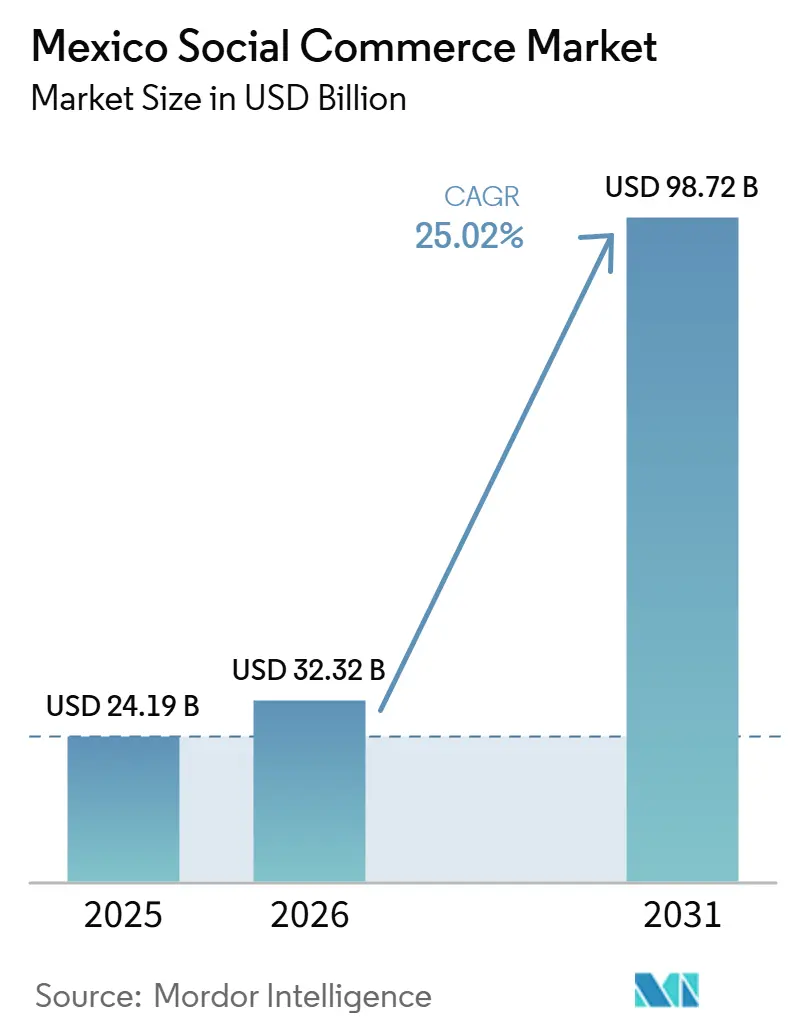
| Base Year Market Size (2025) | USD 24.19 Billion |
| Market Size (2026) | USD 32.32 Billion |
| Market Size (2031) | USD 98.72 Billion |
| Growth Rate (2026 - 2031) | 25.02 % |
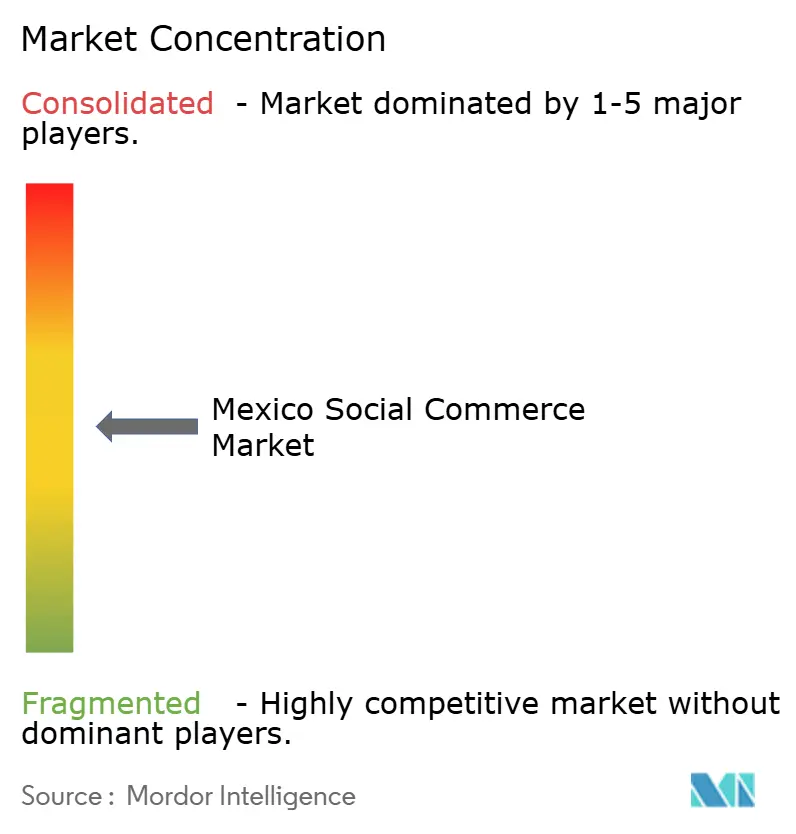
| Market Concentration | Medium |
Major Players *Disclaimer: Major Players sorted in no particular order Image © Mordor Intelligence. Reuse requires attribution under CC BY 4.0. | |
Mexico Social Commerce Market Analysis by Mordor Intelligence
The Mexico Social Commerce Market size is projected to expand from USD 24.19 billion in 2025 to USD 32.32 billion in 2026, and to USD 98.72 billion by 2031, registering a CAGR of 25.02% between 2026 and 2031. Mobile use, creator-led discovery, and payment innovation are bringing product discovery and purchase closer together. The Mexico Social Commerce Market benefits from a large, connected population, but its next phase depends on whether platforms can translate social engagement into trusted, completed transactions. TikTok Shop's February 2025 launch made Mexico its first South American entry point and placed a new transactional option alongside established messaging and marketplace channels. Platform operators are expanding creator programs, checkout tools, logistics links, and payment options as sellers seek multiple routes to customers. Consumer trust, cash dependence, and uneven seller capabilities will continue to determine how quickly usage becomes repeat buying.
Key Report Takeaways
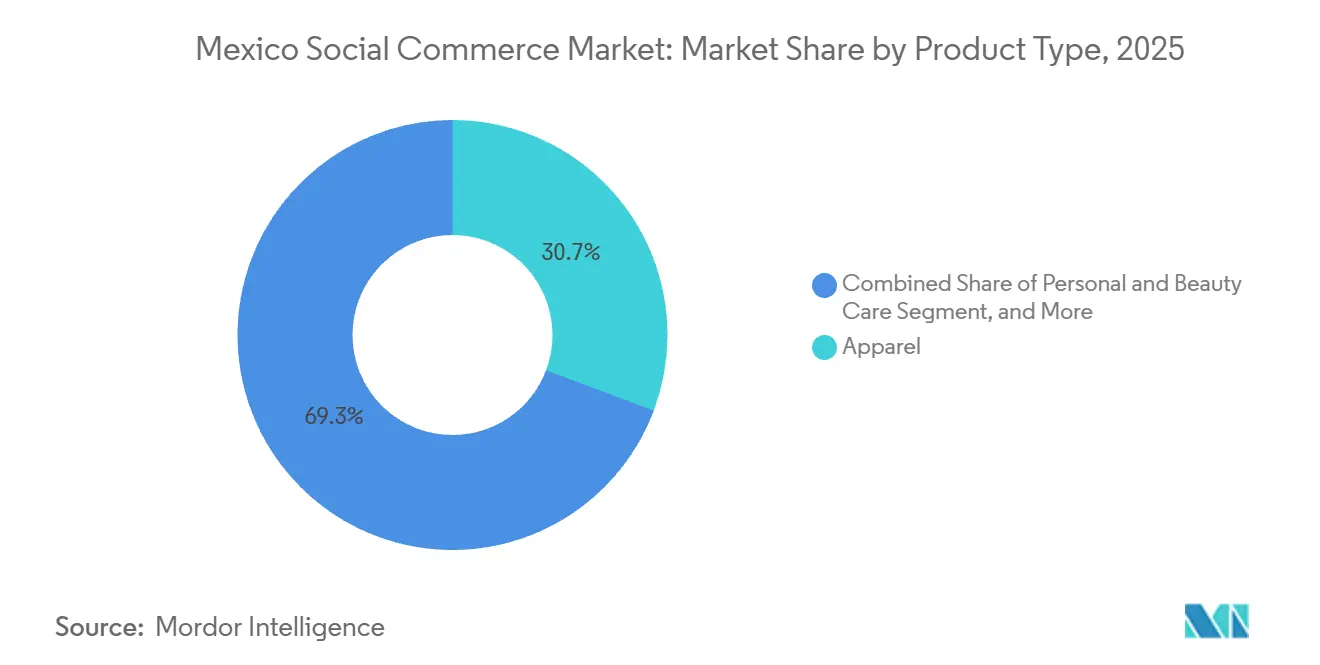
- By product type, apparel led with 30.72% of the Mexico Social Commerce Market share in 2025, while personal and beauty care is projected to expand at a 26.19% CAGR through 2031.
- By device, smartphones accounted for 78.81% of Mexico's social commerce share in 2025 and are projected to grow at a 25.16% CAGR through 2031.
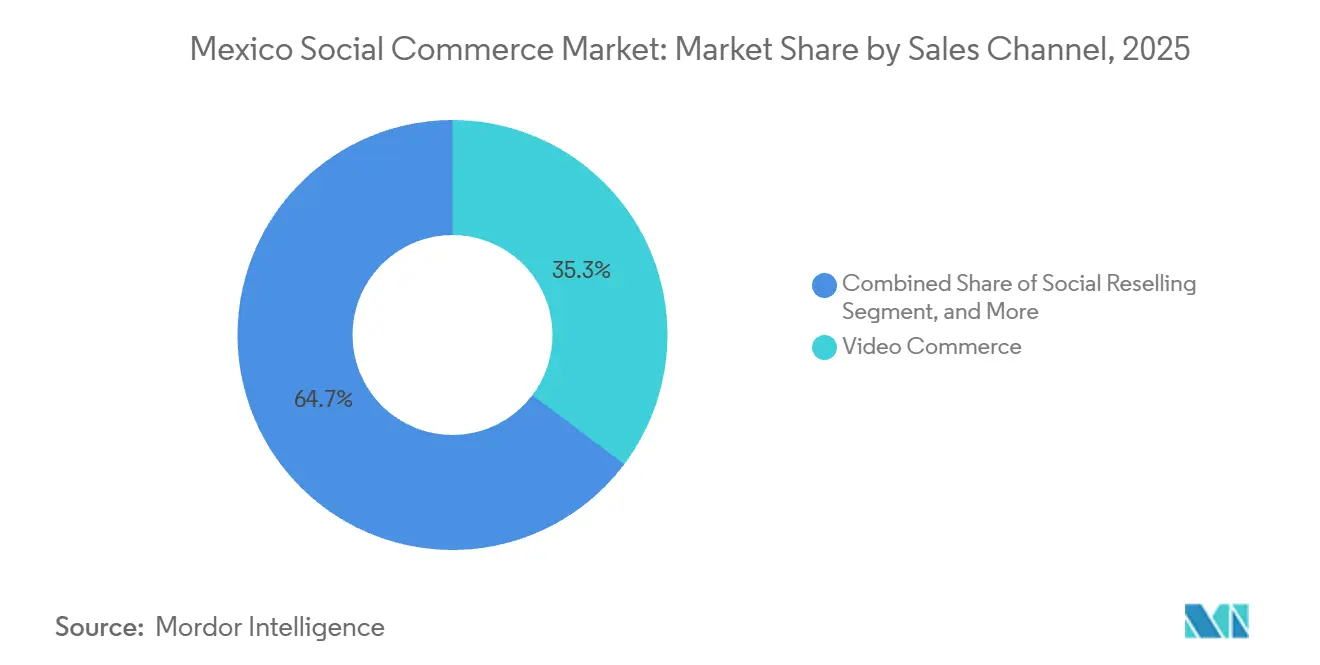
- By sales channel, video commerce accounted for 35.26% of the Mexico social commerce share in 2025, while social reselling is projected to expand at a 26.12% CAGR through 2031.
Note: Market size and forecast figures in this report are generated using Mordor Intelligence’s proprietary estimation framework, updated with the latest available data and insights as of January 2026.
Mexico Social Commerce Market Trends and Insights
Drivers Impact Analysis*
| Driver | (~) % Impact on CAGR Forecast | Geographic Relevance | Impact Timeline |
|---|---|---|---|
| Smartphone-First Purchase Journeys | +6.0% | National, with highest intensity in Mexico City, Jalisco, and Nuevo León | Short term (≤ 2 years) |
| In-App Shopping and Conversational Commerce Integration | +5.0% | National, with deepest penetration in urban and peri-urban centers | Short term (≤ 2 years) |
| Creator-Led Product Discovery and Live Selling | +4.5% | National, with spillover to secondary cities through algorithmic content distribution | Medium term (2-4 years) |
| SME Access to Low-Cost Digital Distribution | +3.5% | National, with early gains in Mexico City, Monterrey, and Guadalajara | Medium term (2-4 years) |
| TikTok Shop Expansion and Scroll-to-Buy Behavior | +3.0% | National, with the strongest concentration among urban Generation Z and millennial consumers | Short term (≤ 2 years) |
| Social Checkout Adaptation to Cash-Constrained Consumers | +2.5% | National, with highest relevance in semi-urban and peri-urban markets | Long term (≥ 4 years) |
| Source: Mordor Intelligence | |||
Smartphone-First Purchase Journeys
Mexico had 145 million active mobile connections in 2025, equal to 110% of the population, while mobile internet use remained the primary channel for accessing online content and commerce. This setting makes the smartphone the normal entry point for the Mexico Social Commerce Market rather than a secondary device used after desktop research. More than 70% of digital purchases were completed on mobile devices, according to figures from the Federal Telecommunications Institute and AMVO, which means product discovery and purchase decisions often occur in the same handheld session.[1] Mobile internet speed reached 45.21 Mbps by August 2025, up 38.9% year over year. Better connectivity supports product video, creator streams, catalog viewing, and messaging-based support without the interruption that previously weakened engagement. Sellers that design product pages and service flows primarily for desktop users may lose visibility and conversion as 5G coverage extends outside the largest cities.[2]
In-App Shopping and Conversational Commerce Integration
The Mexico Social Commerce Market is shifting from social discovery to purchase flows that occur within the same application, reducing the distance between a recommendation and a completed order. WhatsApp has become a selling channel where businesses can manage catalog access, product questions, payment steps, order updates, and follow-up conversations. More than 75% of businesses in Mexico sold through messaging platforms in 2026. Meta expanded its Business AI tools for Mexican companies in July 2025, enabling automated product recommendations and website-linked selling within WhatsApp conversations. This reduces the need for customers to switch between a social post, a browser, and a separate checkout page, particularly when they need clarification before buying. TikTok Shop's reported 59-fold rise in daily gross merchandise value between February 2025 and January 2026 shows how integrated checkout can strengthen a discovery-led transaction model.
Creator-Led Product Discovery and Live Selling
Creator content is becoming an important route for product discovery in the Mexico Social Commerce Market because it joins a recommendation with a product demonstration and a purchase link. A 2026 Kueski study found that 65% of Mexican consumers had bought a product after seeing a social media recommendation. Social networks were the leading fashion discovery channel for 84% of consumers in 2025, ahead of marketplaces at 57%. This gives brands a reason to treat affiliate payments and creator relationships as continuing commercial costs rather than one-off campaign spending tied only to awareness. Early relationships with nano- and micro-influencers can provide sellers with a more stable source of product visibility before creator fees rise and larger creators capture a greater share of high-performing audiences. Top TikTok Shop live sessions in Mexico reportedly achieved conversion rates above 30% in 2026, supporting the role of demonstration-based content in categories where visual proof and direct answers to questions matter.
SME Access to Low-Cost Digital Distribution
Small and medium-sized enterprises account for more than 95% of business units and nearly 50% of employment in Mexico. Social channels give these businesses an alternative to building a full online storefront, funding broad paid advertising, or securing a physical retail network before testing demand with customers. The Mexico Social Commerce Market, therefore, provides a lower-cost route for local merchants to show products, answer questions, collect feedback, and receive repeat orders through familiar consumer applications. Local businesses executed 90% of Mexico's e-commerce transactions in 2026. Tiendanube committed USD 17.5 million in 2025 to tools for payments, logistics, marketing, and conversational selling in Mexico and South America. Training programs launched for micro-businesses in 2025 also brought TikTok Shop activation, catalog creation, live selling, payments, logistics, and post-sale workflows into a more formal support structure for merchants that previously relied on informal channels.[3]
Restraints Impact Analysis*
| Restraint | (~) % Impact on CAGR Forecast | Geographic Relevance | Impact Timeline |
|---|---|---|---|
| Data Privacy and Consumer Protection Compliance Costs | -2.0% | National | Short term (≤ 2 years) |
| Platform Algorithm Volatility and Rising Customer Acquisition Costs | -1.5% | National, most acute for SME sellers relying on a single platform | Short term (≤ 2 years) |
| Weak Livestream Purchase Confidence and Trust Gaps | -1.0% | National, with lower trust levels in non-metro markets | Medium term (2-4 years) |
| Informal Seller Documentation and Fulfillment Constraints | -0.8% | National, concentrated in semi-formal and informal seller segments | Long term (≥ 4 years) |
| Source: Mordor Intelligence | |||
Data Privacy and Consumer Protection Compliance Costs
The same features that improve reach can also create pressure for sellers and platforms. Data rules, advertising costs, customer trust, and seller readiness affect whether rapid use can be sustained. Smaller merchants may be affected more directly because they have fewer resources for compliance, paid traffic, and delivery management. Customers also need confidence that a product will match its description and that support will be available if an order goes wrong. These requirements are likely to keep payment, buyer protection, and seller standards central to the Mexico Social Commerce Market. They also explain why marketplaces and platforms with established operations can retain an advantage as social transactions become more common.
Platform Algorithm Volatility and Rising Customer Acquisition Costs
The Mexico Social Commerce Market relies on algorithmic reach, but this reach can change quickly and is becoming more costly for sellers who need consistent customer traffic. TikTok's advertising reach rose 22.0% year over year through late 2025. More sellers competing for the same users can increase paid distribution costs and make organic exposure less dependable, even when a seller's products and creative approach remain unchanged. This matters most in apparel and food, where margins can be limited, and a small increase in acquisition cost can affect the economics of an order. Sellers that depend on one platform are more exposed when ranking systems, creative preferences, or ad auction conditions change without advance notice. Social reselling and group buying offer an alternative by turning customers into distribution partners and reducing the reliance on paid platform reach.
*Our forecasts treat driver/restraint impacts as directional, not additive. The impact forecasts reflect baseline growth, mix effects, and variable interactions.
Segment Analysis
By Product Type: Apparel Leads While Personal and Beauty Care Grows Fastest
Apparel held 30.72% of the Mexico social commerce share in 2025. The category is well-suited to short-form video because consumers can view styling, fit, colors, and combinations before deciding to buy. 45% of fashion shoppers bought clothing, footwear, or accessories through TikTok Shop and Instagram Shopping. Among Mexican TikTok users, 79% sought outfit recommendations, and 37% had purchased apparel seen in a video. Social networks led fashion discovery for 84% of consumers in 2025, compared with 57% for marketplaces. These patterns give apparel a broad base of discovery activity and a strong connection to creator recommendations.
Personal and beauty care is projected to record the fastest product-type CAGR, at 26.19%, between 2026 and 2031. TikTok Shop Mexico sold more than 255,000 beauty and personal-care units in April 2025, including more than 110,000 orders attributed to creator partnerships. The category's volume rose 83.9% month over month during that period. Mexican beauty brand Sarelly reported more than 1,000 orders during a single 3-hour live session in 2025. Product demonstrations, tutorials, and direct answers to customer questions suit categories where product use and credibility shape the decision. Accessories, home products, health supplements, food and beverages, and other products add to the Mexico Social Commerce Market through their different discovery and repeat-purchase patterns.

By Device: Smartphones Remain the Leading Transaction Device
Smartphones accounted for 78.81% of the Mexico social commerce share in 2025 and are projected to grow at a 25.16% CAGR through 2031. The segment's large share and leading growth rate show that mobile conversion still has room to develop. A faster mobile connection supports video viewing, live streams, catalog browsing, and checkout without switching devices. Messaging-based sales also keep the purchase process on the device consumers use for daily communication. WhatsApp catalog access and customer service are built around this behavior. The Mexico Social Commerce Market size for smartphone-led transactions benefits from this alignment between discovery, conversation, and payment.
Laptops and desktops remain relevant for purchases that require longer comparison, including electronics and premium home goods. These purchases can involve larger values, more detailed specifications, and several competing products. Even so, mobile purchases were at more than 70% of total online spending in Mexico. Better mobile checkout and conversational support reduce the reason to move to a larger screen for many purchases. Sellers still need clear comparison information for desktop users, particularly in higher-consideration categories. However, mobile-first design is likely to remain the core requirement for product presentation and transaction completion.
By Sales Channel: Video Commerce Leads and Social Reselling Expands Fastest
Video commerce held 35.26% of the Mexico social commerce share in 2025. TikTok Shop's discovery model brought short-form content, live sessions, creator storefronts, affiliate links, and native checkout into a single environment. During Hot Sale 2026, TikTok Shop live sessions with more than 500 orders per broadcast grew by more than 5 times compared to the prior year. The number of sellers conducting live transmissions rose more than 8 times over the same period. MercadoLibre also introduced shoppable video formats at Cannes Lions 2026 to connect streaming and social video discovery with marketplace purchases. Social network-led commerce, group buying and team purchase, and product review platforms continue to serve customers with different levels of trust, purchase urgency, and need for product information.
Social reselling is projected to expand at a 26.12% CAGR between 2026 and 2031. This channel lets consumers or creators act as sellers, which can reduce a brand's use of paid customer acquisition. MercadoLibre's affiliate and creator program grew 1,600% between the first quarter of 2025 and the first quarter of 2026, while active affiliates generating sales rose 17 times. YouTube expanded Shopping to Mexico with MercadoLibre on June 18, 2026, allowing eligible creators to tag products in long-form videos, Shorts, and live streams. This move extends affiliate selling beyond short-form social applications. The Mexico Social Commerce Market can expand its distribution channels when creators link content to measurable sales activity across multiple platforms.[4]
Geography Analysis
Mexico City recorded 29% growth in e-commerce transactions in 2026. The capital remains the Mexico Social Commerce Market's main concentration point because it combines digital infrastructure, dense logistics networks, and higher household purchasing power. Jalisco recorded 10.34%, and the State of Mexico recorded 10.12% growth in the same analysis. Guadalajara also supports a growing creator economy that can help brands reach consumers through locally relevant content. These locations form the high-activity core for seller, platform, and creator activity. 47% of Mexicans had used social networks as a purchase channel in 2025.
Nuevo León, Veracruz, and Puebla recorded transaction growth of 5.5%, 4.5%, and 4.0%, respectively, in 2026. Monterrey can support higher-value categories, including electronics and health supplements, because of its stronger financial inclusion profile. Veracruz and Puebla show the early spread of social selling into areas where messaging can reach customers before app-native checkout becomes common. Mexico's retail e-commerce penetration was forecast to reach 17.7% of total retail sales in 2026 and exceed 20% by 2029. That path creates more room for social-origin transactions nationwide. The share of social commerce activity in Mexico remains concentrated in major centers, but secondary cities present a different mix of payment and fulfillment needs.
Semi-urban and peri-urban areas form the next potential demand pool for the Mexico Social Commerce Market. Their current participation is limited by delivery coverage and a payment structure in which 79% of transactions occurred in cash, and 52% of the population remained unbanked in 2025. Walmart de México and Aplazo announced a buy-now, pay-later partnership through the Cashi digital payments application in November 2025. Aplazo pre-approved 1.5 million credit lines under the partnership. CoDi and DiMo real-time payment programs can also reduce the reliance on cash as consumers and merchants adopt interoperable payment tools. A wider set of affordable payment options would help convert interest generated through messaging and social content into completed orders.
Competitive Landscape
The Mexico Social Commerce Market has competition across product discovery, transaction processing, fulfillment, advertising, and seller services. No single platform controls every part of the journey from a social post to delivery. Meta has a broad consumer reach through WhatsApp, Instagram, and Facebook, while TikTok Shop added a direct content-to-checkout model after its February 2025 launch. TikTok Shop generated more than USD 497 million in product sales during its first year in Mexico. MercadoLibre remains important because its marketplace, logistics, payment, and advertising tools support transactions after discovery. This mix makes a multi-platform presence more important for sellers seeking reach and dependable fulfillment.
Trust and post-purchase support are important areas of competition in the Mexico Social Commerce Market. Amazon and MercadoLibre have advantages in buyer protection and fulfillment infrastructure, which can matter more for higher-value purchases. TikTok Shop's growth creates a strong challenge in discovery-led categories, but product disputes and delivery confidence still affect whether users buy expensive items through a social feed. Pinterest identified Mexico as a commercial priority in 2026 and offers a visually led route to product research in home, beauty, and fashion. YouTube's June 2026 Shopping partnership with MercadoLibre gives creators a way to connect video viewers with marketplace purchases. These moves place more value on content that provides useful product context before the customer enters checkout.
Platform strategies are also shaped by the need to manage data and seller operations. MercadoLibre and Meta announced a social commerce integration in Mexico in April 2026 that linked Facebook community recommendations to MercadoLibre's purchase ecosystem. Mercado Ads announced a TikTok advertising inventory integration and shoppable video formats at Cannes Lions 2026. Walmart Connect expanded its retail media activity into Meta- and TikTok-connected channels in 2026. Tiendanube continued to build services for Mexican small and medium-sized merchants, including payment, logistics, marketing, and chat tools. Compliance capabilities can become a practical advantage, as platforms with mature data systems may incur lower costs in applying Mexico's updated privacy requirements. Market concentration score: 4 out of 10, because several major platforms across distinct parts of the value chain provide no combined top-player share that indicates concentrated control.
Mexico Social Commerce Industry Leaders
-
Meta Platforms, Inc.
-
TikTok Pte. Ltd.
-
MercadoLibre, Inc.
-
Amazon.com, Inc.
-
Walmart Inc.
- *Disclaimer: Major Players sorted in no particular order
Recent Industry Developments
- June 2026: YouTube expanded its Shopping affiliate program to Mexico on June 18, 2026, partnering exclusively with MercadoLibre and enabling eligible creators to tag Mercado Libre products directly inside long-form videos, Shorts, and live streams. Viewers can complete purchases within Mercado Libre without interrupting video playback, directly competing with TikTok's discovery commerce model.
- April 2026: MercadoLibre and Meta announced a social commerce integration in Mexico, enabling Facebook community recommendations to connect directly to MercadoLibre's purchase ecosystem. MercadoLibre disclosed that its creator and affiliate program grew over 1,600% between Q1 2025 and Q1 2026, with active affiliates generating at least one sale rising 17 times year over year.
- March 2025: TikTok Shop launched the TikTok Shop US-MX cross-border seller program, enabling US merchants to use existing US accounts and domestic warehouse logistics to sell directly to Mexican consumers, removing the local entity formation requirement.
- November 2025: Walmart de México and Aplazo announced a BNPL partnership integrated via Cashi, Walmart's digital payments app. Aplazo pre-approved 1.5 million credit lines, enabling consumers to complete installment purchases without credit cards and extending social commerce payment access to financially excluded segments.
Mexico Social Commerce Market Report Scope
The Mexico social commerce market refers to the ecosystem of buying and selling goods and services directly through social media platforms, influencer networks, and community-driven channels within Mexico. This market encompasses transactions facilitated via video commerce, social network-led storefronts, social reselling, group buying, and product discovery platforms across devices such as smartphones and desktops. By integrating e-commerce capabilities directly into Mexican consumers' social media experiences, this market enables brands and retailers to shorten the customer journey from product discovery to purchase, leveraging interactive content, live streaming, and peer recommendations to drive sales of apparel, personal care, and other consumer goods.
The Mexico Social Commerce Market Report is Segmented by Product Type (Apparel, Personal and Beauty Care, Accessories, Home Products, Health Supplements, Food and Beverages, and Other Product Types), Device (Laptops and Desktops, and Smartphone), and Sales Channel (Video Commerce, Social Network-Led Commerce, Social Reselling, Group Buying / Team Purchase, and Product Review and Discovery Platforms). The Market Forecasts are Provided in Terms of Value (USD).
| Apparel |
| Personal and Beauty Care |
| Accessories |
| Home Products |
| Health Supplements |
| Food and Beverages |
| Other Product Types |
| Laptops and Desktops |
| Smartphone |
| Video Commerce |
| Social Network-Led Commerce |
| Social Reselling |
| Group Buying / Team Purchase |
| Product Review and Discovery Platforms |
| By Product Type | Apparel |
| Personal and Beauty Care | |
| Accessories | |
| Home Products | |
| Health Supplements | |
| Food and Beverages | |
| Other Product Types | |
| By Device | Laptops and Desktops |
| Smartphone | |
| By Sales Channel | Video Commerce |
| Social Network-Led Commerce | |
| Social Reselling | |
| Group Buying / Team Purchase | |
| Product Review and Discovery Platforms |
Key Questions Answered in the Report
What is the size of the Mexico Social Commerce Market?
The Mexico Social Commerce Market is projected to grow from USD 32.32 billion in 2026 to USD 98.72 billion by 2031, at a 25.02% CAGR. Growth is supported by mobile shopping, creator-led discovery, integrated checkout, and a wider set of payment options.
Which product category leads social commerce in Mexico?
Apparel led with 30.72% share in 2025. Personal and beauty care is projected to be the fastest-growing product category at a 26.19% CAGR through 2031, supported by tutorials, creator recommendations, and live demonstrations that help consumers assess products before ordering.
Why are smartphones important for social selling in Mexico?
Smartphones held 78.81% of transactions in 2025 and are projected to grow at a 25.16% CAGR through 2031. They bring video viewing, creator content, messaging, catalog access, customer questions, and checkout together in the device that consumers use throughout the day.
Which sales channel is growing fastest in Mexico?
Social reselling is projected to grow at a 26.12% CAGR through 2031. The model lets creators and consumers act as distribution partners for sellers, which can lower reliance on paid advertising and expand the number of product recommendations that lead to measurable sales.
What is holding back wider adoption of social commerce in Mexico?
Consumer trust in live selling, cash-based payments, uneven logistics coverage, seller documentation, and privacy compliance costs remain important constraints. These issues are especially relevant outside major cities, where access to formal financial services and dependable delivery networks can be more limited.
Which areas are important for social commerce growth in Mexico?
Mexico City remains the principal activity center. Jalisco, the State of Mexico, Nuevo León, Veracruz, Puebla, and semi-urban areas offer different expansion opportunities as payment access, logistics coverage, and messaging-based sales practices develop.