
Mexico Hydroponics Market Size and Share
Market Overview
| Study Period | 2021 - 2031 |
|---|---|
| Forecast Data Period | 2026 - 2031 |
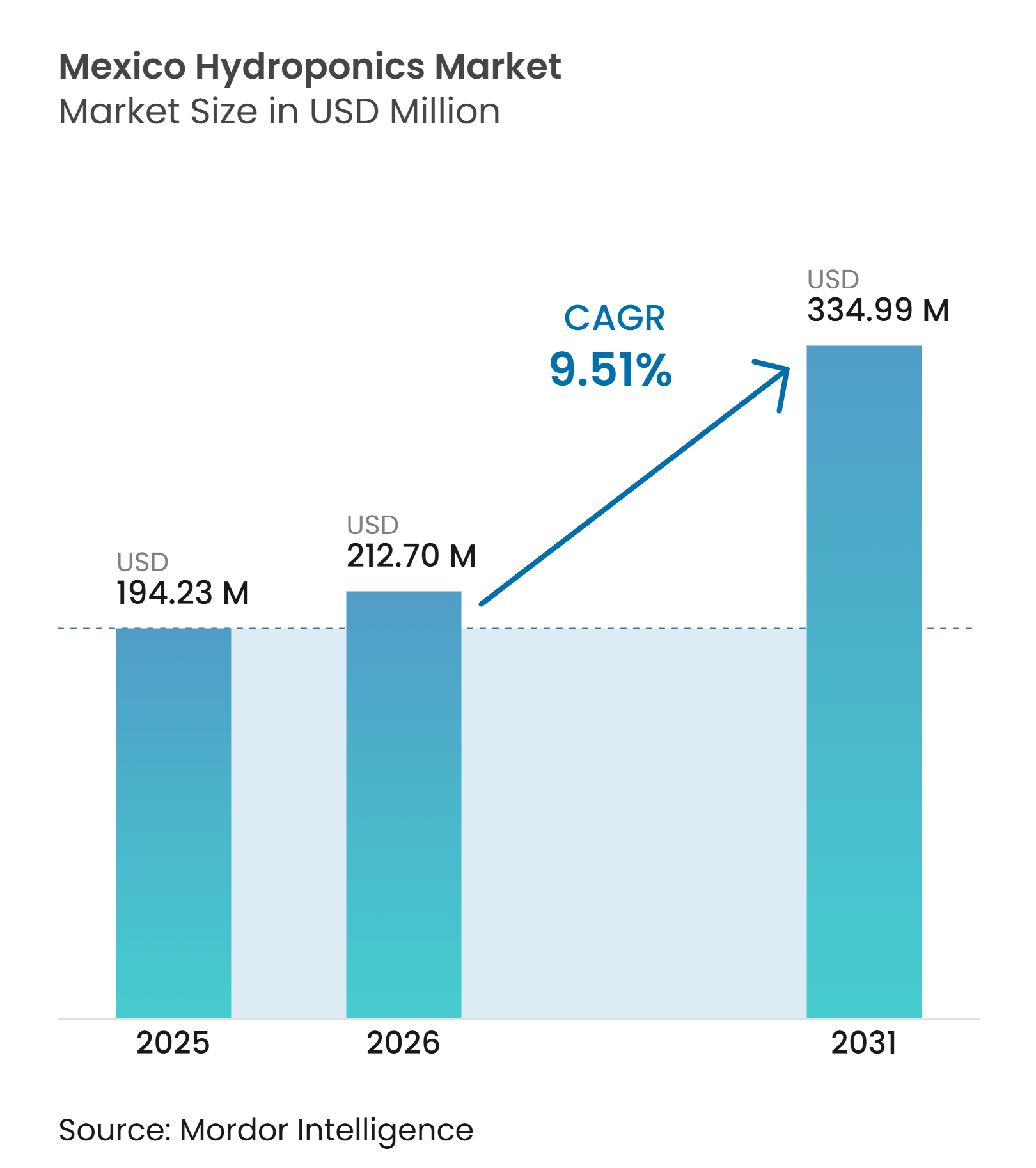
| Base Year Market Size (2025) | USD 194.23 Million |
| Market Size (2026) | USD 212.70 Million |
| Market Size (2031) | USD 334.99 Million |
| Growth Rate (2026 - 2031) | 9.51 % |
| Market Concentration | Medium |
Major Players *Disclaimer: Major Players sorted in no particular order Image © Mordor Intelligence. Reuse requires attribution under CC BY 4.0. | |
Mexico Hydroponics Market Analysis by Mordor Intelligence
The Mexico hydroponics market size was valued at USD 194.23 million in 2025 and is forecast to grow from USD 212.70 million in 2026 to USD 334.99 million by 2031, at a CAGR of 9.51% from 2026 to 2031. Water pressure is making recirculating production systems more relevant for growers who need to manage both supply risk and water-use controls. Mexico's role in supplying fresh produce to the United States also favors controlled production to support consistent quality, traceability, and food safety requirements. Investment is therefore directed toward greenhouse capacity for export crops and smaller urban facilities for fresh leafy produce. Electricity costs, access to finance, and water permissions will continue to shape where new facilities are built. The Mexico hydroponics market also offers technology suppliers an opportunity to provide climate controls, irrigation equipment, and operational support tailored to local growing conditions.
Key Report Takeaways
- By production system, greenhouse hydroponics was the largest segment, accounting for 68.3% of the Mexico hydroponics market size in 2025, while indoor vertical farms are forecast to grow at a CAGR of 13.4% from 2026 to 2031.
- By crop type, leafy greens were the largest segment, accounting for 47.2% of the Mexico hydroponics market share in 2025, while herbs and microgreens are forecast to grow at a CAGR of 12.6% from 2026 to 2031.
- By production scale, large commercial operations were the largest segment, accounting for 55.8% of revenue in 2025, while small systems are forecast to grow at a CAGR of 13.3% from 2026 to 2031.
- By equipment, lighting systems were the largest segment, accounting for 49.5% of revenue in 2025, while climate systems are forecast to grow at a CAGR of 12.8% from 2026 to 2031.
Note: Market size and forecast figures in this report are generated using Mordor Intelligence’s proprietary estimation framework, updated with the latest available data and insights as of January 2026.
Market Trends and Insights
Drivers Impact Analysis of Mexico Hydroponics Market*
| Driver | (~) % Impact on CAGR Forecast | Geographic Relevance | Impact Timeline |
|---|---|---|---|
| Water scarcity and water-use efficiency | +2.0% | National, with acute need in Sonora, Chihuahua, Guanajuato, Querétaro, and northern Baja California | Short term (≤ 2 years) |
| Export-oriented demand for consistent produce | +2.2% | Sinaloa, Bajío corridor, Jalisco, San Luis Potosí, and Sonora | Medium term (2-4 years) |
| Urban and peri-urban local food production | +1.5% | Mexico City, Guadalajara, Monterrey, Querétaro, and Puebla | Medium term (2-4 years) |
| Government programs supporting agricultural resource efficiency | +1.0% | National, with program concentration in southern and central states | Long term (≥ 4 years) |
| Automation, sensors, and data-driven crop management | +1.3% | Bajío corridor and Nuevo León, with early uptake in Querétaro | Medium term (2-4 years) |
| Retailer and food-service contracts for year-round supply | +1.2% | National, with export demand centered on Sinaloa and Sonora supply chains | Medium term (2-4 years) |
| Source: Mordor Intelligence | |||
Water Scarcity and Water-Use Efficiency
Water availability is increasing the appeal of hydroponic production across Mexico. In 2025, water stress continued to affect a large share of the country, especially in northern states including Sonora, Chihuahua, Coahuila, and Durango. Closed-loop systems can reduce reliance on conventional irrigation and help operators manage water more closely. The 2024 water-law reform increased the importance of documentation, metering, and reporting for agricultural water use. New greenhouse projects can therefore view recirculation equipment as a way to manage operating and compliance needs. The Programa Nacional de Tecnificación del Campo also creates opportunities for suppliers of efficient irrigation and controlled growing systems.
Export Demand for Consistent Produce
Mexico is a major supplier of fresh produce to the United States, and this trade supports investment in controlled horticulture. The United States Department of Agriculture reported that Mexico supplied 63% of United States vegetable imports in 2025[1]. Export growers need reliable product quality, traceability, and compliance with the Food Safety Modernization Act Produce Safety Rule. Hydroponic greenhouses can support these requirements through controlled irrigation, more consistent crop handling, and documented growing practices. Growers in Sinaloa, Sonora, and the Bajío corridor are responding with climate control, fertigation, and crop-monitoring equipment. This need for consistency supports the Mexico hydroponics market among producers serving premium retail and foodservice programs.
Urban and Peri-Urban Food Production
Urban demand is supporting smaller hydroponic facilities that can serve customers close to the point of consumption. Foodservice and retail buyers in Mexico City, Guadalajara, and Monterrey value short delivery routes for leafy greens, herbs, and microgreens. These crops have short growing cycles and benefit from being delivered fresh. Container farms and vertical systems can fit hospitality, education, municipal, and corporate settings where a full greenhouse is not practical. The Autonomous University of San Luis Potosí is developing high-density vertical production systems for water-stressed communities through its GroVert project. This activity supports wider awareness of locally controlled production across the Mexico hydroponics market.
Government Programs Supporting Agricultural Resource Efficiency
Government programs are placing greater emphasis on water efficiency and resilient agricultural production. The Secretaría de Agricultura y Desarrollo Rural is expanding support for agricultural electricity use through the Programa Especial de Energía para el Campo, which can subsidize up to 95% of pumping electricity costs for qualifying agricultural users. The 2025 to 2030 Programa Sectorial de Agricultura y Desarrollo Rural also includes water-use efficiency and climate-resilience priorities[2]. Much of the broader support remains directed toward staple crops such as maize and beans. For hydroponic operators, these initiatives may provide indirect support through lower resource costs, while horticulture-specific programs may offer more direct opportunities for sector development.
Restraints Impact Analysis of Mexico Hydroponics Market*
| Restraint | (~) % Impact on CAGR Forecast | Geographic Relevance | Impact Timeline |
|---|---|---|---|
| High upfront capital and financing constraints | -1.5% | National, with strongest effect on smallholders in southern and central states | Short term (≤ 2 years) |
| Electricity exposure in climate-controlled facilities | -0.9% | National, with higher exposure in Valle de México Norte and Cancún | Medium term (2-4 years) |
| Shortage of specialized growers and technicians | -0.7% | National, with the greatest gap outside Bajío and Sinaloa corridors | Long term (≥ 4 years) |
| Water rights, permitting, and imported-equipment delays | -0.6% | National, especially states under water-concession review | Medium term (2-4 years) |
| Source: Mordor Intelligence | |||
High Upfront Capital and Financing Constraints
Commercial hydroponic projects require material initial investment in structures, climate controls, lighting, and fertigation equipment. This is a significant barrier for mid-sized producers without strong collateral. Verde Compacto S.A.P.I. de C.V. has worked with OMNIA and FIRA financing programs to offer terms of 36 to 60 months with down payments of 10% to 20% when projects have offtake agreements. Standard financing products for containerized and modular systems remain limited. The Organisation for Economic Co-operation and Development found that Mexico's agricultural support structure directed 90% of transfers to input subsidies and electricity rather than capital formation[3]. This structure leaves protected horticulture projects dependent on private finance with demanding collateral requirements.
Electricity Exposure in Climate-Controlled Facilities
Electricity costs can materially affect the economics of enclosed growing facilities. Indoor farms need power for lighting, cooling, ventilation, pumps, and controls. The Programa Especial de Energía para el Campo can lower pumping costs for qualifying users, but facilities using supplemental lighting throughout the year may not receive the full benefit. Operators must assess local energy conditions before selecting a site or technology configuration. Higher energy exposure can discourage fully enclosed projects in some central locations. It also makes efficient lighting and climate equipment more important to the Mexico hydroponics market.
*Our forecasts treat driver/restraint impacts as directional, not additive. The impact forecasts reflect baseline growth, mix effects, and variable interactions.
Mexico Hydroponics Market Segment Analysis
By Production System:
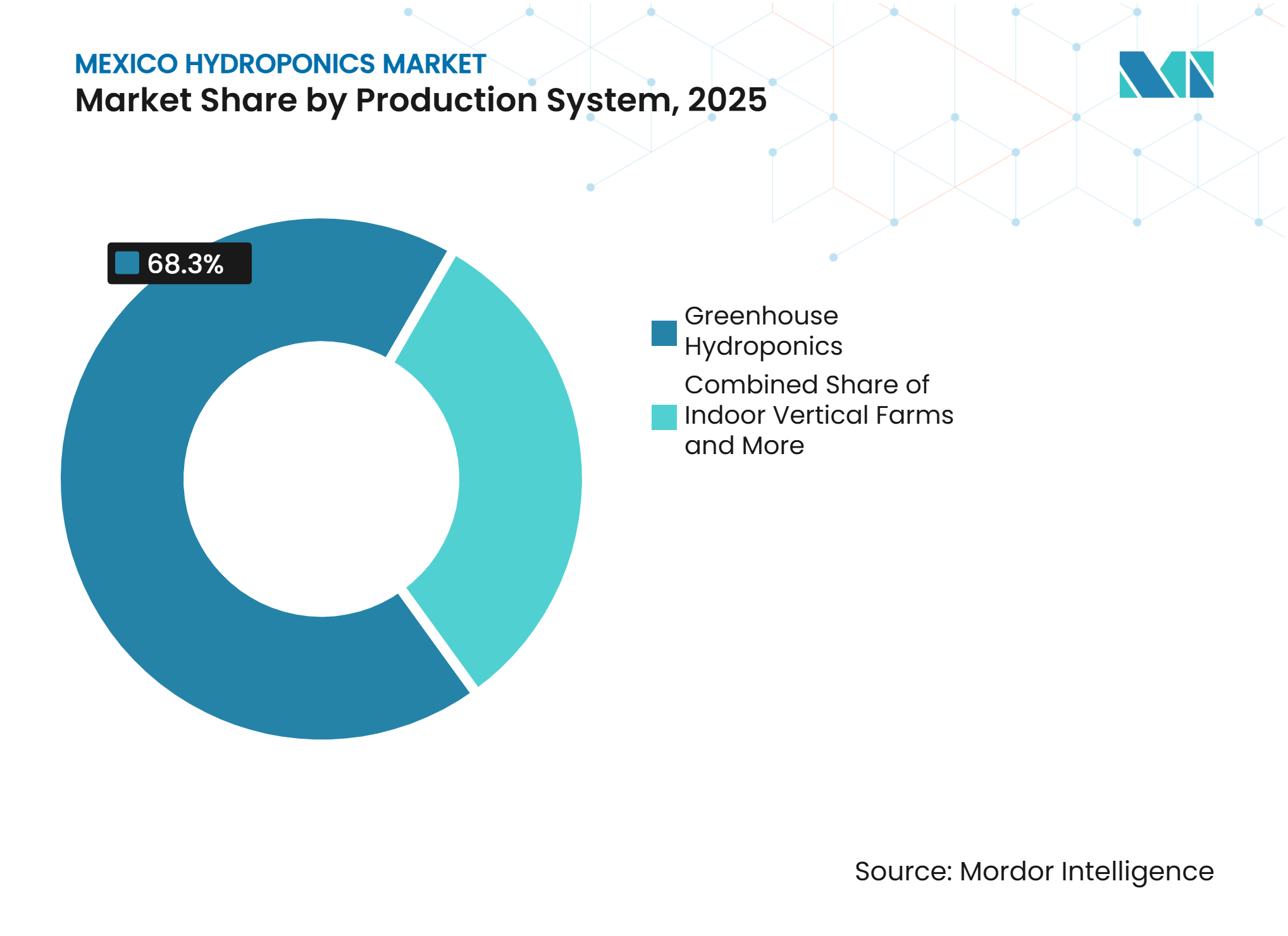
Greenhouse Hydroponics Remains the Largest System and Indoor Vertical Farms Is the Fastest SystemGreenhouse hydroponics was the largest production system, holding 68.3% of Mexico hydroponics market share in 2025. Its position reflects long-standing investment in greenhouse complexes across Sinaloa, Jalisco, and the Bajío corridor. These facilities primarily grow tomatoes, cucumbers, and peppers for continuous-supply programs. Central highland sites are also expanding leafy-green and herb production because altitude can reduce cooling needs. Rising Farms expanded its high-technology greenhouse area to 4.1 million square feet (38 hectares), after acquiring a San Luis Potosí facility in 2024. The company reported water use at 10% of traditional methods and yields up to 30 times higher per square meter. These operating characteristics support the established role of greenhouse production in the Mexico hydroponics market.
Indoor vertical farms are the fastest-growing production system and are forecast to grow at a 13.4% CAGR from 2026 to 2031. Demand for nearby food production and improving light efficiency support this forecast. Modular designs can lower the initial scale required for a project. Container Farms serve a narrower set of hospitality, education, and municipal applications. Verde Compacto S.A.P.I. de C.V. stated that its Huvster Pro container can produce up to 50,000 lettuce heads each year in 30 square meters. These formats are relevant where greenhouse development is constrained by site size. Water recirculation needs provide an additional reason for operators to consider both indoor and greenhouse systems.



By Crop Type:
Leafy Greens is the Largest Category and Herbs and Microgreens is the Fastest CategoryLeafy greens were the largest crop type, accounting for 47.2% of Mexico hydroponics market size in 2025. Short production cycles and consistent hydroponic yields support their use in urban retail and foodservice supply. Domestic supermarkets and foodservice operators provide a stable demand for these crops. Tomatoes, cucumbers, and peppers account for much of the remaining value and remain central to export-focused greenhouses. These crops have established phytosanitary pathways through the Servicio Nacional de Sanidad, Inocuidad y Calidad Agroalimentaria. Buyers also value controlled production for its ability to support clear records and uniform handling. This balance keeps leafy greens important while retaining export crops within the Mexico hydroponics market.
Herbs and microgreens were the fastest-growing crop category and are forecast to grow at a 12.6% CAGR from 2026 to 2031. Restaurant demand and direct-to-consumer subscriptions in Guadalajara, Monterrey, and Mexico City support its expansion. These crops suit local facilities because they have short cycles and benefit from freshness at the time of sale. The GroVert project uses GrowPipes tower systems that can hold 300 plants per tower. This work is focused on vertical production models for water-stressed communities. The 2025 GreenTech Americas event in Querétaro also included a hydroponic leafy-green workshop. These activities show continuing interest in automated specialty-crop production and packaging.
By Equipment:
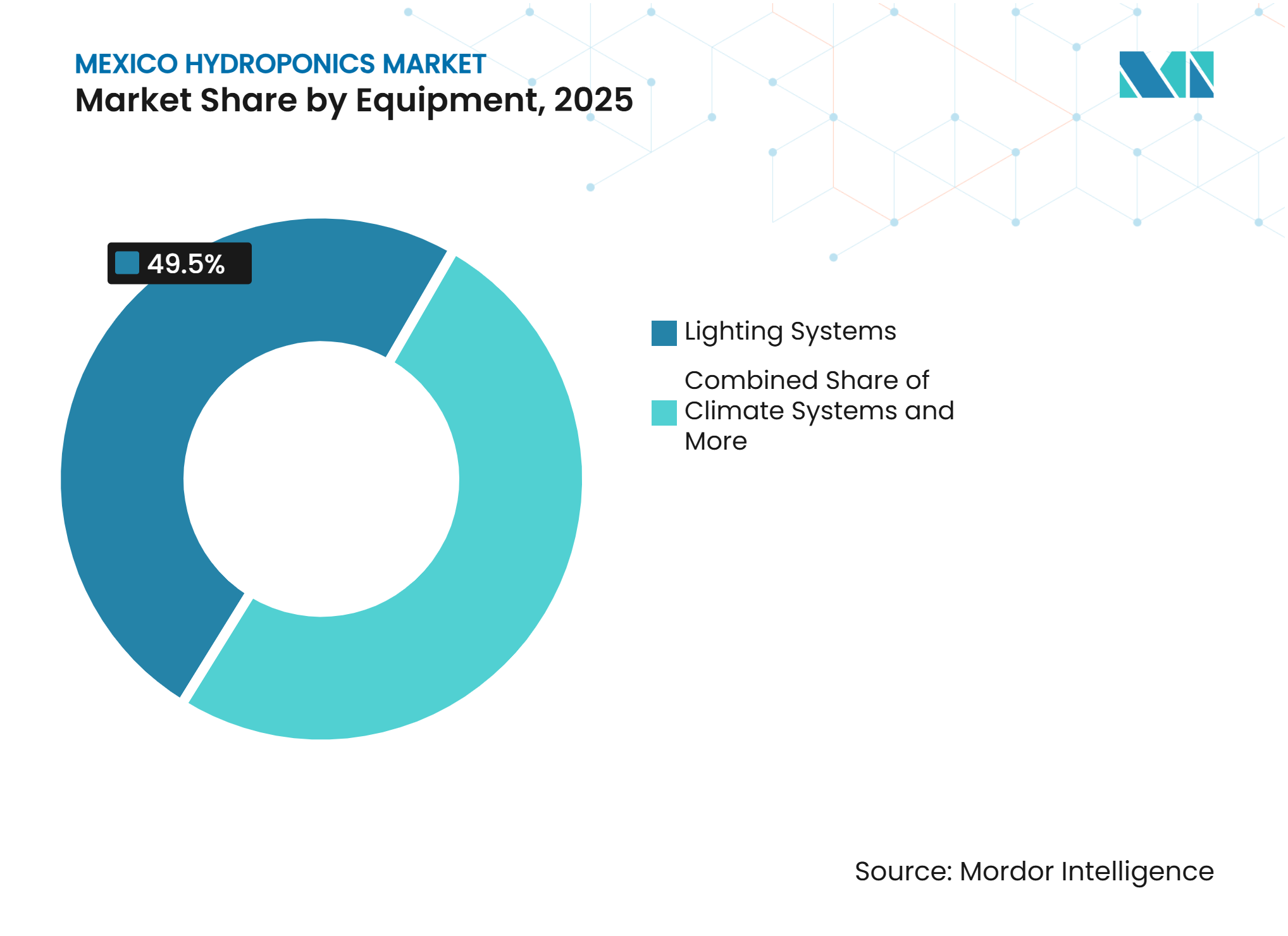
Lighting Systems is the Largest Category and Climate Systems is the Fastest CategoryLighting systems were the largest equipment category, accounting for 49.5% of revenue in 2025. The category includes supplemental greenhouse lighting and full-spectrum light arrays for indoor facilities. Lighting affects crop development, production scheduling, and the operating cost of enclosed farms. Higntek participated in a 2026 project for customized full-spectrum and adjustable-spectrum light modules for Mexican greenhouses. The systems support light settings that can be adjusted by crop stage. Irrigation components, pumps, and structural components account for the remaining equipment expenditure. This keeps lighting at the center of the Mexico hydroponics market size for equipment.
Climate systems are the fastest-growing equipment category, forecast to grow at a 12.8% CAGR from 2026 to 2031. Indoor vertical farms require active control of temperature and humidity throughout the year. Export greenhouses also use more automated climate systems to produce uniform crops. Bionatur has applied artificial intelligence to real-time climate and irrigation management at a large greenhouse operation. Automation and control systems are growing alongside climate equipment. Operators are adding sensors and management software to support traceability and improve daily decision-making. This combination makes climate management a priority for future equipment investment.

By Production Scale:
Large Commercial Operations is the Largest Scale and Small Systems is the Fastest ScaleLarge commercial operations were the largest production scale, representing 55.8% of revenue in 2025. Their share reflects the cost of building greenhouse facilities for export supply programs. Larger operators can spread engineering, seed, certification, and logistics costs across higher volumes. They also have stronger access to direct relationships with retailers and foodservice distributors. The Mexico hydroponics industry benefits from this established commercial base, which creates recurring demand for system components and operational services. Medium-scale operations serve domestic supermarket chains and regional distributors. The Bajío corridor continues to attract these producers because of its climate and growing agrotechnology service base.
Small systems were the fastest-growing production scale and are forecast to grow at a 13.3% CAGR from 2026 to 2031. Containers and modular towers lower the entry cost compared with large greenhouse developments. FIRA and OMNIA financing arrangements can improve access for qualifying projects with offtake agreements. Stadiums, universities, corporate campuses, and municipalities are using on-site units to improve procurement reliability. These settings value reliable access to leafy greens and herbs, as well as the visibility of local production. Smaller systems are therefore extending controlled growing beyond conventional agricultural sites. Their growth broadens the customer base for the Mexico hydroponics market.
Geography Analysis
The Northwest corridor, led by Sinaloa and Sonora, represented an important concentration of hydroponic greenhouse production in 2025 because of its export-focused greenhouse base. Sinaloa produced more than 712,000 metric tons of tomatoes in 2024, an increase of 11.5% from the preceding year. The region supplies fresh tomatoes to the United States during the winter season. Its hydroponic projects are generally large, export-oriented, and tomato-focused. Growers are adding climate-control capabilities to maintain quality during warmer seasons.
The Bajío corridor was the fastest-growing geographic cluster in recent years, supported by stable growing conditions and agrotechnology activity. It includes Jalisco, Querétaro, Guanajuato, San Luis Potosí, and Michoacán. Querétaro accounted for 12% of Mexico's high-technology greenhouse production in 2025. The region has hosted GreenTech Americas in consecutive years and continues to attract technology-oriented greenhouse investment. Rising Farms increased capacity by 52% to 38 hectares through its San Luis Potosí acquisition in 2024. The corridor provides an alternative for growers seeking year-round production outside Sinaloa's summer conditions. It also brings equipment suppliers, service providers, and controlled-environment expertise closer together.
Northern Mexico is becoming an important growth area because it combines border logistics with great urban demand. Alpine Green and Van der Hoeven announced a USD 200 million automated greenhouse project in Galeana, Nuevo León, in May 2026. The first phase involves USD 70 million and includes Signify lighting technology and climate automation. Monterrey's metropolitan population exceeds 5 million people, supporting demand for nearby fresh produce. Mexico City, Guadalajara, and Puebla form a smaller urban node for vertical farms and container systems. These operations serve hospitality, corporate catering, and direct-to-consumer channels. Their contribution remains smaller in 2026, but the Small Systems segment should support expansion through 2031.
Competitive Landscape
Market Concentration
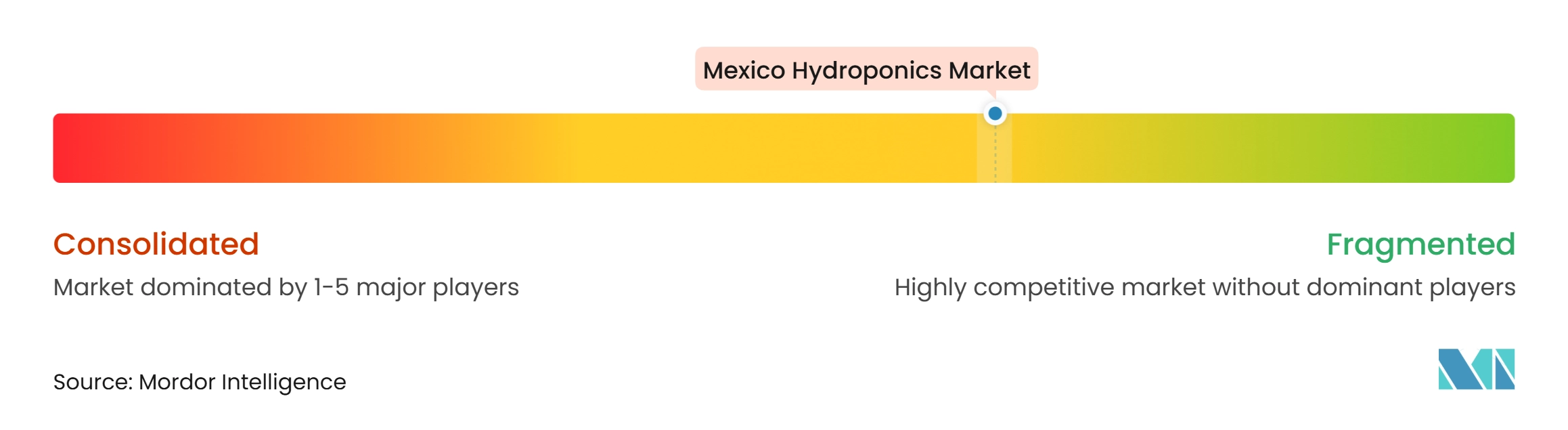
The Mexico hydroponics market is moderate across growers, system suppliers, distributors, and technology providers in 2025. Village Farms International, Inc., J. Huete International, Globalmex International Inc., Rising Farms, Verde Compacto S.A.P.I. de C.V., and Freight Farms Inc. operate alongside international suppliers and distributors. Domestic participants can benefit from knowledge of water permissions, food-safety processes, and local financing structures. iFarm Corporation and Village Farms International contribute through technology licensing, system integration, and supply-chain partnerships. As climate and automation systems become more accessible, mid-sized Mexican operators can install equipment once limited to larger facilities. This supports competition based on operating consistency, service capability, and access to financing.
QG InnovAgro supplies greenhouse plastics, hydroponic systems, and NUF ultrafiltration water-recycling technology in Mexico. Its product range helps more growers access controlled-environment equipment. In 2025, QG InnovAgro allied with NUF Water Treatment to distribute water-recycling systems in Mexico. Orbia Netafim's June 2026 Hermosillo plant is another strategic move that expands local availability of precision-irrigation components. Alpine Green and Van der Hoeven's announced Galeana project also adds a high-automation greenhouse development to Nuevo León. These actions strengthen the role of equipment, water management, and automation in competitive positioning.
There is room for Spanish-language nutrient-management software that aligns with local agronomic practices. Financing structures designed for container and modular projects also remain limited. Traceability platforms that support lot-level records for fresh produce may gain relevance as export compliance requirements evolve. The GroVert project provides an example of locally adapted vertical production research. Large commercial operations are increasingly treating real-time crop data as a standard operating requirement. Smaller operators will need practical technology and training support to keep pace.
Mexico Hydroponics Industry Leaders
-
Village Farms International, Inc.
-
J. Huete International
-
Globalmex International Inc.
-
Verde Compacto S.A.P.I. de C.V.,
-
Freight Farms Inc.
- *Disclaimer: Major Players sorted in no particular order
Mexico Hydroponics Market Companies Covered in this Report
- Verde Compacto S.A.P.I. de C.V.
- Karma Verde Fresh S.A.P.I. de C.V.
- Comercializadora Hydro Environment S.A. de C.V.
- Inverfarms Mexico S.A.P.I. de C.V.
- Freight Farms Inc.
- iFarm Corporation
- Rising Farms
- Origeen Transforma Verde
- Hidrogomez USA
- Globalmex International Inc.
- Desert Verde Farm, LLC
- Village Farms International
- J. Huete International
- QG InnovAgro
- Growtech Agroindustrial
Recent Industry Developments in Mexico Hydroponics Market
- June 2026: Orbia Netafim opened a 30,000-square-meter manufacturing plant in Hermosillo, Sonora, its third production site in Mexico, to meet growing precision-irrigation demand across North and Central America. The expansion indirectly supports Mexico’s hydroponics market by improving access to irrigation and fertigation technologies.
- May 2026: Alpine Green and Van der Hoeven announced a USD 200 million investment to develop a high-tech greenhouse project in Galeana, Nuevo León, Mexico, focused on lettuce and other vegetables. The first phase represents USD 70 million and incorporates advanced Signify lighting technology, with the greenhouses designed to be highly automated and sustainable.
- October 2025: UASLP developed the GroVert project, a 128-square-meter living laboratory for vertical greenhouse farming that integrates GrowPipes vertical systems and TIRUSS hydroponic towers. The project supports Mexico’s hydroponics market by advancing research on high-density production, fertigation, water efficiency, and controlled-environment cultivation.
Mexico Hydroponics Market Report Scope
Hydroponics is a soilless cultivation method in which plants are grown in a nutrient-rich water solution, often using substrates such as coco coir or rockwool for support. It enables precise control over water, nutrients, and growing conditions, improving resource efficiency and crop productivity.
The Mexico hydroponics market report is segmented by production system (greenhouse hydroponics, indoor vertical farms, and container farms), by crop type (leafy greens, tomatoes, cucumbers, peppers, herbs and microgreens, and others), by equipment (lighting systems, irrigation components and pumps, climate systems, automation and control systems, structural components, and others), and by production scale (large, medium, and small). The market forecasts are provided in terms of value (USD).
Segmentation Overview
| Greenhouse Hydroponics |
| Indoor Vertical Farms |
| Container Farms |
| Leafy Greens |
| Tomatoes |
| Cucumbers |
| Peppers |
| Herbs and Microgreens |
| Others |
| Lighting Systems |
| Irrigation Components and Pumps |
| Climate Systems |
| Automation and Control Systems |
| Structural Components |
| Others |
| Large |
| Medium |
| Small |
| By Production System | Greenhouse Hydroponics |
| Indoor Vertical Farms | |
| Container Farms | |
| By Crop Type | Leafy Greens |
| Tomatoes | |
| Cucumbers | |
| Peppers | |
| Herbs and Microgreens | |
| Others | |
| By Equipment | Lighting Systems |
| Irrigation Components and Pumps | |
| Climate Systems | |
| Automation and Control Systems | |
| Structural Components | |
| Others | |
| By Production Scale | Large |
| Medium | |
| Small |
Key Questions Answered in the Report
What is the projected value of Mexico hydroponics in 2031?
The Mexico hydroponics market is forecast to reach USD 334.99 million by 2031, growing at a 9.51% CAGR from 2026. The forecast reflects continued demand for controlled production and efficient water management.
Which production system leads hydroponic adoption in Mexico?
Greenhouse Hydroponics was the largest production system with 68.3% share in 2025. It remains important because export programs require sustained volumes and consistent crop quality.
Which crop has the strongest projected growth in hydroponics?
Herbs and Microgreens is the fastest crop category, with a projected CAGR of 12.6% from 2026 to 2031. Local restaurant demand and direct subscriptions support this category.
What limits investment in controlled growing facilities?
High initial investment, electricity exposure, skills shortages, and permitting requirements remain material constraints. These factors affect project financing, operating costs, and deployment schedules.