
Methacrylic Ester Market Size and Share
Market Overview
| Study Period | 2021 - 2031 |
|---|---|
| Market Size (2026) | USD 6.40 Billion |
| Market Size (2031) | USD 9.24 Billion |
| Growth Rate (2026 - 2031) | 7.62 % |
| Fastest Growing Market | Asia-Pacific |
| Largest Market | Asia-Pacific |
| Market Concentration | Medium |
Major Players *Disclaimer: Major Players sorted in no particular order Image © Mordor Intelligence. Reuse requires attribution under CC BY 4.0. | |
Methacrylic Ester Market Analysis by Mordor Intelligence
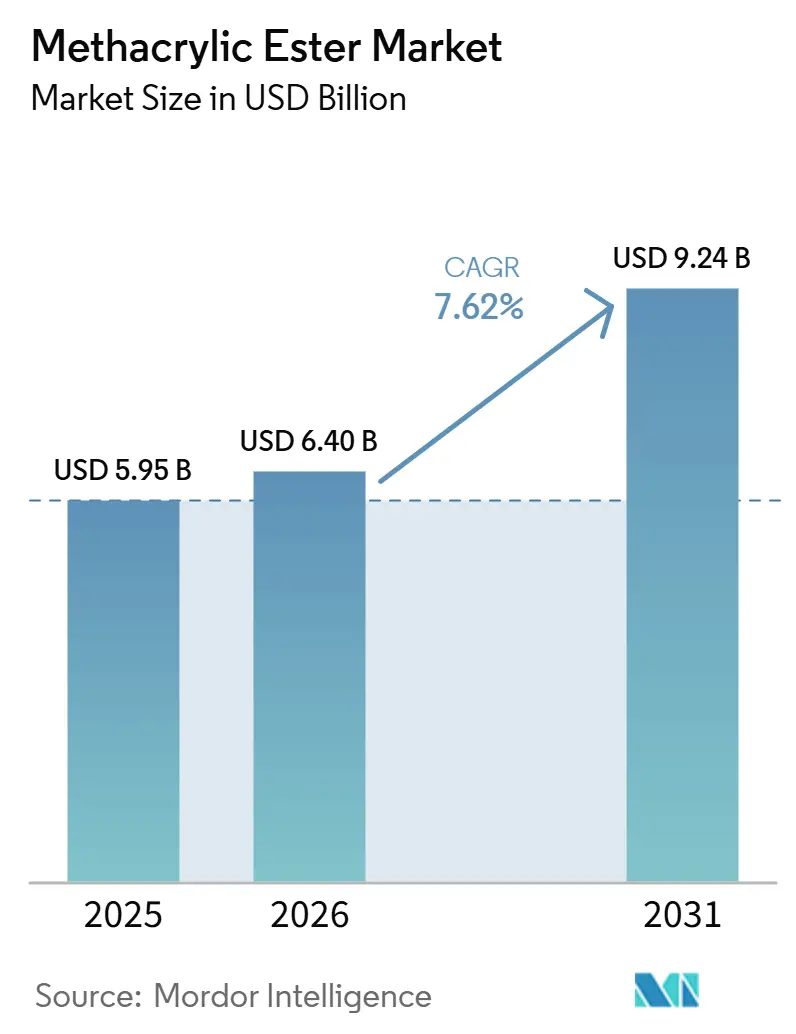
The Methacrylic Ester Market size is expected to grow from USD 5.95 billion in 2025 to USD 6.40 billion in 2026 and is forecast to reach USD 9.24 billion by 2031 at 7.62% CAGR over 2026-2031. The methacrylic ester market is supported by construction activity in developing economies, changes in electric vehicle design, and the growing use of specialty esters in electronics and healthcare manufacturing. Integrated capacity in Asia-Pacific supports the market through local consumption and exports to downstream manufacturers. Producers are shifting investment toward higher-purity grades, as these products address demanding applications in semiconductor packaging, optical materials, and healthcare products. Competition in the commodity methyl methacrylate market is rising as Asian producers add capacity, placing greater emphasis on specialized products and on securing established customer approvals. Low-carbon production routes are also shaping purchasing decisions as automotive and construction buyers address supply chain emissions.
Key Report Takeaways
- By type, methyl methacrylate held 39.43% of the Methacrylic Ester Market share in 2025, while cyclohexyl methacrylate is forecast to grow at an 8.21% CAGR through 2031.
- By manufacturing process, the Acetone Cyanohydrin (ACH) route held 56.81% of the Methacrylic Ester Market share in 2025, while the C4 route is projected to grow at an 8.47% CAGR through 2031.
- By application, paints and coatings accounted for 41.85% of the Methacrylic Ester Market size in 2025, while adhesives and sealants are expected to expand at an 8.36% CAGR through 2031.
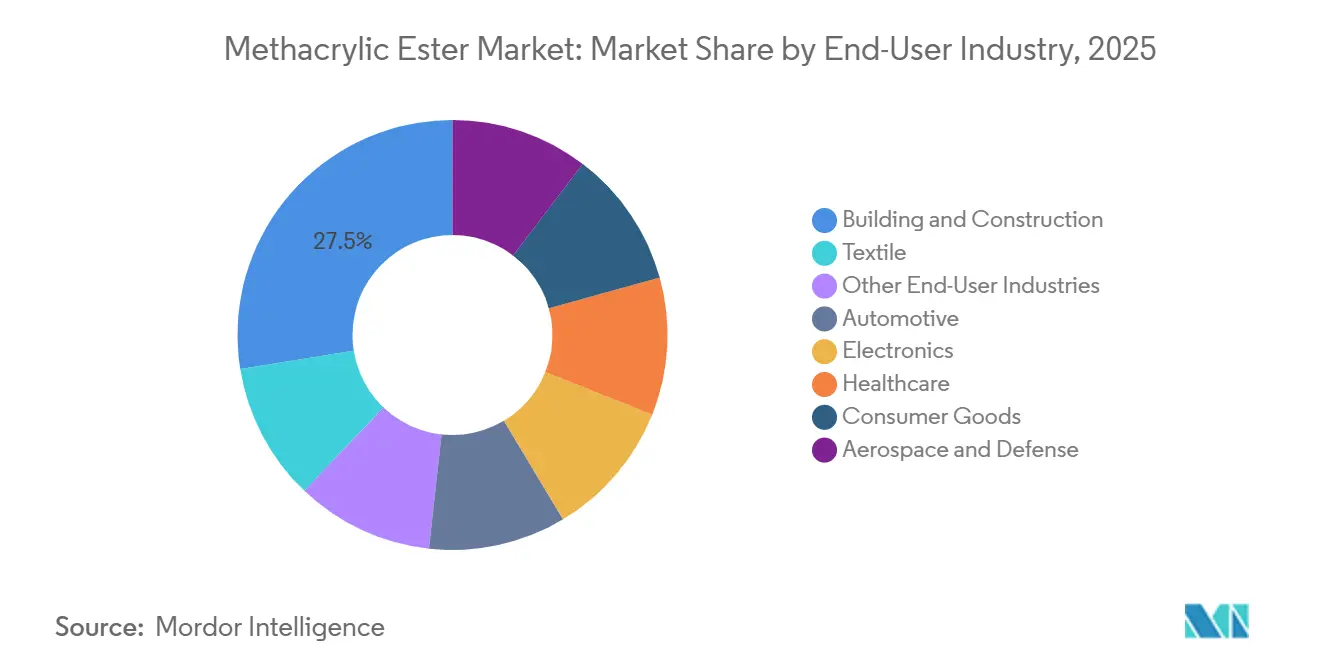
- By end-user industry, building and construction held 27.53% of revenue in 2025, while electronics is forecast to record an 8.58% CAGR through 2031.
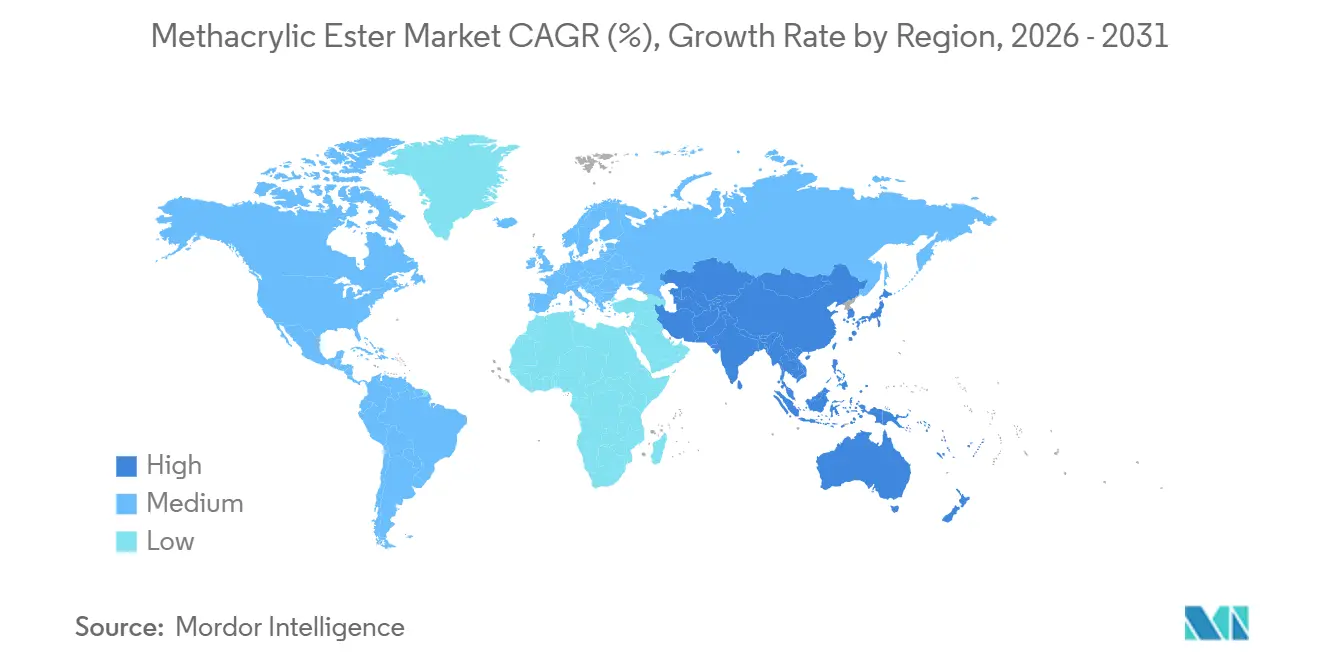
- By geography, Asia-Pacific accounted for 46.33% of revenue in 2025 and is forecast to grow at an 8.18% CAGR through 2031.
Note: Market size and forecast figures in this report are generated using Mordor Intelligence’s proprietary estimation framework, updated with the latest available data and insights as of January 2026.
Market Trends and Insights
Drivers Impact Analysis of Methacrylic Ester Market*
| Drivers | (~) % Impact on CAGR Forecast | Geographic Relevance | Impact Timeline |
|---|---|---|---|
| Demand in Automotive Lightweight Components and Advanced Acrylic Applications | +2.2% | Global, concentrated in China, Germany, the United States, Japan, and South Korea | Medium term (2-4 years) |
| Adoption in High-Performance Coatings, Adhesives, and Sealants | +1.8% | Global, strongest in North America, Europe, and the Asia-Pacific | Medium term (2-4 years) |
| Use in Electronics, Optical Materials, and Healthcare Applications | +1.6% | Asia-Pacific core, with demand in China, South Korea, Japan, Taiwan, and North America | Short term (≤ 2 years) |
| Production Technology, Efficiency, and Sustainable Product Development | +1.0% | North America, Europe, and the Asia-Pacific | Long term (≥ 4 years) |
| Demand for Sustainable and Bio-Based Methacrylic Ester Products | +0.5% | Europe and North America | Long term (≥ 4 years) |
| Source: Mordor Intelligence | |||
Growing Demand in Automotive Lightweight Components and Advanced Acrylic Applications
Methacrylic esters serve automotive applications in transparent acrylic parts and structural adhesive systems. Poly(methyl methacrylate) (PMMA) is used in lidar covers, panoramic roofs, headlamp optics, and other components that require optical clarity at a lower weight than glass. Structural methyl methacrylate adhesives bond aluminum and carbon-fiber composites without the stress concentrations caused by mechanical fasteners. Electric vehicle battery enclosures are subject to repeated temperature swings from -40°C to 85°C, which favors crosslinked adhesive systems with thermal and chemical resistance. The shift from mechanical assembly to structural bonding increases the methacrylic ester content per vehicle, even as overall vehicle production grows more slowly. This automotive demand is expanding the Methacrylic Ester Market beyond traditional glazing and lighting applications.
Increasing Adoption in High-Performance Coatings, Adhesives, and Sealants
Coatings formulators are replacing solvent-borne binders with waterborne and high-solids methacrylic systems as emission requirements tighten. The U.S. Environmental Protection Agency finalized amendments to its aerosol-coating volatile organic compound (VOC) standards in January 2025, with compliance required by January 17, 2027[1]U.S. Environmental Protection Agency, “Aerosol Coatings: National Volatile Organic Compound Emission Standards,” U.S. Environmental Protection Agency, epa.gov. Methacrylic reactive diluents and binder monomers enable waterborne and UV-curable formulations that maintain outdoor durability and gloss retention, supporting their use in architectural coatings and automotive refinish products. Prefabricated construction in India and Southeast Asia is also shifting from wet-set bonding toward fast-cure structural adhesives. This change supports the Methacrylic Ester Market, as modular construction benefits from shorter bonding cycles and stronger joints.
Expanding Use in Electronics, Optical Materials, and Healthcare Applications
Electronics is the fastest-growing end-user category, supported by changes in semiconductor packaging. Flip-chip and wafer-level packaging require encapsulants with low dielectric constants, low outgassing, and compatible thermal expansion. Cyclohexyl methacrylate provides low water absorption, thermal stability, and a low dielectric constant for these applications. The same material supports UV-curable optical resins, organic light-emitting diode (OLED) display adhesives, and conformal coatings for printed circuit boards. The expansion of 5G infrastructure increases the surface area requiring protective conformal coatings. Healthcare also uses biocompatible methacrylic materials in dental composites, bone cement, and controlled-release drug delivery systems, although qualification requirements remain a consideration.
Advancements in Production Technologies Enhancing Manufacturing Efficiency and Product Quality
Production technology is changing how producers compete in the Methacrylic Ester Market. Röhm began production using its LiMA C2-based technology at Bay City, Texas, in March 2025. The process uses ethylene, natural gas, and methanol instead of hydrogen cyanide and sulfuric acid. Röhm states that the 250,000 t/year facility reached full industrial-scale operation in 2026 and has reduced CO2 emissions by up to 42% compared with conventional acetone cyanohydrin (ACH) production. Chinese producers are also expanding C4 oxidative esterification capacity, avoiding hydrogen cyanide and reducing the need to dispose of ammonium sulfate. A 2026 scientific study found that biomass-derived ethylene used in a C2 route could produce negative lifecycle emissions compared with conventional MMA production.
Restraints Impact Analysis of Methacrylic Ester Market*
| Restraints | (~) % Impact on CAGR Forecast | Geographic Relevance | Impact Timeline |
|---|---|---|---|
| Raw Material Price Volatility and Supply Chain Disruptions | -1.5% | Global, with propylene exposure in North America and isobutylene and acetone exposure in Asia | Short term (≤ 2 years) |
| Environmental, VOC, and Chemical Safety Regulations | -0.8% | Europe, North America, and China | Medium term (2-4 years) |
| Competition from Alternative Polymer and Resin Technologies | -0.6% | North America and Europe | Long term (≥ 4 years) |
| Source: Mordor Intelligence | |||
Volatility in Raw Material Prices and Supply Chain Disruptions
Acetone Cyanohydrin (ACH)-route production is exposed to cycles in propylene and acetone prices. Acetone is derived from cumene, which is itself a propylene derivative, so upstream changes can affect several stages of the value chain. The C4 route has a different exposure, as isobutylene prices are linked to crude oil conditions. No major production method is fully insulated from feedstock price changes. Production is concentrated in China, Singapore, and several Gulf Coast locations, which can tighten regional spot supply following an outage. Specialty grades are particularly exposed because the number of qualified replacement suppliers is limited.
Stringent Environmental, Volatile Organic Compound (VOC), and Chemical Safety Regulations
ACH facilities must manage ammonium sulfate by-products in accordance with increasingly stringent waste regulations in Europe and China. Registration, Evaluation, Authorization, and Restriction of Chemicals (REACH) requirements and evolving Chinese volatile organic compound (VOC) standards require investments in reformulation, emissions documentation, and supply chain traceability. These costs tend to weigh more heavily on smaller specialty producers that lack dedicated regulatory resources. VOC limits for finished coatings and waste disposal rules for production sites can narrow margins at older facilities. Compliance with standards in advanced markets remains important for access to automotive and architectural original equipment manufacturer (OEM) supply chains. Alternative polymer and resin technologies compete in selected applications when changes in price, compliance cost, or product performance influence buyer decisions.
*Our forecasts treat driver/restraint impacts as directional, not additive. The impact forecasts reflect baseline growth, mix effects, and variable interactions.
Methacrylic Ester Market Segment Analysis
By Type:
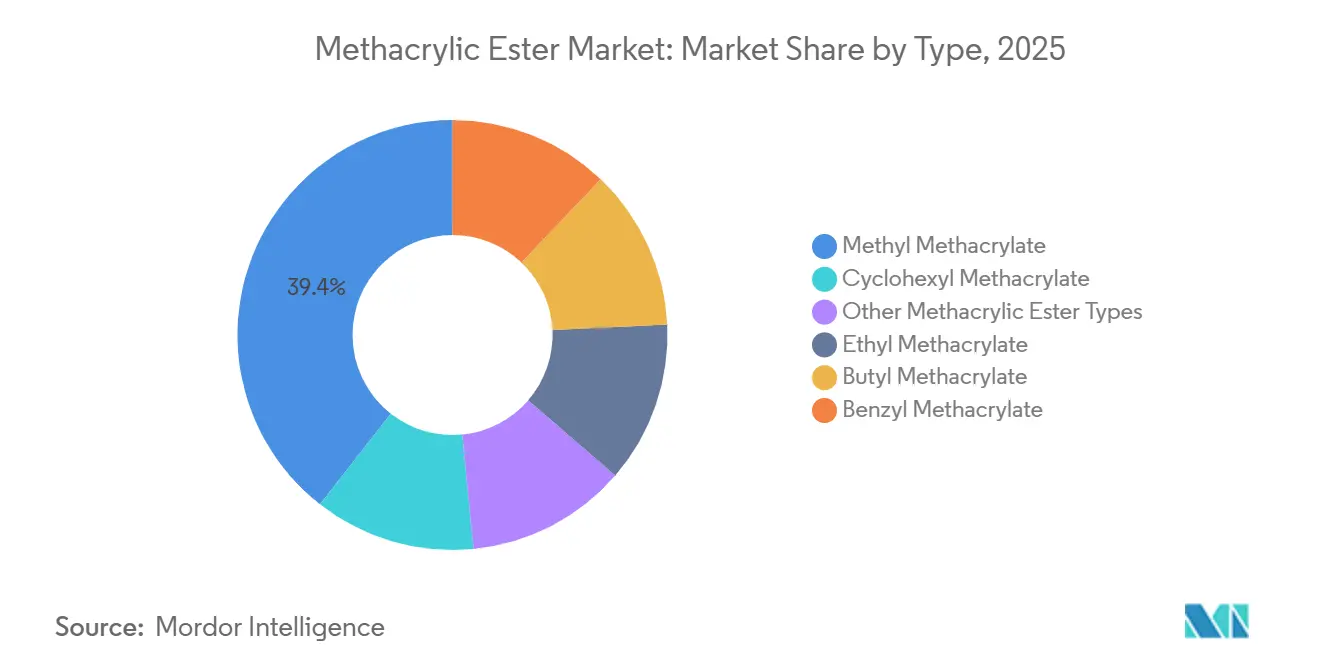
Specialty Esters Outperform Commodity MMACyclohexyl methacrylate is forecast to grow at an 8.21% CAGR through 2031, the highest rate among type categories. Its low dielectric constant, low water absorption, UV stability, and optical clarity support its use as an encapsulant in electronics and as a UV-curable optical resin. These properties also make it suitable for clear coats, organic light-emitting diode (OLED) display adhesives, and conformal coatings. Demand benefits from applications where product qualification creates a barrier to substitution. Commodity methyl methacrylate faces greater pressure from additional Asian capacity. By contrast, cyclohexyl and benzyl methacrylate can command higher prices in applications that require precise performance specifications. NOF Corporation invested JPY 10 billion (USD 66 million) in new manufacturing facilities at Aichi Works, which began operations in 2025[2]NOF Corporation, “Integrated Report 2025,” NOF Corporation, nof.co.jp. The investment supports the production of (meth)acrylic acid derivatives for electronics and life sciences applications.
Methyl methacrylate held 39.43% of 2025 revenue. It remains important as the monomer for poly(methyl methacrylate) (PMMA) used in optical sheets, signage, sanitary ware, and automotive glazing. Ethyl methacrylate and butyl methacrylate are used for textile finishing, paper sizing, and general-purpose copolymer binders. These categories serve established end uses and are growing more slowly as mature end markets in developed economies level off. Benzyl methacrylate has a more focused role in specialty optical polymers and hair-care chemistry. Producers can improve portfolio resilience by increasing specialty capacity with verified purity profiles, which can improve margins and support longer customer contracts.



By Manufacturing Process:
C4 and Ethylene Routes Challenge Acetone Cyanohydrin (ACH) DominanceThe ACH route held 56.81% of 2025 revenue. Mature plants in Europe, Japan, and North America benefit from established equipment and existing customer qualifications. Continued use of the route depends on access to hydrogen cyanide through acrylonitrile production and on reliable management of by-products. Kuraray announced in June 2024 that it would optimize capacity at its ACH-based MMA plant and stop external MMA sales from July 2025. This move reflected pressure on smaller ACH facilities in the methacrylic ester market outside the lowest-cost production tier. Operators that cannot manage hydrogen cyanide supply or ammonium sulfate disposal costs face a more difficult commodity position. The methacrylic ester market continues to rely on ACH capacity, but its role is changing as alternative routes expand.
The C4 route is forecast to grow at a CAGR of 8.47% from 2026 to 2031. New capacity in China accesses refinery C4 streams and avoids the sulfuric acid waste associated with ACH production. The ethylene route remains a smaller part of the supply, but it is strategically important because it changes the production mix and environmental profile. Röhm GmbH's Bay City facility operates at 250,000 t/year and eliminates hydrogen cyanide from the production chain. In April 2025, Mitsubishi Chemical Group stated that its Kyushu-Fukuoka derivatives plant would begin commercial operations in March 2026, adding 1,100 t/year of specialty methacrylate derivative capacity. Investment in derivatives rather than commodity monomers reflects the importance of product differentiation.
By Application:
Adhesives and Sealants Redefine Growth BenchmarksAdhesives and sealants are forecast to grow at an 8.36% CAGR through 2031, the fastest rate among application categories. Structural adhesives are used in the assembly of electric vehicle batteries, prefabricated construction, and electronics manufacturing. In electric vehicles, they bond battery cells to modules, attach composite body panels, and protect power electronics during wide temperature changes. These requirements favor fast-cure, high-strength methacrylic systems over lower-performing alternatives. Demand for adhesives and sealants benefits from the shift away from welding and mechanical fastening. Coating reformulation also creates related demand for reactive diluents in waterborne and high-solids systems. This combination broadens demand in the methacrylic ester market beyond a single end-use category, and producers with technical application support are better positioned to serve these uses.
Paints and coatings accounted for 41.85% of revenue in 2025. Exterior architectural coatings and automotive original-equipment manufacturer topcoats use methacrylic copolymers for weather resistance and a durable finish. Waterborne, high-solids, and UV-curable formulations can incorporate methacrylic ingredients while reducing dependence on conventional solvent systems. Plastics and polymers applications use these materials in PMMA optical sheets, molding compounds, and other specialty products that require high light transmission, low haze, consistent molecular weight, and documented purity. UV-curable inks benefit from inkjet printing in digital packaging and commercial printing. Textile finishes remain stable, while paper-processing demand faces pressure from lower paper-media use in developed economies, partially offset by packaging demand in Asia.
By End-user Industry:
Electronics Grow Fastest as Construction Drives DemandElectronics is forecast to grow at an 8.58% CAGR from 2026 to 2031, the highest rate among end-user industries. Semiconductor packaging requires underfill resins and encapsulants with controlled dielectric behavior, low outgassing, and matched thermal expansion. Cyclohexyl and benzyl methacrylate are suitable monomers for these applications. Fifth-generation communications infrastructure is also driving demand for conformal coatings on denser printed circuit boards. AI server deployment supports demand for potting compounds that protect power electronics in high-temperature environments. These uses favor methacrylic ester market producers that can supply ultra-high-purity material and maintain certified supply chains. Electronics manufacturers value consistency and technical support over commodity supply, creating a margin opportunity for producers that meet these requirements.
Building and construction held 27.53% of end-user revenue in 2025. Infrastructure activity in India, Southeast Asia, and Gulf Cooperation Council member states supports PMMA glazing, waterproof coatings, and construction-grade sealants, which are particularly useful in tropical and high-UV environments. Automotive demand for PMMA remains supported by its use in headlamps, taillights, and light guides, with structural adhesives further expanding its automotive use in composite-body assembly and battery enclosures. Healthcare growth is steadier, as dental, bone-cement, and drug-delivery applications require ISO 10993 and FDA 510(k) qualification processes. Consumer goods use PMMA in display fixtures, sanitaryware, and personal-care products.
Geography Analysis
APAC Methacrylic Ester Market
Asia-Pacific accounted for 46.33% of 2025 revenue and is forecast to grow at a CAGR of 8.18% through 2031. China combines MMA production with downstream PMMA fabrication for construction glazing, electronics displays, and automotive panels. India is developing demand through urban development, metro rail expansion, and additions to pharmaceutical capacity. Japan faces pressure in commodity acetone cyanohydrin (ACH) production, while optical and dental-grade materials retain a specialized role. South Korea supports demand through semiconductor and display manufacturing, where high-purity monomers are used for organic light-emitting diode (OLED) bonding and conformal coatings.
North America and Europe Methacrylic Ester Market
North America and Europe are mature regions where premium applications support value growth. Röhm expects its Bay City plant to operate at full industrial scale from 2026, adding 250,000 tons per year of C2-based MMA capacity in the United States. The facility is expected to reduce North America’s dependence on imports and provide a lower-carbon supply option for coatings and PMMA sheet manufacturers. Europe’s methacrylic ester market includes producers such as Röhm, Evonik, and Arkema, which use Registration, Evaluation, Authorization, and Restriction of Chemicals (REACH) documentation and customer approvals to serve demanding applications. In these regions, specialty grades drive value growth more than large-scale commodity expansion.
MEA and South America Methacrylic Ester Market
South America, the Middle-East, and Africa have earlier-stage demand profiles. Brazil supports demand for methacrylic esters in construction coatings, automotive refinish products, and adhesives. Saudi Arabia's Vision 2030 development program supports demand for coatings, architectural sealants, and specialty materials. South Africa is the main African center of demand for methacrylic esters in coatings and adhesives.

Competitive Landscape
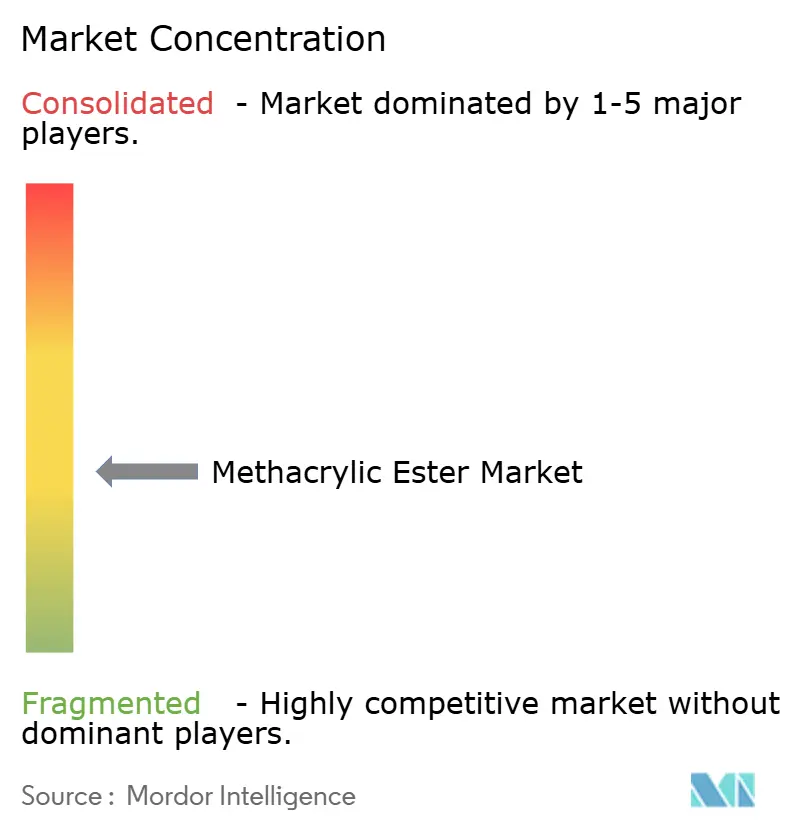
The methacrylic ester market is moderately fragmented. Röhm, Mitsubishi Chemical Group Corporation, Evonik, and BASF hold positions through integrated MMA supply, proprietary processes, and long-standing customer approvals. Asian producers are increasing price pressure on the commodity MMA market, prompting established companies to reduce commodity exposure and expand specialty offerings for electronics, electric vehicles, and healthcare applications. Evonik's VISIOMER portfolio comprises more than 50 specialty monomer grades for medical, electronic, and advanced-coating applications.
Röhm opened its Bay City MMA facility at full industrial scale in June 2026. This added C2-based capacity that uses a different feedstock path and lowers stated emissions compared with conventional acetone cyanohydrin (ACH) production. Kuraray stopped external MMA sales from July 2025, reducing its participation in the commodity supply chain. Mitsubishi Chemical Group has shifted investment toward specialty derivatives at Kyushu-Fukuoka rather than bulk MMA. These developments indicate that the methacrylic ester market is moving toward application-specific products and cleaner production routes across its value chain.
Ultra-high-purity cyclohexyl and benzyl methacrylate for semiconductor packaging and OLED bonding represent opportunities in the market. Japanese producers such as Osaka Organic Chemical Industry and NOF hold qualification advantages in specialty supply. A 2026 RSC Advances study reported successful photopolymerization of a glucose-derived methacrylate monomer with MMA. Producers that combine certified low-carbon supply with high-purity performance are positioned to address both technical and procurement requirements in the methacrylic ester market.
Methacrylic Ester Industry Leaders
Mitsubishi Chemical Corporation
BASF
Dow
Evonik Industries AG
LG Chem
- *Disclaimer: Major Players sorted in no particular order
Methacrylic Ester Market Companies Covered in this Report
- Arkema
- BASF
- Dow
- Evonik Industries AG
- Hexion Inc.
- Kuraray Co., Ltd.
- LG Chem
- Mitsubishi Chemical Corporation
- Nippon Shokubai Co., Ltd.
- NOF CORPORATION
- Osaka Organic Chemical Industry Ltd.
- Röhm GmbH
- Sumitomo Chemical Co., Ltd.
- TOAGOSEI CO.,LTD.
- Trinseo
- U-PICA Company, Ltd.

Recent Industry Developments in Methacrylic Ester Market
- June 2026: Röhm GmbH opened its Bay City, Texas, MMA plant at full industrial-scale operation using its proprietary LiMA C2-based technology. The 250,000 t/year facility reduces CO2 emissions by up to 42% compared to conventional ACH-route production. It is North America's only C2-based MMA facility, repositioning Röhm's supply chain strategy for US and export markets.
- January 2025: Mitsubishi Chemical Group terminated its previously announced plan to construct a 350,000 t/year greenfield MMA plant in Geismar, Louisiana, citing project economics and the reallocation of resources to optimize its global production platform.


Global Methacrylic Ester Market Report Scope
A methacrylic ester (or methacrylate) is a chemical compound formed from methacrylic acid and an organic alcohol group. It contains a reactive double bond that enables it to form rigid, durable acrylic plastics and resins.
The methacrylic ester market is segmented by type, manufacturing process, application, end-user industry, and geography. By type, the market is segmented into methyl methacrylate, ethyl methacrylate, butyl methacrylate, benzyl methacrylate, cyclohexyl methacrylate, and other methacrylic ester types. By manufacturing process, the market is segmented into ACH route, C4 route, ethylene route, and other processes. By application, the market is segmented into paints and coatings, adhesives and sealants, plastics and polymers, printing inks, textiles, paper processing, and other applications. By end-user industry, the market is segmented into automotive, building and construction, electronics, healthcare, consumer goods, aerospace and defense, textile, and other end-user industries. The report also covers the market size and forecasts for methacrylic ester in 16 countries across major regions. The market sizes and forecasts are provided in terms of value (USD).
| Methyl Methacrylate |
| Ethyl Methacrylate |
| Butyl Methacrylate |
| Benzyl Methacrylate |
| Cyclohexyl Methacrylate |
| Other Methacrylic Ester Types |
| ACH Route |
| C4 Route |
| Ethylene Route |
| Other Processes |
| Paints and Coatings |
| Adhesives and Sealants |
| Plastics and Polymers |
| Printing Inks |
| Textiles |
| Paper Processing |
| Other Applications |
| Automotive |
| Building and Construction |
| Electronics |
| Healthcare |
| Consumer Goods |
| Aerospace and Defense |
| Textile |
| Other End-User Industries |
| Asia-Pacific | China |
| India | |
| Japan | |
| South Korea | |
| Rest of Asia-Pacific | |
| North America | United States |
| Canada | |
| Mexico | |
| Europe | Germany |
| United Kingdom | |
| France | |
| Italy | |
| Russia | |
| Rest of Europe | |
| South America | Brazil |
| Argentina | |
| Rest of South America | |
| Middle-East and Africa | Saudi Arabia |
| South Africa | |
| Rest of Middle-East and Africa |
| By Type | Methyl Methacrylate | |
| Ethyl Methacrylate | ||
| Butyl Methacrylate | ||
| Benzyl Methacrylate | ||
| Cyclohexyl Methacrylate | ||
| Other Methacrylic Ester Types | ||
| By Manufacturing Process | ACH Route | |
| C4 Route | ||
| Ethylene Route | ||
| Other Processes | ||
| By Application | Paints and Coatings | |
| Adhesives and Sealants | ||
| Plastics and Polymers | ||
| Printing Inks | ||
| Textiles | ||
| Paper Processing | ||
| Other Applications | ||
| By End-User Industry | Automotive | |
| Building and Construction | ||
| Electronics | ||
| Healthcare | ||
| Consumer Goods | ||
| Aerospace and Defense | ||
| Textile | ||
| Other End-User Industries | ||
| By Geography | Asia-Pacific | China |
| India | ||
| Japan | ||
| South Korea | ||
| Rest of Asia-Pacific | ||
| North America | United States | |
| Canada | ||
| Mexico | ||
| Europe | Germany | |
| United Kingdom | ||
| France | ||
| Italy | ||
| Russia | ||
| Rest of Europe | ||
| South America | Brazil | |
| Argentina | ||
| Rest of South America | ||
| Middle-East and Africa | Saudi Arabia | |
| South Africa | ||
| Rest of Middle-East and Africa | ||


Key Questions Answered in the Report
What is current market size of Methacrylic Ester Market?
The Methacrylic Ester Market size is expected to grow from USD 5.95 billion in 2025 to USD 6.40 billion in 2026 and is forecast to reach USD 9.24 billion by 2031 at 7.62% CAGR over 2026-2031.
Which type is expected to grow fastest through 2031?
Cyclohexyl methacrylate is forecast to grow at an 8.21% CAGR, supported by electronic encapsulants and UV-curable optical resins.
Which application has the highest forecast growth?
Adhesives and sealants are projected to grow at an 8.36% CAGR through 2031, supported by applications in electric vehicles, construction, and electronics.
Why is electronics important for methacrylic ester demand?
Electronics are forecast to grow at an 8.58% CAGR as semiconductor packaging, 5G equipment, and high-reliability power electronics need specialized materials.
Page last updated on:





