
Metal-Organic Frameworks (MOFs) Market Size and Share
Market Overview
| Study Period | 2021 - 2031 |
|---|---|
| Market Size (2026) | USD 122.65 Million |
| Market Size (2031) | USD 318.91 Million |
| Growth Rate (2026 - 2031) | 21.06 % |
| Fastest Growing Market | North America |
| Largest Market | Asia-Pacific |
| Market Concentration | Medium |
Major Players *Disclaimer: Major Players sorted in no particular order Image © Mordor Intelligence. Reuse requires attribution under CC BY 4.0. | |
Metal-Organic Frameworks (MOFs) Market Analysis by Mordor Intelligence
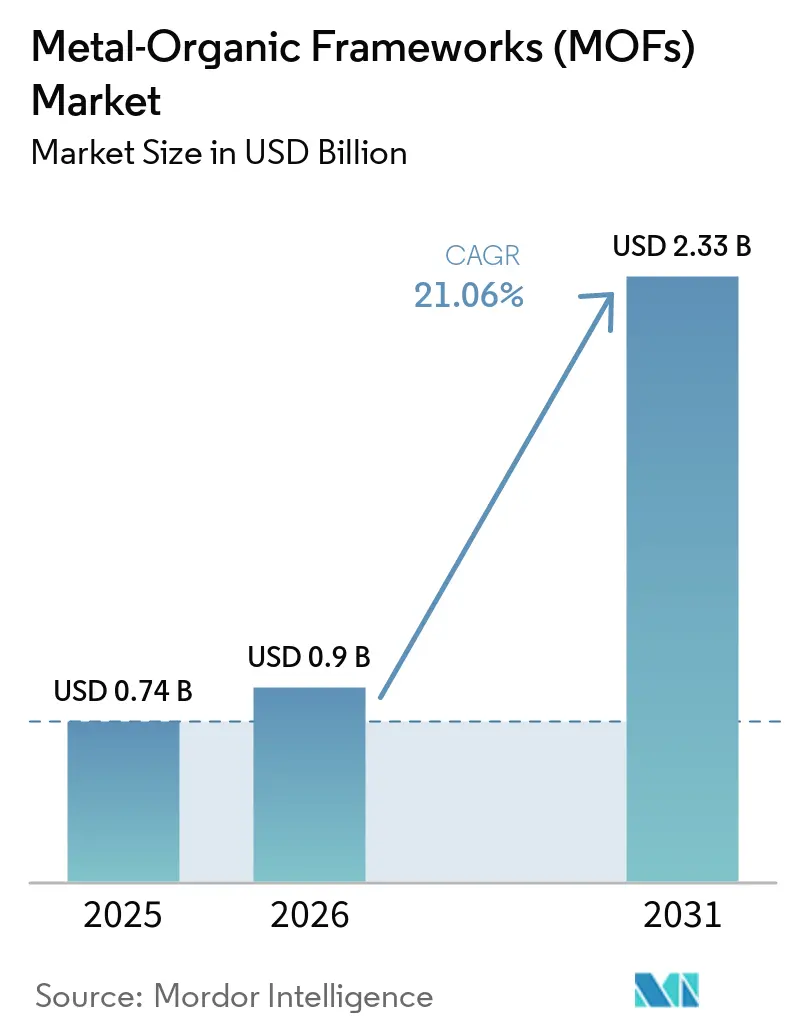
The Metal-Organic Frameworks Market size is expected to increase from USD 103.94 million in 2025 to USD 122.65 million in 2026 and reach USD 318.91 million by 2031, at a CAGR of 21.06% over 2026-2031. Carbon capture, industrial gas purification, and semiconductor gas delivery are creating demand for materials that can separate gases with high selectivity. Metal-organic frameworks have tunable pores and surface areas that can exceed 6,000 square meters per gram, which supports their use in separation and storage systems. The metal-organic frameworks (MOFs) market is moving beyond laboratory powder production as suppliers develop coated filters, pellets, and membrane formats for industrial use. Manufacturers are focusing on scalable synthesis, stable material performance, and application-specific formulations because buyers require proven results under operating conditions. The 2025 Nobel Prize in Chemistry for the development of metal-organic frameworks increased public attention on the field, while commercial projects continue to determine the pace of adoption.
Key Report Takeaways
- By product type, Copper-Based MOFs held 38.42% of the metal-organic frameworks (MOFs) market share in 2025, while Zinc-Based MOFs are projected to advance at a 22.34% CAGR through 2031.
- By form, powder held 61.08% of revenue in 2025, while membranes and thin films are projected to advance at a 24.83% CAGR through 2031.
- By synthesis method, solvothermal and hydrothermal synthesis held 55.47% of the metal-organic frameworks (MOFs) market share in 2025 and are projected to advance at a 25.06% CAGR through 2031.
- By application, gas storage and separation held 34.51% of the metal-organic frameworks (MOFs) market share in 2025, while carbon capture is projected to advance at a 24.43% CAGR through 2031.
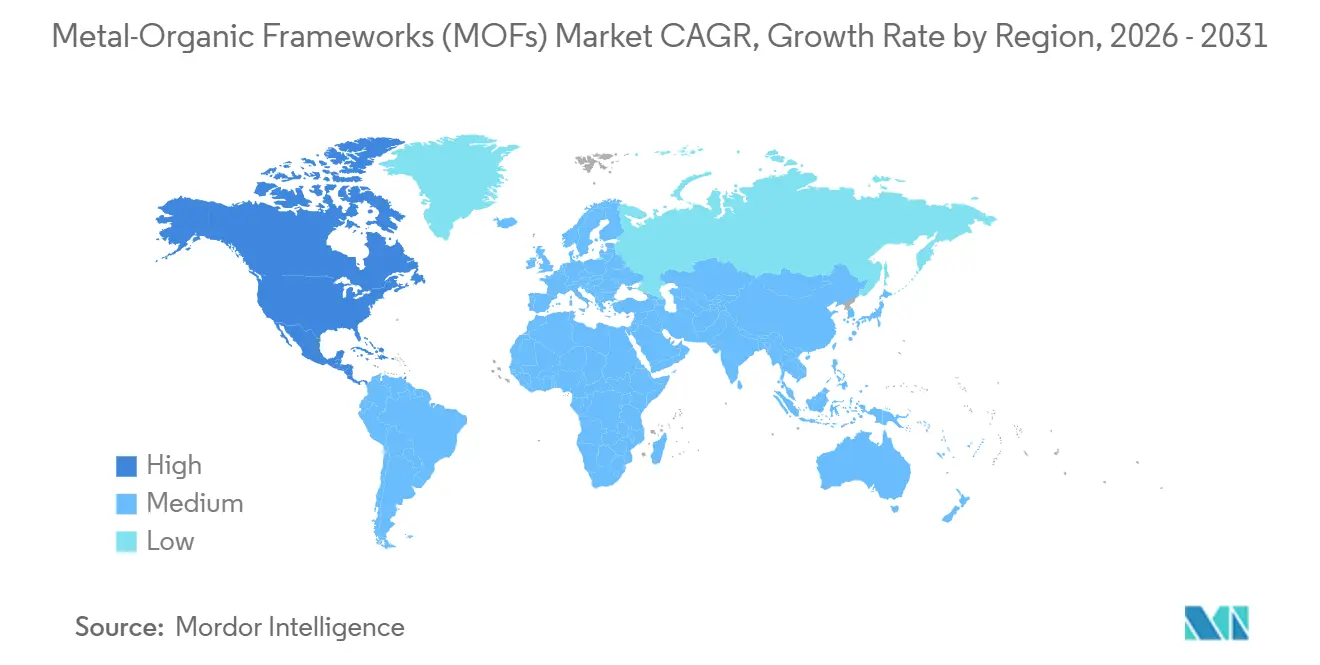
- By geography, Asia-Pacific held 35.04% of the metal-organic frameworks (MOFs) market share in 2025, while North America is projected to advance at a 22.81% CAGR through 2031.
Note: Market size and forecast figures in this report are generated using Mordor Intelligence’s proprietary estimation framework, updated with the latest available data and insights as of January 2026.
Market Trends and Insights
Drivers Impact Analysis of Metal-Organic Frameworks (MOFs) Market*
| Driver | (~) % Impact on CAGR Forecast | Geographic Relevance | Impact Timeline |
|---|---|---|---|
| Carbon Capture and Industrial Decarbonization Deployment | +4.8% | Global, concentrated in North America and EU | Short term (≤ 2 years) |
| Energy-Efficient Gas Separation and Purification | +4.2% | Global (APAC core, North America, Europe) | Short term (≤ 2 years) |
| Hydrogen and Alternative Gas Storage Qualification | +3.6% | Europe, North America, Japan, South Korea | Medium term (2-4 years) |
| Semiconductor Toxic-Gas Safety and Yield Requirements | +2.9% | APAC core (Taiwan, South Korea, Japan), North America | Short term (≤ 2 years) |
| AI-Assisted Discovery and Application-Specific MOF Design | +2.4% | North America, Europe, APAC | Medium term (2-4 years) |
| Water Scarcity and Low-Energy Atmospheric Water Harvesting | +1.8% | Middle East, South Asia, arid APAC, global spill-over | Medium term (2-4 years) |
| Source: Mordor Intelligence | |||
Carbon Capture and Industrial Decarbonization Deployment
Carbon pricing, net-zero commitments, and improving sorbent economics are supporting demand for the metal-organic frameworks (MOFs) market. Metal-organic framework solid-sorbent systems can require less regeneration energy than liquid amine alternatives and can avoid moisture-removal pretreatment for a wet flue-gas stream. This makes them relevant to cement kilns, boilers, and ethanol fermenters. Svante Technologies commissioned its Redwood facility in Burnaby, British Columbia, in May 2025, with the capacity to supply filters supporting 10 million metric tons of annual carbon dioxide capture. Kobe Steel, Atomis, and Nagase & Co. completed Japan’s first practical-scale metal-organic framework carbon dioxide capture demonstration at 30 kilograms per day in April 2026 and are planning a metric-ton-scale test in fiscal 2026. These projects are shifting procurement attention from materials testing toward dependable filter supply and operating performance within the metal-organic frameworks (MOFs) market.
Energy-Efficient Gas Separation and Purification
The metal-organic frameworks (MOFs) market benefits from the need to reduce energy use in gas separation and purification. Multivariate aluminum-based frameworks demonstrated both carbon dioxide capacity and methane selectivity, addressing a constraint for earlier porous solids. A 2026 study demonstrated continuous roll-to-roll manufacture of quasi-pure ZIF-67 membranes containing more than 90% metal-organic framework by volume. The membranes achieved separation performance across propylene and propane, ethylene and ethane, and carbon dioxide and nitrogen. Copper-based materials such as HKUST-1 have established carbon dioxide and nitrogen selectivity, but they must maintain this performance in humid gas streams with trace contaminants. Numat Technologies has demonstrated sub-atmospheric gas delivery systems for ultra-high-purity specialty gases, showing that this use case has commercial relevance within the metal-organic frameworks (MOFs) market.
Hydrogen and Alternative Gas Storage Qualification
Hydrogen and alternative gas storage qualification can broaden end uses for the metal-organic frameworks (MOFs) market. Nickel-based frameworks achieved a hydrogen gravimetric capacity of 3.7 wt% while also supporting catalytic carbon dioxide cycloaddition. Flexible zinc-dipyrazolate materials achieved a methane storage working capacity of 225 cubic centimeters at standard temperature and pressure per cubic centimeter at 298 kelvin. Bimetallic zirconium and hafnium UiO-66 variants also showed hydrogen adsorption gains over single-metal materials. Promethean Particles shipped 4 metric tons of metal-organic frameworks to a European energy-storage customer in November 2025. Commercial volumes are likely to remain concentrated in natural gas and propylene and propane storage while hydrogen systems complete qualification in the metal-organic frameworks (MOFs) market.
AI-Assisted Discovery and Application-Specific MOF Design
Artificial intelligence-assisted development is changing how new candidates enter the metal-organic frameworks (MOFs) market. Large language models, diffusion algorithms, and high-throughput synthesis can reduce the time required to move from a reticular chemistry concept to a synthesized candidate. IBM Research presented a Granite large language model framework at NeurIPS 2025 to improve property prediction when data is limited. Computational design can tune pore dimensions and assess water stability before synthesis. An ensemble model for atmospheric water harvesting achieved an R-squared value of 0.95 against external frameworks using 88 experimental isotherms. Experimental validation and industrial qualification remain necessary because predicted materials still require multi-cycle performance data in the metal-organic frameworks (MOFs) market.
Restraints Impact Analysis of Metal-Organic Frameworks (MOFs) Market*
| Restraint | (~) % Impact on CAGR Forecast | Geographic Relevance | Impact Timeline |
|---|---|---|---|
| High Cost of Linkers, Solvents, and Controlled Processing | -3.8% | Global | Short term (≤ 2 years) |
| Moisture and Harsh-Condition Stability Gaps | -3.2% | Global (especially North America and European industrial) | Medium term (2-4 years) |
| Powder Forming and Performance-Retention Difficulty | -2.7% | Global (APAC core, Europe) | Medium term (2-4 years) |
| Qualification, Compliance, and Scale-Up Proof Burden | -2.1% | North America, EU | Long term (≥ 4 years) |
| Source: Mordor Intelligence | |||
High Cost of Linkers, Solvents, and Controlled Processing
High material and processing costs continue to limit wider adoption in the metal-organic frameworks (MOFs) market. Carboxylate-based ligands and nitrogen-heterocycle compounds account for a major share of the synthesis cost for high-performance materials. High-boiling solvents such as dimethylformamide also create waste-treatment requirements. The cost reduction achieved by AirJoule and BASF shows that industrial engineering can improve economics for selected frameworks. That experience does not yet apply across most framework compositions, where specialty linker prices remain high. New entrants buying research-grade inputs, therefore, face a cost disadvantage until they secure larger procurement partnerships.
Moisture and Harsh-Condition Stability Gaps
Moisture stability remains a central technical constraint for the metal-organic frameworks (MOFs) market. Copper-based HKUST-1 and zinc-based isoreticular metal-organic frameworks (IRMOFs) can degrade under humid conditions, which limits their use in direct air capture, wet flue-gas purification, and water treatment. A 2026 study found that water can destabilize certain frameworks through metal-ligand bond cleavage while stabilizing others through hydrogen-bond networks. Machine-learning models can screen for water stability, but industrial use still requires multi-cycle testing. Zirconium-based UiO-66 demonstrated steam stability for 7 days at temperatures up to 200 degrees Celsius, although its linker costs limit broad substitution. Buyers for critical applications consequently favor the limited group of frameworks supported by long-duration stability evidence.
*Our forecasts treat driver/restraint impacts as directional, not additive. The impact forecasts reflect baseline growth, mix effects, and variable interactions.
Metal-Organic Frameworks (MOFs) Market Segment Analysis
By Product Type:
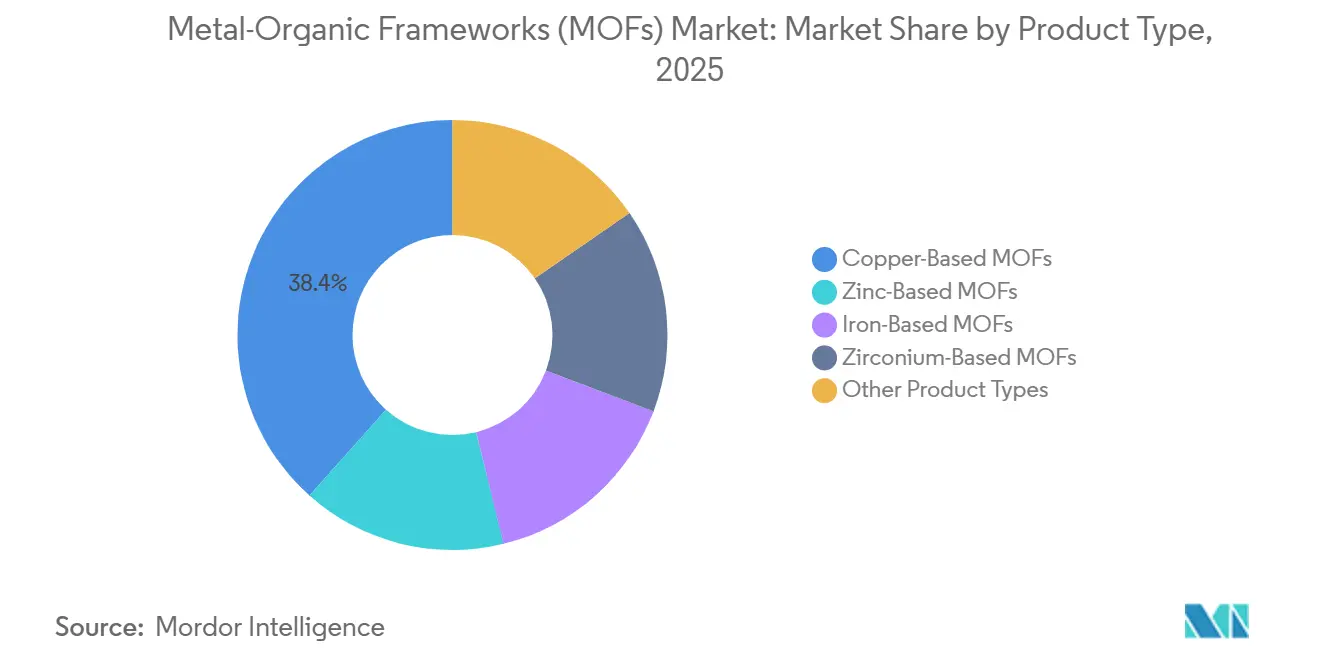
Copper-Based MOFs’ Scale Lead While Zinc-Based MOFs Gain MomentumCopper-Based MOFs held 38.42% of revenue in 2025. Their position reflected well-characterized synthesis protocols, accessible copper-salt feedstocks, and selectivity across carbon dioxide and nitrogen and carbon dioxide and methane. Copper(II) open-metal sites provide Lewis acid binding that supports selective carbon dioxide uptake. The mechanism remains reliable at the crystallographic level but can decline in wet industrial conditions relevant to carbon capture. These performance conditions influence product selection for industrial systems.
Zinc-Based MOFs are projected to advance at a 22.34% CAGR through 2031 within the metal-organic frameworks (MOFs) market. Their growth is linked to CALF-20, which BASF produced for Svante Technologies’ carbon capture program. This deployment moved zinc-based materials from an academic reference to an industrial procurement benchmark. Iron-Based MOFs offer lower-cost feedstocks and catalytic activity in photochemical and Fenton-type reactions. Zirconium-Based variants provide moisture and thermal resilience for harsh industrial settings, and their reliability can outweigh higher initial material costs where regulations require validated performance.

By Form:
Powder’s Operational Reality and Membranes and Thin Films Scale-Up AccelerationPowder held 61.08% of revenue in 2025. It remained central to laboratory synthesis, process development, and packed-bed adsorption systems. Powder can be difficult to handle, can create uncontrolled pressure drop, and can raise occupational safety concerns. These limitations support demand for more practical formats. Granules and pellets offer a direct route to packed-bed adsorbents.
Membranes and thin films are projected to advance at a 24.83% CAGR through 2031 in the metal-organic frameworks (MOFs) market. Continuous roll-to-roll fabrication of quasi-pure ZIF-67 membranes demonstrated a potential route to industrial module production. The process delivered benchmark separation across propylene and propane, ethylene and ethane, and carbon dioxide and nitrogen. Pelletization can reduce Brunauer-Emmett-Teller surface area by up to 50%, while green binders retained more than 90% of gas uptake in kilogram-scale pellet batches. Improvements in binders and fabrication methods are narrowing the performance gap between powder and deployable forms.
By Synthesis Method:
Solvothermal and Hydrothermal’s Dual Position and Emerging Scalable AlternativesSolvothermal and hydrothermal synthesis held 55.47% of revenue in 2025 and are projected to advance at a 25.06% CAGR through 2031. Its dual position reflects established scale-up knowledge and a broad base of industrial qualification data. Customer familiarity and existing supply chains also favor materials made through this route. These conditions make substitution with alternative routes more difficult for buyers. The metal-organic frameworks industry, therefore, continues to rely on solvothermal and hydrothermal production for commercial supply.
Promethean Particles’ continuous-flow hydrothermal reactors can produce 100 kilograms of material per hour, and its 4-metric-ton shipment in November 2025 demonstrated commercial-volume supply. Mechanochemical synthesis removes solvent use and related waste treatment while operating at ambient temperature. Microwave-assisted synthesis can shorten reaction times and produce more uniform crystal sizes for membrane and thin-film applications. Sonochemical methods remain a niche option for nanosized particles used in diffusion-sensitive sensors and drug-release applications. These alternatives address specific process and product needs, but do not yet displace the established route.
By Application:
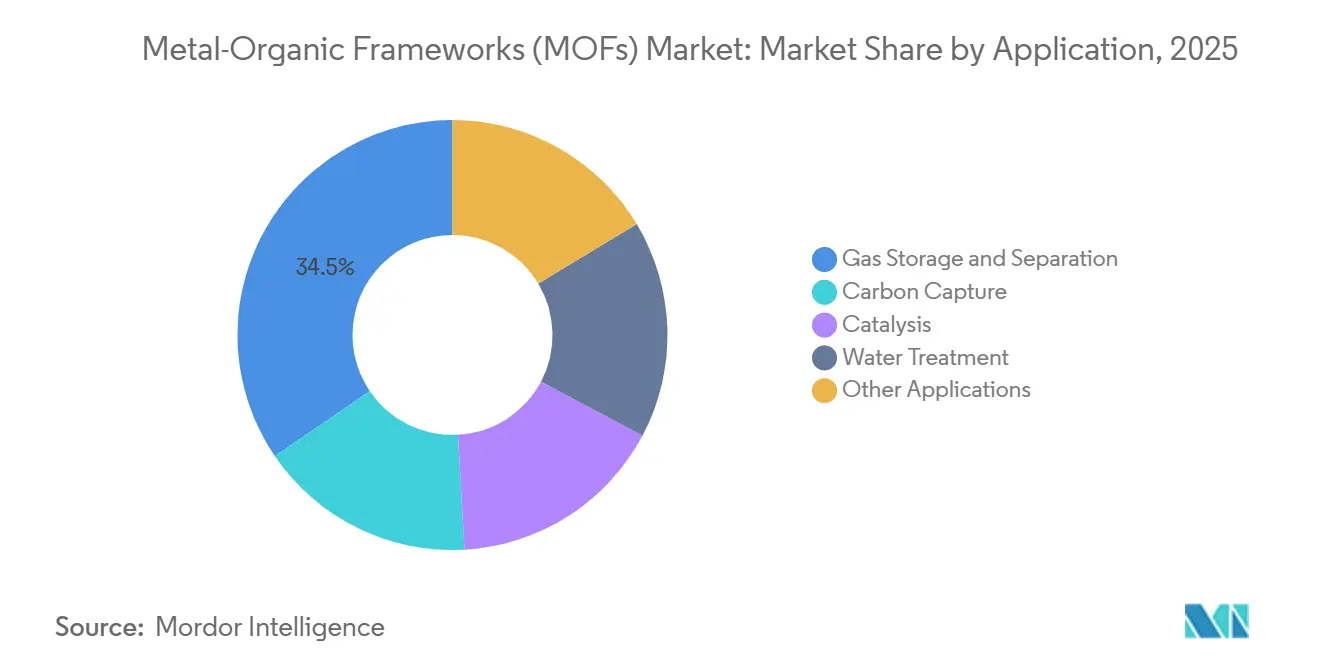
Gas Storage and Separation’s Established Base and Carbon Capture’s Growth PremiumGas storage and separation held 34.51% of revenue in 2025. The segment reflects the use of metal-organic frameworks as performance upgrades within existing adsorption systems. Numat Technologies’ ION-X sub-atmospheric gas delivery system serves semiconductor dopant-gas applications. The company manufactured more than 100 metric tons of metal-organic frameworks annually for this application in 2025. This use case shows the role of purity control and reliable delivery in commercial adoption.
Carbon capture is projected to advance at a 24.43% CAGR through 2031. Svante’s facility, the practical-scale Japanese demonstration, and performance at low carbon dioxide concentrations support this trajectory. Catalysis uses tunable active sites and pore confinement, while copper and zinc frameworks have shown use in carbon dioxide-to-cyclic-carbonate conversion. Water treatment uses adsorption for trace micropollutant removal and heavy-metal sequestration. Evolving effluent standards are creating demand for validated materials in this application.
Geography Analysis
APAC Metal-Organic Frameworks (MOFs) Market
Asia-Pacific held 35.04% of revenue in 2025. China’s integrated chemical base extends from metal salts and organic linkers to gas separation and catalysis applications. South Korea, Japan, and Taiwan add a dense semiconductor manufacturing base. Kobe Steel, Atomis, and Nagase & Co. completed Japan’s first practical-scale carbon dioxide capture demonstration at 30 kilograms per day in April 2026 and are planning a metric-ton-scale test in fiscal 2026[1]. India’s pharmaceutical and water-treatment sectors provide an additional, developing source of demand.
North America Metal-Organic Frameworks (MOFs) Market
North America is projected to advance at a 22.81% CAGR through 2031 in the metal-organic frameworks (MOFs) market, supported by carbon capture investment and semiconductor demand. Svante’s Redwood facility serves as a North American production anchor for metal-organic framework-coated filters. AirJoule Technologies unveiled AirJoule Prime in June 2026 and deployed AirJoule Core at GE Vernova’s Frontier Campus in Niskayuna, New York, in July 2026[2]. Natural Resources Canada provided funding to Svante in 2026 to validate filter durability. Government support can reduce the capital at risk for early commercial projects.
EMEA and South America Metal-Organic Frameworks (MOFs) Market
In Europe, Germany held a strong national position because of its industrial chemistry base and mature decarbonization requirements. novoMOF secured CHF 4.4 million, equivalent to USD 4.9 million, in April 2025 for industrial carbon dioxide capture projects, while Promethean Particles shipped 4 metric tons to a European gas-storage customer in November 2025. South America, and Middle East and Africa remain smaller markets, although arid areas can support atmospheric water harvesting demand that is separate from carbon capture and semiconductor applications.
Competitive Landscape
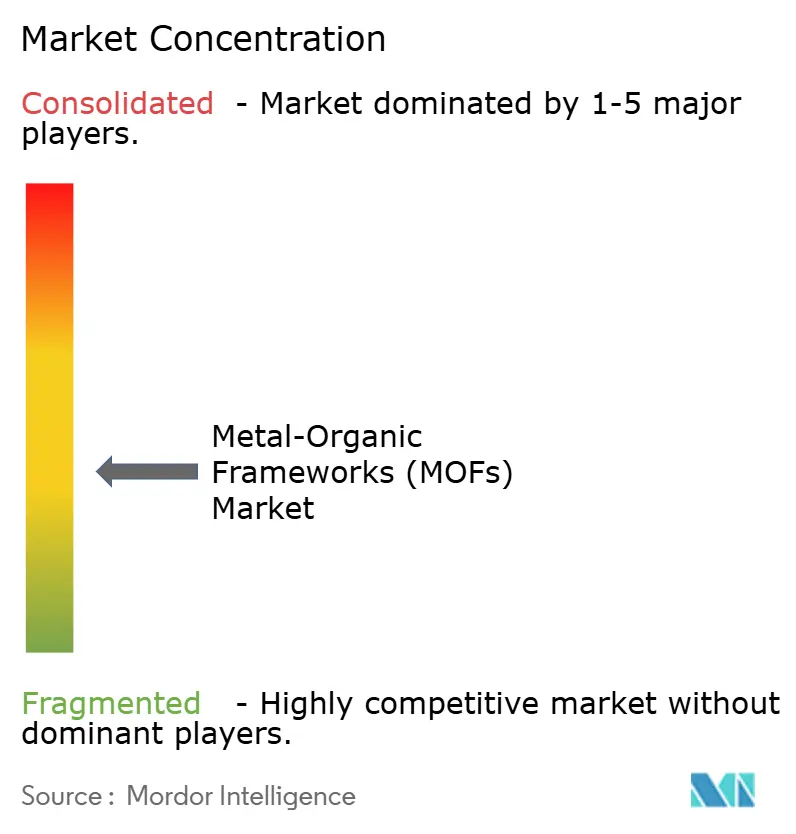
The metal-organic frameworks (MOFs) market is moderately concentrated, with the top five players including BASF, NUMAT TECHNOLOGIES, INC., Promethean Particles, Svante Technologies Inc., and MOF Technologies Ltd. BASF has an important production role through CALF-20 supply for carbon capture and materials development for atmospheric water harvesting. Its output at several hundred metric tons per year supports carbon capture supply. Promethean Particles uses continuous-flow reactors for higher-throughput production, while Numat Technologies has built a position in semiconductor gas delivery through the ION-X patent family.
Manufacturing processes can be as important as framework composition in the metal-organic frameworks (MOFs) market. novoMOF focuses on carbon dioxide capture materials for lower separation costs and runs industrial pilot projects. UniSieve uses mixed-matrix membranes that embed molecular sieves in polymer films. Scalable membrane research has increased the importance of fabrication-route intellectual property. Semiconductor customers also evaluate suppliers against environmental and quality standards, reinforcing the position of established suppliers with proven compliance capabilities.
Opportunities remain in humid-condition direct air capture and atmospheric water harvesting systems for data centers and defense uses. AirJoule is developing water-generation systems, while smaller companies such as Framergy are addressing specialized application areas. Funding has concentrated among Svante, Numat, Promethean, and novoMOF, while many other participants rely on academic licensing income or smaller grants. AI-first firms such as Orbital Materials and Cusp.AI are pursuing platform-licensing approaches for materials design.
Metal-Organic Frameworks (MOFs) Industry Leaders
-
BASF
-
NUMAT TECHNOLOGIES, INC.
-
Promethean Particles
-
Svante Technologies Inc.
-
MOF Technologies Ltd.
- *Disclaimer: Major Players sorted in no particular order
Metal-Organic Frameworks (MOFs) Market Companies Covered in this Report
- ACSYNAM
- AirJoule LLC
- BASF
- framergy, Inc.
- Immaterial Ltd.
- Merck KGaA
- MOF Technologies Ltd.
- MOFapps AS
- Nanorh
- novoMOF
- NUMAT TECHNOLOGIES, INC.
- Promethean Particles
- Svante Technologies Inc.
- UniSieve Ltd
Recent Industry Developments in Metal-Organic Frameworks (MOFs) Market
- July 2026: AirJoule Technologies deployed its AirJoule Core atmospheric water generation system at GE Vernova's Advanced Research Center Frontier Campus in Niskayuna, New York. The MOF-based system produces distilled water from ambient air using low-grade heat recycling and functions as a live demonstration unit for GE Vernova's enterprise clients.
- June 2026: novoMOF joined the Swiss Power-to-X Collaborative Innovation Network (SPIN). The climate-tech startup integrates its proprietary Metal-Organic Frameworks (MOFs) for carbon capture into sustainable fuel supply chains, supplying recycled CO₂ feedstock for e-methanol and synthetic e-fuels production.
Global Metal-Organic Frameworks (MOFs) Market Report Scope
Metal-organic frameworks (MOFs) are highly porous crystalline materials composed of metal ions or clusters linked by organic ligands, offering exceptionally high surface area and tunable pore structures. They are used in gas storage and separation, carbon capture, catalysis, water treatment, and other advanced applications due to their unique adsorption and molecular separation capabilities.
The Metal-Organic Frameworks (MOFs) Market is segmented by product type, form, synthesis method, application, and geography. By product type, the market is segmented into copper-based MOFs, zinc-based MOFs, iron-based MOFs, zirconium-based MOFs, and other product types. By form, the market is segmented into powder, granules and pellets, membranes and thin films, and other forms. By synthesis method, the market is segmented into solvothermal and hydrothermal, mechanochemical, microwave-assisted, sonochemical, and other synthesis methods. By application, the market is segmented into gas storage and separation, carbon capture, catalysis, water treatment, and other applications. The report also covers the market size and forecasts for metal-organic frameworks (MOFs) in 15 countries across major regions. For each segment, the market sizing and forecasts have been done on the basis of value (USD).
Segmentation Overview
| Copper-Based MOFs |
| Zinc-Based MOFs |
| Iron-Based MOFs |
| Zirconium-Based MOFs |
| Other Product Types |
| Powder |
| Granules and Pellets |
| Membranes and Thin Films |
| Other Forms |
| Solvothermal and Hydrothermal |
| Mechanochemical |
| Microwave-Assisted |
| Sonochemical |
| Other Synthesis Methods |
| Gas Storage and Separation |
| Carbon Capture |
| Catalysis |
| Water Treatment |
| Other Applications |
| Asia-Pacific | China |
| India | |
| Japan | |
| South Korea | |
| ASEAN Countries | |
| Rest of Asia-Pacific | |
| North America | United States |
| Canada | |
| Mexico | |
| Europe | Germany |
| United Kingdom | |
| France | |
| Italy | |
| NORDIC Countries | |
| Rest of Europe | |
| South America | Brazil |
| Argentina | |
| Rest of South America | |
| Middle East and Africa | Saudi Arabia |
| South Africa | |
| Rest of Middle East and Africa |
| By Product Type | Copper-Based MOFs | |
| Zinc-Based MOFs | ||
| Iron-Based MOFs | ||
| Zirconium-Based MOFs | ||
| Other Product Types | ||
| By Form | Powder | |
| Granules and Pellets | ||
| Membranes and Thin Films | ||
| Other Forms | ||
| By Synthesis Method | Solvothermal and Hydrothermal | |
| Mechanochemical | ||
| Microwave-Assisted | ||
| Sonochemical | ||
| Other Synthesis Methods | ||
| By Application | Gas Storage and Separation | |
| Carbon Capture | ||
| Catalysis | ||
| Water Treatment | ||
| Other Applications | ||
| By Geography | Asia-Pacific | China |
| India | ||
| Japan | ||
| South Korea | ||
| ASEAN Countries | ||
| Rest of Asia-Pacific | ||
| North America | United States | |
| Canada | ||
| Mexico | ||
| Europe | Germany | |
| United Kingdom | ||
| France | ||
| Italy | ||
| NORDIC Countries | ||
| Rest of Europe | ||
| South America | Brazil | |
| Argentina | ||
| Rest of South America | ||
| Middle East and Africa | Saudi Arabia | |
| South Africa | ||
| Rest of Middle East and Africa | ||
Key Questions Answered in the Report
What is the size of the metal-organic frameworks (MOFs) market?
The Metal-Organic Frameworks Market size is expected to increase from USD 103.94 million in 2025 to USD 122.65 million in 2026 and reach USD 318.91 million by 2031, at a CAGR of 21.06% over 2026-2031.
What is driving demand for metal-organic frameworks?
Carbon capture, energy-efficient gas separation, semiconductor gas delivery, gas storage, and atmospheric water harvesting are supporting demand.
Which product type held the largest share in 2025?
Copper-Based MOFs held 38.42% of revenue in 2025 because of established synthesis routes and selective gas adsorption performance.
Which application is projected to grow fastest through 2031?
Carbon capture is projected to advance at a 24.43% CAGR through 2031, supported by commercial filter production and practical-scale demonstrations.