
Men Skin Care Products Market Size and Share
Market Overview
| Study Period | 2022 - 2032 |
|---|---|
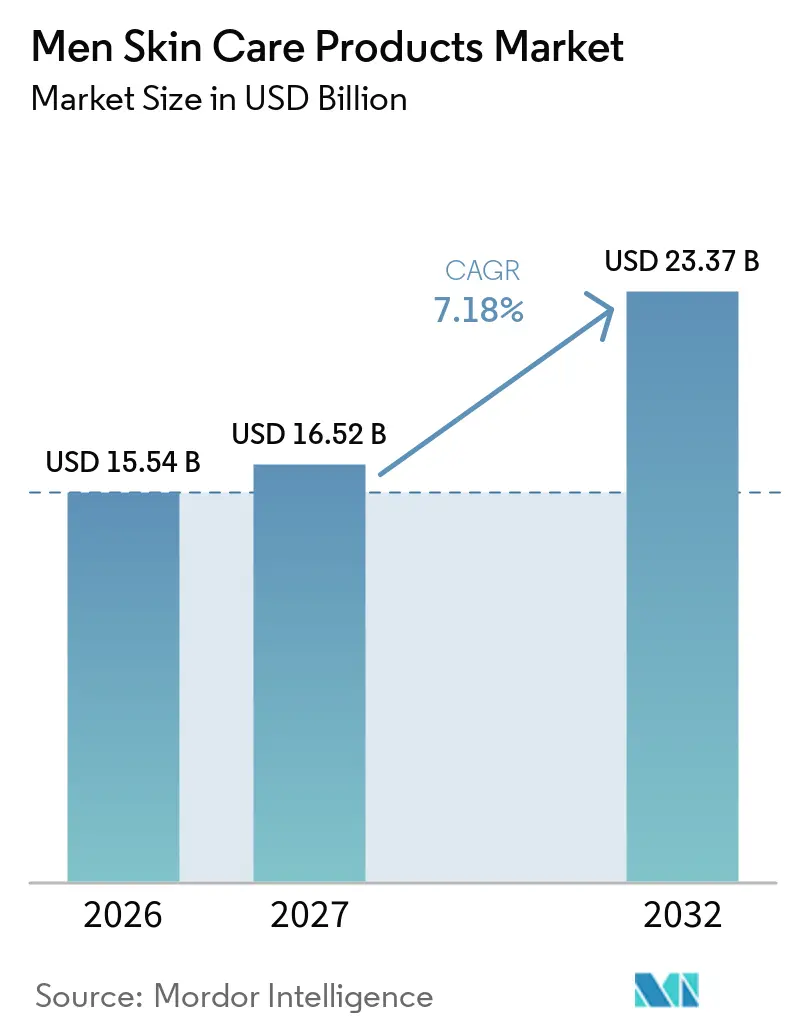
| Market Size (2027) | USD 16.52 Billion |
| Market Size (2032) | USD 23.37 Billion |
| Growth Rate (2027 - 2032) | 7.18 % |
| Fastest Growing Market | Asia-Pacific |
| Largest Market | North America |
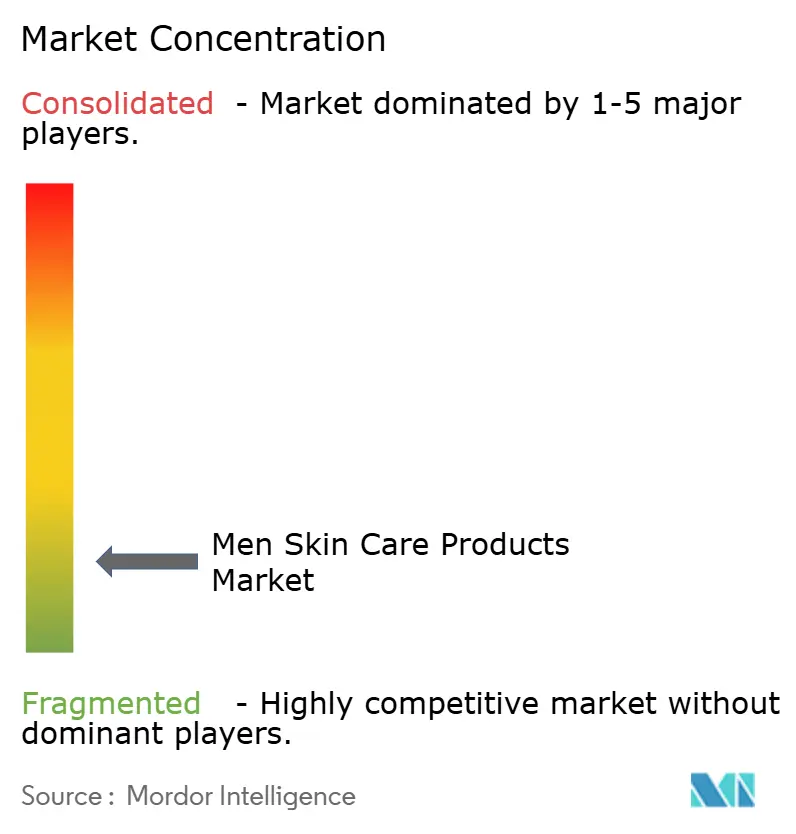
| Market Concentration | Low |
Major Players *Disclaimer: Major Players sorted in no particular order Image © Mordor Intelligence. Reuse requires attribution under CC BY 4.0. | |
Men Skin Care Products Market Analysis by Mordor Intelligence
The Men skin care products market is expected to grow from USD 15.54 billion in 2026 and is forecast to reach USD 23.37 billion by 2032 at 7.18% CAGR over 2027-2032. Growth is tied to a sustained shift toward routine skin health among male consumers, rather than occasional grooming purchases. Digital discovery is shortening the path from product research to purchase and is giving specialized brands broader access to consumers. Demand is also moving toward products that address oil control, irritation after shaving, hydration, and visible signs of aging. Clinical support, clear ingredient information, and convenient replenishment are becoming more important for purchase decisions. The Men skin care products market therefore offers the strongest opportunities to brands that pair credible formulations with accessible online and store-based service.
Key Report Takeaways
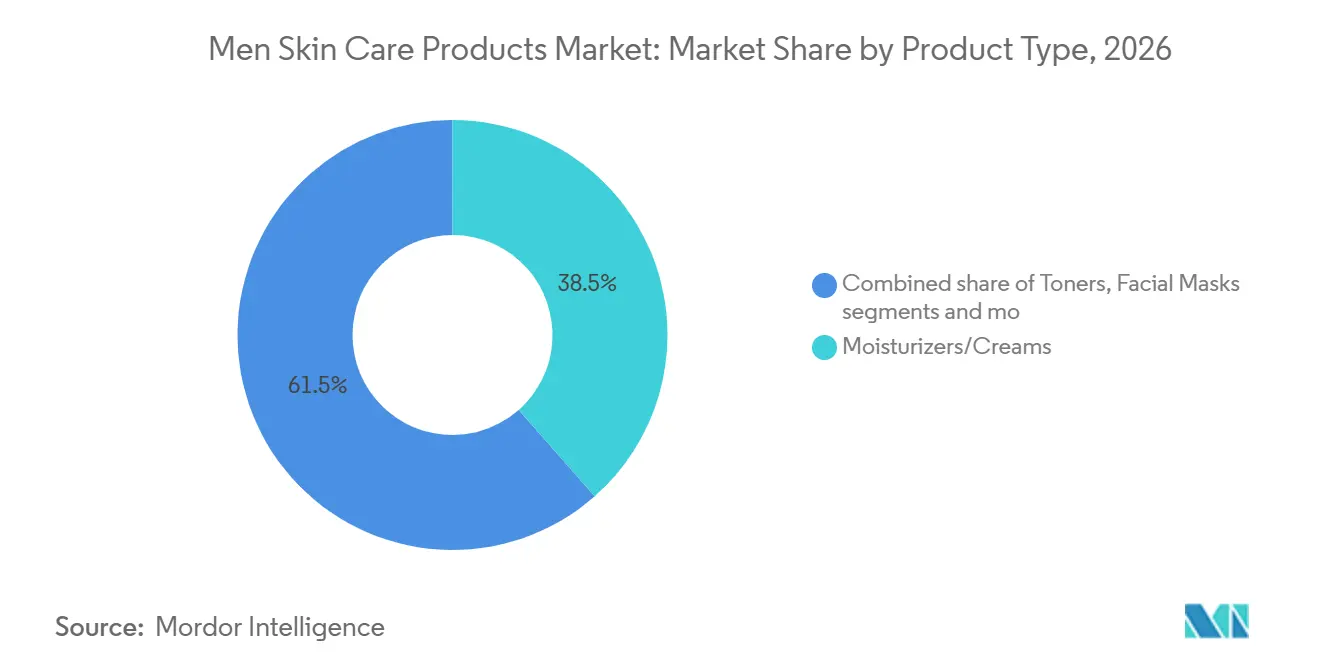
- By product type, Moisturizers and Creams held 38.5% of the Men skin care products market share in 2026, while Toners are forecast to expand at an 8.3% CAGR through 2032.
- By skin type, Oily Skin held 40.2% of the Men skin care products market share in 2026, while Sensitive Skin is forecast to expand at a 9.5% CAGR through 2032.
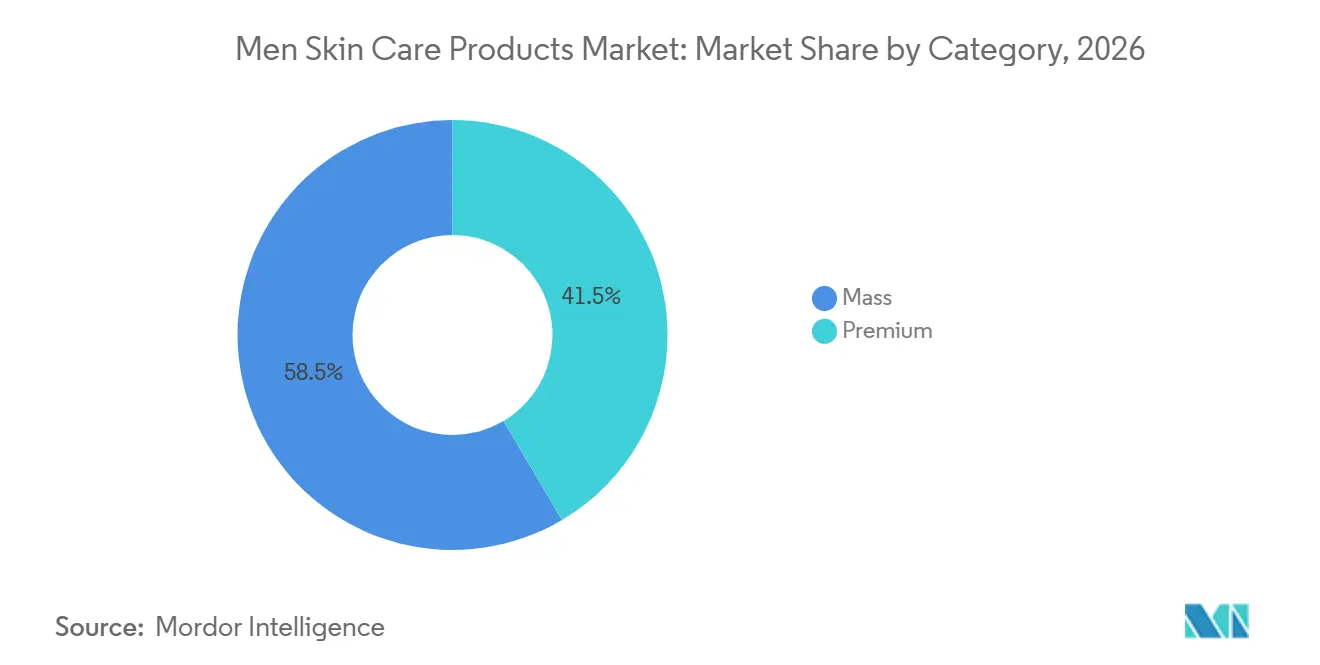
- By category, Mass held 58.5% of the Men skin care products market share in 2026, while Premium is forecast to expand at a 9.1% CAGR through 2032.
- By distribution channel, Online Retail held 42.3% of the Men skin care products market share in 2026, while Health and Beauty Stores are forecast to expand at an 8.5% CAGR through 2032.
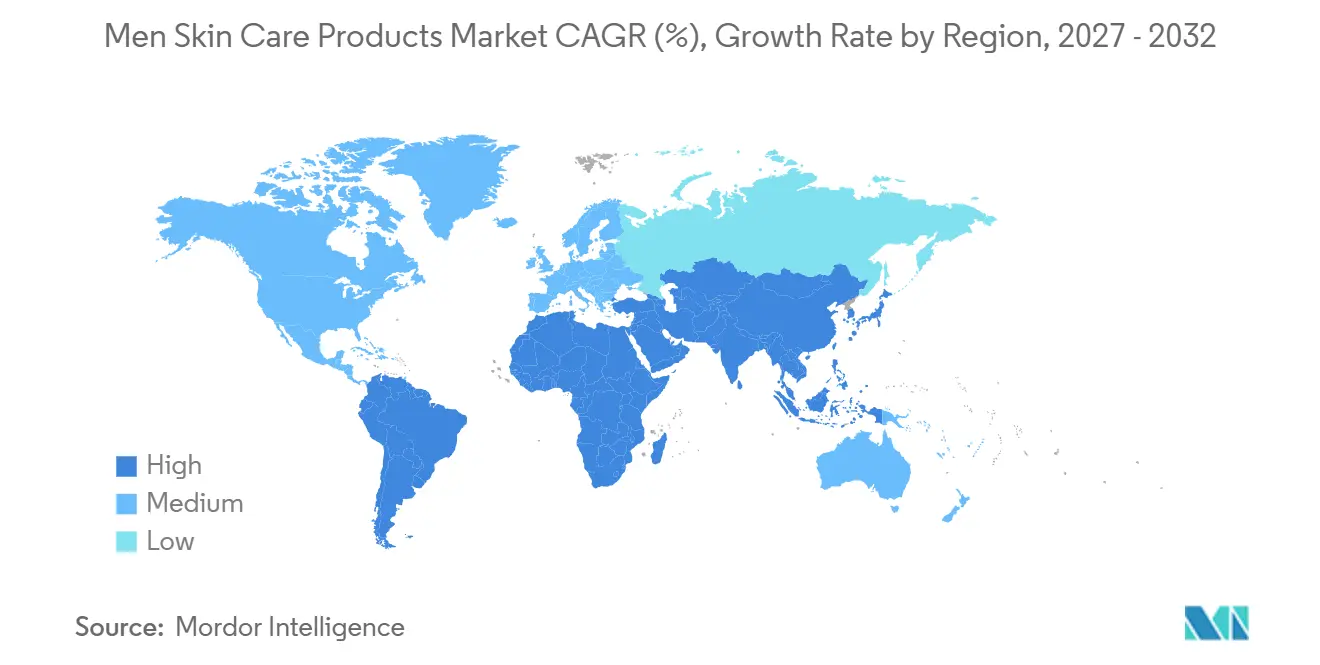
- By geography, North America held 37.2% of the Men skin care products market share in 2026, while Asia-Pacific is forecast to expand at a 9.2% CAGR through 2032.
Note: Market numbers in this report are based on Mordor Intelligence's proprietary estimation framework, which combines nine months of actuals with Q4 projections for base year 2026.
Market Trends and Insights
Drivers Impact Analysis of Men Skin Care Products Market*
| Driver | (~) % Impact on CAGR Forecast | Geographic Relevance | Impact Timeline |
|---|---|---|---|
| Rising Male Grooming and Self-Care Awareness | +1.4% | Global, with highest intensity in North America and Asia-Pacific | Short term (≤ 2 years) |
| Product Innovation Tailored to Male Skin | +1.1% | Global | Medium term (2-4 years) |
| Expansion of E-Commerce and Direct-to-Consumer Channels | +1.2% | Global, dominant in North America, Asia-Pacific, and Europe | Short term (≤ 2 years) |
| Rising Demand for Anti-Aging and Skin Rejuvenation Products | +0.9% | North America, Europe, and East Asia | Medium term (2-4 years) |
| Preference for Natural, Organic, and Clean-Label Formulations | +0.8% | North America, Europe, and core Asia-Pacific markets | Medium term (2-4 years) |
| Dermatologist-Backed and Clinically Tested Products | +0.6% | Global | Long term (≥ 4 years) |
| Source: Mordor Intelligence | |||
Rising Male Grooming and Self-Care Awareness
Male grooming is increasingly viewed as a regular form of self-care, supporting repeat purchases in the men's skin care products market as consumers shift from occasional to routine use. Men aged 25-34 show particularly strong routine adoption, making this cohort important for brands seeking to establish long-term relevance. Early routine formation can create durable loyalty when a brand establishes trust before consumers settle on a preferred regimen or purchase products only in response to seasonal needs. Self-purchasing broadens demand beyond gifts and promotional periods, allowing men to select products based on their own skin concerns. This shift favors products with clear daily use cases, including cleansing, moisturizing, and shaving-related care that can be explained without specialist language. It also increases the value of consumer education that demonstrates how a straightforward routine can address oiliness, dryness, irritation, or visible aging concerns.
Product Innovation Tailored to Male Skin
Male skin has specific characteristics, including greater thickness, more active sebaceous function, and repeated stress from shaving, which makes a generic approach less suited to everyday concerns. A 2025 clinical review notes that post-shave water loss and follicular density require formulation choices suited to male skin, including gentler cleansing systems and barrier-supporting ingredients. This clinical framing moves product design beyond cosmetic gender labeling and toward practical concerns that consumers can recognize from their own daily routines. Beiersdorf introduced NIVEA MEN Sensitive Liquid Moisturizer in September 2026 with a 5% Ceramide and Zinc PCA Soothing Complex, and reported that 98% of tested male users found it suitable for sensitive skin. Such launches support products designed around irritation, barrier care, and oil control instead of relying solely on a male-oriented label. They also make formulation evidence, clear usage instructions, and reported testing more important in the Men skin care products market.
Expansion of E-Commerce and Direct-to-Consumer Channels
Online purchasing gives consumers access to a wider range of products and allows emerging brands to reach buyers without relying only on retail shelves or national store listings. The channel is particularly useful when consumers need information about ingredients, skin concerns, routine steps, or compatibility with shaving before making a purchase. Digital storefronts can support replenishment through subscriptions and repeat-order prompts, which may help a consumer continue a routine after the initial purchase. The Men skin care products market benefits when brands make product selection easier through clear descriptions, credible reviews, and usage guidance that is not overly complicated. Online channels can reduce discovery barriers for niche or treatment-oriented products that would have limited visibility in a general store environment. Trusted seller controls remain important because marketplace growth can expose consumers to counterfeit goods that weaken confidence in both the product and the category.
Rising Demand for Anti-Aging and Skin Rejuvenation Products
Anti-aging care creates a higher-value purchase path for male consumers who begin with basic cleansing or hydration and later seek products for more specific concerns. Intage reported that Japan's men's cosmetics market reached JPY 49.7 billion (USD 340 million) in 2024, with strong growth in moisturizing and anti-aging products. Beiersdorf launched the NIVEA MEN Age Defense line in the United States in February 2025, including serums, eye cream, and an SPF 30 moisturizer with Thiamidol and Pro-Retinol. This expands the range of products available for consumers seeking targeted benefits and makes it easier for retailers to present anti-aging as part of a standard routine. Demand for visible results can support serums and other higher-value formulations when claims are supported by appropriate testing and realistic product information. It also increases the need for brands in the Men skin care products market to communicate clinical testing, appropriate use, and expected benefits clearly.
Restraints Impact Analysis of Men Skin Care Products Market*
| Restraint | (~) % Impact on CAGR Forecast | Geographic Relevance | Impact Timeline |
|---|---|---|---|
| Counterfeit and Low-Quality Products | -1.2% | Global e-commerce, concentrated in Asia-Pacific and the Middle East and Africa | Short term (≤ 2 years) |
| Regulatory Compliance and Ingredient Restrictions | -0.7% | Europe and North America, with global influence | Medium term (2-4 years) |
| Limited Skincare Routines Among Traditional Male Consumers | -1.1% | Middle East and Africa, parts of South America, and rural Asia-Pacific | Long term (≥ 4 years) |
| Consumer Skepticism About Product Effectiveness | -0.9% | Global, with greater relevance among older consumers | Medium term (2-4 years) |
| Source: Mordor Intelligence | |||
Counterfeit and Low-Quality Products
Counterfeit products can harm consumers and weaken confidence in established brands, particularly when a buyer cannot easily verify that an online seller is authorized. A July 2025 investigation by Which? found that 67% of cosmetics it bought from major online marketplaces were likely counterfeit. The Korean Intellectual Property Office prosecuted a network in June 2025 that distributed 87,000 counterfeit products imitating SK-II, Kiehl's, and Estée Lauder, with seized goods valued at KRW 7.9 billion in genuine-product equivalent. This issue is important because social commerce and online marketplaces are key discovery channels in the Men skin care products market, particularly for younger consumers comparing products quickly. Authorized sellers, product authentication, and pharmacy partnerships can help reduce consumer risk and make it clearer where an item has originated. Legitimate brands also face ongoing compliance requirements under the United States Modernization of Cosmetics Regulation Act and the European Union Cosmetics Regulation, which raise the importance of documented product safety and traceability.
Limited Skincare Routines Among Traditional Male Consumers
Some consumers continue to treat grooming as basic hygiene rather than regular skin health care, which can limit both the number of products used and the consistency of purchase. This can restrict usage to 1 or 2 products and slow adoption of fuller routines even when consumers recognize concerns such as oiliness, dryness, or post-shave irritation. A 2025 study in the Journal of the American Academy of Dermatology identified fear of adverse reactions, inconvenience, and cost as important barriers to consistent use. The study supports clear, outcome-focused communication for consumers who are uncertain about skincare and may not see an immediate reason to maintain a routine[1]. Brands can address this barrier by offering straightforward routines and explaining the role of each product in language that connects use with a specific practical concern. Clinical evidence can be more persuasive than aspirational messaging for consumers who are skeptical about product effectiveness or reluctant to spend on a product without clear support.
*Our forecasts treat driver/restraint impacts as directional, not additive. The impact forecasts reflect baseline growth, mix effects, and variable interactions.
Men Skin Care Products Market Segment Analysis
By Product Type:
Moisturizers Lead Volume as Toners Redefine Routine ArchitectureMoisturizers and Creams held 38.5% of the Men skin care products market share in 2026, reflecting their role as an accessible entry point for men beginning a regular routine. Lightweight, non-comedogenic products suit consumers managing oily or combination skin without adding a heavy finish that can discourage repeat use. SPF-inclusive moisturizers and anti-aging variants raise the value of a basic product without asking the consumer to add another separate step. Cleansers hold the second-largest position because they meet an established hygiene need and are used often enough to create regular replenishment. Facial masks, serums and oils, and other formats grow from smaller bases as multi-step care becomes more familiar to digitally engaged consumers.
Toners are forecast to grow at an 8.3% CAGR through 2032 in the Men skin care products market, as routines move beyond basic cleansing and hydration toward more targeted care. Alcohol-free products with niacinamide, hyaluronic acid, or gentle exfoliants can address oiliness, post-shave irritation, and congestion in a format that is simple to explain. Intage reported that men's moisturizing essences and toners in Japan rose 15.7% in 2024, indicating greater acceptance of products beyond a single moisturizer. KIZEN launched a 3-in-1 Complete Facial Moisturizer in the United States in June 2025, combining toner, serum, and moisturizing cream in one application. Multi-use formats can reduce perceived routine complexity while retaining the targeted benefits that encourage consumers to move beyond a basic regimen.

By Skin Type:
Oily Skin Anchors Volume While Sensitive Skin Attracts Clinical InvestmentOily Skin held 40.2% of the Men skin care products market share in 2026, making it the leading skin-type need for product design and communication. Higher sebaceous activity among men supports demand for oil-control cleansers, lightweight moisturizers, and pore-focused toners. Ingredient-led product descriptions can help consumers identify suitable options for acne, excess sebum, and visible congestion. Dry Skin and Combination Skin require hydration that does not feel overly occlusive, while Normal Skin supports regular demand for preventive hydration and SPF. Skin-type guidance therefore provides a practical route for brands to improve product selection and reduce uncertainty for new users.
Sensitive Skin is forecast to expand at a 9.5% CAGR through 2032, the fastest growth rate among the skin-type segments. Repeated shaving can create micro-injuries, increase water loss, and disrupt the skin barrier, which makes irritation a recurring concern rather than a narrow niche. This supports products built with ceramides, soothing agents, and gentler surfactant systems that are easy to use in a daily routine. NIVEA MEN's 2026 Sensitive Liquid Moisturizer illustrates this direction through its Ceramide and Zinc PCA formulation and reported suitability testing. Brands with credible sensitive-skin testing can build trust among consumers who have experienced irritation from strongly fragranced or aggressive legacy products.
By Category:
Mass Drives Penetration as Premium Captures Spending MomentumMass held 58.5% of the Men skin care products market share in 2026, supported by wide availability through supermarkets, pharmacies, and online retailers. The category is particularly important for first-time users because cleansers and basic moisturizers have familiar purposes and accessible prices. Frequent use of these products creates recurring demand and gives brands an opportunity to build a relationship before consumers trade up. Mass brands can increasingly use clinically familiar ingredients while maintaining price points that are easier to accept. This category remains central to broad penetration in the Men skin care products industry.
Premium is forecast to grow at a 9.1% CAGR through 2032, supported by consumer interest in dermatologist-informed products and more targeted active ingredients. Anti-aging serums, exfoliating treatments, and specialized formulas can command higher spending than basic moisturizers because they are purchased for defined outcomes. Their potential relies on explaining product benefits, appropriate use, and realistic expectations with enough clarity to overcome hesitation. Retention can improve when users see results and trust claims about testing and formulation quality. Premium growth therefore rests on clinical credibility, consumer education, and a clear reason to pay more.
By Distribution Channel:
Online Retail Leads Volume as Health and Beauty Stores Drive ConversionOnline Retail held 42.3% of the Men skin care products market share in 2026, giving it the largest position among the distribution channels. It offers broad assortments, detailed product pages, reviews, and replenishment options that can make unfamiliar products easier to consider. The channel is especially useful when a buyer needs information about ingredients, skin concerns, or routine steps before deciding. It also gives smaller brands national reach without building a full physical retail network. Supermarkets, hypermarkets, pharmacies, and drug stores continue to serve routine replenishment and clinically positioned purchases.
Health and Beauty Stores are forecast to grow at an 8.5% CAGR through 2032, because they provide in-person discovery that online shopping cannot fully replace. Dedicated men's sections, consultations, and curated routines can help consumers understand a regimen before committing to multiple products. Skin diagnostics and knowledgeable staff can also encourage adoption of premium or treatment-oriented products. These stores complement online retail by providing a setting for higher-touch education and product trial. The Men skin care products market benefits when channels help consumers progress from a single purchase to an appropriate routine.
Geography Analysis
North America Men Skin Care Products Market
North America held 37.2% of the Men skin care products market share in 2026, supported by established retail infrastructure, high spending capacity, and broad online access. Consumers can buy mass, premium, pharmacy, and direct-to-consumer products through well-developed channels. The United States is an important launch market for products that combine clinical positioning with broad distribution. Beiersdorf's 2025 NIVEA MEN Age Defense launch across Walmart, Amazon, and Target demonstrates how brands can reach buyers through mainstream retail and e-commerce. Direct-to-consumer subscriptions and specialist stores can further support discovery of higher-value products in the region.
EMEA and South America Men Skin Care Products Market
Europe is the second-largest regional contributor to the Men skin care products market, with Germany, the United Kingdom, France, and the Nordic countries serving as important demand centers. Mature personal care habits and established pharmacy and beauty retail give consumers access to a wide range of products. Ingredient safety and transparency remain important under the European Union Cosmetics Regulation, which supports brands with well-documented safety practices and clear claims. This setting can benefit clinical-grade products and make it harder for undifferentiated imports to establish consumer trust. South America and the Middle East and Africa remain smaller in value, while Brazil and Gulf markets offer growth potential through younger consumers, modern retail expansion, and premium grooming interest.
APAC Men Skin Care Products Market
Asia-Pacific is forecast to grow at a 9.2% CAGR through 2032, making it the primary regional growth engine for the Men skin care products market. South Korea influences routine-based skincare across Asia through the international reach of Korean beauty products and its established acceptance of multi-step care. Japan provides evidence of demand for moisturizing and anti-aging products, with its men's cosmetics market reaching JPY 49.7 billion (USD 340 million) in 2024. China, India, Indonesia, Thailand, and other ASEAN markets offer broader growth potential through expanding digital commerce, wider distribution, and different consumer income levels. Portfolios that combine straightforward routines with targeted solutions can serve both new entrants and more experienced skincare users across the region.
Competitive Landscape
The Men skin care products market has a fragmented competitive structure, so no single company determines the direction of demand alone. Beiersdorf, L'Oréal, Unilever, Procter & Gamble, and Shiseido form the established tier and use broad distribution, research capability, and portfolios across price points. Their position depends on maintaining product evidence, recognizable brands, and convenient online availability. Direct-to-consumer companies can compete by using simple product communication, targeted offers, and platform-native engagement. This leaves room for focused challengers, although it also makes clear differentiation necessary for sustained growth.
Beiersdorf has used product launches to strengthen its male skin-care range and respond to demand for targeted products. Its February 2025 NIVEA MEN Age Defense launch brought Thiamidol and Pro-Retinol products to Walmart, Amazon, and Target. Its September 2026 NIVEA MEN Liquid Moisturizer launch added sensitive-skin and hydration products and began through Amazon. Unilever announced its acquisition of Dr. Squatch in June 2025, extending its position in men's personal care through a brand with direct-to-consumer strengths. Together, these actions show established companies using both product development and portfolio moves to reach digitally engaged consumers.
Direct-to-consumer brands compete through clear language, targeted products, and convenient online purchasing, but they may have less physical reach and supply-chain scale than multinational companies. The strongest position combines credible formulations, accessible pricing, online convenience, and selected specialist retail. Counterfeit risk increases the importance of authorized sellers, product authentication, and pharmacy partnerships. These approaches can reassure consumers who are concerned about safety and authenticity after purchasing from online marketplaces. Brands that communicate clearly on formulation, testing, and authenticity can improve their standing in the Men skin care products market.
Men Skin Care Products Industry Leaders
-
Procter & Gamble Co.
-
L’Oréal SA
-
Beiersdorf AG
-
Unilever PLC
-
Kao Corporation
- *Disclaimer: Major Players sorted in no particular order
Men Skin Care Products Market Companies Covered in this Report
- Procter & Gamble Co.
- L’Oréal SA
- Beiersdorf AG
- Kao Corporation
- Unilever PLC
- Shiseido Co. Ltd.
- The Estée Lauder Companies Inc.
- Kenvue Inc.
- Edgewell Personal Care Co.
- Coty Inc.
- Natura & Co Holding SA
- Johnson & Johnson Services Inc.
- Groupe Clarins
- LVMH Moët Hennessy Louis Vuitton SE
- Koninklijke Philips N.V.
- Brickell Brands LLC
- Harry’s Inc.
- Bulldog Skincare
- Every Man Jack
- Dr. Squatch
Recent Industry Developments in Men Skin Care Products Market
- September 2026: Beiersdorf's NIVEA MEN launched its first Liquid Moisturizer line in the US, featuring a Sensitive SKU formulated with a 5% Ceramide and Zinc PCA Soothing Complex and a Maximum Hydration SKU with hyaluronic acid. Both were dermatologically tested, with 98% of male users confirming suitability for sensitive skin. The products debuted on Amazon before planned national retail availability in 2027, directly targeting the fastest-growing skin-type segment.
- June 2025: Unilever acquired of men's personal care brand Dr. Squatch from Summit Partners. The transaction expanded Unilever's portfolio into direct-to-consumer men's care, leveraging Dr. Squatch's social-media marketing, natural ingredient positioning, and Gen-Z consumer loyalty. Distribution spans digital commerce, retail, and direct-to-consumer channels primarily in North America and Europe.
- May 2025: Unilever's CLEAR brand globally launched its Scalpceuticals Pro Range at TANK Shanghai. The range was backed by 50 years of scientific research, 5 global laboratories, and contributions from over 200 dermatologists. Three patented technologies address scalp oiliness, dandruff, and sensitivity, repositioning CLEAR at the clinical premium tier within men's care.
- February 2025: Beiersdorf's NIVEA MEN launched the Age Defense line across the US at Walmart, Amazon, and Target. The 4-SKU range includes Advanced Serum, Instant Hydrating Serum, Eye Cream, and SPF 30 Moisturizer with Thiamidol and Pro-Retinol to address 5 aging signs. Clinical testing showed 100% of male testers confirmed visible reduction in aging signs.
Global Men Skin Care Products Market Report Scope
The Men’s Skin Care Products Market refers to the market for skincare products specifically formulated, marketed, or positioned for men to support skin cleansing, hydration, protection, and maintenance. By product type, the market is segmented into cleansers, moisturizers/creams, facial masks, toners, serums and oils, and other products. By skin type, the market is divided into oily skin, dry skin, sensitive skin, combination skin, and normal skin. By category, the market is segmented into mass and premium products. By distribution channel, the market is divided into supermarkets/hypermarkets, pharmacies and drug stores, health and beauty stores, online retail stores, and other distribution channels. Geographically, the market covers North America, Europe, Asia-Pacific, South America, and the Middle East and Africa, with country-level coverage across major markets within each region. Market size and growth forecasts are presented in terms of value (USD).
Segmentation Overview
| Cleansers |
| Moisturizers/Creams |
| Facial Masks |
| Toners |
| Serums and Oils |
| Others |
| Oily Skin |
| Dry Skin |
| Sensitive Skin |
| Combination Skin |
| Normal Skin |
| Mass |
| Premium |
| Supermarkets/Hypermarkets |
| Pharmacies and Drug stores |
| Health & Beauty Stores |
| Online Retail Stores |
| Other Distribution Channels |
| North America | United States |
| Canada | |
| Mexico | |
| Rest of North America | |
| Europe | Germany |
| United Kingdom | |
| Italy | |
| France | |
| Spain | |
| Netherlands | |
| Poland | |
| Belgium | |
| Sweden | |
| Rest of Europe | |
| Asia-Pacific | China |
| India | |
| Japan | |
| Australia | |
| Indonesia | |
| South Korea | |
| Thailand | |
| Singapore | |
| Rest of Asia-Pacific | |
| South America | Brazil |
| Argentina | |
| Colombia | |
| Chile | |
| Peru | |
| Rest of South America | |
| Middle East and Africa | South Africa |
| Saudi Arabia | |
| United Arab Emirates | |
| Nigeria | |
| Egypt | |
| Morocco | |
| Turkey | |
| Rest of Middle East and Africa |
| By Product Type | Cleansers | |
| Moisturizers/Creams | ||
| Facial Masks | ||
| Toners | ||
| Serums and Oils | ||
| Others | ||
| By Skin Type | Oily Skin | |
| Dry Skin | ||
| Sensitive Skin | ||
| Combination Skin | ||
| Normal Skin | ||
| By Category | Mass | |
| Premium | ||
| By Distribution Channel | Supermarkets/Hypermarkets | |
| Pharmacies and Drug stores | ||
| Health & Beauty Stores | ||
| Online Retail Stores | ||
| Other Distribution Channels | ||
| By Geography | North America | United States |
| Canada | ||
| Mexico | ||
| Rest of North America | ||
| Europe | Germany | |
| United Kingdom | ||
| Italy | ||
| France | ||
| Spain | ||
| Netherlands | ||
| Poland | ||
| Belgium | ||
| Sweden | ||
| Rest of Europe | ||
| Asia-Pacific | China | |
| India | ||
| Japan | ||
| Australia | ||
| Indonesia | ||
| South Korea | ||
| Thailand | ||
| Singapore | ||
| Rest of Asia-Pacific | ||
| South America | Brazil | |
| Argentina | ||
| Colombia | ||
| Chile | ||
| Peru | ||
| Rest of South America | ||
| Middle East and Africa | South Africa | |
| Saudi Arabia | ||
| United Arab Emirates | ||
| Nigeria | ||
| Egypt | ||
| Morocco | ||
| Turkey | ||
| Rest of Middle East and Africa | ||
Key Questions Answered in the Report
What is the projected value of men skin care products by 2032?
The category is forecast to reach USD 23.37 billion by 2032, growing from USD 15.54 billion in 2026 at a 7.1% CAGR over 2027-2032.
Which product type holds the largest share?
Moisturizers and Creams lead with a 38.5% share in 2026 because they provide a simple entry point for daily hydration and routine use.
Which skin type is growing fastest?
Sensitive Skin is forecast to grow at a 9.5% CAGR through 2032 as consumers seek products that address shaving-related irritation, water loss, and barrier care.
Which distribution channel is largest?
Online Retail holds 42.3% of 2026 sales, while Health and Beauty Stores are the fastest-growing channel at an 8.5% CAGR through 2032 because they support in-person discovery.