
Membranes Market Size and Share
Market Overview
| Study Period | 2021 - 2031 |
|---|---|
| Market Size (2026) | USD 11.97 Billion |
| Market Size (2031) | USD 15.84 Billion |
| Growth Rate (2026 - 2031) | 5.76 % |
| Fastest Growing Market | Asia-Pacific |
| Largest Market | Asia-Pacific |
| Market Concentration | Medium |
Major Players *Disclaimer: Major Players sorted in no particular order Image © Mordor Intelligence. Reuse requires attribution under CC BY 4.0. | |
Membranes Market Analysis by Mordor Intelligence
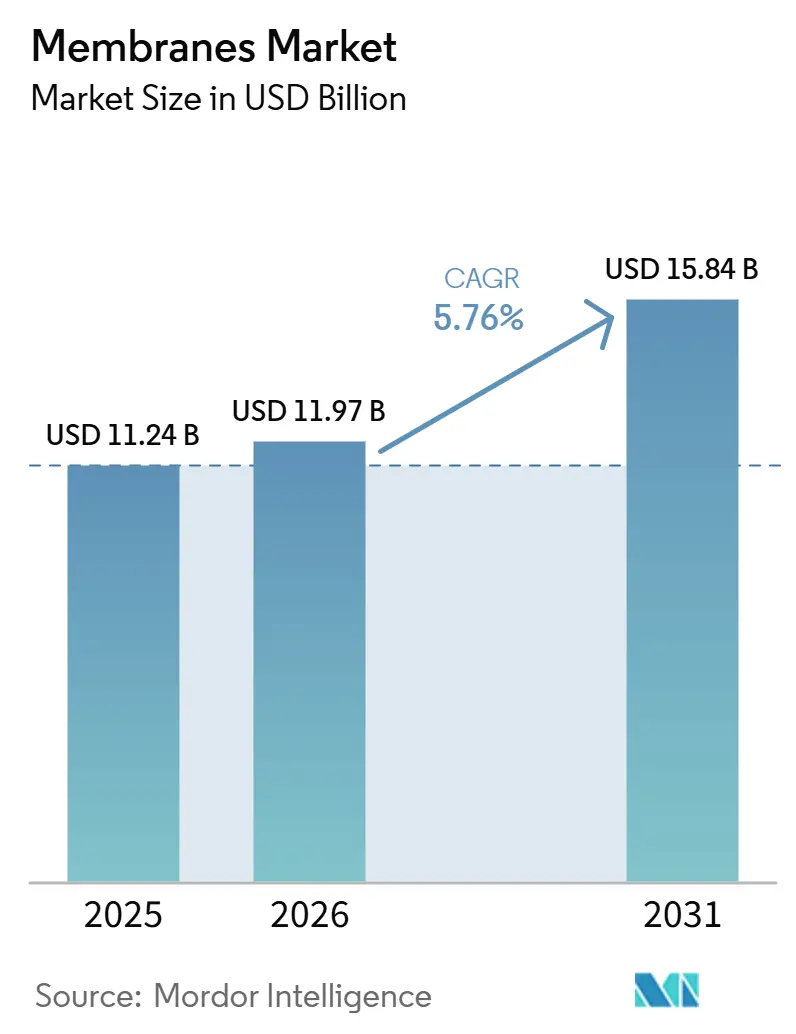
The Membranes Market was valued at USD 11.24 billion in 2025 and is estimated to grow from USD 11.97 billion in 2026 to reach USD 15.84 billion by 2031, at a CAGR of 5.76% during the forecast period (2026–2031). Water security programs, semiconductor fabrication, and biopharmaceutical manufacturing are expanding the need for membrane separation systems. Desalination investment and tighter industrial discharge requirements are also supporting demand across the membranes market. These conditions support replacement demand as well as new plant construction, which reduces dependence on discretionary capital spending. Suppliers are placing greater emphasis on products used in zero-liquid-discharge systems, ultrapure water production, and pharmaceutical filtration, where application requirements are more difficult to meet with standard products. Fouling and energy use remain important constraints, but anti-fouling coatings and energy recovery systems are reducing their operating impact.
Key Report Takeaways
- By material, polymeric membranes held 62.83% of the membranes market share in 2025, while carbon and graphene-based membranes are forecast to grow at an 8.61% CAGR through 2031.
- By technology, reverse osmosis (RO) held 34.61% of the membranes market share in 2025, while forward osmosis (FO) is forecast to grow at a 9.27% CAGR through 2031.
- By module configuration, spiral wound captured 48.72% of the membranes market share in 2025, while hollow fiber is forecast to grow at a 6.89% CAGR through 2031.
- By application, water and wastewater treatment held 46.95% of the membranes market share in 2025, while electronics and semiconductor processing are forecast to grow at an 8.14% CAGR through 2031.
- By end-use industry, municipal water and wastewater held 38.86% of the membranes market share in 2025, while electronics and semiconductors is forecast to grow at an 8.17% CAGR through 2031.
- By geography, Asia-Pacific held 42.27% of the membranes market share in 2025 and is forecast to grow at a 6.52% CAGR through 2031.
Note: Market size and forecast figures in this report are generated using Mordor Intelligence’s proprietary estimation framework, updated with the latest available data and insights as of January 2026.
Market Trends and Insights
Drivers Impact Analysis of Membranes Market*
| Driver | (~) % Impact on CAGR Forecast | Geographic Relevance | Impact Timeline |
|---|---|---|---|
| Increasing Water Scarcity and Expansion of Desalination Infrastructure | +1.5% | Global; highest intensity in MENA, coastal APAC, and Latin America | Medium term (2-4 years) |
| Stringent Regulations for Wastewater Treatment, Water Reuse, and Environmental Compliance | +0.8% | EU, North America, APAC core; spill-over to MEA and South America | Short term (≤ 2 years) |
| Rapid Industrialization and Urbanization Driving Demand for Advanced Water Treatment Solutions | +1.2% | APAC (China, India, Southeast Asia); secondary gains in South America and MEA | Medium term (2-4 years) |
| Growing Purity Requirements in Pharmaceutical and Biopharmaceutical Manufacturing | +0.7% | North America, EU, Japan; secondary in South Korea and Singapore | Long term (≥ 4 years) |
| Rising Water Demand from Semiconductor Manufacturing and Electronics Production | +0.9% | APAC core (Taiwan, South Korea, Japan, China); spill-over to US Southwest and EU Chips Act regions | Long term (≥ 4 years) |
| Source: Mordor Intelligence | |||
Increasing Water Scarcity and Expansion of Desalination Infrastructure
Global desalination capacity exceeded 130 million m³ per day in 2025 across more than 22,000 operating plants in 177 countries, while more than 2 billion people still lacked safely managed drinking water. This imbalance is strengthening the case for large-scale desalination projects and long-term membrane supply agreements. New facilities planned in Saudi Arabia, Iraq, and Egypt create a multi-year procurement pipeline for the membranes market. Water availability is becoming a national infrastructure issue rather than a limited utility concern. Suppliers with local manufacturing and service capabilities can become more competitive when project owners prioritize delivery certainty. Energy-efficient membrane selection also carries fiscal and climate importance, particularly where desalination is central to water security.
Stringent Regulations for Wastewater Treatment, Water Reuse, and Environmental Compliance
Regulatory requirements are shortening replacement cycles for treatment equipment across the membranes market. India requires membrane-based zero-liquid-discharge systems in critical industrial sectors, while its 2024 clean-water program supported reverse osmosis and ultrafiltration in rural treatment plants. China’s water pollution plan also supports broader industrial wastewater reclamation using ultrafiltration and reverse osmosis. The European Union continues to raise requirements for wastewater treatment and removal of emerging contaminants. A regulated treatment step creates recurring membrane purchases once it is installed. This supports a more stable demand base for the membranes market than equipment purchases that can be deferred during periods of weaker capital spending.
Rapid Industrialization and Urbanization Driving Demand for Advanced Water Treatment Solutions
Urban growth in South and Southeast Asia is increasing demand for modular treatment systems in industrial parks and second-tier cities. India’s Jal Jeevan Mission committed USD 4 billion to clean-water access in 2024 and included reverse osmosis and ultrafiltration in rural treatment programs[1]Ministry of Jal Shakti, “Jal Jeevan Mission Annual Report,” Government of India, jaljeevanmission.gov.in. This adds demand from locations that previously had limited access to industrial membrane systems. China’s expansion in photovoltaic and lithium battery manufacturing also requires consistent process water quality. Flat-sheet and hollow fiber ultrafiltration modules are well-suited to decentralized installations because of their modular design and smaller footprint. Lower prices and greater domestic production capacity are widening access to the membranes market in developing economies.
Growing Purity Requirements in Pharmaceutical and Biopharmaceutical Manufacturing
The U.S. Food and Drug Administration recognized Parenteral Drug Association (PDA)/ANSI Standard 05-2021 for mycoplasma-retentive membrane filtration in September 2025[2]U.S. Food and Drug Administration, “Complete List of Guidances, Regulatory Actions and Other Information Related to CBER-Regulated Products,” FDA, fda.gov. The action increased the documentation requirements for suppliers serving pharmaceutical applications. Suppliers that can provide complete validation packages are better positioned to retain high-value accounts. Advanced biologics, including peptides, oligonucleotides, and viral vectors, require substantial concentration and clarification work. This supports wider use of membrane systems in processes that once relied on thermal or centrifugal equipment. These requirements favor membrane market suppliers with application knowledge, validation support, and reliable product consistency.
Restraints Impact Analysis of Membranes Market*
| Restraint | (~) % Impact on CAGR Forecast | Geographic Relevance | Impact Timeline |
|---|---|---|---|
| Membrane Fouling, Scaling, and Biofouling Affecting System Performance | -0.8% | Global; acute in MENA seawater desalination and industrial wastewater reuse | Short term (≤ 2 years) |
| High Energy Consumption Associated with Pressure-Driven Membrane Processes | -0.6% | Global; disproportionate in MENA and developing APAC where grid costs and carbon commitments coincide | Medium term (2-4 years) |
| High Capital Investment and Membrane Replacement Costs | -0.5% | Emerging economies — South Asia, Sub-Saharan Africa, Latin America | Long term (≥ 4 years) |
| Source: Mordor Intelligence | |||
Membrane Fouling, Scaling, and Biofouling Affecting System Performance
Biofouling remains a major operating constraint in reverse osmosis desalination systems. Research published in 2025 found that chlorine-resistant bacteria can form structured biofilms on seawater reverse osmosis membranes after standard pretreatment. Fouling raises pressure requirements, which increases energy use and can speed membrane aging. Laboratory models can also understate the severity of fouling in operating plants because synthetic feedwater does not fully reproduce field conditions. This has increased interest in membrane autopsies and site-specific characterization. DuPont’s March 2026 NF270-400/34 update addressed this issue with lower initial pressure drop and improved biofouling protection.
High Energy Consumption Associated with Pressure-Driven Membrane Processes
Seawater reverse osmosis generally operates at feed pressures of 55 to 70 bar. The energy requirement is particularly important in the Middle-East, where desalination expansion and carbon reduction commitments occur at the same time. Energy performance has therefore become a central procurement consideration for new capacity. Saudi water authorities have linked energy-efficient desalination membranes with annual savings of SAR 14 billion, equivalent to USD 3.7 billion. Toray’s planned TSW-K/M/V seawater reverse osmosis series is designed to lower salt permeability and support single-pass configurations. Such designs can reduce the need for a second pass in membrane market projects, both new and retrofit.
*Our forecasts treat driver/restraint impacts as directional, not additive. The impact forecasts reflect baseline growth, mix effects, and variable interactions.
Membranes Market Segment Analysis
By Material:
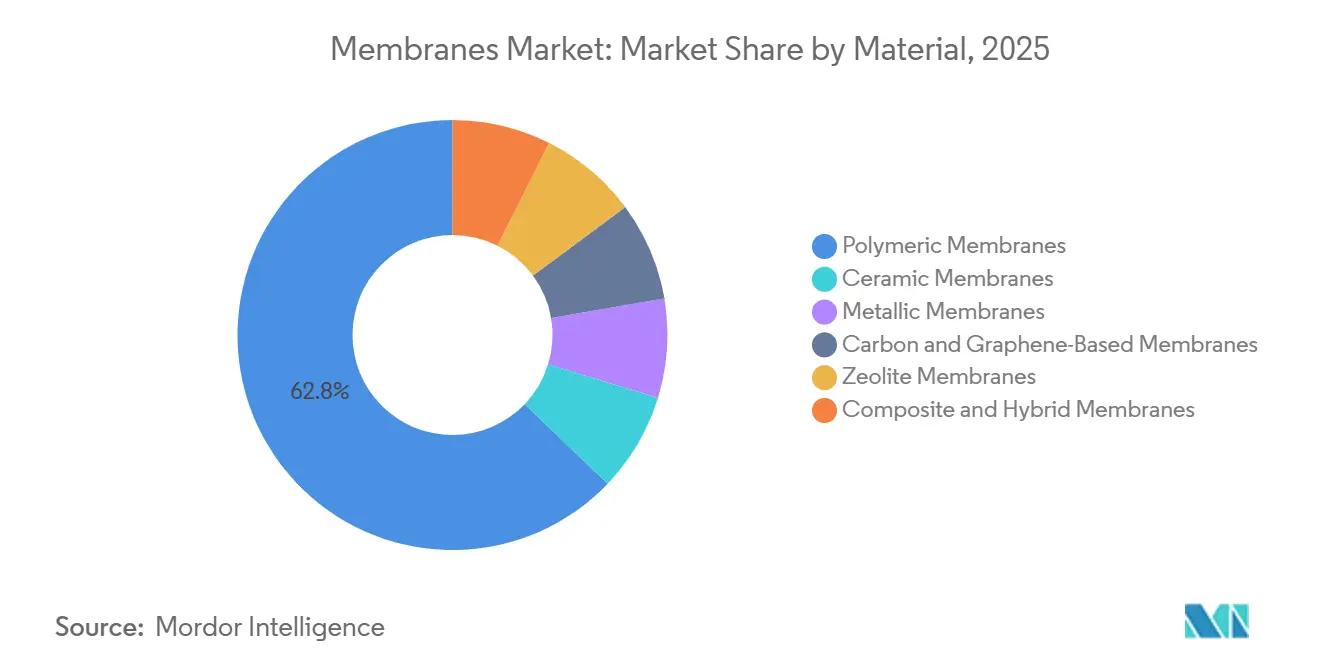
Polymeric Membranes Remain an Established Material While Carbon and Graphene-Based Membranes ProgressPolymeric membranes held 62.83% of the membranes market revenue in 2025. Their position reflects processing flexibility, cost competitiveness, and extensive use in municipal water treatment and pharmaceutical filtration. Polyvinylidene fluoride hollow fiber membranes are gaining use in industrial wastewater reuse because of their chemical resistance and mechanical strength. They can perform better than cellulose acetate alternatives in high-fouling streams. This established base keeps polymeric products central to the membranes market industry across major applications.
Carbon and graphene-based membranes are forecast to grow at an 8.61% CAGR through 2031. Research from 2025 demonstrated porous graphene membrane production at 500 cm² using low-cost copper foil substrates with a reported cost of USD 10 per m². Ceramic membranes are gaining use in chemical, petrochemical, and food processing settings with demanding temperature and chemical conditions. Metallic membranes remain relevant for specialized high-temperature separations in energy and chemical applications. Zeolite, composite, and hybrid membranes support earlier-stage or specialized uses in gas separation, dehydration, pharmaceutical clarification, and food-grade concentration.



By Technology:
Forward Osmosis Gains Momentum While Reverse Osmosis Retains ScaleReverse osmosis was the largest technology segment in 2025 with a 34.61% share. High-rejection and lower-energy elements are replacing older units during standard replacement cycles. Ultrafiltration and microfiltration continue to serve as pretreatment systems for reverse osmosis and nanofiltration. Toray introduced the F-HFUG Series ultrafiltration module in May 2026, with a 0.005 µm pore size and a stated reduction in downstream reverse osmosis biofouling. Nanofiltration, membrane distillation, electrodialysis, and membrane bioreactors serve drinking water, brine management, desalination, and municipal reuse needs.
Forward osmosis is projected to expand at a 9.27% CAGR through 2031. Its use in zero-liquid-discharge pretreatment and brine concentration reflects lower energy use than pressure-driven alternatives. The technology can reduce energy consumption by 30% to 50% in relevant applications. A 2025 industrial pilot in India achieved 99.5% dye rejection at 10 liters per square meter per hour (LMH) flux with nano-selective forward osmosis technology. These results indicate progress beyond the emergency and military uses that characterized earlier installations.
By Module Configuration:
Spiral Wound Leads While Hollow Fiber ExpandsSpiral wound modules captured 48.72% of the membranes market revenue in 2025. Their position reflects pressure-handling efficiency, membrane area above 40 m² per 8-inch element, and compatibility with large reverse osmosis and nanofiltration systems. They are widely used in municipal desalination, industrial water recycling, and pharmaceutical purification. The module format provides a practical fit for applications that require high treatment capacity. Its installed base also supports a steady replacement opportunity for the membranes market.
Hollow fiber is forecast to grow at a 6.89% CAGR through 2031, supported by membrane bioreactor and ultrafiltration wastewater reuse systems. Its backwashability, packing density, and ability to handle variable feedwater are important operating advantages. DuPont expanded its FilmTec Fortilife range in April 2026 with XC220 and XC-Max Ultra High Purity (UHP) elements for high-concentration zero-liquid-discharge and minimal-liquid-discharge applications. Tubular modules remain useful for pulp and paper, oil-water separation, and food processing with high suspended solids. Plate and frame and capillary modules retain specialized roles in pharmaceutical, high-viscosity food, and drinking water applications.
By Application:
Water and Wastewater Treatment Leads While Electronics and Semiconductor Processing Grows FasterWater and wastewater treatment was the largest application segment in 2025 with a 46.95% share. Greenfield municipal projects and the replacement of plants installed in the 1990s and 2000s support this position. Demand comes from drinking water, industrial reuse, desalination, and municipal wastewater treatment. The segment benefits from policy spending on water security and compliance. These conditions maintain water treatment as the broadest application base in the membranes market.
Electronics and semiconductor processing are forecast to grow at an 8.14% CAGR through 2031. Leading-edge chip plants require ultrapure water, and membrane systems are a fixed part of those treatment trains. Japan’s semiconductor investment is also increasing demand for high-performance membrane products. Food and beverage processing uses membranes for concentration and clarification that can reduce thermal processing. Pharmaceutical, chemical, petrochemical, pulp and paper, and oil and gas applications add demand where reuse, purity, or discharge requirements justify membrane investment.
By End-Use Industry:
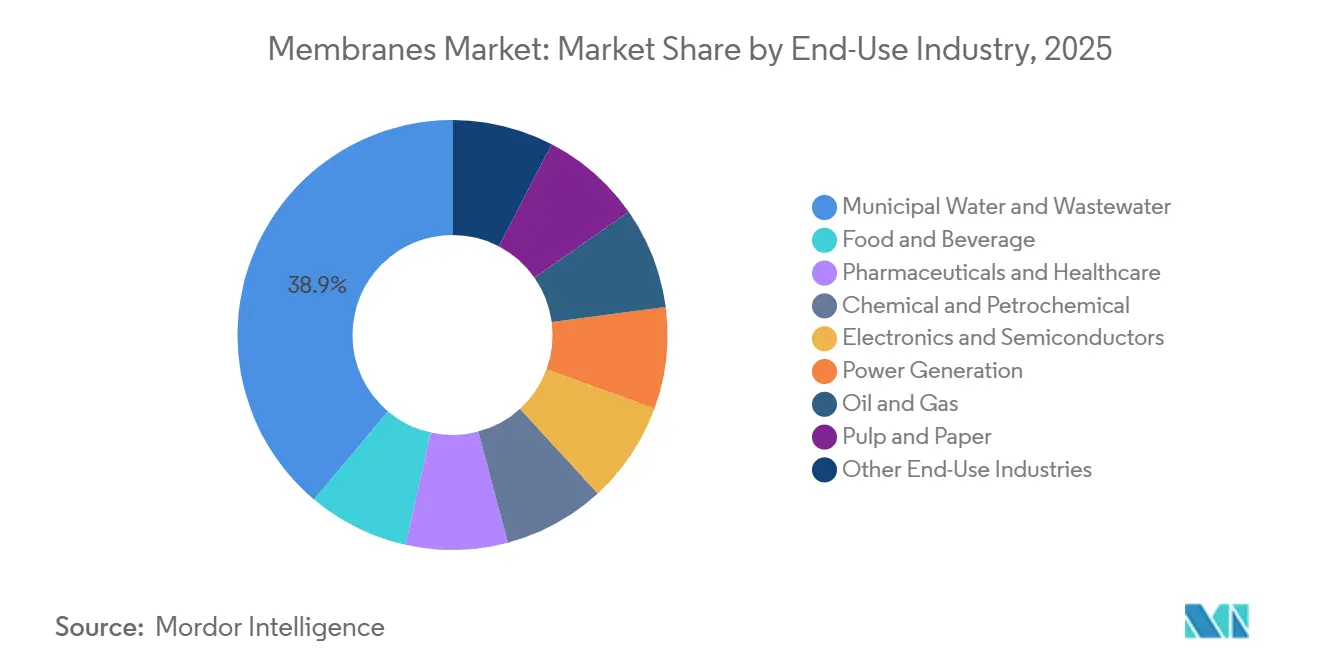
Municipal Water and Wastewater Remain the Foundation While Electronics and Semiconductors ExpandMunicipal water and wastewater held 38.86% of the membranes market revenue in 2025. The segment’s scale reflects the daily water volumes treated by public systems and the priority governments place on water security. India’s Jal Jeevan Mission and China’s water pollution programs support multi-year procurement of treatment equipment. Public policy can provide a stronger demand indicator than broad industrial production for this end use. Municipal systems, therefore, remain the foundational customer base for the membranes market industry.
Electronics and semiconductors is forecast to grow at an 8.17% CAGR through 2031. Its growth is tied to the physical water-purity requirements of advanced chip fabrication. Food and beverage, pharmaceuticals and healthcare, chemical and petrochemical, and power generation are mid-tier contributors with separate demand drivers. In oil and gas and pulp and paper, discharge compliance is often more important than new capacity. Power plants use membranes for cooling water treatment and boiler feed systems, where scaling and fouling control affect operating efficiency.
Geography Analysis
APAC Membranes Market
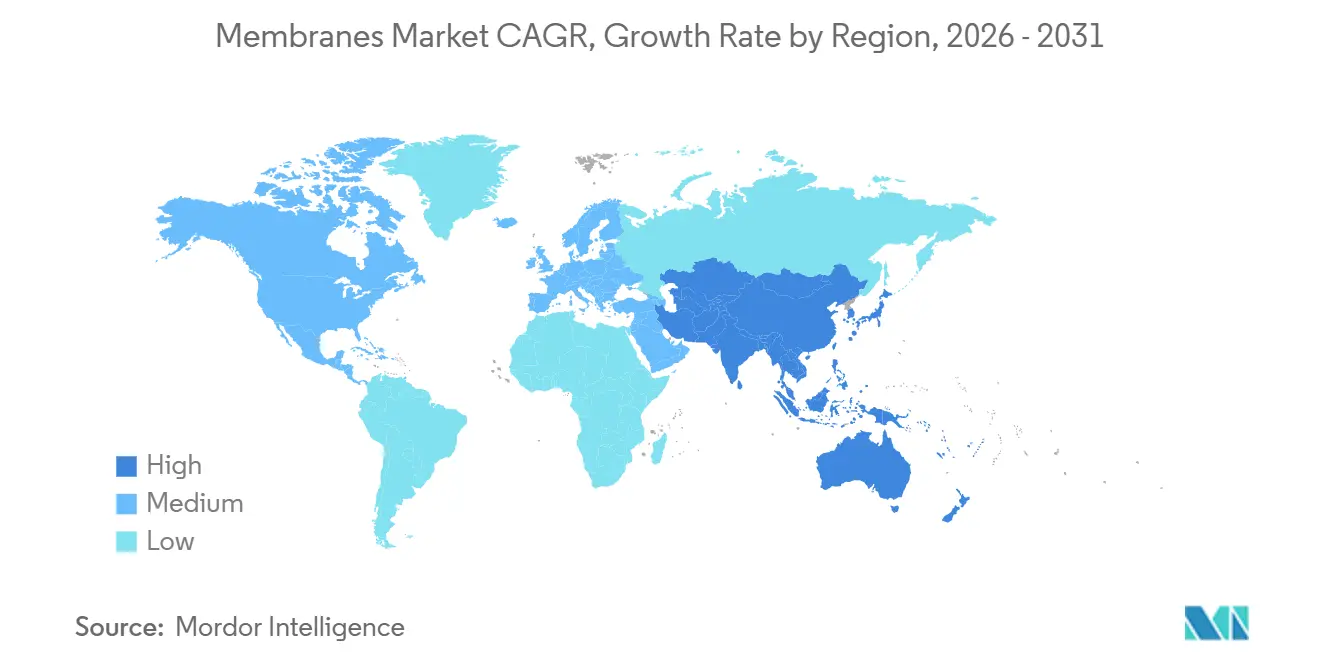
Asia-Pacific commanded 42.27% of the membranes market share in 2025 and is forecast to grow at a 6.52% CAGR through 2031. China’s demand is supported by large reverse osmosis manufacturing capacity and government water programs. Its production base exceeds 10 million reverse osmosis elements annually. In India, demand is supported by the Namami Gange program, industrial zero-liquid-discharge mandates, and coastal desalination expansion. Domestic production meets only a portion of Indian demand, maintaining the need for imports and creating partnership opportunities for global suppliers.
North America and Europe Membranes Market
North America is a mature region shaped by regulatory requirements and system modernization. U.S. municipal utilities are upgrading systems in response to per- and polyfluoroalkyl substances (PFAS) remediation needs, drinking water standards, and infrastructure allocations. Canada supplies stable municipal and industrial treatment demand, while Mexico’s manufacturing base supports greater process-water treatment needs. Europe is driven by the Water Framework Directive and the Urban Wastewater Treatment Directive. Germany, France, and the United Kingdom lead adoption in pharmaceutical, food and beverage, and municipal applications. Semiconductor projects in Germany, the Netherlands, and Ireland are adding a newer demand base for ultrapure water membranes.
MEA and South America Membranes Market
The Middle-East and Africa is among the most capital-intensive regions for the membranes market. Saudi Arabia’s Ras Mohaisen desalination project reached financial close in 2025 with an investment of USD 686 million and is planned to produce 300,000 m³ per day at full capacity by 2030. Local production is becoming more relevant in supplier selection for regional desalination tenders. Brazil and Argentina anchor South American demand through municipal water and industrial effluent treatment. Macroeconomic volatility and infrastructure finance gaps moderate project activity in parts of the region. The membranes market size across these regions depends heavily on the timing of utility investment and industrial water reuse projects.

Competitive Landscape
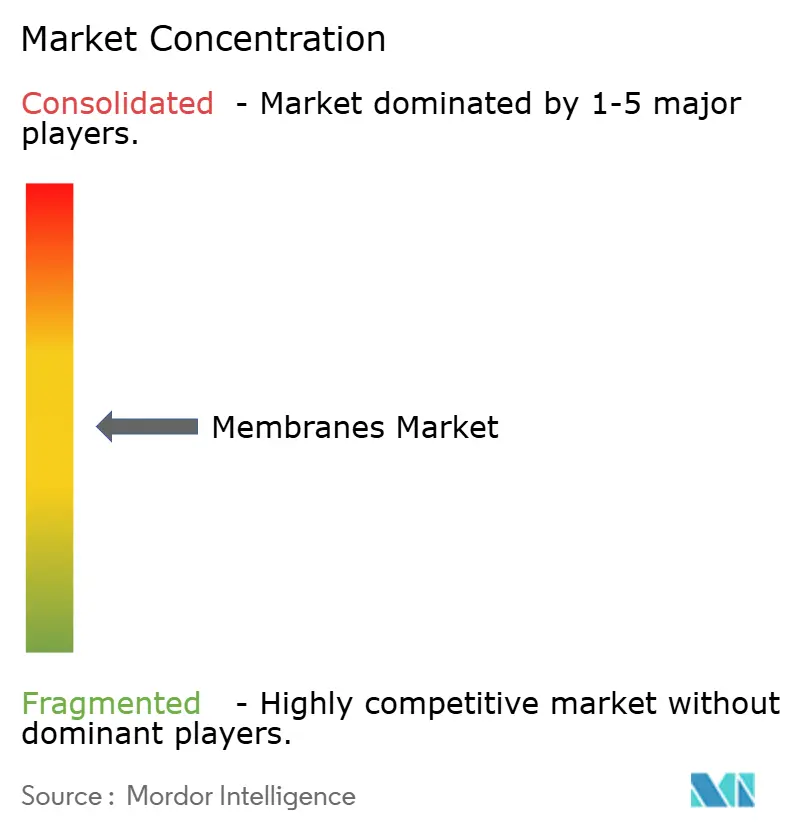
The membranes market is moderately concentrated, with the top five players including DuPont, TORAY INDUSTRIES, INC., Veolia, Hydranautics - A Nitto Group Company, and Kovalus Separation Solutions. Chinese manufacturers are increasing price pressure in mid-grade products, especially in South and Southeast Asian public tenders. This structure encourages established suppliers to focus on zero-liquid-discharge reverse osmosis, ultrapure water, and pharmaceutical filtration.
DuPont expanded the FilmTec Fortilife portfolio in April 2026 with the XC220 and XC-Max UHP elements for zero-liquid-discharge and resource recovery applications. The company also introduced integrated pre-filter ultrafiltration modules in April 2026 for new and space-constrained installations. These moves broaden its offering in municipal water quality and high-concentration treatment. Toray is preparing the TSW-K/M/V series for seawater desalination applications with lower salt permeability. Its product development reflects the value of membrane formation and characterization capabilities, in addition to production scale.
Manufacturing proximity is becoming a competitive factor in the Middle-East desalination projects. Toray’s Dammam facility and LG Chem’s Saudi production initiative show why local capability is gaining weight in tender decisions. Energy Recovery signed a lease in July 2026 for a manufacturing facility near Dammam, which is expected to support its pressure exchanger process from 2027. Nanostone Water and Kovalus Separation Solutions serve more specialized opportunities in ceramic and industrial separation products. These firms can build positions where reverse-osmosis-focused suppliers have less established offerings. The membranes market is therefore differentiated by product performance, validation requirements, local service, and application engineering, rather than price alone.
Membranes Industry Leaders
DuPont
TORAY INDUSTRIES, INC.
Veolia
Hydranautics - A Nitto Group Company
Kovalus Separation Solutions
- *Disclaimer: Major Players sorted in no particular order
Membranes Market Companies Covered in this Report
- Alfa Laval
- Applied Membranes, Inc.
- DuPont
- GEA Group Aktiengesellschaft
- Hydranautics - A Nitto Group Company
- Kovalus Separation Solutions
- MANN+HUMMEL
- Nanostone Water, Inc.
- Pall Corporation
- Pentair
- Sterlitech Corporation
- Synder Filtration, Inc.
- Thermo Fisher Scientific Inc.
- TORAY INDUSTRIES, INC.
- TOYOBO CO., LTD.
- Veolia
- Xylem

Recent Industry Developments in Membranes Market
- June 2026: Evonik Industries AG launched pilot production of DURAION, a high-performance anion exchange membrane (AEM) for green hydrogen production, at its Marl Chemical Park facility in Germany. The facility has an annual production capacity of up to 2.5 GW, representing approximately 25% of Germany's total planned electrolysis capacity for 2030.
- May 2026: TORAY INDUSTRIES, INC. launched the F-HFUG Series ultrafiltration membrane module for wastewater reuse, featuring a 0.005 µm nominal pore size. The module reduced downstream reverse osmosis biofouling by approximately two-thirds compared with conventional ultrafiltration modules.


Global Membranes Market Report Scope
Membranes are selective barriers that separate substances based on properties such as particle size, molecular weight, or chemical affinity. They are widely used for filtration, purification, concentration, and separation processes across water treatment, food processing, healthcare, chemical manufacturing, and other industrial applications.
The Membranes Market is segmented by material, technology, module configuration, application, end-use industry, and geography. By material, the market is segmented into polymeric membranes, ceramic membranes, metallic membranes, carbon and graphene-based membranes, zeolite membranes, and composite and hybrid membranes. By technology, the market is segmented into reverse osmosis (RO), forward osmosis (FO), ultrafiltration (UF), microfiltration (MF), nanofiltration (NF), membrane distillation (MD), electrodialysis and electrodialysis reversal (ED/EDR), pervaporation, membrane bioreactors (MBR), and other technologies. By module configuration, the market is segmented into spiral wound, hollow fiber, tubular, plate and frame, and capillary. By application, the market is segmented into water and wastewater treatment, food and beverage processing, pharmaceutical and medical processing, chemical and petrochemical processing, electronics and semiconductor processing, pulp and paper processing, oil and gas processing, and other applications. By end-use industry, the market is segmented into municipal water and wastewater, food and beverage, pharmaceuticals and healthcare, chemical and petrochemical, electronics and semiconductors, power generation, oil and gas, pulp and paper, and other end-use industries. The report also covers the market size and forecasts for membranes in 16 countries across major regions. For each segment, the market sizing and forecasts have been done on the basis of value (USD).
| Polymeric Membranes |
| Ceramic Membranes |
| Metallic Membranes |
| Carbon and Graphene-Based Membranes |
| Zeolite Membranes |
| Composite and Hybrid Membranes |
| Reverse Osmosis (RO) |
| Forward Osmosis (FO) |
| Ultrafiltration (UF) |
| Microfiltration (MF) |
| Nanofiltration (NF) |
| Membrane Distillation (MD) |
| Electrodialysis and Electrodialysis Reversal (ED/EDR) |
| Pervaporation |
| Membrane Bioreactors (MBR) |
| Other Technologies |
| Spiral Wound |
| Hollow Fiber |
| Tubular |
| Plate and Frame |
| Capillary |
| Water and Wastewater Treatment |
| Food and Beverage Processing |
| Pharmaceutical and Medical Processing |
| Chemical and Petrochemical Processing |
| Electronics and Semiconductor Processing |
| Pulp and Paper Processing |
| Oil and Gas Processing |
| Other Applications |
| Municipal Water and Wastewater |
| Food and Beverage |
| Pharmaceuticals and Healthcare |
| Chemical and Petrochemical |
| Electronics and Semiconductors |
| Power Generation |
| Oil and Gas |
| Pulp and Paper |
| Other End-Use Industries |
| Asia-Pacific | China |
| India | |
| Japan | |
| South Korea | |
| Rest of Asia-Pacific | |
| North America | United States |
| Canada | |
| Mexico | |
| Europe | Germany |
| United Kingdom | |
| France | |
| Italy | |
| Russia | |
| Rest of Europe | |
| South America | Brazil |
| Argentina | |
| Rest of South America | |
| Middle-East and Africa | Saudi Arabia |
| South Africa | |
| Rest of Middle-East and Africa |
| By Material | Polymeric Membranes | |
| Ceramic Membranes | ||
| Metallic Membranes | ||
| Carbon and Graphene-Based Membranes | ||
| Zeolite Membranes | ||
| Composite and Hybrid Membranes | ||
| By Technology | Reverse Osmosis (RO) | |
| Forward Osmosis (FO) | ||
| Ultrafiltration (UF) | ||
| Microfiltration (MF) | ||
| Nanofiltration (NF) | ||
| Membrane Distillation (MD) | ||
| Electrodialysis and Electrodialysis Reversal (ED/EDR) | ||
| Pervaporation | ||
| Membrane Bioreactors (MBR) | ||
| Other Technologies | ||
| By Module Configuration | Spiral Wound | |
| Hollow Fiber | ||
| Tubular | ||
| Plate and Frame | ||
| Capillary | ||
| By Application | Water and Wastewater Treatment | |
| Food and Beverage Processing | ||
| Pharmaceutical and Medical Processing | ||
| Chemical and Petrochemical Processing | ||
| Electronics and Semiconductor Processing | ||
| Pulp and Paper Processing | ||
| Oil and Gas Processing | ||
| Other Applications | ||
| By End-Use Industry | Municipal Water and Wastewater | |
| Food and Beverage | ||
| Pharmaceuticals and Healthcare | ||
| Chemical and Petrochemical | ||
| Electronics and Semiconductors | ||
| Power Generation | ||
| Oil and Gas | ||
| Pulp and Paper | ||
| Other End-Use Industries | ||
| By Geography | Asia-Pacific | China |
| India | ||
| Japan | ||
| South Korea | ||
| Rest of Asia-Pacific | ||
| North America | United States | |
| Canada | ||
| Mexico | ||
| Europe | Germany | |
| United Kingdom | ||
| France | ||
| Italy | ||
| Russia | ||
| Rest of Europe | ||
| South America | Brazil | |
| Argentina | ||
| Rest of South America | ||
| Middle-East and Africa | Saudi Arabia | |
| South Africa | ||
| Rest of Middle-East and Africa | ||


Key Questions Answered in the Report
What is the size of the membranes market?
The membranes market stands at USD 11.97 billion and is projected to reach USD 15.84 billion by 2031.
Which material led the membrane demand in 2025?
Polymeric membranes led revenue with a 62.83% share in 2025 because they are widely used in municipal treatment and pharmaceutical filtration.
Which membrane technology is expected to grow fastest?
Forward osmosis (FO) is projected to grow at a 9.27% CAGR through 2031. Its role in zero-liquid-discharge pretreatment and brine concentration is supported by lower energy use than pressure-driven alternatives in appropriate industrial treatment applications.
Why are semiconductor plants important for membrane suppliers?
Advanced semiconductor plants need large volumes of ultrapure water, making membrane treatment systems essential for fabrication operations.
Page last updated on:





