
Medical Marker Bands Market Size and Share
Market Overview
| Study Period | 2020 - 2031 |
|---|---|
| Market Size (2026) | USD 9.92 Billion |
| Market Size (2031) | USD 12.48 Billion |
| Growth Rate (2026 - 2031) | 4.71 % |
| Fastest Growing Market | Asia-Pacific |
| Largest Market | North America |
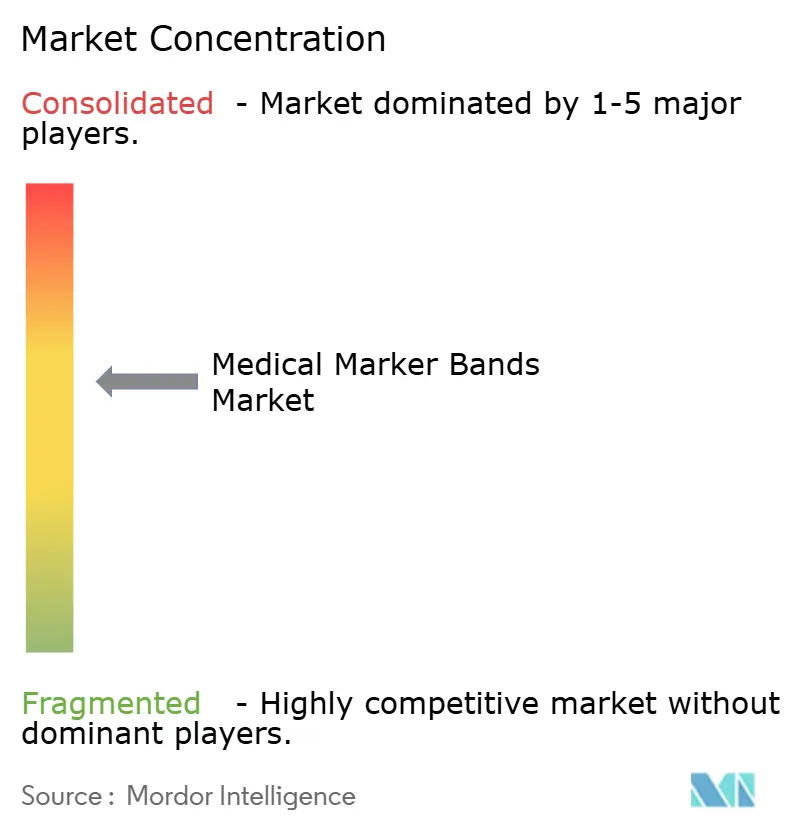
| Market Concentration | Medium |
Major Players *Disclaimer: Major Players sorted in no particular order Image © Mordor Intelligence. Reuse requires attribution under CC BY 4.0. | |
Medical Marker Bands Market Analysis by Mordor Intelligence
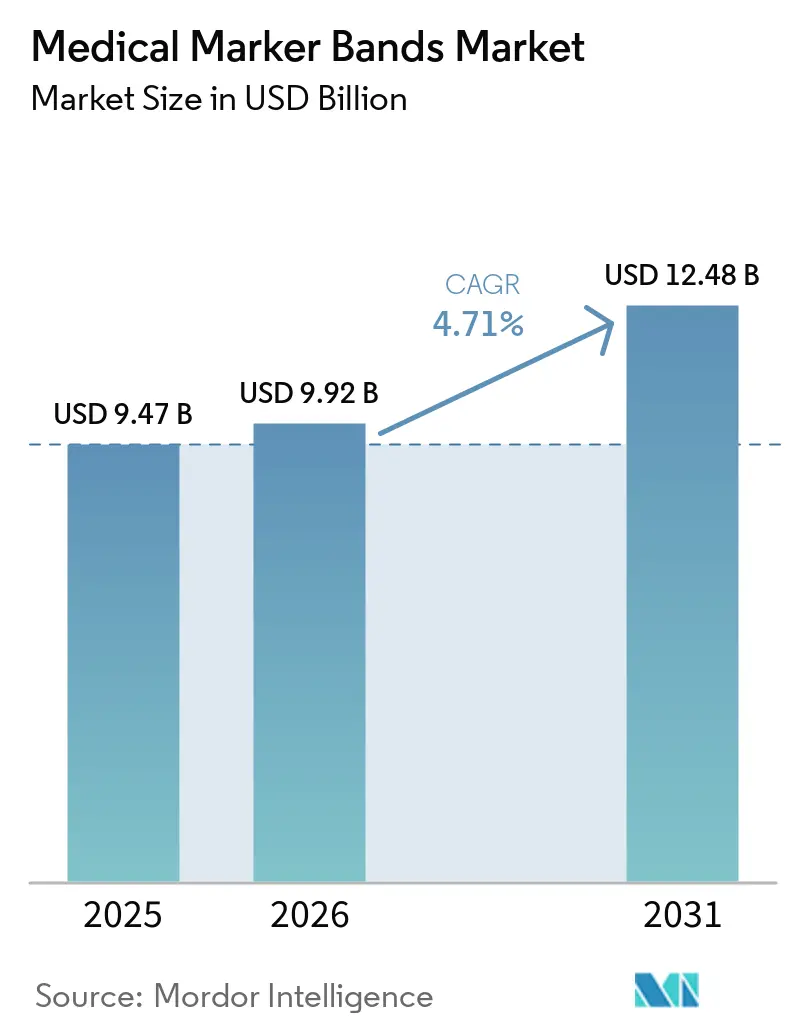
The Medical Marker Bands Market size was valued at USD 9.47 billion in 2025 and is estimated to grow from USD 9.92 billion in 2026 to reach USD 12.48 billion by 2031, at a CAGR of 4.71% during the forecast period (2026-2031).
The medical marker bands market is supported by wider use of catheter-based treatment in cardiovascular, neurovascular, and urological care, where accurate device location is central to procedure planning and execution. Image-guided procedures require reliable visibility at critical points on a catheter, guidewire, or delivery system, particularly when clinicians work within narrow vessels or complex anatomical pathways during treatment. Demand is also moving upstream as device manufacturers specify customized bands earlier in product development, linking the component choice to catheter design rather than treating it as a final assembly decision. Precision requirements are becoming more demanding as device profiles become smaller and hybrid imaging becomes more common. Cost pressure from precious metals and longer validation work will continue to influence supplier selection in the medical marker bands market, as OEMs weigh validated performance against material cost and supply continuity.
Key Report Takeaways
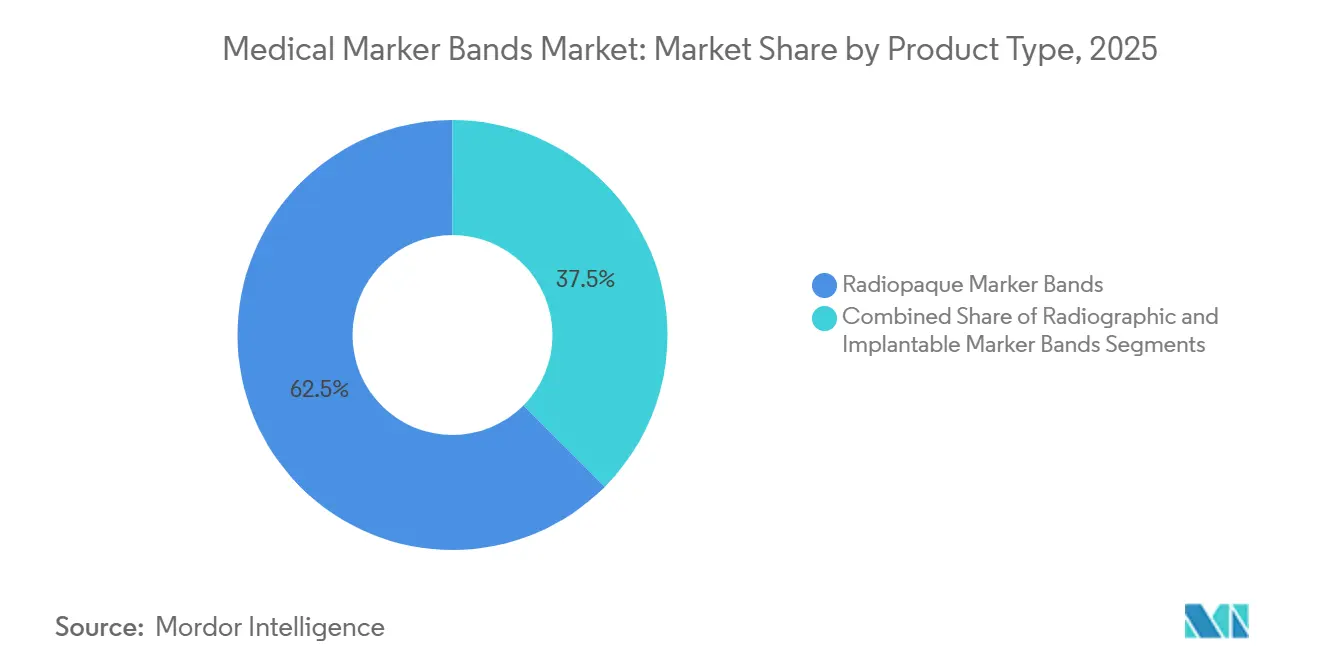
- By product type, radiopaque marker bands held 62.54% of the medical marker bands market share in 2025, while radiographic marker rings are forecast to grow at a 6.47% CAGR through 2031.
- By material, platinum-iridium alloys accounted for 45.65% of the medical marker bands market share in 2025, while tungsten-filled polymers are forecast to expand at a 7.21% CAGR through 2031.
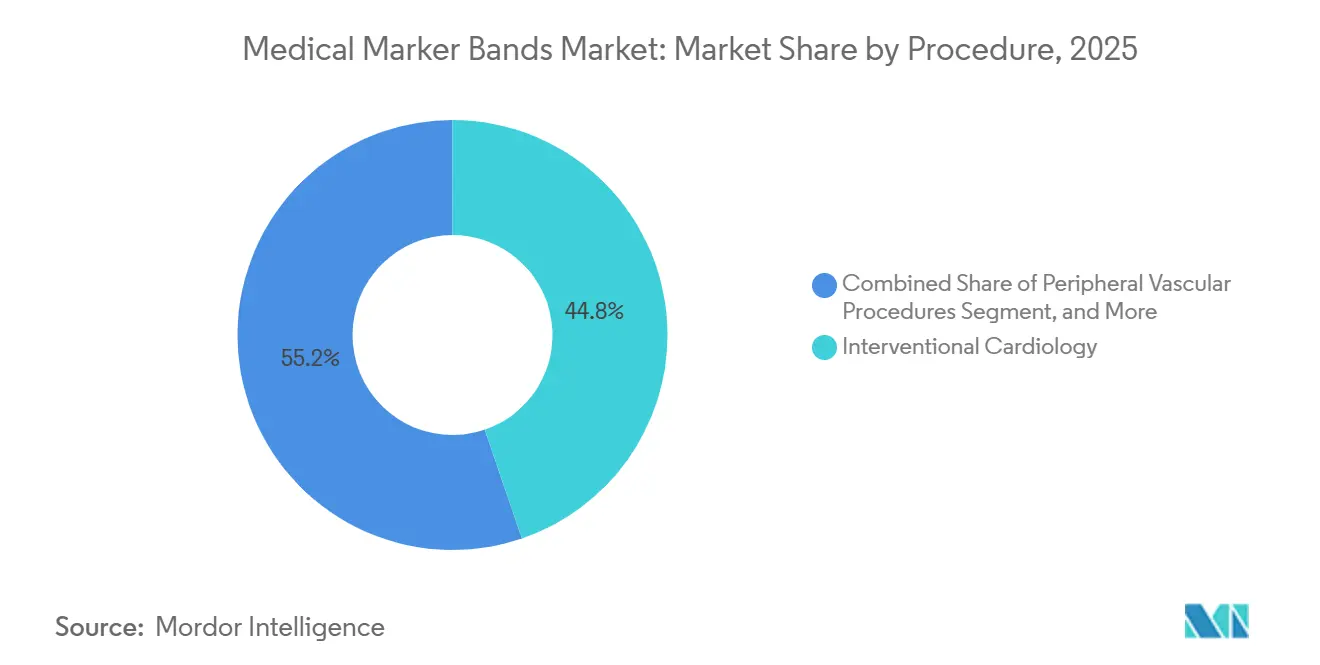
- By procedure, interventional cardiology held 44.76% revenue share in 2025, while urological procedures are forecast to grow at a 7.54% CAGR through 2031.
- By end user, hospitals accounted for 52.65% of demand in 2025, while medical device manufacturers are forecast to expand at a 7.76% CAGR through 2031.
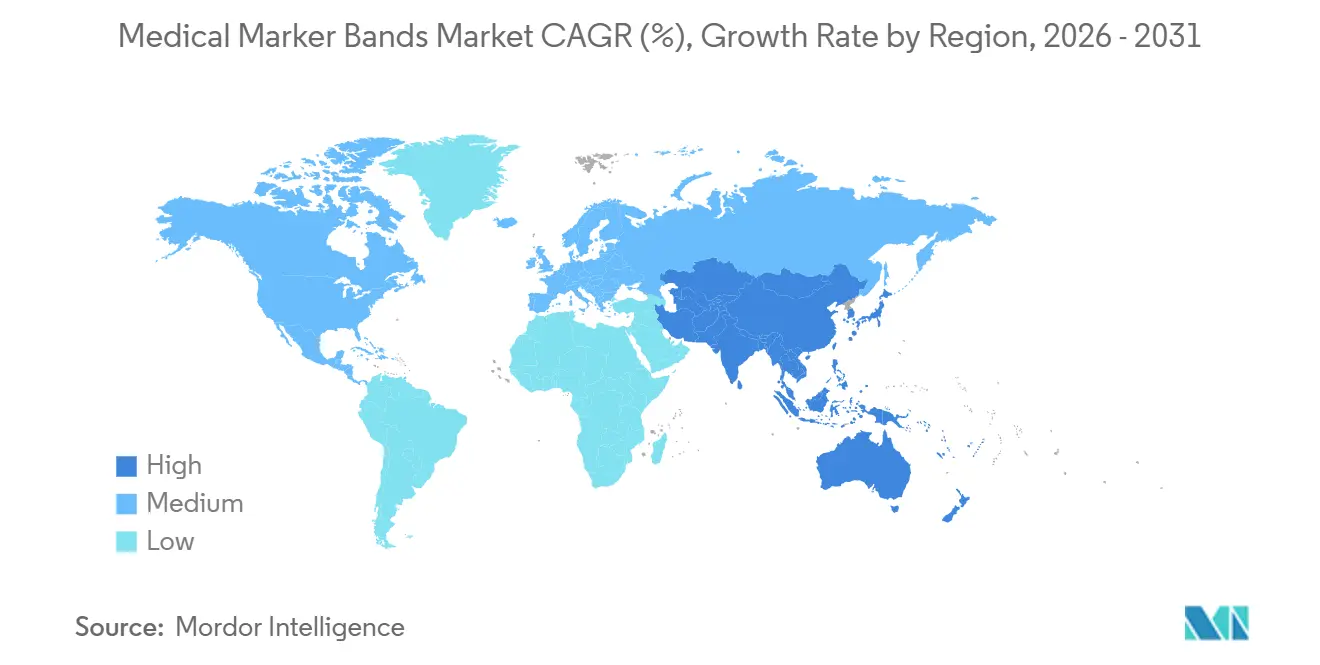
- By geography, North America accounted for 42.43% of demand in 2025, and Asia-Pacific is projected to expand at a 5.87% CAGR through 2031.
Note: Market size and forecast figures in this report are generated using Mordor Intelligence’s proprietary estimation framework, updated with the latest available data and insights as of January 2026.
Market Trends and Insights
Drivers Impact Analysis of Medical Marker Bands Market*
| Driver | (~) % Impact on CAGR Forecast | Geographic Relevance | Impact Timeline |
|---|---|---|---|
| Expansion of Image-Guided Minimally Invasive Procedures | +1.30% | Global, concentrated in North America and Western Europe with fast acceleration in Asia-Pacific | Medium term (2-4 years) |
| Rising Cardiovascular and Neurovascular Intervention Volumes | +1.10% | Global, with the highest procedure density in North America, Europe, and East Asia | Long term (≥ 4 years) |
| Growing Demand for High-Precision Catheter Navigation | +0.80% | North America and Europe, with spillover to Asia-Pacific and the Middle East and Africa | Medium term (2-4 years) |
| Increasing Adoption of Tungsten-Filled Polymer Marker Bands | +0.60% | Global, with strong traction across OEM supply chains | Short term (≤ 2 years) |
| Ultra-Thin Marker Integration for Distal Neurovascular Devices | +0.50% | North America, Europe, Japan, China, and South Korea | Medium term (2-4 years) |
| Integrated Radiopacity and Device Identification | +0.40% | Global, with early adoption in North America and Europe | Medium term (2-4 years) |
| Source: Mordor Intelligence | |||
Expansion of Image-Guided Minimally Invasive Procedures
Image-guided minimally invasive procedures are expanding across cardiology, neurology, and urology, increasing the number of situations where clinicians need to see the distal portion of a device during treatment. The American Academy of Facial Plastic and Reconstructive Surgery reported that minimally invasive techniques represented 83% of procedures in the United States in 2023. Fluoroscopic and CT-guided workflows are also reaching regional hospitals, which broadens the procedural settings that depend on marker-equipped catheters and delivery devices. Complex cases can require several marker band-equipped devices instead of 1 device, because guiding, imaging, treatment, and support catheters can each be used during the same episode of care. Spain's 2024 registry recorded a 3.6% rise in diagnostic procedures and use of intracoronary imaging in 10.6% of percutaneous coronary interventions[1]. This supports higher device content per procedure in the medical marker bands market and makes component demand sensitive to the mix and complexity of procedures, not only total procedure counts.
Rising Cardiovascular and Neurovascular Intervention Volumes
Cardiovascular disease remains a major source of mortality and treatment demand. The American Heart Association reported 17.9 million cardiovascular deaths worldwide each year in its 2026 update. Structural heart procedures added volume across Spain's participating catheterization laboratories in 2024. These procedures use several devices that require accurate radiographic positioning, as treatment teams need to distinguish the device tip and other functional points under imaging. Acute ischemic stroke treatment also uses aspiration catheters, microcatheters, and guide catheters in a single procedure. Higher procedural complexity, therefore, raises marker band content per completed case in the medical marker bands market, even where the increase in total cases is more measured.
Growing Demand for High-Precision Catheter Navigation
Smaller endovascular devices require closer control of marker band dimensions, since a component that is too large or poorly positioned can compromise the intended device profile. Nittoku Seisakusho states that its catheter marker pipes can achieve wall thicknesses of 13 μm. At these dimensions, band geometry affects visibility and the profile of the catheter shaft, making manufacturing consistency important for both clinical handling and imaging performance. Physicians need a clear device location when treating torturous anatomy. This requirement is especially relevant to neurovascular and structural heart procedures. Suppliers with micro-machining and precision tube-drawing capabilities can address tighter customer specifications and provide the documentation needed for repeatable component performance. These requirements support demand for higher-value components in the medical marker bands market.
Increasing Adoption of Tungsten-Filled Polymer Marker Bands
Tungsten-filled polymer bands offer an alternative to precious-metal components in applications where catheter flexibility, integrated construction, and material cost are important design considerations. Putnam Plastics offers polymer systems with tungsten loading from 65% to 80% by weight. These materials can align with the flexibility requirements of nylon, Pebax, and polyurethane catheter shafts, allowing the marker feature to be considered alongside shaft construction. Polymer bands can be bonded with the shaft material rather than attached through a crimping process. This design can reduce the risk of separation caused by mechanical attachment and may simplify an assembly step for catheter makers. The approach also lets manufacturers combine tubing and radiopaque elements in a more integrated production process. The medical marker bands market therefore has a lower-cost option for suitable gastrointestinal, urological, and peripheral vascular devices, while high-criticality applications may continue to favor established metal designs.
Restraints Impact Analysis of Medical Marker Bands Market*
| Restraint | (~) % Impact on CAGR Forecast | Geographic Relevance | Impact Timeline |
|---|---|---|---|
| Volatility in Platinum, Gold, and Iridium Prices | -0.80% | Global, most acute for North American and European OEMs with high precious-metal content | Short term (≤ 2 years) |
| Stringent Biocompatibility and Device-Validation Requirements | -0.60% | Global, with intensive compliance requirements in North America and Europe | Long term (≥ 4 years) |
| Risk of Marker Delamination or Distal-Tip Failure | -0.50% | Global, particularly in cardiac, neurovascular, and peripheral vascular applications | Medium term (2-4 years) |
| Limited High-Precision Manufacturing Capacity in Emerging Markets | -0.40% | Asia-Pacific, the Middle East and Africa, and South America | Medium term (2-4 years) |
| Source: Mordor Intelligence | |||
Volatility in Platinum, Gold, and Iridium Prices
Precious-metal pricing is an immediate cost issue for component suppliers and device makers because the cost of radiopaque materials can change independently of clinical procedure demand. U.S. Geological Survey data showed global platinum mine production declined from 179,000 kg in 2024 to an estimated 170,000 kg in 2025[2]. The same source reported an average platinum price of USD 960.7 per troy ounce in 2024 and USD 1,200 per troy ounce in 2025. Platinum-iridium, platinum, gold, and tantalum remain important materials where radiopacity and established clinical use are necessary. Higher input costs can limit the margin available to both component suppliers and catheter OEMs, especially when device contracts and production plans are set before material prices change. Manufacturers may respond through longer procurement arrangements, recycling programs, and material redesign, although each response requires qualification work and operational coordination. Complete substitution remains difficult for critical cardiac and neurovascular applications in the medical marker bands market.
Stringent Biocompatibility and Device-Validation Requirements
The U.S. Food and Drug Administration's Quality Management System Regulation became effective on February 2, 2026[3]. The regulation incorporates ISO 13485:2016 into 21 CFR Part 820[3].. Component manufacturers must maintain design, production, and lifecycle controls that meet finished-device requirements, which raises the importance of controlled processes and traceable records. Vascular devices also require careful evaluation of particulate risks and assembly quality. Dimensional checks, biocompatibility work, and radiopacity testing can lengthen development schedules, particularly when a new material or marker geometry is introduced into an established device platform. These requirements favor suppliers with established quality systems and can slow entry into the medical marker bands market, while also reinforcing the value of prior validation experience for existing suppliers.
*Our forecasts treat driver/restraint impacts as directional, not additive. The impact forecasts reflect baseline growth, mix effects, and variable interactions.
Medical Marker Bands Market Segment Analysis
By Product Type:
Radiopaque Bands Lead While Radiographic Rings Gain UseRadiopaque marker bands held 62.54% of the medical marker bands market share in 2025. Their use in the medical marker bands market reflects the need for reliable visibility in fluoroscopy-guided coronary and neurovascular procedures. Platinum, platinum-iridium, and gold bands provide a strong contrast against arterial anatomy. Their clinical use is supported by long-established device designs and qualification practices. For manufacturers, this installed base creates a practical preference for materials and band formats that can be incorporated into existing validated catheter platforms without changing the core clinical workflow. Implantable marker bands serve a different requirement in anatomical marking and radiation therapy applications. These applications require careful consideration of imaging and biocompatibility requirements. The product type, therefore, includes both high-volume procedural components and more specialized solutions where the marker function is linked to a defined therapeutic or localization purpose.
Radiographic marker rings are projected to grow at a 6.47% CAGR from 2026 to 2031. Their adoption is associated with CT-guided and cone-beam CT procedures. Hybrid imaging rooms require device visibility across more than 1 imaging method. This changes the design requirement from simple fluoroscopic contrast to visibility under multiple modalities. Penumbra introduced the RED 72 SILVER LABEL reperfusion catheter in April 2025 with an articulating marker band design. The medical marker bands market can benefit when catheter developers seek more specialized marker geometries.
By Material:
Platinum-Iridium Leads While Polymers ExpandPlatinum-iridium alloys accounted for 45.65% of the medical marker bands market size in 2025. The material combines radiopacity, biocompatibility, mechanical stiffness, and resistance to imaging artifacts. The 90/10 and 80/20 platinum-iridium compositions are common in coronary and neurovascular applications. These settings require documented performance in high-risk procedures. Gold, tantalum, and pure platinum serve other use cases within the precious-metal material base. Palladium retains a smaller role because its cost-to-performance balance is less favorable than that of leading alloys. Material selection continues to reflect the balance between image visibility, shaft construction, established clinical evidence, and the practical cost of qualifying a component for a specific device.
Tungsten-filled polymers are forecast to grow at a 7.21% CAGR between 2026 and 2031. Within the medical marker bands market, they can be extruded with catheter shaft polymers and reduce the need for mechanical crimping. Putnam Plastics identifies tungsten-filled polymer marker bands as suitable for radiopaque catheter applications. Their radiopacity can support fluoroscopic guidance in gastrointestinal, urological, and peripheral vascular procedures. The material shift is connected to both device design and supply chain simplification. It can increase the role of polymer-focused manufacturers within the medical marker bands market. The shift does not remove the role of metal bands in demanding applications, but it gives device teams a broader material set for platforms with different flexibility and visibility needs.
By Procedure:
Cardiology Holds Volume While Urology Grows FasterInterventional cardiology accounted for 44.76% of the procedure mix in 2025. Percutaneous coronary intervention, transcatheter aortic valve replacement, and left atrial appendage closure support this demand. In the medical marker bands market, a procedure can use guiding catheters, balloon catheters, stent delivery systems, and imaging catheters. Each device may contain multiple bands for positioning. Peripheral vascular and neurovascular procedures also require high marker band content. Stroke thrombectomy can use aspiration, guide, and microcatheters together. This combination illustrates why procedure type matters, because each device used to access, visualize, and treat the target can carry its own marker band requirements.
Urological procedures are projected to grow at a 7.54% CAGR from 2026 to 2031. Ureteroscopy, flexible cystoscopy, and ureteral stent placement need accurate positioning under fluoroscopy. Marker bands help clinicians confirm stent placement and ureteral measurements. This can reduce the need for additional imaging during a procedure. Gastrointestinal procedures also use fluoroscopic guidance in complex anatomical cases. The broader procedure base reduces the medical marker bands market's reliance on cardiology alone. It also brings different clinical users into device specifications, including urologists, gastroenterologists, and interventional radiologists with their own handling and visibility preferences.

By End User:
Hospitals Lead While Device Manufacturers Grow FasterHospitals accounted for 52.65% of end-user demand in 2025. They are the main point of use for single-use catheter kits purchased through device supply contracts. Hospitals do not usually procure individual marker bands directly, yet their purchasing requirements shape the medical marker bands market. However, purchasing specifications can influence the radiopacity performance expected from finished devices. Ambulatory surgical centers are gaining importance as selected urological, gastrointestinal, and electrophysiology procedures move outside hospitals. Lower reimbursement per case can increase the value of lower-cost component choices. This makes the end-user setting relevant even when hospitals and centers buy finished devices rather than individual components, because their purchasing criteria influence OEM design decisions and supplier discussions during catheter development.
Medical device manufacturers are projected to grow at a 7.76% CAGR through 2031. This category captures upstream demand from OEMs buying components for finished catheter systems. Manufacturers are seeking qualified suppliers that can provide customized bands and related subassemblies. Integer supplies marker bands and ring electrodes for medical devices. This upstream demand is expanding as device pipelines grow and supply bases become more focused. OEMs may seek suppliers that can provide a consistent band design, related components, and supporting documentation across multiple catheter programs. The medical marker bands market is therefore shaped by both clinical use and OEM component sourcing.
Geography Analysis
North America Medical Marker Bands Market
North America held 42.43% of the medical marker bands market share in 2025. The medical marker bands market in the region has a high concentration of catheterization laboratories and established reimbursement for advanced interventions. The United States drives regional consumption through cardiovascular, stroke, and structural heart treatment. The American Heart Association identified cardiovascular disease as a major cause of death in the United States in its 2026 statistical update. The FDA's QMSR now requires manufacturers to align their quality systems with ISO 13485:2016.
Europe Medical Marker Bands Market
Europe is the second-largest medical market, with Germany, France, the United Kingdom, and Italy leading procedural throughput. Spain's catheterization registry reported growing structural intervention volumes in 2024. Intracoronary imaging was used in 10.6% of percutaneous coronary interventions in the registry. The EU Medical Device Regulation can make entry more difficult for new implantable marker configurations. Existing suppliers with validated device programs can have an advantage in these settings. Private hospital capacity and hybrid imaging suites are also supporting procedure growth in smaller European countries.
APAC, MEA and South America Medical Marker Bands Market
Asia-Pacific is forecast to grow at a 5.87% CAGR between 2026 and 2031. China, India, Japan, and South Korea are expanding catheterization laboratory capacity. China is increasing domestic catheter production and structural heart procedure volumes. Japan's precision engineering base supports demand for smaller and tighter-tolerance components. Nittoku Seisakusho's 13 μm wall-thickness capability shows the level of precision sought in some catheter applications. The Middle East and Africa remain smaller but benefit from investment in tertiary care. These investments can support the gradual adoption of image-guided treatment, although the regional demand base remains below that of North America, Europe, and the Asia-Pacific. South America remains price-sensitive, while urological and peripheral vascular procedures continue to add demand.
Competitive Landscape
The medical marker bands market is moderately concentrated among specialized component manufacturers. Integer Holdings, Resonetics, Prince & Izant Company, and Edgetech Industries operate in the precision-component tier. These suppliers compete on dimensional control, available materials, and regulatory documentation. Catheter OEMs such as Boston Scientific, Medtronic, Penumbra, and Teleflex establish the product specifications that component suppliers must meet. This makes development activity closely linked to the needs of finished-device programs across varied clinical settings.
Integer stated that KKR agreed to acquire the company in an all-cash transaction valued at USD 5.7 billion in August 2026. The transaction points to investor interest in medical device component capacity and related supply relationships. Resonetics completed its acquisition of Resolution Medical in March 2026. Resonetics also acquired manufacturing assets and process intellectual property from Med-Ally in January 2026. These moves expand its ability to support device development, assembly, and related manufacturing.
Competition also covers precision machining for metal bands and co-extrusion for tungsten-filled polymer alternatives. Penumbra launched the ACCESS25 Delivery Microcatheter in February 2025 with a radiopaque marker band for precise positioning. Regional suppliers in Asia-Pacific may gain interest as local OEMs seek shorter supply routes and less exposure to imported raw materials. Suppliers still need robust quality systems to win qualified OEM programs. This requirement narrows the field of potential suppliers because a component must meet customer specifications and fit within a device maker's established regulatory and manufacturing controls. The FDA framework makes ISO 13485:2016 alignment a core requirement for suppliers serving the United States.
Medical Marker Bands Industry Leaders
-
Resonetics
-
Integer Holdings Corporation
-
Biomerics LLC
-
Johnson Matthey
-
Prince & Izant Company
- *Disclaimer: Major Players sorted in no particular order
Medical Marker Bands Market Companies Covered in this Report
- ALB Materials Inc
- American Elements Corporation
- Argon Medical Devices
- Beckton Dickinson
- Boston Scientific
- Cook Group
- Edgetech Industries LLC
- Healthcare Technologies Ltd
- IMC Intertech LLC
- Integer Holdings
- ITL Innovative Technologies Ltd
- Merit Medical Systems
- Medtronic
- Penumbra
- Prince & Izant Company
- Radiopaque Solutions Inc
- Resonetics
- Smiths Group
- Stanford Advanced Materials Corp
- Teleflex
- Terumo
Recent Industry Developments in Medical Marker Bands Market
- August 2026: KKR announced a definitive agreement to acquire Integer Holdings Corporation in an all-cash transaction valued at approximately USD 5.7 billion enterprise value, representing a 51.8% premium to Integer's April 29 closing price. Integer is one of the world's largest CDMOs for catheter components, including marker bands, ring electrodes, and cardiac leads, serving Abbott, Boston Scientific, and Medtronic. The deal is expected to close by year-end 2026 and will take Integer private.
- May 2026: The FDA classified Cook Medical's voluntary recall of Centimeter, Aurous Centimeter, and Beacon Tip Centimeter sizing catheters as a Class I recall, Recall Numbers Z-1934, Z-1935, and Z-1936-2026, due to marker bands at increased risk of cracking and breakage. The recall affected 15,769 units distributed in the United States and internationally. The FDA noted that device fragmentation and separation could cause life-threatening harm or death.
- March 2026: Resonetics completed its acquisition of Resolution Medical, a Minnesota and Netherlands-based CDMO specializing in integrated design engineering and cleanroom assembly for neuromodulation, structural heart, and interventional cardiology devices. The transaction expanded Resonetics' integrated manufacturing capabilities for catheter therapeutic areas.
- January 2026: Resonetics acquired manufacturing assets, process know-how, and intellectual property related to implantable and external pulse generator manufacturing from Med-Ally. The acquisition expanded its medical power business for neuromodulation, brain-computer interface, and cardiac rhythm management applications.
Global Medical Marker Bands Market Report Scope
According to the report’s scope, medical marker bands are small, flexible rings used to mark or identify specific areas of tissue or medical devices during surgical procedures. They assist in precise localization and measurement in medical treatments.
The medical marker bands market is segmented into product type, material, procedure, end user, and geography. By product type, the market is segmented into radiopaque marker bands, radiographic marker rings, and implantable marker Bands. By material, the market is segmented into platinum-iridium, gold, platinum, tantalum, palladium, tungsten-filled polymers, and other materials. By procedure, the market is segmented into interventional cardiology, peripheral vascular procedures, neurovascular procedures, gastrointestinal procedures, urological procedures, electrophysiology procedures, and other procedures. By end user, the market is segmented into medical device manufacturers, hospitals, ambulatory surgical centers, diagnostic laboratories and imaging centers, and other end users. By geography, the market is segmented into North America, Europe, Asia-Pacific, the Middle East and Africa, and South America. The report also covers the estimated market sizes and trends for 17 countries across major regions globally. The report offers values (USD) for all the above segments.
Segmentation Overview
| Radiopaque Marker Bands |
| Radiographic Marker Rings |
| Implantable Marker Bands |
| Platinum-Iridium |
| Gold |
| Platinum |
| Tantalum |
| Palladium |
| Tungsten-Filled Polymers |
| Other Materials |
| Interventional Cardiology |
| Peripheral Vascular Procedures |
| Neurovascular Procedures |
| Gastrointestinal Procedures |
| Urological Procedures |
| Electrophysiology Procedures |
| Other Procedures |
| Medical Device Manufacturers |
| Hospitals |
| Ambulatory Surgical Centers |
| Diagnostic Laboratories and Imaging Centers |
| Other End Users |
| North America | United States |
| Canada | |
| Mexico | |
| Europe | Germany |
| United Kingdom | |
| France | |
| Italy | |
| Spain | |
| Rest of Europe | |
| Asia-Pacific | China |
| Japan | |
| India | |
| Australia | |
| South Korea | |
| Rest of Asia-Pacific | |
| Middle East and Africa | GCC |
| South Africa | |
| Rest of Middle East and Africa | |
| South America | Brazil |
| Argentina | |
| Rest of South America |
| By Product Type | Radiopaque Marker Bands | |
| Radiographic Marker Rings | ||
| Implantable Marker Bands | ||
| By Material | Platinum-Iridium | |
| Gold | ||
| Platinum | ||
| Tantalum | ||
| Palladium | ||
| Tungsten-Filled Polymers | ||
| Other Materials | ||
| By Procedure | Interventional Cardiology | |
| Peripheral Vascular Procedures | ||
| Neurovascular Procedures | ||
| Gastrointestinal Procedures | ||
| Urological Procedures | ||
| Electrophysiology Procedures | ||
| Other Procedures | ||
| By End User | Medical Device Manufacturers | |
| Hospitals | ||
| Ambulatory Surgical Centers | ||
| Diagnostic Laboratories and Imaging Centers | ||
| Other End Users | ||
| Geography | North America | United States |
| Canada | ||
| Mexico | ||
| Europe | Germany | |
| United Kingdom | ||
| France | ||
| Italy | ||
| Spain | ||
| Rest of Europe | ||
| Asia-Pacific | China | |
| Japan | ||
| India | ||
| Australia | ||
| South Korea | ||
| Rest of Asia-Pacific | ||
| Middle East and Africa | GCC | |
| South Africa | ||
| Rest of Middle East and Africa | ||
| South America | Brazil | |
| Argentina | ||
| Rest of South America | ||
Key Questions Answered in the Report
What is the forecast value for medical marker bands market in 2031?
The medical marker bands market size was valued at USD 9.47 billion in 2025 and is estimated to grow from USD 9.92 billion in 2026 to reach USD 12.48 billion by 2031, at a CAGR of 4.71% during the forecast period (2026-2031).
Which product type led demand in 2025?
Radiopaque marker bands led with 62.5% share in 2025 because fluoroscopy-guided procedures need dependable visibility. They remain relevant where clinicians require consistent contrast while navigating coronary and neurovascular anatomy.
Which material is growing fastest?
Tungsten-filled polymers are projected to grow at a 7.2% CAGR through 2031. Their integrated polymer bonding can reduce mechanical assembly steps and lower exposure to precious-metal cost movements in suitable applications, especially when a device developer can align the marker material with the catheter shaft polymer and does not require the established metal configuration used in the most clinically demanding catheter systems.
Which procedure is growing fastest?
Urological procedures are projected to grow at a 7.5% CAGR through 2031. Fluoroscopic positioning supports ureteroscopy and stent placement, where clinicians need to confirm device location and measurements.
Why do regulations matter for marker band suppliers?
The FDA's QMSR became effective in 2026 and incorporates ISO 13485:2016 into 21 CFR Part 820. The medical marker bands market therefore places greater value on controlled processes, records, and repeatable component validation.
Which region is growing fastest?
Asia-Pacific is projected to grow at a 5.8% CAGR through 2031 as catheterization capacity expands across China, India, Japan, and South Korea. The medical marker bands market may gain from regional manufacturing demand and local device development.