
Medical Ceramics Market Size and Share
Market Overview
| Study Period | 2021 - 2031 |
|---|---|
| Market Size (2026) | USD 20.95 Billion |
| Market Size (2031) | USD 28.91 Billion |
| Growth Rate (2026 - 2031) | 6.65 % |
| Fastest Growing Market | Asia-Pacific |
| Largest Market | North America |
| Market Concentration | Medium |
Major Players *Disclaimer: Major Players sorted in no particular order Image © Mordor Intelligence. Reuse requires attribution under CC BY 4.0. | |
Medical Ceramics Market Analysis by Mordor Intelligence
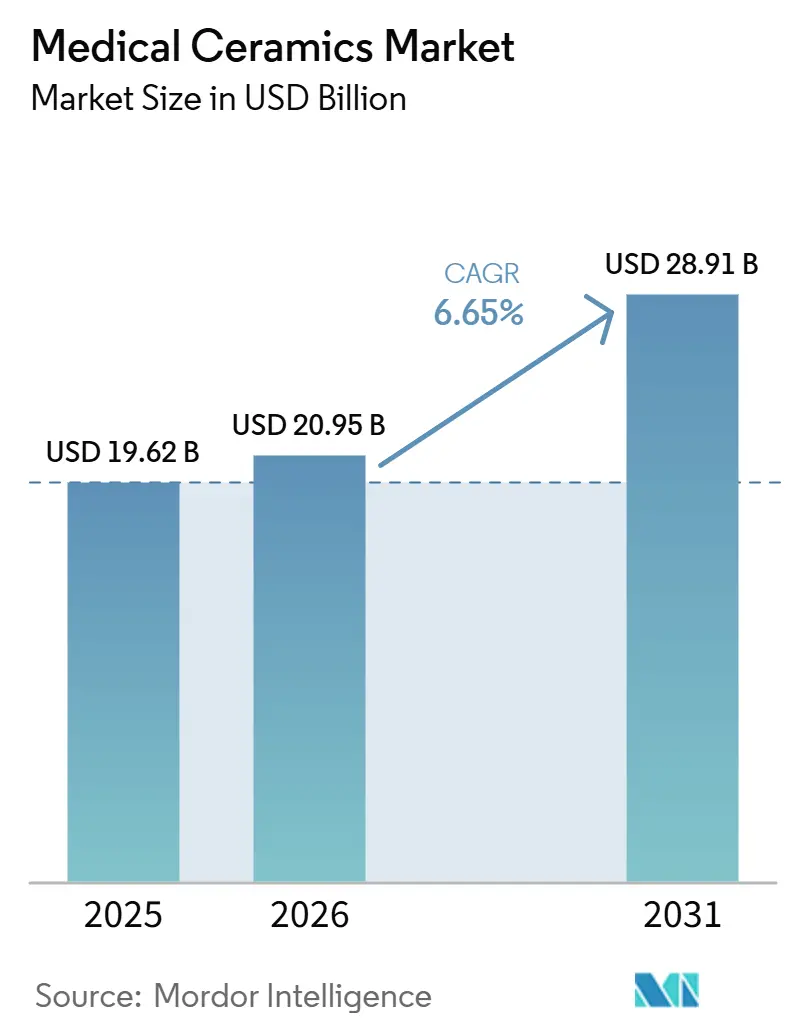
The Medical Ceramics Market size was valued at USD 19.62 billion in 2025 and is estimated to grow from USD 20.95 billion in 2026 to reach USD 28.91 billion by 2031, at a CAGR of 6.65% during the forecast period (2026-2031). Aging populations, musculoskeletal conditions, and dental treatments continue to drive procedure volumes for ceramic implants. Clinical demand favors ceramic materials in applications where wear performance, biocompatibility, and metal-free designs are important. The medical ceramics market is shaped by greater use of digital manufacturing, surface engineering, and specialized components for medical devices. These developments allow suppliers to differentiate through validated materials, production quality, and regulatory support, rather than solely through component supply. Regulatory costs, clinical evidence requirements, and reliance on high-purity materials remain significant barriers to adoption.
Key Report Takeaways
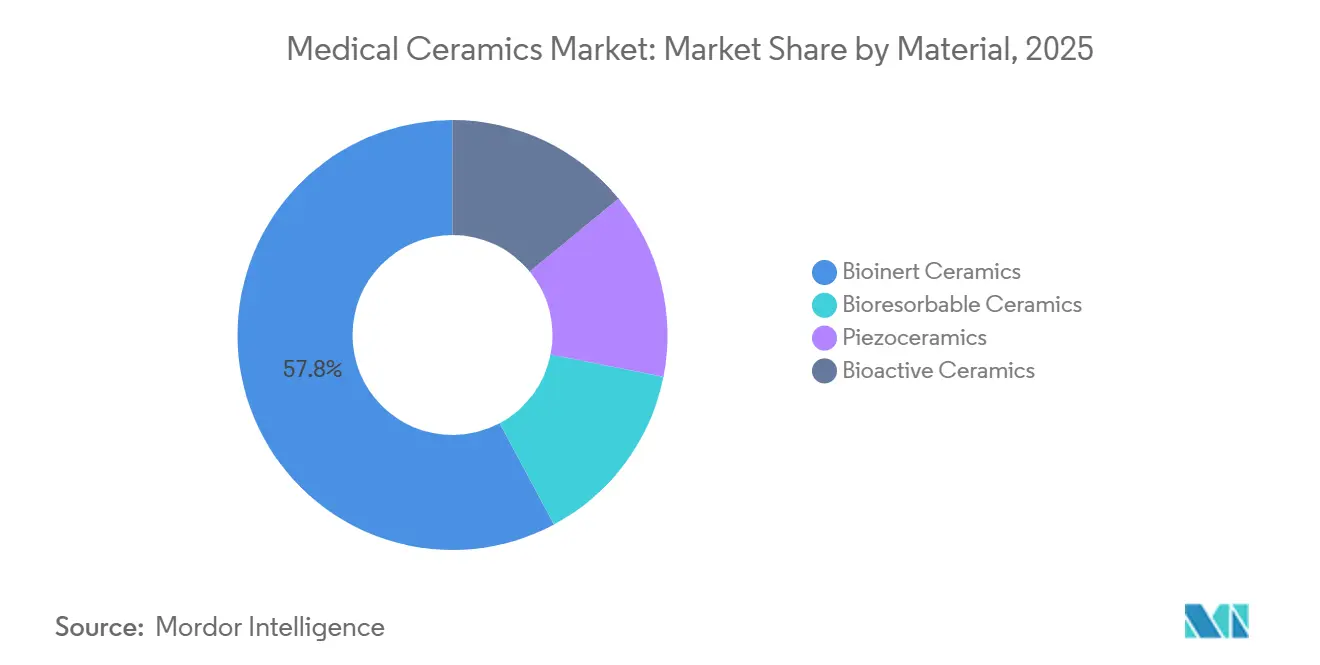
- By material, bioinert ceramics held 57.83% revenue share in 2025, while bioresorbable ceramics are forecast to grow at a CAGR of 8.33% through 2031.
- By application, orthopedic ceramics accounted for 44.81% share in 2025, while dental ceramics are forecast to expand at a 7.41% CAGR through 2031.
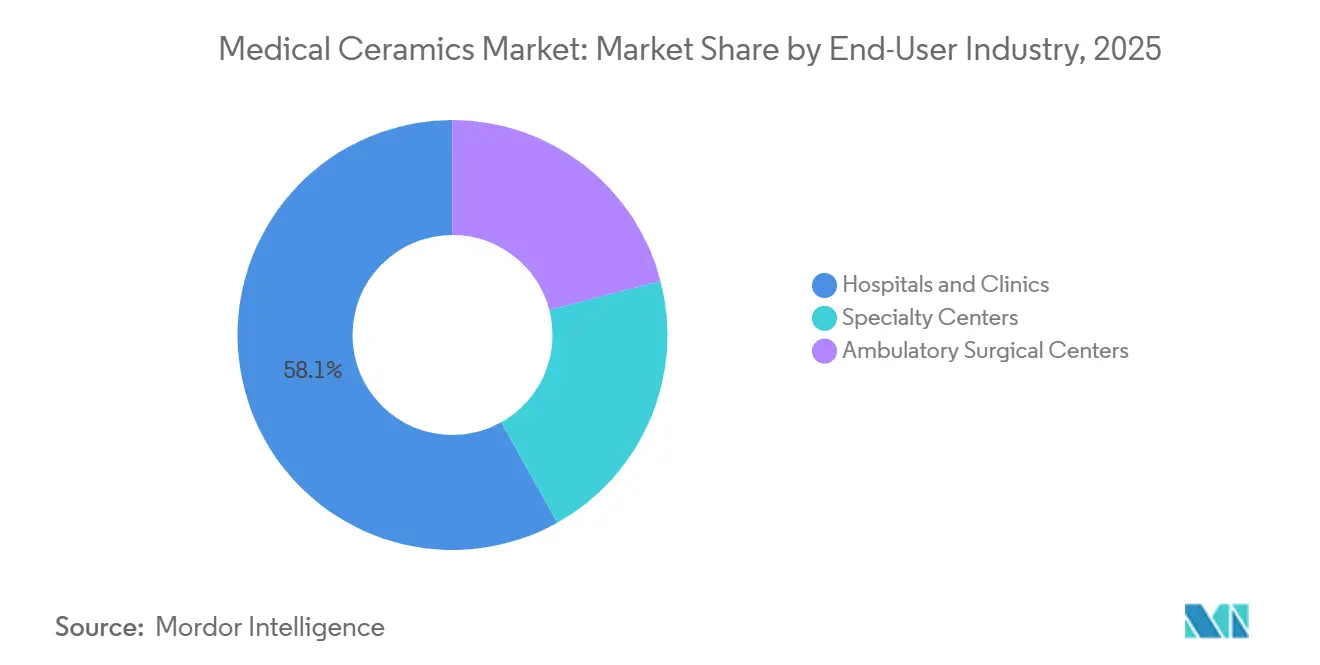
- By end-user industry, hospitals and clinics held 58.09% share in 2025, while ambulatory surgical centers are projected to grow at a 7.28% CAGR through 2031.
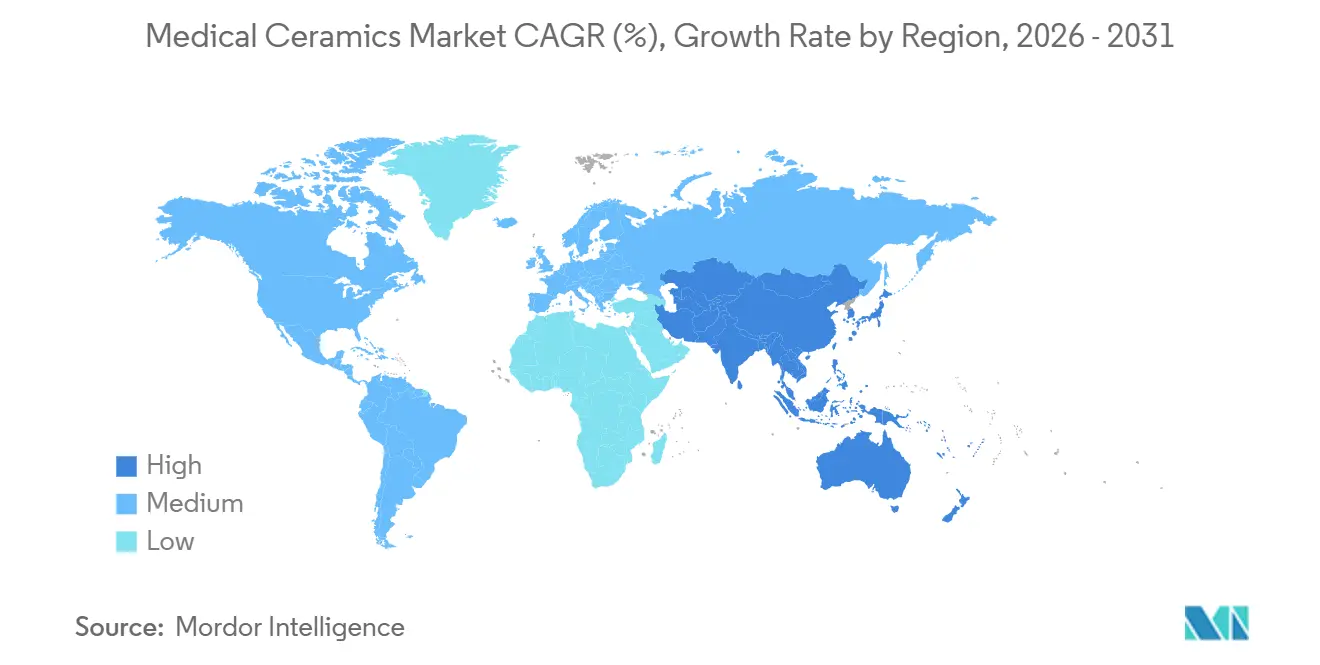
- By geography, North America held 38.22% revenue share in 2025, and Asia-Pacific is forecast to grow at a 7.81% CAGR through 2031.
Note: Market size and forecast figures in this report are generated using Mordor Intelligence’s proprietary estimation framework, updated with the latest available data and insights as of January 2026.
Market Trends and Insights
Drivers Impact Analysis of Medical Ceramics Market*
| Drivers | (~) % Impact on CAGR Forecast | Geographic Relevance | Impact Timeline |
|---|---|---|---|
| Increasing Demand for Orthopedic and Dental Ceramic Implants | +2.1% | Global | Short term (≤ 2 years) |
| Patient-Specific Ceramic Implants Through Advanced Manufacturing | +1.3% | North America, Europe, APAC | Medium term (2-4 years) |
| Additive Manufacturing in Medical Ceramics Production | +1.0% | North America, Europe, APAC core | Medium term (2-4 years) |
| Bioactive Surface Engineering for Osseointegration and Tissue Regeneration | +0.7% | North America, Europe, APAC | Long term (≥ 4 years) |
| Miniaturized Piezoceramic Components in Advanced Medical Devices | +0.5% | North America, Europe | Medium term (2-4 years) |
| Source: Mordor Intelligence | |||
Increasing Demand for Orthopedic and Dental Ceramic Implants
Demand for orthopedic and dental ceramic implants is driven by factors beyond population aging. Joint replacement and dental procedures require materials with established clinical performance in demanding applications. Ceramic bearing systems and dental restorations remain relevant where wear resistance and biocompatibility influence treatment choices. The medical ceramics market also benefits when lower procedure costs broaden patient access for those who previously deferred treatment. Reimbursement and procurement policies affect whether hospitals select ceramic components or competing materials. This combination of procedure volume, payment structures, and clinical requirements supports sustained demand across orthopedic and dental care in the medical ceramics market.
Growing Adoption of Patient-Specific Ceramic Implants Through Advanced Manufacturing Technologies
Patient-specific ceramic implants are moving beyond a narrow premium use case as digital design and manufacturing workflows develop. Tampere University reported in 2025 that 3D-printed bioceramic scaffolds with 400-micrometer pores and 45% porosity could replicate cancellous bone architecture with clinically relevant fidelity. Such design control can support bone regeneration applications that require anatomy-specific structures. Integrated development and production capabilities reduce handoffs between material developers, designers, and manufacturers. ISO 13485:2016 quality management certification also simplifies procurement for suppliers of patient-specific systems. The medical ceramics market therefore rewards manufacturers that pair customization capabilities with documented process control and stable quality systems.
Expanding Use of Additive Manufacturing in Medical Ceramics Production
Additive manufacturing is expanding the range of ceramic structures that can be designed for medical use. A 2025 study reported that vat photopolymerization could produce gradient-porous zirconia-toughened alumina cages with mechanical performance aligned with vertebral load requirements. Research published in 2026 found that composite powder approaches for lithium disilicate printing could combine precision, flexural strength, and antibacterial properties[1]F. Zhang, Y. Zhang, J. Kang, et al., “Composite Powder Design Strategy Enabling Vat Photopolymerization 3D Printing of Lithium Disilicate Glass-Ceramics With High Precision, Strength, and Antibacterial Properties,” Journal of Advanced Ceramics, sciopen.com. Polymer-derived ceramic manufacturing provides spatial control over geometry and composition at several scales. These capabilities expand prototyping options for specialist device developers and medical research centers. The medical ceramics market is consequently opening to applications that conventional forming and milling routes cannot readily produce, particularly where complex geometries are clinically relevant.
Advancements in Bioactive Surface Engineering for Enhanced Osseointegration and Tissue Regeneration
Surface engineering is shifting focus from a ceramic implant's bulk material toward its interaction with surrounding tissue. Calcium phosphate and hydroxyapatite coatings can improve bone-to-implant contact on zirconia substrates in preclinical models. A 2026 review identified laser treatment, selective infiltration etching, and calcium phosphate coatings as approaches that may improve zirconia osteogenesis and osseointegration. The same review noted that clinical results for zirconia remained less consistent than those for titanium across varied patient populations. Zinc-phosphate-coated 3 mol% yttria-stabilized tetragonal zirconia polycrystal (3Y-TZP) ceramics also demonstrated interfacial bonding, antibacterial activity, and osteogenic potential in a 2026 study. In the medical ceramics market, proprietary surface treatments can add value beyond the selection of the base substrate and standard component finishing.
Restraints Impact Analysis of Medical Ceramics Market*
| Restraints | (~) % Impact on CAGR Forecast | Geographic Relevance | Impact Timeline |
|---|---|---|---|
| Regulatory Approval, Material Testing, and Cleanroom Manufacturing Costs | -1.5% | Global, concentrated in North America and the EU | Short term (≤ 2 years) |
| Limited Long-Term Clinical Evidence for Emerging Bioceramics | -0.8% | Global | Medium term (2-4 years) |
| Dependence on High-Purity Materials and Specialized Processing Equipment | -0.9% | Asia-Pacific core, spillover to the Middle-East and Africa | Medium term (2-4 years) |
| Source: Mordor Intelligence | |||
High Costs Associated with Regulatory Approval, Material Testing, and Cleanroom Manufacturing
Regulatory compliance creates a significant cost burden for smaller and emerging ceramic manufacturers. MedTech Europe reported that Medical Device Regulation (MDR) certification costs increased by up to 100% for nearly all manufacturers surveyed, compared with the former Medical Device Directive[2]MedTech Europe, “IVDR & MDR Survey Results 2024,” MedTech Europe, medtecheurope.org. The association also found that maintenance and recertification costs over five years were expected to exceed initial fees by 50%. Larger integrated companies can distribute these expenses across broader portfolios, while focused innovators carry them against narrower revenue bases. Cleanroom requirements add capital costs for bioactive and piezoceramic products with tight contamination limits. The medical ceramics market faces higher entry barriers as U.S. and European requirements increase demands for biocompatibility, wear testing, and traceability across development programs.
Limited Long-Term Clinical Evidence for Emerging Bio-Ceramic Materials
The gap between preclinical results and long-term clinical evidence is most visible for bioresorbable and bioactive ceramic materials. A 2025 review found that bioresorbable ceramics can support vascular ingrowth and new bone formation, while degradation and bone deposition vary by patient and skeletal site. Hospitals often require large registry datasets and longer follow-up periods before changing procurement practices for implantable materials. Bioinert ceramics remain favored because joint arthroplasty registries provide long records of their use. This evidence gap limits the broader adoption of new formulations, even when short-term biological outcomes are favorable. The medical ceramics market depends on prospective clinical studies to move newer materials from specialist settings into high-volume care and wider hospital procurement.
*Our forecasts treat driver/restraint impacts as directional, not additive. The impact forecasts reflect baseline growth, mix effects, and variable interactions.
Medical Ceramics Market Segment Analysis
By Material:
Bioresorbable Ceramics Gain Ground on Bioinert IncumbencyBioresorbable ceramics are projected to grow at the fastest pace, with an 8.33% CAGR through 2031. These materials can reduce the need for revision procedures in bone-defect and spinal-fusion applications when degradation and tissue formation remain well-matched. Bioinert ceramics held 57.83% of the medical ceramics market share in 2025, as alumina, zirconia, and related composites have long clinical records in arthroplasty and dental prosthetics. Their position in the medical ceramics market rests on durability data for ceramic-on-ceramic and ceramic-on-polyethylene bearing systems. Bioactive ceramics, including hydroxyapatite and calcium silicate, serve distinct roles in bone-graft substitution and implant coatings.
Piezoceramics remain specialized materials for ultrasonic surgical tools, intravascular lithotripsy catheters, and implantable sensors. Their selection depends mainly on device performance requirements rather than implant preference. The segment is shifting from passive structural materials toward interfaces designed to support biological activity. A 2025 study reported that calcium phosphate cement modified for fast shaping, biodegradation control, and microenvironment modulation improved osseointegration and bone regeneration in preclinical work. Bioinert suppliers can respond through bioactive surface layers that retain established mechanical performance while adding regenerative functions.



By Application:
Dental Ceramics Outpace Orthopedic Growth RateOrthopedic ceramics accounted for 44.81% of the medical ceramics market size in 2025. Ceramic-on-ceramic and ceramic-on-polyethylene systems support this position in hip and knee arthroplasty, where wear characteristics and aluminum oxide grain control can differentiate products. Dental ceramics are forecast to grow at a 7.41% CAGR through 2031, supported by cosmetic care, implant-supported prosthetics, and chairside digital workflows. A 2026 study found that zinc-phosphate-functionalized 3 mol% yttria-stabilized tetragonal zirconia polycrystal (3Y-TZP) zirconia could deliver bonding strength, antibacterial activity, and osteogenic signaling.
Dental and orthopedic care show different demand patterns in the medical ceramics market. Dental procedures are supported by elective treatment and wider access to aesthetic restorations, while orthopedic demand depends more on trauma levels and program capacity. Cardiovascular ceramics remain technically demanding components for heart valves, sensor housings, and ultrasonic catheter transducers. Plastic surgery applications include craniofacial implants and orbital reconstruction, although these remain the smallest applications by value. Researchers in Italy reported clinical use of bioresorbable 3D-printed craniofacial composite implants in frontal, mandibular, and cleft palate reconstructions, with shorter surgeries and faster recovery than conventional alloplastic substitutes.
By End-User Industry:
Hospitals Remain Dominant as Ambulatory Surgery Centers (ASCs) ExpandHospitals and clinics held 58.09% of end-user revenue in 2025. They manage complex implant procedures, including bilateral joint replacement, spinal fusion, cardiac device implantation, and sedation-supported dental reconstruction. Their formulary committees assess clinical evidence, total ownership costs, and supply reliability, often favoring bioinert ceramics with documented revision-rate performance. The medical ceramics market relies on these institutional settings for complex procedures that require multidisciplinary care. Specialty centers form a second tier for elective orthopedic and dental procedures in focused care settings.
Ambulatory surgical centers are forecast to grow at a 7.28% CAGR through 2031. The medical ceramics market can reach these sites with implant systems that use simplified trays, reduced instrument sets, and streamlined packaging. These facilities have smaller order volumes and faster product evaluations than large hospital systems. Their purchasing decisions tend to place more emphasis on operating-room workflow compatibility than on long-term registry evidence. The medical ceramics industry can access this channel by qualifying systems that do not require full hospital operating-room infrastructure.
Geography Analysis
North America Medical Ceramics Market
North America accounted for 38.22% of the medical ceramics market share in 2025. The region benefits from mature orthopedic and dental procedure capacity, reimbursement support for ceramic bearing systems, and a dense network of medical device and specialist component suppliers. MatOrtho's ReCerf all-ceramic hip resurfacing system received European CE marking in July 2025, following an earlier FDA Breakthrough Device Designation, and uses CeramTec's BIOLOX delta material. This progression reflects the region's importance for clinical validation and early commercialization of advanced ceramic systems. Canada contributes demand through orthopedic program expansion, while Mexico benefits from private-pay dental implant activity in urban areas.
EMEA and South America Medical Ceramics Market
Europe holds a significant position in the market, supported by Germany's depth in high-performance technical ceramics and medical technology manufacturing. SPECTARIS reported that Germany's medical technology sector included nearly 1,500 manufacturers, generated EUR 41.3 billion (~USD 47.03 billion) in revenue in 2024, and accounted for 16% of exports to Asian markets. Medical Device Regulation (MDR) maintenance and recertification costs are putting pressure on smaller European specialists and encouraging consolidation. South American demand is concentrated in Brazil and Argentina, while the Middle-East and Africa remain early-stage markets, constrained by financing limitations and specialist care capacity.
APAC Medical Ceramics Market
Asia-Pacific is projected to be the fastest-growing medical ceramics market, with a CAGR of 7.81% through 2031. Population aging, localized manufacturing policies, and healthcare capacity expansion are driving demand across major regional economies. The market also benefits from growing public and private treatment capacity. Japan's established regulatory framework, India's domestic device development, and South Korea's dental ceramics capabilities offer varied routes to regional growth. Suppliers in the Asia-Pacific medical ceramics market are still required to meet high standards for biocompatibility, traceability, and reproducible materials processing.

Competitive Landscape
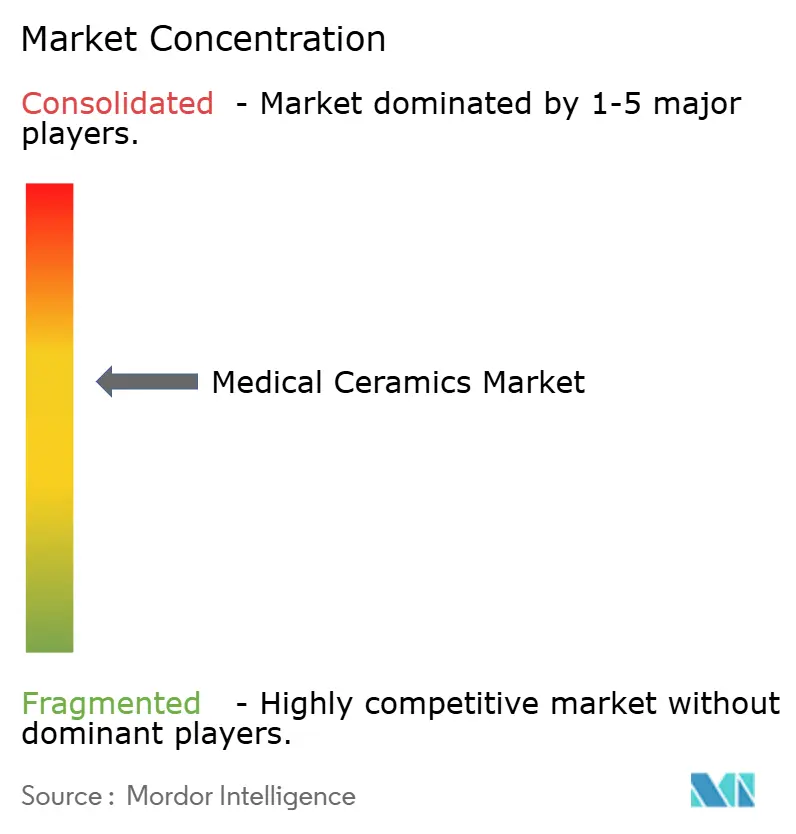
The medical ceramics market is moderately consolidated. CeramTec GmbH, KYOCERA Corporation, Morgan Advanced Materials, CoorsTek Inc., and Saint-Gobain Advanced Ceramics supply precision components to orthopedic and dental original equipment manufacturers. These suppliers gain leverage through long-term supply agreements and validated material specifications. Their primary strategy is to extend capabilities from powder formulation and sintering into component characterization, clinical test support, and regulatory filing assistance, thereby increasing switching costs during original equipment manufacturer qualification cycles.
CeramTec's BIOLOX delta material supported MatOrtho's ReCerf system, which received European CE marking in July 2025. This example illustrates how proprietary materials can be embedded within regulatory submissions and product designs. Additive manufacturing specialists and vertically integrated bioceramic developers are challenging asset-heavy production models by combining prototype development, custom geometry, and production within more integrated workflows. Surface bioactivation is another area where component suppliers can offer differentiated, pre-functionalized substrates to device manufacturers.
Zimmer Biomet completed its acquisition of Monogram Technologies in October 2025, linking robotic surgery capabilities with implant development and workflow design. This transaction highlights how robotic compatibility can influence hospital purchasing decisions. Smaller companies, including Nishimura Advanced Ceramics, Precision Ceramics Limited, and Ceramaret SA, serve niche applications requiring custom engineering and tight tolerances. The medical ceramics market remains shaped by established materials suppliers, device manufacturer relationships, and focused specialists serving demanding applications.
Medical Ceramics Industry Leaders
CeramTec GmbH
KYOCERA Corporation
CoorsTek Inc.
Morgan Advanced Materials plc
Institut Straumann AG
- *Disclaimer: Major Players sorted in no particular order
Medical Ceramics Market Companies Covered in this Report
- 3M
- Ceramaret SA
- CeramTec GmbH
- CoorsTek Inc.
- Institut Straumann AG
- Ivoclar Vivadent
- KYOCERA Corporation
- Morgan Advanced Materials plc
- NGK Spark Plug Co., Ltd.
- Nishimura Advanced Ceramics Co., Ltd.
- Precision Ceramics Limited
- Rauschert GmbH
- Saint-Gobain Ceramics
- Tosoh Corporation
- Zimmer Biomet Holdings, Inc.

Recent Industry Developments in Medical Ceramics Market
- July 2026: CeramTec Switzerland announced a distribution partnership with Kara Grup Turkey for the Zeramex ceramic dental implant portfolio. This partnership expands the brand's presence in the Turkish market and represents a further step in CeramTec's international commercialization strategy for zirconia dental implants.
- May 2026: Himed and Adva Cera announced a strategic partnership to establish a complete development-to-production pathway for 3D-printed calcium phosphate bioceramic components used in dental, orthopedic, and spinal applications. The partnership eliminates material requalification steps and provides a fully domestic, vertically integrated US supply chain built on Himed's FDA-registered, ISO 13485:2016-certified manufacturing platform.


Global Medical Ceramics Market Report Scope
Medical ceramics are biocompatible and wear-resistant materials used in implants, dental prosthetics, and medical equipment components. Common types, such as alumina and zirconia, are valued for their durability and biocompatibility.
The medical ceramics market is segmented by material, application, end-user industry, and geography. By material, the market is segmented into bioinert ceramics, bioactive ceramics, bioresorbable ceramics, and piezoceramics. By application, the market is segmented into dental, orthopedic, cardiovascular, and plastic surgery. By end-user industry, the market is segmented into hospitals and clinics, ambulatory surgical centers, and specialty centers. The report also covers market size and forecasts for medical ceramics across 16 countries in major regions. The market sizes and forecasts are provided in terms of value (USD).
| Bioinert Ceramics |
| Bioactive Ceramics |
| Bioresorbable Ceramics |
| Piezoceramics |
| Dental |
| Orthopedic |
| Cardiovascular |
| Plastic Surgery |
| Hospitals and Clinics |
| Ambulatory Surgical Centers |
| Specialty Centers |
| Asia-Pacific | China |
| India | |
| Japan | |
| South Korea | |
| Rest of Asia-Pacific | |
| North America | United States |
| Canada | |
| Mexico | |
| Europe | Germany |
| United Kingdom | |
| France | |
| Italy | |
| Russia | |
| Rest of Europe | |
| South America | Brazil |
| Argentina | |
| Rest of South America | |
| Middle-East and Africa | Saudi Arabia |
| South Africa | |
| Rest of Middle-East and Africa |
| By Material | Bioinert Ceramics | |
| Bioactive Ceramics | ||
| Bioresorbable Ceramics | ||
| Piezoceramics | ||
| By Application | Dental | |
| Orthopedic | ||
| Cardiovascular | ||
| Plastic Surgery | ||
| By End-User Industry | Hospitals and Clinics | |
| Ambulatory Surgical Centers | ||
| Specialty Centers | ||
| By Geography | Asia-Pacific | China |
| India | ||
| Japan | ||
| South Korea | ||
| Rest of Asia-Pacific | ||
| North America | United States | |
| Canada | ||
| Mexico | ||
| Europe | Germany | |
| United Kingdom | ||
| France | ||
| Italy | ||
| Russia | ||
| Rest of Europe | ||
| South America | Brazil | |
| Argentina | ||
| Rest of South America | ||
| Middle-East and Africa | Saudi Arabia | |
| South Africa | ||
| Rest of Middle-East and Africa | ||


Key Questions Answered in the Report
What is current market size of Medical Ceramics Market?
The Medical Ceramics Market size was valued at USD 19.62 billion in 2025 and is estimated to grow from USD 20.95 billion in 2026 to reach USD 28.91 billion by 2031, at a CAGR of 6.65% during the forecast period (2026-2031).
Which material category is growing fastest in medical ceramics?
Bioresorbable ceramics are forecast to grow at an 8.33% CAGR through 2031, supported by uses in bone-defect and spinal-fusion care.
Which application holds the largest share of medical ceramics demand?
Orthopedic applications accounted for 44.81% of the market in 2025, driven by hip and knee arthroplasty systems.
Why are dental ceramics expanding faster than orthopedic ceramics?
Dental ceramics are forecast to grow at a 7.41% CAGR because of cosmetic treatments, implant-supported prosthetics, and digital chairside workflows.
Page last updated on:





