
Medical Biomimetic Materials Market Size and Share
Market Overview
| Study Period | 2020 - 2031 |
|---|---|
| Market Size (2026) | USD 20.66 Billion |
| Market Size (2031) | USD 29.33 Billion |
| Growth Rate (2026 - 2031) | 7.26 % |
| Fastest Growing Market | Asia-Pacific |
| Largest Market | North America |
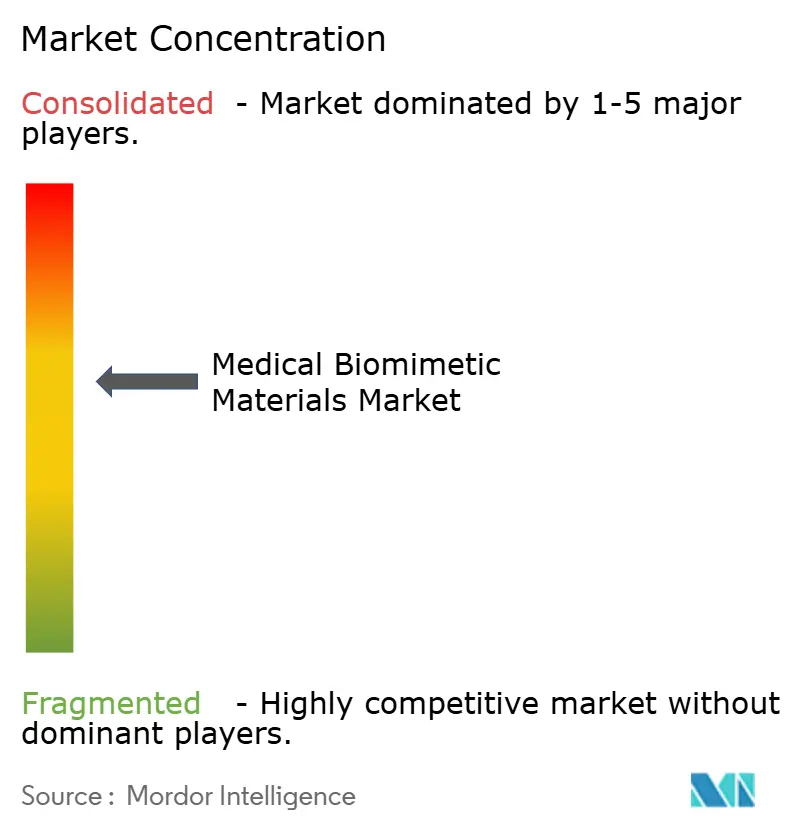
| Market Concentration | Medium |
Major Players *Disclaimer: Major Players sorted in no particular order Image © Mordor Intelligence. Reuse requires attribution under CC BY 4.0. | |
Medical Biomimetic Materials Market Analysis by Mordor Intelligence
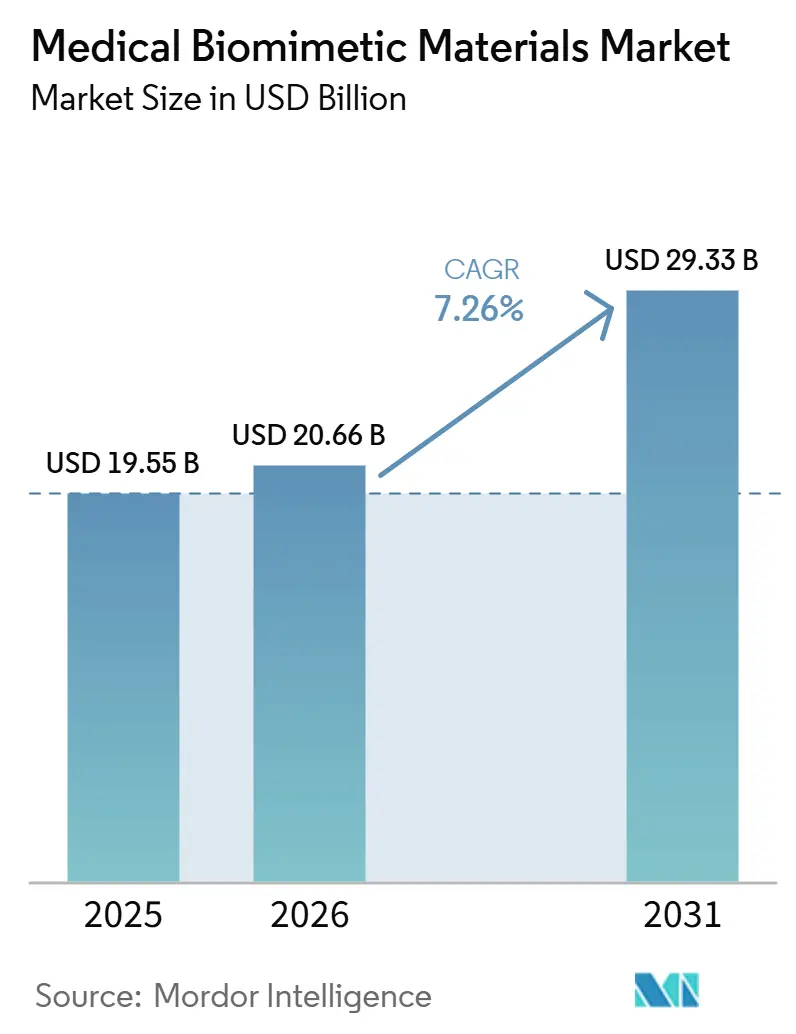
The Medical Biomimetic Materials Market size was valued at USD 19.55 billion in 2025 and is estimated to grow from USD 20.66 billion in 2026 to reach USD 29.33 billion by 2031, at a CAGR of 7.26% during the forecast period (2026-2031).
Demand is supported by an aging population and by the greater need for treatment of musculoskeletal and cardiovascular conditions. It also reflects the move of biofabrication from research settings into commercially usable implant and scaffold platforms. The medical biomimetic materials market covers orthopedic and dental implants, tissue-engineering scaffolds, wound matrices, drug-delivery systems, and neurological interfaces. These uses depend on materials such as hydroxyapatite ceramics, smart polymers, extracellular matrix-mimetic hydrogels, and nanostructured metallic surfaces. The largest opportunities are tied to clinical applications that can combine repair outcomes with scalable manufacturing and viable reimbursement pathways.
Key Report Takeaways
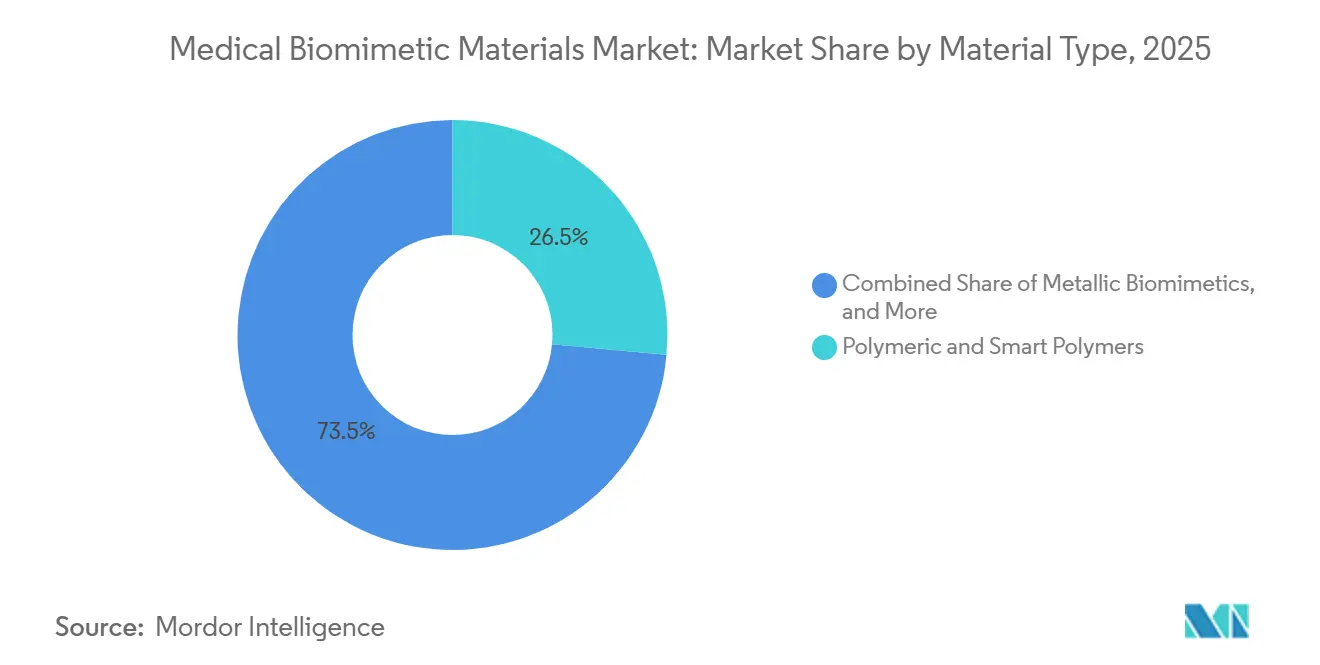
- By material type, polymeric and smart polymers held 26.46% share in 2025, while hydrogel, peptide, and extracellular matrix-mimetic materials are forecast to record an 11.83% CAGR through 2031.
- By application, tissue engineering and regenerative medicine accounted for 30.23% of the medical biomimetic materials market share in 2025 and are forecast to expand at an 11.45% CAGR through 2031.
- By form, porous scaffolds and lattices held 31.36% share in 2025, while hydrogels, bioinks, and injectable pastes are projected to grow at an 11.83% CAGR through 2031.
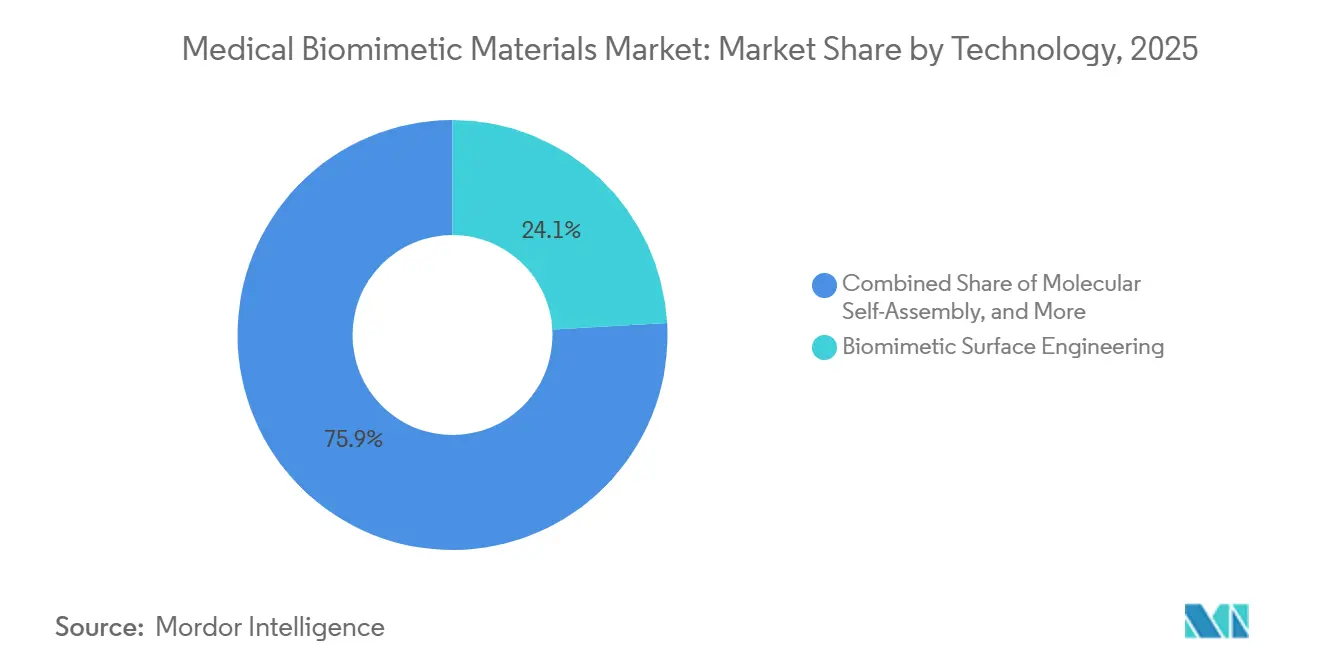
- By technology, biomimetic surface engineering held 24.12% share in 2025, while additive manufacturing and 3D bioprinting are projected to grow at a 13.21% CAGR through 2031.
- By end user, hospitals held 39.23% share in 2025, while pharmaceutical and biotechnology companies are forecast to expand at a 10.12% CAGR through 2031.
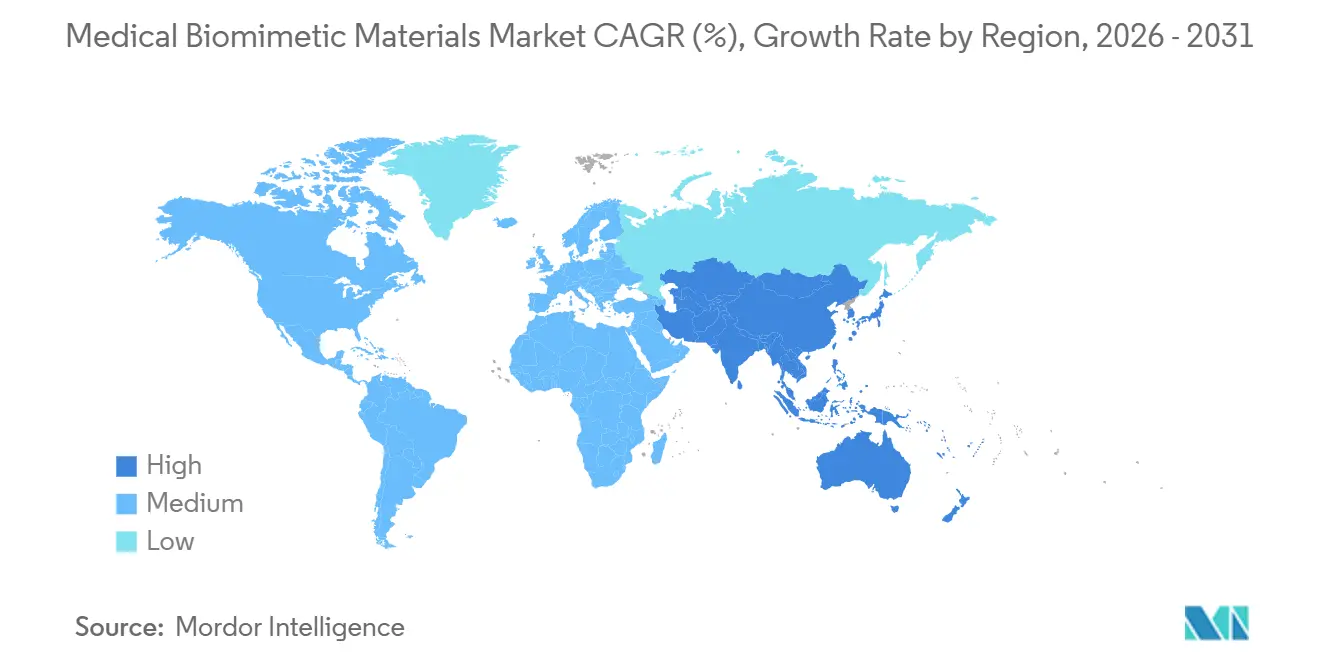
- By geography, North America held 39.35% share in 2025, while Asia-Pacific is forecast to grow at an 11.63% CAGR through 2031.
Note: Market size and forecast figures in this report are generated using Mordor Intelligence’s proprietary estimation framework, updated with the latest available data and insights as of January 2026.
Market Trends and Insights
Drivers Impact Analysis of Medical Biomimetic Materials Market*
| Driver | (~) % Impact on CAGR Forecast | Geographic Relevance | Impact Timeline |
|---|---|---|---|
| Rising Demand for Biocompatible Implants and Prostheses | +1.50% | Global, with concentrated volume in North America and Europe | Medium term (2-4 years) |
| Expansion of Tissue Engineering and Regenerative Medicine | +1.80% | Global, with clinical translation concentrated in North America and Asia-Pacific | Long term (≥ 4 years) |
| Nanostructured Surfaces Improving Osseointegration and Healing | +1.00% | North America, Europe, and East Asia | Medium term (2-4 years) |
| Biomimetic Drug Delivery for Targeted and Long-Acting Therapies | +1.00% | North America, with spillover to Europe | Medium term (2-4 years) |
| Patient-Specific Biofabrication and 3D Bioprinting | +0.90% | North America and Europe, with growth in Asia-Pacific | Long term (≥ 4 years) |
| Smart Implant Interfaces for Real-Time Biological Feedback | +0.70% | North America and Europe | Long term (≥ 4 years) |
| Source: Mordor Intelligence | |||
Rising Demand for Biocompatible Implants and Prostheses
Biocompatibility is becoming an active design target rather than only a regulatory threshold. Orthopedic surfaces increasingly use nanostructured hydroxyapatite and zirconia coatings to influence protein adsorption and reduce fibrous encapsulation. These coatings can also support longer functional life for implants. Zimmer Biomet received FDA Breakthrough Device Designation in October 2025 for an iodine-treated total hip replacement system that uses anodization and electrophoresis to embed a controlled-release iodine layer in the implant surface. Prosthetic limb interfaces are also extending biomimetic design from hard-tissue fixation to peripheral nerve and soft-tissue integration. This broadens the materials used beyond established metal and ceramic systems toward polymer-hydrogel composites.
Expansion of Tissue Engineering and Regenerative Medicine
Tissue engineering and regenerative medicine combine the largest application share with the fastest application growth in the medical biomimetic materials market. A 2026[1]“Functional Integration of an Autologous Engineered Esophagus in a Large-Animal Model,” Nature Biotechnology, nature.com. large-animal study reported functional integration of a full-thickness autologous engineered esophageal graft and recorded autonomous peristalsis. The result narrows the practical gap between tissue research and surgical use. A Phase 1/2 study[2]“Human Embryonic Stem Cell-Derived Dopaminergic Cells for Parkinson’s Disease: A Phase 1/2 Open-Label Trial,” Nature Medicine, nature.com. also reported 12-month safety data for pluripotent stem-cell-derived dopaminergic implants in Parkinson’s disease patients, including focal increases in putaminal [18F]F-DOPA uptake that indicated graft survival. Pharmaceutical companies are using organoids, organ-on-chip systems, and 3D tissue models in drug discovery. This creates a demand channel for scaffold materials that is less dependent on procedural volumes and reimbursement decisions.
Nanostructured Surfaces Improving Osseointegration and Healing
Nanostructured implant surfaces have progressed beyond laboratory research in several use cases. A 2026 study found that hierarchical porous oxide surfaces on biomedical 316L stainless steel improved early osseointegration in rabbit femur models compared with unmodified controls[3]C. L. Shen, K. S. Hung, H. T. Shen, et al., “An Innovative Hierarchical Porous Oxide Surface with Enhanced Surface Area for Promoting Early-Stage Bone Regeneration Potential,” Journal of Materials Science: Materials in Medicine, link.springer.com.. A separate study reported that chiral ZnO/BMP-2 coatings on titanium supported antibacterial activity and macrophage polarization toward the M2 phenotype. A further 2026 paper showed that nanopillar diameter on PEEK substrates can influence soft-tissue integration. Femtosecond laser processing, anodization, and vacuum melt-casting now provide manufacturing routes that can support larger production volumes. This makes surface modification more relevant to established implant manufacturing.
Biomimetic Drug Delivery for Targeted and Long-Acting Therapies
Cell-membrane-coated nanoparticles and exosome-mimetic lipid nanoparticles form a distinct class of biomimetic delivery systems. Their targeting and immune-evasion properties differ from the features that synthetic nanocarriers must add through formulation. A 2026 review described their use in cancer photodynamic therapy, including work on tumor penetration, hypoxia mitigation, and photosensitizer loading. A 2026 study reported machine learning-designed exosome-mimetic lipid nanoparticles with a 120 nm diameter, a polydispersity index below 0.20, tumor-specific accumulation, and limited cytotoxicity to healthy tissue. ECM Therapeutics received FDA 510(k) clearance in June 2026 for ECMT-100 WMD, a flowable extracellular matrix hydrogel for wound management. However, no extracellular matrix-mimetic hydrogel nanocomposite had received general medical approval as of 2025, which leaves a material gap between preclinical performance and broad authorization.
Restraints Impact Analysis of Medical Biomimetic Materials Market*
| Restraint | (~) % Impact on CAGR Forecast | Geographic Relevance | Impact Timeline |
|---|---|---|---|
| Multi-Region Regulatory and Clinical Validation Burden | -0.90% | Global, most acute in Europe and Asia-Pacific | Short term (≤ 2 years) |
| High Manufacturing and Customization Costs | -0.70% | Global | Short term (≤ 2 years) |
| Batch Variability in Bio-Derived and Self-Assembled Materials | -0.60% | Global | Medium term (2-4 years) |
| Uncertain Reimbursement for Novel Biomimetic Procedures | -0.50% | Global, most acute in developing markets | Long term (≥ 4 years) |
| Source: Mordor Intelligence | |||
Multi-Region Regulatory and Clinical Validation Burden
Differences among the United States, Europe, China, and Japan can delay market access for biomimetic products. Europe’s Medical Device Regulation requires prospective clinical data for implantable devices in cases where literature-based equivalence had been used under the earlier framework. This requirement has added 12-24 months to premarket timelines for certain products. China generally treats novel implantable biomaterials as Class III devices and applies demanding postmarket surveillance requirements. These processes affect smaller innovators more heavily because they have fewer regulatory resources. The result is a short-term advantage for companies with established compliance systems and clinical evidence capabilities.
High Manufacturing and Customization Costs
Patient-specific fabrication has premium manufacturing costs that can limit use at current price levels. A 2026 study on a hospital-based framework for 3D-printed PEEK cranial implants reported an end-to-end production period of 1 week. This process can fit high-acuity neurosurgical cases but is less suited to high-volume and price-sensitive uses such as standard dental prosthetics or chronic wound dressings. Bio-derived raw materials add another cost issue because recombinant human collagen systems rely on genetically modified plant production that is still scaling. Hospitals and ambulatory surgical centers remain price sensitive when procedures do not have defined reimbursement codes. This relationship between cost, reimbursement, and procurement can slow adoption even when the clinical technology is feasible.
*Our forecasts treat driver/restraint impacts as directional, not additive. The impact forecasts reflect baseline growth, mix effects, and variable interactions.
Medical Biomimetic Materials Market Segment Analysis
By Material Type:
Polymers Dominant, ECM Hydrogels Fastest GrowingPolymeric and smart polymers held 26.46% of material-type revenue in 2025, representing the broadest material base. In the medical biomimetic materials market, their position rests on mechanical tunability, established manufacturing methods, and compatibility with injection molding and additive manufacturing. The category includes PLGA, PCL, and PEG systems, as well as responsive polymers that can alter stiffness or porosity with pH or temperature.
Hydrogel, peptide, and extracellular matrix-mimetic materials are forecast to grow at an 11.83% CAGR through 2031. Their injectable and 3D-printable formats support minimally invasive procedures and wound-care uses. A 2026 review noted that injectable extracellular matrix-mimetic hydrogels can be tailored for degradation, porosity, and biofunctionalization according to clinical requirements.



By Application:
Tissue Engineering and Regenerative Medicine Defines Market MomentumTissue engineering and regenerative medicine held 30.23% of application revenue in 2025, the largest application share in the medical biomimetic materials market. The segment is also projected to grow at an 11.45% CAGR through 2031. Within the medical biomimetic materials market, bone and cartilage regeneration, skin and soft-tissue repair, and vascular and cardiac repair are expanding through separate development pathways. A 2026 paper described a bilayer membrane that moves from rigidity in early healing toward elasticity as bone matures. Drug delivery and controlled release remain connected to biomaterial design choices that affect how therapies are delivered. Neurology and sensorimotor rehabilitation also have scope for faster growth as human clinical data accumulates.
By Form:
Porous Scaffolds Anchor Structural Repair, Bioinks Redefine DeliveryPorous scaffolds and lattices held 31.36% of form-segment revenue in 2025, the leading share for forms in the medical biomimetic materials market. Across the medical biomimetic materials market, interconnected pore structures are important in bone void filling, cartilage repair, and guided tissue regeneration. A 2026 study of triply periodic minimal surface gyroid hydrogel scaffolds found that the geometry can support mechanical compliance, nutrient diffusion, and cell infiltration.
Hydrogels, bioinks, and injectable pastes are projected to grow at an 11.83% CAGR through 2031. This form benefits from demand for minimally invasive delivery and growing 3D bioprinting capacity. A 2026 study described an extracellular matrix-mimetic ink that can be printed into a shape-memory construct, delivered through a syringe, and recover its intended structure in situ.
By Technology:
Surface Engineering Leads, 3D Bioprinting Redefines the CeilingBiomimetic surface engineering held 24.12% of technology revenue in 2025, the largest technology share. Its scale in the medical biomimetic materials market reflects surface treatment use across orthopedic, dental, and cardiovascular devices. Hydroxyapatite plasma spraying, laser texturing, and anodic oxidation form part of the established production base. These methods allow implant makers to improve biological interaction without changing the entire product architecture. Molecular self-assembly, electrospinning and nanofabrication, decellularization and extracellular matrix processing, and controlled release technologies each support complementary uses.
Additive manufacturing and 3D bioprinting are forecast to grow at a 13.21% CAGR through 2031, the fastest rate across technology segments. A systematic review of more than 700 registered clinical trials identified anatomical models, patient-specific prostheses, and regenerative scaffolds as the leading clinical application domains for 3D bioprinting.
By End User:
Hospitals Command Volume, Pharma Companies Drive Fastest UpliftHospitals held 39.23% of end-user revenue in 2025, the largest end-user share. They remain the main location in the medical biomimetic materials market for orthopedic, cardiovascular, and oncology-related procedures that consume biomimetic materials. Their purchasing decisions shape the adoption rate for implants, wound matrices, and procedural materials. Specialty clinics and ambulatory surgical centers are increasing their role as some complex procedures move to outpatient settings. Pharmaceutical and biotechnology companies are projected to grow at a 10.12% CAGR through 2031. Their demand is linked to biomimetic scaffolds used in drug discovery, tissue models, and preclinical development.
Geography Analysis
North America Medical Biomimetic Materials Market
North America held 39.35% of the medical biomimetic materials market share in 2025. The region’s position comes from procedural volumes, established hospital systems, and a concentrated medical technology base. The United States accounted for nearly 20,000 surgical mitral valve replacements annually.
Europe and APAC Medical Biomimetic Materials Market
Europe was the second-largest geography in 2025. Germany, the United Kingdom, and France support regional demand through established medical technology clusters and well-capitalized hospital networks. Asia-Pacific is forecast to grow at an 11.63% CAGR through 2031, the fastest regional rate. Growth reflects demographic pressure, healthcare infrastructure investment, and manufacturing support in China, India, Japan, and South Korea.

Competitive Landscape
The medical biomimetic materials market has moderate-to-high concentration at the product-category level. Orthopedic and cardiovascular repair are led by established medical technology companies with regulatory infrastructure, hospital contracts, and integrated supply chains. Stryker, Zimmer Biomet, Johnson & Johnson through DePuy Synthes, and Medtronic have strong positions in these categories. Large firms can incorporate biomimetic surface science into existing product platforms and use established surgeon relationships. This reduces the procurement barriers that may affect a new standalone device. Scale, distribution reach, and a record of regulatory compliance remain significant barriers within these high-volume categories. Specialist companies compete through focused material platforms and proprietary process capabilities. CollPlant’s plant-derived recombinant human collagen supports bioink and regenerative-material applications.
Medical Biomimetic Materials Industry Leaders
Stryker Corporation
Zimmer Biomet
Medtronic plc
Evonik Industries AG
CollPlant Biotechnologies Ltd.
- *Disclaimer: Major Players sorted in no particular order
Medical Biomimetic Materials Market Companies Covered in this Report
- AVINENT Science and Technology
- Berkeley Advanced Biomaterials, Inc.
- BioHorizons Implant Systems, Inc.
- Biomatlante
- Biomimetic Innovations Ltd / PBC Biomed Ltd
- Botiss Biomaterials
- CollPlant Biotechnologies Ltd.
- CorNeat Vision Inc.
- Curasan AG
- Evonik Industries
- Geistlich Pharma
- Johnson & Johnson
- Medtronic
- Orthofix
- Osteopore International Pte Ltd
- Promimic AB
- Stryker
- Zimmer Biomet

Recent Industry Developments in Medical Biomimetic Materials Market
- June 2026: ECM Therapeutics received FDA 510(k) clearance (K253521) for ECMT-100 WMD, a flowable extracellular matrix hydrogel for wound management, marking the company's first commercial product and validating its ECM hydrogel platform for large-scale wound-care deployment.
- April 2026: Medtronic plc received FDA approval for the Mosaic Neo mitral bioprosthesis and launched the valve commercially in the United States, with initial implants at The Mount Sinai Hospital, University of Michigan Health Frankel Cardiovascular Center, and WVU Heart and Vascular Institute. The launch included the first robotic implantation of the device.


Global Medical Biomimetic Materials Market Report Scope
As per the scope of the market, medical biomimetic materials are advanced materials engineered to replicate the biological, structural, mechanical, or functional characteristics of natural tissues and biological systems. These materials are increasingly used across implants, regenerative therapies, tissue engineering platforms, wound care products, drug delivery systems, and next-generation medical devices to improve patient outcomes and accelerate tissue repair and regeneration.
The medical biomimetic material market is segmented by application, covering tissue engineering and regenerative medicine, wound healing and advanced wound care, plastic and reconstructive surgery, orthopedic and sports medicine, cardiovascular repair and vascular access, dental restoration and oral regeneration, ophthalmic repair and vision restoration, and others. Additionally, the market is segmented by material type into metallic biomimetics, polymeric and smart polymers, ceramic and bioactive glass, natural and bio-derived materials, composite biomimetic materials, hydrogel, peptide and extracellular matrix (ECM)-mimetic materials, and others. The report also categorizes the market by form, which includes bulk and load-bearing components, porous scaffolds and lattices, hydrogels, bioinks, and injectable pastes, films, membranes, fibers, and sutures, and others. The technology segment is categorized as biomimetic surface engineering, molecular self-assembly, electrospinning and nanofabrication, additive manufacturing and 3D bioprinting, decellularization and ECM processing, controlled release and microfluidic delivery, and end user that encompasses hospitals, specialty clinics, ambulatory surgical centers, medical device manufacturers, pharmaceutical and biotechnology companies, and others. Geographically, the market is segmented into North America, Europe, Asia-Pacific, the Middle East & Africa, and South America. The market report further provides market size estimates and forecasts for key countries across major regions, with market values presented in USD.
| Metallic Biomimetics |
| Polymeric and Smart Polymers |
| Ceramic and Bioactive Glass |
| Natural and Bio-Derived Materials |
| Composite Biomimetic Materials |
| Hydrogel, Peptide, and ECM-Mimetic Materials |
| Others (Carbon-Based Biomimetic Materials, Nanostructured Biomimetic Materials) |
| Tissue Engineering and Regenerative Medicine | Bone and Cartilage Regeneration |
| Skin and Soft-Tissue Repair | |
| Vascular and Cardiac Repair | |
| Neural and Spinal Repair | |
| Wound Healing and Advanced Wound Care | |
| Plastic and Reconstructive Surgery | |
| Orthopedic and Sports Medicine | |
| Cardiovascular Repair and Vascular Access | |
| Dental Restoration and Oral Regeneration | |
| Ophthalmic Repair and Vision Restoration | |
| Others (Drug Delivery and Controlled Release, Neurology and Sensorimotor Rehabilitation) |
| Bulk and Load-Bearing Components |
| Porous Scaffolds and Lattices |
| Hydrogels, Bioinks, and Injectable Pastes |
| Films, Membranes, Fibers, and Sutures |
| Others (Coatings, Powders, and Suspensions) |
| Biomimetic Surface Engineering |
| Molecular Self-Assembly |
| Electrospinning and Nanofabrication |
| Additive Manufacturing and 3D Bioprinting |
| Decellularization and ECM Processing |
| Controlled Release and Microfluidic Delivery |
| Others (Sensors, Actuators, and Smart Implant Electronics) |
| Hospitals |
| Specialty Clinics |
| Ambulatory Surgical Centers |
| Medical Device Manufacturers |
| Pharmaceutical and Biotechnology Companies |
| Others (Research and Academic Institutes, CDMO) |
| North America | United States |
| Canada | |
| Mexico | |
| Europe | Germany |
| United Kingdom | |
| France | |
| Italy | |
| Spain | |
| Rest of Europe | |
| Asia-Pacific | China |
| India | |
| Japan | |
| Australia | |
| South Korea | |
| Rest of Asia-Pacific | |
| Middle East and Africa | GCC |
| South Africa | |
| Rest of Middle East and Africa | |
| South America | Brazil |
| Argentina | |
| Rest of South America |
| By Material Type | Metallic Biomimetics | |
| Polymeric and Smart Polymers | ||
| Ceramic and Bioactive Glass | ||
| Natural and Bio-Derived Materials | ||
| Composite Biomimetic Materials | ||
| Hydrogel, Peptide, and ECM-Mimetic Materials | ||
| Others (Carbon-Based Biomimetic Materials, Nanostructured Biomimetic Materials) | ||
| By Application | Tissue Engineering and Regenerative Medicine | Bone and Cartilage Regeneration |
| Skin and Soft-Tissue Repair | ||
| Vascular and Cardiac Repair | ||
| Neural and Spinal Repair | ||
| Wound Healing and Advanced Wound Care | ||
| Plastic and Reconstructive Surgery | ||
| Orthopedic and Sports Medicine | ||
| Cardiovascular Repair and Vascular Access | ||
| Dental Restoration and Oral Regeneration | ||
| Ophthalmic Repair and Vision Restoration | ||
| Others (Drug Delivery and Controlled Release, Neurology and Sensorimotor Rehabilitation) | ||
| By Form | Bulk and Load-Bearing Components | |
| Porous Scaffolds and Lattices | ||
| Hydrogels, Bioinks, and Injectable Pastes | ||
| Films, Membranes, Fibers, and Sutures | ||
| Others (Coatings, Powders, and Suspensions) | ||
| By Technology | Biomimetic Surface Engineering | |
| Molecular Self-Assembly | ||
| Electrospinning and Nanofabrication | ||
| Additive Manufacturing and 3D Bioprinting | ||
| Decellularization and ECM Processing | ||
| Controlled Release and Microfluidic Delivery | ||
| Others (Sensors, Actuators, and Smart Implant Electronics) | ||
| By End User | Hospitals | |
| Specialty Clinics | ||
| Ambulatory Surgical Centers | ||
| Medical Device Manufacturers | ||
| Pharmaceutical and Biotechnology Companies | ||
| Others (Research and Academic Institutes, CDMO) | ||
| By Geography | North America | United States |
| Canada | ||
| Mexico | ||
| Europe | Germany | |
| United Kingdom | ||
| France | ||
| Italy | ||
| Spain | ||
| Rest of Europe | ||
| Asia-Pacific | China | |
| India | ||
| Japan | ||
| Australia | ||
| South Korea | ||
| Rest of Asia-Pacific | ||
| Middle East and Africa | GCC | |
| South Africa | ||
| Rest of Middle East and Africa | ||
| South America | Brazil | |
| Argentina | ||
| Rest of South America | ||


Key Questions Answered in the Report
What is the projected size of the medical biomimetic materials market by 2031?
The medical biomimetic materials market is projected to reach USD 29.33 billion by 2031, growing at a 7.26% CAGR from 2026 to 2031. The forecast reflects demand from implant, scaffold, wound-care, drug-delivery, and neurological applications.
Which medical biomimetic materials application has the largest share?
Tissue engineering and regenerative medicine held the largest application share at 30.23% in 2025 and is forecast to grow at an 11.45% CAGR through 2031. Its scope includes bone, cartilage, skin, soft tissue, vascular, and cardiac repair pathways.
Why are biomimetic materials important in orthopedic implants?
Surface treatments and porous structures can improve osseointegration, healing response, and implant durability in orthopedic procedures. They also allow established implant makers to add biological functionality while retaining familiar device platforms.
Which region has the highest demand for medical biomimetic materials?
North America held the largest regional share at 39.35% in 2025, supported by clinical infrastructure and medical technology adoption. The region also has academic medical centers and regulatory pathways that support early clinical use of new constructs.
What limits wider use of biomimetic materials in healthcare?
Regulatory evidence requirements, customized manufacturing costs, material batch variability, and uncertain reimbursement can slow adoption. These issues are most difficult for smaller developers that must finance clinical validation and consistent production at the same time.
Page last updated on:





