
Mechanical Fuel Dispensers Market Size and Share
Market Overview
| Study Period | 2021 - 2031 |
|---|---|
| Market Size (2026) | USD 1.16 Billion |
| Market Size (2031) | USD 1.41 Billion |
| Growth Rate (2026 - 2031) | 3.98 % |
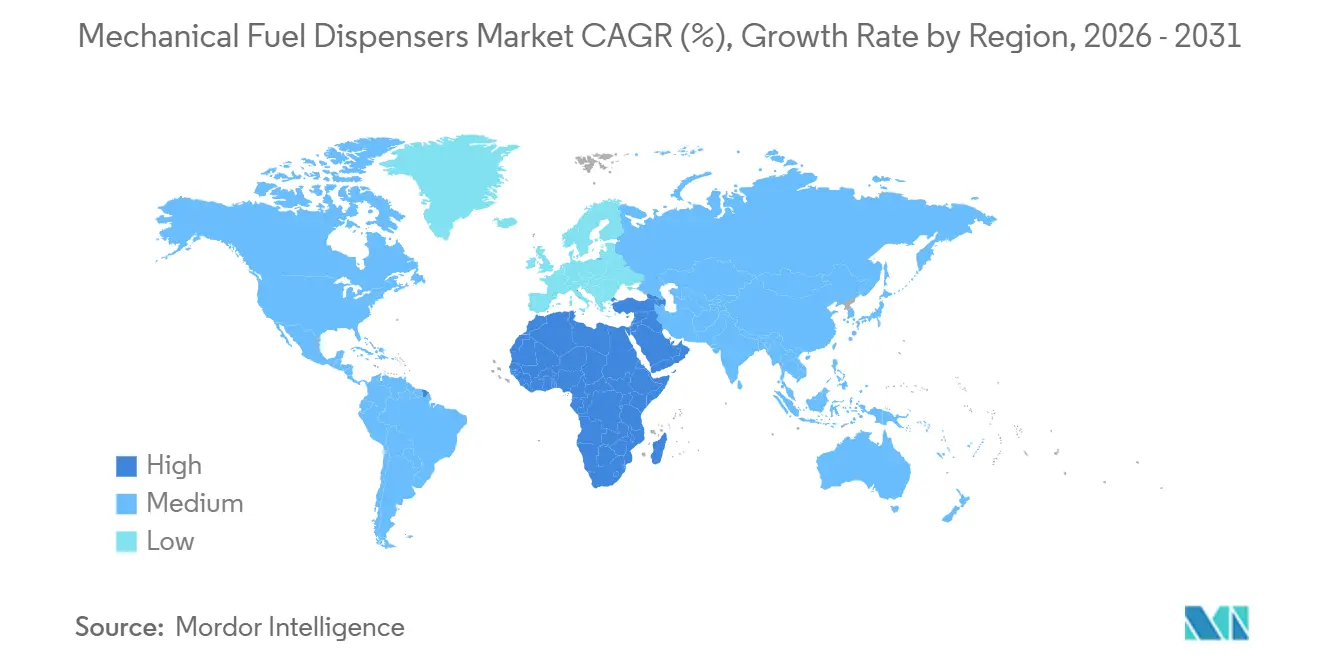
| Fastest Growing Market | Middle East and Africa |
| Largest Market | Asia-Pacific |
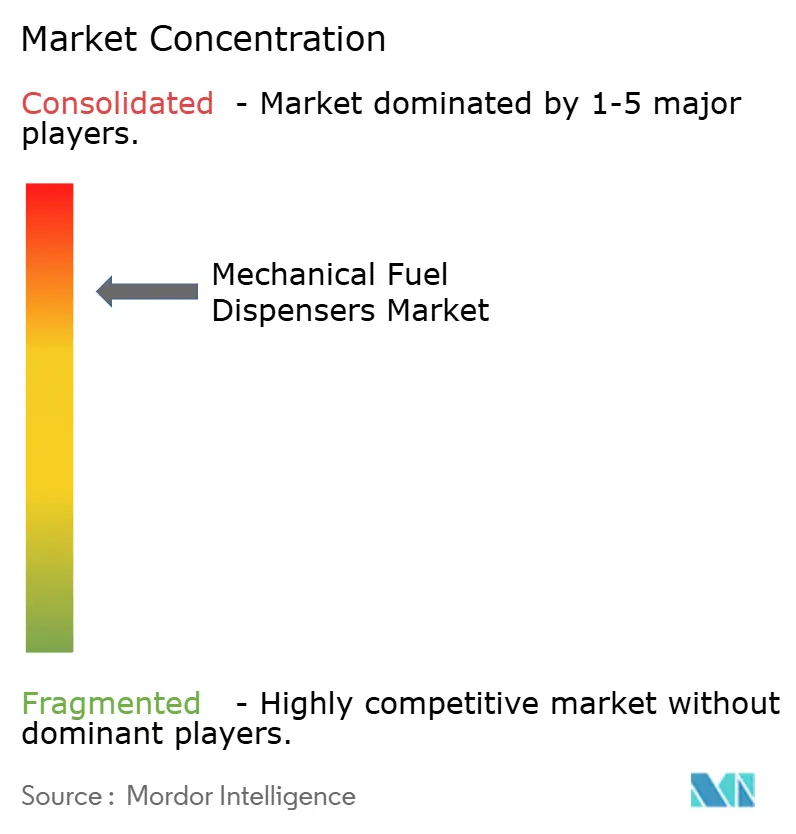
| Market Concentration | High |
Major Players *Disclaimer: Major Players sorted in no particular order Image © Mordor Intelligence. Reuse requires attribution under CC BY 4.0. | |
Mechanical Fuel Dispensers Market Analysis by Mordor Intelligence
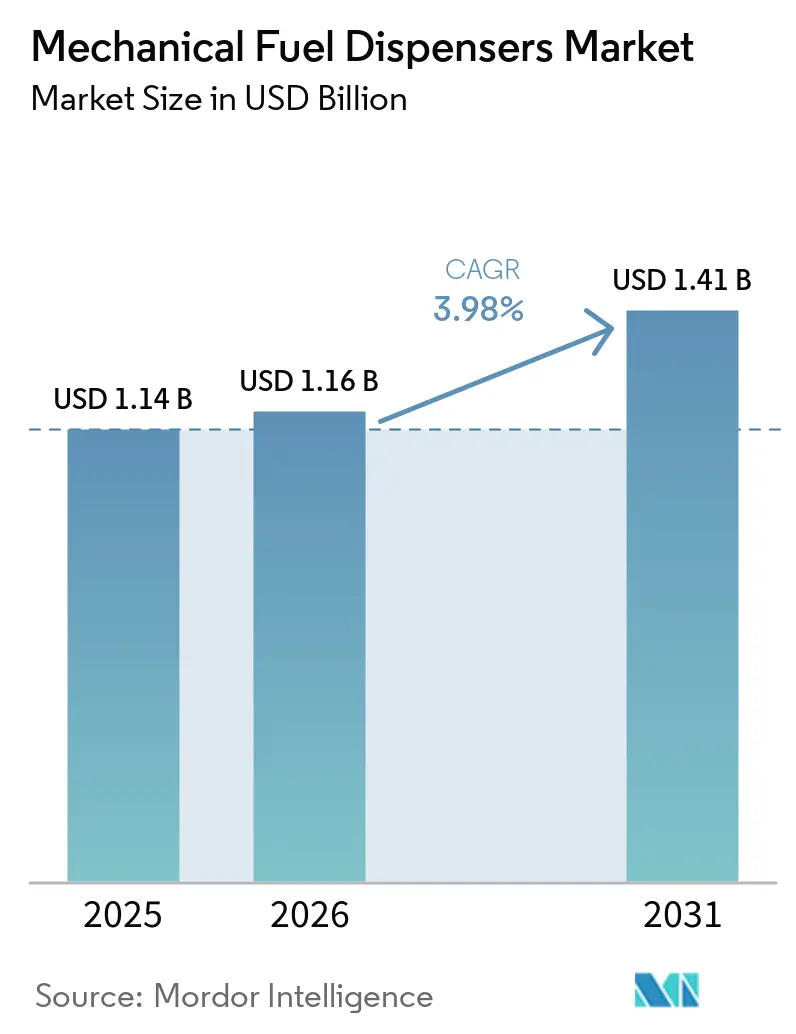
The Mechanical Fuel Dispensers Market size is expected to grow from USD 1.14 billion in 2025 to USD 1.16 billion in 2026 and is forecast to reach USD 1.41 billion by 2031 at 3.98% CAGR over 2026-2031. Growth is supported by the operating needs of fuel retailers, fleet depots, and remote industrial operating sites that value durable equipment, reliable measurement, accessible service, and repairability over a long operating life. Demand remains strongest where power supply is inconsistent, electronic service support is limited, and the consequences of downtime are high. Regulatory requirements for measurement accuracy, payment security, and fuel compatibility are also shaping replacement decisions at both established and new sites. Suppliers are responding with certified metering systems, adaptable hose and seal materials, and modular payment options that can extend the useful life of installed mechanical equipment. The mechanical fuel dispensers market, therefore, combines new-site demand in developing regions with refurbishment demand at established forecourts, while allowing suppliers to serve retail, commercial, and remote industrial users.
Key Report Takeaways
- By fuel type, diesel held 46.8% of the mechanical fuel dispensers market share in 2025, while biofuels are forecast to grow at a 4.2% CAGR through 2031.
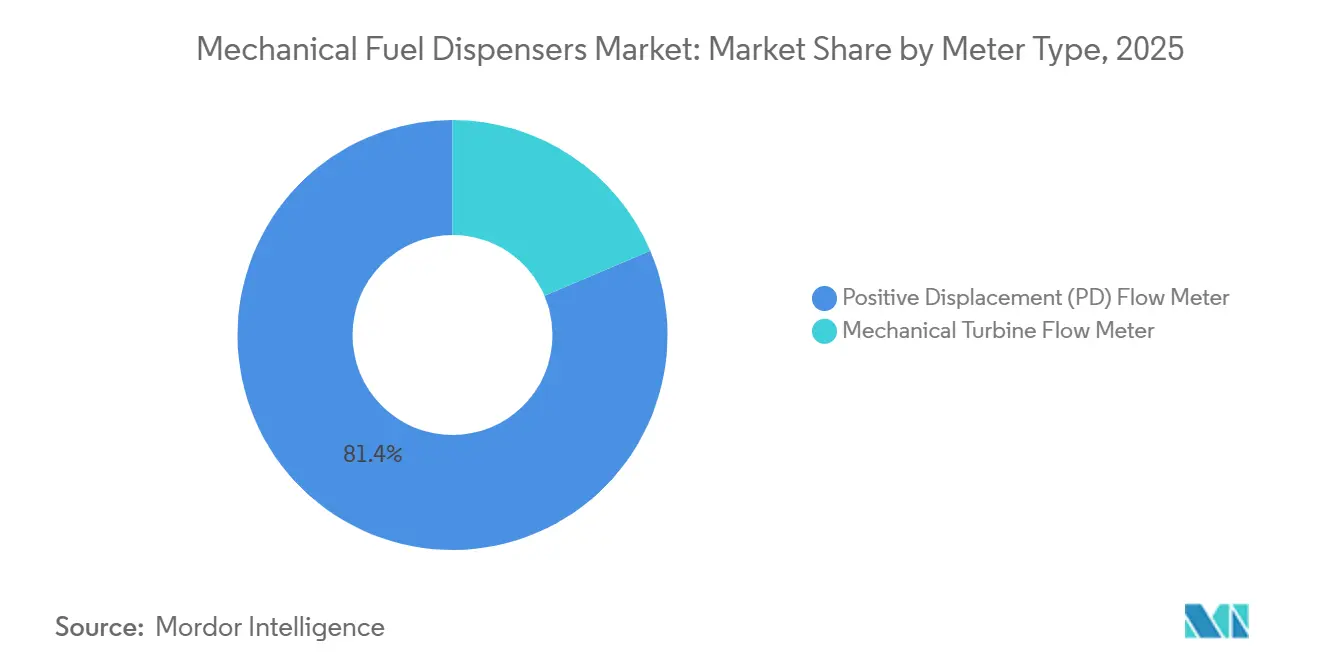
- By meter type, positive displacement meters held 81.4% of the mechanical fuel dispensers market share in 2025, while mechanical turbine meters are forecast to grow at a 4.6% CAGR through 2031.
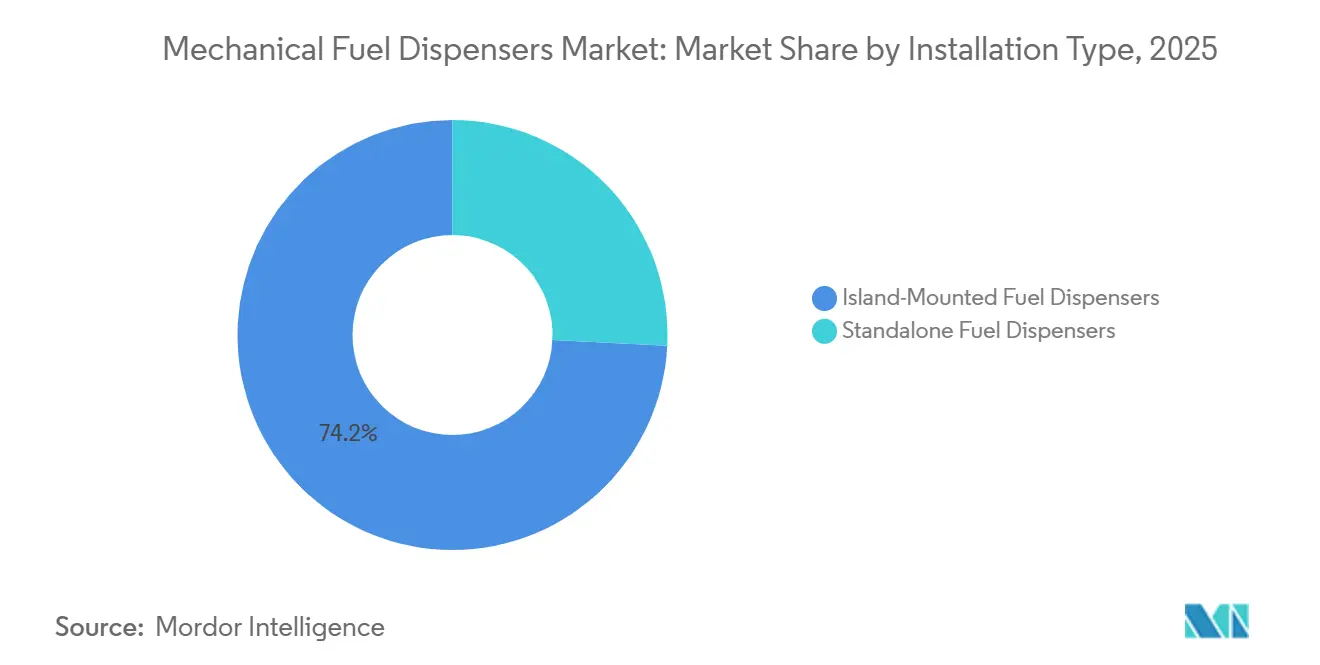
- By installation type, island-mounted dispensers held 74.2% of revenue in 2025, while standalone dispensers are forecast to grow at a 4.4% CAGR through 2031.
- By end user, retail fuel stations accounted for 66.5% of demand in 2025, while commercial fleet fueling is forecast to grow at a 4.3% CAGR through 2031.
- By geography, Asia-Pacific held 38.6% of revenue in 2025, while the Middle East & Africa is forecast to grow at a 5.1% CAGR through 2031.
Note: Market size and forecast figures in this report are generated using Mordor Intelligence’s proprietary estimation framework, updated with the latest available data and insights as of January 2026.
Market Trends and Insights
Drivers Impact Analysis of Mechanical Fuel Dispensers Market*
| Driver | (~) % Impact on CAGR Forecast | Geographic Relevance | Impact Timeline |
|---|---|---|---|
| Expansion of Fuel-Retail Infrastructure in Emerging Economies | +1.20% | APAC core, MEA, South America | Medium term (2–4 years) |
| Retrofitting of Aging Forecourts for Accuracy and Digital Payments | +0.80% | North America & EU, spill-over to APAC | Short term (≤ 2 years) |
| Growth of Commercial Fleet and High-Flow Diesel Refueling | +0.70% | Global, with concentration in APAC and MEA | Medium term (2–4 years) |
| Multi-Fuel Compatibility for Biofuels, CNG, LNG, Hydrogen and DEF | +0.60% | Europe, North America, APAC | Long term (≥ 4 years) |
| Water-Ingress Detection and Fuel-Quality Assurance in Remote Stations | +0.30% | MEA, tropical APAC, South America | Medium term (2–4 years) |
| Automated Visual Safety Authorization for Low-Staffed Stations | +0.20% | Global, early gains in Europe and MEA | Long term (≥ 4 years) |
| Source: Mordor Intelligence | |||
Expansion of Fuel-Retail Infrastructure in Emerging Economies
Fuel retail investment in Africa and South Asia supports new equipment demand where station networks are expanding, providing a practical growth base for the mechanical fuel dispensers market. The mechanical fuel dispensers market benefits when lower-cost, serviceable equipment can support smaller and remote locations where operators need straightforward maintenance. India expanded the Government-Approved Test Centre verification scope in May 2026 to include petrol, diesel, CNG, LPG, LNG, and hydrogen dispensers. The broader verification requirement raises the importance of certified equipment in new installations and replacement programs because a station operator must demonstrate that the equipment is acceptable for commercial use. It also favors suppliers that can provide documented compliance, local service support, spare parts, and training for station operators. These conditions make procurement decisions less dependent on initial price alone.
Retrofitting of Aging Forecourts for Accuracy and Digital Payments
Older forecourts are upgrading measurement and payment components within a narrow capital-planning period. PCI DSS 4.0 security requirements apply to payment environments, making secure payment architecture relevant to outdoor payment terminals[1]. Many operators can retain the mechanical metering unit while adding certified payment modules, limiting disruption to the fuel-delivery system. Dover Fueling Solutions launched DFS Crypto NOVA for EMEA in June 2026 as an open, Android-based payment platform compatible with Tokheim OASE systems and supporting more than 250 card types. This approach can lower the cost, outage risk, and installation disruption of a full replacement, especially at sites that must continue serving customers while work is completed. It also creates aftermarket revenue opportunities for the mechanical fuel dispensers market.
Growth of Commercial Fleet and High-Flow Diesel Refueling
Commercial fleet fueling is forecast to grow at a 4.3% CAGR through 2031. Fleet operators prioritize throughput, measurement accuracy, fuel accounting, and dependable access because fuel is a material operating cost. Diesel continues to serve long-haul transport, construction, mining, and off-grid activity in the supplied analysis. High-flow positive displacement systems are suited to sites where continuous power is unavailable or specialized electronic maintenance is difficult to obtain. Mining and construction locations also replace equipment as sites expand, equipment wears, fuel-control requirements become more formal, and operators need dependable records for internal allocation and reconciliation. These requirements support recurring demand within the mechanical fuel dispensers market.
Multi-Fuel Compatibility for Biofuels, CNG, LNG, Hydrogen, and DEF
Biofuels are forecast to grow at a 4.2% CAGR through 2031, supported by fuel-blend requirements in several markets. The U.S. Environmental Protection Agency states that equipment used with biodiesel blends must be compatible with the stored fuel and the relevant system components[2]. UL 87B covers power-operated dispensing devices for diesel, biodiesel, diesel and biodiesel blends up to B20, kerosene, and fuel oil[3]. Higher blend levels can require review of seals, hoses, metering chambers, and the materials that contact fuel during daily operation. Certified multi-fuel configurations can therefore distinguish equipment suppliers in blend-mandate locations, particularly when a buyer needs evidence that materials can operate safely with its planned fuels. This replacement and recertification activity broadens the mechanical fuel dispensers market beyond conventional diesel and gasoline applications.
Restraints Impact Analysis of Mechanical Fuel Dispensers Market*
| Restraint | (~) % Impact on CAGR Forecast | Geographic Relevance | Impact Timeline |
|---|---|---|---|
| EV Adoption Reducing Conventional-Fuel Volumes in Mature Markets | -0.90% | Western Europe, North America coastal markets | Medium term (2–4 years) |
| High Compliance and Re-Certification Costs for Legal Metrology | -0.50% | Global, acute in South Asia and Latin America | Short term (≤ 2 years) |
| Calibration Drift from Fuel Blends, Temperature and Water Contamination | -0.40% | Tropical APAC, MEA, South America remote stations | Medium term (2–4 years) |
| Cybersecurity Exposure of Connected Dispensers and Legacy Payment Hardware | -0.30% | North America, Europe, advanced APAC | Short term (≤ 2 years) |
| Source: Mordor Intelligence | |||
EV Adoption Reducing Conventional-Fuel Volumes in Mature Markets
Electric vehicle adoption can reduce conventional-fuel volumes at sites in mature markets. The impact is most relevant in Western Europe and coastal North American markets where charging access and electric vehicle ownership are more developed. This exposure affects a minority of global mechanical dispenser volumes in the supplied analysis because freight, industrial, and remote fueling applications continue to depend on conventional fuels. Operators in these regions may convert part of a site to charging rather than add conventional fueling capacity. Equipment suppliers are responding by broadening their forecourt portfolios and maintaining support for installed conventional equipment. The mechanical fuel dispensers market remains more resilient in freight, remote operations, and regions with lower electric vehicle penetration.
Cybersecurity Exposure of Connected Dispensers and Legacy Payment Hardware
Connected payment modules bring cybersecurity obligations to mechanical dispenser installations. PCI DSS requires controls that protect payment account data and applies to entities that store, process, or transmit that data. Legacy payment hardware can create upgrade costs for independent station operators with limited capital budgets, even when the underlying pump and metering equipment remains operationally sound. Dover Fueling Solutions received PCI Secure Software Standard v1.2 certification for its Anthem UX platform in June 2025. Suppliers that offer compatible, certified modules can reduce the burden of a payment upgrade and preserve the operation of existing mechanical equipment. The cost of compliance can still delay upgrades in the mechanical fuel dispensers market, where a station owner is price-sensitive.
*Our forecasts treat driver/restraint impacts as directional, not additive. The impact forecasts reflect baseline growth, mix effects, and variable interactions.
Mechanical Fuel Dispensers Market Segment Analysis
By Fuel Type:
Diesel Anchors Volume, Biofuels Require New Hardware StandardsDiesel held 46.8% of demand in 2025, while biofuels are forecast to expand at a 4.2% CAGR through 2031. Diesel demand is sustained by commercial transport, power generation, and off-highway operations. These uses prioritize dependable delivery, practical maintenance, predictable calibration, and access to replacement parts over advanced digital features. Biofuel requirements create demand because installed equipment must be compatible with the blend in use and supported by manufacturer documentation for its intended application. The U.S. Environmental Protection Agency identifies compatibility requirements for biodiesel equipment and storage systems[4].
UL 87B defines covered diesel and biodiesel blend applications for dispensing equipment. Brazil’s B15 biodiesel requirement, the EU EN590 B7 standard, and India’s E20 program were identified as factors requiring documented compatibility. Gasoline and kerosene continue to support demand outside diesel. Other liquid fuels include diesel exhaust fluid dispensing at heavy-duty fleet sites. The mechanical fuel dispensers market must address changing material-compatibility requirements across several fuel grades.
By Meter Type:
PD Meters Dominate on Accuracy, Turbines Gain in High-Flow Fleet ApplicationsPositive displacement meters accounted for 81.4% of the mechanical fuel dispensers market size in 2025. Their position reflects the need for reliable custody-transfer measurement in retail, fleet, and remote applications, where small measurement errors can affect fuel accounting. OIML R 117-1 sets requirements for dynamic liquid measuring systems used in commercial measurement. Positive displacement technology can operate without external power and does not require an upstream straight-pipe run. These attributes suit off-grid locations and installations with limited technical support, which helps sustain the mechanical fuel dispensers market in difficult operating environments.
Mechanical turbine meters are forecast to grow at a 4.6% CAGR through 2031. Their use is concentrated in high-flow fleet depots where fuel is clean, viscosity is stable, and operators can maintain controlled operating conditions. Turbine systems can offer lower pressure drop and a lower capital cost per nozzle in suitable applications. Their performance can be more sensitive to changes in fuel viscosity, temperature, and blend composition. Suppliers must match meter selection to the fuel, flow profile, and measurement requirements of each site.
By Installation Type:
Island-Mounted Units Define Retail Scale, Standalone Models Expand IndustriallyIsland-mounted dispensers held 74.2% of demand in 2025. They are widely used at retail stations with multi-nozzle layouts, organized vehicle movement, and shared cabling. Their scale is supported by expanding forecourt networks in China, India, Indonesia, and Vietnam. These sites typically need equipment that can serve several fuel grades, high daily vehicle counts, payment functions, and clear traffic patterns. Island-mounted layouts can accommodate payment and accessory upgrades within an established forecourt design, supporting renewal activity in the mechanical fuel dispensers market.
Standalone dispensers are forecast to grow at a 4.4% CAGR through 2031. Mining sites, construction camps, agricultural operations, and temporary projects use them because they require less civil work. These units do not require a defined island, canopy, or extensive multi-nozzle cabling, which can simplify deployment at isolated sites. Relocatable equipment also fits projects with finite operating lives and changing site needs. This use case gives standalone systems a distinct role in the mechanical fuel dispensers market.
By End User:
Retail Stations Anchor Demand, Commercial Fleet Fueling Drives Incremental GrowthRetail fuel stations represented 66.5% of end-user demand in 2025. New station construction in Africa, South Asia, and Southeast Asia supports demand in this segment. Established markets also require refurbishment as metrology and payment requirements change. Retail sites often need a broad fuel offering, multiple nozzles, documented accuracy, and equipment that can accommodate later payment or accessory upgrades. The segment remains the volume anchor of the mechanical fuel dispensers market, supporting a large installed base and predictable servicing needs.
Commercial fleet fueling is forecast to grow at a 4.3% CAGR through 2031. Depot fueling is expanding with logistics activity in South Asia and the Middle East, according to the supplied analysis, particularly where operators seek greater control of fuel use. Mining and construction operations require high-flow equipment for internal fuel control. These users often specify positive displacement metering and documented calibration accuracy. Industrial facilities, agriculture, aviation ground support, marine bunkering, and diesel exhaust fluid applications provide diverse additional demand.
Geography Analysis
APAC Mechanical Fuel Dispensers Market
Asia-Pacific held 38.6% of the mechanical fuel dispensers market size in 2025. China, India, Indonesia, Vietnam, and Thailand support the region through dense fuel station networks. China generates the largest absolute volume in the region, with domestic manufacturers competing strongly in island-mounted equipment, regional distribution, and price-sensitive procurement. India expanded verification coverage for several types of fuel dispensers in May 2026. Japan and South Korea remain higher-specification markets where accuracy certification is important.
MEA Mechanical Fuel Dispensers Market
Middle East & Africa is forecast to grow at a 5.1% CAGR through 2031. Demand is linked to fuel retail expansion, modernized station networks, logistics activity, and remote operations that require robust equipment and straightforward servicing. Saudi Arabia’s station modernization supports replacement demand for legacy hardware in the supplied analysis. Morocco, Egypt, and the UAE support procurement through highway and urban retail coverage. Local service capacity and power-independent equipment are important in parts of sub-Saharan Africa, where operators may face long travel distances, intermittent grid supply, and limited specialized support.
Europe and the Americas Mechanical Fuel Dispensers Market
North America and Europe are mature areas of the mechanical fuel dispensers market, where compliance, refurbishment, and operator efforts to retain existing assets shape demand. NIST’s legal metrology guidance and the PCI security framework make accurate measurement and protected payment systems central to upgrades. Europe’s biofuel blend requirements can prompt a review of dispensing materials and certification. South America contributes steady demand through Brazil’s biodiesel program, logistics activity in Argentina, and mining and urban growth in Chile and Colombia.
Competitive Landscape
The mechanical fuel dispensers market is consolidated, with different competitive positions across regulated and volume-driven regions, and no single supplier is described as controlling global demand. Gilbarco Veeder-Root, Dover Fueling Solutions, Tatsuno Corporation, and Scheidt & Bachmann compete through certification depth, service coverage, and payment-accessory options. Chinese manufacturers such as Censtar, Beijing Sanki, Zhejiang Datian, Zhejiang Lanfeng, Jiangsu Furen, and Jiangsu Henghe compete on cost and lead time. OIML-type evaluation and similar approvals are becoming more relevant to competitive access in regulated tenders. This structure leaves room for global suppliers and regional manufacturers with strong distribution support, certification capabilities, local technical service, and products suited to the fuel and operating conditions of each customer.
Dover Fueling Solutions launched DFS Crypto NOVA in June 2026 as a payment platform for EMEA that works with Tokheim OASE systems and supports more than 250 card types. Dover Fueling Solutions also showcased its connected forecourt system at the NACS Show in October 2025. These moves extend the company’s scope from dispensing hardware into payment and forecourt management, creating a broader relationship with the station operator. Gilbarco Veeder-Root launched its Konect 400 kW charging platform in December 2025, indicating a broader multi-energy forecourt strategy. The mechanical fuel dispensers market is being shaped by hardware capability and adjacent site services.
Multi-fuel-certified mechanical equipment remains an opening in the mechanical fuel dispensers market where fuel blends are becoming more common, and suppliers can demonstrate compatible materials through certification, local approvals, and suitable after-sales support for station operators. Rugged, power-independent units also serve mining and off-grid agricultural sites with limited service infrastructure, intermittent power, and difficult access to repairs. Bennett Pump and Kraus Global remain relevant in North America through distribution and service reach. Korea EnE and Neotec maintain positions in Northeast Asia through local market coverage, equipment familiarity, and relationships with local service providers.
Mechanical Fuel Dispensers Industry Leaders
-
Dover Fueling Solutions
-
Gilbarco Veeder-Root
-
Tatsuno Corporation
-
Tominaga Mfg. Co., Ltd.
-
Scheidt & Bachmann GmbH
- *Disclaimer: Major Players sorted in no particular order
Mechanical Fuel Dispensers Market Companies Covered in this Report
- Beijing Sanki Petroleum Technology Co., Ltd.
- Bennett Pump Company
- Censtar Science & Technology Corp., Ltd.
- Dover Fueling Solutions (DFS)
- Gilbarco Veeder-Root
- Jiangsu Furen Group
- Jiangsu Henghe Petroleum Machinery Co., Ltd.
- Korea EnE Co., Ltd.
- Kraus Global Ltd.
- Neotec Corporation
- Scheidt & Bachmann GmbH
- Shenzhen Kaisai Electric Motor Co., Ltd.
- Tatsuno Corporation
- Tokheim Group S.A.S.
- Tominaga Mfg. Co., Ltd.
- Zhejiang Datian Machine Co., Ltd.
- Zhejiang Lanfeng Machine Co., Ltd.
Recent Industry Developments in Mechanical Fuel Dispensers Market
- July 2026: Dover Fueling Solutions launched ProGauge MagLink Anywhere, a mobile ATG application providing real-time tank inventory and console data for fuel retailers. The product reduces operational overheads at unmanned or remotely managed sites and extends DFS's connected forecourt ecosystem.
- June 2026: Dover Fueling Solutions launched DFS Crypto NOVA for the EMEA market, an open, Android-based payment platform compatible with Tokheim OASE dispenser systems, supporting over 250 card types and consolidating payment processing across fuel pumps, EV chargers, and in-store POS terminals into a single system.
- March 2026: Dover Fueling Solutions launched ProGauge DMP MagRF, a wireless connectivity upgrade for magnetostrictive tank probes, converting wired installations to wireless without site disruption, reducing forecourt retrofit cost during the compliance-driven upgrade wave.
- February 2026: Dover Fueling Solutions launched the ProGauge LR120 Radar, an industrial-grade ATG solution for EMEA and Latin American markets, integrating with the ProGauge MagLink LX console family for enhanced liquid measurement accuracy at industrial fuel storage sites.
Global Mechanical Fuel Dispensers Market Report Scope
Mechanical fuel dispensers are fuel dispensing systems that use mechanical metering mechanisms, primarily positive displacement (PD) meters or mechanical turbine meters, to measure and deliver liquid fuels accurately into vehicle or equipment tanks. These dispensers operate without relying on electronic flow measurement for fuel metering, although some modern models may incorporate basic electronic displays or payment interfaces while retaining a mechanical meter. They are widely used at retail fueling stations, commercial fleets, agricultural operations, mining sites, and remote fueling locations due to their durability, ease of maintenance, and reliable operation in environments with limited electrical infrastructure.
The Mechanical Fuel Dispensers Market is segmented by fuel type, meter type, installation type, end user, and geography. By fuel type, the market is segmented into gasoline, diesel, kerosene, biofuels, and other fuels. By meter type, the market is segmented into positive displacement and mechanical turbine. By installation type, the market is segmented into standalone and island-mounted. By end user, the market is segmented into retail fuel stations, commercial fleet, mining, construction, industrial, and others. The report also covers the market size and forecasts for the mechanical fuel dispensers market across 26 countries in key regions. For each segment, the market sizing and forecasts have been provided on the basis of value (USD).
Segmentation Overview
| Gasoline |
| Diesel |
| Kerosene |
| Biofuels |
| Other Liquid Fuels |
| Positive Displacement (PD) Flow Meter |
| Mechanical Turbine Flow Meter |
| Standalone Fuel Dispensers |
| Island-Mounted Fuel Dispensers |
| Retail Fuel Stations |
| Commercial Fleet Fueling |
| Mining |
| Construction |
| Industrial Facilities |
| Others |
| North America | United States |
| Canada | |
| Mexico | |
| Europe | Germany |
| France | |
| Italy | |
| Spain | |
| United Kingdom | |
| Poland | |
| Russia | |
| Rest of Europe | |
| Asia-Pacific | China |
| India | |
| Japan | |
| South Korea | |
| Australia | |
| Indonesia | |
| Vietnam | |
| Thailand | |
| Rest of Asia-Pacific | |
| South America | Brazil |
| Argentina | |
| Chile | |
| Rest of South America | |
| Middle East and Africa | Saudi Arabia |
| United Arab Emirates | |
| Egypt | |
| South Africa | |
| Morocco | |
| Rest of Middle East and Africa |
| By Fuel Type | Gasoline | |
| Diesel | ||
| Kerosene | ||
| Biofuels | ||
| Other Liquid Fuels | ||
| By Meter Type | Positive Displacement (PD) Flow Meter | |
| Mechanical Turbine Flow Meter | ||
| By Installation Type | Standalone Fuel Dispensers | |
| Island-Mounted Fuel Dispensers | ||
| By End User | Retail Fuel Stations | |
| Commercial Fleet Fueling | ||
| Mining | ||
| Construction | ||
| Industrial Facilities | ||
| Others | ||
| By Geography | North America | United States |
| Canada | ||
| Mexico | ||
| Europe | Germany | |
| France | ||
| Italy | ||
| Spain | ||
| United Kingdom | ||
| Poland | ||
| Russia | ||
| Rest of Europe | ||
| Asia-Pacific | China | |
| India | ||
| Japan | ||
| South Korea | ||
| Australia | ||
| Indonesia | ||
| Vietnam | ||
| Thailand | ||
| Rest of Asia-Pacific | ||
| South America | Brazil | |
| Argentina | ||
| Chile | ||
| Rest of South America | ||
| Middle East and Africa | Saudi Arabia | |
| United Arab Emirates | ||
| Egypt | ||
| South Africa | ||
| Morocco | ||
| Rest of Middle East and Africa | ||
Key Questions Answered in the Report
What is the projected value of the mechanical fuel dispensers sector by 2031?
The sector is projected to reach USD 1.41 billion by 2031, growing at a 3.98% CAGR from 2026, supported by replacement demand, new installations, and demand from retail, fleet, and remote industrial operating sites.
Which fuel type has the largest demand for mechanical fuel dispensers?
Diesel held 46.8% of demand in 2025, supported by transport, power generation, and off-highway uses.
Why are biofuels important for dispenser suppliers?Why are biofuels important for dispenser suppliers?
Biofuels are forecast to grow at a 4.2% CAGR, and blend requirements can require verified material compatibility.
Which meter type is most widely used?
Positive displacement meters held 81.4% of demand in 2025 because they suit accurate commercial measurement and remote sites.
Which region is growing fastest for mechanical fuel dispensers?
Middle East & Africa is forecast to grow at a 5.1% CAGR through 2031, supported by station modernization and remote operating needs.
What affects replacement demand at fuel stations?
Measurement verification, biofuel compatibility, and payment-security upgrades can lead operators to replace or retrofit equipment.