
Meat Quality Imaging Systems Market Size and Share
Market Overview
| Study Period | 2020 - 2031 |
|---|---|
| Market Size (2026) | USD 190.26 Million |
| Market Size (2031) | USD 278.57 Million |
| Growth Rate (2026 - 2031) | 7.92 % |
| Fastest Growing Market | Asia-Pacific |
| Largest Market | Europe |
| Market Concentration | Medium |
Major Players *Disclaimer: Major Players sorted in no particular order Image © Mordor Intelligence. Reuse requires attribution under CC BY 4.0. | |
Meat Quality Imaging Systems Market Analysis by Mordor Intelligence
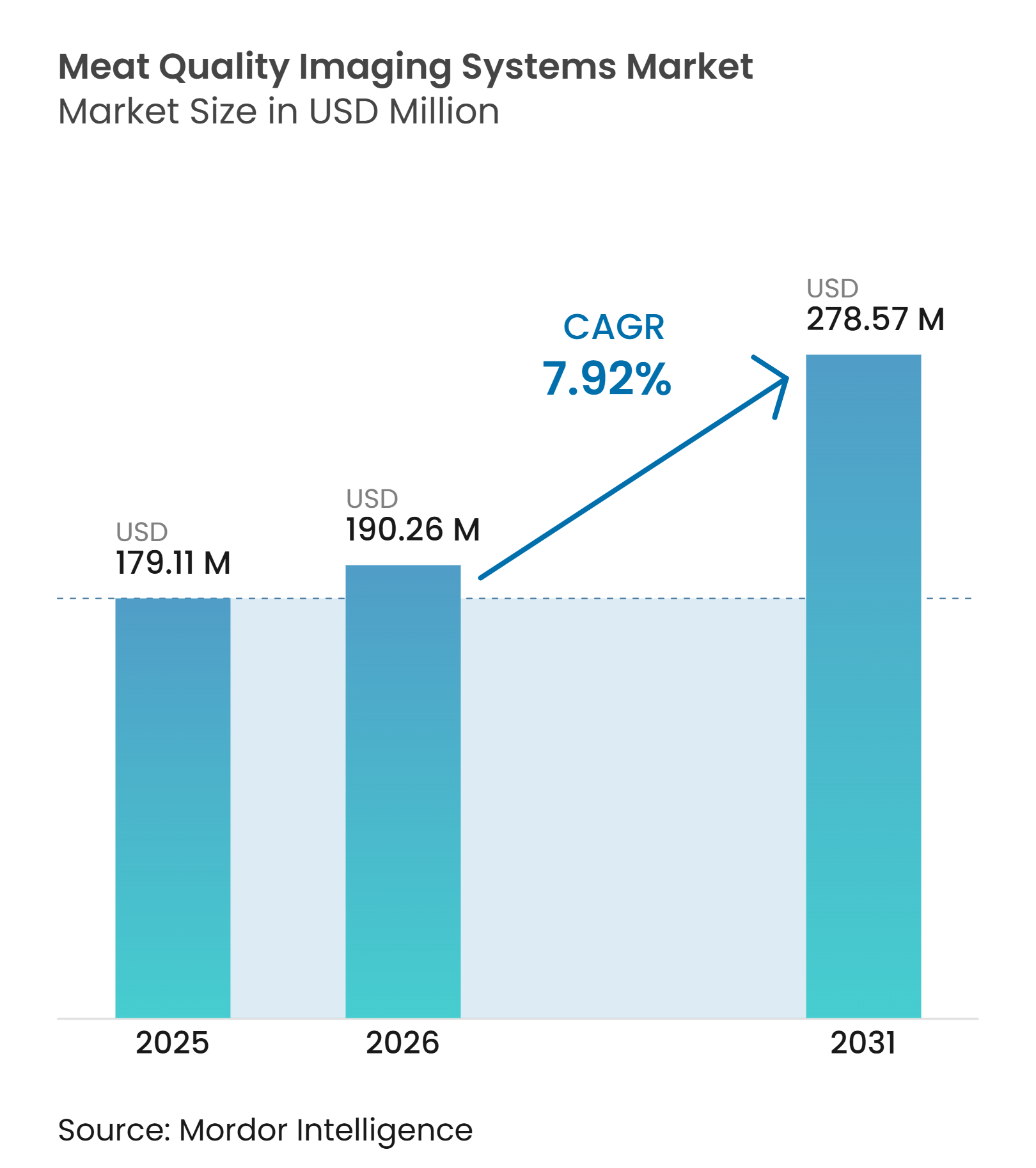
The meat quality imaging systems market size was USD 179.11 million in 2025 and is estimated to increase from USD 190.26 million in 2026 to USD 278.57 million by 2031, at a CAGR of 7.92% during the forecast period, 2026-2031. The meat quality imaging systems market is moving from sampled lot releases toward continuous inspection and recorded quality checks. Food safety rules, traceability demands, and export requirements are increasing the value of verified inspection records for processors in the meat quality imaging systems market. Inline imaging can assess fat distribution, low-density foreign material, and texture conditions at line speed, which supports more consistent product decisions than periodic manual checks. Large processors are integrating inspection hardware with data systems to gain better control over yield, specifications, and labor utilization. High ownership costs, legacy system integration, and performance changes across breeds, lighting, and plant conditions can delay adoption, especially at smaller facilities.
Key Report Takeaways
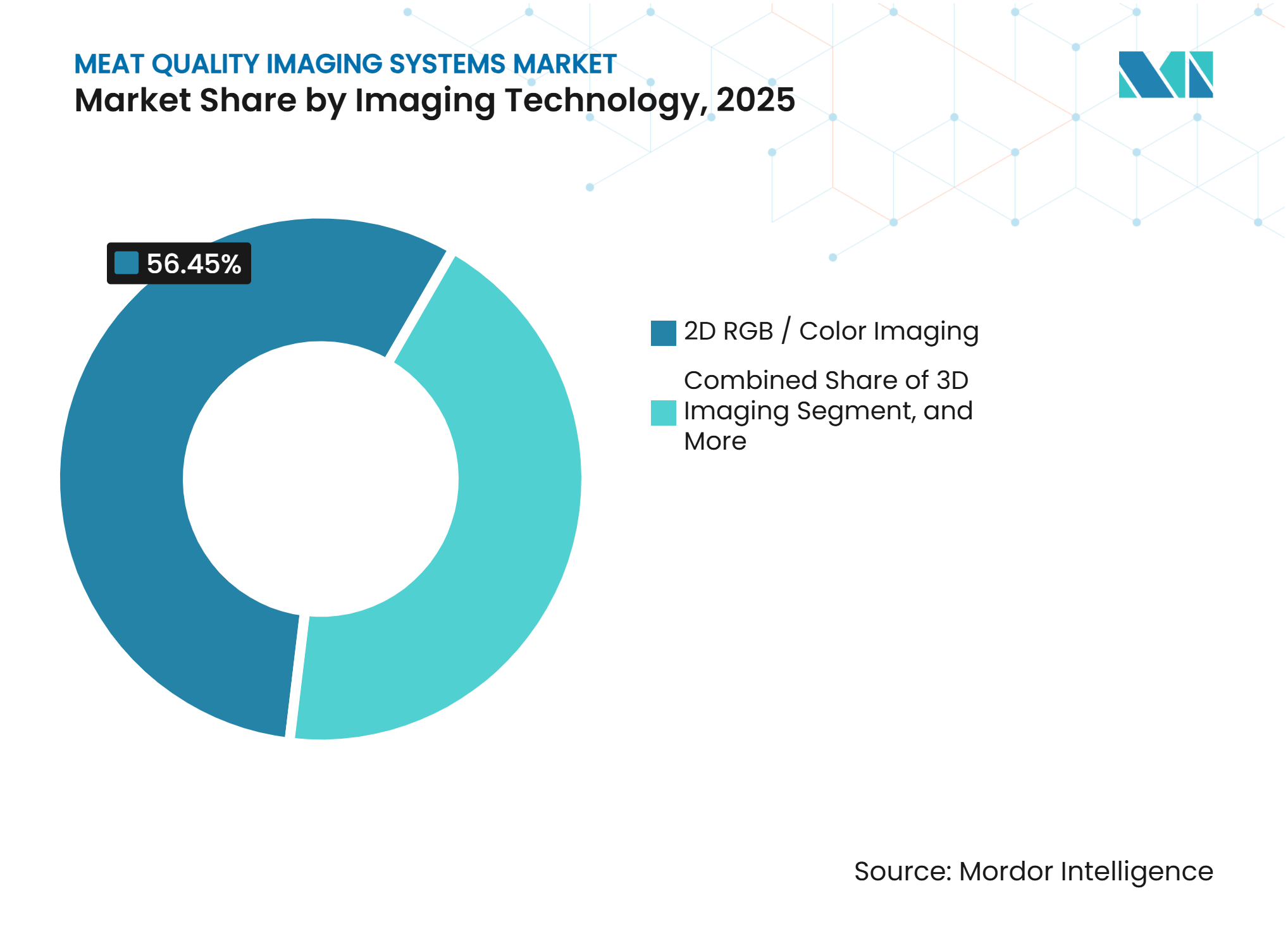
- Among imaging technologies, 2D RGB/Color Imaging held a 56.45% revenue share in 2025, while Hyperspectral Imaging is projected to expand at an 8.92% CAGR through 2031.
- By meat type, Pork held 31.67% revenue share in 2025, while Poultry is expected to expand at an 8.89% CAGR through 2031.
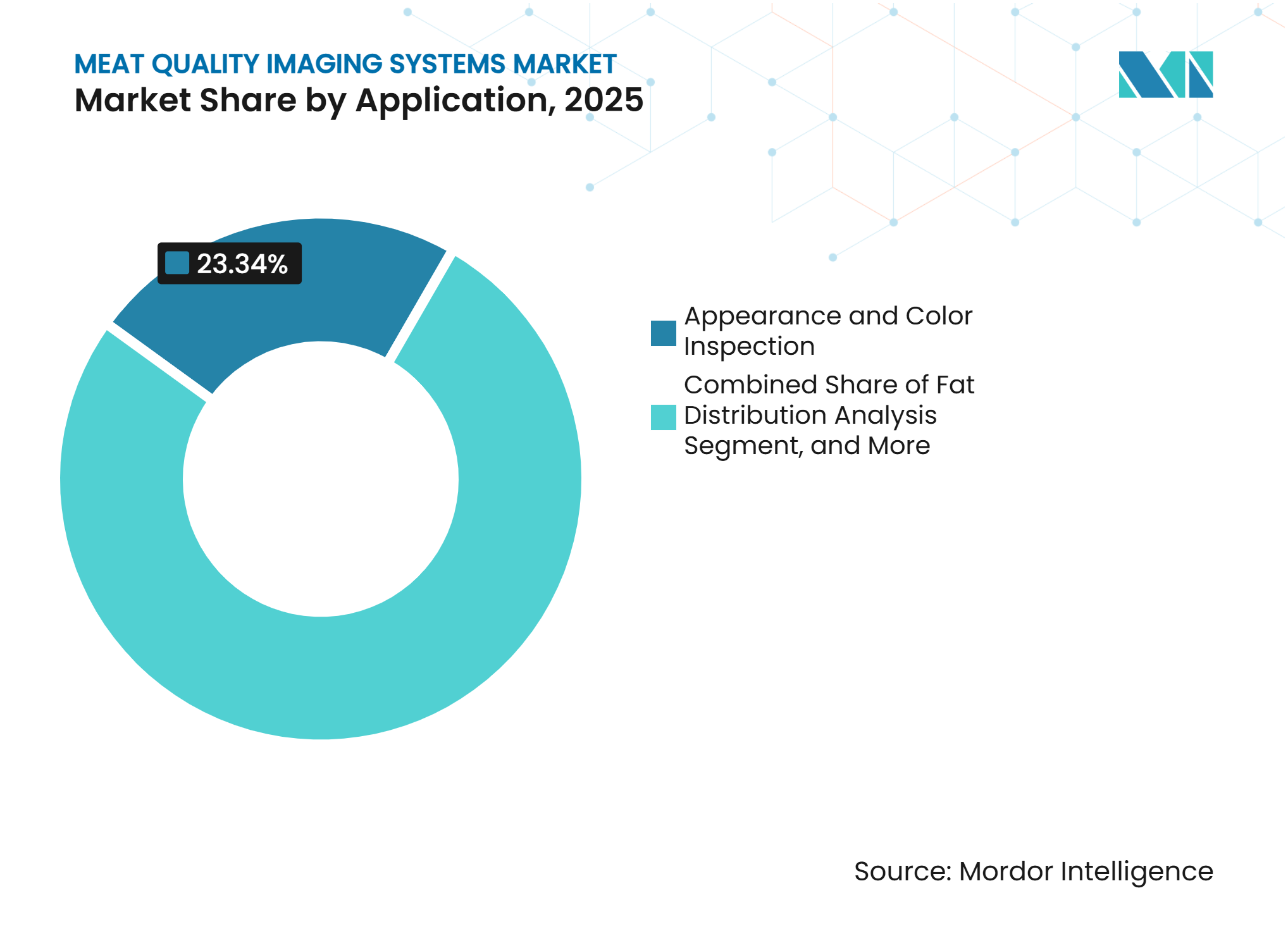
- By application, Appearance and Color Inspection held 24.34% revenue share in 2025, while Fat Distribution Analysis is projected to expand at a 9.28% CAGR through 2031.
- By end user, Meat-Processing Companies held 34.61% revenue share in 2025, while Poultry Processors are expected to expand at a 9.09% CAGR through 2031.
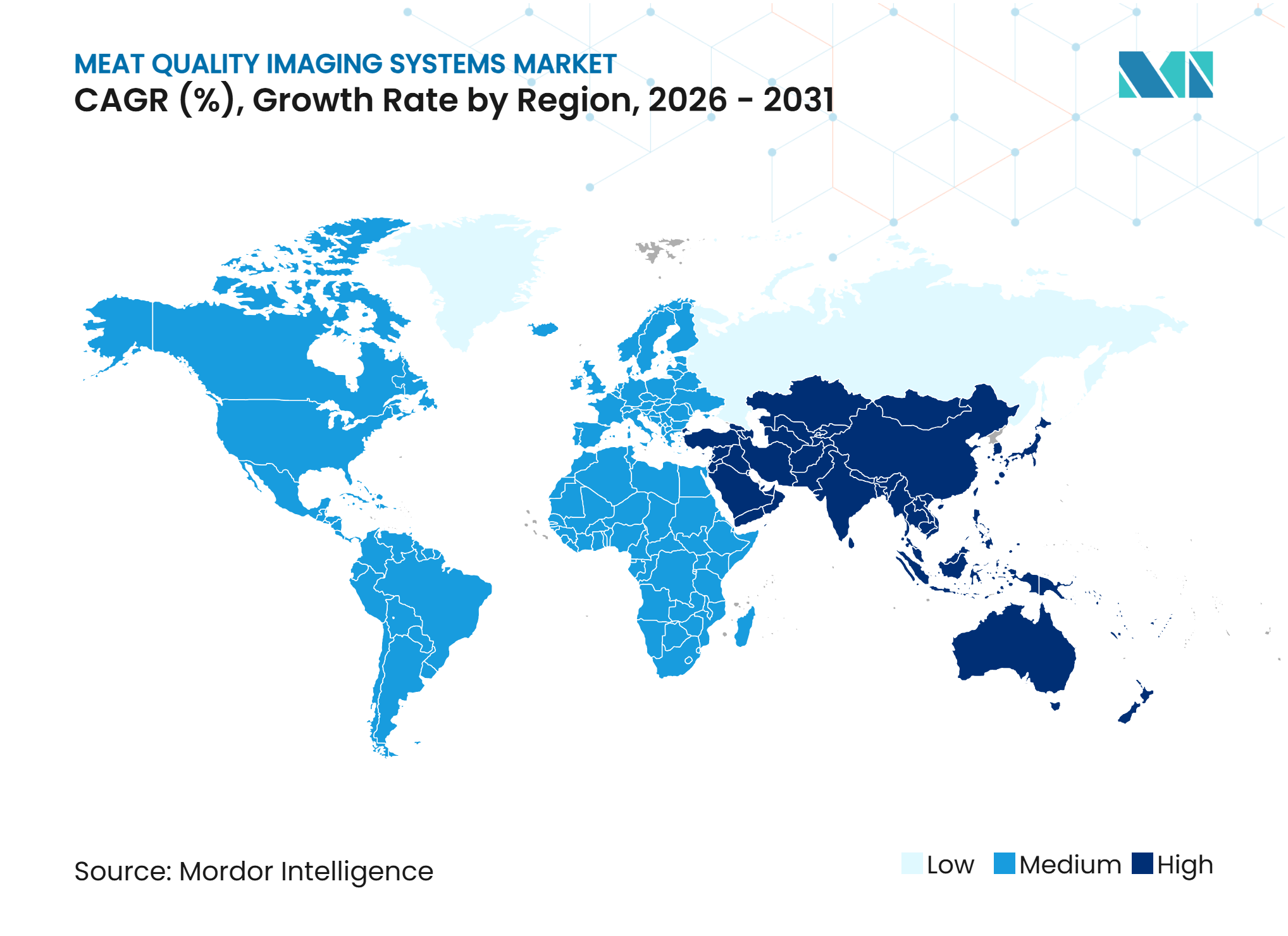
- By geography, Europe accounted for 29.91% of revenue in 2025, while Asia-Pacific is projected to expand at an 8.91% CAGR through 2031.
Note: Market size and forecast figures in this report are generated using Mordor Intelligence’s proprietary estimation framework, updated with the latest available data and insights as of January 2026.
Market Trends and Insights
Drivers Impact Analysis of Meat Quality Imaging Systems Market*
| Driver | (~) % Impact on CAGR Forecast | Geographic Relevance | Impact Timeline |
|---|---|---|---|
| Stricter Food Safety, Traceability, and Export Certification Requirements | +2.0% | Global, with highest relevance in Europe and North America. Export-oriented processors in Asia-Pacific are also affected. | Medium term (2-4 years) |
| Shift From Sampling to 100% Inline Quality Control | +1.5% | North America and Europe, with expanding use in Asia-Pacific. | Short term (≤ 2 years) |
| Labor Scarcity and Automation of Slaughter and Processing Lines | +1.2% | North America, Europe, Japan, South Korea, Australia, and Thailand. | Short term (≤ 2 years) |
| Yield Optimization Through Real-Time Lean-to-Fat Measurement | +0.9% | Global, especially North America, South America, and Australia. | Medium term (2-4 years) |
| Digital Calibration Transfer Across Plants and Suppliers | +0.6% | Multi-plant operators in North America and Europe. | Long term (≥ 4 years) |
| Demand for Low-Density Foreign-Material Detection | +0.5% | North America and Europe, with emerging demand in Asia-Pacific and Middle East and Africa export corridors. | Medium term (2-4 years) |
| Source: Mordor Intelligence | |||
Stricter Food Safety, Traceability, and Export Certification Requirements
The meat quality imaging systems market is supported by food safety and traceability requirements across major processing regions, particularly where processors must document inspection decisions for domestic and export customers. In February 2026, the US Food Safety and Inspection Service proposed allowing eligible young chicken establishments under the New Poultry Inspection System to operate at speeds up to 175 birds per minute.[1] That speed leaves little time for full manual carcass coverage and strengthens the case for automated inspection equipment. The European Commission’s 2026 campaign describes traceability as a foundation of food safety under Regulation EC 178/2002. Commission Implementing Regulation (EU) 2026/344 also sets objective poultry meat marketing standards that align with measurement and quality data produced by inline systems. Processors serving multiple export destinations face overlapping documentation requirements, making recorded inspection data more important for access to those channels.
Shift From Sampling to 100% Inline Quality Control
The shift from sampled testing to full product coverage is changing how processors use quality data. Manual sampling has often covered only selected production lots, leaving gaps in defect identification and requiring labor that rises with throughput. A 2025 review found that hyperspectral imaging combined with structured illumination reflectance imaging can assess surface and internal quality characteristics in real time without destroying the product. The meat quality imaging systems market benefits when continuous inspection data can also support supplier comparisons, maintenance planning, and yield forecasting. This gives processors greater operational use of imaging data than a single end-of-line approval decision. Full coverage also makes it easier to identify recurring process variation before it affects a larger volume of product.
Labor Scarcity and Automation of Slaughter and Processing Lines
Labor availability remains a direct reason for processors to adopt vision-guided automation across the meat quality imaging systems market, especially at repetitive cutting and trimming stations. A 2025 review of meat processing reported that labor shortages continued to encourage the use of robotic and AI systems across poultry, pork, beef, and veal operations. Plants in the United States, Germany, the Netherlands, and South Korea are using camera-guided systems for deboning, portioning, and trimming. A separate 2025 review identified 3D vision and camera systems as important tools for robotic cutting and deboning because they can respond to differences in animal size and muscle structure. JBT Marel’s OQULA AI system is trained to identify defects that include bruises, blood spots, fat deposits, and bone or cartilage fragments. Such equipment can reduce dependence on the judgment of scarce, skilled trimmers while providing more consistent inspection records.
Yield Optimization Through Real-Time Lean-to-Fat Measurement
Real-time lean-to-fat measurement is a key driver for large beef and pork processors to purchase advanced imaging equipment. Precise measurement of incoming trim allows plants to blend material to fat specifications with less conservative over-trimming. European processors have reported savings of EUR 2 to EUR 5 (USD 2.26 to USD 5.65) per carcass at 2025 average exchange rates when fat-trim decisions are based on inline NIR or hyperspectral imaging. P&P Optica states that its hyperspectral platform can reduce a laboratory lean-point measurement cycle of 15 minutes to an inline decision made in less than 1 second. JBT Marel’s SensorX measures chemical lean content and detects bone fragments across the product stream. The meat quality imaging systems market is aided when recovered yield can offset system costs at high-volume sites within a short operating period.
Restraints Impact Analysis of Meat Quality Imaging Systems Market*
| Restraint | (~) % Impact on CAGR Forecast | Geographic Relevance | Impact Timeline |
|---|---|---|---|
| High Capital Cost and Total Cost of Ownership | -1.2% | Global, with greatest relevance for small and mid-sized operators in Middle East and Africa, South America, Asia-Pacific, and North America. | Long term (≥ 4 years) |
| Integration With Legacy Production-Control Systems | -0.7% | North America and Europe, plus brownfield expansions in Asia-Pacific. | Medium term (2-4 years) |
| Model Drift From Breed, Cut, Lighting, and Plant Variability | -0.3% | Global, especially multi-site processors using diverse sourcing networks. | Medium term (2-4 years) |
| Limited Interoperability of Proprietary Spectral Libraries | -0.2% | Global, particularly multi-vendor processing environments. | Long term (≥ 4 years) |
| Source: Mordor Intelligence | |||
High Capital Cost and Total Cost of Ownership
High capital costs remain a material constraint on the meat quality imaging systems market, particularly when deployment requires substantial plant changes and staff training. A full inline hyperspectral system for a high-throughput trim or poultry line can require investment in hardware, installation, calibration, and operator training. Software licenses, model retraining, and sanitation-related downtime add to the cost over the equipment's life. Larger integrated processors can fund these investments more easily than cooperatives, contract manufacturers, and regional slaughterhouses. This difference can leave smaller facilities dependent on manual methods or basic 2D RGB equipment. Modular designs that start with 2D RGB capabilities and enable later upgrades to hyperspectral performance could reduce the barrier to entry for mid-sized facilities.
Integration With Legacy Production-Control Systems
Legacy SCADA, MES, and ERP systems can make deployment of modern imaging systems difficult at established plants in the meat quality imaging systems market, where equipment must communicate with several operating systems. Older control systems were generally designed for linear streams of temperature, weight, and line-speed data rather than high-bandwidth imaging inputs. A 2025 review of Meat Industry 5.0 identified high integration costs and compliance requirements as major barriers to the adoption of automation. Custom engineering work can be costly in plants that have separate systems and proprietary protocols. Spectral calibration libraries also tend to be specific to plant conditions, species, and cuts. This can limit multi-site processors' ability to use the same setup across their entire network.
*Our forecasts treat driver/restraint impacts as directional, not additive. The impact forecasts reflect baseline growth, mix effects, and variable interactions.
Meat Quality Imaging Systems Market Segment Analysis
By Imaging Technology:
2D RGB Leads While Hyperspectral Adoption Increases2D RGB/Color Imaging accounted for 56.45% of revenue in 2025 and remained the most established imaging technology in the meat quality imaging systems market. It is widely used for appearance and color grading across poultry, pork, and beef processing lines, supported by straightforward integration, lower software complexity, and a mature supplier base. Many processors in the meat quality imaging systems market also have validated systems and trained maintenance teams, which reduces the pressure to replace existing equipment. 3D imaging supports robotic deboning and portioning through depth maps, while thermal and infrared imaging are used for freshness assessment and spoilage detection at receiving docks. Multispectral imaging provides more chemical sensitivity than RGB systems with lower data-processing demands than full hyperspectral platforms.
Hyperspectral imaging can suit processors that require detailed composition or contaminant information, although its configuration needs remain more demanding and can require calibration for local operating conditions. Hyperspectral Imaging is expected to expand at an 8.92% CAGR through 2031, the highest rate among technology types. A 2025 scientific review found that combining hyperspectral imaging with structured illumination reflectance imaging can allow non-destructive assessment of both surface and internal quality attributes. Fraunhofer IPMS reported on an ultra-compact, energy-efficient, AI-powered hyperspectral camera for food quality control applications in 2026. The PRISMA project in Spain also reported industrial validation of hyperspectral imaging in meat environments during 2026.



By Meat Type:
Pork Anchors Demand While Poultry Expands FastestPork accounted for 31.67% of revenue in 2025, making it the largest meat type within the meat quality imaging systems market. Europe’s integrated pork processing base supports demand for systems that inspect high-line volumes in Germany, the Netherlands, Spain, and Denmark, where plants must maintain consistent quality checks across large product flows. Beef is the second-largest meat type and uses imaging for carcass grading, marbling assessment, and chemical lean measurement. Lamb and mutton represent a smaller share because automation in sheep slaughter is lower, and breed variation complicates calibration. Other meat types include veal, game, and processed protein blends, where mixed-species facilities may seek common inspection platforms.
Poultry is projected to expand at an 8.89% CAGR through 2031, making it the fastest-growing meat type. High-speed deboning lines in the meat quality imaging systems market create conditions in which manual defect detection can be difficult to sustain. A 2026 paper documented the use of machine learning for quality prediction and control in meat and meat products. The February 2026 FSIS proposal to allow eligible young chicken plants to operate at speeds of up to 175 birds per minute provides a regulatory incentive to use automated inspection systems. Faster line speeds can raise the labor cost of manual inspection per unit when staffing is constrained, supporting broader use of camera-based inspection in poultry facilities.
By Application:
Appearance Inspection Has the Broadest Base While Fat Analysis Advances FastestAppearance and Color Inspection accounted for 24.34% of revenue in 2025, giving it the largest application share in the meat quality imaging systems market. Most beef, pork, and poultry lines use some form of color grading or appearance assessment, so plants often buy higher-resolution cameras or AI-enabled grading software rather than replace full platforms. Defect and bruise detection helps processors reduce carcass downgrades. Foreign material detection targets plastic, rubber, and organic debris that can lead to recalls, which makes it an important complement to visual quality grading. Texture assessment in the meat quality imaging systems market supports the identification of poultry conditions, including woody breast and white striping, that may not be visible with standard color cameras.
Size, shape, and dimension inspection is becoming increasingly relevant as processors supply weight-guaranteed packs that require consistent unit dimensions. Fat Distribution Analysis is projected to expand at a 9.28% CAGR through 2031. Visible-spectrum systems cannot fully assess subsurface fat structure, which supports the use of hyperspectral and X-ray platforms. KPM Analytics updated its SiftAI FM HD platform in July 2026 with enhanced AI models, clear-plastic detection, and an IP69K-rated hygiene enclosure for washdown conditions. P&P Optica added real-time size, shape, thickness, and estimated-weight measurement to its hyperspectral platform in January 2025.

By End User:
Meat Processors Lead While Poultry Specialists AccelerateMeat-Processing Companies held 34.61% revenue share in 2025, the largest position among end users in the meat quality imaging systems market. These facilities in the meat quality imaging systems market manage many SKUs, retailer requirements, and private-label composition specifications across inputs that vary by fat cover, breed, season, and origin. Continuous inline measurement helps plants manage this variation while meeting labeling requirements, reducing reliance on periodic laboratory checks. Contract manufacturers and co-packers can benefit from software that switches between inspection programs for different client specifications. Quality-control laboratories and research institutes form a smaller user group, but their validation work can inform plant purchasing decisions.
Poultry Processors are projected to expand at a 9.09% CAGR through 2031. Broiler fillets vary in size, fat cover, bruising, and myopathies, while high line speeds limit the practicality of manual inspection. In September 2026, JBT Marel introduced an integrated poultry preparation and portioning line that combined OQULA AI vision, SensorX inspection, and AXIN performance-monitoring software. Slaughterhouses and abattoirs are adopting vision systems for carcass health scoring, contamination detection, and sex determination. INSPECTRA Vision Systems’ CARCASS CHECKER applies computer vision and AI to inspect pork carcasses for sex, fecal and bile contamination, and processing defects.
Geography Analysis
Europe held 29.91% revenue share in 2025, the largest geographic position in the meat quality imaging systems market. Dense pork and poultry infrastructure and strict regulatory requirements drive demand for equipment in the region, including systems that link inspection data to traceability records. Regulation EC 178/2002 provides a core framework for EU food traceability. Commission Implementing Regulation (EU) 2026/344 establishes poultry meat marketing standards that reinforce objective quality assessment. The Horizon Europe Sensor4Food project is developing a poultry quality platform that combines MIR, VIS-NIR-SWIR hyperspectral imaging, and RF-plus-ultrasound sensing with traceability standards.[2]
North America is the second-largest regional market, and large beef and poultry processing operations are concentrated in the United States. FSIS inspection frameworks and higher poultry throughput influence the meat quality imaging systems market in the region. The February 2026 FSIS proposal covering speeds up to 175 birds per minute strengthens the use case for equipment that can inspect at line speed without increasing inspector headcount. Canada and Mexico add demand as integrated supply chains raise processing standards in poultry and pork trade routes, where consistent records can support cross-border product movements. In January 2026, P&P Optica completed its first Smart Imaging System, manufactured in the United States in partnership with Midwest Metalcraft.
Asia-Pacific is projected to expand at an 8.91% CAGR through 2031, the fastest rate across geographic segments. China is modernizing its food safety infrastructure under the oversight of the State Administration for Market Regulation, while major processors are introducing robotic portioning and packaging lines in 2025. In India, integrated platforms are combining cold-chain IoT monitoring with AI-enabled vision systems for automated grading, and ABB India is deploying robotic handling in high-capacity lines. Japan and South Korea are using imaging equipment in precision food manufacturing as hygiene requirements and labor costs encourage automation, particularly in facilities seeking more repeatable inspection routines. The Middle East and Africa remain smaller, but the stronger Gulf Cooperation Council food safety standards are creating interest in inspection technologies.
Competitive Landscape
Market Concentration
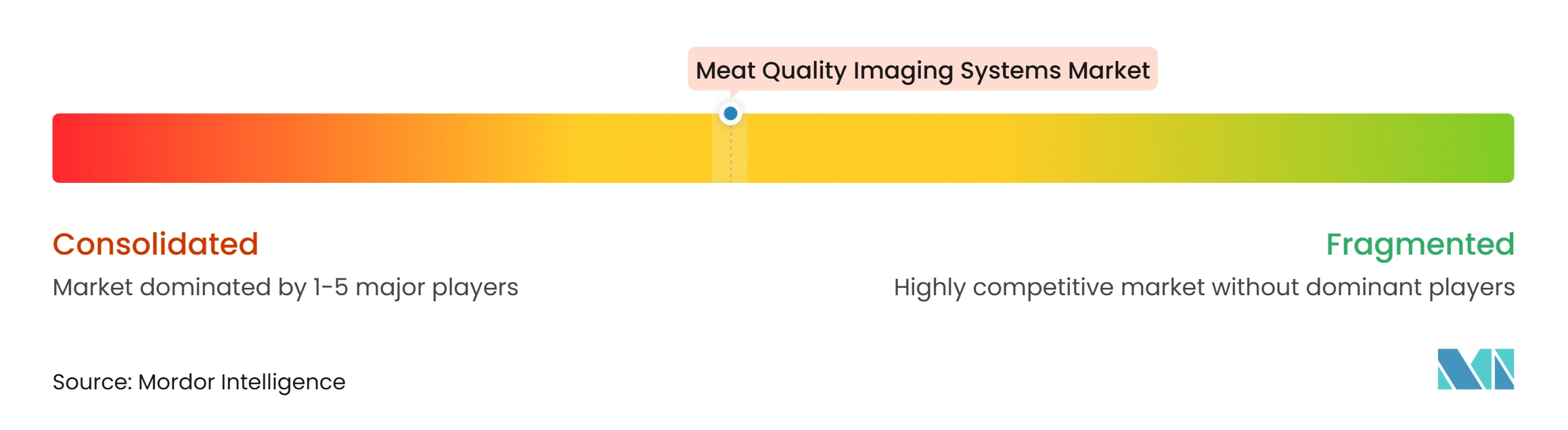
The meat quality imaging systems market is moderately concentrated, with JBT Marel and METTLER TOLEDO International Inc. among the major integrated equipment providers. Their portfolios include X-ray inspection, metal detection, AI-driven vision, and data management software, allowing processors to combine several inspection functions within a coordinated equipment relationship. This approach appeals to large processors that prefer a single supplier for system accountability and software integration. The meat quality imaging systems market favors suppliers that integrate established inspection equipment with AI capabilities and data management functions. The strategy helps suppliers respond to customer demand for connected quality and traceability data.
Specialist suppliers compete with integrated vendors on spectral resolution, calibration flexibility, and detection of low-density contaminants. Specim, P&P Optica, and XNEXT S.p.A. are active in hyperspectral and multispectral inspection applications. This competition also includes food technology suppliers with established experience in optical sorting. Headwall Photonics and Laitram Machinery announced a 2025 partnership for industrial hyperspectral deployment in food processing. These suppliers give processors more options for specialized inspection functions when plant needs cannot be met through a standard full-line configuration.
Mid-market processors operating with mixed species and varied SKUs remain an open area for suppliers. Their needs may not align with the cost structure of full-line systems or the narrow configuration of specialist equipment, especially when product mix and volumes vary across operating shifts. Modular systems that start with 2D RGB or NIR and later add hyperspectral capabilities can better align with phased capital spending. KPM Analytics supports SiftAI FM HD through updated detection models, remote software maintenance, and custom model training.[3]
Meat Quality Imaging Systems Industry Leaders
-
JBT Marel
-
METTLER TOLEDO International Inc.
-
P&P Optica Inc.
-
TOMRA Systems ASA
-
KPM Analytics
- *Disclaimer: Major Players sorted in no particular order
Meat Quality Imaging Systems Market Companies Covered in this Report
- JBT Marel
- METTLER TOLEDO International Inc.
- P&P Optica Inc.
- TOMRA Systems ASA
- KPM Analytics
- Specim, Spectral Imaging Ltd.
- Loma Systems
- ISHIDA CO., LTD.
- Anritsu Corporation
- Fortress Technology Inc.
- Scanway S.A.
- EVK DI Kerschhaggl GmbH
- ZEUTEC Opto-Elektronik GmbH
- INSPECTRA Vision Systems
- Food Radar Systems AB
- XNEXT S.p.A.
- Headwall Photonics, Inc.
- Resonon Inc.
- IMEC
- Bühler AG
Recent Industry Developments in Meat Quality Imaging Systems Market
- September 2026: JBT Marel launched integrated end-to-end meat preparation and portioning lines incorporating the M-Weigher Process Check inline weight-monitoring system, OQULA AI vision for poultry fillet defect detection, and AXIN software for performance monitoring, the launch targets meat processors globally seeking full-line automation, with live demonstrations announced for Meat ShowHow 2026 at JBT Marel Progress Point in Copenhagen on October 6, 2026.
- July 2026: KPM Analytics released the upgraded SiftAI FM HD platform featuring significantly improved AI detection models trained on years of real-world deployment data, expanded capability to detect clear plastics, a previously undetectable contaminant category, and a new IP69K-rated extreme hygiene stainless steel enclosure compatible with full sanitation washdowns, immediately available for meat and poultry processors globally.
- February 2026: IFS Vision Solutions, in collaboration with HySpex, completed an on-site evaluation of the HySpex SWIR hyperspectral camera applied to meat quality control, demonstrating reliable detection of bone, skin, and cartilage through opaque tray film and presenting findings to food industry stakeholders at a dedicated application workshop.
- January 2026: P&P Optica debuted precision bacon grading and automated chicken nugget grading solutions at IPPE 2026 in Atlanta, using hyperspectral imaging and AI for real-time strip-level color assessment, cook-level inspection, and automated rejection, reducing reliance on manual inspection at high-speed cooked and raw product lines.
Global Meat Quality Imaging Systems Market Report Scope
The Meat Quality Imaging Systems Market comprises the sale and implementation of imaging hardware, sensors, software, analytics platforms, and integrated inspection solutions for evaluating, classifying, grading, and monitoring the quality, composition, condition, and safety of raw and processed meat products. These systems use visible-light, spatial, spectral, thermal, and computer-vision technologies to provide rapid, non-destructive, and increasingly automated inspection across meat-processing and distribution workflows.
The Meat Quality Imaging Systems Market Report is Segmented by Imaging Technology (2D RGB/Color Imaging, 3D Imaging, Multispectral Imaging, Hyperspectral Imaging, and Thermal/Infrared Imaging), Meat Type (Beef, Pork, Poultry, Lamb and Mutton, and Other Meat Types), Application (Appearance and Color Inspection, Fat Distribution Analysis, Defect and Bruise Detection, Texture Quality Analysis, Size, Shape, Dimension Inspection, Foreign Material Detection, and Other Applications), End User (Slaughterhouses and Abattoirs, Meat-Processing Companies, Poultry Processors, Contract Manufacturers and Co-Packers, Retailers and Private-Label Suppliers, and Quality-Control Laboratories and Research Institutes), and Geography (North America, South America, Europe, Asia-Pacific, and Middle East and Africa). The Market Forecasts are Provided in Terms of Value (USD).
Segmentation Overview
| 2D RGB / Color Imaging |
| 3D Imaging |
| Multispectral Imaging |
| Hyperspectral Imaging |
| Thermal / Infrared Imaging |
| Beef |
| Pork |
| Poultry |
| Lamb and Mutton |
| Other Meat Types |
| Appearance and Color Inspection |
| Fat Distribution Analysis |
| Defect and Bruise Detection |
| Texture Quality Assessment |
| Size, Shape, and Dimension Inspection |
| Foreign Material Detection |
| Other Applications |
| Slaughterhouses and Abattoirs |
| Meat-Processing Companies |
| Poultry Processors |
| Contract Manufacturers and Co-Packers |
| Retailers and Private-Label Suppliers |
| Quality-Control Laboratories and Research Institutes |
| North America | United States | |
| Canada | ||
| Mexico | ||
| South America | Brazil | |
| Argentina | ||
| Rest of South America | ||
| Europe | Germany | |
| United Kingdom | ||
| France | ||
| Italy | ||
| Spain | ||
| Rest of Europe | ||
| Asia-Pacific | China | |
| Japan | ||
| India | ||
| South Korea | ||
| ASEAN | ||
| Rest of Asia-Pacific | ||
| Middle East and Africa | Middle East | Saudi Arabia |
| Turkey | ||
| United Arab Emirates | ||
| Rest of the Middle East | ||
| Africa | South Africa | |
| Egypt | ||
| Rest of Africa | ||
| By Imaging Technology | 2D RGB / Color Imaging | ||
| 3D Imaging | |||
| Multispectral Imaging | |||
| Hyperspectral Imaging | |||
| Thermal / Infrared Imaging | |||
| By Meat Type | Beef | ||
| Pork | |||
| Poultry | |||
| Lamb and Mutton | |||
| Other Meat Types | |||
| By Application | Appearance and Color Inspection | ||
| Fat Distribution Analysis | |||
| Defect and Bruise Detection | |||
| Texture Quality Assessment | |||
| Size, Shape, and Dimension Inspection | |||
| Foreign Material Detection | |||
| Other Applications | |||
| By End User | Slaughterhouses and Abattoirs | ||
| Meat-Processing Companies | |||
| Poultry Processors | |||
| Contract Manufacturers and Co-Packers | |||
| Retailers and Private-Label Suppliers | |||
| Quality-Control Laboratories and Research Institutes | |||
| By Geography | North America | United States | |
| Canada | |||
| Mexico | |||
| South America | Brazil | ||
| Argentina | |||
| Rest of South America | |||
| Europe | Germany | ||
| United Kingdom | |||
| France | |||
| Italy | |||
| Spain | |||
| Rest of Europe | |||
| Asia-Pacific | China | ||
| Japan | |||
| India | |||
| South Korea | |||
| ASEAN | |||
| Rest of Asia-Pacific | |||
| Middle East and Africa | Middle East | Saudi Arabia | |
| Turkey | |||
| United Arab Emirates | |||
| Rest of the Middle East | |||
| Africa | South Africa | ||
| Egypt | |||
| Rest of Africa | |||
Key Questions Answered in the Report
What is the meat quality imaging systems market size?
The meat quality imaging systems market size is estimated at USD 190.26million in 2026 and is projected to reach USD 278.57 million by 2031 at a 7.92% CAGR.
Which imaging technology leads meat quality inspection adoption?
2D RGB/Color Imaging led with 56.45% revenue share in 2025 because it is well established for appearance and color grading.
Which meat type is projected to expand fastest through 2031?
Poultry is projected to expand at an 8.89% CAGR through 2031 due to the inspection needs of high-speed deboning lines.
What application is projected to expand fastest in this field?
Fat Distribution Analysis is projected to expand at a 9.28% CAGR through 2031 because advanced platforms can assess subsurface fat structure.
Which region leads revenue, and which is expected to expand fastest?
Europe led with 29.91% revenue share in 2025, while Asia-Pacific is projected to expand at an 8.91% CAGR through 2031.
What limits adoption of meat quality imaging systems?
High capital and ownership costs, legacy system integration, model drift, and proprietary spectral libraries can make adoption harder for processors, particularly when sites operate older equipment and lack specialized technical support.