
Material Testing Market Size and Share
Market Overview
| Study Period | 2020 - 2031 |
|---|---|
| Market Size (2026) | USD 63.99 Billion |
| Market Size (2031) | USD 90.34 Billion |
| Growth Rate (2026 - 2031) | 7.14 % |
| Fastest Growing Market | Asia-Pacific |
| Largest Market | Asia-Pacific |
| Market Concentration | Medium |
Major Players *Disclaimer: Major Players sorted in no particular order Image © Mordor Intelligence. Reuse requires attribution under CC BY 4.0. | |
Material Testing Market Analysis by Mordor Intelligence
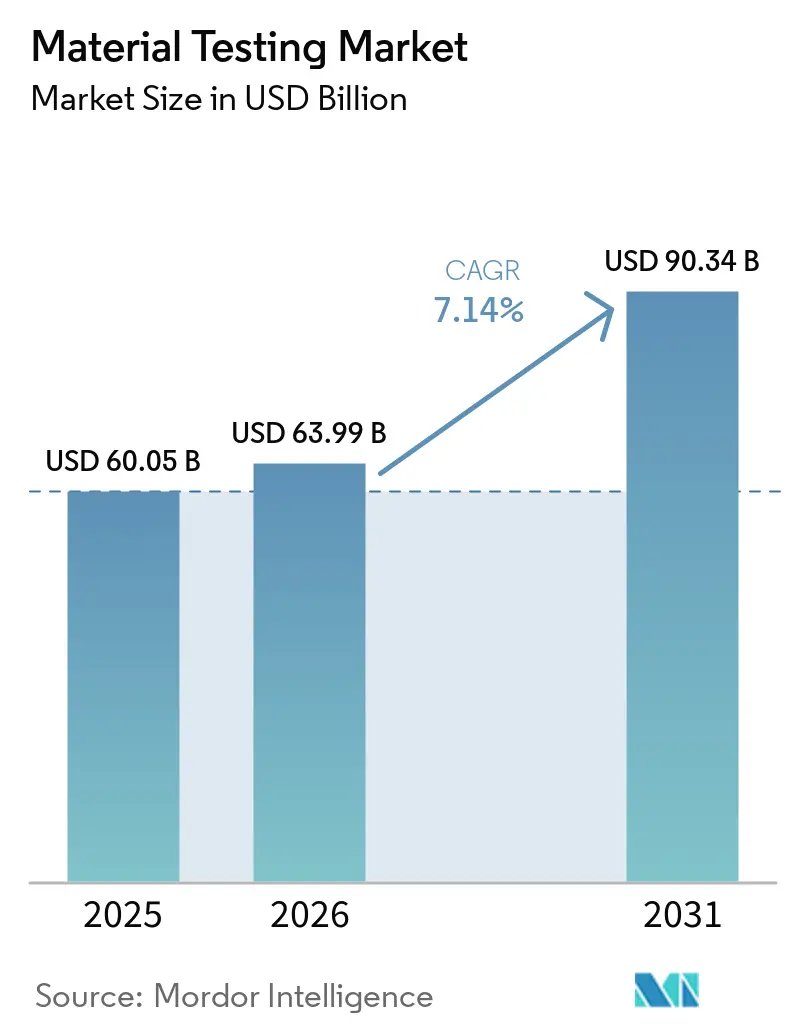
The Material Testing Market size is projected to expand from USD 60.05 billion in 2025 and USD 63.99 billion in 2026 to USD 90.34 billion by 2031, registering a CAGR of 7.14% between 2026 to 2031. The Material Testing Market is supported by tighter quality and safety requirements in regulated manufacturing. It is also supported by the wider use of advanced materials in vehicles, aircraft, electronics, and industrial equipment. Infrastructure and manufacturing investment in high-growth economies increases the need for verification at each stage of construction and production, from qualification of incoming steel, cement, polymers, and other inputs through verification of finished components, installation work, and the performance checks required before an asset is placed into service. Testing spending remains linked to industrial activity, but complex materials require more frequent and specialized evaluation than established materials, because manufacturers must validate material behavior during development, supplier qualification, process change, production release, and failure investigation rather than rely on one initial test program. Service providers and equipment suppliers are responding through automation, broader accreditation coverage, and larger regional networks, since customers increasingly seek one provider that can deliver comparable methods, documented records, and predictable turnaround times across product lines and locations.
Key Report Takeaways
- By offering, material testing services held a 55.44% share of the material testing market in 2025 and is projected to expand at a 7.45% CAGR through 2031.
- By equipment type, universal testing machines held 25.78% of the segment in 2025, while fatigue and durability testing equipment is projected to expand at an 8.13% CAGR through 2031.
- By service type, laboratory testing held 63.10% of the segment in the material testing market in 2025, while on-site testing is projected to expand at a 7.63% CAGR through 2031.
- By accreditation, accredited testing held 69.91% of the segment in 2025 and is projected to expand at an 8.20% CAGR through 2031 in the material testing market.
- By end-use industry, industrial manufacturing held 19.78% of the segment in 2025, while the electronics and semiconductor industry is projected to expand at an 8.40% CAGR through 2031 in the material testing market.
- By geography, Asia-Pacific held 34.65% of the material testing market share in 2025 and is projected to expand at an 8.11% CAGR through 2031.
Note: Market size and forecast figures in this report are generated using Mordor Intelligence’s proprietary estimation framework, updated with the latest available data and insights as of January 2026.
Market Trends and Insights
Drivers Impact Analysis of Material Testing Market*
| DRIVER | (~) % IMPACT ON CAGR FORECAST | GEOGRAPHIC RELEVANCE | IMPACT TIMELINE |
|---|---|---|---|
| Stringent Quality, Safety, and Regulatory Standards | +2.2% | Global | Long term (≥ 4 years) |
| Growth in Construction and Infrastructure Development | +1.6% | APAC core, spill-over to MEA | Medium term (2-4 years) |
| Expansion of Automotive and Aerospace Manufacturing | +1.4% | North America and Europe, APAC | Long term (≥ 4 years) |
| Increasing Adoption of Advanced Materials | +1.0% | North America, Europe, APAC | Long term (≥ 4 years) |
| Rising Adoption of Non-Destructive Testing (NDT) | +0.8% | Global | Medium term (2-4 years) |
| Automation and Digitalization of Material Testing | +0.7% | North America and Europe, APAC | Medium term (2-4 years) |
| Source: Mordor Intelligence | |||
Stringent Quality, Safety, and Regulatory Standards
Quality and safety requirements provide a recurring demand base for the Material Testing Market. ISO/IEC 17025:2017 sets general requirements for the competence of testing and calibration laboratories, which supports acceptance of laboratory results by buyers and regulators. ISO/IEC 17020:2026 specifies requirements for bodies performing inspection, including competence and impartiality requirements that apply across materials, products, plants, and processes.[1] Manufacturers must also requalify materials and production lines when applicable test protocols change. This makes demand recurring because compliance is tied to continued production and supplier approval, not simply to the first introduction of a product, and laboratories must maintain documentation, method control, equipment capability, and staff competence to retain confidence in each reported result. Mutual recognition arrangements can reduce duplicate testing, but they also place greater importance on accredited conformity assessment bodies, because a result must be traceable, repeatable, and accepted by parties that may be located in different regulatory jurisdictions, creating a durable advantage for laboratories with recognized quality systems.
Growth in Construction and Infrastructure Development
Construction activity creates demand for verification of concrete strength, steel integrity, soil bearing capacity, and asphalt performance before projects are commissioned. The Material Testing Market benefits when large transport, energy, and urban projects require these checks at several project stages. India remains an important area of demand because transport corridors, logistics facilities, smart cities, and industrial projects require third-party verification. Brazil also provides a clear example of this connection, as Intertek acquired the building-products testing company TESIS in May 2025 to expand its position in the country. The transaction shows that established providers view construction-linked testing capacity as strategically important. Digital engineering tools can add validation work when physical tests are used to calibrate project models, as engineers need observed material data to confirm assumptions on strength, deformation, durability, and response to environmental exposure before relying on a model for design or operating decisions.
Expansion of Automotive and Aerospace Manufacturing
Automotive and aerospace production requires material qualification beyond routine tensile and hardness testing. The adoption of 1,500-MPa-class ultra-high-strength steels creates failure modes that require thermomechanical and fracture-mechanics testing. Aerospace producers also need full-scale validation when they introduce advanced material systems. A Federal Aviation Administration program completed testing of fuselage panels made from fiber-metal laminate materials in early 2026.[2] These programs show why simulation does not remove the need for physical verification during qualification. Electric vehicle battery cases, separator films, and electrode substrates introduce mechanical, thermal, and electrochemical testing requirements, broadening the work from a single property check to a set of linked evaluations that must account for safety, durability, temperature response, and performance under normal operating conditions.
Increasing Adoption of Advanced Materials
Composites, additive manufacturing outputs, high-entropy alloys, and new semiconductor substrates require test methods capable of assessing unfamiliar properties. The Material Testing Market gains value when existing standards and equipment do not fully address those properties, because users need to establish how a new material responds to loads, temperatures, interfaces, aging, and manufacturing conditions before they can set reliable specifications or use it in a safety-sensitive product. NIST identified polymer-based soft materials used in advanced semiconductor packaging as a measurement science gap in 2024. Polymer-based soft materials used in advanced semiconductor packaging as a measurement science gap in 2024. Carbon-fiber composites require fatigue, delamination, and environmental aging tests that differ from tests used for conventional metals. Guided-wave structural health monitoring can supplement periodic inspection by using in-service data to assess structural condition. The wider range of test types underscores the importance of specialized fixtures, environmental chambers, and skilled data interpretation, while also increasing the need to link test conditions to production methods so that laboratory findings can guide material selection, process control, and product qualification in the Material Testing Market.
Restraints Impact Analysis of Material Testing Market*
| RESTRAINT | (~) % IMPACT ON CAGR FORECAST | GEOGRAPHIC RELEVANCE | IMPACT TIMELINE |
|---|---|---|---|
| High Capital and Ownership Costs of Advanced Testing Equipment | -0.7% | Global, most acute in MEA and South America | Medium term (2-4 years) |
| Shortage of Skilled Testing Professionals | -0.5% | North America and Europe, APAC | Long term (≥ 4 years) |
| High Complexity and Frequent Technology Upgrades | -0.4% | Global | Medium term (2-4 years) |
| Cyclicality of Major End-Use Industries | -0.3% | North America, Europe | Short term (≤ 2 years) |
| Source: Mordor Intelligence | |||
High Capital and Ownership Costs of Advanced Testing Equipment
Advanced fatigue rigs, multi-axis machines, environmental chambers, and digital testing platforms require substantial initial investment. The Material Testing Market faces a slower equipment adoption cycle, in which smaller laboratories and mid-sized manufacturers cannot fund complete systems, particularly when a valid setup requires not only the main machine but also suitable grips, environmental controls, sensors, software, calibration support, and personnel who can perform and document the method correctly. ISO/IEC 17025 compliance also requires calibration of load frames and reference standards, which adds recurring costs. These costs are particularly challenging in cost-sensitive areas of South America, Southeast Asia, and sub-Saharan Africa. Equipment-as-a-service arrangements and outsourced testing can reduce buyers' capital burden. They can also shift revenue toward service laboratories and away from direct equipment purchases, because a laboratory can spread the cost of a specialized machine, calibration program, software license, and qualified operator across work from many customers rather than placing the full burden on a single manufacturer.
Shortage of Skilled Testing Professionals
A shortage of certified personnel limits laboratory throughput even where equipment is available. TechForce Foundation reported 241,842 annual openings across U.S. technical occupations and 101,743 graduates in 2026.[3] Nondestructive testing is especially exposed because experienced technicians require formal training and supervised practice. The ASNT Foundation identified workforce development as a strategic priority in its 2025 economic impact report, released in March 2026. Automated setup checks and data analysis can improve consistency, but personnel still need enough technical knowledge to assess flagged results. This favors larger organizations that can combine equipment investment with training and certification programs, maintain clear career paths for technicians, and use automated tools to support consistent work while retaining professional judgment for unusual results, complex materials, and safety-critical decisions.
*Our forecasts treat driver/restraint impacts as directional, not additive. The impact forecasts reflect baseline growth, mix effects, and variable interactions.
Material Testing Market Segment Analysis
By Offering:
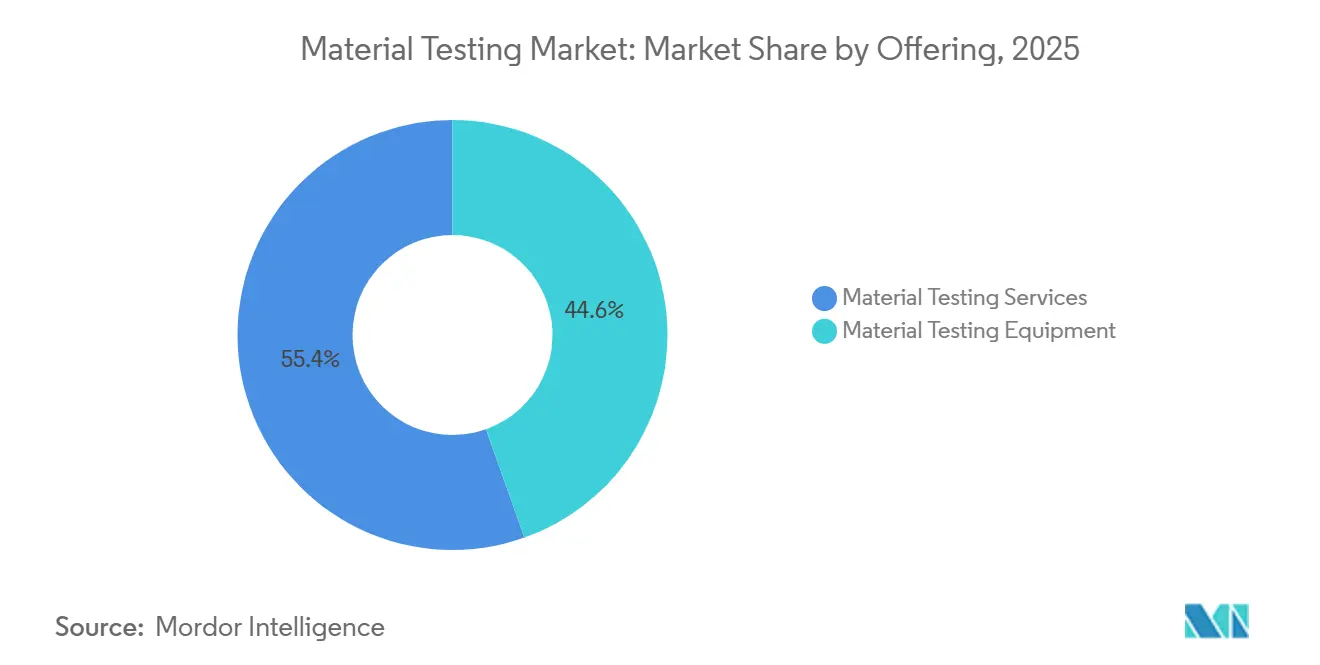
Services Lead as Outsourcing BroadensMaterial Testing Services held 55.44% of the offering segment in 2025 and is projected to expand at a 7.45% CAGR through 2031. Third-party laboratories give manufacturers access to accredited methods without requiring them to own every test capability. This model is particularly relevant where organizations need to meet ISO/IEC 17025 and sector-specific documentation requirements, yet do not have enough specimen volume to justify maintaining a complete in-house laboratory with several machines, controlled environments, calibration routines, and qualified staff across every required method. Pharmaceuticals and biotechnology companies face demanding audit and supplier-qualification requirements. Aerospace and defense suppliers also need formal test records for product approval. These conditions make accredited service providers an important part of the Material Testing Market, particularly for companies that produce several product types or serve multiple regulated customers and therefore need access to diverse methods without diverting capital and technical teams from their main manufacturing activities.
Material Testing Equipment continues to serve large original equipment manufacturers, steel producers, and tier-1 automotive suppliers. These users retain routine testing in-house when they need direct control over quality decisions and turnaround times. ZwickRoell introduced its SmartLab concept in November 2025, describing a laboratory workflow with automated specimen handling, test configuration, and data validation. Instron introduced the AT1 Automation System in March 2026 for automated film and elastomer testing in quality laboratories.[4] Such systems bring equipment, software, and standardized outputs closer together. The distinction between a purchased machine and a delivered service is therefore becoming less clear for buyers that prioritize repeatable results, since automated systems combine hardware, software, method settings, specimen handling, data review, and reporting into a single workflow that can be managed internally or obtained through a specialist provider.
By Equipment Type:
Universal Testing Machines Remain Central While Fatigue Testing GrowsUniversal Testing Machines held 25.78% of the equipment segment in 2025. Their position reflects the ability to perform tensile, compression, bending, and shear tests on metals, polymers, composites, and ceramics. Original equipment manufacturers, contract manufacturers, and research institutions use these instruments as general-purpose quality control systems. Hardness, impact, compression and flexural, and tensile equipment address specific material properties and support a broad installed base. Nondestructive testing equipment also supports energy, infrastructure, and aerospace operators that need digital radiography and phased-array ultrasonic inspection. This base keeps universal testing systems relevant across the Material Testing Market, because laboratories and factories can adapt a core instrument through grips, fixtures, sensors, and software rather than purchase separate machines for every routine material property, supporting flexible use across changing product portfolios, routine quality work, supplier comparisons, development projects, and investigations of unexpected material behavior.
Fatigue and Durability Testing Equipment is projected to expand at an 8.13% CAGR through 2031. The category is important because cyclic loading tests simulate the stresses that materials face during normal use. This need has increased as automotive structures use ultra-high-strength steel and aerospace platforms use advanced composites. Element Materials Technology expanded its Cincinnati facility in February 2026 with a USD 20 million investment and new MTS Landmark fatigue testing frames. Fatigue tests usually take longer than static tests and produce more complex datasets. Equipment suppliers can use analysis software and maintenance services to build recurring revenue around these systems, particularly where customers need reliable test execution over long periods, secure handling of high-frequency load data, and support for method updates as materials, designs, and customer specifications change.
By Service Type:
Laboratory Testing Holds the Lead While On-Site Testing ExpandsLaboratory Testing held 63.10% of the service segment in 2025. Controlled laboratory conditions remain necessary for high-precision characterization that must meet international standards. Long-term fatigue cycling, elevated-temperature creep measurement, impact toughness testing, and environmental aging simulations require calibrated facilities. ISO/IEC 17025 accreditation reinforces the need for facilities that can show technical competence and repeatability. This requirement supports established laboratories serving regulated manufacturing customers, because controlled settings allow organizations to document test conditions, maintain equipment traceability, and repeat complex procedures when customers or regulators require results that can be compared across batches, sites, and time periods. The Material Testing Market size for laboratory testing remains supported by applications where ambient conditions could affect result quality.
On-Site Testing is projected to expand at a 7.63% CAGR through 2031. Infrastructure and energy projects need rapid structural assessment without sending every sample to a central laboratory. Portable phased-array ultrasonic and digital radiography tools can support field decisions for welded joints, anchor bolts, and structural interfaces. Wind turbine towers, hydrogen pipelines, and utility-scale battery installations generate such work during construction and commissioning. Cloud-based systems can transfer field results into engineering review workflows, giving the Material Testing Market a stronger role in time-sensitive construction and asset decisions where project leaders need controlled access to current records rather than separate, delayed files from several testing locations. This improves the speed of quality decisions while keeping a record that can be reviewed by project teams, enabling engineers, contractors, and asset owners to address a concern during construction or commissioning instead of waiting until a sample reaches a distant facility and a separate review cycle is complete.
By Accreditation:
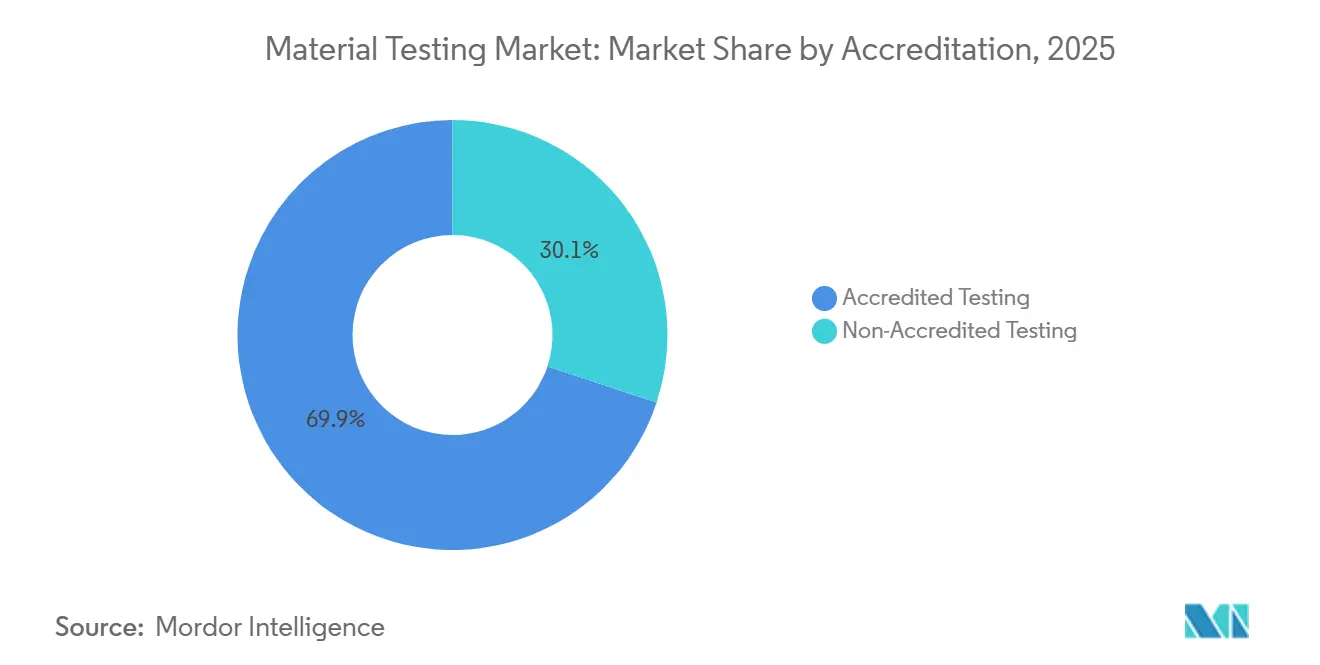
Accredited Testing Extends Its LeadAccredited Testing held 69.91% of the segment in 2025 and is projected to expand at an 8.20% CAGR through 2031. This combination shows that accredited testing is both the largest and fastest-growing accreditation category. Aerospace manufacturers, pharmaceutical companies, and public construction buyers often require accredited results as part of supplier qualification. ISO/IEC 17025 has become an operating requirement in many procurement processes rather than a differentiator. SGS reported that its Qatar OCM Laboratory achieved ISO/IEC 17025:2017 accreditation in April 2026. The result is a stronger role for laboratories that can provide documented and recognized outcomes.
Non-Accredited Testing still serves lower-risk and cost-sensitive work. Typical uses include incoming raw-material checks, early research screening, and in-process spot checks. Its position is weaker where supply chain accountability and product liability are high. ECQA reported that its Shanghai laboratory achieved CNAS accreditation in March 2026, with recognition through the ILAC Mutual Recognition Arrangement. Portable accredited results are valuable for exporters and multinational manufacturers, and the Material Testing Market benefits when a laboratory record can support supplier approvals and product movement without a customer having to repeat the same qualification work in every destination. This encourages laboratories to invest in accreditation even when initial compliance costs are high, because recognized results can support business with exporters, multinational manufacturers, and regulated customers that need one credible laboratory record to be accepted by partners operating in several countries.
By End-Use Industry:
Manufacturing Leads While Electronics and Semiconductor AccelerateManufacturing and Industrial held 19.78% of the end-use segment in 2025. Metal fabrication, plastics processing, rubber compounding, and industrial production require recurring in-process and final-product testing. Steel and aluminum producers use verification to meet specifications for customers and regulators. Automotive component manufacturers also need material records to support supply-chain quality requirements. Industrial machinery producers rely on testing to verify performance across many components and materials. This broad demand base gives manufacturing and industrial a stable role in the Material Testing Market, since the work spans incoming materials, process checks, final product approval, supplier verification, and investigations of quality issues rather than depending on one product category or one major capital program, and because many manufacturers must keep this discipline in place even during slower periods to preserve customer confidence and meet contractual specifications.
Electronics and Semiconductor is projected to expand at an 8.40% CAGR through 2031. Chipmakers and advanced-packaging engineers need methods for materials that operate at small dimensional scales and under demanding reliability conditions. NIST identified underfill compounds, encapsulants, and laminate substrates as materials that need better-standardized characterization methods at the production scale. The IEEE Electronics Packaging Society also described the need to combine materials science, process knowledge, and data analysis in failure assessment for advanced packages.[5] These requirements favor specialist providers that can address mechanical, thermal, and reliability issues together. The need for these capabilities supports specialized laboratory investments and equipment development, as providers must combine methods to assess material interfaces, thermal response, package reliability, and failure mechanisms, while helping customers interpret results within the manufacturing processes used for advanced electronic assemblies.
Geography Analysis
APAC Material Testing Market
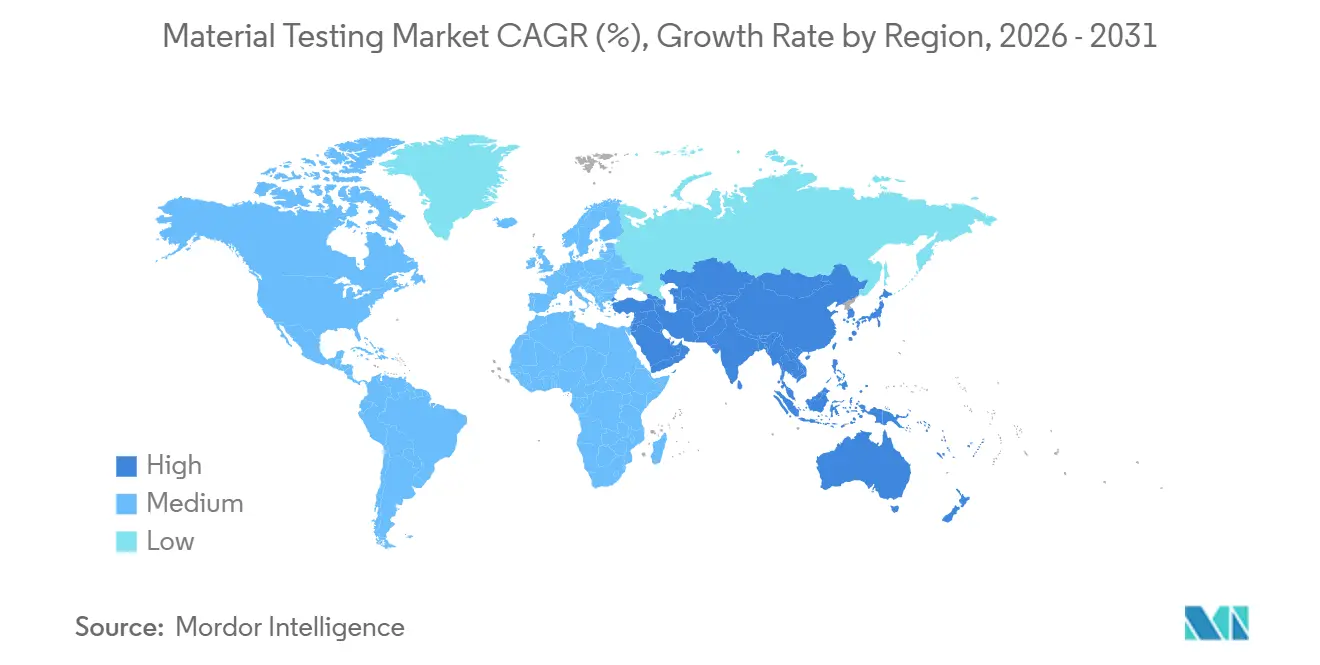
Asia-Pacific held 34.65% of the Material Testing Market share in 2025 and is projected to expand at an 8.11% CAGR through 2031. China supports this position through automotive production, steel manufacturing, and electronics assembly. ZwickRoell installed multi-station systems at the JITRI Materials Academy in Jiangsu Province, covering nearly CNY 300 million, or USD 41 million, of installed testing infrastructure. India is increasing demand through highway corridors, logistics facilities, and semiconductor and electronics manufacturing parks. Vietnam, Thailand, and Indonesia are also attracting automotive and electronics suppliers. These investments drive testing demand beyond established hubs in China, Japan, and South Korea, as new supplier plants need access to local testing for incoming materials, product development, process control, construction, and certification, broadening the Material Testing Market's regional footprint.
North America and Europe Material Testing Market
North America and Europe are mature regions with high accreditation penetration and strong demand from aerospace, automotive, and pharmaceutical customers. North America relies on ASTM standards, Federal Aviation Administration requirements, safety rules, and calibration traceability. SGS closed its acquisition of Applied Technical Services in January 2026, adding 2,100 employees and taking North American annual sales beyond USD 1.5 billion.[6] Europe has strict product requirements and established laboratory networks. Germany remains an important center for testing equipment manufacturing, including ZwickRoell. These regions give providers a reliable base for accredited and specialist services, as well-developed regulatory systems and mature customers value documented results, technical depth, and consistent methods, while consolidation encourages providers to build wider laboratory networks that can serve complex programs across multiple locations.
South America and MEA Material Testing Market
South America and the Middle East and Africa remain growth-stage areas for the Material Testing Market, where the practical availability of local accredited laboratories and trained on-site teams can influence how quickly infrastructure owners and manufacturers can complete verification work and move projects into their next development or operating stage. Brazil is the largest South American testing location and has attracted investment in building-products testing capacity. Intertek's May 2025 acquisition of TESIS strengthened its direct presence in Brazil. Oil refinery modernization, LNG terminal expansion, and renewable energy projects create demand for on-site nondestructive testing in the Middle East. Saudi Arabia and the United Arab Emirates are important locations because industrial diversification programs require local quality-assurance capacity. SGS's Qatar laboratory accreditation shows continued investment in credentialed testing capability in the region, while infrastructure owners and industrial operators increasingly need locally available laboratories and on-site teams that can produce results aligned with international requirements during construction, maintenance, and commissioning work.
Competitive Landscape
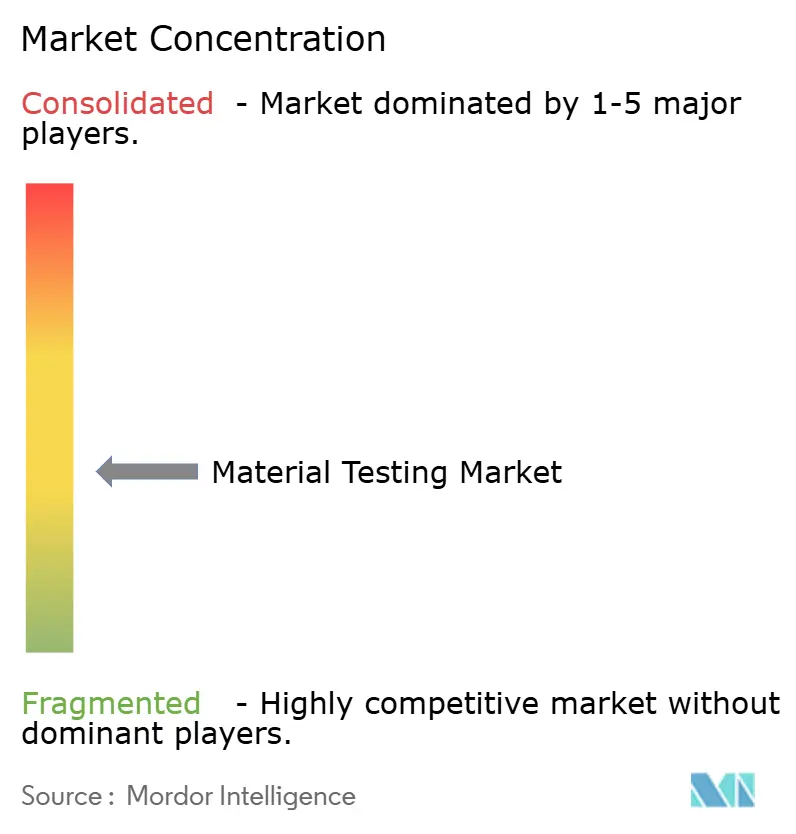
The global material testing market is moderately fragmented, with concentration varying between equipment and services. Established technical brands dominate equipment categories, while global networks, national laboratories, and regional specialists provide testing services with varying accreditation scopes and customer relationships. Equipment suppliers compete through mechanical design, software integration, measurement accuracy, and automation. The market increasingly favors suppliers that integrate these capabilities into reliable laboratory workflows. Instron, ZwickRoell, MTS Systems Corporation, and Shimadzu Corporation are established suppliers across core equipment categories. Service providers compete through laboratory coverage, accreditation breadth, and vertical specialization. Buyers often select larger service networks for consistent methods across multiple countries, centralized account management, and coordinated laboratory work, inspections, certification, failure analysis, and technical reporting. Regional specialists remain competitive through expertise in specific testing disciplines, rapid local response, and tailored methods for particular components, failure modes, or regulated product applications.
SGS closed the Applied Technical Services acquisition in January 2026, which added 2,100 employees and strengthened its North American network. SGS also acquired Granite River Labs Services in March 2026, adding high-speed wired data-connection validation capabilities across 9 laboratories. Eurofins agreed in July 2026 to acquire Element Materials Technology's North American life sciences testing services business for USD 400 million. These moves show that larger providers are adding geography and specialized capabilities at the same time. Siemens stated that its September 2025 Simcenter Testlab update accelerated modal analysis workflows through AI-assisted automation. Digital workflows can reduce manual effort in data-intensive laboratory tasks, but laboratories still need qualified personnel to establish suitable test methods, verify data quality, review exceptions, and explain how the result relates to a material decision, product requirement, or potential field-performance risk.
Advanced semiconductor packaging presents an opportunity for the Material Testing Market because standardized methods for certain polymer-based materials are still evolving. This creates demand for proven methods that assess material behavior at interfaces where mechanical, thermal, and process conditions interact. NIST’s published measurement needs further support the requirement for specialized equipment and laboratory services in this area. In December 2024, ZwickRoell partnered with Cormica MET to support early-stage medical device innovators requiring validated testing before regulatory submission. This partnership demonstrates how targeted collaborations can serve customers that do not require broad inspection portfolios. Larger providers can leverage automation, accreditation, and regional scale to support multinational customers, while smaller providers can maintain their position through specialized methods, local service, and niche certification capabilities. Smaller providers can differentiate themselves by responding quickly to customer issues, providing direct access to senior technical staff, and building a reputation in specific applications where broad network scale cannot replace practical experience.
Material Testing Industry Leaders
-
Instron (Illinois Tool Works Inc.)
-
ZwickRoell
-
MTS Systems Corporation
-
Shimadzu Corporation
-
AMETEK, Inc.
- *Disclaimer: Major Players sorted in no particular order
Material Testing Market Companies Covered in this Report
- Instron (Illinois Tool Works Inc.)
- ZwickRoell
- MTS Systems Corporation
- Shimadzu Corporation
- AMETEK, Inc.
- Tinius Olsen
- SGS SA
- Intertek Group plc
- Bureau Veritas SA
- Eurofins Scientific SE
- Bruker Corporation
- Thermo Fisher Scientific Inc.
- Evident Corporation
- Qness GmbH
- Element Materials Technology Group
- Applus+ Laboratories
- TÜV SÜD AG
- TÜV Rheinland AG
- Galdabini S.p.A.
- ADMET, Inc.
Recent Industry Developments in Material Testing Market
- July 2026: Eurofins Scientific agreed to acquire Element Materials Technology's Life Sciences Testing Services business in North America for an enterprise value of USD 400 million. The business operates 27 laboratories, employs 750 FTEs, and is expected to generate over USD 150 million in 2026 revenue. Closing is subject to regulatory approvals and expected in Q4 2026, expanding Eurofins' geographic coverage into US and Canadian regions where it was historically underrepresented.
- March 2026: SGS acquired Granite River Labs Services, a specialist in validating high-speed wired data connections, with more than 200 experts across 9 laboratories in Asia, Europe, and the United States. The acquisition extends SGS's testing capabilities into digital infrastructure and AI-enabling systems, reinforcing its position in the digital trust and connectivity segment.
- February 2026: Element Materials Technology's Cincinnati facility launched a USD 20 million capacity expansion, deploying a new fleet of MTS Landmark fatigue testing frames. The investment was designed to ramp up high-cycle fatigue testing capacity for aerospace and industrial clients, with the first systems coming online in February 2026.
- February 2026: Intertek ETL agreed to acquire QTEST, a market-leading electrical testing and certification services provider in Colombia. The acquisition expands Intertek ETL's ATIC offering into Colombia and strengthens its scale leadership across South America's high-growth economies.
Global Material Testing Market Report Scope
The Material Testing Market encompasses equipment, software, and services used to evaluate the mechanical, physical, chemical, and structural properties of materials. Key testing methods include tensile, compression, hardness, impact, fatigue, and chemical analysis, which help assess material performance and ensure compliance with industry standards. The market serves industries such as construction, manufacturing, aerospace, automotive, energy, and research institutions, where material quality and durability are critical to product performance, reliability, and safety.
The Material Testing Market Report is Segmented by Offering (Material Testing Equipment, and Material Testing Services), Equipment Type (Universal Testing Machines (UTM), Hardness Testing Equipment, Impact Testing Equipment, Fatigue and Durability Testing Equipment, Compression and Flexural Testing Equipment, Tensile Testing Equipment, NDT Equipment, and Other Material Testing Equipment), Service Type (Laboratory Testing, and On-Site Testing), Accreditation (Accredited Testing, and Non-Accredited Testing), End-use Industry (Industrial Manufacturing, Aerospace and Defense, Automotive and Transportation, Construction and Infrastructure, Pharmaceuticals and Biotechnology, Chemicals and Materials, Electronics and Semiconductor, Energy and Power, Food and Beverage, Oil and Gas, and Other End-Use Industries), and Geography (North America, South America, Europe, Asia-Pacific, and Middle East and Africa). The Market Sizes and Forecasts are Provided in Terms of Value in (USD).
Segmentation Overview
| Material Testing Equipment |
| Material Testing Services |
| Universal Testing Machines (UTM) |
| Hardness Testing Equipment |
| Impact Testing Equipment |
| Fatigue and Durability Testing Equipment |
| Compression and Flexural Testing Equipment |
| Tensile Testing Equipment |
| NDT Equipment |
| Other Material Testing Equipment |
| Laboratory Testing |
| On-Site Testing |
| Accredited Testing |
| Non-Accredited Testing |
| Industrial Manufacturing |
| Aerospace and Defense |
| Automotive and Transportation |
| Construction and Infrastructure |
| Pharmaceuticals and Biotechnology |
| Chemicals and Materials |
| Electronics and Semiconductor |
| Energy and Power |
| Food and Beverage |
| Oil and Gas |
| Other End-Use Industries |
| North America | United States | |
| Canada | ||
| Mexico | ||
| South America | Brazil | |
| Argentina | ||
| Rest of South America | ||
| Europe | Germany | |
| United Kingdom | ||
| France | ||
| Italy | ||
| Spain | ||
| Rest of Europe | ||
| Asia-Pacific | China | |
| Japan | ||
| India | ||
| South Korea | ||
| ASEAN | ||
| Rest of Asia-Pacific | ||
| Middle East and Africa | Middle East | Saudi Arabia |
| United Arab Emirates | ||
| Turkey | ||
| Rest of the Middle East | ||
| Africa | South Africa | |
| Nigeria | ||
| Rest of Africa | ||
| By Offering | Material Testing Equipment | ||
| Material Testing Services | |||
| By Equipment Type | Universal Testing Machines (UTM) | ||
| Hardness Testing Equipment | |||
| Impact Testing Equipment | |||
| Fatigue and Durability Testing Equipment | |||
| Compression and Flexural Testing Equipment | |||
| Tensile Testing Equipment | |||
| NDT Equipment | |||
| Other Material Testing Equipment | |||
| By Service Type | Laboratory Testing | ||
| On-Site Testing | |||
| By Accreditation | Accredited Testing | ||
| Non-Accredited Testing | |||
| By End-use Industry | Industrial Manufacturing | ||
| Aerospace and Defense | |||
| Automotive and Transportation | |||
| Construction and Infrastructure | |||
| Pharmaceuticals and Biotechnology | |||
| Chemicals and Materials | |||
| Electronics and Semiconductor | |||
| Energy and Power | |||
| Food and Beverage | |||
| Oil and Gas | |||
| Other End-Use Industries | |||
| By Geography | North America | United States | |
| Canada | |||
| Mexico | |||
| South America | Brazil | ||
| Argentina | |||
| Rest of South America | |||
| Europe | Germany | ||
| United Kingdom | |||
| France | |||
| Italy | |||
| Spain | |||
| Rest of Europe | |||
| Asia-Pacific | China | ||
| Japan | |||
| India | |||
| South Korea | |||
| ASEAN | |||
| Rest of Asia-Pacific | |||
| Middle East and Africa | Middle East | Saudi Arabia | |
| United Arab Emirates | |||
| Turkey | |||
| Rest of the Middle East | |||
| Africa | South Africa | ||
| Nigeria | |||
| Rest of Africa | |||
Key Questions Answered in the Report
What is the material testing market size?
The Material Testing Market size is projected to expand from USD 60.05 billion in 2025 and USD 63.99 billion in 2026 to USD 90.34 billion by 2031, registering a CAGR of 7.14% between 2026 to 2031.
What is driving demand for material testing services?
Quality requirements, accreditation needs, advanced materials, infrastructure projects, and regulated manufacturing support demand for testing services.
Which offering leads the material testing sector?
Material Testing Services led the offering segment with 55.44% share in 2025 and are projected to expand at a 7.45% CAGR through 2031.
Which equipment category is growing fastest?
Fatigue and Durability Testing Equipment is projected to expand at an 8.13% CAGR through 2031 as users need to evaluate materials under cyclic loading.
Which end-use area is expanding fastest?
Electronics and Semiconductor is projected to expand at an 8.40% CAGR through 2031 because advanced packaging requires specialized material characterization.
Which region leads material testing demand?
Asia-Pacific held 34.65% share in 2025 and is projected to expand at an 8.11% CAGR through 2031.