
Massage Guns Market Size and Share
Market Overview
| Study Period | 2021 - 2031 |
|---|---|
| Market Size (2026) | USD 1.71 Billion |
| Market Size (2031) | USD 2.48 Billion |
| Growth Rate (2026 - 2031) | 7.68 % |
| Fastest Growing Market | Asia-Pacific |
| Largest Market | North America |
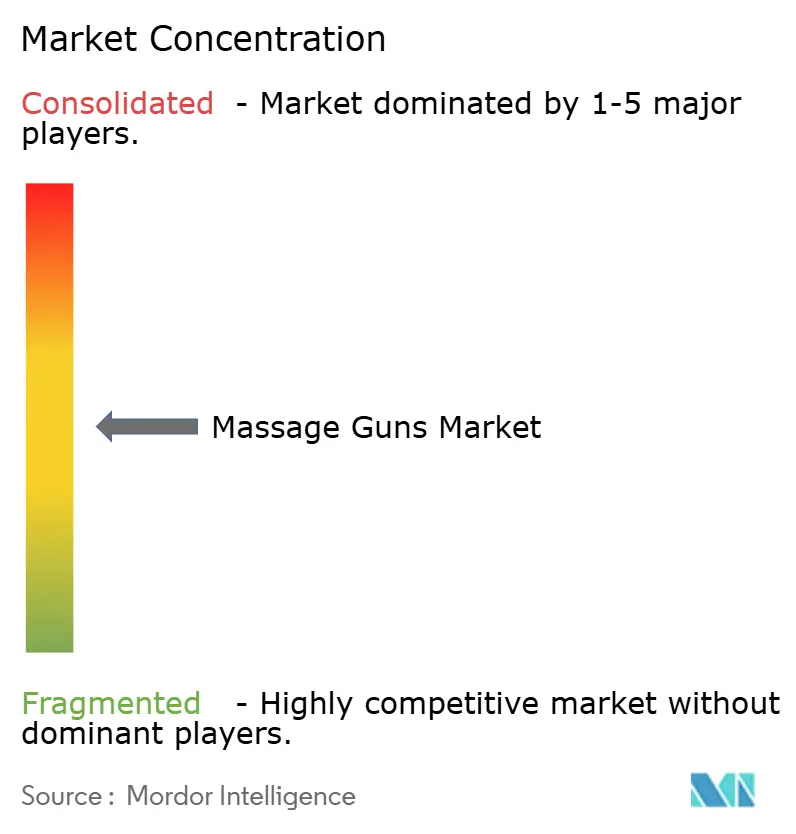
| Market Concentration | Medium |
Major Players *Disclaimer: Major Players sorted in no particular order Image © Mordor Intelligence. Reuse requires attribution under CC BY 4.0. | |
Massage Guns Market Analysis by Mordor Intelligence
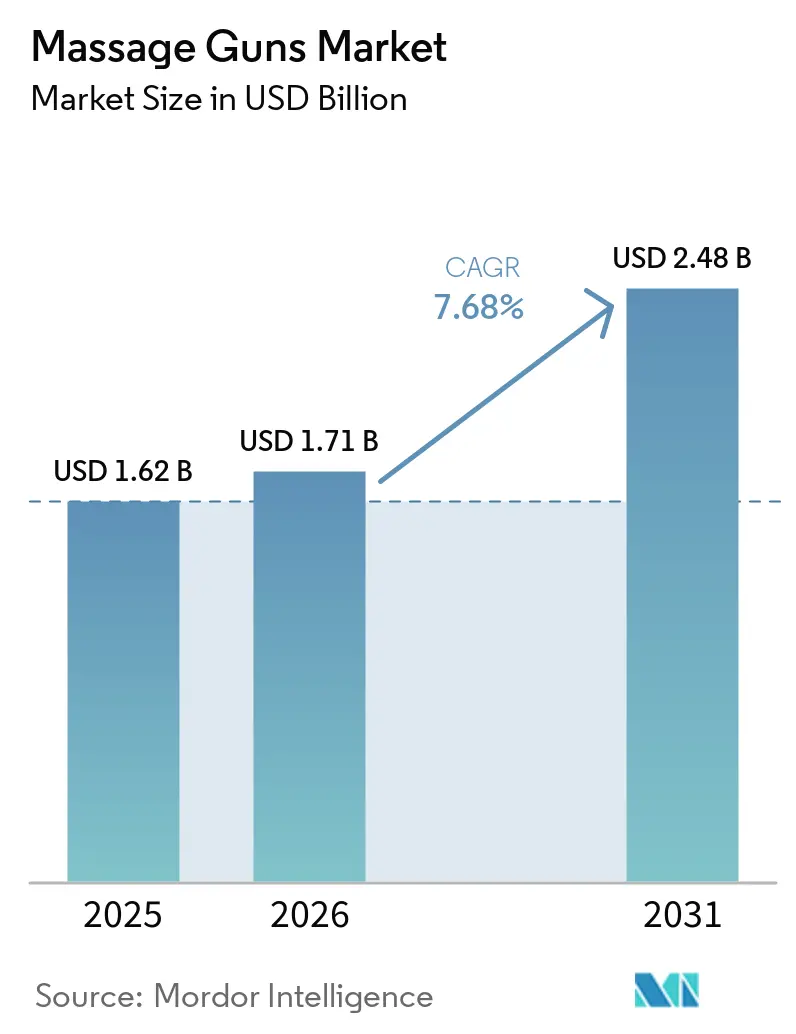
The massage guns market size is projected to expand from USD 1.62 billion in 2025 and USD 1.71 billion in 2026 to USD 2.48 billion by 2031, registering a CAGR of 7.7% between 2026 to 2031. Home-based recovery is expanding the use of massage guns beyond post-workout sessions and into regular self-care routines. Online channels widen product choice and product comparison, while also intensifying price pressure for mid-tier suppliers. Clinical adoption is supported by short-term rehabilitation evidence, but broader institutional uptake depends on stronger evidence of long-term outcomes. The massage guns market is therefore shaped by a premium segment built around connected features and a crowded lower-price segment that competes through product specifications and visibility on e-commerce platforms.
Key Report Takeaways
- By product type, percussion massage guns held 61.12% of the massage guns market share in 2025, while vibration massage guns are forecast to grow at an 8.73% CAGR through 2031.
- By form factor, standard and full-size devices commanded 48.81% of the massage guns market size in 2025, while mini and compact devices are forecast to grow at an 8.35% CAGR through 2031.
- By end user, individual consumers held 58.36% of the massage guns market share in 2025, while physiotherapy and rehabilitation centers are forecast to grow at an 8.50% CAGR through 2031.
- By distribution channel, online distribution held 68.12% of global demand in 2025 and is forecast to grow at an 8.22% CAGR through 2031.
Note: Market size and forecast figures in this report are generated using Mordor Intelligence’s proprietary estimation framework, updated with the latest available data and insights as of January 2026.
Market Trends and Insights
Drivers Impact Analysis of Massage Guns Market*
| Driver | (~) % Impact on CAGR Forecast | Geographic Relevance | Impact Timeline |
|---|---|---|---|
| Expansion of Home-Based Recovery and Self-Care | 2.00% | Global | Medium-term (2–4 years) |
| Growth in Sports Participation and Athletic Recovery | 1.50% | Global (Asia-Pacific & North America) core, spill-over to Europe) | Short-term (≤ 2 years) |
| Increasing Use in Physiotherapy and Rehabilitation | 1.20% | North America & Europe | Medium-term (2–4 years) |
| E-Commerce and Direct-to-Consumer Distribution | 1.30% | Global (strongest in Asia-Pacific & North America) | Short-term (≤ 2 years) |
| App-Guided and Sensor-Based Personalization | 0.80% | North America & Europe, spill-over to Asia-Pacific | Medium-term (2–4 years) |
| Micro-Recovery Routines for Sedentary and Hybrid Workers | 0.70% | North America & Europe | Long-term (≥ 4 years) |
| Source: Mordor Intelligence | |||
Expansion of Home-Based Recovery and Self-Care
Home-based recovery is becoming part of regular self-care, rather than being limited to use after exercise. This change increases the number of occasions on which a device can be used during the day. Short sessions before sleep, during breaks, or after commuting fit this wider pattern of use. Therabody introduced guided routines on the Theragun Sense 2nd Gen, including a 6-minute sleep-preparation routine, to help less experienced users use the device[1]. Guided use can reduce the knowledge barrier for casual buyers and support repeat engagement with the product. In the massage guns market, this pattern can support replacement purchases and upgrades as users seek added therapeutic features.
Growth in Sports Participation and Athletic Recovery
Sports participation continues to support demand for percussion devices and handheld recovery products. The draft reported that 65% of U.S. youth aged 6-17 tried organized sports in 2024, the highest reported rate since at least 2012[2]. It also reported 14% growth in flag football participation since 2019. New participants can require support in managing muscle soreness and soft-tissue strain as they build fitness routines. Professional and semi-professional teams also use percussion devices in locker rooms, which makes the category more familiar to recreational users. This use by sports organizations supports the massage guns market through consumer awareness, as well as direct equipment purchases.
E-Commerce and Direct-to-Consumer Distribution
E-commerce is the leading route through which buyers compare massage gun features and prices. Online distribution accounted for 68.12% of global demand in 2025. Buyers can compare stall force, amplitude, noise levels, and battery life more easily through digital listings than through physical retail displays. Hyperice extended its F45 Training partnership in May 2025, bringing Hypervolt massage guns and Normatec compression products to select studios globally[3]. Such partnerships create in-person product discovery that can support later online purchases. The massage guns market also faces price pressure in this channel because private-label suppliers can compete on search placement and lower operating costs.
App-Guided and Sensor-Based Personalization
Connected features are increasingly important in premium percussion devices. Therabody's Coach by Therabody is available across Theragun devices and uses activity information from Garmin, Apple Watch, and Strava to tailor recovery recommendations. Hyperice launched the Hypervolt 3 line in March 2026 and added a pressure sensor to the USD 249 mid-tier device. This places a feature once reserved for top-tier products within reach of more buyers. A 2025 study found that percussion massage for more than 60 seconds improved range of motion, passive stiffness, and peak passive torque. App-guided timing and pressure recommendations can therefore align user behavior with the application periods assessed in research. The massage guns market may favor suppliers that can demonstrate consistent device use in clinical and corporate wellness settings.
Restraints Impact Analysis of Massage Guns Market*
| Restraint | (~) % Impact on CAGR Forecast | Geographic Relevance | Impact Timeline |
|---|---|---|---|
| Product Saturation and Price Compression | -0.90% | Global (strongest in North America & Europe) | Short-term (≤ 2 years) |
| Limited Clinical Evidence for Long-Term Benefits | -0.50% | Global (most pronounced in clinical-adoption markets) | Medium-term (2–4 years) |
| Lithium-Ion Battery Safety and Cross-Border Compliance | -0.50% | Global (Asia-Pacific-originating supply chains) | Short-term (≤ 2 years) |
| Consumer Misuse and Product Liability Exposure | -0.40% | North America & EU | Medium-term (2–4 years) |
| Source: Mordor Intelligence | |||
Product Saturation and Price Compression
Product saturation is the most immediate commercial risk for the massage guns market. More than 120 distinct massage gun SKUs compete on major e-commerce platforms in leading markets, according to the draft. Entry-level devices are available below USD 30, narrowing the former USD 80-150 mid-market price range. Hyperice filed 16 additional patent infringement lawsuits in January 2024 against Sharper Image, HoMedics, Ekrin Athletics, and other parties. The legal action shows how intellectual property enforcement can be used when price competition limits commercial flexibility. Premium suppliers can rely on software, sensors, and clinical partnerships, while lower-priced suppliers often compete on basic motor and attachment specifications.
Limited Clinical Evidence for Long-Term Benefits
Evidence supports several short-term effects of percussion therapy, but evidence of longer-term benefits remains limited. A 2026 scoping review found the most consistent findings were acute improvements in range of motion, flexibility, and pain reduction. Only 4 reviewed studies assessed outcomes beyond the immediate post-treatment period, and findings on muscle strength were inconsistent. A 2025 systematic review and meta-analysis of 12 randomized controlled trials found improved countermovement jump recovery, but no statistically significant improvement in delayed-onset muscle soreness or maximum voluntary contraction. Hospitals, physical therapy chains, and insurance coding bodies generally need multi-session evidence using validated outcomes before they expand procurement. The massage guns market may benefit when manufacturers build research partnerships that address this evidence gap.
*Our forecasts treat driver/restraint impacts as directional, not additive. The impact forecasts reflect baseline growth, mix effects, and variable interactions.
Massage Guns Market Segment Analysis
By Product Type:
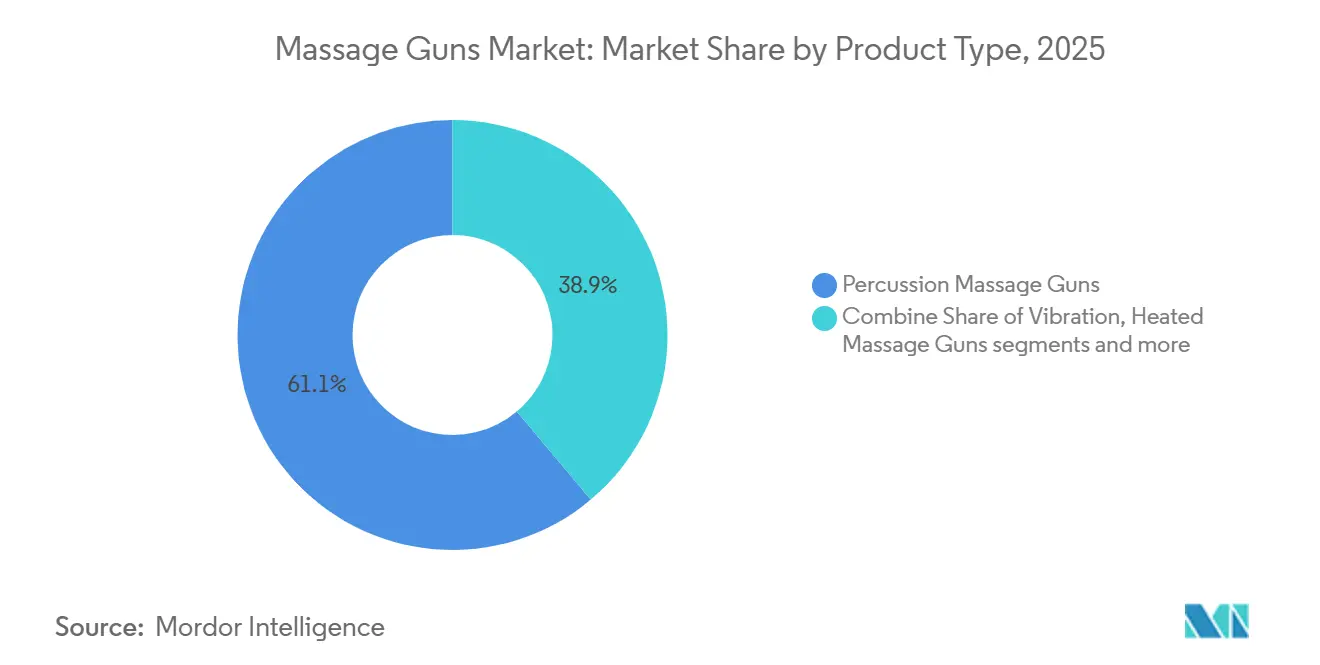
Percussion Leads While Vibration Gains Clinical TractionPercussion massage guns held 61.12% of the global massage guns market share in 2025. Their position reflects high stall-force output, stroke amplitudes typically ranging from 12-16 mm, and endorsement networks among sports teams and physiotherapy organizations. Therabody reported more than 6.5 million Theragun devices sold worldwide across more than 60 countries in November 2025. Hyperice launched the Hypervolt 3 line in March 2026, with 45 pounds of stall force in its USD 149 entry model, reducing the performance gap with mid-tier products. Heated devices and other product types remained smaller contributors in 2025, although clinicians show interest in combining heat with percussion for chronic stiffness.
Vibration massage guns are forecast to grow at an 8.73% CAGR from 2026 to 2031. They operate at lower amplitude and penetration depth than percussion devices, which supports use on sensitive or recently injured tissue. A 2025 study found no statistically significant changes in muscle strength when percussive massage was applied immediately after exercise fatigue, supporting consideration of lower-intensity vibration options where force output matters. Dual-mode products can serve higher-energy sports recovery and lower-intensity rehabilitation needs within one product. The massage guns industry can use this distinction to address different settings without separate product lines.

By Form Factor:
Full-Size Anchors Revenue While Compact Formats Reshape Use CasesStandard and full-size massage guns commanded 48.81% of the global massage guns market in 2025. They are widely used in professional sports, fitness facilities, and homes where buyers value stall force and battery life. These devices typically weigh 1.0-1.5 kilograms and provide 4-6 hours of battery runtime. Physiotherapy clinics and sports equipment rooms favor these characteristics because durability and motor torque are important. Adjustable-handle products and professional high-torque versions serve specialized uses.
Mini and compact massage guns are forecast to grow at an 8.35% CAGR during 2026-2031. Remote and hybrid work has increased demand for lighter devices that can be used at a desk with limited disruption. Therabody launched the heat-enabled Theragun Mini Plus at USD 279.99 in October 2025, while Hyperice launched the 0.73-kilogram, TSA-friendly Hypervolt Go 3 at USD 149 in March 2026. Pocket and travel devices meet similar mobility needs, particularly among urban commuters in the Asia-Pacific. The massage guns market size for compact products reflects a pattern in which households may own one full-size device for home use and another for work or travel.
By End-User:
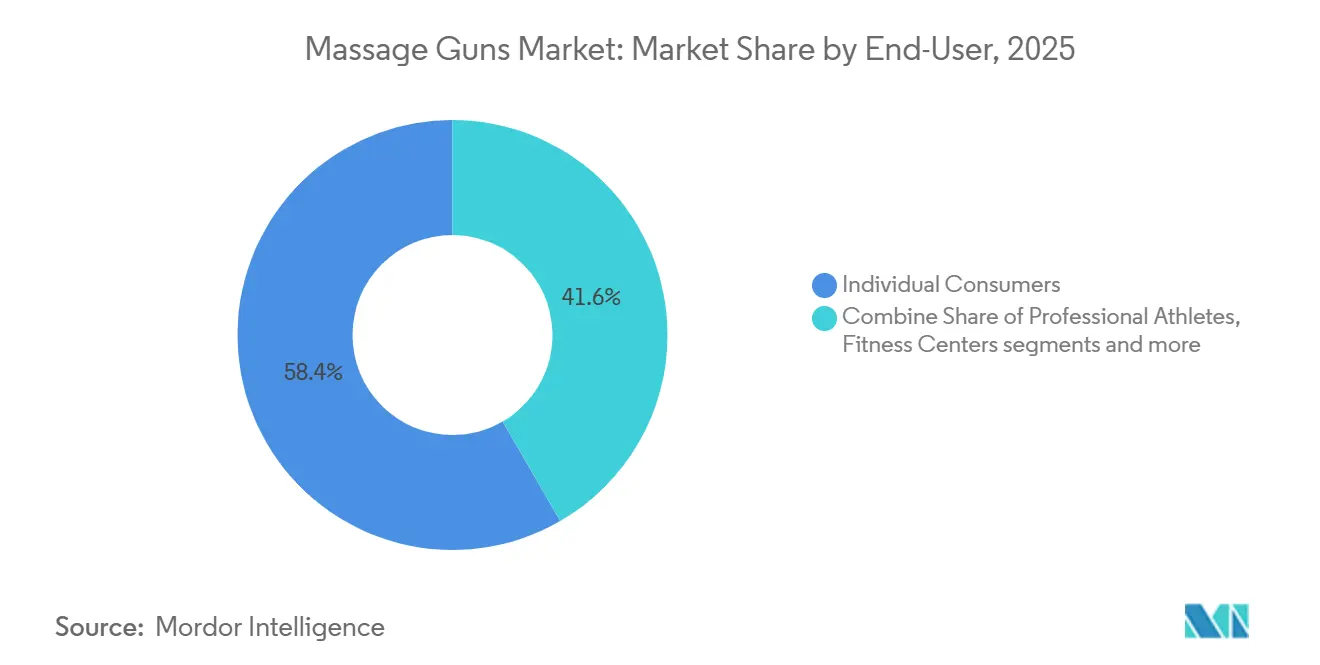
Consumers Lead While Clinical Channels Drive the Fastest ExpansionIndividual consumers held 58.36% of global demand in 2025. This group remains the volume base, although its buyer profile now extends beyond recreational athletes aged 20-40. The draft identified active retirees, postpartum women, and office workers as additional users. Fitness centers and gyms provide a stable institutional channel but generally treat these devices as a member amenity. Hyperice positioned the USD 349 Hypervolt 3 Pro for high-volume athletes and physical therapists.
Physiotherapy and rehabilitation centers are forecast to expand at an 8.50% CAGR from 2026 to 2031. A 2025 randomized controlled trial found that percussion massage therapy with structured exercise produced better knee range of motion, joint-position sense, pain, WOMAC functionality, and Berg balance scores than structured exercise alone for ACL-reconstruction patients. The World Health Organization called for expanded national rehabilitation capacity through World Health Assembly resolution WHA76.6, with member states expected to report rehabilitation service coverage by 2026. This direction expands rehabilitation infrastructure in the Asia-Pacific and Sub-Saharan Africa. Healthcare and wellness facilities are building interest in massage gun stations near compression and cold-therapy equipment.
By Distribution Channel:
Online Dominance Entrenches While DTC Dynamics EvolveOnline distribution held 68.12% of global demand in 2025 and is forecast to grow at an 8.22% CAGR during 2026-2031. This channel combines the largest current position with the fastest forecast growth among distribution channels. Consumer reviews on Amazon, Tmall, and JD.com help buyers assess a product without a physical trial. Direct-to-consumer websites allow suppliers to pair device sales with app subscriptions and trade-in incentives. Therabody expanded its Ulta Beauty partnership to more than 1,000 doors in March 2026, from approximately 300 stores in fall 2025.
Specialty health and wellness stores remain important for buyers who want to assess devices in person. Supermarkets and hypermarkets serve price-sensitive buyers in the USD 50-100 range. Online private-label alternatives can take demand from this part of retail because they carry lower retail overhead. Direct sales cover business-to-business purchases by sports teams, hospitals, and corporate wellness programs, with larger average values than individual consumer purchases. The massage guns market depends on online reach, selective retail presence, and institutional sales relationships.
Geography Analysis
North America Massage Guns Market
North America held 38.85% of the massage guns market share in 2025. High discretionary health spending and a developed direct-to-consumer e-commerce channel support the region's position. The United States is the largest contributor within the region. Therabody's presence in more than 1,000 Ulta Beauty doors illustrates the movement from sports-focused retail into mainstream wellness channels. Canada benefits from sports participation programs, while Mexico remains an emerging market as disposable income expands the addressable buyer base.
Europe Massage Guns Market
Europe is the second-largest regional market in the massage guns market. The draft estimated massage gun ownership at 10-14% of EU households in 2026, with higher concentrations in Scandinavia and Benelux. Germany, the United Kingdom, France, and the Netherlands show higher household penetration than Southern and Eastern European member states. German buyers favor clinical-grade, low-noise, physiotherapist-endorsed devices, and Stiftung Warentest reviewed 11 massage guns, including Beurer, Blackroll, Flow Recovery, and Therabody.
APAC Massage Guns Market
Asia-Pacific is forecast to grow at a 9.21% CAGR from 2026 to 2031, making it the fastest-growing region in the massage guns market. The massage guns market in the region combines wider fitness participation, growing e-commerce infrastructure, and high online concentration in China. The draft estimated that Tmall, JD.com, and Douyin account for 70-80% of Chinese massage gun sales. Japan is the region's second-largest value market and has demand for compact, low-noise products because of apartment-living constraints. India and South Korea are the fastest-growing submarkets by percentage growth, supported by gym memberships, sports-participation programs, and installment-payment options.
Competitive Landscape
The massage guns market is moderately concentrated in the premium tier, where Therabody and Hyperice hold the strongest brand positions. Their positions rest on percussive-therapy intellectual property, connected product ecosystems, and elite-athlete endorsement networks, while the mid-market remains fragmented across direct-to-consumer brands and private-label suppliers. Hyperice filed 16 additional patent infringement lawsuits in January 2024 against competitors and retailers, reinforcing intellectual property enforcement as a competitive tool. Leading brands are expanding beyond standalone devices by linking percussion products with compression, thermal, and biometric technologies.
Therabody added new products in October 2025, including Theragun Sense 2nd Gen at USD 299.99, Theragun Prime 6th Gen at USD 329.99, Theragun Mini Plus at USD 279.99, and TheraFace Mask Glo at USD 379.99. The company also expanded its Ulta Beauty partnership in March 2026 to more than 1,000 doors nationwide. Hyperice launched its Hypervolt 3 line globally on March 10, 2026, with 3 devices priced at USD 149, USD 249, and USD 349. The respective devices offer stall forces of 45, 60, and 70 pounds. Within the massage guns market, these moves pressure mid-market suppliers by placing stronger performance and connected features at lower price points.
Chinese OEM suppliers are introducing devices that combine percussion, EMS, heat, and near-infrared light at prices below USD 100. This challenges single-modality products that lack comparable connected features or clinical positioning. Nike and Hyperice commercially launched the Hyperboot on May 17, 2025, following athlete testing during the 2024 Paris Olympics. RENPHO became an official Recommended by IMA partner in 2026, with selected devices receiving professional endorsement marks for retail and clinical settings. The massage guns market combines premium leaders with a fragmented group of lower-priced and specialized suppliers.
Massage Guns Industry Leaders
-
Therabody
-
Hyperice
-
TimTam
-
RENPHO
-
Ekrin Athletics
- *Disclaimer: Major Players sorted in no particular order
Massage Guns Market Companies Covered in this Report
- Therabody
- Hyperice
- TimTam
- RENPHO
- Ekrin Athletics
- Lifepro Fitness
- OPOVE
- Bob and Brad
- Achedaway
- HoMedics
- Xiaomi
- Beurer GmbH
- Philips
- SKG
- Caresmith
- Rapid Release Therapy
- Compex
- Pulseroll
- Sportneer
- Wahl
Recent Industry Developments in Massage Guns Market
- March 2026: Therabody expanded its Ulta Beauty partnership from approximately 300 stores in fall 2025 to more than 1,000 doors nationwide, tripling its physical retail footprint.
- March 2026: Hyperice launched the Hypervolt 3 product line globally on March 10, 2026, with 3 devices priced at USD 149, USD 249, and USD 349, and stall forces of 45, 60, and 70 pounds.
- February 2026: RENPHO launched the RENPHO x Headspace Eyeris Zen Eye Massager, embedding Headspace mindfulness content into a physical massage device
- October 2025: Therabody launched Theragun Sense 2nd Gen at USD 299.99, Theragun Prime 6th Gen at USD 329.99, Theragun Mini Plus at USD 279.99, and TheraFace Mask Glo at USD 379.99
Global Massage Guns Market Report Scope
Segmentation Overview
| Percussion Massage Guns |
| Vibration Massage Guns |
| Heated Massage Guns |
| Other Product Types |
| Standard and Full-Size Massage Guns |
| Mini and Compact Massage Guns |
| Pocket and Travel Massage Guns |
| Professional High-Torque Massage Guns |
| Adjustable-Handle Massage Guns |
| Individual Consumers |
| Professional Athletes and Sports Teams |
| Physiotherapy and Rehabilitation Centers |
| Fitness Centers and Gyms |
| Healthcare and Wellness Facilities |
| Other End Users |
| Direct Sales |
| Supermarkets and Hypermarkets |
| Specialty Stores (health and wellness) |
| Online |
| Other Distribution Channels (convenience stores, departmental stores, etc.) |
| North America | Canada |
| United States | |
| Mexico | |
| South America | Brazil |
| Peru | |
| Chile | |
| Argentina | |
| Rest of South America | |
| Europe | United Kingdom |
| Germany | |
| France | |
| Spain | |
| Italy | |
| BENELUX (Belgium, Netherlands, and Luxembourg) | |
| NORDICS (Denmark, Finland, Iceland, Norway, and Sweden) | |
| Rest of Europe | |
| Asia-Pacific | India |
| China | |
| Japan | |
| Australia | |
| South Korea | |
| South East Asia (Singapore, Malaysia, Thailand, Indonesia, Vietnam, and the Philippines) | |
| Rest of Asia-Pacific | |
| Middle East and Africa | United Arab Emirates |
| Saudi Arabia | |
| South Africa | |
| Nigeria | |
| Rest of the Middle East and Africa |
| By Product Type | Percussion Massage Guns | |
| Vibration Massage Guns | ||
| Heated Massage Guns | ||
| Other Product Types | ||
| By Form Factor | Standard and Full-Size Massage Guns | |
| Mini and Compact Massage Guns | ||
| Pocket and Travel Massage Guns | ||
| Professional High-Torque Massage Guns | ||
| Adjustable-Handle Massage Guns | ||
| By End-User | Individual Consumers | |
| Professional Athletes and Sports Teams | ||
| Physiotherapy and Rehabilitation Centers | ||
| Fitness Centers and Gyms | ||
| Healthcare and Wellness Facilities | ||
| Other End Users | ||
| By Distribution Channel | Direct Sales | |
| Supermarkets and Hypermarkets | ||
| Specialty Stores (health and wellness) | ||
| Online | ||
| Other Distribution Channels (convenience stores, departmental stores, etc.) | ||
| By Geography | North America | Canada |
| United States | ||
| Mexico | ||
| South America | Brazil | |
| Peru | ||
| Chile | ||
| Argentina | ||
| Rest of South America | ||
| Europe | United Kingdom | |
| Germany | ||
| France | ||
| Spain | ||
| Italy | ||
| BENELUX (Belgium, Netherlands, and Luxembourg) | ||
| NORDICS (Denmark, Finland, Iceland, Norway, and Sweden) | ||
| Rest of Europe | ||
| Asia-Pacific | India | |
| China | ||
| Japan | ||
| Australia | ||
| South Korea | ||
| South East Asia (Singapore, Malaysia, Thailand, Indonesia, Vietnam, and the Philippines) | ||
| Rest of Asia-Pacific | ||
| Middle East and Africa | United Arab Emirates | |
| Saudi Arabia | ||
| South Africa | ||
| Nigeria | ||
| Rest of the Middle East and Africa | ||
Key Questions Answered in the Report
What is driving growth in massage guns?
Home-based self-care, sports participation, e-commerce access, and wider use of guided recovery features support demand. The category is forecast to grow at a 7.7% CAGR from 2026 to 2031.
Which massage gun type has the largest share?
Percussion massage guns held 61.12% of global demand in 2025. Vibration massage guns are forecast to be the fastest-growing product type at an 8.73% CAGR through 2031.
Why are compact massage guns gaining demand?
Mini and compact devices are suited to office, travel, and smaller living spaces. They are forecast to grow at an 8.35% CAGR between 2026 and 2031.
Which buyers account for the largest demand for massage guns?
Individual consumers accounted for 58.36% of global demand in 2025. Physiotherapy and rehabilitation centers are forecast to grow faster, at an 8.50% CAGR through 2031.