
Marketing Services Market Size and Share
Market Overview
| Study Period | 2020 - 2031 |
|---|---|
| Market Size (2026) | USD 0.96 Trillion |
| Market Size (2031) | USD 1.39 Trillion |
| Growth Rate (2026 - 2031) | 7.64 % |
| Fastest Growing Market | Middle East |
| Largest Market | North America |
| Market Concentration | Low |
Major Players *Disclaimer: Major Players sorted in no particular order Image © Mordor Intelligence. Reuse requires attribution under CC BY 4.0. | |
Marketing Services Market Analysis by Mordor Intelligence
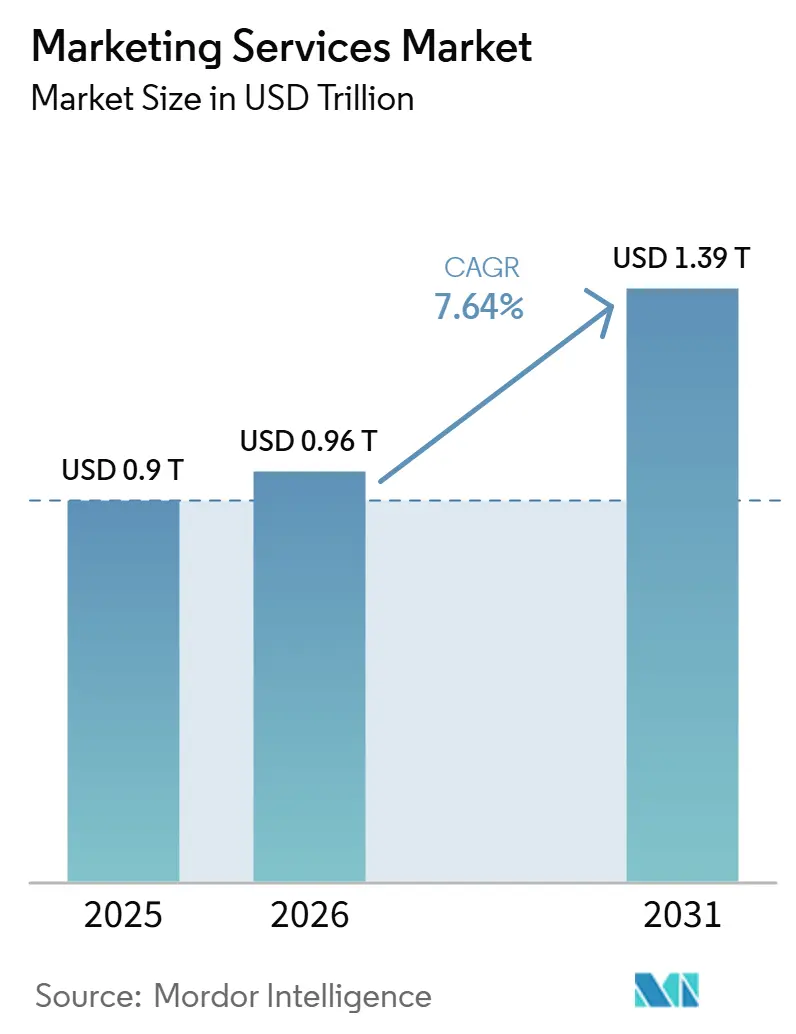
The marketing services market size was USD 0.90 trillion in 2025 and is forecast to reach USD 1.39 trillion by 2031, growing at a CAGR of 7.64% from 2026 to 2031. Digital channels continue to absorb advertising budgets because buyers can link spending more directly to business outcomes. AI is becoming part of campaign planning, content production, media optimization, and measurement. Brands are also seeking outside help as marketing technology environments become increasingly difficult to manage. Large integrated providers are strengthening their data and measurement capabilities through acquisitions and platform investments. Specialists still have room to compete where clients need speed, local expertise, or regulated-sector knowledge.
Key Report Takeaways
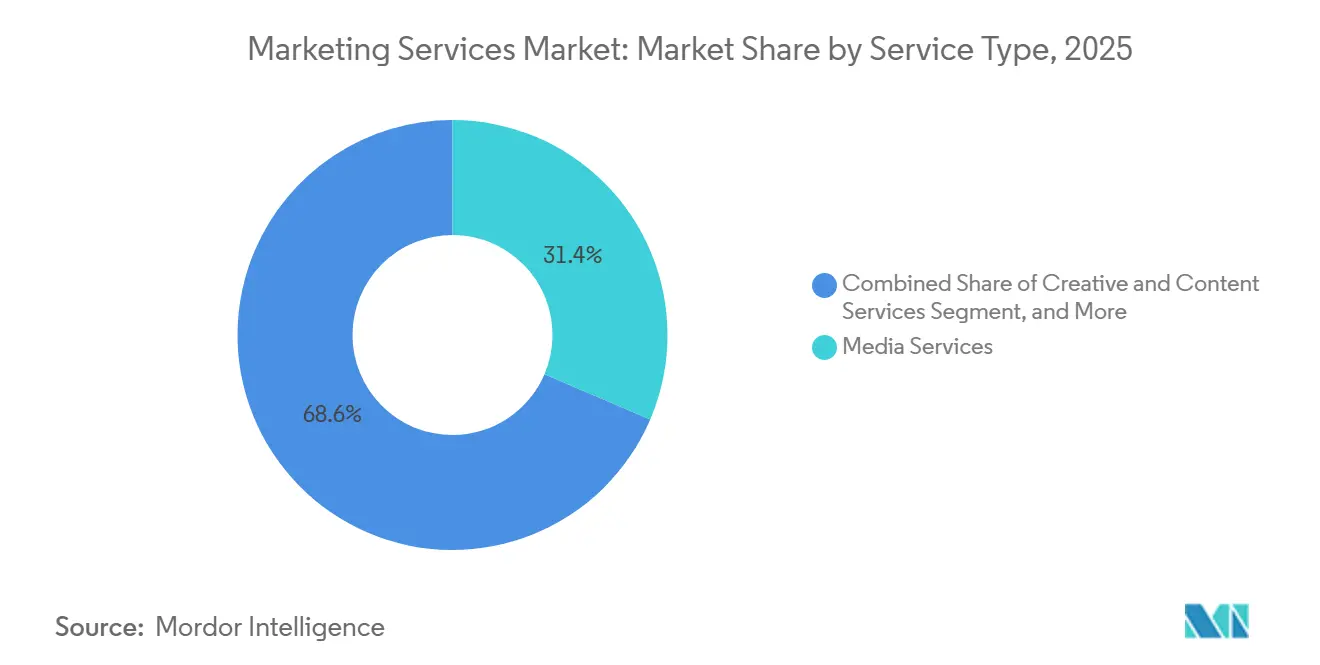
- By service type, media services held 31.42% of the marketing services market share in 2025, while analytics and measurement services are projected to expand at a 9.34% CAGR through 2031.
- By organization size, large enterprises accounted for 68.91% of the marketing services market size in 2025, while SMEs are expected to grow at a 10.05% CAGR through 2031.
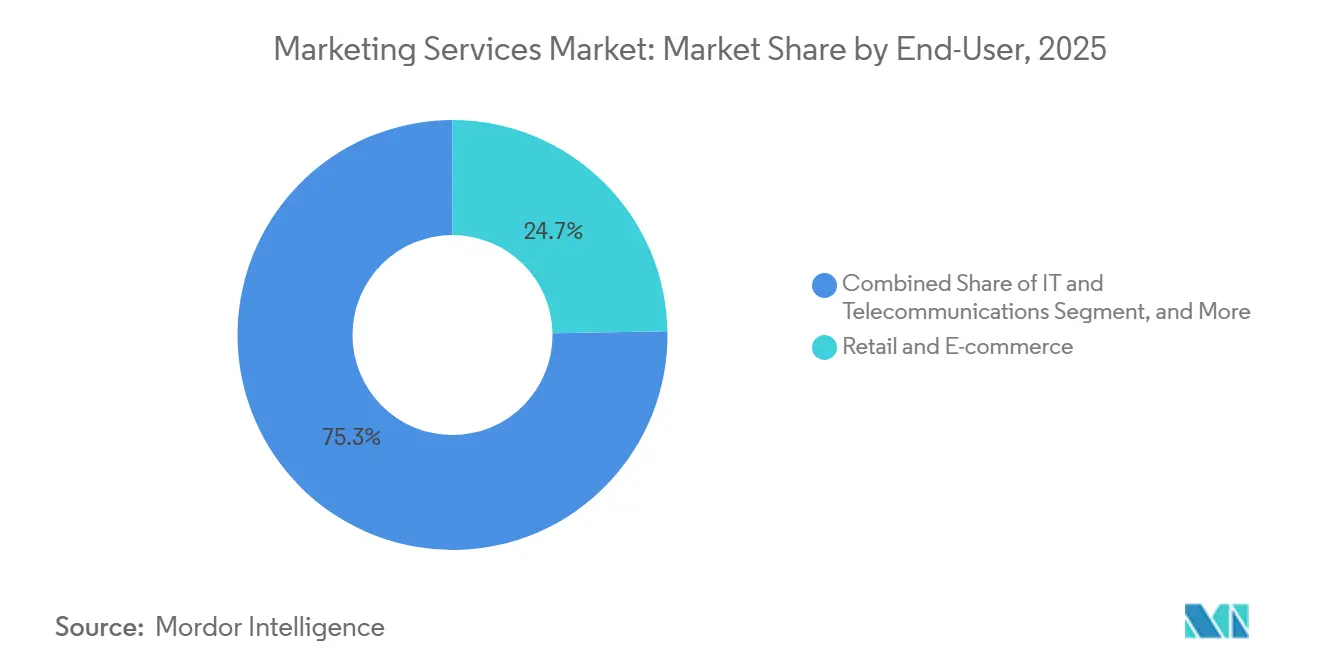
- By end-user industry, retail and e-commerce captured 24.72% of the marketing services market share in 2025, while healthcare and life sciences are projected to advance at a 9.42% CAGR through 2031.
- By channel, performance marketing channels held 56.12% of the marketing services market in 2025, while engagement and content channels are projected to grow at an 8.87% CAGR through 2031.
- By geography, North America accounted for 30.29% of the marketing services market in 2025, while the Middle East is expected to expand at a 9.81% CAGR through 2031.
Note: Market size and forecast figures in this report are generated using Mordor Intelligence’s proprietary estimation framework, updated with the latest available data and insights as of January 2026.
Global Marketing Services Market Trends and Insights
Drivers Impact Analysis*
| Driver | (~) % Impact on CAGR Forecast | Geographic Relevance | Impact Timeline |
|---|---|---|---|
| Expansion of Performance and Digital-First Budgets | +1.8% | Global, most acute in North America and Asia-Pacific | Short term (≤ 2 years) |
| Rising Adoption of AI-Powered Campaign Optimization | +1.6% | Global | Short term (≤ 2 years) |
| Growing Demand for Measurable Return on Investment and Attribution | +1.3% | North America and Europe | Medium term (2-4 years) |
| Omnichannel Commerce and Customer Experience Integration | +1.0% | Asia-Pacific and North America, with spillover to South America | Medium term (2-4 years) |
| Retail Media Service Outsourcing by Non-Endemic Brands | +0.7% | North America, with early gains in Europe | Short term (≤ 2 years) |
| Fragmented MarTech Stacks Driving Managed Marketing Operations Demand | +0.5% | North America and Europe | Long term (≥ 4 years) |
| Source: Mordor Intelligence | |||
Expansion of Performance and Digital-First Budgets
The marketing services market is benefiting from the continued move toward performance-accountable media. The IAB projected that US advertising spending would grow 9.5% in 2026, supported by demand for campaigns with measurable results.[1]Interactive Advertising Bureau, “2026 IAB Outlook Study,” IAB, iab.com This change increases demand for specialists in paid search, retail media, programmatic buying, social media, and reporting. These activities require continuing optimization rather than a one-time creative assignment. Dentsu projected 5.0% growth in global advertising spending in 2026, with digital accounting for 69% of spending across the markets it analyzed. The shift allows service providers to combine planning, execution, and measurement under longer client relationships.
Rising Adoption of AI-Powered Campaign Optimization
AI tools are now being used in campaign setup, audience selection, content workflows, and optimization. Google stated that more than 500,000 advertisers had adopted AI Max for Search campaigns by mid-2026. Google also reported an average 15% increase in conversions, with a similar return on ad spend, for advertisers using the product. These tools raise the value of agencies that can configure, review, and govern automated activities across many client accounts. Accenture Song introduced its Marketing Investment Navigator in 2026, bringing together marketing mix modeling, attribution, sales lift, and brand lift into a single AI-based measurement platform. The marketing services market, therefore, requires growing operational oversight and measurement expertise, not simply automated production.
Growing Demand for Measurable Return on Investment and Attribution
Marketing leaders are under greater pressure to show how spending supports revenue, demand generation, and customer retention. This pressure supports demand for analytics and measurement services within the marketing services market. Publicis acquired AdgeAI in March 2026 to add real-time content measurement and predictive performance capabilities to its production offer. Brands must also work across different measurement approaches, including marketing mix modeling, attribution, sales lift, and platform reporting. Using different standards makes cross-channel comparisons harder for internal teams. Providers with established measurement environments can be harder to replace because moving historical data and operational practices entails time and execution risk.
Omnichannel Commerce and Customer Experience Integration
Customer journeys often move across owned media, paid media, retail platforms, social applications, and physical locations. This creates demand for partners that can connect customer data, lifecycle programs, content, and service activity. Clients are moving away from separate channel assignments when they need more consistent customer experiences. In many markets, social commerce and messaging have become important parts of the customer experience. Regional agencies can benefit from understanding local platforms, language, and buying behavior. The marketing services market is moving toward engagements that connect channel execution with customer data and retention activity.
Restraints Impact Analysis*
| Restraint | (~) % Impact on CAGR Forecast | Geographic Relevance | Impact Timeline |
|---|---|---|---|
| Privacy Regulation and Signal Loss Raising Targeting Costs | -0.9% | Global, acute in Europe and North America | Short term (≤ 2 years) |
| Client In-Housing and Procurement Pressure Compressing Fees | -0.7% | North America and Europe | Medium term (2-4 years) |
| Walled-Garden Measurement Incompatibility Slowing Cross-Channel Optimization | -0.5% | Global | Medium term (2-4 years) |
| AI Liability, Copyright, and Disclosure Risk Increasing Approval Cycles | -0.3% | Europe and North America | Long term (≥ 4 years) |
| Source: Mordor Intelligence | |||
Privacy Regulation and Signal Loss Raising Targeting Costs
Privacy rules and platform changes make it harder to use third-party signals for precise targeting. Research published by the University of Colorado Boulder found that GDPR implementation reduced average advertising revenue by 0.3% to 6% because targeting became less efficient. The study also found traffic declines of 25% for personalized email and display marketing channels.[2]University of Colorado Boulder, “How the GDPR Reshaped Europe's Digital Economy,” Leeds School of Business, colorado.edu These pressures can increase campaign costs and slow optimization. They also increase the importance of first-party data, consent management, contextual buying, and careful data governance. Marketing providers with these capabilities may gain work, although the loss of low-cost targeting signals remains a constraint on client results.
Client In-Housing and Procurement Pressure Compressing Fees
Many large brands retain some marketing activities in-house, especially routine media, social content, and lifecycle work. This can limit external scope and create stronger price pressure on agency contracts. Clients are also using formal procurement reviews to compare rates, outputs, and performance terms. Some work may be returned to agencies when internal teams lack specialized skills or when peak campaign volumes occur. The constraint is strongest where service offerings are standardized and can be compared easily. The marketing services market remains more attractive to providers that offer specialized expertise, integrated data capabilities, or regulated-sector support that clients find difficult to maintain internally.
*Our forecasts treat driver/restraint impacts as directional, not additive. The impact forecasts reflect baseline growth, mix effects, and variable interactions.
Segment Analysis
By Service Type: Analytics Investment Changes Revenue Mix
Media services held 31.42% of the marketing services market in 2025 because advertisers needed managed support for programmatic buying, video placements, and retail media. The category remains important because platform options, inventory choices, and reporting demands continue to expand. Campaign teams also need active adjustments to budgets, audiences, creative formats, and placements. This work favors providers that can combine planning with day-to-day execution. Media specialists are also adapting their offers to retail media, connected television, social video, and digital out-of-home, which are gaining budget. Dentsu identified these formats as among the fastest-growing advertising formats globally in its 2026 outlook.
Analytics and measurement services are projected to grow at a 9.34% CAGR from 2026 to 2031, the fastest rate among service categories. The marketing services market size for this category is supported by demand for clearer links between marketing activity and commercial outcomes. AI adoption and reduced access to third-party signals have increased the importance of measurement infrastructure. Accenture Song's 2026 Marketing Investment Navigator illustrates how providers are bundling modeling, attribution, sales lift, and brand lift into broader service arrangements. Strategic consulting and transformation work can command higher fees when boards need operating-model reviews alongside execution. Creative and content work is also changing as generative AI shortens production cycles and shifts value toward strategy, governance, and quality control.



By Organization Size: SMEs Gain Access to Professional Capabilities
Large enterprises accounted for 68.91% of the marketing services market in 2025, reflecting their broad media budgets and established relationships with global agency networks. These clients often seek integrated support across media, content, data, customer experience, and communications. Their requirements can include governance across markets and coordination with internal technology teams. Consolidated assignments can favor providers with broad geographic coverage and standardized operating methods. Large enterprises also have more capacity to retain selected activities internally. External partners remain relevant where campaigns require specialist skills, independent measurement, or additional operating scale.
SMEs are expected to grow at a 10.05% CAGR from 2026 to 2031, the strongest rate by organization size. The marketing services market for SMEs is supported by AI-enabled tools that reduce the minimum spend required to run multichannel campaigns. Shopify introduced Campaign Autopilot in 2026 to plan and run campaigns across channels, including Meta and email. These tools make professional marketing methods more accessible to firms with smaller teams. SMEs still need outside assistance with channel planning, content adaptation, consent practices, and campaign reporting. A hybrid arrangement, with an internal marketing lead and outsourced specialist execution, can suit companies that need flexibility without building a full internal organization.
By End-User Industry: Healthcare Moves Toward Precision Formats
Retail and e-commerce accounted for 24.72% of the marketing services market in 2025, driven by their mature performance marketing practices and large customer acquisition needs. Their work commonly involves retail media, paid search, social advertising, customer relationship management, and conversion analysis. The expansion of non-endemic retail media has also created new planning and buying assignments. Agencies serving this group must connect media activity with product availability, pricing, promotions, and commerce data. The sector's preference for measurable outcomes continues to support managed media and analytics work. IT and telecommunications, BFSI, and media and entertainment also represent established client groups with significant digital marketing activity.
Healthcare and life sciences are projected to advance at a 9.42% CAGR from 2026 to 2031, making them the fastest-growing end-user segment. US healthcare and pharmaceutical digital advertising spending reached USD 24.8 billion in 2025 and is projected to reach USD 26.2 billion in 2026. The same source projected that traditional advertising spending would decline from USD 7.9 billion in 2025 to USD 6.9 billion in 2026. Regulation shapes both message development and campaign review in this segment. This creates demand for agencies that can manage documentation, approved claims, and local promotional rules. Travel and hospitality, manufacturing, and industrial clients present further room for growth as digital marketing adoption broadens from a lower base.
By Channel: Measurable Media Leads While Engagement Expands
Performance marketing channels held 56.12% of the marketing services market in 2025, supported by spending on search, social, retail media, and programmatic display. These formats are widely used because they provide relatively direct information on activity and outcomes. Finance leaders often favor channels tied to acquisition, sales, or other measurable goals. This preference reinforces demand for campaign management, testing, and attribution support. Performance work, however, depends on good data quality and careful measurement design. Privacy changes and fragmented platforms can make simple comparisons across channels more difficult.
Engagement and content channels are projected to grow at an 8.87% CAGR from 2026 to 2031. These channels support brand recognition, customer retention, and consideration that short-term acquisition metrics may not capture fully. The marketing services industry is responding with services that connect content planning with performance measurement. Stagwell launched The Media Machine in June 2026 as an operating system that combines automation and human expertise through more than 20 intelligent agents. Its stated purpose is to improve media planning and optimization through the campaign lifecycle. Influencer and creator-led formats also continue to draw spending as platforms expand their commercial tools. Providers that can plan engagement and performance activities together can offer clients a more coordinated channel strategy.
Geography Analysis
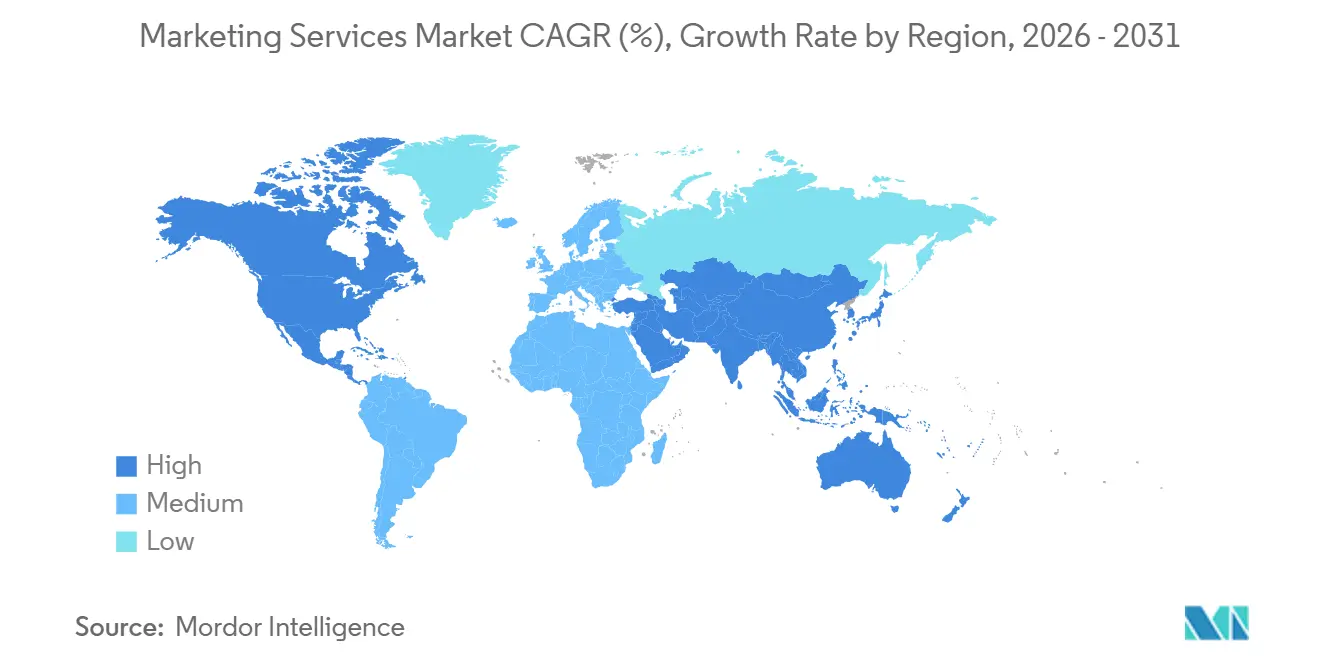
North America held 30.29% of the marketing services market in 2025, supported by large enterprise budgets, global network headquarters, and a developed US performance marketing environment. Omnicom completed its acquisition of Interpublic in November 2025, forming a combined company with pro forma revenue above USD 25 billion. The transaction reinforced the region's role in large-scale agency consolidation. The IAB projected 9.5% growth in US advertising spending in 2026. Europe has a different operating environment because privacy rules and AI disclosure requirements place greater weight on data governance and oversight.
South America and Africa represent longer-term growth opportunities for the marketing services market. Social commerce and influencer activity are expanding among retail and consumer goods brands in South America, particularly in Brazil and Chile. Argentina offers potential but faces currency volatility and regulatory uncertainty that can limit multi-year agency commitments. In Africa, South Africa, Egypt, and Nigeria serve as important hubs for multinational brand investment. IAB MENA reported that Egypt recorded 23.1% growth in digital advertising spending in 2025.[3]Interactive Advertising Bureau MENA, “2025 MENA Digital Ad Spend,” IAB MENA, iabmena.com
The Middle East is projected to grow at a 9.81% CAGR from 2026 to 2031, the fastest regional rate. IAB MENA reported that the regional digital advertising market reached USD 8.185 billion in 2025, increasing 17.8% from the previous year. GCC diversification programs support localized brand investment outside oil-related sectors. IAB MENA also reported 40.5% growth in retail media in the region during 2025. Providers with bilingual capabilities, local cultural knowledge, and digital commerce experience are well-positioned to meet this demand.

Competitive Landscape
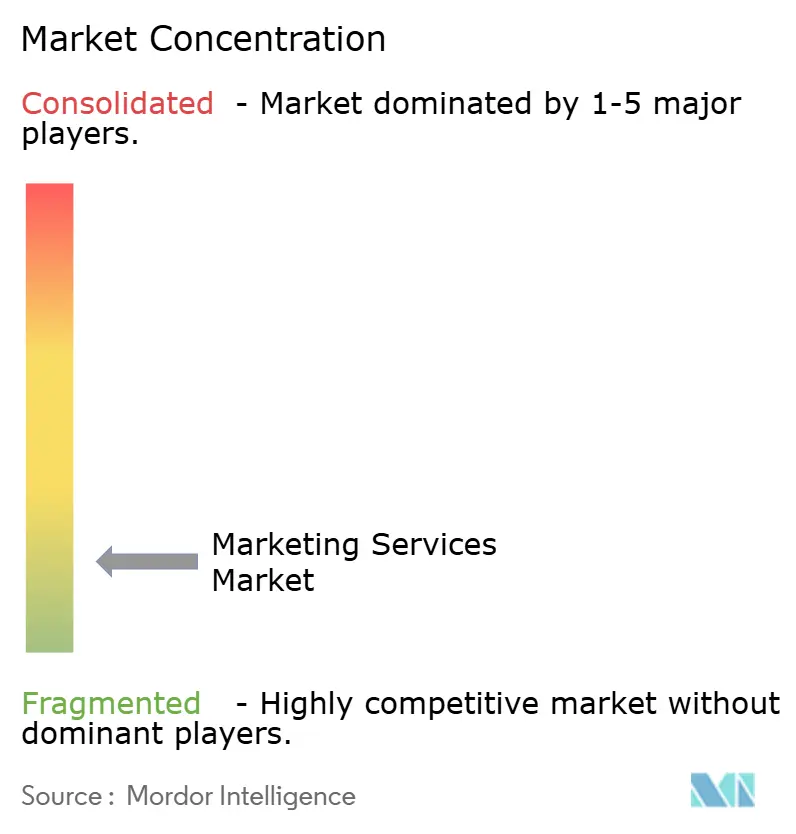
The marketing services market is fragmented, combining consolidation among global networks with continued demand for specialists. Omnicom's acquisition of Interpublic created a company with pro forma revenue exceeding USD 25 billion.[4]Omnicom Group Inc., “Omnicom Completes Acquisition of Interpublic,” Omnicom, omc.com The transaction expanded Omnicom's scale across media, creative, data, and technology services. Large networks are using scale to win broad enterprise assignments that require common standards across markets. Specialist providers remain relevant for local execution, technical work, and sector-specific communications.
Publicis acquired AdgeAI in March 2026 to add predictive measurement and content intelligence. In May 2026, Publicis agreed to acquire LiveRamp for USD 2.167 billion, with the deal expected to close before the end of 2026. WPP signed a multi-year collaboration agreement with Amazon Web Services in June 2026 to support agentic AI applications for enterprise brands. WPP also reported that WPP Media manages more than USD 60 billion in annual media investment across 80 markets. These moves show that data collaboration, automation, and measurement have become central parts of competitive strategy.
Consultancy-led providers also compete in strategic consulting and digital experience assignments. Accenture Song launched its Marketing Investment Navigator in 2026 as part of its data and measurement offer. Stagwell is pursuing a technology-led challenger position through its Media Machine platform and related AI tools. Competitive openings remain in AI governance, healthcare communications, and entry support for GCC and African markets. The available information does not provide a combined revenue share for the leading companies, so a concentration score cannot be assigned under the stated scoring method.
Marketing Services Industry Leaders
Omnicom Group Inc.
Accenture Plc
Publicis Groupe S.A.
WPP plc
Dentsu Group Inc.
- *Disclaimer: Major Players sorted in no particular order

Recent Industry Developments
- July 2026: Stagwell Inc. and Microsoft Advertising became the first to integrate Copilot directly into live media campaigns through a Model Context Protocol connection to The Media Machine. The integration enabled continuous optimization and extended Stagwell's agentic operating system across live campaign environments.
- June 2026: WPP Enterprise Solutions signed a multi-year Strategic Collaboration Agreement with Amazon Web Services to operationalize agentic AI for enterprise brands across commerce, customer experience, and marketing operations. WPP is an AWS Advanced Tier Services Partner with dedicated Amazon Marketing Cloud Center of Excellence deployments.
- June 2026: Accenture Plc completed its acquisition of creator and social agency Whalar from Whalar Group, integrating it into Accenture Song. Whalar managed more than USD 600 million in creator campaigns across major platforms and has measurement capabilities.
- May 2026: Publicis Groupe S.A. entered into an agreement to acquire LiveRamp, a global data collaboration platform, for a total enterprise value of USD 2.167 billion in an all-cash transaction at USD 38.50 per share. The transaction is expected to close before the end of 2026.


Global Marketing Services Market Report Scope
The Marketing Services Market comprises organizations that provide specialized professional services to help businesses plan, execute, optimize, and measure marketing strategies and customer engagement initiatives across digital, traditional, and omnichannel environments. These services enable organizations to strengthen brand positioning, acquire and retain customers, enhance customer experiences, improve campaign performance, and maximize return on marketing investments through strategic planning, creative execution, media activation, communications, analytics, and technology-enabled marketing solutions.
The Marketing Services Market Report is Segmented by Service Type (Strategic Consulting and Transformation Services, Creative and Content Services, Media Services, Digital Experience and Lifecycle Services, Communications and Influence Services, Analytics and Measurement Services, and Other Service Types), Organization Size (Large Enterprises and Small and Medium-Sized Enterprises), End-User Industry (Retail and E-commerce, IT and Telecommunications, BFSI, Healthcare and Life Sciences, Media and Entertainment, Travel and Hospitality, Manufacturing and Industrials, and Other End-User Industries), Channel (Performance Marketing Channels, Engagement and Content Channels, and Other Channels), and Geography (North America, South America, Europe, Asia-Pacific, Middle East, and Africa). The Market Forecasts are Provided in Terms of Value (USD).
| Strategic Consulting and Transformation Services |
| Creative and Content Services |
| Media Services |
| Digital Experience and Lifecycle Services |
| Communications and Influence Services |
| Analytics and Measurement Services |
| Other Service Types |
| Large Enterprises |
| Small and Medium-Sized Enterprises |
| Retail and E-commerce |
| IT and Telecommunications |
| BFSI |
| Healthcare and Life Sciences |
| Media and Entertainment |
| Travel and Hospitality |
| Manufacturing and Industrials |
| Other End-User Industries |
| Performance Marketing Channels |
| Engagement and Content Channels |
| Others Channels |
| North America | United States |
| Canada | |
| Mexico | |
| South America | Brazil |
| Argentina | |
| Chile | |
| Rest of South America | |
| Europe | Germany |
| United Kingdom | |
| France | |
| Italy | |
| Spain | |
| Rest of Europe | |
| Asia-Pacific | China |
| Japan | |
| India | |
| South Korea | |
| Australia | |
| Rest of Asia-Pacific | |
| Middle East | United Arab Emirates |
| Saudi Arabia | |
| Qatar | |
| Rest of Middle East | |
| Africa | South Africa |
| Egypt | |
| Nigeria | |
| Rest of Africa |
| By Service Type | Strategic Consulting and Transformation Services | |
| Creative and Content Services | ||
| Media Services | ||
| Digital Experience and Lifecycle Services | ||
| Communications and Influence Services | ||
| Analytics and Measurement Services | ||
| Other Service Types | ||
| By Organization Size | Large Enterprises | |
| Small and Medium-Sized Enterprises | ||
| By End-User Industry | Retail and E-commerce | |
| IT and Telecommunications | ||
| BFSI | ||
| Healthcare and Life Sciences | ||
| Media and Entertainment | ||
| Travel and Hospitality | ||
| Manufacturing and Industrials | ||
| Other End-User Industries | ||
| By Channel | Performance Marketing Channels | |
| Engagement and Content Channels | ||
| Others Channels | ||
| By Geography | North America | United States |
| Canada | ||
| Mexico | ||
| South America | Brazil | |
| Argentina | ||
| Chile | ||
| Rest of South America | ||
| Europe | Germany | |
| United Kingdom | ||
| France | ||
| Italy | ||
| Spain | ||
| Rest of Europe | ||
| Asia-Pacific | China | |
| Japan | ||
| India | ||
| South Korea | ||
| Australia | ||
| Rest of Asia-Pacific | ||
| Middle East | United Arab Emirates | |
| Saudi Arabia | ||
| Qatar | ||
| Rest of Middle East | ||
| Africa | South Africa | |
| Egypt | ||
| Nigeria | ||
| Rest of Africa | ||


Key Questions Answered in the Report
What is the projected size of the marketing services market?
The marketing services market was USD 0.90 trillion in 2025 and is forecast to reach USD 1.39 trillion by 2031 at a 7.64% CAGR from 2026 to 2031.
Which service category is growing fastest?
Analytics and measurement services are projected to expand at a 9.34% CAGR from 2026 to 2031.
Which client group has the highest growth outlook?
SMEs are expected to grow at a 10.05% CAGR through 2031 as AI tools make multichannel capabilities more accessible.
Which end-user segment is expanding fastest?
Healthcare and life sciences are projected to grow at a 9.42% CAGR through 2031, supported by a move toward precision digital formats.
Which region has the strongest growth outlook?
The Middle East is expected to record a 9.81% CAGR from 2026 to 2031.
How are AI tools changing marketing service providers?
Providers are using AI for campaign optimization, content workflows, and integrated measurement, while clients still need governance and operational support.
Page last updated on:





