
Mandibular Advancement Devices Market Size and Share
Market Overview
| Study Period | 2020 - 2031 |
|---|---|
| Market Size (2026) | USD 555.06 Million |
| Market Size (2031) | USD 808.79 Million |
| Growth Rate (2026 - 2031) | 7.82 % |
| Fastest Growing Market | Asia-Pacific |
| Largest Market | North America |
| Market Concentration | Medium |
Major Players *Disclaimer: Major Players sorted in no particular order Image © Mordor Intelligence. Reuse requires attribution under CC BY 4.0. | |
Mandibular Advancement Devices Market Analysis by Mordor Intelligence
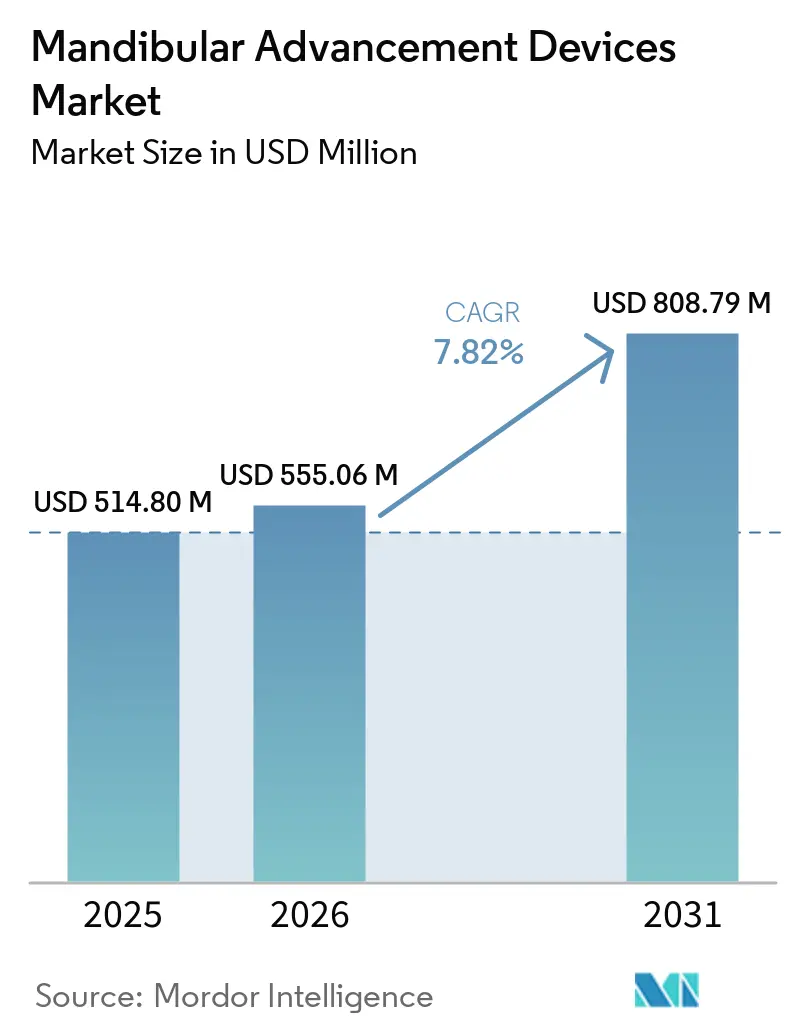
The Mandibular Advancement Devices Market size is projected to expand from USD 514.80 million in 2025 and USD 555.06 million in 2026 to USD 808.79 million by 2031, registering a CAGR of 7.82% between 2026 and 2031.
The mandibular advancement devices market is supported by the large and underdiagnosed burden of obstructive sleep apnea, or OSA. Oral appliances give clinicians a noninvasive treatment option for people with mild to moderate OSA and for people who cannot tolerate continuous positive airway pressure, or CPAP. Custom appliances remain important because they are designed around the patient’s dentition and can be adjusted during treatment. Digital manufacturing is changing both device design and laboratory workflows, which is increasing the availability of precision-fitted appliances. Reimbursement rules, clinical evidence, and the availability of trained dental providers will determine how evenly demand develops across countries.
Key Report Takeaways
- By product type, custom devices held 56.76% revenue share in 2025, while custom devices recorded the highest projected CAGR at 9.65% through 2031.
- By application, obstructive sleep apnea held 45.76% revenue share in 2025, while primary snoring recorded the highest projected CAGR at 9.33% through 2031.
- By material type, plastic and polymer held 63.65% revenue share in 2025, while metal components recorded the highest projected CAGR at 9.76% through 2031.
- By end user, sleep clinics held 59.65% revenue share in 2025, while dental clinics recorded the highest projected CAGR at 10.32% through 2031.
- By distribution channel, hospitals and dental clinics held 63.65% revenue share in 2025, while online stores and pharmacies recorded the highest projected CAGR at 10.54% through 2031.
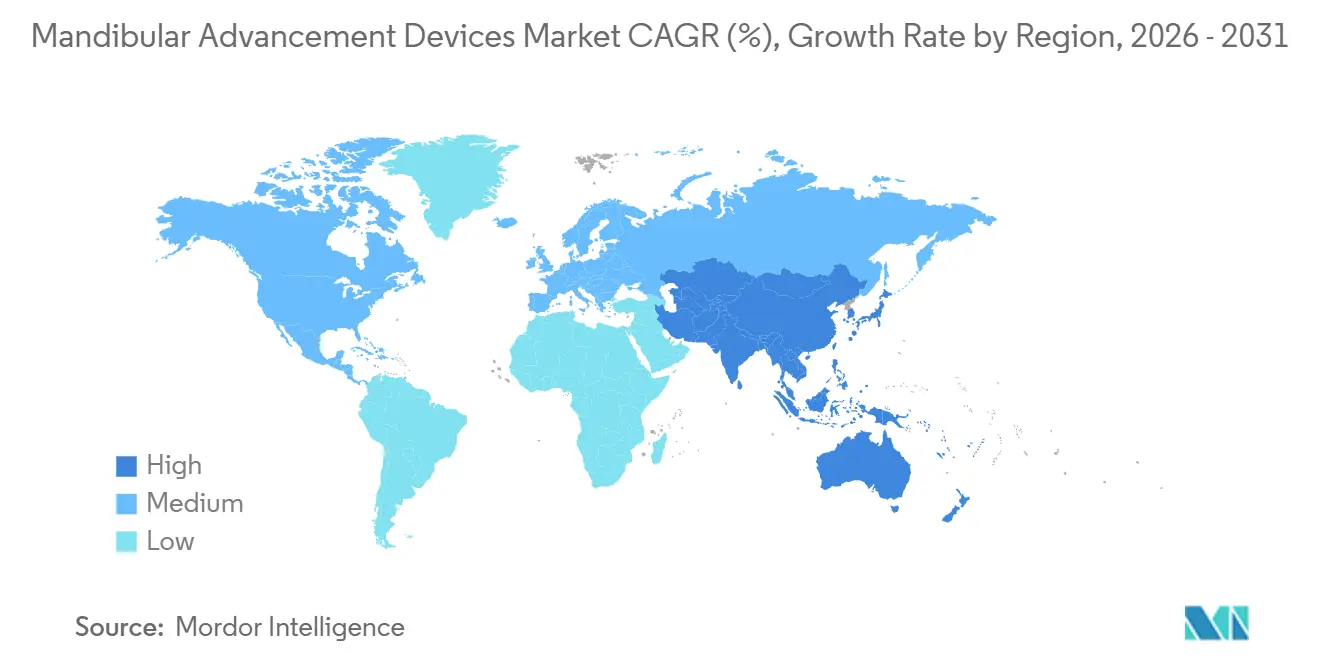
- By geography, North America held 43.21% revenue share in 2025, while Asia-Pacific recorded the highest projected CAGR at 8.54% through 2031.
Note: Market size and forecast figures in this report are generated using Mordor Intelligence’s proprietary estimation framework, updated with the latest available data and insights as of January 2026.
Market Trends and Insights
Drivers Impact Analysis of Mandibular Advancement Devices Market*
| Driver | (~) % Impact on CAGR Forecast | Geographic Relevance | Impact Timeline |
|---|---|---|---|
| Rising Prevalence and Diagnosis of Obstructive Sleep Apnea | +2.00% | Global | Short term (≤ 2 years) |
| Preference for Noninvasive Alternatives to CPAP | +1.80% | Global, strongest in North America and Europe | Medium term (2-4 years) |
| Digitized Customization Through CAD/CAM and 3D Printing | +1.50% | North America, Europe, Japan, Australia | Medium term (2-4 years) |
| Expansion of Sleep Clinic and Dental Sleep Medicine Networks | +1.20% | North America, Europe, APAC core | Medium term (2-4 years) |
| Remote Titration and Compliance Monitoring for Underserved Patients | +0.80% | North America, with spillover to APAC | Long term (≥ 4 years) |
| Device Clinician Workflow Integration with Home Sleep Testing | +0.70% | North America and Europe | Medium term (2-4 years) |
| Source: Mordor Intelligence | |||
Rising Prevalence and Diagnosis of Obstructive Sleep Apnea
OSA remains underdiagnosed in many health systems, even as screening and access to sleep testing improve. Home sleep testing can reduce the distance between suspected symptoms and a formal diagnosis. The American Academy of Sleep Medicine and the American Academy of Dental Sleep Medicine recommend oral appliance therapy for adults with OSA who cannot tolerate CPAP or prefer an alternative treatment. That clinical position provides a defined referral route for the mandibular advancement devices market. A 2026 longitudinal study reported objective mean oral appliance use of 7.05 hours on nights worn during the first 3 months[1]. Greater awareness of snoring as a possible sign of sleep-disordered breathing can also bring people without an OSA diagnosis into dental sleep practices.
Preference for Noninvasive Alternatives to CPAP
CPAP intolerance continues to support the use of oral appliance therapy among eligible patients. The choice is also becoming more relevant for newly diagnosed people who want care that fits home testing and telehealth-enabled pathways. A 2025 pilot randomized trial found that a digitally fabricated MAD delivered a statistically equivalent reduction in apnea-hypopnea index, or AHI, to a traditional monoblock device. The same study found that lower anterior dental pain was significantly reduced with the digital device. A separate 2025 study reported that a precision-custom protocol reduced AHI to below 10 events per hour in 90% of treated patients and achieved a 63% mean AHI improvement from baseline. These findings can support referral relationships that include sleep physicians, pulmonologists, cardiologists, and dentists.
Digitized Customization Through CAD/CAM and 3D Printing
Digital scanning, computer-aided design and manufacturing, or CAD/CAM, and 3D printing are replacing parts of the conventional impression-based workflow. These methods can improve fit and allow laboratories to produce devices without equivalent increases in labor. A 2026 study found that customized, 3D-printed appliances produced clinical results comparable with CPAP for oxygen desaturation and snoring over 1 year[2]. The study also found no significant occlusal change or impairment of masticatory performance over that period. The mandibular advancement devices market, therefore, has a pathway to wider clinical acceptance among dentists concerned about long-term treatment effects. Digital production may also shift competition from basic manufacturing capability toward device mechanics and clinical support.
Expansion of Sleep Clinic and Dental Sleep Medicine Networks
Sleep clinics remain important because they diagnose OSA and coordinate physician-led treatment. Dental clinics are expanding their role in titration, follow-up, and long-term appliance management. Professional training programs provide a route for dentists to develop competence in dental sleep medicine. The mandibular advancement devices market benefits when these clinical networks have clear referral and reimbursement processes. Sleep clinics generally require evidence and physician-facing support from suppliers. Dental clinics also need workflow tools, training, and patient-financing support to manage the appliance after diagnosis.
Restraints Impact Analysis of Mandibular Advancement Devices Market*
| Restraint | (~) % Impact on CAGR Forecast | Geographic Relevance | Impact Timeline |
|---|---|---|---|
| Dental and Temporomandibular Joint Side Effects | -1.20% | Global | Short term (≤ 2 years) |
| Uneven Reimbursement and High Custom Device Cost | -1.00% | Global, most acute in MEA and South America | Medium term (2-4 years) |
| Shortage of Qualified Dental Sleep Medicine Providers | -0.60% | APAC, MEA, South America | Long term (≥ 4 years) |
| Patient Selection Friction From Dentition and Nasal Resistance Constraints | -0.40% | Global | Short term (≤ 2 years) |
| Source: Mordor Intelligence | |||
Dental and Temporomandibular Joint Side Effects
Temporomandibular joint discomfort, occlusal changes, and lower anterior tooth pain can limit long-term adherence. A randomized controlled trial followed 65 patients using 2 MAD designs for 12 months. It documented orofacial pain, masticatory muscle tenderness, temporomandibular joint tenderness, and changes in interdental contact. These effects require careful patient selection and regular follow-up by the prescribing clinician. Manufacturers can support prescriber confidence by supplying repositioning tools and by designing appliances that help manage side effects. The mandibular advancement devices market may be constrained where providers lack experience managing these treatment issues.
Uneven Reimbursement and High Custom Device Cost
Coverage for custom appliances differs substantially among payers and countries. Superior HealthPlan introduced a prior authorization requirement for E0486, the procedure code for a custom-fabricated MAD, effective July 1, 2026. The requirement increases documentation and administrative work for practices serving affected members. In Germany, statutory coverage is available for eligible diagnosed OSA patients, but access depends on CPAP intolerance documentation and a physician's prescription through the sleep medicine pathway. Custom devices priced at USD 1,000 to USD 3,000 or more also face competition from sub-USD 100 boil-and-bite products. The difference in cost can increase online traffic without producing similar revenue for clinically fitted devices.
*Our forecasts treat driver/restraint impacts as directional, not additive. The impact forecasts reflect baseline growth, mix effects, and variable interactions.
Mandibular Advancement Devices Market Segment Analysis
By Product Type:
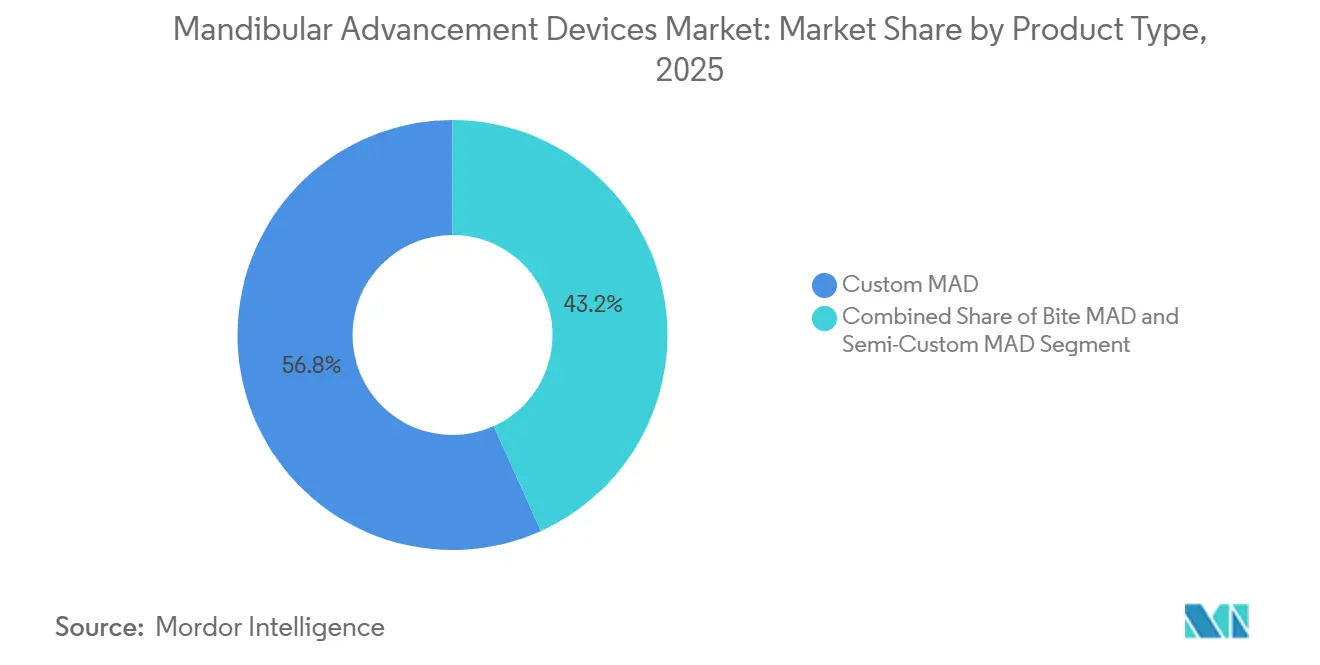
Custom Devices Support Premium Clinical CareCustom devices held 56.76% of the mandibular advancement devices market share within the product type in 2025. Their position reflects their adjustment capability and their role in physician-referred treatment. Precision-custom therapy reported a 63% mean AHI improvement across patient subgroups in a 2025 study. That evidence supports the use of fitted appliances for patients who need structured clinical care. Semi-custom products provide an intermediate option with more adjustment than bite devices. They can reduce fabrication time and cost, although digital workflows are narrowing the historic price difference with custom products.
Custom devices are forecast to grow at a CAGR of 9.65% through 2031. The mandibular advancement devices industry is moving toward greater use of digital design and additive manufacturing in this category. Bite devices continue to serve over-the-counter, pharmacy, and primary snoring demand. Their simpler form makes them less suited to clinician-led adjustment and ongoing treatment management. Laboratories that use CAD/CAM and 3D printing can challenge specialist brands on production quality. Suppliers are therefore differentiating with adjustment systems, monitoring features, and evidence that supports treatment outcomes.
By Application:
OSA Remains the Largest Clinical UseObstructive sleep apnea accounted for 45.76% of application revenue in 2025. Its leading position is linked to reimbursement pathways, physician referrals, and established guidance on oral appliance therapy. Mild to moderate OSA is the core setting for many fitted appliances. Patients who cannot tolerate CPAP are also a defined treatment population. The clinical role of the mandibular advancement device market is consequently closely tied to diagnosis, prescribing, and follow-up within sleep medicine.
Primary snoring is forecast to grow at a CAGR of 9.33% through 2031. Digital and direct-to-consumer pathways can make an appliance more accessible before a formal sleep study occurs. The virtual titration model described in the supplied evidence shows how remote care can establish objective improvement for selected mild to moderate OSA patients. Some people seeking treatment for snoring may later receive an OSA diagnosis and enter a higher-acuity care pathway. Temporomandibular joint syndrome and other applications remain smaller, more stable areas that are often served by orofacial pain specialists and orthodontists. A 2026 study also reported reductions in both respiratory events and sleep bruxism episodes during oral appliance therapy.
By Material Type:
Polymers Lead Digital Appliance ProductionPlastic and polymer materials held 63.65% of material revenue in 2025. Their position comes from a combination of biocompatibility and suitability for digital fabrication. Medical-grade polyamide type 12 nylon is used in the Hushd Pro Z-Link, which received FDA clearance in 2025. Polymer trays can be designed for fit, strength, and a smooth finish. These characteristics make them suitable for custom devices produced through 3D printing. The material choice also fits the broader movement toward digitally manufactured appliances.
Metal components are forecast to grow at a CAGR of 9.76% through 2031. Growth relates to titanium and cobalt-chromium parts used in hinges, adjustment arms, and post mechanisms rather than to full-metal appliances. These components can improve durability and dimensional stability in hybrid devices. Their role increases as devices require more precise mandibular positioning. The mandibular advancement device industry uses polymer frames and metal mechanisms to combine patient comfort with reliable adjustment. This design approach is relevant to appliances that incorporate more complex monitoring or mechanical features.
By End User:
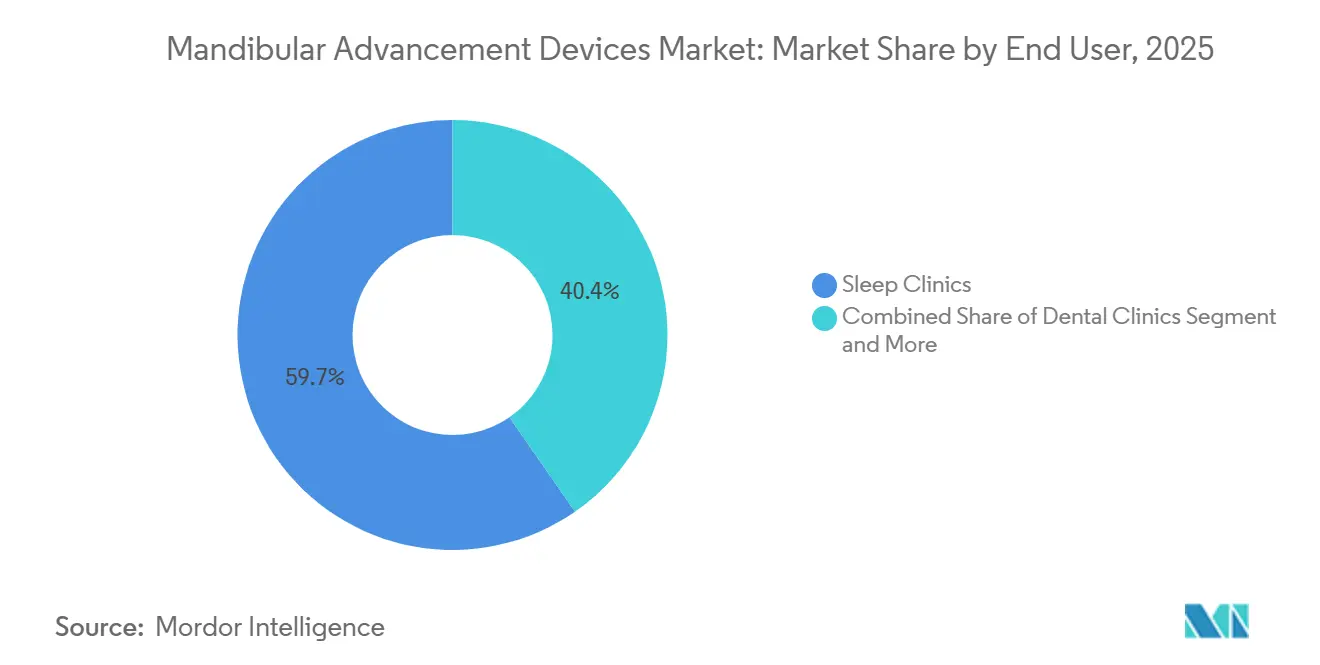
Dental Clinics Expand Their Management RoleSleep clinics retained 59.65% of end-user revenue in 2025. They remain the formal diagnostic entry point for many patients with OSA. Sleep studies and physician sign-off commonly support coverage decisions in North America and Europe. The largest portion of the mandibular advancement devices market size at the end-user level, therefore, remained linked to established sleep care pathways in 2025. Hospitals are a smaller but important setting where respiratory, cardiology, dental, and sleep services can be coordinated. Home care and individual use are more associated with self-purchased and lower-value bite devices.
Dental clinics are forecast to grow at a CAGR of 10.32% through 2031. Dentists can manage fitting, titration, follow-up, and monitoring after a sleep clinician has identified an eligible patient. This role grows as training in dental sleep medicine becomes more widely available. Dental practices respond to practice-building support, digital workflow tools, and patient financing. Sleep clinics need suppliers to provide clinical evidence and support physician engagement. The mandibular advancement devices market is thus served by different channel needs within diagnosis and long-term appliance care.

By Distribution Channel:
Online Access Broadens the Patient FunnelHospitals and dental clinics accounted for 63.65% of distribution revenue in 2025. Clinical channels retain a central role because prescription-required custom devices need professional assessment and follow-up. Retail pharmacies largely serve over-the-counter anti-snoring and bite-device demand. This channel mix separates the service requirements for clinical therapy from those for self-directed purchases. The mandibular advancement devices market size in clinical channels remains supported by the higher value of fitted appliances. Providers can also coordinate titration and address dental side effects that may not be managed in retail settings.
Online stores and pharmacies are forecast to grow at a CAGR of 10.54% through 2031. Growth is supported by consumer use of sleep-health applications and familiarity with remote care. Direct-to-consumer suppliers provide impression-based custom devices through digital ordering paths. Lower online prices can set expectations for convenience and affordability among people who later need more complex treatment. A hybrid channel model can allow digital routes to address lower-acuity snoring demand. Clinical routes are likely to remain important for medium- and high-complexity OSA cases that require diagnosis and supervised care.
Geography Analysis
North America Mandibular Advancement Devices Market
North America held 43.21% of the global mandibular advancement devices market share in 2025. The United States supports demand through sleep-dental referral networks, commercial insurance coverage, and active device regulation. E0486 provides a billing route for custom-fabricated appliances, although new prior authorization policies can increase administrative work for practices. Canada has variable provincial coverage, while Mexico relies more on private-pay dental demand. The region has competition across specialist device suppliers, laboratory groups, and direct-to-consumer channels.
Europe Mandibular Advancement Devices Market
Europe is the second-largest regional area for these appliances. Germany is a key market because its coverage and clinical guidance support the use of individually fitted devices for eligible people with OSA. The DGSM 2025 S3 guideline positioned individually fitted MADs alongside CPAP as a first-line therapy for mild OSA, defined as AHI 5 to 15. The guideline cited a meta-analysis of 14 randomized controlled trials involving 2,100 participants. It also reported long-term oral appliance compliance of 75% to 85%, compared with 30% to 50% for CPAP users at 6 months[3]. The United Kingdom, Spain, France, and Italy offer additional demand through guided care pathways, dental sleep clinics, specialist availability, and private payer coverage.
APAC, MEA and South America Mandibular Advancement Devices Market
Asia-Pacific is forecast to expand at a CAGR of 8.54% through 2031. China, Japan, South Korea, India, and Australia are increasing diagnoses and developing dental sleep medicine capacity. Japan’s aging population, South Korea’s dental technology investment, and Australia’s private dental sector favor premium custom appliances. India and Southeast Asia have earlier-stage reimbursement and fewer specialists, which limits near-term access. Their unmet need and expanding private sleep care create scope for future adoption. The Middle East and Africa, along with South America, remain smaller regions where private sleep clinics and awareness of oral appliance therapy are growing.
Competitive Landscape
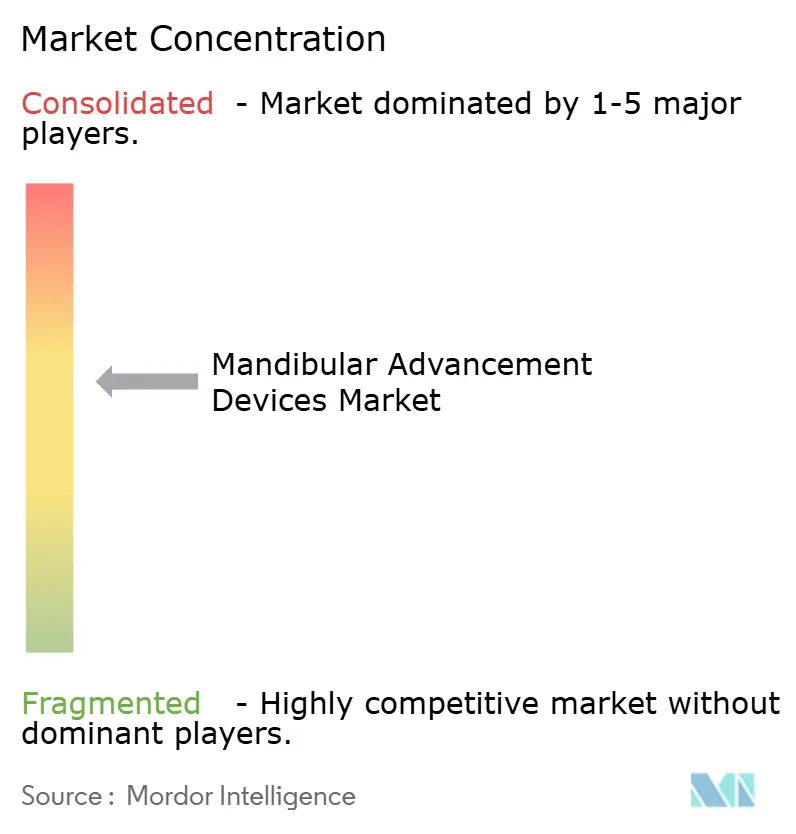
The mandibular advancement devices market is moderately fragmented. ProSomnus Sleep Technologies, SomnoMed Limited, Vivos Therapeutics, and Oventus Medical operate in the premium branded-device group. DynaFlex, Glidewell, NDX Keller Dental Lab, and The Aurum Group compete through laboratory scale and integration with dental fabrication services. These companies vary in how they balance device design, clinical evidence, and manufacturing reach. The competitive structure includes suppliers focused on custom appliances and laboratories that produce appliances within a broader dental portfolio.
ProSomnus received FDA Class II 510(k) clearance for its RPMO₂ OSA Device in April 2026. The device combines a precision oral appliance with an embedded oximeter for multi-night SpO₂ and pulse-rate monitoring. The company stated that a University of Calgary validation study measured SpO₂ accuracy at 2.94% ARMS without systematic bias across skin-pigmentation groups. This development places monitoring and data generation alongside mandibular repositioning in the premium device category. SomnoMed introduced its Virtus platform across North America, Europe, and Asia-Pacific, using proprietary soft-liner technology and digital workflow integration to maintain its custom-device position.
Good Sleep Co. received FDA 510(k) clearance for the Hushd Pro Z-Link in October 2025, using polyamide type 12 nylon and interchangeable links for incremental adjustment. Competition increasingly centers on digital fabrication, clinical outcomes evidence, and payer access. Direct-to-consumer suppliers seek price-sensitive snoring and mild-OSA patients but may face limits when patients need diagnosis and supervised treatment. Devices with monitoring capability may also have an advantage in future payer discussions and in treatment follow-up.
Mandibular Advancement Devices Industry Leaders
-
SomnoMed Limited
-
ResMed
-
ProSomnus Sleep Technologies
-
Panthera Dental
-
Vivos Therapeutics, Inc.
- *Disclaimer: Major Players sorted in no particular order
Mandibular Advancement Devices Market Companies Covered in this Report
- Airway Management, Inc.
- Apnea Sciences Corporation
- DynaFlex
- Erkodent Erich Kopp GmbH
- Glidewell
- NDX Keller Dental Lab
- Myerson
- OpenAirway
- Oventus Medical Limited
- ProSomnus Sleep Technologies
- Scheu-Dental GmbH
- SomnoMed Limited
- The Aurum Group
- Tomed GmbH
- Vivos Therapeutics
- Whole You, Inc.
- OravanOSA
- OSCIMED
Recent Industry Developments in Mandibular Advancement Devices Market
- April 2026: ProSomnus Sleep Technologies received FDA Class II 510(k) clearance (K252765) for the RPMO₂ OSA Device, the first theragnostic device for sleep medicine combining precision oral appliance therapy with a fully embedded intraoral oximeter. The device transmits multi-night SpO₂ and pulse-rate data to a secure provider portal via smartphone app, and a University of Calgary validation study documented SpO₂ ARMS of 2.94% with no systematic bias across skin-pigmentation groups, enabling data-guided titration and remote physiologic monitoring of OSA as a chronic disease.
- October 2025: Good Sleep Co. announced FDA 510(k) clearance for the Hushd Pro Z-Link, a custom-fabricated mandibular advancement device manufactured from medical-grade polyamide type 12 nylon via CAD/CAM and selective laser sintering, or SLS, 3D printing. The device uses interchangeable Z-Links on each side for millimeter-precision incremental adjustment and is distributed across the United States through licensed dental sleep medicine professionals.
- June 2025: ProSomnus Sleep Technologies launched EVO Guided at the AADSM 2025 annual meeting, the first oral device bioengineered to simultaneously dilate the oropharynx and velopharynx through a 95-degree guided prescription post mechanism and lingual-less dental overlays. The device is FDA-cleared, patented, and covered by commercial insurance, Medicare, and TRICARE, representing more than 200 million covered lives globally.
Global Mandibular Advancement Devices Market Report Scope
According to the report’s scope, mandibular advancement devices are dental appliances designed to reposition the lower jaw forward to improve airflow and reduce sleep apnea symptoms. It is commonly used in the treatment of obstructive sleep apnea and snoring.
The mandibular advancement device market is segmented into product type, material type, application, end user, distribution channel, and geography. By product type, the market is segmented into bite MAD, custom MAD, and semi-custom MAD. By material type, the market is segmented into plastic and polymer and metal components. By application, the market is segmented into obstructive sleep apnea, primary snoring, temporomandibular joint syndrome, and other mandibular advancement device applications. By distribution channel, the market is segmented into hospitals and dental clinics, retail pharmacies, and online stores and pharmacies. By end user, the market is segmented into sleep clinics, dental clinics, hospitals, and home care settings and individuals. By geography, the market is segmented into North America, Europe, Asia-Pacific, the Middle East and Africa, and South America. The report also covers the estimated market sizes and trends for 17 countries across major regions globally. The report offers values (USD) for all the above segments.
Segmentation Overview
| Bite MAD |
| Custom MAD |
| Semi-Custom MAD |
| Obstructive Sleep Apnea |
| Primary Snoring |
| Temporomandibular Joint Syndrome |
| Other Mandibular Advancement Device Applications |
| Plastic and Polymer |
| Metal Components |
| Hospitals and Dental Clinics |
| Retail Pharmacies |
| Online Stores and Pharmacies |
| Sleep Clinics |
| Dental Clinics |
| Hospitals |
| Home Care Settings and Individuals |
| North America | United States |
| Canada | |
| Mexico | |
| Europe | Germany |
| United Kingdom | |
| France | |
| Italy | |
| Spain | |
| Rest of Europe | |
| Asia-Pacific | China |
| Japan | |
| India | |
| Australia | |
| South Korea | |
| Rest of Asia-Pacific | |
| Middle East and Africa | GCC |
| South Africa | |
| Rest of Middle East and Africa | |
| South America | Brazil |
| Argentina | |
| Rest of South America |
| By Product Type | Bite MAD | |
| Custom MAD | ||
| Semi-Custom MAD | ||
| By Application | Obstructive Sleep Apnea | |
| Primary Snoring | ||
| Temporomandibular Joint Syndrome | ||
| Other Mandibular Advancement Device Applications | ||
| By Material Type | Plastic and Polymer | |
| Metal Components | ||
| By Distribution Channel | Hospitals and Dental Clinics | |
| Retail Pharmacies | ||
| Online Stores and Pharmacies | ||
| By End User | Sleep Clinics | |
| Dental Clinics | ||
| Hospitals | ||
| Home Care Settings and Individuals | ||
| Geography | North America | United States |
| Canada | ||
| Mexico | ||
| Europe | Germany | |
| United Kingdom | ||
| France | ||
| Italy | ||
| Spain | ||
| Rest of Europe | ||
| Asia-Pacific | China | |
| Japan | ||
| India | ||
| Australia | ||
| South Korea | ||
| Rest of Asia-Pacific | ||
| Middle East and Africa | GCC | |
| South Africa | ||
| Rest of Middle East and Africa | ||
| South America | Brazil | |
| Argentina | ||
| Rest of South America | ||
Key Questions Answered in the Report
What is driving demand for mandibular advancement devices?
Demand is supported by wider recognition of OSA, CPAP intolerance, home sleep testing, and the use of digitally fabricated custom appliances.
How large is the mandibular advancement devices sector in 2026?
It was valued at USD 555.1 million in 2026 and is forecast to reach USD 808.8 million by 2031, growing at a CAGR of 7.8%.
Which mandibular advancement device type leads revenue?
Custom devices led product-type revenue with 56.8% in 2025 and are forecast to grow at a CAGR of 9.7% through 2031.
Why are dental clinics important for oral appliance therapy?
Dental clinics are forecast to grow at a CAGR of 10.3% through 2031 because they fit, titrate, and monitor appliances during ongoing care.
Which region is expanding fastest for mandibular advancement devices?
Asia-Pacific is forecast to grow at a CAGR of 8.5% through 2031 as diagnosis and dental sleep medicine capacity increase.
What limits wider use of custom oral appliances?
Side effects, uneven reimbursement, high custom-device costs, and limited availability of qualified providers can restrict access and long-term use.