
Malaysia Cartonboard Market Size and Share
Market Overview
| Study Period | 2020 - 2031 |
|---|---|
| Forecast Data Period | 2026 - 2031 |
| Base Year Market Size (2025) | USD 0.92 Billion |
| Market Size (2026) | USD 0.97 Billion |
| Market Size (2031) | USD 1.30 Billion |
| Growth Rate (2026 - 2031) | 6.03 % |
| Market Concentration | Medium |
Major Players *Disclaimer: Major Players sorted in no particular order Image © Mordor Intelligence. Reuse requires attribution under CC BY 4.0. | |
Malaysia Cartonboard Market Analysis by Mordor Intelligence
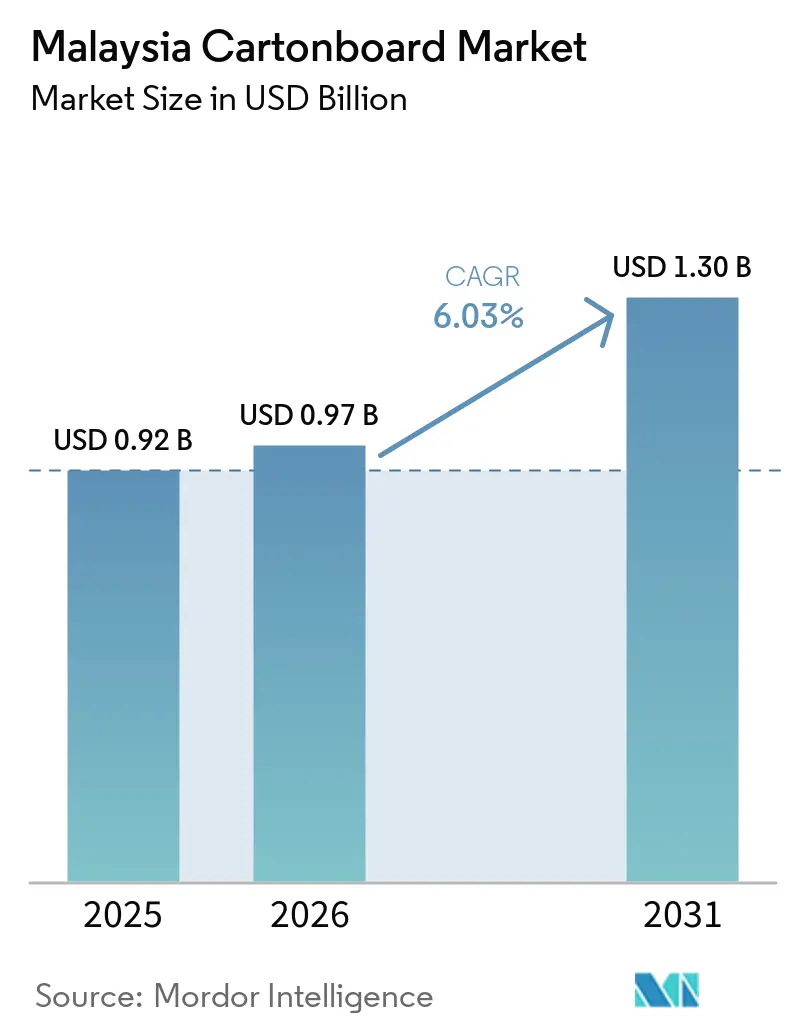
The Malaysia Cartonboard Market size is expected to grow from USD 0.92 billion in 2025 to USD 0.97 billion in 2026 and is forecast to reach USD 1.30 billion by 2031 at 6.03% CAGR over 2026-2031.
The Malaysia cartonboard market is being supported by a continued shift away from rigid plastic formats and by a deeper packaged food and e-commerce culture that keeps folding carton demand broad and steady. Sustainability has moved beyond brand positioning and now shapes procurement rules, converter planning cycles, and substrate selection across FMCG, foodservice, and pharmaceutical packaging. The Malaysia cartonboard market also benefits from the country’s role as a regional manufacturing base that connects domestic demand with export-oriented packaging requirements. This setting favors converters that can offer recyclable, EPR-ready, and specification-compliant board solutions without weakening cost or lead-time performance. Competitive behavior remains moderate, as multinational suppliers hold stronger positions in premium liquid cartons while domestic mid-scale converters compete intensely in folding cartons through customization, service, and efficiency.
Key Report Takeaways
- By product grade, folding boxboard held 38.13% of the Malaysia cartonboard market share in 2025, while solid bleached board is projected to expand at a 6.72% CAGR through 2031.
- By packaging format, folding cartons accounted for 48.41% of the Malaysia cartonboard market size in 2025, while liquid packaging is forecast to grow at a 6.34% CAGR through 2031.
- By end-user industry, food retained the largest share at 35.45% in 2025, while cosmetics and toiletries is expected to grow at a 6.51% CAGR through 2031.
Note: Market size and forecast figures in this report are generated using Mordor Intelligence’s proprietary estimation framework, updated with the latest available data and insights as of January 2026.
Malaysia Cartonboard Market Trends and Insights
Drivers Impact Analysis*
| Driver | (~) % Impact on CAGR Forecast | Geographic Relevance | Impact Timeline |
|---|---|---|---|
| Sustainability Shift Toward Recyclable Fiber Packaging | +1.3% | National, concentrated in Klang Valley and Penang industrial zones | Medium term (2-4 years) |
| Rising Packaged Food and On-the-Go Consumption | +1.1% | National, with early gains in Greater Kuala Lumpur, Johor Bahru, and Penang | Short term (≤ 2 years) |
| E-Commerce and Shelf-Ready Branding Demand | +0.9% | National, concentrated in Greater Kuala Lumpur and Selangor logistics corridors | Short term (≤ 2 years) |
| Healthcare and Pharmaceutical Packaging Localization | +0.6% | Selangor and Johor, spill-over to Penang biomedical cluster | Medium term (2-4 years) |
| Extended Producer Responsibility and Eco-Design Readiness | +0.5% | National | Medium term (2-4 years) |
| Plant-Based and Functional Beverage Innovation Lifts Liquid Carton Demand | +0.4% | Selangor, Klang Valley, with spill-over to East Malaysia food manufacturers | Long term (≥ 4 years) |
| Source: Mordor Intelligence | |||
Sustainability Shift Toward Recyclable Fiber Packaging
The sustainability shift toward recyclable fiber packaging is the strongest structural driver in the Malaysia cartonboard market. Fiber-based cartonboard has become the easiest substitute for single-use plastics across FMCG, foodservice, and retail because it fits current converting systems and established carton formats. Global brand owners operating in Malaysia have been redesigning packaging portfolios toward recyclable solutions since 2024, and those decisions are now flowing into formal procurement specifications. Malaysia’s Phase 1 EPR framework places cartons among the first 6 material streams, with voluntary implementation beginning in 2026 and mandatory compliance scheduled for 2030.[1] The Circular Economy Blueprint for Solid Waste in Malaysia 2025–2035 also reinforces eco-design and design-for-recyclability as upstream priorities, which gives converters a clearer regulatory direction. As a result, converters with FSC-certified sourcing, verifiable recyclability claims, and recognized eco-label credentials are moving into a stronger position in brand-owner tenders.[2]
Rising Packaged Food and On-the-Go Consumption
Rising packaged food and on-the-go consumption continues to widen the addressable base for the Malaysia cartonboard market. Urbanization, dual-income households, and fast delivery habits are supporting demand for shelf-ready and portable packaged food formats that rely heavily on folding boxboard and food service board. Food held 35.45% of market value in 2025, and that leadership reflects both the scale of daily consumption and the breadth of cartonboard specifications across cereal, snack, ready-to-eat, and dry goods categories. Demand is not driven by volume alone, because premiumization is pushing branded food producers to improve pack graphics and structural features that stand out on shelf. SKU growth in functional food, convenience meals, and snacks is also shortening average print runs, which shifts converter value toward flexible production and faster changeovers. This is separating the market between scale converters defending large recurring accounts and agile mid-market players capturing shorter-run premium work.
E-Commerce and Shelf-Ready Branding Demand
E-commerce and shelf-ready branding demand are giving the Malaysia cartonboard market another durable source of growth. The packaging requirement goes beyond higher box volumes, because online fulfillment needs packs that protect products, carry strong graphics, and hold print quality under variable storage conditions. Those same performance needs align closely with shelf-ready packaging used by hypermarkets and convenience chains that want faster replenishment at the store level. Folding boxboard and coated white-lined chipboard fit this overlap well, which makes omnichannel carton formats more valuable to brand owners serving both digital and physical retail. As retailers and marketplaces keep raising expectations for presentation and handling efficiency, converters are being pushed to combine structural design, print precision, and logistics awareness in one offer. That overlap strengthens demand for cartonboard solutions that can move from warehouse picking to retail display without a packaging redesign.
Healthcare and Pharmaceutical Packaging Localization
Healthcare and pharmaceutical packaging localization is expanding the premium end of the Malaysia cartonboard market. Malaysia is becoming a stronger healthcare manufacturing base in Southeast Asia, and that shift is lifting demand for pharmaceutical outer packaging that requires hygienic and high-whiteness board grades. Amcor opened an advanced healthcare packaging coating facility in Subang Jaya on April 24, 2026, with an investment of over USD 35 million and the region’s first air-knife coating technology for this application.[3] Oliver Healthcare Packaging opened its largest Asia-Pacific manufacturing facility in Johor in May 2025, with ISO 13485-compliant ISO-7 and ISO-8 cleanrooms that serve pharmaceutical and medical device customers across APAC.[4] These investments strengthen the case for co-located packaging supply, because healthcare manufacturers want shorter lead times and lower supply risk. Solid bleached board is the main beneficiary, as localization favors clean, compliant, and premium-looking substrates for pharmaceutical and healthcare cartons.
Pulp, Board, and Energy Cost Volatility
Pulp, board, and energy cost volatility remains the most immediate operating constraint in the Malaysia cartonboard market. Converters are dealing with higher uncertainty across raw materials, freight, and utilities at the same time, which makes pricing discipline harder to maintain. The Automatic Fuel Adjustment electricity tariff scheme took effect in July 2025 and tied electricity tariffs more closely to monthly fossil-fuel prices, reducing the predictability that converters previously relied on. This pressure is amplified by Malaysia’s dependence on imported virgin fiber and specialty board grades, where lead times and landed costs can shift quickly. Large converters have more room to manage these swings through contract structures and procurement planning, but smaller domestic players are less protected. The result is margin compression across the Malaysia cartonboard market, especially where brand-owner customers resist full pass-through of higher costs.
Recycled PET, Cans, and Refill Formats Limit Format Conversion
Recycled PET, cans, and refill formats limit how far format conversion can go in some of the Malaysia cartonboard market’s most attractive growth pockets. FE Green PET secured MYR 150 million, approximately USD 33.6 million, in green and sustainability-linked financing in October 2025 to expand its Melaka rPET resin plant to 50,000 tonnes per annum, which confirms that rPET capacity is still attracting meaningful capital in Malaysia. Coca-Cola Malaysia’s national rollout of 100% rPET 500 ml bottles in 2024 also showed that plastic circularity is being marketed as a visible packaging identity, not only as a backend sustainability metric. Refill models in personal care add another layer of competitive pressure, because they can reduce demand for any single-use primary format, including cartonboard. These formats do not remove cartonboard’s role in food, pharmaceuticals, and tobacco, but they do limit upside in beverages and cosmetics where converters hope to win more conversion. That makes the Malaysia cartonboard market more dependent on execution in core end uses, rather than on broad substitution from every adjacent packaging category.
*Our forecasts treat driver/restraint impacts as directional, not additive. The impact forecasts reflect baseline growth, mix effects, and variable interactions.
Segment Analysis
By Product Grade: Folding Boxboard Anchors Share, Solid Bleached Board Drives Premiumization
Folding boxboard held 38.13% of the Malaysia cartonboard market share in 2025, while solid bleached board is projected to grow at a 6.72% CAGR through 2026–2031. Folding boxboard remains the foundational grade in the Malaysia cartonboard industry, because it serves food, cosmetics, pharmaceutical, and tobacco applications with a balance of printability, strength, and cost efficiency. Its dominant position is hard to displace, since no other grade matches the same price-performance profile across the large print runs required by Malaysian FMCG packaging. Solid bleached board is growing faster because healthcare localization and beauty premiumization both favor hygienic, high-whiteness, and high-finish substrates.
Solid unbleached board serves heavier-duty industrial and premium food applications where structural strength matters more than surface appearance. White-lined chipboard stays relevant in more cost-sensitive tobacco, food, and household packaging, where acceptable print quality and recycled-content economics are both important. Liquid packaging board and food service board occupy narrower but important niches, with one tied to aseptic beverage development and the other tied to restaurant delivery and takeaway growth. Large food manufacturers also started to use FSC certification as a supplier approval factor in 2024–2025, which points to stricter grade-level sustainability screening as EPR compliance advances.

By End-User Industry: Food Sustains Leadership, Cosmetics And Toiletries Leads Growth
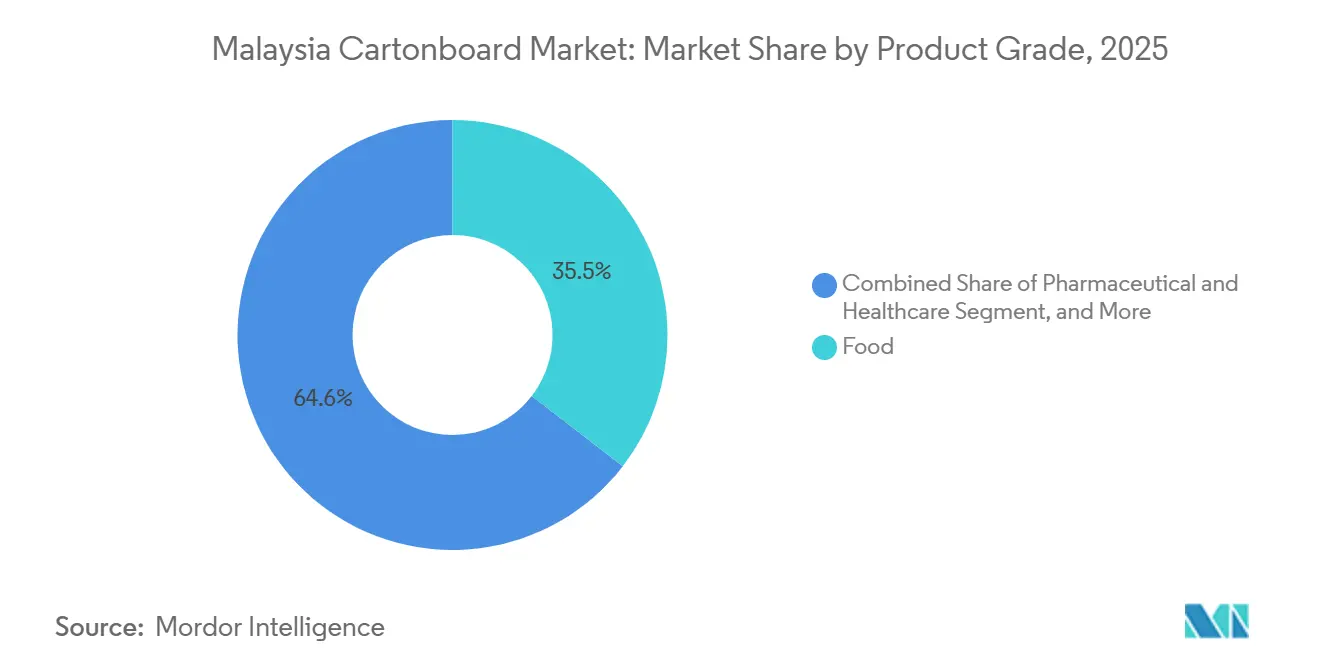
Food accounted for 35.45% of market value in 2025, while cosmetics and toiletries is expected to grow at a 6.51% CAGR through 2026–2031. Food leads because Malaysia has a broad FMCG base and because folding boxboard and food service board serve many staple categories, including cereal, snacks, ready-to-eat meals, and dry goods. Cosmetics and toiletries is growing faster as Malaysia strengthens its role as a regional launch base for international beauty brands and for domestic halal beauty labels targeting Southeast Asia. Pharmaceutical and healthcare demand is also strengthening, supported by medical device and related manufacturing investment that deepens local packaging requirements.
Beverage demand is closely linked to liquid packaging board growth, especially in dairy, juice, plant-based, and functional beverages that benefit from aseptic carton formats. Tobacco remains a meaningful end use, but regulation has reduced the value of premium print differentiation on pack surfaces. Malaysia’s packaging and labeling rules and the tobacco display ban that took effect in 2024 and 2025 limit brand visibility at retail and reduce the print complexity that carton converters once captured in this category. Other end users, including toys, apparel, automotive parts, household goods, and electrical products, continue to provide steady volume that moves with consumer sentiment and manufacturing export cycles.
Geography Analysis
Selangor and the Klang Valley corridor formed the dominant converting hub in the Malaysia cartonboard market in 2025. The area functions as the country’s logistics spine, which helps both liquid carton suppliers and folding carton converters serve Peninsular Malaysia with short lead times. Malaysia also holds a distinctive position in Southeast Asia because it combines relatively mature converting capability with multinational anchor presence and ongoing paper manufacturing investment. That combination makes the Malaysia cartonboard market more industrially developed than many mid-tier regional peers, even though it still depends on imported specialty and liquid carton board grades. Import reliance matters because exchange-rate swings and shipping disruptions can move landed board costs faster than domestic converters can fully reprice customer contracts.
Penang provides stable demand through its established electronics and life-sciences base, which supports outer packaging for medical devices, diagnostics, and pharmaceutical products. Johor is the fastest-growing sub-national cluster in the Malaysia cartonboard market, supported by healthcare and food manufacturing expansion linked to the Johor–Singapore Special Economic Zone. Oliver Healthcare Packaging’s large Johor facility strengthened that position in May 2025, while the state’s proximity to Singapore improves its appeal for integrated regional supply chains. Selangor’s role was further reinforced in April 2025 when Jingxing Holdings launched Phase 2 of its expansion in Banting with a MYR 1.9 billion, approximately USD 425.1 million, investment that added 600,000 metric tonnes of Kraft Liner capacity.
East Malaysia, including Sabah and Sarawak, remains a smaller cartonboard demand base and is still served largely through distribution links from Peninsular Malaysia. Its longer-term potential comes from resource-based food processing and tourism-linked foodservice demand, both of which can gradually widen the addressable base for cartons and food service board. The Malaysia cartonboard market is also influenced by regional liquid carton supply architecture, because material sourcing for aseptic formats is shaped by production hubs outside the country. That creates a mild concentration risk in liquid packaging supply, even as domestic converting and downstream demand continue to broaden.
Competitive Landscape
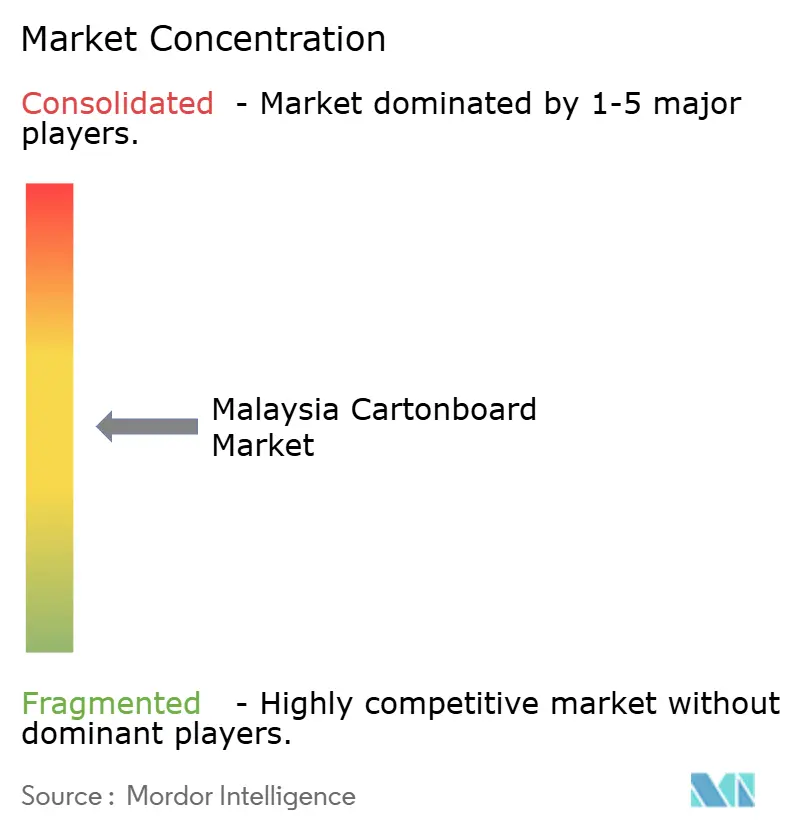
The Malaysia cartonboard market has a bifurcated competitive structure, with a concentrated premium tier in liquid cartons and specialty substrates, and a fragmented mid-market of local folding carton converters. Tetra Pak (Malaysia) Sdn Bhd and SIG Combibloc Malaysia Sdn Bhd hold strong positions in liquid packaging because installed filling equipment locks in long-term substrate relationships and raises switching costs for brand owners. That equipment-linked model gives the premium segment more defensible economics than the broader folding carton field. In contrast, domestic SME-scale converters compete more on turnaround, customization, and price, which keeps competitive pressure high across standard carton formats. This mix supports a moderate concentration profile for the Malaysia cartonboard market rather than a fully consolidated one.
Strategic investment is increasingly moving toward sustainability systems, cleaner substrate portfolios, and technical specialization. Vivar Printing Sdn Bhd’s 2025 agreement with SGS to adopt the SGS S-Carbon digital carbon management platform shows that larger domestic converters are turning emissions tracking and value-chain transparency into customer-facing differentiators. Amcor’s new healthcare coating facility in Selangor is another example of competitive positioning through technical capability, as it brings region-first coating technology closer to local medical packaging demand. These moves suggest that future share gains in the Malaysia cartonboard market will depend less on generic capacity and more on compliance, traceability, and specialized conversion performance.
Another competitive angle is local fiber innovation, where Nextgreen Global Bhd’s December 2025 joint venture with IOI Corp Bhd and Xiamen C&D Paper and Pulp Group Co. Ltd. points to a future domestic source of renewable pulp input for paperboard applications. Huhtamäki Oyj’s decision to close its Port Klang production site in 2024 while keeping distribution and sales operations in Malaysia also reflects how companies are reshaping footprints without leaving the Malaysia cartonboard market altogether. White space remains strongest where short-run digital printing, FSC-certified sourcing, and recyclable substrate claims are combined in one proposition. That is where the Malaysia cartonboard market is likely to reward converters that can meet tighter procurement standards while still serving faster product-launch cycles.
Malaysia Cartonboard Industry Leaders
-
Tetra Pak (Malaysia) Sdn Bhd
-
Huhtamäki Oyj
-
HPP Holdings Berhad
-
Paper Base Converting Sdn Bhd
-
SIG Combibloc Malaysia SDN. BHD.
- *Disclaimer: Major Players sorted in no particular order
Recent Industry Developments
- May 2026: Wasco Greenergy Bhd commissioned a biomass steam energy system at a pioneer paper manufacturing facility in Kajang, Selangor, fueled by treated empty fruit bunches and engineered to achieve a utilization rate of over 80%. The system directly reduces the facility’s reliance on conventional fuel and the national grid, supporting paper-sector energy cost stability under Malaysia’s new Automatic Fuel Adjustment tariff mechanism.
- April 2026: Amcor formally opened an advanced healthcare packaging coating facility in Subang Jaya, Selangor on April 24, 2026, an investment of over USD 35 million facilitated by MIDA, introducing air-knife coating technology to the region and making it the first site in Asia to manufacture both top and bottom substrates for sterile medical device packaging on a single campus. The facility strengthens Malaysia’s position as an integrated regional hub for healthcare packaging and expands demand for pharmaceutical-grade cartonboard substrates from co-located pharmaceutical manufacturers.
- April 2026: Pure Mylk and Tetra Pak launched The Mylky Way in Pulau Indah, Selangor, Southeast Asia’s first end-to-end innovation hub for plant-based beverages, in a ceremony officiated by Malaysia’s Deputy Minister of Science, Technology and Innovation on April 8, 2026. The hub provides R&D, pilot testing, and co-packing capabilities using Tetra Pak’s aseptic liquid carton technology, directly stimulating structural demand for liquid packaging board from local brand owners commercializing plant-based and functional beverages.
Malaysia Cartonboard Market Report Scope
The Malaysia Cartonboard Market encompasses the production, distribution, and application of cartonboard materials for packaging. Key product grades in the market include Solid Bleached Board, Solid Unbleached Board, Folding Boxboard, White-Lined Chipboard, Liquid Packaging Board, and Food Service Board. These grades are used across various packaging formats, including folding cartons, liquid packaging, sleeves, trays, cups, and foodservice containers. Due to their recyclability, printability, and sustainable packaging attributes, these cartonboard solutions are widely used across sectors such as food, beverage, pharmaceuticals, tobacco, cosmetics, and more.
The Malaysia Cartonboard Market is Segmented by Product Grade (Solid Bleached Board, Solid Unbleached Board, Folding Boxboard, White-Lined Chipboard, Liquid Packaging Board, and Food Service Board), Packaging Format (Folding Cartons, Liquid Packaging, Sleeve and Tray, and Other Packaging Formats), End-User Industry (Food, Beverage, Pharma and Healthcare, Tobacco, Cosmetics, and Other End-User Industries). The Market Forecasts are in Value (USD).
| Solid Bleached Board |
| Solid Unbleached Board |
| Folding Boxboard |
| White-Lined Chipboard |
| Liquid Packaging Board |
| Food Service Board |
| Folding Cartons |
| Liquid Packaging |
| Sleeve and Tray |
| Other Packaging Formats (Cups, Foodservice Containers) |
| Food |
| Beverage |
| Pharmaceutical and Healthcare |
| Tobacco |
| Cosmetics and Toiletries |
| Other End-User Industries (Toy, Apparel, Automotive, Household, Electrical, Foodservice) |
| By Product Grade | Solid Bleached Board |
| Solid Unbleached Board | |
| Folding Boxboard | |
| White-Lined Chipboard | |
| Liquid Packaging Board | |
| Food Service Board | |
| By Packaging Format | Folding Cartons |
| Liquid Packaging | |
| Sleeve and Tray | |
| Other Packaging Formats (Cups, Foodservice Containers) | |
| By End-User Industry | Food |
| Beverage | |
| Pharmaceutical and Healthcare | |
| Tobacco | |
| Cosmetics and Toiletries | |
| Other End-User Industries (Toy, Apparel, Automotive, Household, Electrical, Foodservice) |
Key Questions Answered in the Report
What is the 2026 size of the Malaysia cartonboard market?
The Malaysia cartonboard market stands at USD 0.97 billion in 2026 and is forecast to reach USD 1.30 billion by 2031 at a 6.03% CAGR.
Which product grade leads demand in Malaysia cartonboard?
Folding boxboard led with a 38.13% value share in 2025 because it serves food, cosmetics, pharmaceutical, and tobacco packaging with strong versatility.
Which carton format is growing fastest in Malaysia?
Liquid packaging is the fastest-growing format, with a 6.34% CAGR through 2031, supported by aseptic beverage development and the launch of The Mylky Way innovation hub.
Which end-user group is expanding the quickest?
Cosmetics and toiletries is the fastest-growing end-user segment, with a 6.51% CAGR through 2031, helped by beauty brand launches and premium packaging needs.
Why is Johor becoming more important for cartonboard demand?
Johor is emerging as the fastest-growing sub-national cluster because healthcare and food manufacturing are expanding there, supported by the Johor-Singapore Special Economic Zone and Oliver Healthcare Packaging’s facility.
What are the main risks for converters in Malaysia?
The key constraints are pulp, board, and energy cost volatility, along with rising competition from rPET, cans, and refill models in beverages and personal care.