
Magnesium Sulfate Market Size and Share
Market Overview
| Study Period | 2021 - 2031 |
|---|---|
| Market Size (2026) | USD 0.85 Billion |
| Market Size (2031) | USD 1.12 Billion |
| Growth Rate (2026 - 2031) | 5.76 % |
| Fastest Growing Market | Asia-Pacific |
| Largest Market | Asia-Pacific |
| Market Concentration | Low |
Major Players *Disclaimer: Major Players sorted in no particular order Image © Mordor Intelligence. Reuse requires attribution under CC BY 4.0. | |
Magnesium Sulfate Market Analysis by Mordor Intelligence
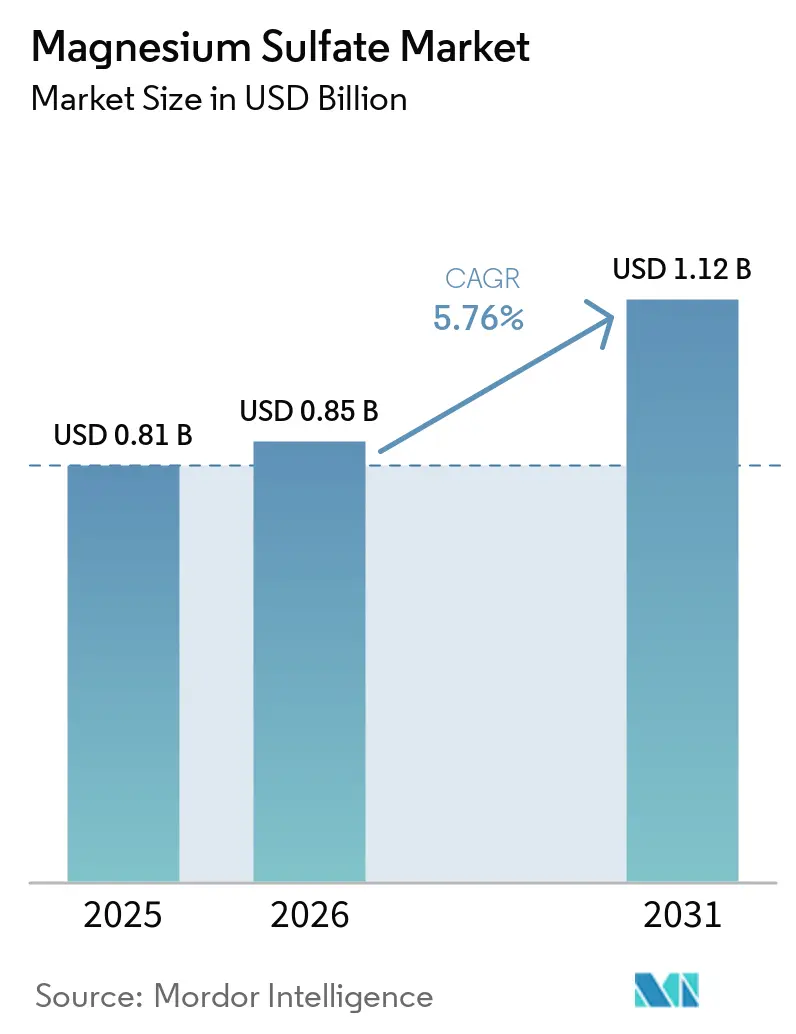
The Magnesium Sulfate Market was valued at USD 0.81 billion in 2025 and is estimated to grow from USD 0.85 billion in 2026 to reach USD 1.12 billion by 2031, at a CAGR of 5.76% during the forecast period (2026–2031). Magnesium sulfate provides magnesium and sulfur through one highly soluble input, which supports its use where both nutrients are depleted. Lower atmospheric sulfur deposition after stricter industrial-combustion controls has shifted sulfur replenishment toward purchased inputs in several farming regions. The magnesium sulfate market also benefits from higher-value healthcare uses and from controlled-environment farming systems that require soluble nutrient inputs. Competitive activity is therefore moving toward pharmaceutical grade capacity, reliable regional supply, and products designed for precision horticulture.
Key Report Takeaways
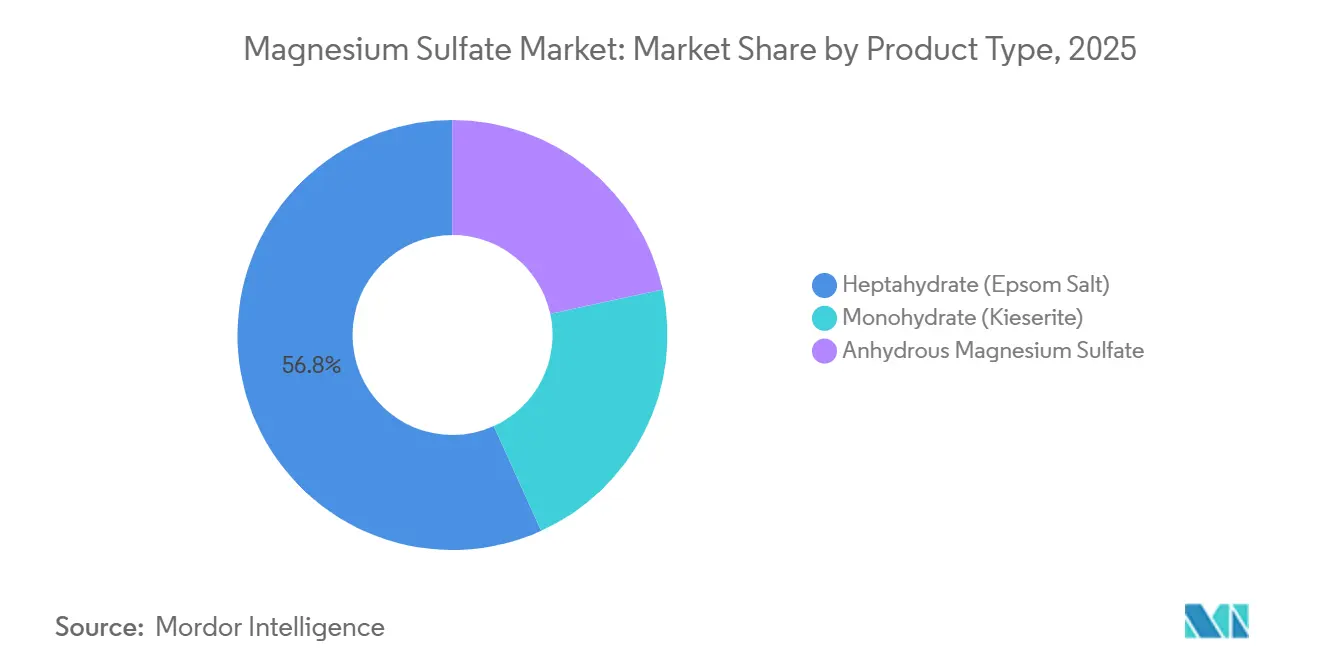
- By product type, Heptahydrate (Epsom salt) held 56.78% of the magnesium sulfate market share in 2025, while anhydrous magnesium sulfate is projected to grow at a 6.36% CAGR through 2031.
- By physical form, powder held 38.35% of the magnesium sulfate market share in 2025, while liquid solution is projected to grow at a 6.62% CAGR through 2031.
- By grade, agriculture grade held 41.67% of the magnesium sulfate market share in 2025, while pharmaceutical grade is projected to grow at a 7.05% CAGR through 2031.
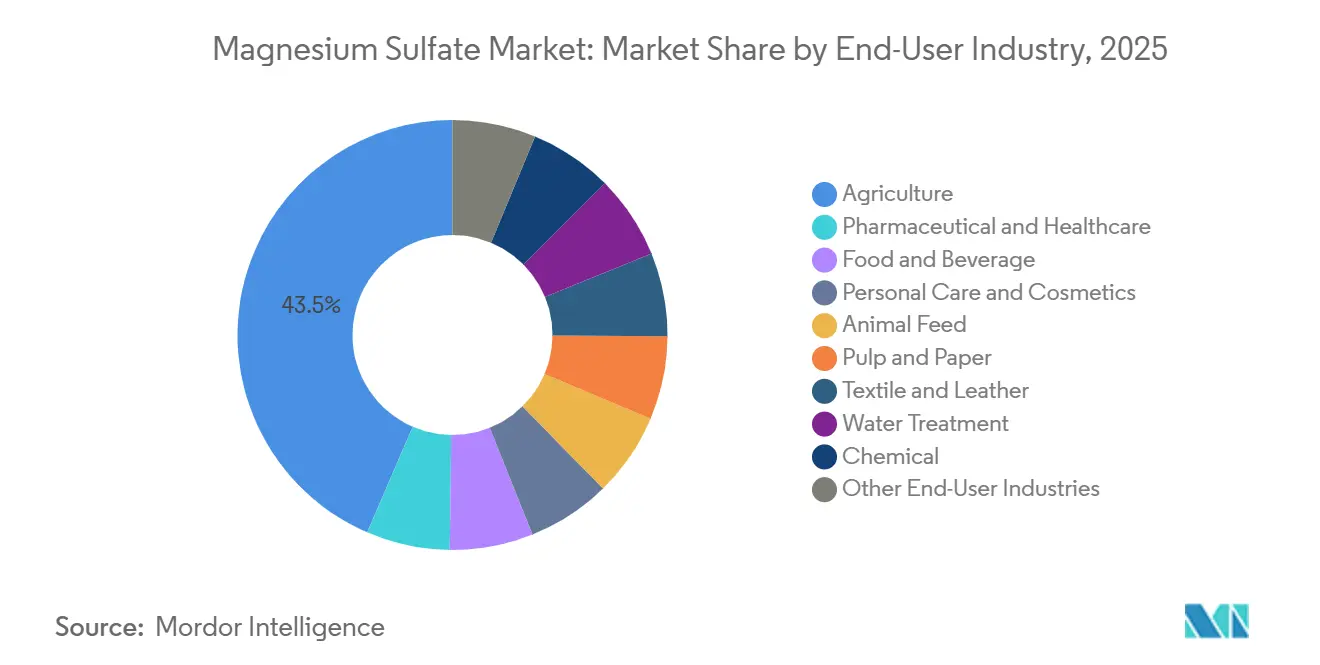
- By end-user industry, agriculture held 43.51% of the magnesium sulfate market share in 2025, while pharmaceutical and healthcare is projected to grow at a 7.17% CAGR through 2031.
- By geography, Asia-Pacific held 41.78% of the magnesium sulfate market share in 2025 and is projected to grow at a 6.87% CAGR through 2031.
Note: Market size and forecast figures in this report are generated using Mordor Intelligence’s proprietary estimation framework, updated with the latest available data and insights as of January 2026.
Global Magnesium Sulfate Market Trends and Insights
Drivers Impact Analysis*
| Driver | (~) % Impact on CAGR Forecast | Geographic Relevance | Impact Timeline |
|---|---|---|---|
| Soil Magnesium and Sulfur Depletion | +1.6% | Global; most acute in China, South Asia, Sub-Saharan Africa, and tropical South America | Long term (≥ 4 years) |
| Food Security and Higher Crop Productivity Requirements | +1.5% | Asia-Pacific, Sub-Saharan Africa, South America | Medium term (2–4 years) |
| Expansion of Pharmaceutical Magnesium Sulfate Use in Maternal Healthcare | +1.2% | Global; concentrated in Asia-Pacific, Sub-Saharan Africa, Latin America | Short term (≤ 2 years) |
| Crop-Specific Magnesium-Sulfur Formulation for Closed-Loop Horticulture | +0.7% | Netherlands, South Korea, Japan, China (greenhouse districts) | Medium term (2–4 years) |
| Pharmaceutical Grade Supply Localization for Emergency-Care Formulations | +0.5% | North America, Western Europe, East Africa | Short term (≤ 2 years) |
| Source: Mordor Intelligence | |||
Soil Magnesium and Sulfur Depletion
Intensive crop production removes magnesium and sulfur faster than natural cycles can restore them in many production systems. A 2025 review reported maize yield responses of 20% to 260% after sulfur application across Sub-Saharan African test sites, showing the severity of baseline sulfur deficiencies. Long-term potassium fertilizer use has also reduced root uptake of magnesium, creating a structural nutrient gap that current fertilizer spending only partly addresses. Acidic soils affect 40% to 50% of potentially cultivable land and can accelerate magnesium leaching in tropical and subtropical systems. Fruit, vegetable, and sugarcane production can intensify these nutrient losses because of repeated harvest cycles. The magnesium sulfate market benefits where growers need both nutrients in one soluble application rather than separate products.
Expansion of Pharmaceutical Magnesium Sulfate Use in Maternal Healthcare
Magnesium sulfate use in maternal medicine is expanding beyond established eclampsia treatment into protocols that increase dosage volumes per patient. A 2026 review stated that antenatal MgSO4 is recommended for fetal neuroprotection when preterm birth is imminent before 30 weeks of gestation. The review linked this use to a reduction in cerebral palsy incidence of nearly one-third. The National PreCePT Programme in England increased MgSO4 uptake for threatened preterm births and showed favorable cost-effectiveness, as cited in the same review. Piston Medical Limited launched Uganda’s first locally manufactured magnesium sulfate injection in July 2026 for an East African demand pool. Local production can increase pharmaceutical consumption in places that previously relied fully on imports.
Crop-Specific Magnesium-Sulfur Formulation for Closed-Loop Horticulture
Closed-loop hydroponic and aeroponic systems require fully water-soluble nutrients and precise control of ion levels. Soil does not buffer nutrient variation in recirculating systems, so each nutrient must be managed with sensors or dosing tools. A decision-tree-based, ion-specific dosing approach improved MgSO4 replenishment from drainage-solution readings in a published study. A 2025 validation of ion-selective electrode-guided management in closed-loop tomato systems reported 46% higher water productivity and 64% to 73% higher nitrogen-use efficiency than open soilless systems. Greenhouse expansion in the Netherlands, South Korea, and China supports demand for high-purity soluble products in the magnesium sulfate market. Liquid formats are relevant because they can be supplied through dedicated channels and are ready for dilution.
Pharmaceutical Grade Supply Localization for Emergency-Care Formulations
Reliable pharmaceutical grade supply has become an active policy issue in several major consuming regions. Magnesium sulfate IV bags have appeared repeatedly on U.S. drug shortage lists, prompting Angels for Change to support domestic 503B outsourcing facilities through Project PROTECT. STAQ Pharma completed preparation for magnesium sulfate IV-bag production in December 2025 under this program. The United States imported 53% of its magnesium sulfates from China during 2021 through 2024 and had net import reliance of 59% of apparent consumption in 2025[1]“Mineral Commodity Summaries 2026: Magnesium Compounds,” U.S. Geological Survey, usgs.gov. These conditions support domestic capacity for producers with Good Manufacturing Practice (GMP) certification and U.S. Drug Master File registrations. In this part of the magnesium sulfate market, supply reliability can matter more than price per kilogram.
Restraints Impact Analysis*
| Restraint | (~) % Impact on CAGR Forecast | Geographic Relevance | Impact Timeline |
|---|---|---|---|
| Stringent Pharmacopeial and Contaminant Specifications | -1.0% | Global (highest impact in North America, EU, Japan) | Short term (≤ 2 years) |
| Natural Mineral Quality Variability Across Deposits | -0.8% | China, Germany, India (primary mining regions) | Long term (≥ 4 years) |
| Compatibility and Precipitation Risk in Multi-Tank Fertigation Systems | -0.6% | Asia-Pacific, Middle-East (high-growth fertigation regions) | Medium term (2–4 years) |
| Source: Mordor Intelligence | |||
Stringent Pharmacopeial and Contaminant Specifications
Multi-pharmacopeia compliance limits the number of suppliers that can serve regulated pharmaceutical buyers. The United States Pharmacopeia (USP) monograph specifies 98.0% to 102.0% assay purity on an anhydrous basis, chloride below 0.014%, and strict limits for iron, selenium, and bacterial endotoxin in parenteral forms. These specifications require dedicated manufacturing lines, validated cleaning, and procedures that differ from agricultural grade production. Iron limits also differ between the USP and European Pharmacopoeia, requiring separate inventory, certificates of analysis, and use-specific labeling. The USP posted a notice to revise the monograph in May 2024, and the change became official in May 2025. Producers had to update validation documentation and analytical standards during a period of growing demand. The costs are especially difficult for emerging-market producers that want to move from agricultural to pharmaceutical grade.
Compatibility and Precipitation Risk in Multi-Tank Fertigation Systems
Magnesium sulfate is incompatible with calcium nitrate in concentrated stock solutions used for fertigation. Combining the two can form insoluble calcium sulfate and other precipitates that clog drip emitters, block injector nozzles, and reduce nutrient-delivery accuracy. Guidance from Michigan State University identifies this pairing as a common fertilizer compatibility problem. Multi-head and A-B tank systems solve the issue but require capital investment and operating skills that some smallholder and mid-scale farms lack. Haifa Group instructs users to prepare calcium and sulfate fertilizers in separate stock tanks, confirming that separation is a routine technical requirement. This limitation can restrict single-application use of the magnesium sulfate market in regions with limited advisory support.
*Our forecasts treat driver/restraint impacts as directional, not additive. The impact forecasts reflect baseline growth, mix effects, and variable interactions.
Segment Analysis
By Product Type: Heptahydrate Dominates Across a Wide Use Spectrum
Heptahydrate (Epsom salt) accounted for 56.78% of the magnesium sulfate market in 2025. The form remains widely used because it is stable under ambient conditions, dissolves fully in water, and serves agricultural, pharmaceutical, and personal care uses. Its 7 molecules of crystallization make it the reference product for specifications, pricing, and trade reporting. Monohydrate (Kieserite) is another product type supplied by K+S Aktiengesellschaft under the ESTA Kieserit brand from German underground deposits using dry electrostatic separation. The company positions it as a pH-neutral and immediately plant-available input for soil application.
Anhydrous magnesium sulfate is forecast to grow at a 6.36% CAGR through 2031. It is used as an industrial desiccant, a compounding ingredient for moisture-controlled pharmaceutical solid-dose formulations, and an active ingredient in electrolyte therapies. China imported 18,000 metric tons of high-purity anhydrous magnesium sulfate from Japan and Germany in 2025 and paid 2.3 times its domestic price because the suppliers offer precision crystallization and heavy-metal-removal capabilities. Global filings in MgSO4 process technology reached 247 in 2025, up 9% from the prior year, with activity in crystal-size control, heavy-metal removal, and soluble magnesium-salt preparation. These technical capabilities can support the magnesium sulfate industry in higher-specification pharmaceutical and horticulture applications.



By Physical Form: Liquid Solution Gains Ground in Precision Systems
Powder accounted for 38.35% of the magnesium sulfate market in 2025. It leads because it can be used in fertigation stock preparation, pharmaceutical compounding, and industrial processes. Its use is supported by compatibility with mechanized spreaders and compound-fertilizer blending. Crystals are used mainly in personal care, bath products, and food grade applications, where larger particle size and visual clarity support retail positioning.
Liquid solution is forecast to grow at a 6.62% CAGR through 2031, the fastest rate among physical forms. Demand comes mainly from commercial closed-loop horticulture in Europe, South Korea, and China, where systems need pre-dissolved magnesium and sulfate ions that are immediately available to plants. A liquid product can be delivered through a dedicated injector channel and diluted in-stream, reducing the precipitation risk associated with concentrated powder stock preparation. In published trials, closed-loop systems with ion-selective electrode monitoring achieved 46% higher water productivity than conventional open systems. This performance is being incorporated into procurement specifications at some commercial greenhouse operations in the magnesium sulfate market.
By Grade: Pharmaceutical Grade Premium Reshapes Market Economics
Agriculture grade held 41.67% of the magnesium sulfate market by grade in 2025. It is used in fertilizer manufacturing, direct soil application, and compound-fertilizer blending. Its typical specification of at least 99% MgSO4 does not carry endotoxin, heavy-metal, or bioburden restrictions, which keeps production costs manageable for commodity-scale manufacturers in China, India, and Mexico. Food grade serves tofu coagulation, beverage fortification, brewery-water adjustment, and infant-formula manufacturing. Feed grade supports ruminant and aquaculture supplementation, while industrial grade is used in textile dyeing, pulp and paper, and water treatment.
Pharmaceutical grade is forecast to grow at a 7.05% CAGR through 2031. USP, British Pharmacopoeia (BP), and European Pharmacopoeia (EP) requirements restrict the certified supplier base and limit commodity-price competition. The USP revision that became official in May 2025 required certified producers serving the U.S. market to revalidate testing protocols. Consumer grade includes Epsom salt bath products and magnesium-fortified wellness drinks that are gaining relevance in North American and European retail channels because magnesium sulfate has a neutral pH and high solubility. The grade structure creates a clear distinction between high-volume fertilizer demand and regulated applications with more demanding specifications.
By End-User Industry: Agriculture Anchors Revenue, Healthcare Accelerates Value
Agriculture held 43.51% of the magnesium sulfate market by end-user industry in 2025. Magnesium is central to chlorophyll synthesis, and sulfur supports amino-acid and protein formation. The Food and Agriculture Organization (FAO) identified cropland degradation as an ongoing constraint on yield potential across smallholder systems in Sub-Saharan Africa and South Asia. This supports the use of magnesium sulfate as a corrective nutrient input where soil health and food productivity intersect. Fertilizer manufacturing, direct soil application, and compound-fertilizer blending support broad agricultural use of powder, granules, and heptahydrate products.
Pharmaceutical and healthcare is forecast to expand at a 7.17% CAGR through 2031, the fastest rate among end-user industries. Maternal care, fetal neuroprotection, severe asthma management, and localization investment in the United States, Uganda, and South Asia support this growth. Food and beverage, personal care and cosmetics, and animal feed form a cluster of value-added uses with specifications that lift pricing above agricultural grade benchmarks. In textile and leather processing, magnesium sulfate acts as an electrolyte in reactive cotton dyeing, can improve dye exhaustion and color consistency, and can support textile-effluent decolorization, electroplating wastewater treatment, and anaerobic-digestion bioreactors. Pulp and paper and chemical uses remain stable, representing moderate applications within the magnesium sulfate industry.
Geography Analysis
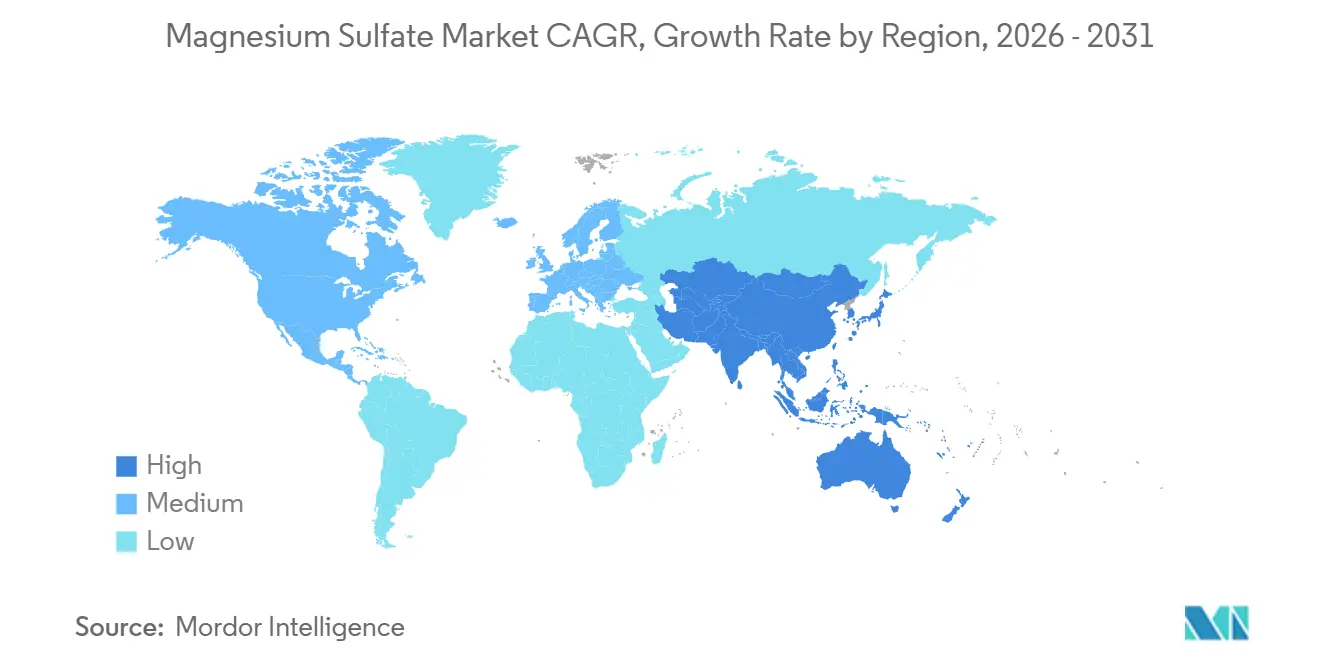
Asia-Pacific held 41.78% of the magnesium sulfate market share in 2025 and is forecast to grow at a 6.87% CAGR through 2031. In China, a soil assessment in Fujian Province found that 81.5% of tested plots were below the magnesium-sufficiency threshold of 120 mg/kg. Research also found magnesium deficiency across 55% of arable land in southern China. China’s soil-testing and formula-fertilization program has covered more than 1 billion mu (approximately 66.7 million hectares) of cultivated land and has incorporated magnesium sulfate into provincial secondary-nutrient recommendations.
North America and Europe represent the main premium grade demand centers for the magnesium sulfate market, although their supply positions differ. China supplied 53% of U.S. magnesium sulfate imports from 2021 to 2024, followed by Germany at 12%, India at 11%, and Mexico at 7%. North American benchmark prices reached USD 0.41 per kg in April 2026, 37% above Northeast Asian and European levels of USD 0.30 per kg. Europe is largely self-sufficient in specialty grades, and K+S Aktiengesellschaft states that its Werra 2060 project is designed to maintain the capacity to supply 100% of EU magnesium sulfate demand from Germany.
South American demand is concentrated in Brazil and Argentina, where soybean, corn, and sugarcane production on tropical soils supports ongoing magnesium and sulfur demand, and K+S Aktiengesellschaft expects Brazil to remain a growth area for potassium and magnesium fertilizers during its planning period. In the Middle-East and Africa, pharmaceutical demand is growing because of maternal health investment. Piston Medical Limited’s July 2026 launch of a locally manufactured injection for Uganda, Kenya, Tanzania, South Sudan, and the Democratic Republic of Congo shows the development of regional supply. Gulf Cooperation Council countries also form a distinct demand area for controlled-environment agriculture and precision-irrigated horticulture under food-security programs.

Competitive Landscape
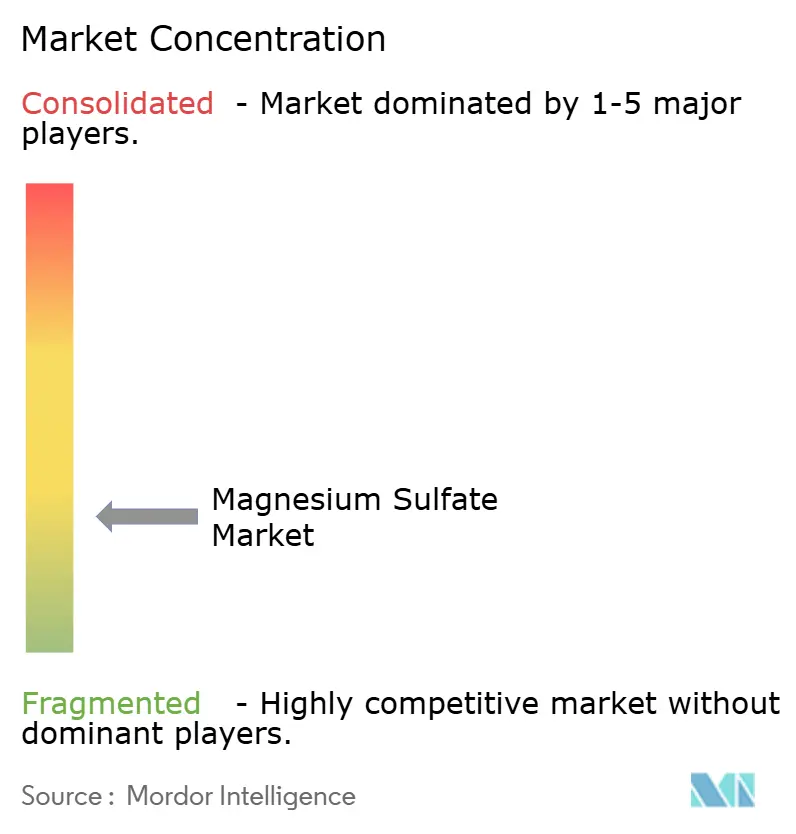
The magnesium sulfate market is highly fragmented, with the top five players including K+S Aktiengesellschaft, Premier Magnesia, LLC, Haifa Negev Technologies LTD, Laizhou City Laiyu Chemical CO., Ltd, and Weifang City Huakang Magnesium Sulphate Factory. Commodity heptahydrate overcapacity held agricultural grade gross margins at 15% to 18%, while pharmaceutical grade margins were 38% to 42%. This margin difference supports investment in specialty capacity and creates pressure on producers that remain in commodity production.
K+S Aktiengesellschaft launched its C:LIGHT range in May 2025, including ESTA Kieserit, with renewable energy used at its Werra plant[2]K+S Aktiengesellschaft, “Company Presentation September 2025,” K+S Aktiengesellschaft Investor Relations, kpluss.com. The range supports a low-carbon fertilizer position for regulated Western buyers. ICL identified specialty crop nutrition as one of its 2 primary growth engines in its 2025 annual report filed in March 2026. It cited geographic expansion and the acquisition of Bartek Ingredients as tools to support its strategy. Jost Chemical Co. and ACURO ORGANICS LIMITED serve niche pharmaceutical supply positions supported by U.S. Drug Master File registrations and GMP certifications.
The main openings are pharmaceutical grade supply in emerging markets and certified sustainable products for regulated buyers. Producers that improve crystallization precision and obtain third-party environmental audits can move toward pharmaceutical and precision-horticulture applications, where margins are 2 to 3 times higher than the commodity tier. ISO 9001, REACH, Halal, and Kosher certifications are increasingly important access conditions for export flows to Europe, the Gulf, and East Asia. These requirements favor producers that invest in quality systems and export readiness before demand develops.
Magnesium Sulfate Industry Leaders
K+S Aktiengesellschaft
Premier Magnesia, LLC
Haifa Negev technologies LTD
Laizhou City Laiyu Chemical CO.,Ltd
Weifang City Huakang Magnesium Sulphate Factory
- *Disclaimer: Major Players sorted in no particular order

Recent Industry Developments
- July 2026: Piston Medical Limited (Uganda) launched Pistomag, Uganda's first domestically manufactured magnesium sulfate injection for the treatment of preeclampsia and eclampsia. The launch reduced East Africa's dependence on imported pharmaceutical grade magnesium sulfate for this critical maternal healthcare application.
- May 2026: Lupin Limited received approval from the US FDA for its abbreviated new drug application for sodium sulfate, magnesium sulfate, and potassium chloride tablets. These tablets are indicated for colon cleansing as a preparation for colonoscopy in adults.


Global Magnesium Sulfate Market Report Scope
Magnesium sulfate is an inorganic compound widely used for its nutritional, therapeutic, and industrial properties across a broad range of applications. It is available in different hydrate forms and grades to meet the requirements of agriculture, pharmaceuticals, food processing, personal care, water treatment, and various industrial processes.
The Magnesium Sulfate Market is segmented by product type, physical form, grade, end-user industry, and geography. By product type, the market is segmented into heptahydrate (Epsom salt), monohydrate (kieserite), and anhydrous magnesium sulfate. By physical form, the market is segmented into crystals, powder, granules, and liquid solution. By grade, the market is segmented into agriculture grade, pharmaceutical grade, food grade, feed grade, industrial grade, and consumer grade. By end-user industry, the market is segmented into agriculture, pharmaceutical and healthcare, food and beverage, personal care and cosmetics, animal feed, pulp and paper, textile and leather, water treatment, chemical, and other end-user industries. The report also covers the market size and forecasts for magnesium sulfate in 16 countries across major regions. For each segment, the market sizing and forecasts have been done on the basis of value (USD).
| Heptahydrate (Epsom Salt) |
| Monohydrate (Kieserite) |
| Anhydrous Magnesium Sulfate |
| Crystals |
| Powder |
| Granules |
| Liquid Solution |
| Agriculture Grade |
| Pharmaceutical Grade |
| Food Grade |
| Feed Grade |
| Industrial Grade |
| Consumer Grade |
| Agriculture |
| Pharmaceutical and Healthcare |
| Food and Beverage |
| Personal Care and Cosmetics |
| Animal Feed |
| Pulp and Paper |
| Textile and Leather |
| Water Treatment |
| Chemical |
| Other End-User Industries |
| Asia-Pacific | China |
| India | |
| Japan | |
| South Korea | |
| ASEAN Countries | |
| Rest of Asia-Pacific | |
| North America | United States |
| Canada | |
| Mexico | |
| Europe | Germany |
| United Kingdom | |
| France | |
| Italy | |
| NORDIC Countries | |
| Russia | |
| Rest of Europe | |
| South America | Brazil |
| Argentina | |
| Rest of South America | |
| Middle-East and Africa | Saudi Arabia |
| South Africa | |
| Rest of Middle-East and Africa |
| By Product Type | Heptahydrate (Epsom Salt) | |
| Monohydrate (Kieserite) | ||
| Anhydrous Magnesium Sulfate | ||
| By Physical Form | Crystals | |
| Powder | ||
| Granules | ||
| Liquid Solution | ||
| By Grade | Agriculture Grade | |
| Pharmaceutical Grade | ||
| Food Grade | ||
| Feed Grade | ||
| Industrial Grade | ||
| Consumer Grade | ||
| By End-User Industry | Agriculture | |
| Pharmaceutical and Healthcare | ||
| Food and Beverage | ||
| Personal Care and Cosmetics | ||
| Animal Feed | ||
| Pulp and Paper | ||
| Textile and Leather | ||
| Water Treatment | ||
| Chemical | ||
| Other End-User Industries | ||
| By Geography | Asia-Pacific | China |
| India | ||
| Japan | ||
| South Korea | ||
| ASEAN Countries | ||
| Rest of Asia-Pacific | ||
| North America | United States | |
| Canada | ||
| Mexico | ||
| Europe | Germany | |
| United Kingdom | ||
| France | ||
| Italy | ||
| NORDIC Countries | ||
| Russia | ||
| Rest of Europe | ||
| South America | Brazil | |
| Argentina | ||
| Rest of South America | ||
| Middle-East and Africa | Saudi Arabia | |
| South Africa | ||
| Rest of Middle-East and Africa | ||


Key Questions Answered in the Report
What is the size of the magnesium sulfate market?
The magnesium sulfate market stands at USD 0.85 billion in 2026 and is forecast to reach USD 1.12 billion by 2031.
Which product type led demand in 2025?
Heptahydrate (Epsom Salt) led with a 56.78% share in 2025 because it supported agricultural, pharmaceutical, and personal care uses.
Which physical form is expected to grow fastest through 2031?
Liquid solution is forecast to grow at a 6.62% CAGR through 2031, supported by closed-loop horticulture systems.
Why is pharmaceutical grade magnesium sulfate expected to grow fastest through 2031?
Pharmaceutical grade is forecast to grow at a 7.05% CAGR through 2031 as maternal-health uses, stricter quality requirements, and regional supply efforts expand.
Page last updated on:





