
Machine Learning Medical Software Market Size and Share
Market Overview
| Study Period | 2020 - 2031 |
|---|---|
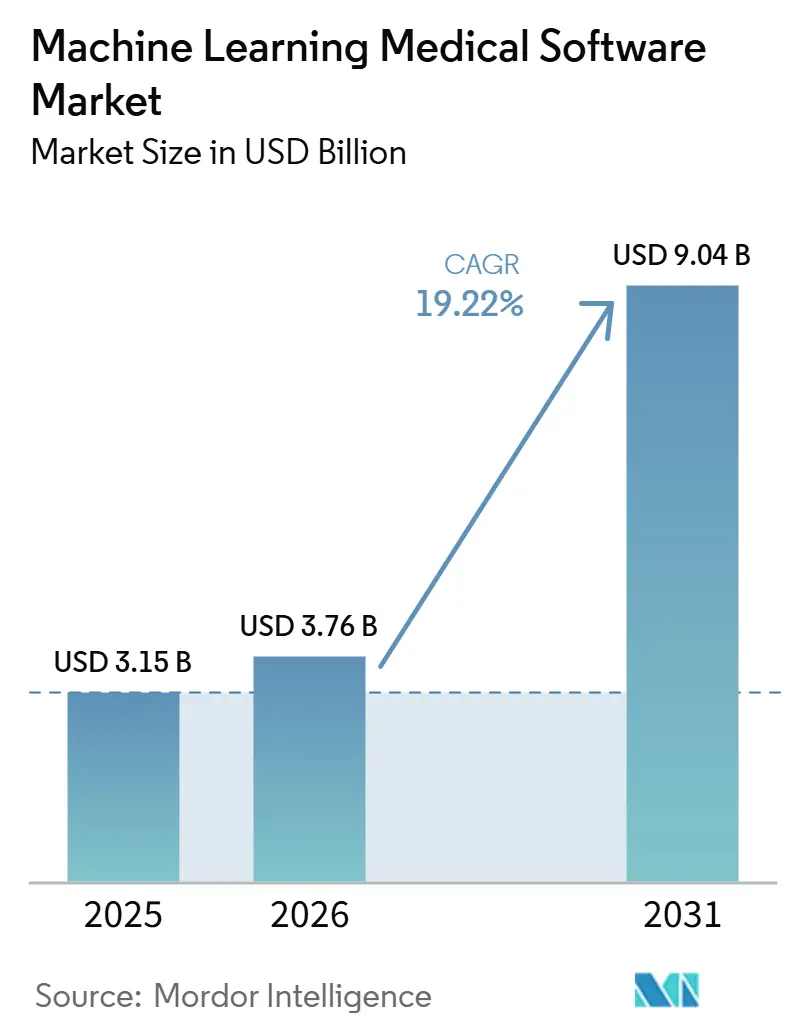
| Market Size (2026) | USD 3.76 Billion |
| Market Size (2031) | USD 9.04 Billion |
| Growth Rate (2026 - 2031) | 19.22 % |
| Fastest Growing Market | Asia-Pacific |
| Largest Market | North America |
| Market Concentration | Medium |
Major Players *Disclaimer: Major Players sorted in no particular order Image © Mordor Intelligence. Reuse requires attribution under CC BY 4.0. | |
Machine Learning Medical Software Market Analysis by Mordor Intelligence
The Machine Learning Medical Software Market size was valued at USD 3.15 billion in 2025 and is estimated to grow from USD 3.76 billion in 2026 to reach USD 9.04 billion by 2031, at a CAGR of 19.22% during the forecast period (2026-2031).
Growth is moving beyond isolated pilots as hospitals place software into documentation, diagnosis, monitoring, and treatment-planning workflows. The main commercial opportunity is shifting toward products that fit existing clinical systems and show a practical financial benefit for providers. Data governance, reimbursement, and regulatory readiness increasingly shape vendor selection, particularly for enterprise contracts. Large imaging vendors retain advantages in established hospital workflows, while specialized software providers compete in clinical decision support, monitoring, and specialty applications. The machine learning medical software market will also depend on whether providers can move successful pilots into governed, organization-wide deployments without increasing clinical or cybersecurity risk.
Key Report Takeaways
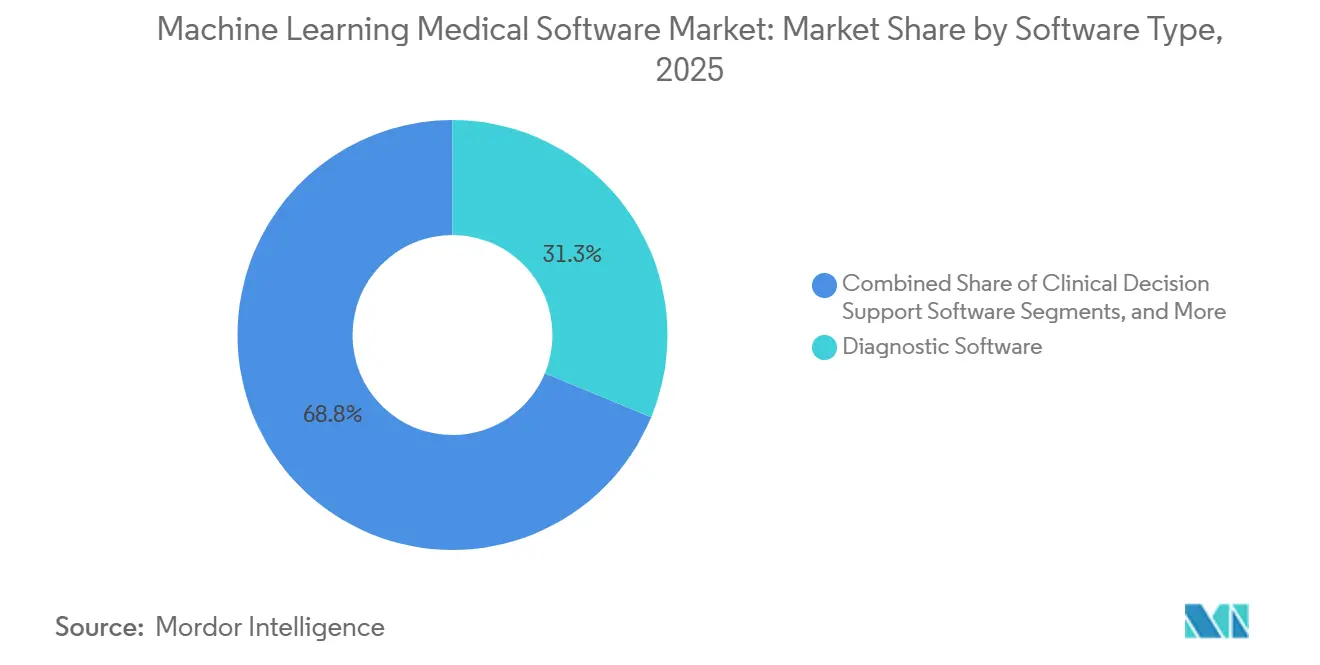
- By software type, diagnostic software led with 31.25% share in 2025, while monitoring and predictive analytics software is projected to grow at a 21.93% CAGR through 2031.
- By clinical specialty, radiology and medical imaging held 35.35% share in 2025, while neurology is projected to record a 22.67% CAGR through 2031.
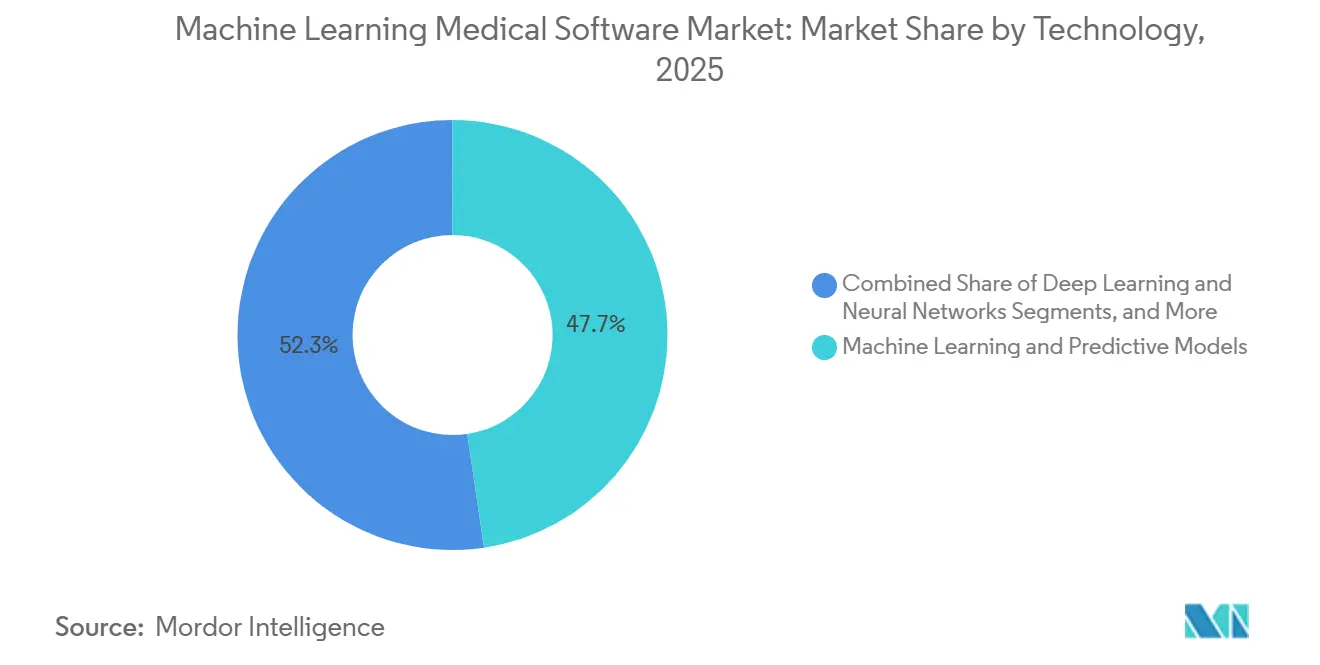
- By technology, machine learning and predictive models accounted for 47.66% share in 2025, while deep learning and neural networks is projected to expand at a 22.35% CAGR through 2031.
- By deployment, cloud-based deployment held 58.33% share in 2025, while hybrid and edge-enabled deployment is forecast to advance at a 23.45% CAGR through 2031.
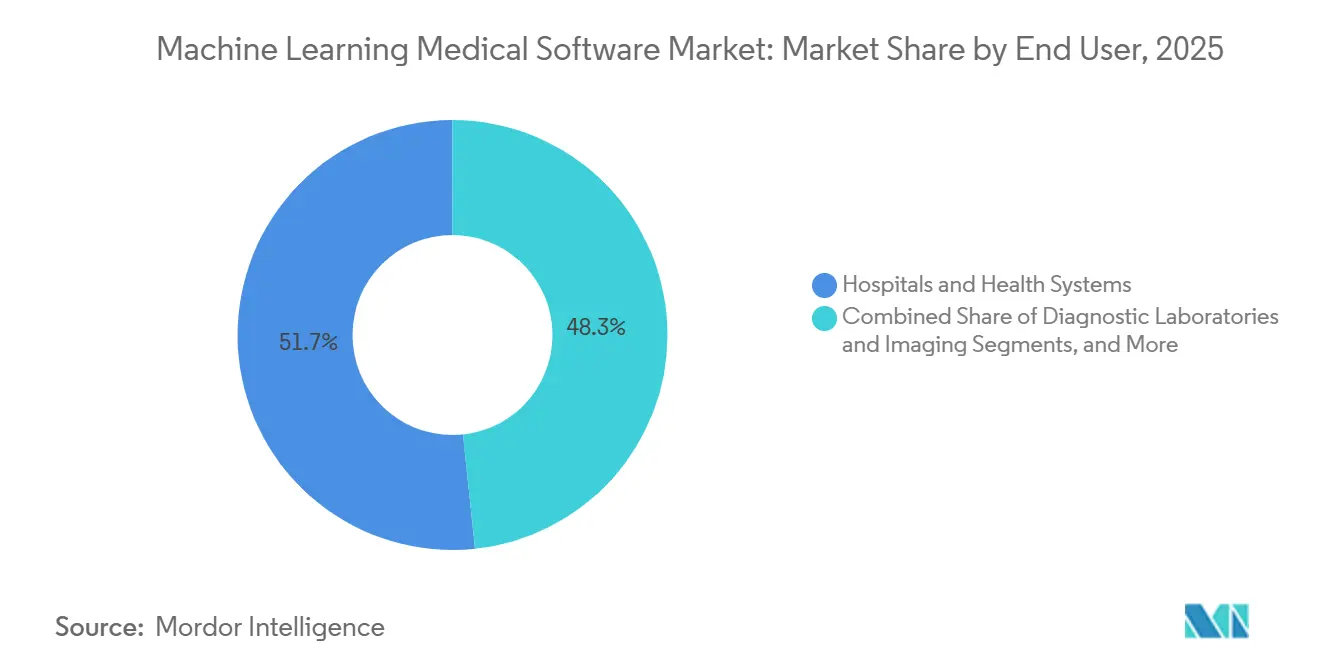
- By end user, hospitals and health systems accounted for 51.66% share in 2025, while diagnostic laboratories and imaging centers is projected to grow at a 20.95% CAGR through 2031.
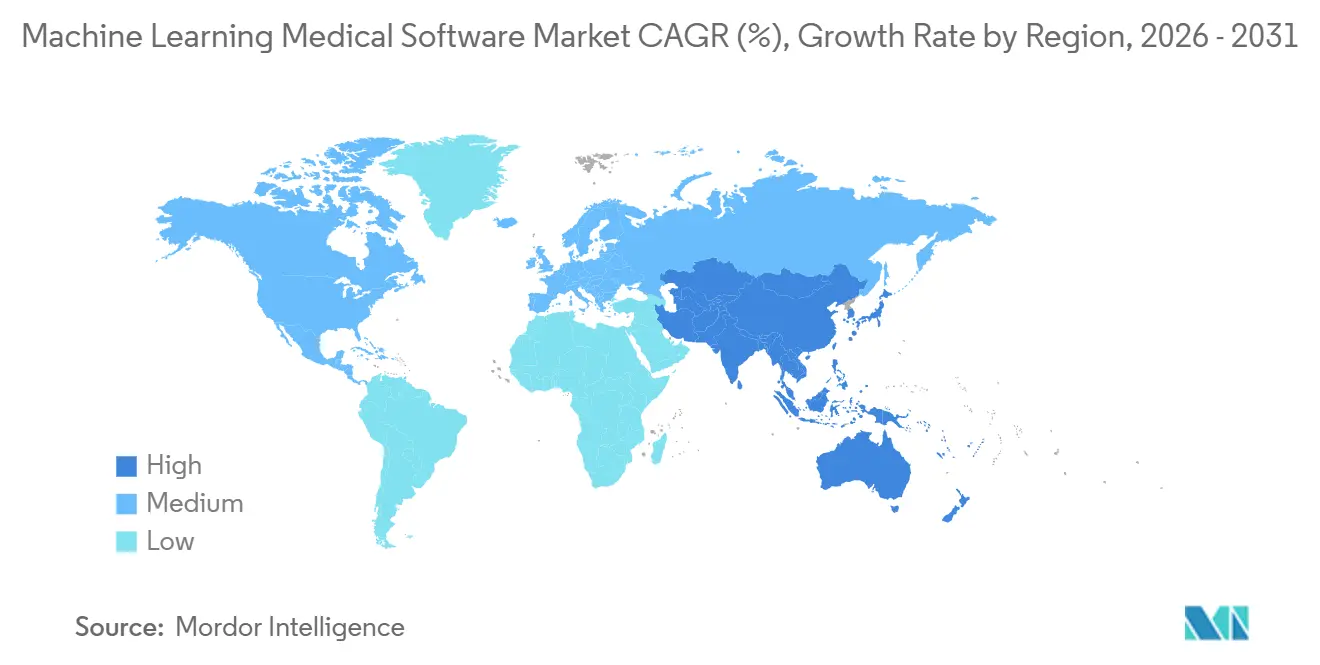
- By geography, North America led with 39.99% share in 2025, while Asia-Pacific is forecast to grow at a 21.77% CAGR through 2031.
Note: Market size and forecast figures in this report are generated using Mordor Intelligence’s proprietary estimation framework, updated with the latest available data and insights as of January 2026.
Market Trends and Insights
Drivers Impact Analysis of Machine Learning Medical Software Market*
| DRIVER | (~) % IMPACT ON CAGR FORECAST | GEOGRAPHIC RELEVANCE | IMPACT TIMELINE |
|---|---|---|---|
| Clinical workflow automation and documentation burden reduction | +3.2% | Global, led by North America and Europe | Short term (≤ 2 years) |
| Multimodal healthcare data expansion | +2.8% | Global | Medium term (2-4 years) |
| Shortage of clinicians and diagnostic specialists | +2.5% | Global, with acute impact in Asia-Pacific and South America | Medium term (2-4 years) |
| Regulatory and reimbursement maturation for AI-enabled SaMD | +3.5% | North America and Europe, with spillover to Asia-Pacific | Medium term (2-4 years) |
| AI-ready data infrastructure from hospital modernization | +2.1% | North America, Europe, and advanced Asia-Pacific markets | Medium term (2-4 years) |
| Narrow-workflow ai with faster evidence-to-deployment cycles | +1.8% | Global | Short term (≤ 2 years) |
| Source: Mordor Intelligence | |||
Clinical Workflow Automation and Documentation Burden Reduction
Administrative work continues to reduce clinician time for patient-facing activities, making documentation and workflow software an accessible entry point for the machine learning medical software market. Providers can deploy ambient documentation, clinical coding, and clinical documentation improvement tools within established electronic health record processes. These tools deliver clear value by reducing repetitive work while preserving clinician review and accountability. Adoption can become more durable when software captures structured feedback during routine encounters and supports defined governance processes.
Regulatory and Reimbursement Maturation for AI-Enabled SaMD
Clearer regulation and payment pathways help providers evaluate purchases in the machine learning medical software market more effectively. Vendors that document how they will monitor, update, and validate a model after launch are better positioned to meet procurement requirements. Quality systems have become a competitive requirement, as hospitals require evidence of change control, risk management, and accountability before large-scale deployment. This environment favors companies with resources to maintain regulatory files across several jurisdictions and raises market entry barriers for smaller developers with limited compliance capacity.
Shortage of Clinicians and Diagnostic Specialists
Staff shortages create demand for software that helps clinicians prioritize work and review more cases without replacing professional judgment. This need is especially visible in imaging, where clinical teams manage growing volumes while specialist capacity remains limited. AI triage, preliminary analysis, and monitoring tools can help hospitals route urgent cases to the appropriate specialist sooner. Aidoc states that its platform has analyzed more than 100 million patient cases across nearly 2,000 hospitals worldwide, demonstrating the practical scale of imaging workflow products.
Multimodal Healthcare Data Expansion
Healthcare providers now work with information from records, imaging, pathology, genomics, and connected monitoring devices. This broader information base supports software that combines data types rather than interpreting a single record or image. A July 2026 study in Nature Medicine reported that a health-system neuroimaging model had achieved 92.6% balanced accuracy in critical-findings triage and had exceeded general-purpose large language models by 21.4 percentage points on the same task. As providers seek integrated solutions, data depth and clinical validation are likely to matter more than model architecture alone.
Restraints Impact Analysis of Machine Learning Medical Software Market*
| RESTRAINT | (~) % IMPACT ON CAGR FORECAST | GEOGRAPHIC RELEVANCE | IMPACT TIMELINE |
|---|---|---|---|
| Cybersecurity, privacy, and data-integrity exposure | -2.3% | Global, particularly Europe and North America | Short term (≤ 2 years) |
| Clinical validation and generalizability across populations | -1.9% | Global | Medium term (2-4 years) |
| Model drift and silent performance decay after deployment | -1.4% | Global | Long term (≥ 4 years) |
| Liability allocation across vendor, provider, and clinician | -1.2% | North America and Europe | Medium term (2-4 years) |
| Source: Mordor Intelligence | |||
Cybersecurity, Privacy, and Data-Integrity Exposure
Clinical software that handles protected health information must secure data across model development, inference, storage, and system integration. These requirements can extend contracting and implementation timelines, as providers need clarity on data residency, access rights, model updates, and deletion obligations. A June 2026 paper in Scientific Reports found that healthcare AI cloud architectures required layered controls designed for clinical operations. Smaller vendors may find these requirements harder to meet across multiple regulatory jurisdictions. Model drift adds risk, as software performance can decline when patient populations, equipment, or clinical practices change. Organizations must clearly allocate liability among the vendor, provider, and clinician before deploying high-stakes tools more broadly.
Clinical Validation and Generalizability Across Populations
Hospitals increasingly assess software performance in their own clinical settings rather than relying solely on benchmark results. A 2025 study in npj Digital Medicine found that randomized clinical trials supported fewer than 2% of FDA-authorized AI and machine learning medical devices, while 46.1% of submissions included detailed performance-study information. This evidence gap can delay enterprise decisions when providers use software for diagnosis or treatment planning. Models trained at large academic centers may not perform consistently across different populations, equipment, care settings, or clinical practices. Providers may require local validation, independent review, and continuous monitoring before scaling a tool across their networks, increasing the time and cost required for broad deployment.
*Our forecasts treat driver/restraint impacts as directional, not additive. The impact forecasts reflect baseline growth, mix effects, and variable interactions.
Machine Learning Medical Software Market Segment Analysis
By Software Type:
Diagnostic Software Anchors Current Demand While Monitoring Tools Grow FasterDiagnostic Software held 31.25% of the machine learning medical software market in 2025, supported by strong use in imaging interpretation, pathology analysis, and laboratory evaluation. Labeled data, established review processes, and integration with hospital imaging systems support segment adoption. Providers assess these tools through familiar metrics, including reading time, triage effectiveness, and diagnostic workflow fit.
Monitoring and Predictive Analytics Software is forecast to expand at a CAGR of 21.93% through 2031, the highest rate in this segmentation. Demand comes from intensive care monitoring, deterioration alerts, sepsis prediction, and risk scores based on continuous patient data. Therapeutic and Treatment-Planning Software is gaining relevance in oncology and robotic surgery. GE HealthCare received FDA 510(k) clearance in June 2026 for MIM Contour ProtégéAI+ 2.0, adding MRI brain and updated CT pelvic models for radiation oncology planning. Workflow, Documentation, and Revenue-Cycle Software also remains relevant due to its role in administrative efficiency and financial operations.

By Clinical Specialty:
Radiology Holds the Largest Position While Neurology Gains MomentumRadiology and Medical Imaging accounted for a 35.35% share in 2025, supported by large annotated image datasets and mature picture archiving and communication systems. These factors help providers integrate algorithms into routine imaging workflows across the machine learning medical software market. The segment remains important for triage, image review, reporting support, and quality control.
Neurology is projected to record a CAGR of 22.67% through 2031, the fastest growth rate among clinical specialties. Growth opportunities include diagnostic aids, epilepsy monitoring, and neuroimaging analysis for specialist review. NeuroPace received FDA approval in May 2026 for ECoG Assistant, an AI-driven clinician feature built on 124,450 epileptologist-labeled intracranial EEG records. Abbott received FDA clearance and CE Mark in April 2026 for Ultreon 3.0, which combines real-time AI plaque assessment with guidance for coronary intervention.
By Technology:
Predictive Models Lead Today While Deep Learning Expands the Addressable Use CasesMachine Learning and Predictive Models captured a 47.66% share in 2025. Classical models support risk stratification, deterioration scores, documentation improvement, and revenue-cycle prediction across existing health system integrations. Their efficient processing, clear audit trails, and established installed base make them practical for governance-led adoption.
Deep Learning and Neural Networks is expected to grow at a CAGR of 22.35% through 2031. Foundation models can support multiple imaging tasks and reduce the need for separate models for each narrow use case. A 2026 npj Digital Medicine paper introduced Decipher-MR, a 3D MRI foundation model trained on more than 200,000 imaging series across different ages, body regions, and anatomical structures. Buyers are likely to prioritize validated data, workflow integration, and regulatory evidence over model type alone.
By Deployment:
Cloud Retains the Largest Share While Hybrid and Edge Options Meet New RequirementsCloud-Based deployment accounted for 58.33% of the machine learning medical software market size in 2025. Managed infrastructure, scalable computing, and links with cloud-oriented clinical systems support its position. Cloud delivery also reduces the local technology burden for providers and supports subscription-based access for smaller organizations.
Hybrid and Edge-Enabled deployment is forecast to grow at a CAGR of 23.45% through 2031. Providers use these models when data residency, local control, or low-latency processing is critical, especially in operating rooms, imaging departments, and high-security health settings. Medtronic unveiled Touch Surgery Aide in July 2026 as an operating-room computing platform for real-time AI inference, and its Instrument Exit Point application received FDA clearance for use with the Hugo robotic-assisted surgery system.
By End User:
Hospitals Lead Spending While Labs and Imaging Centers Expand Their UseHospitals and Health Systems held 51.66% of the machine learning medical software market size in 2025. Large acute-care organizations use multiple tools across decision support, documentation, imaging, and care coordination. Their technology resources, governance structures, and enterprise budgets support adoption across clinical workflows.
Diagnostic Laboratories and Imaging Centers is forecast to grow at a CAGR of 20.95% through 2031. Independent imaging networks use AI triage and preliminary reporting to manage higher study volumes without a similar increase in specialist staffing. Pharmaceutical and biotechnology companies use AI platforms for trial operations, biomarker discovery, and precision-medicine programs. Tempus announced a strategic collaboration with Merck that uses its multimodal data platform and workspace to support AI-driven precision medicine.
Geography Analysis
North America and LATAM Machine Learning Medical Software Market
North America accounted for 39.99% of the machine learning medical software market in 2025. The region benefited from strong hospital IT infrastructure, established imaging workflows, and health systems capable of purchasing enterprise software. The United States remained the primary demand center, with providers using AI in documentation, diagnostics, monitoring, and clinical operations. Canada offered a smaller opportunity, while Mexico and other Latin American markets remained at an earlier stage, driven by hospital modernization and diagnostic capacity.
Europe Machine Learning Medical Software Market
Europe held a meaningful position in the machine learning medical software market, supported by advanced hospital systems and strong clinical research networks in Germany, the United Kingdom, and France. Procurement decisions increasingly depended on privacy protections, technical documentation, and evidence of compliance with medical-device requirements. Italy and Spain added demand as hospital digitalization strengthened infrastructure. The region’s commercial pace depended on vendors’ ability to meet compliance requirements without slowing clinical implementation.
APAC and MEA Machine Learning Medical Software Market
Asia-Pacific is forecast to grow at a CAGR of 21.77% through 2031, the highest rate among geographic segments. Government programs, hospital modernization, and specialist shortages supported AI-assisted diagnostics and clinical decision tools. South Korea built a growing digital health ecosystem, while China remained important as public hospitals evaluated software for local workflow and data needs. India offered opportunities in private diagnostic networks, Singapore invested in national AI capabilities, and the Middle East and Africa remained earlier-stage markets led by Gulf health system investments.
Competitive Landscape
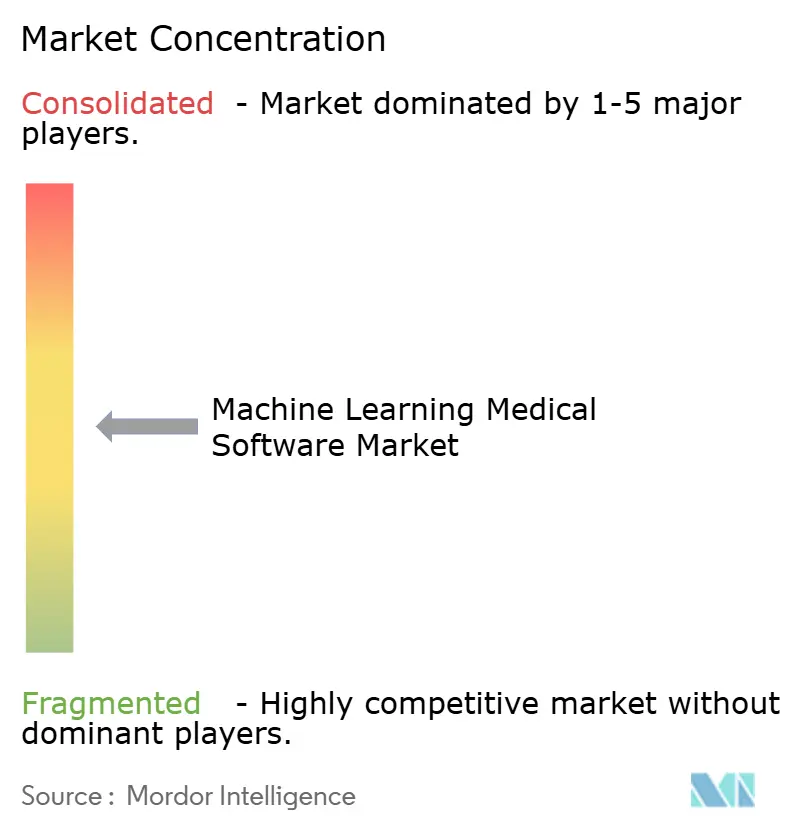
The machine learning medical software market is moderately concentrated in imaging AI, where GE HealthCare and Siemens Healthineers maintain broad product portfolios and strong relationships with hospital imaging systems. Their existing integrations create switching costs for providers using their clinical platforms. In clinical decision support, monitoring, and specialty software, competition remains more fragmented, as AI-native firms develop focused products and update them quickly. Providers favor suppliers that combine validated performance, secure integration, and practical implementation support.
Data platforms and partnerships are becoming important competitive tools in the machine learning medical software market. Tempus announced a USD 1.5 billion agreement in July 2026 to acquire Personalis, adding the NeXT Personal molecular residual disease test to its oncology platform, subject to shareholder and regulatory approval. The deal reflected the value of linking clinical, pathology, imaging, and molecular data in precision-oncology software. Aidoc received FDA Breakthrough Device Designation in June 2026 for First Read, a system designed to analyze chest radiographs and draft preliminary radiology report text.
Competitive barriers depend on the cost of validation, quality management, cybersecurity controls, and multi-country compliance. Established companies spread these costs across broader product portfolios, while smaller developers may need partnerships to achieve similar market access. Foundation-model capabilities may improve product breadth, but buyers will continue to assess performance reliability in their own settings. The machine learning medical software market is likely to remain active, as no single supplier leads across all clinical, technical, and deployment categories.
Machine Learning Medical Software Industry Leaders
-
GE HealthCare Technologies Inc.
-
Koninklijke Philips N.V.
-
Medtronic plc
-
Siemens Healthineers AG
-
Tempus AI, Inc.
- *Disclaimer: Major Players sorted in no particular order
Machine Learning Medical Software Market Companies Covered in this Report
- Abbott Laboratories
- Aidoc Medical Ltd.
- Alphabet Inc.
- Butterfly Network, Inc.
- GE HealthCare Technologies Inc.
- Guardant Health, Inc.
- HeartFlow, Inc.
- IBM
- Intuitive Surgical, Inc.
- IQVIA
- iRhythm Technologies
- Koninklijke Philips
- Medidata Solutions, Inc.
- Medtronic
- Microsoft
- Natera, Inc.
- NVIDIA
- Oracle
- PathAI, Inc.
- Qure.ai Technologies Private Limited
- Roche Holdings, Inc.
- Siemens Healthineers
- Stryker
- Tempus AI, Inc.
- Viz.ai, Inc.
Recent Industry Developments in Machine Learning Medical Software Market
- July 2026: Tempus AI announced a USD 1.5 billion agreement to acquire Personalis, aiming to integrate the NeXT Personal molecular residual disease test into its multimodal oncology machine learning platform, subject to shareholder and regulatory approvals.
- July 2026: Medidata launched Medidata Plus, an AI-native clinical trial platform that automated study design, generated synthetic patient data, and supported audit reviews through natural-language queries.
- July 2026: Medtronic unveiled Touch Surgery Aide, an AI-native surgical computing platform built on NVIDIA Holoscan for real-time intraoperative AI inference, with its Instrument Exit Point application receiving FDA clearance.
- July 2026: Raidium launched Raidium Read in the United States at Moffitt Cancer Center, applying AI-based whole-body lesion detection and segmentation models to oncology imaging workflows.
- June 2026: GE HealthCare received FDA 510(k) clearance for MIM Contour ProtégéAI+ 2.0, an AI-enabled auto-contouring software for radiation oncology treatment planning with expanded MRI brain and CT male pelvis models.
Global Machine Learning Medical Software Market Report Scope
As per the scope of the report, machine learning medical software refers to medical software that applies machine learning algorithms to analyze structured and unstructured healthcare data, identify complex patterns, make predictions, and support clinical decision-making. These solutions continuously or statically utilize trained computational models for applications such as disease detection, medical image analysis, patient risk prediction, remote patient monitoring, treatment optimization, and personalized medicine, improving the accuracy, efficiency, and consistency of healthcare delivery.
The machine learning medical software market is segmented by software type, clinical specialty, technology, deployment, end user, and geography. By software type, the market includes diagnostic software, therapeutic and treatment planning software, clinical decision support software, monitoring and predictive analytics software, and workflow, documentation, and revenue cycle software. By clinical specialty, the market is segmented into radiology and medical imaging, cardiology, oncology, neurology, pathology and laboratory medicine, ophthalmology, women’s health and obstetrics, emergency medicine and critical care, and other clinical specialties. By technology, the market is categorized into machine learning and predictive models, deep learning and neural networks, natural language processing, computer vision, generative AI and large language models, and others. By deployment, the market is segmented into cloud-based, on-premises, and hybrid and edge-enabled. By end user, the market is segmented into hospitals and health systems, ambulatory surgical centers and physician groups, diagnostic laboratories and imaging centers, pharmaceutical and biotechnology companies, and others. By geography, the market is analyzed across North America, Europe, Asia-Pacific, the Middle East and Africa, and South America. The report also covers the estimated market sizes and trends for 17 countries across major regions globally. The report offers the market sizes and forecasts in terms of value (USD) for the above segments.
Segmentation Overview
| Diagnostic Software |
| Therapeutic and Treatment-Planning Software |
| Clinical Decision Support Software |
| Monitoring and Predictive Analytics Software |
| Workflow, Documentation, and Revenue-Cycle Software |
| Radiology and Medical Imaging |
| Cardiology |
| Oncology |
| Neurology |
| Pathology and Laboratory Medicine |
| Ophthalmology |
| Women's Health and Obstetrics |
| Emergency Medicine and Critical Care |
| Other Clinical Specialties |
| Machine Learning and Predictive Models |
| Deep Learning and Neural Networks |
| Natural Language Processing |
| Computer Vision |
| Generative AI and Large Language Models |
| Others |
| Cloud-Based |
| On-Premises |
| Hybrid and Edge-Enabled |
| Hospitals and Health Systems |
| Ambulatory Surgical Centers and Physician Groups |
| Diagnostic Laboratories and Imaging Centers |
| Pharmaceutical and Biotechnology Companies |
| Others |
| North America | United States |
| Canada | |
| Mexico | |
| Europe | Germany |
| United Kingdom | |
| France | |
| Italy | |
| Spain | |
| Rest of Europe | |
| Asia-Pacific | China |
| India | |
| Japan | |
| Australia | |
| South Korea | |
| Rest of Asia-Pacific | |
| Middle East and Africa | GCC |
| South Africa | |
| Rest of Middle East and Africa | |
| South America | Brazil |
| Argentina | |
| Rest of South America |
| By Software Type | Diagnostic Software | |
| Therapeutic and Treatment-Planning Software | ||
| Clinical Decision Support Software | ||
| Monitoring and Predictive Analytics Software | ||
| Workflow, Documentation, and Revenue-Cycle Software | ||
| By Clinical Specialty | Radiology and Medical Imaging | |
| Cardiology | ||
| Oncology | ||
| Neurology | ||
| Pathology and Laboratory Medicine | ||
| Ophthalmology | ||
| Women's Health and Obstetrics | ||
| Emergency Medicine and Critical Care | ||
| Other Clinical Specialties | ||
| By Technology | Machine Learning and Predictive Models | |
| Deep Learning and Neural Networks | ||
| Natural Language Processing | ||
| Computer Vision | ||
| Generative AI and Large Language Models | ||
| Others | ||
| By Deployment | Cloud-Based | |
| On-Premises | ||
| Hybrid and Edge-Enabled | ||
| By End User | Hospitals and Health Systems | |
| Ambulatory Surgical Centers and Physician Groups | ||
| Diagnostic Laboratories and Imaging Centers | ||
| Pharmaceutical and Biotechnology Companies | ||
| Others | ||
| By Geography | North America | United States |
| Canada | ||
| Mexico | ||
| Europe | Germany | |
| United Kingdom | ||
| France | ||
| Italy | ||
| Spain | ||
| Rest of Europe | ||
| Asia-Pacific | China | |
| India | ||
| Japan | ||
| Australia | ||
| South Korea | ||
| Rest of Asia-Pacific | ||
| Middle East and Africa | GCC | |
| South Africa | ||
| Rest of Middle East and Africa | ||
| South America | Brazil | |
| Argentina | ||
| Rest of South America | ||
Key Questions Answered in the Report
What is the size of the machine learning medical software market?
The machine learning medical software market is valued at USD 3.76 billion in 2026 and is forecast to reach USD 9.04 billion by 2031 at a 19.22% CAGR.
Which software category has the largest share?
Diagnostic Software led software types with 31.25% share in 2025, supported by imaging, pathology, and laboratory evaluation use cases.
Which clinical specialty is expected to grow the fastest?
Neurology is forecast to expand at a 22.67% CAGR through 2031, supported by diagnostic aids and epilepsy-monitoring applications.
Why are hybrid and edge deployments growing quickly?
Hybrid and Edge-Enabled deployment is forecast to grow at 23.45% CAGR because providers need data control, low-latency processing, and local operational resilience.
Who are the main buyers of machine learning medical software?
Hospitals and Health Systems held 51.66% share in 2025, while diagnostic laboratories and imaging centers are the fastest-growing end-user group at a 20.95% CAGR.
What is the main barrier to wider adoption of clinical AI software?
Providers need robust clinical validation, cybersecurity safeguards, local performance evidence, and clear accountability before scaling software across clinical settings.