
Luxury Decorative Lighting Market Size and Share
Market Overview
| Study Period | 2021 - 2031 |
|---|---|
| Market Size (2026) | USD 9.74 Billion |
| Market Size (2031) | USD 12.62 Billion |
| Growth Rate (2026 - 2031) | 5.32 % |
| Fastest Growing Market | Asia-Pacific |
| Largest Market | North America |
| Market Concentration | Low |
Major Players *Disclaimer: Major Players sorted in no particular order Image © Mordor Intelligence. Reuse requires attribution under CC BY 4.0. | |
Luxury Decorative Lighting Market Analysis by Mordor Intelligence
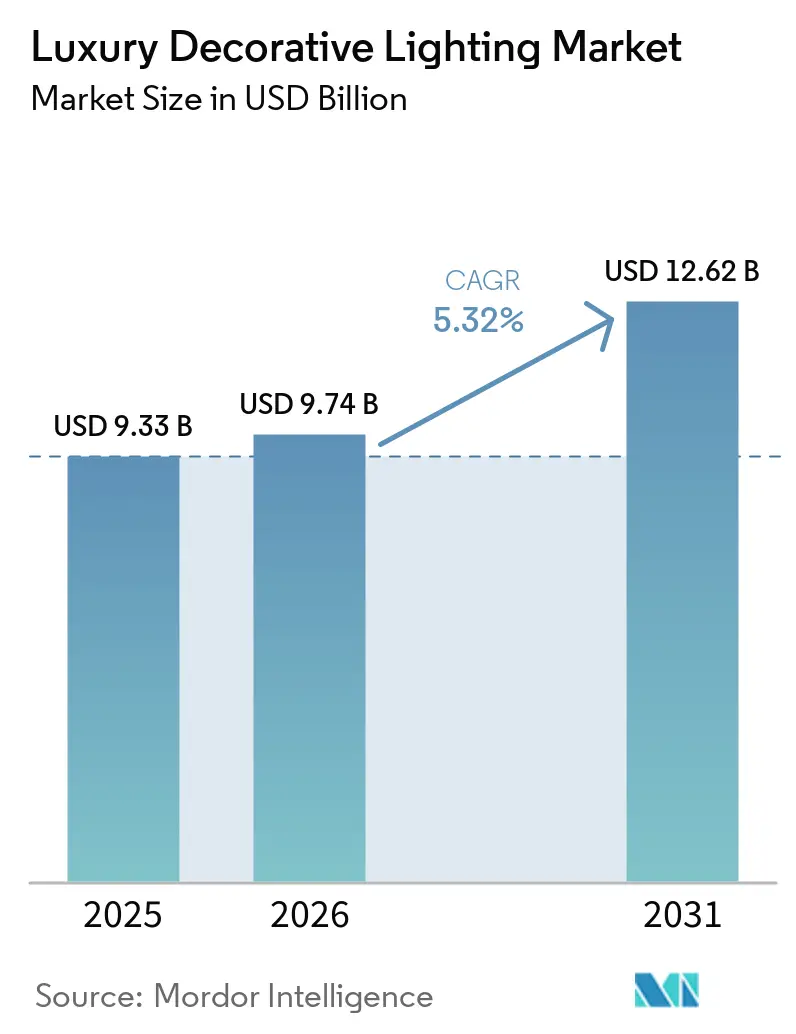
The luxury decorative lighting market size is expected to increase from USD 9.33 billion in 2025 to USD 9.74 billion in 2026 and reach USD 12.62 billion by 2031, growing at a CAGR of 5.3% over 2026-2031. The luxury decorative lighting market is supported by higher investment in affluent homes, hospitality projects, and lighting systems that can adjust color temperature and intensity. Property assets held by ultra-high-net-worth households rose from USD 2.61 trillion in 2020 to USD 3.04 trillion in 2025, while spending on homes by households with net worth above USD 5 million grew 18.5% faster than spending on personal luxury goods. This spending pattern favors products that combine visual appeal, longer useful life, and a clear place within a wider interior design plan. Commercial buyers are also moving toward project procurement, where hotel groups, designers, and architects specify fixtures earlier in the development cycle. The luxury decorative lighting market, therefore, depends not only on household purchases but also on the ability of brands to serve hospitality and branded-residence projects with reliable design, technical support, and installation capability.
Key Report Takeaways
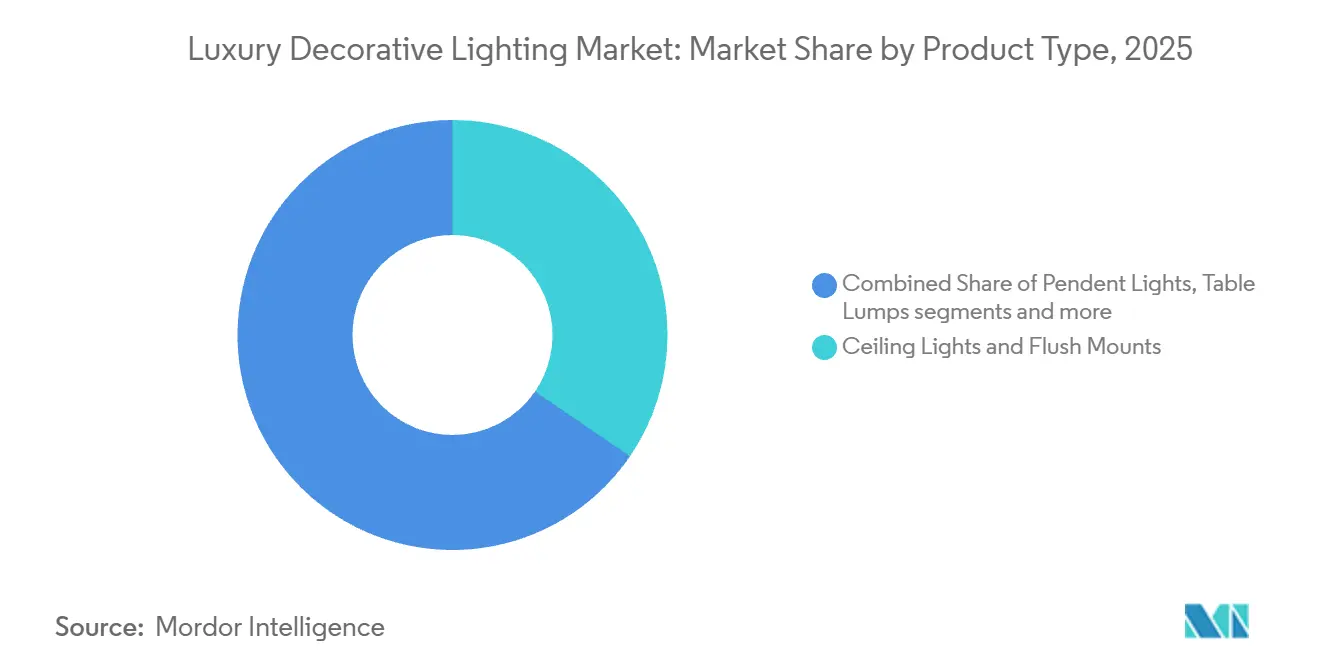
- By product type, Ceiling Lights and Flush Mounts held 34.54% share in 2025, while Outdoor and Landscape Decorative Lighting is forecast to expand at a 6.1% CAGR through 2031.
- By light source, LED held 71.12% share in 2025 and is forecast to expand at a 6.4% CAGR through 2031.
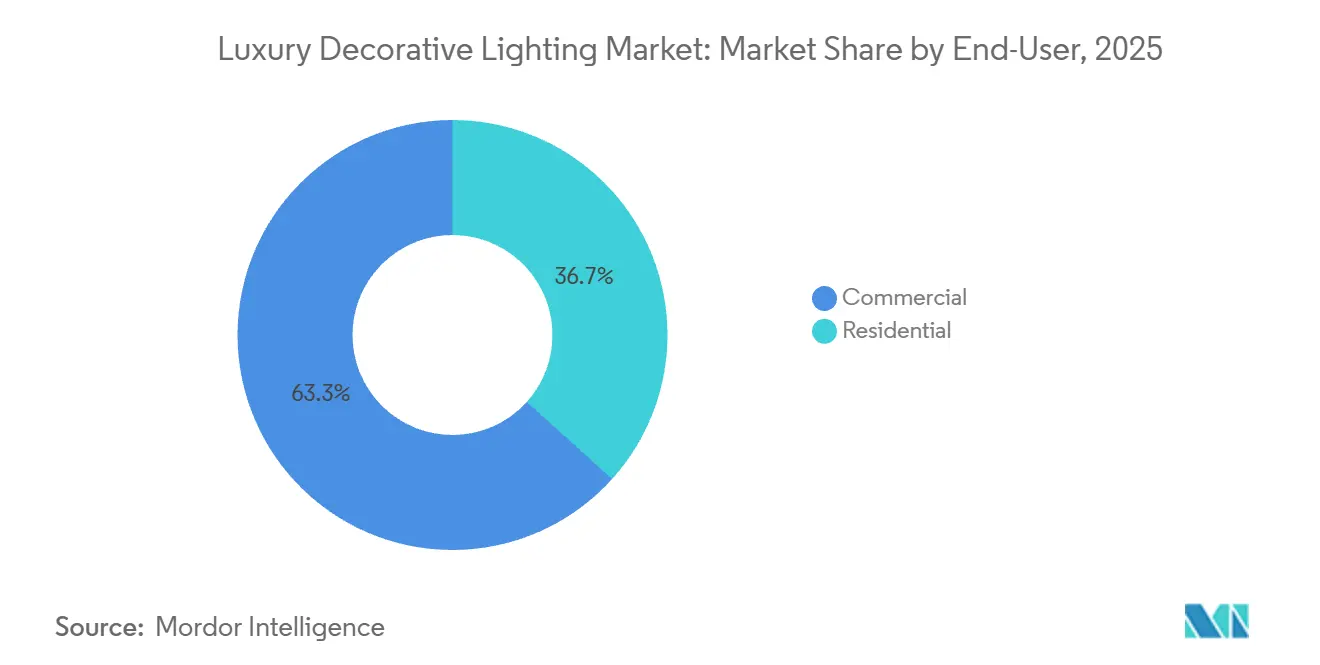
- By end-user, Commercial held 63.32% share in 2025 and is forecast to expand at a 5.8% CAGR through 2031.
- By distribution channel, B2C/Retail Channels held 64.24% share in 2025, while B2B/Direct Sales and Projects is forecast to expand at a 5.9% CAGR through 2031.
- By geography, North America held 38.11% share in 2025, while Asia-Pacific is forecast to expand at a 5.7% CAGR through 2031.
Note: Market size and forecast figures in this report are generated using Mordor Intelligence’s proprietary estimation framework, updated with the latest available data and insights as of January 2026.
Global Luxury Decorative Lighting Market Trends and Insights
Drivers Impact Analysis*
| Driver | (~) % Impact on CAGR Forecast | Geographic Relevance | Impact Timeline |
|---|---|---|---|
| Premiumization of Residential and Hospitality Interiors | +1.4% | Global, North America and Europe lead residential demand, while MEA and Asia-Pacific lead hospitality demand | Medium term (2-4 years) |
| Luxury Hospitality and Branded-Residence Expansion | +1.2% | Asia-Pacific, Middle East and Africa, North America | Medium term (2-4 years) |
| Smart, Tunable and Human-Centric Lighting Integration | +1.0% | Global, North America and the European Union | Long term (≥ 4 years) |
| Designer-Led Renovation and Replacement Cycles | +0.5% | North America and Europe | Short term (≤ 2 years) |
| Bespoke Lighting as an Experiential Brand Asset | +0.6% | Global, Middle East and Africa luxury hospitality and European Union design hubs | Long term (≥ 4 years) |
| Luxury Cruise, Yacht and Private Aviation Fit-Outs | +0.3% | Global, European manufacturing clusters | Short term (≤ 2 years) |
| Source: Mordor Intelligence | |||
Premiumization of Residential and Hospitality Interiors
The luxury decorative lighting market benefits as wealthy households allocate a greater share of their spending to their homes. Ultra-high-net-worth property assets increased from USD 2.61 trillion in 2020 to USD 3.04 trillion in 2025. Households with a net worth above USD 5 million increased home-related expenditure 18.5% faster than spending on personal luxury goods. In high-value renovation projects, lighting has evolved from a final decorative purchase into an early design specification, supporting demand for fixtures that combine functional illumination with a distinctive visual identity. The 2026 Houzz & Home Study found that the top 10% of the United States renovators had a median spending of USD 150,000 in 2025, compared with USD 140,000 in 2024[1]. It also reported that 54% of the United States homeowners renovated their homes in 2025. These projects increase the value of individual lighting orders, as high-budget homeowners favor large ceiling fixtures, custom pendants, and coordinated wall lighting. This trend strengthens demand for design-led brands and supports repeat replacement cycles as homeowners update interiors to maintain a property’s design standard.
Luxury Hospitality and Branded-Residence Expansion
Hotel and branded-residence construction creates defined procurement opportunities for the luxury decorative lighting market. The branded-residence sector exceeded 700 operational properties globally in 2025, with a similar number under development[2]. Supply in this format was projected to double by 2030. These developments require lighting for public spaces, suites, restaurants, corridors, and exterior areas. Buyers commonly assess fixture durability, maintenance access, control compatibility, and visual fit at the same time. This makes hospitality lighting a larger and more complex order than most residential purchases. Asia-Pacific excluding China had 2,506 hotel projects and 452,972 rooms in its pipeline in Q2 2026, up 17% year over year by projects[3]. Luxury projects reached a record 432 developments. India accounted for 1,033 projects and 137,601 rooms, representing year-over-year increases of 36% in projects and 39% in rooms. A 300-room luxury hotel can specify more than 5,000 luminaires across different areas. The pipeline can therefore sustain the luxury decorative lighting market even when individual consumer purchases become less predictable.
Smart, Tunable and Human-Centric Lighting Integration
Human-centric lighting is becoming more important in premium commercial interiors. The WELL Building Standard v2 includes requirements for circadian lighting design in certified spaces. Its lighting criteria include melanopic equivalent daylight illuminance thresholds of 136 mEDI at one level and 250 mEDI at a higher level. These standards encourage tunable-white LED systems that can change output during the day. They also give project teams a recognized framework for discussing lighting quality with owners and procurement teams. In the luxury decorative lighting market, technical performance can therefore support higher fixture prices when it is integrated without detracting from the product’s form. DALI-2 DT8 under IEC 62386-209 allows dual-channel control through a single device address. This capability can simplify commissioning for larger human-centric installations. Hospitality operators can use these attributes when assessing wellness-oriented projects. The opportunity is strongest where brands can combine controls, light quality, and a decorative product without making the technology visually dominant. It can extend from North America and Northern Europe into high-value hospitality development in the Asia-Pacific.
Designer-Led Renovation and Replacement Cycles
Architect-led renovation remains an important source of demand in North America and Europe. Higher-spending homeowners often renovate multiple rooms at once, which creates a need for coordinated decorative and ambient lighting. The USD 150,000 median spend among the top 10% of the United States renovators in 2025 indicates the financial capacity for this type of specification. Replacement decisions are influenced by changing layouts, upgraded controls, and demand for more efficient light sources. They also arise when owners want a recognizable design feature in a kitchen, entrance, dining space, or outdoor area. The luxury decorative lighting market benefits when suppliers offer technical guidance alongside finishes and styling options. Designer involvement can shift demand from standalone fixtures toward coordinated systems. Ceiling installations, sconces, table lamps, and exterior lighting can then be chosen as part of a single interior plan. This approach favors brands with wide collections and strong relationships with the design trade. It also supports specialty stores where customers can compare materials, dimensions, and light effects before purchasing.
Restraints Impact Analysis*
| Restraint | (~) % Impact on CAGR Forecast | Geographic Relevance | Impact Timeline |
|---|---|---|---|
| High Material, Craftsmanship and Installation Costs | -0.8% | Global, most acute in North America and MEA project markets | Short term (≤ 2 years) |
| Long Project Lead Times and Skilled-Artisan Constraints | -0.4% | Europe and global bespoke projects | Medium term (2-4 years) |
| Counterfeit Products and Premium-Brand Price Erosion | -0.5% | Global, with effects in North America and the EU | Short term (≤ 2 years) |
| Component Traceability and Repairability Gaps in Bespoke Fixtures | -0.2% | Global, primarily high-end residential and heritage hospitality | Long term (≥ 4 years) |
| Source: Mordor Intelligence | |||
High Material, Craftsmanship and Installation Costs
Material and installation costs constrain some purchases in the luxury decorative lighting market. Brass, hand-blown Murano glass, crystal, and specialty polymers need skilled processing and careful transport. Tunable systems also require electricians who can commission DALI-2 controls correctly. These costs can compound on hospitality and residential projects that use custom fixtures across many spaces. Ultra-premium customers may accept these expenses as part of the design brief. Mid-luxury operators face more pressure to reduce scope or replace bespoke products with simpler alternatives. The supply of specialist craft workers presents a longer-running constraint. Murano glassblowing schools are training fewer apprentices than the number of experienced workers retiring. European heritage brands cannot easily move this work offshore without losing material provenance and design credibility.
Counterfeit Products and Premium-Brand Price Erosion
Counterfeit lighting products can damage the price and brand signals that support luxury positioning. Chongqing public security authorities arrested 47 suspects and seized more than 90,000 sets of counterfeit branded fixtures and more than 280,000 sets of counterfeit trademarks in an enforcement operation[4]. The scale of the seizure shows why online channels require a stronger review of product provenance. Copycat goods can appear beside authentic products and confuse buyers who use digital channels for initial research. This is particularly damaging when a lighting brand depends on distinctive forms, materials, and long-standing design authorship. It can also weaken customer confidence in the quality and safety of products offered under a familiar name. Legal action remains one response to this issue. Barn Light Electric Company obtained a preliminary injunction against a counterfeit domain in 2025, and Restoration Hardware filed a trademark and copyright case against a network of lighting sellers in 2024. Legal protection needs to be paired with clearer authorized-distributor networks and better product authentication.
*Our forecasts treat driver/restraint impacts as directional, not additive. The impact forecasts reflect baseline growth, mix effects, and variable interactions.
Segment Analysis
By Product Type, Ceiling Fixtures Lead While Outdoor Lighting Grows Faster
Ceiling Lights and Flush Mounts held 34.54% of the luxury decorative lighting market share in 2025. Their central role as an ambient light source supports demand in both homes and commercial interiors. Larger diffusers, linear suspension arrays, and custom coffered systems can raise order values beyond those of standard ceiling products. Pendant Lights are common in restaurants, food and beverage spaces, and entrance halls. Wall Sconces are increasingly used in extended arrangements along hotel corridors. Table Lamps and Floor Lamps serve the accessory layer of residential interiors.
Outdoor and Landscape Decorative Lighting is projected to record a 6.1% CAGR through 2031, the fastest product-type growth rate in the luxury decorative lighting market. Estate gardens, terraces, yacht decks, and resort pool areas are creating more demand for lighting designed for exterior conditions. Design teams are selecting IP65-rated fixtures, natural stone, textured metal, and linear LED products for these settings. RGBW fixtures allow operators to change an outdoor setting from daytime use to evening hospitality with one installed system. High-budget home renovation also supports spending on exterior living areas. Sculptural and site-specific installations remain a high-margin category for clients seeking a distinct visual feature.

By Light Source, LED Combines Scale With the Fastest Growth Rate
LED held 71.12% share in 2025 and is expected to grow at a 6.4% CAGR through 2031. The source leads both in installed use and forecast growth within the luxury decorative lighting market. Premium LED products distinguish themselves through spectral engineering, high color-rendering emitters above 95, and advanced dimming systems. This allows manufacturers to offer a different value proposition from commodity LED fixtures. Tunable-white systems also address the requirements of commercial projects pursuing WELL certification.
DALI-2 DT8 gives designers a practical control approach for tunable systems in large installations. Incandescent sources remain relevant in some heritage products where filament lamps are integral to the intended appearance. European efficiency rules have nevertheless limited their broader market potential. OLED products address specialized ultra-thin applications, while solar-integrated products are used in selected outdoor projects. These alternatives serve narrower needs than LED. The segment, therefore, combines broad LED adoption with specialist niches that support specific design or sustainability requirements.
By End-User, Commercial Projects Lead in Both Revenue and Growth
Commercial buyers accounted for 63.32% share in 2025 and are forecast to grow at a 5.8% CAGR through 2031. Hotels, branded residences, retail flagships, and high-end restaurants treat lighting as a project asset rather than a routine consumable. This creates larger orders and longer selection processes. The 432 luxury projects in the Asia-Pacific hotel pipeline provide a visible set of future procurement opportunities. Commercial projects also favor suppliers that can provide documentation, control expertise, and service after installation.
Residential end-users accounted for 36.68% of 2025 revenues. Estate homes, penthouses, and private villas often use architect-specified fixtures at a scale close to commercial work. Mid-luxury buyers use specialty stores and online channels, where brands provide room visualization and delivery support. Growing home-related spending among affluent households supports this demand base. Commercial demand offers higher volume per project, while residential work can support customized margins and long-term designer relationships. These two demand groups require different sales approaches, but both remain important to the luxury decorative lighting market.
By Distribution Channel, Retail Leads While Direct Project Sales Expand
B2C/Retail Channels held 64.24% share in 2025. Specialty Lighting Stores remain an important point of access for buyers who want to assess scale, materials, and light output in person. This is valuable for fixtures with prices that reach the four- to six-figure range. Online channels are growing through configurators and room visualization, but they are more relevant to entry-level products and repeat buyers. Home Centers and Hypermarkets address accessible luxury and aspirational purchases. Retail remains important because consultation can influence a high-value purchase.
B2B/Direct Sales and Projects is forecast to grow at a 5.9% CAGR through 2031. The channel benefits from hotel construction and branded-residence development. A five-star hotel can specify more than 5,000 luminaires across rooms and public areas. Flos launched Maap through global flagships and Design Within Reach in July 2026, illustrating a model that combines consumer access with direct project capability. This hybrid approach helps brands serve private customers while keeping close contact with architects and commercial buyers. It also allows collection launches to support both retail visibility and contract specifications.
Geography Analysis
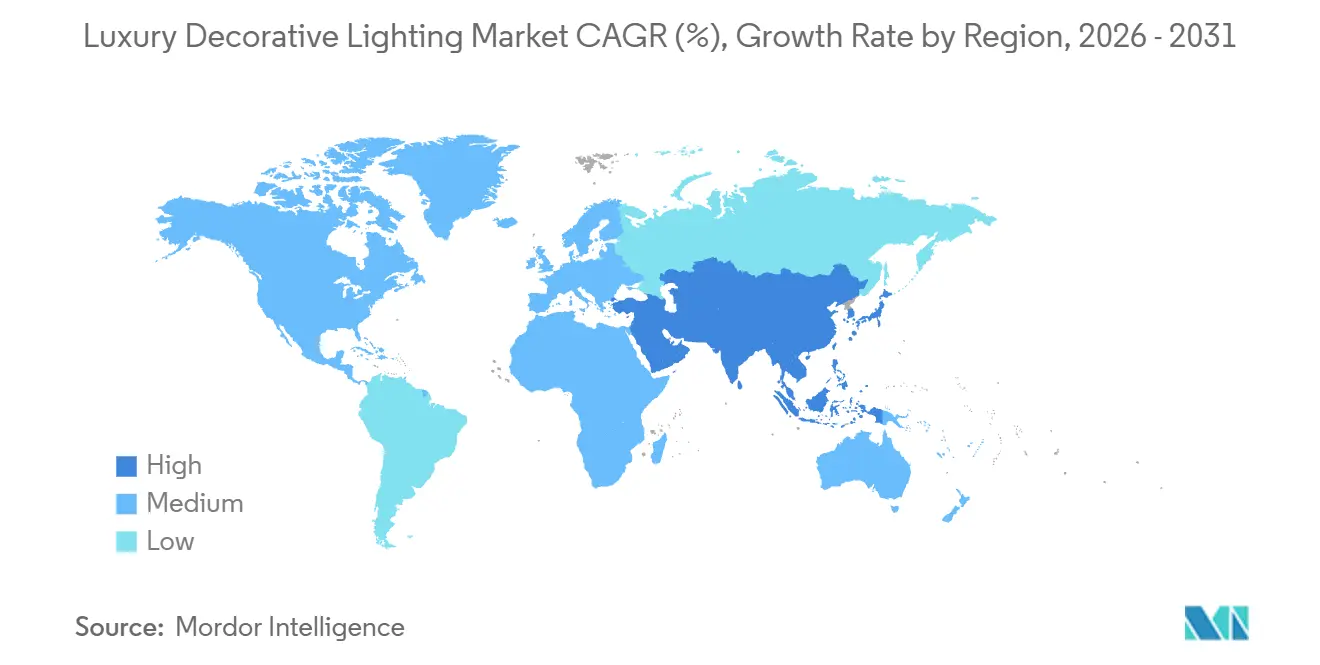
North America accounted for 38.11% of the luxury decorative lighting market share in 2025. The region benefits from a dense, affluent customer base in New York, Miami, Los Angeles, and Sun Belt luxury corridors. It also has a well-developed culture of architect-led renovation. The 2026 Houzz & Home Study recorded USD 150,000 in median spending among the top 10% of the United States renovators in 2025. Branded-residence development and WELL-oriented commercial projects create additional routes to demand.
Europe retained a significant position in the luxury decorative lighting market through Italian and Nordic design capabilities. The Murano, Milan, and Veneto clusters remain important for hand-crafted glass and high-design specification. Barovier&Toso introduced its 2026 Chapter 1 collection at Milan Design Week under CEO Andrea Signoroni and Artistic Director Luca Nichetto. European hospitality renovations in Paris, London, Barcelona, and Rome support project-led distribution. Louis Poulsen reported DKK 966 million in 2025 revenue, a gain of 8% from 2024. The region remains a source of design authority as well as a major project market.
Asia-Pacific is projected to grow at a 5.7% CAGR through 2031, making it the fastest-growing regional part of the luxury decorative lighting market. India’s Q2 2026 hotel pipeline reached 1,033 projects and 137,601 rooms, while China’s pipeline stood at 3,602 projects and 640,328 rooms. Artemide’s Asian revenue increased 14.6% in 2025, supported by Korea, China, and Japan. Southeast Asia is becoming a more important hospitality commissioning location. The Middle East also supports ultra-premium demand through branded residences and major development projects.
Competitive Landscape
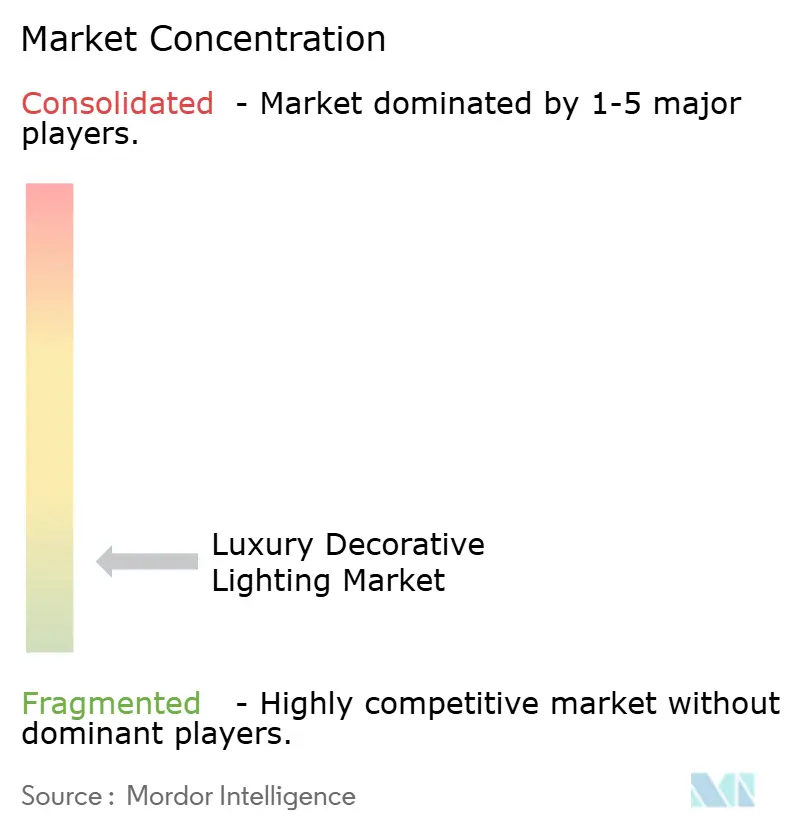
The luxury decorative lighting market is fragmented, with Italian and Nordic design houses, boutique makers, and project-focused specialists serving different product and regional needs. No supplier held a dominant global position, so design quality, material expertise, and relationships with architects remained important competitive factors. Established brands competed through recognizable collections, technical capability, and support for complex hospitality and residential specifications. Manufacturers also faced pressure to protect design ownership as copied products became more visible across online sales channels. This structure gave specialist brands room to compete, but it required consistent distribution and reliable project delivery.
Portfolio development was an important competitive strategy in 2026. Chr. Augustinus Fabrikker completed its acquisition of Louis Poulsen from Flos B&B Italia Group, returning the Danish lighting brand to domestic ownership and emphasizing its international growth potential. Louis Poulsen generated DKK 966 million in revenue during 2025, up 8% from 2024, which underlined the commercial strength of established design brands. Barovier&Toso used Milan Design Week 2026 to introduce Etime, Profilo, and Aurora under CEO Andrea Signoroni and Artistic Director Luca Nichetto. These moves showed how heritage manufacturers were updating product lines and creative leadership while retaining their craft-led positioning.
Companies also sought growth through modular products and high-visibility reference projects. Lasvit’s installation for the Ritz-Carlton Luminara used hand-blown Czech glass lighting sculptures and programmed changes from daytime to evening settings. The project demonstrated how bespoke lighting can support a hospitality brand’s identity and provide a reference for future specifications. Ferretti Group and Flexjet also used signature accent lighting in the Riva Volare cabin design for a Gulfstream G650 and 2 Sikorsky S-76 helicopters. Competitive strength increasingly depended on combining recognizable design, project execution, and technical lighting performance across residential, hospitality, marine, and private aviation applications.
Luxury Decorative Lighting Industry Leaders
-
Flos B&B Italia Group
-
Visual Comfort & Co.
-
Artemide S.p.A.
-
Signify Holding
-
WAC Group, including Schonbek
- *Disclaimer: Major Players sorted in no particular order
Recent Industry Developments
- September 2026: Lasvit unveiled the Herbarium chandelier for a private Napa Valley residence, a hand-blown glass installation encasing preserved botanical forms within individually crafted glass elements at varying suspension heights, part of the Lasvit Icons modular system.
- July 2026: Flos launched Maap, a large-format wall-mounted lamp by Erwan Bouroullec, through global flagships and Design Within Reach as the exclusive United States launch partner. The fixture uses a Tyvek® diffuser shaped by the end-user, available in 3 sizes extending to 3.2 meters wide and delivering 8,000 lumens at 2,700K from an E27 LED system.
- April 2026: Foscarini presented INTRECCI DI LUCE/KNITTED LIGHT at its Spazio Monforte during Milan Design Week 2026, an experimental research project by designers Jozeph Forakis and Lorenzo Palmeri exploring 3D knitting and light, while marking the 20th anniversary of its Twiggy arc lamp.
- June 2025: Flexjet and Ferretti Group unveiled the Riva Volare bespoke cabin design aboard a Gulfstream G650 and 2 Sikorsky S-76 helicopters, integrating high-gloss mahogany veneer, metallic trims, and signature accent lighting drawn from Riva motoryacht DNA.
Global Luxury Decorative Lighting Market Report Scope
| Pendant Lights |
| Wall Sconces and Wall-Mounted Fixtures |
| Ceiling Lights and Flush Mounts |
| Table Lamps |
| Floor Lamps |
| Portable and Rechargeable Decorative Lamps |
| Sculptural and Bespoke Lighting Installations |
| Outdoor and Landscape Decorative Lighting |
| LED |
| Incandescent |
| Fluorescent and CFL |
| Halogen |
| Others (OLED, Solar, etc.) |
| Residential |
| Commercial |
| B2C/Retail Channels | Hypermarkets and Supermarkets |
| Home Centers | |
| Specialty Lighting Stores | |
| Online | |
| Other Distribution Channels | |
| B2B/Direct Sales and Projects |
| North America | Canada |
| United States | |
| Mexico | |
| South America | Brazil |
| Peru | |
| Chile | |
| Argentina | |
| Rest of South America | |
| Europe | United Kingdom |
| Germany | |
| France | |
| Spain | |
| Italy | |
| BENELUX (Belgium, Netherlands, and Luxembourg) | |
| NORDICS (Denmark, Finland, Iceland, Norway, and Sweden) | |
| Rest of Europe | |
| Asia-Pacific | India |
| China | |
| Japan | |
| Australia | |
| South Korea | |
| South East Asia (Singapore, Malaysia, Thailand, Indonesia, Vietnam, and the Philippines) | |
| Rest of Asia-Pacific | |
| Middle East and Africa | United Arab Emirates |
| Saudi Arabia | |
| South Africa | |
| Nigeria | |
| Rest of the Middle East and Africa |
| By Product Type | Pendant Lights | |
| Wall Sconces and Wall-Mounted Fixtures | ||
| Ceiling Lights and Flush Mounts | ||
| Table Lamps | ||
| Floor Lamps | ||
| Portable and Rechargeable Decorative Lamps | ||
| Sculptural and Bespoke Lighting Installations | ||
| Outdoor and Landscape Decorative Lighting | ||
| By Light Source | LED | |
| Incandescent | ||
| Fluorescent and CFL | ||
| Halogen | ||
| Others (OLED, Solar, etc.) | ||
| By End-User | Residential | |
| Commercial | ||
| By Distribution Channel | B2C/Retail Channels | Hypermarkets and Supermarkets |
| Home Centers | ||
| Specialty Lighting Stores | ||
| Online | ||
| Other Distribution Channels | ||
| B2B/Direct Sales and Projects | ||
| By Geography | North America | Canada |
| United States | ||
| Mexico | ||
| South America | Brazil | |
| Peru | ||
| Chile | ||
| Argentina | ||
| Rest of South America | ||
| Europe | United Kingdom | |
| Germany | ||
| France | ||
| Spain | ||
| Italy | ||
| BENELUX (Belgium, Netherlands, and Luxembourg) | ||
| NORDICS (Denmark, Finland, Iceland, Norway, and Sweden) | ||
| Rest of Europe | ||
| Asia-Pacific | India | |
| China | ||
| Japan | ||
| Australia | ||
| South Korea | ||
| South East Asia (Singapore, Malaysia, Thailand, Indonesia, Vietnam, and the Philippines) | ||
| Rest of Asia-Pacific | ||
| Middle East and Africa | United Arab Emirates | |
| Saudi Arabia | ||
| South Africa | ||
| Nigeria | ||
| Rest of the Middle East and Africa | ||
Key Questions Answered in the Report
What is the forecast growth rate for luxury decorative lighting?
The luxury decorative lighting market is forecast to grow at a 5.3% CAGR from 2026 to 2031, reaching USD 12.62 billion.
Which product type leads luxury decorative lighting sales?
Ceiling Lights and Flush Mounts led with 34.54% share in 2025, while Outdoor and Landscape Decorative Lighting is the fastest-growing product type at 6.1% CAGR.
Why is LED important in luxury decorative lighting?
LED held 71.12% share in 2025 and is forecast to grow at 6.4% CAGR, supported by tunable lighting and high-quality dimming capabilities.
Which end-user group buys the most luxury decorative lighting?
Commercial buyers held 63.32% of 2025 revenue, driven by hotels, branded residences, retail flagships, and high-end restaurants.
Which region is growing fastest for luxury decorative lighting?
Asia-Pacific is forecast to grow at a 5.7% CAGR through 2031, supported by hotel construction and luxury project activity.